 For the second year in a row, the Senate Armed Services Committee, which Michigan Senator Gary Peters sits on, has voted for an increase in military spending.
According to the independent news agency, The Intercept:
The Senate version of this year’s National Defense Authorization Act would raise military and other defense spending to levels not seen since 2009, when more than 180,000 troops were deployed in Iraq and Afghanistan, according to data from the Stockholm International Peace Research Institute. The Pentagon forecasts that in years to come, its budget requests will keep rising to levels not seen since the World War II.
In some areas, the Senate bill even exceeds what the Trump administration requested. According to a summary document provided by committee staff, the bill authorizes $10 billion for 94 F-35 Fighters — 16 more than the Pentagon asked for.
In a bi-partisan vote of 25 – 2, the Senate Armed Services Committee members voted to approve an increase in US military spending. Some of that spending includes:
• Fully funds the mission of the men and women of USSTRATCOM, beginning with the sustainment modernization of our nuclear forces, including the warheads and supporting the Department of Energy’s nuclear complex.
• Builds on last year’s support for the supplemental systems announced in the president’s Nuclear Posture Review by authorizing funds for the deployment of a low-yield ballistic missile warhead to increase deterrence against Russia.
• Complements the administration’s approach to comprehensive arms control by requiring the Department of Defense to submit a report describing threats beyond the scope of today’s arms control regime, including Russia’s deployed non-strategic weapons, weapons not covered by New START, non-deployed strategic weapons, and China’s nuclear modernization program.
• Fully authorizes critical bilateral U.S.-Israel cooperative missile defense programs.
◦ $69.8 million for several critical weapons programs at the National Nuclear Security Administration – such as the Stockpile Responsiveness Program – in order to buy-down future risk and enhance the resilience of our nuclear complex.
◦ $113 million for the development of the next generation of GPS receivers to ensure the U.S. military continues to have access to resilient position, navigation, and timing capabilities.
• Prohibits any reduction in responsiveness, alert level, or quantity of our ICBM forces.
Michigan Senator Gary Peters voted for this massive US military budget, along with most of his Democratic and Republican colleagues on the Senate Armed Services Committee. However, Senator Peters does not include many of the details of this increased US military budget in his Press Release from last Friday. Instead, Peters chose to present himself as someone who is looking out for US military veterans and Michigan Defense Contractors. As we have reported in the past, Senator Gary Peters, like his predecessor Carl Levin, have always supported massive US military budgets no matter which party sits in the White House. This dynamic demonstrates that the Democratic Party is equally (and has always been) committed to US imperialism as the Republicans are. However, it won’t matter that Democrats like Gary Peters will vote for massive military budgets, while so many Americans live in poverty, because ultimately people will continue to vote for Democrats no matter how much they defend war and militarism at home and abroad.
Memorial Day and Organized Forgetting
There is a need for social movements that invoke stories as a form of public memory, stories that have the potential to unsettle common sense, challenge the commonplace, and move communities to invest in their own sense of civic and collective agency.” Henry Giroux, The Violence of Organized Forgetting: Thinking Beyond America’s Disimagination Machine
 Yesterday, millions of Americans enjoyed a long weekend, spending time with family and friends, and firing up the grill to celebrate Memorial Day. Memorial Day is designated as a day to remember, specifically to remember and honor US soldiers, whom, we are taught, have been and are still fighting for our freedom.
Now, I don’t know how many people actually believe that, but as I was thinking about the significance of Memorial Day, I came to realize that it was not so much a day to remember, but a day to forget.
The late radical historian Howard Zinn would often say that the way most people learn US history is through the lens of the historical winners – those in power, both politically and economically. Zinn would also say that so much of the real history, the history from below, has fallen into the historical memory hole. We have either forgotten much of the history from below or it was never presented to us.
If Memorial Day, is a day for the public to re-member US soldiers and US militarism, then by all means, let’s re-member this collective history.
I wanted to start by quoting the most decorated military officer in US history, General Smedley Butler. After Butler retired from the military, he wrote one of the most important critiques of the US military. Initially given as a speech, Butler then wrote a short booklet entitled, War is a Racket. Here is one brief excerpt from what Butler believed was his real purpose as a US military leader.
I helped make Mexico, especially Tampico, safe for American oil interests in 1914. I helped make Haiti and Cuba a decent place for the National City Bank boys to collect revenues in. I helped in the raping of half a dozen Central American republics for the benefits of Wall Street. The record of racketeering is long. I helped purify Nicaragua for the international banking house of Brown Brothers in 1909-1912 (where have I heard that name before?). I brought light to the Dominican Republic for American sugar interests in 1916. In China I helped to see to it that Standard Oil went its way unmolested.
During those years, I had, as the boys in the back room would say, a swell racket. Looking back on it, I feel that I could have given Al Capone a few hints. The best he could do was to operate his racket in three districts. I operated on three continents.
The United States was founded on two foundational realities. First, the US practiced what indigenous scholar Roxanne Dunbar Ortiz calls Settler Colonialism, which was a practice of indigenous land theft by euro-Americans. The second foundational aspect of the creation and expansion of the US was slavery. The United States would never have become the dominant global power it is today if it had not stolen indigenous land and then created wealth by relying on chattel slavery for the first century of its existence.
Most US history books do not include the critique that the US was founded on settler colonialism and slavery, but this is a fact which is impossible to suppress. In Ward Churchill’s important book, On the Justice of Roosting Chickens: Reflections on the Consequences of US Imperial Arrogance and Criminality, he devotes a large section of the book providing a chronological overview of US militarism between 1776 and 2003. Churchill methodically documents US military actions against First Nations people in North America and US militarism abroad.
In the 1980s, I remember being part of an action at the Federal Building in downtown Grand Rapids. The action was designed to draw attention to US support for the Contra forces who were fighting the Sandinista government in Nicaragua, primarily by engaging in terrorist attacks against civilians. On Memorial Day of 1986, we placed about 100 cross on the Federal Building lawn, each with the name of a Nicaragua civilian who had been killed by Contra soldiers. We wanted to demonstrate that US militarism had a cost and we wanted to NOT forget that innocent people were the victims of US imperialism. We wanted to re-member!

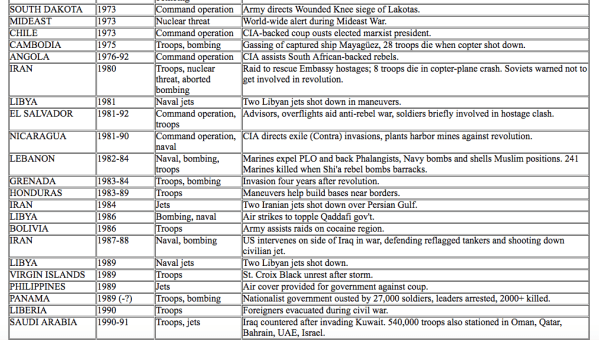
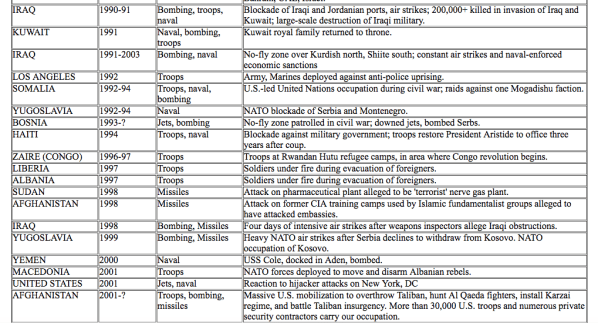
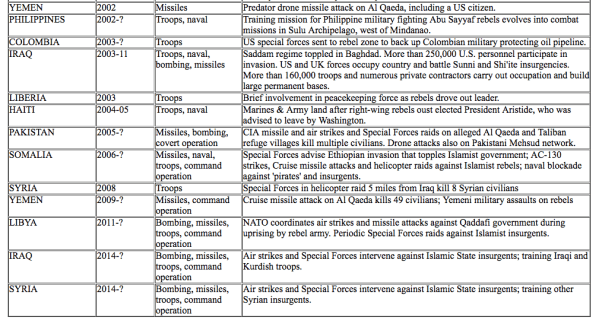
Another person who has documented US military interventions is Professor Zoltan Grossman. Grossman has been documenting this history for years and he has a list beginning with the US Army massacre at Wounded Knee in 1890, through 2014. What Grossman has done is not only to document the history of US militarism, but to provide us with a tool or a mechanism to re-member, to put back together again and to resist what Henry Giroux calls Organized Forgetting.
What follows is what Grossman has documented, which you comes from this link. While this list does not provide many details, it does demonstrate that US militarism and US imperialism has always been an integral part of US history. Millions of people have been murdered during this history, millions more displaced, yet it is history that gets put down the memory hole by politicians and pundits alike. Let us not forget this history and let us all re-member!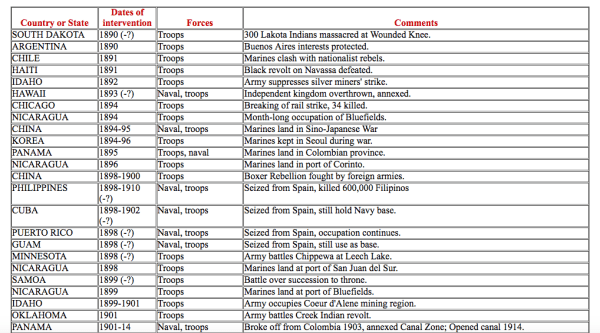


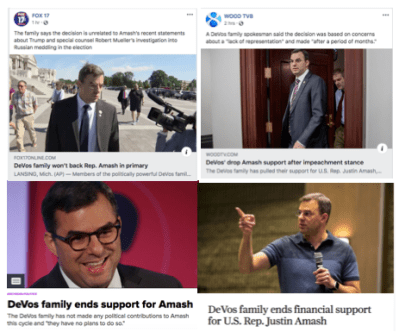 Whenever the DeVos family does anything, it becomes major news. This is understandable, in part, because they are the most powerful family in West Michigan. However, it is also a reflection of how the local news media panders to the family behind the pyramid scheme known as Amway.
The recent news that 3rd Congressional District, Representative Justin Amash, calling for the impeachment of President Donald Trump, has become the biggest news story in the US, since the release of the Mueller Report. While there have been some calls from the Democrats for the impeachment of Trump, no one was expecting a Republican Congressman to do the same.
Rep. Justin Amash, who identifies as a Constitutionalist and a Libertarian, doesn’t always vote the same way that most Republicans do. This is partly motivated by Amash’s ideological views, but it also has to do with the fact that the 3rd Congressional District has been dominated by the GOP in recent decades. When Vern Ehlers held the same seat, he would vote outside of the GOP framework, particularly on environmental issues. Like Amash, Ehlers was never really challenged, so he could vote outside of party lines, because the district has been considered a “safe” district since Paul Henry first came on the scene in 1984.
This history of the 3rd Congressional District is completely absent from the local news coverage of the DeVos family announcing that they would no longer be contributing to Congressman Justin Amash.
Another aspect of the local news coverage regarding the DeVos family announcement is rather predictable. In looking at the three West Michigan TV station coverage and MLive, the story is driven by what the DeVos family spokesperson (Nick Wasmiller) says in a formal statement. The primary statement reflected in West Michigan news coverage was:
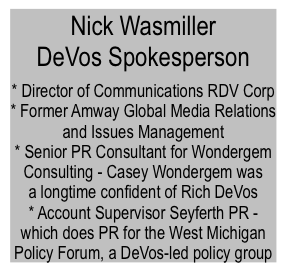 “DeVos family members have not made campaign contributions to Congressman Amash during this political cycle and based on earlier discussions have no plans to do so.”
“Family members have expressed increasing concerns about a lack of representation for their district, the Third Congressional, and I would say an inability to advance efforts connected to important policy matters.”
Like most statements from the DeVos family they are calculating and vague. These comments are calculating, because the DeVos family doesn’t do anything on a whim. Whatever one thinks about the most powerful family in West Michigan, they are strategic and calculating. These statements are also vague, since the DeVos family never fully wants to show their hand. They always hold their cards close to the chest and therefore, only reveal the bare essentials.
West Michigan News Coverage
The WZZM 13 story, along with the WXMI 17 story are both very short. These stories cite the DeVos spokesperson as a reaction to Amash’s call for Trump’s impeachment.
The WZZM 13 story also mentions that there are already two GOP challengers for the 3rd Congressional District.
The WOOD TV 8 story is a bit longer, since it included a twitter post from Justin Amash on his conclusions of the Mueller Report. The other major difference was that channel 8 cited Kent County Commissioner Jim Saalfeld, who said that what Amash was doing was a publicity stunt for his possible Presidential run.
The MLive article was longer than any of the three TV news stories, especially since the MLive reporter actually provided some information about how much money the DeVos family had provided previously to Congressman Amash. MLive cited some data from the 2013-2014 election cycle on how much money the DeVos family contributed, data provided by Craig Mauger, with the Michigan Campaign Finance Network.
However, even though MLive did include some data on DeVos political contributions to Amash, it was a lazy form of journalism, especially since it would be easy to provide comprehensive information on how much money the DeVos family has contributed to Justin Amash since he was first elected in 2010.
According to OpenSecrets.org, the DeVos family has contributed the following to Justin Amash between 2009 – 2018:
- Amway/Alticor Inc. $162,205
- Windquest Group $89,875
- DP Fox Ventures $38,700
By comparison, here is what the DeVos family has contributed to Rep. Bill Huizenga, from the 2nd Congressional District during the same time frame:
- Amway/Alticor Inc. $122,000
- Windquest Group $40,300
The local news media also could have provided data on how much the DeVos family has contributed to Michigan political candidates in recent years, with data provided by the Michigan Campaign Finance Network. Doing so, would provide another example of how much money the family contributes to electoral outcomes in Michigan.
In the election cycle leading up to the last Presidential Election (2015 – 2016), the DeVos family contributed a total of $14 million.
In the 2017 – 2018 election cycle, the amount provided to candidates in Michigan by the most powerful family in West Michigan was $11 million.
In both cases, one can see from the data and analysis provided by the Michigan Campaign Finance Network, most of the candidates that received money from the DeVos family ended up winning their election. Again, this family is calculating and strategic.
Therefore, the fact that Amash will no longer be receiving money from the DeVos family is significant. What we do not know for sure, are the reasons why. Again, the statement from the DeVos spokesperson are rather vague, which is by design. It is possible that the call from Amash for the impeachment of Trump is the main reason for the DeVos family to 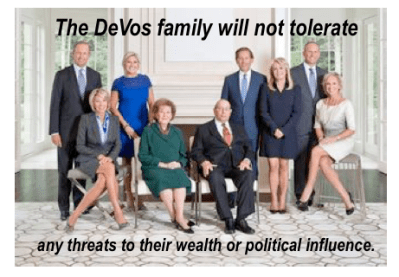 end their financial support for Amash, or they could have already made that decision based on Amash’s announcement that he may run against Trump in 2020.
It is possible that both of the reasons factor in to the family’s decision to no longer back Amash. What is important to consider, based upon the strategic approach that the DeVos family takes in terms of political contributions, is that any political change that is a threat to their wealth and power will result in a reaction from the family. If the GOP is divided, that is certainly a threat the DeVos’s cannot tolerate and they will do whatever it takes to make sure that any politician or candidate that threatens their wealth and influence will incur their wrath. This is the real issue that journalists need to explore, but as of yet have failed to do.
Follow the Money: Which politicians received money from the Auto Insurance Industry in Michigan?
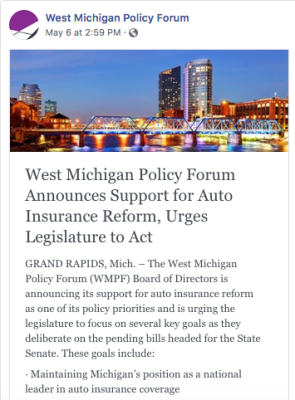 Anytime the West MI Policy Forum endorsed legislation, we all should pay attention. I say that because, the West Michigan Policy Forum is made up of many of the members of the Grand Rapids Power Structure.
Two weeks ago, the West Michigan Policy Forum posted this statement on their Facebook page, endorsing the GOP-led auto insurance legislation.
So, what exactly is the proposed legislation in Michigan and who is lobbying state legislators on the matter?
The Michigan State House version of the bill can be viewed at this link. However, finding out who the auto insurance industry has been lobbying or more accurately, what politicians the auto industry has been contributing money to, is the more relevant issue.
According to recent data from the Michigan Campaign Finance Network, there are numerous auto insurance company PACs, along with other Political Action Committees, like the Michigan Chamber of Commerce, that have been spending a significant amount of money to influence politicians on this issue.
Of the 18 PACs examined for this report, two connected to the Michigan Chamber of Commerce were among the biggest spenders in support of current lawmakers.
The Michigan Chamber, which lobbies on a variety of issues, has spoken out of support of Senate Bill 1. Rich Studley, the chamber’s president and CEO, called it “bold action to drive down Michigan’s highest-in-the-nation car insurance rates.”
The Michigan Chamber’s traditional PAC has made about $703,350 in contributions to current lawmakers’ political accounts over the last five years. The Michigan Chamber’s super PAC, which acts independently of candidates to purchase advertisements to benefit candidates, spent $1.04 million in support of current lawmakers over the last five years.
Nearly half of the super PAC’s fundraising haul in 2018 can be traced back to insurance interests, including the Michigan Insurance Coalition, which gave $410,000, the Auto Club Group, which gave $35,000, and the Insurance Alliance of Michigan, which gave $32,500, according to disclosures.
Anyone can look at all the data, by going to this link and downloading the spreadsheet.
What follows is a listing of West Michigan politicians and how much money they have received around the issue of auto insurance policy.

As you can see, the only politician who has not received money in an effort to sway how they vote on auto insurance, was Rep. Rachel Hood. As with most issue that are voted on, no matter what level of government, it is always useful to Follow the Money.
 On Monday, May 20th, MLive ran a story headlined, Grand Rapids mayor says possible Census citizenship question a concern.
The article in MLive cites the Mayor of Grand Rapids, and a few officials with the Grand Rapids Public Schools, over the issue of whether or not Citizenship Status will be a question on the 2020 Census. The Mayor, a City Commissioner and representatives from the Grand Rapids Public Schools met last Friday to talk about the concerns they have over how the possible Census question of Citizenship Status might impact the immigrant community.
The city officials are concerned about those in the undocumented community not filling out Census forms, for fear that it will put them at risk. In the MLive article, Mayor Bliss is quoted as saying, “We know that there is a lot of fear and mistrust in the community and that’s what’s most concerning.”
However, what is interesting is that the MLive article, nor the sources cited in the article, ever refer to specifics about why there is fear and mistrust in the immigrant community. In other words, there is no mention of the fact that Immigration and Customs Enforcement (ICE) has been arresting, detaining and deporting immigrants at an alarming rate. There is also no mention in the article about the cooperation between the GRPD and ICE in recent years, based up FOIA’d documents related to the Jilmar Ramos-Gomez case.
Much of the concern from City officials has to do with the relationship between how many are counted in the 2020 Census and how that translates into potentially more federal funding. In other words, the Mayor of Grand Rapids wants immigrants, undocumented or otherwise who live in fear of police & ICE, to fill out the Census data, since it will result in the City getting more federal dollars.
The problem with money being an incentive for the City of Grand Rapids is twofold. First, it demonstrates how the City is either minimizing or denying the actual fear that immigrants face every day in this community, the fear that they will suffer state violence and experience family separation. If the City of Grand Rapids and the Grand Rapids Public Schools wanted to reduce the level of fear in the immigrant community then they need to make it a policy that the GRPD will in no way cooperate with ICE agents. In the MLive article, the Mayor of Grand Rapids is talking about holding educational forums in the community so that people will understand the importance of being counted in the Census. If that is true, then the City of Grand Rapids needs to demonstrate to the immigrant community that they will no longer play a role in the arrest, detention and deportation of immigrants living in Grand Rapids by ending their relationship with ICE.
The second reason why money as an incentive for the City of Grand Rapids is problematic, has to do with a position they have taken since December of 2016. In early December of 2016, City officials hosted a meeting with immigration lawyers, members of the faith community and community organizers over the issue of whether or not the City of Grand Rapids would be a Sanctuary City.
The Chief of Police at that time (Rahinsky), the Mayor of Grand Rapids and the City Manager at that time (Greg Sundstrom) each made it clear that the City would not declare itself a Sanctuary City because they would put millions of federal dollars at risk by making such a declaration.
Therefore, it seems that the City of Grand Rapids didn’t want to risk federal funding by making a public commitment to immigrants in 2016, but now they want the immigrant community to participate in the 2020 Census to get more federal dollars, without making any commitment to reducing the fear and terror the immigrant community experiences daily because of ICE and the GRPD’s cooperation with that federal agency.
Seems like a double standard to this writer.
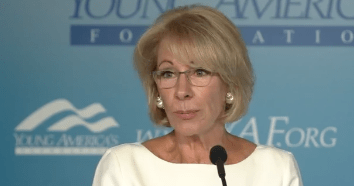 On Friday, US Education Secretary Betsy DeVos once again spoke to an audience that shares her ideological positions, the Young America’s Foundation (YAF).
The speech that DeVos delivered was held at Rancho del Cielo, formerly known as the Ronald Reagan Ranch or the Western White House.
DeVos didn’t really share any new ideas or thoughts, since she mostly talked about freedom, God and again used the phrase “education Cabal” in referring to teacher unions and other organization committed to protecting public education. DeVos also talked about the Education Freedom Scholarships, which is federal education funding that states can apply for and can be used for Charter Schools and other education systems outside of Public Education.
Beyond the repetitive comments in her speech, what is most important to talk about was who the Secretary of Education was speaking to. The Young America’s Foundation not only embraces deeply conservative values, it actively promotes them on campuses across the country.
Founded in 1960, at the home of William F. Buckley Jr., YAF has been a leading entity in promoting US imperialism around the world and far right domestic principles. The Young America’s Foundation has been a leader in the anti-Muslim movement even before 9/11, helping to craft the Anti-Muslim playbook.
YAF has always embrace deeply nationalistic and xenophobia values, as is evidenced in their recent statement on President Trump’s immigration reform plan:
The President’s plans for immigration reform will:
- Fully secure the border
- Protect American wages
- Attract and retain the best and brightest talent
- Prioritize immediate families
- Strengthen our workforce
- Preserve our humanitarian values
The President’s proposal will protect our nation by continuing to add to the 400-plus miles of border wall underway in key locations.
The proposal will empower immigration officials to protect American communities, increasing their ability to remove criminal aliens and alien gang members. It will also restore integrity to our asylum system and expedite the asylum review process for immigrants.
The President’s proposal will stop the deluge of child smuggling and quickly reunite unaccompanied children with their families back home.
The President’s proposal will put our country’s interest first—like so many other nations do for their own citizens—moving to a merit-based immigration system to protect American workers.
Today, vulnerable Americans are the ones hurt the most by the current immigration system, which undercuts wages and drains our social safety net programs.
The President’s proposal includes the “Build America Visa,” which selects immigrants based on high-skill categories: extraordinary talent, professional and specialized vocations, and exceptional academic track records.
 The Young America’s Foundation provides a who’s who list of speakers that students can bring to campus. The list includes John Ashcroft, Ward Connerly, Steven Crowder, Dinesh D’Souza, Newt Gingrich, Jonah Goldberg, David Horowitz, Michelle Malkin, Oliver North, Ted Nugent, Karl Rove, Rick Santorum, Jeff Sessions and John Stossel……just to name a few. These speakers represent the worst of the far right and include war criminals and white supremacists among them.
If it hasn’t been clear to people before, it should be clear that in addition to radically restructuring the US education system in America, Betsy DeVos makes it a point to address organizations that embrace far right politics in order to reassure these entities that she is equally committed to the far right agenda and to rally the base of the far right and white supremacist organizations that are absolutely necessary for the capitalist class (like the DeVos family) to remain in power.
 While people are very angry about the attack against women’s reproductive rights in Alabama, the Michigan legislature is doing very similar things.
According to MLive:
Both the Senate and House had floor votes scheduled on legislation to define the procedure as “dismemberment abortion” in law and ban it, making it a two-year felony for a physician to perform one unless it was to save the life of the mother.
While it is true that both the Michigan House and Senate were adopting bills that would undermine women’s reproductive rights and punish physicians who believe that women have control over their own bodies, MLive also uses the Right to Life language.
On Tuesday, the Senate voted 22-16 along partisan lines on the legislation, Senate bills 229 and 230. The House passed similar legislation, in House Bills 4320 and 4321.
The politicians who voted for these anti-women’s choice bills should be the subjects of massive protests immediately. None of them can be voted out for at least 20 months, so why wait to confront them, where they work and live?
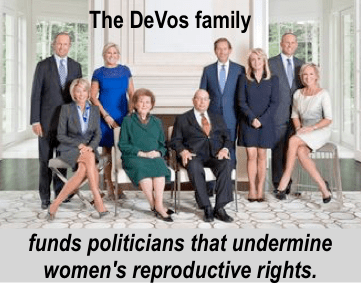
However, we should never forget who funded these politicians in the first place and their far right agendas. There are several names from the West Michigan community who contributed significantly to the politicians who just voted to take away women’s control over their own bodies, names like John Kennedy, Peter Secchia, Michael Jandernoa and members of the Meijer family. However, the West Michigan name that contributed more than anyone else from this area, was DeVos.
In fact, the DeVos family, for many of these state legislators, were in the top 10 of contributors. In addition, if you include those who received money from the Senate and House Republican Committees (most did), then you also have to recognize that with both of these GOP entities, the DeVos family was the number one contributor. Since 2011, the DeVos family contributed $1,121,000 to the Republican Senate Campaign Committee and $1,880,000 to the Republican House Campaign Committee.
What follows is a list of the Michigan Senate and Michigan House who voted to undermine women’s reproductive rights and how much money they have received from the DeVos family and the GOP Senate and House Campaign Committees. Data is from the Michigan Campaign Finance Network, the Follow the Money page.
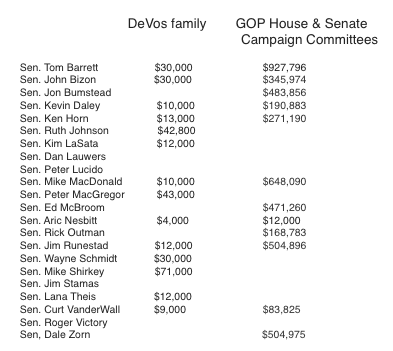
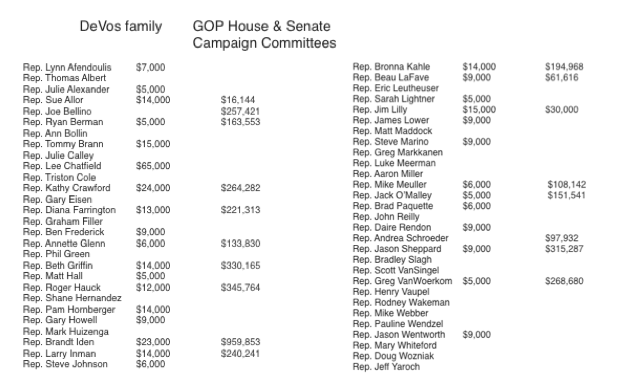
The various DeVos family foundations certainly contribute to groups like Michigan Right to Life and the Pregnancy Resource Center. Those contributions are much smaller than their collective political contributions. However, it is important to note that their foundation contributions also go to think tanks which promote and sometimes create the legislative framework for bills that do the kind of harm that SB 229 and SB 230 will do. Therefore, it is important that we understand how strategic DeVos money is used – changing the cultural narrative about reproductive rights, funding groups that are explicitly anti-Choice and then direct political contributions to politicians who will pass legislation that fits their ideological agenda.
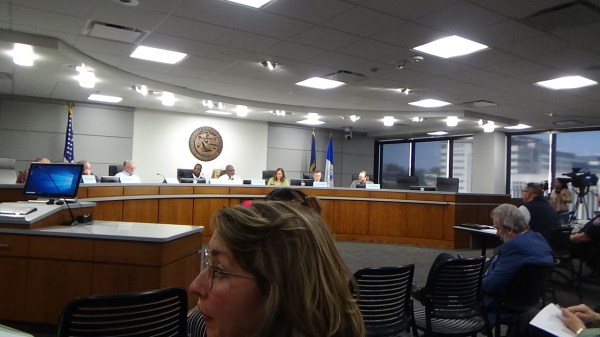
 Yesterday, the Civilian Appeals Board held a meeting to specifically address the issue of the conduct of Captain Kurt VanderKooi, as it relates to him contacting ICE on former US Marine and US citizen Jilmar Ramos-Gomez.
The meeting began at 4pm, however, the board chair asked for a recess to give time for the board members to read interviews that were conducted by the GRPD’s Internal Affairs of Captain Kurt VanderKooi. This action got many in the audience questioning the validity of the Civil Appeal Board (CAB) process and whether or not the GRPD was pressuring the CAB to allow the Internal Affairs investigation on the matter to stand.
In March, the ACLU & MIRC had filed a request to the Civil Appeals Board, asking to be able to present at their next public meeting, in order to challenge the GRPD’s Internal Affairs decision to re-instate Captain VanderKooi.
At this point one of the City Attorney’s provided a summary of the case involving Jilmar Ramos Gomez, which the ACLU has documented throughly.
During the summary of the case, it was acknowledged that there was no formal training of the GRPD as it relates to when they should be contacting Immigration and Customs Enforcement (ICE).
The City Attorney then stated that the ACLU & MIRC had requested to give a 30 minute presentation regarding the case of GRPD conduct and Jilmar Ramos-Gomez. The board chair of the Civilian Appeals Board then wanted to address the issue of transparency, because he had been forwarded numerous documents. The members of the CAB then discussed the merits of allowing or disallowing the ACLU request.
Several members of the CAB stated that they did not support allowing the ACLU/MIRC present their case. There were two board members, Russ Olmstead and Dick Bulkowski, who stated that the ACLU/MIRC should be allowed to present, both because of the seriousness of this case as it relates to the broader community and because the GRPD provided new information that board members read, so why couldn’t the ACLU/MIRC present information as well. The board chair then suggested that the board should vote on whether or not to allow the ACLU/MIRC to present. Once again, the board took a recess to confer amongst themselves on how to proceed.
Once the board resumed, the City Attorney said that after conferring with city staff and labor relations, they recommended to deny the ACLU/MIRC an opportunity to present. Board member Bulkowski then reversed his decision and stated he thought that the ACLU/MIRC should not be allowed to present. There was a great deal of confusion about what to do at this point, to such a degree that numerous members of the public found the proceedings both frustrating and comical. Russ Olmstead made another motion, but it was never seconded, thus denying the ACLU/MIRC to present.
At this point members of the Civilian Appeals Board were given the opportunity to ask questions to the GRPD officers who investigated Captain VanderKooi. The first question asked had to do with why there was no formal policy of the GRPD when dealing with Immigration and Customs Enforcement. The GRPD was now crafting a policy, to which a board member asked why now. The GRPD stated that they felt it was necessary to have a formal procedure, based on this case.
There was further discussion about whether or not Captain VanderKooi could or should have contacted ICE. The GRPD official stated repeatedly that VanderKooi contacting ICE was the right thing to do, considering what Jilmar Ramos-Gomez was doing at the Spectrum Hospital at the time of his arrest.
Additional questions centered around VanderKooi making calls, based on what information and who he contacted. At one point the GRPD officers stated that the criticism of VanderKooi calling while he was off duty, was unfair, because the police are “never really off duty.”
Another question posed to the GRPD had to do with the e-mail communication by the GRPD & ICE that was racial in make-up. One board member didn’t seem to think that there was adequate analysis of racial bias in the communications. Russ Olmstead asked that since there was no formal policy for the GRPD to contact ICE, whether or not there was any racial bias in this case. Olmstead continued to press the GRPD on this matter and the GRPD responded by saying “you are trying to press whatever agenda you have.” This statement elicited a response from the public, which pointed out the irony in the statement, since the GRPD doesn’t have any “agenda.”
The issue of status was raised as well, where one board member wanted to be clear that this was referring to immigration status. The GRPD responded by saying this was true, along with any other information on the person in question. Russ Olmstead asked a follow up observation that in virtually all of the e-mail communications immigration status was the primary concern. Olmstead pointed out to the GRPD that this was a pattern and that there didn’t seem to be any acknowledgement of this fact.
 Another question was asked about when the Captain VanderKooi knew that Jilmar Ramos-Gomez is a US citizen. The GRPD stated they did not know when he knew, which seems rather ridiculous, since this issue is critical to determining whether or not there was bias or not.
Lastly, the GRPD was asked why the GRPD contact a certain department within ICE, one that was listed in the majority of the e-mails. This question also demonstrated the selective aspect of the GRPD’s investigation.
The board chair made the observation that even though VanderKooi had been in the ICE liaison position for two years, there was never any formal policy or training as it relates to ICE.
One additional comment was made by a board member, pointing out that the investigation was done correctly, but that the GRPD’s conclusion to exonerate VanderKooi, that was the wrong conclusion. The board member said that it seemed clear that based on the disability that Jilmar Ramos-Gomez was experiencing, the actions of VanderKooi were clearly biased and wrong.
At this point, the board needed to determine whether or not their was sufficient information regarding Captain VanderKooi’s case and whether or not he violated the GRPD’s impartial bias policy. The majority of the board members voted by saying there was sufficient information.
George Storms made a motion to reverse the findings by Internal Affairs of exonerating Captain VanderKooi, in regards to the Impartial Policing policy. The vote was 6 – 2 in favor of reversing the findings.
Throughout the proceedings, there were two overriding themes that this writer heard. First, that the GRPD conducted a weak investigation, which was evident since when questioned by the CAB members, the two cops involved in the investigation either couldn’t answer the questions or had vague responses. Secondly, to many people in the room, even without seeing all the documentation that the Civilian Appeals Board had, it was clear that Captain VanderKooi demonstrated significant bias during the Jilmar Ramos-Gomez case.
There was a proposal by the Civilian Appeals Board to meet on May 22nd to determine the next steps, although it was made clear by one of the City attorney’s present that the City Manager will now have the power to determine what to do about Captain VanderKooi.
“Silence is the voice of complicity.” Dr. Martin Luther King Jr.
Since the beginning of 2019, there have been numerous demands coming from communities impact by police/ICE violence, demands presented to the Grand Rapids City Commission.
This effort began when the ACLU & MIRC sent a letter to the Grand Rapids City Commission, confronting them on the role that the GRPD played in the arrest of former US Marine and US Citizen, Jilmar Ramos-Gomez.
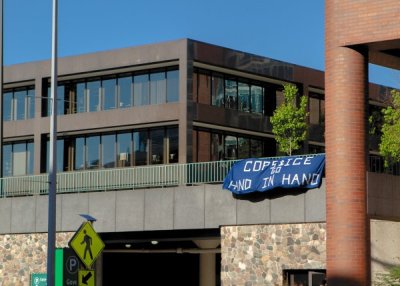 In early February, Movimiento Cosecha GR and GR Rapid Response to ICE first presented a list of demands during at Grand Rapids City Commission meeting, demands that primarily centered around the relationship between the GRPD and ICE.
This effort was intensified at a late February City Commission meeting, where activists shut down the proceedings. The Grand Rapids Police Officers Association reacted to these demands and claimed that City officials were being “held hostage” by immigration activists.
In the second week of March, the ACLU and MIRC filed an appeal with the City over the Jilmar Ramos-Gomez case. At this point two other groups from the African American community, who have also been deeply impacted by police violence, joined Movimiento Cosecha GR and GR Rapid Response in a Press Conference that was held outside of City Hall in late March. At this press conference, the list of demands placed before the City had expanded.
In April, the coalition of four groups attended by City Commission meetings, with one of the meetings centered on a proposed Human Rights Ordinance. Then, just before the end of April, the ACLU & MIRC held a press conference based on a FOIA request about ICE and GRPD interactions. The FOIA documents revealed not only racist elements of the GRPD in their dealings with Jilmar Ramos-Gomez, but also that the relationship between the GRPD and ICE was significant.
The four community groups that have presented a list of demands several months ago, had put an April 30th deadline for a response from City officials about the demands.
Last night, in response to the City’s failure to meet the demands, the coalition of community groups released the following statement:
Statement from Movimiento Cosecha GR, GR Rapid Response to ICE, 360 Movement and Together We Are Safe
The Memo
Our coalition has been making an achievable list of demands (listed below) for the City of Grand Rapids since February of this year. We gave the City a clear deadline of April 30. The City of Grand Rapids has NOT directly responded to our demands for holding GRPD accountable and responsible for the police brutality and other incidents involving officer’s misconduct that violates public safety concerns along with ending all cooperation with ICE.
We are disappointed in the City’s actions. The failure of the City sends a message to our groups and to the oppressed populations from which these demands came – the Black and brown residential citizens as well as immigrant communities in our city.
Instead of a direct response, we received a copy of a memo from the Grand Rapids City Manager to the Mayor and the Commissioners. The memo vaguely addressed our overall concerns, but resulted in policy decisions that are counter to our demands. We asked for justice and the City responded with more bureaucracy. The City Manager has proposed:
• Creation of a five-person evening shift of community policing services.
• Addition of a crisis intervention and behavioral health specialist.
• Creation of a position in the Executive Office to work on public safety community relations.
There is no accountability, no money for trauma inflicted, no end of cooperation with ICE, and little support for community care.
The March
The city agreed to bring the issue of Driver’s Licenses to the Secretary of State and the West Michigan Delegation, yet for the Cosecha May 1st march for Driver’s Licenses the city demanded that Movimiento Cosecha GR obtain a permit.
This was the 3rd year for the march and the City has never required a permit in the past. The City threatened the immigrant community with arrest if we marched in the streets. This was a clear message that they were going to step up the repression against communities most affected by police and ICE violence. We continue to push for a formal resolution supporting Driver’s Licenses for All from the City of Grand Rapids.
Our Movements
While these responses from the City are disheartening, they in no way will impact our commitment to seeking accountability and transformative justice for Black, brown and immigrant communities.
If anything, the response from the City and GRPD has energized our movement to continue to fight for justice and to radically imagine a world where police, ICE agents, prisons, detention centers, and borders are no longer used as agents of oppression.
The City has postponed voting on their Human Rights Ordinance tonight. We believe that such an ordinance has no meaning if the GRPD can continue to harm Black, brown and immigrant communities and get away with it. Yet bureaucratic delays are dragging out even this basic symbolic gesture. It is more important than ever that we continue the fight for justice.
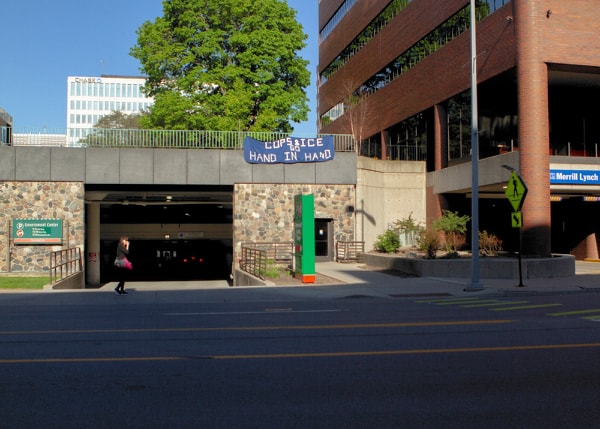
Original statement of demands
To the City Commission and GRPD:
We in the community, Movimiento Cosecha GR, GR Rapid Response to ICE, 360 GR Movement, and Together We Are Safe demand the following:
1. Support Driver’s Licenses for All in the State of Michigan.
2. Fire police officers who have committed brutality by beating and kicking Black drivers. Fire Captain Curt VanderKooi who has a long history of discrimination based on race and is not safe for our neighborhoods.
3. Stop all cooperation with ICE and use no city resources to do the work of ICE. There should be no police role of “ICE liaison.”
4. Release the code of conduct for officers and the track record of each officer’s misconduct report, including complaints against them. Release the reports of their investigations so that the public can track their accountability processes. Create an accountability reprimand policy for all officers that stand by during instances of beatings or other harm.
5. Create subpoena powers and investigative powers for our Civilian Appeals Board.
6. Give a vote of No Confidence to Acting Chief Kiddle.
7. Create a program whereby GRPD pays for at minimum 5 years of trauma-related therapy especially for any youth interaction deemed inappropriate regarding harassment, profiling, excessive force etc.
8. Regarding the million dollars over five years that the city has set aside to deal with community police relations: appropriate that to the community to keep our neighborhoods safe.
 Nearly three weeks ago, we posted an article about the Jerry & Marcia Tubergen Foundation. Jerry Tubergen is the CEO of RDV Corp, sits on the board of directors of every DeVos family foundation and essentially manages all of the family investments through Ottawa Private Capital LLC.
Today we want to look at the last three years of the Dick & Betsy DeVos Foundation, with the three most recent 990 documents the foundation has submitted being 2015, 2016 & 2017. We also want to see if there has been any major changes, since Betsy DeVos became the Secretary of Education in early 2017.
While there are dozens of entities that received funding from the Dick & Betsy DeVos Foundation between 2015 – 2017, there are a few causes that received larger sums of money. The major groupings to receive substantial funds from the Dick & Betsy DeVos Foundation were conservative think tanks, pro-Charter School/private education groups, christian entities and pro-capitalist/entrepreneurial groups. These four sectors demonstrate Dick & Betsy DeVos’ commitment to radically altering the education landscape in the US, plus their deep ideological commitment to the religious right and neoliberal capitalism.
Think Tanks push a far right neoliberal agenda
The Dick & Betsy DeVos Foundation has always supported conservative think tanks, since these organizations develop neoliberal platforms and then push neoliberal policy at the state and federal level.
At the federal level, the think tank that has consistently received the most money from the Dick & Betsy DeVos Foundation is the American Enterprise Institute (AEI). In 2015, AEI received $1,750,000 from Dick & Betsy, $750,000 in 2016 and $1,000,000 in 2017.
At the State level, there are two main think tanks that have received support from the Dick & Betsy DeVos Foundation. First, is the Mackinac Center for Public Policy. This neoliberal think tank received $75,000 in 2015 and $900,000 in 2017. Then there is the Acton Institute, based in Grand Rapids. The Dick & Betsy DeVos Foundation contributed $305,000 in 2016 to the Acton Institute and $150,000 in 2017.
Pro-Charter School/Education Privatization groups
A second major area the Dick & Betsy DeVos Foundation has contributed to is an area that they have been deeply committed to since the Reagan years. One group is the Alliance for School Choice, which received $100,000 in 2015, $290,000 in 2016 and $1,000,000 in 2017.
Another group fighting for Charter Schools and the privatization of education is the Great Lakes Education Project (GLEP), which Betsy DeVos founded. Dick & Betsy gave GLEP $56,000 in 2015, $200,000 in 2016 and $100,000 in 2017.
A third group in this sector is a group called Partnership for Education Justice. The Partnership is essentially an organization dedicated to providing legal defense and legal support to families and groups within the public school system that wants to bring religion into school or push Charter School-like agendas within public schools. The Dick & Betsy DeVos Foundation contributed $400,000 to this group in 2015.
Conservative Christian organizations
The DeVos family has a long history of financially backing the religious right, specifically the Christian Right. In Grand Rapids, some of the main groups they have contributed to are Potters House School, where the Dick & Betsy DeVos Foundation gave $200,000 in 2015, $1,200,000 in 2016 and $200,250 in 2017.
The Dick & Betsy DeVos Foundation also contributed money to the Grand Rapids Christian Schools, giving $300,000 in 2015, $350,000 in 2016 and $300,000 in 2017. Another conservative Christian entity the DeVos family loves is the Willow Creek Association. In 2015, the Dick & Betsy DeVos Foundation contributed $600,000, in 2016 another $600,000 and in 2017, just $500. The reason for the major drop in funding was the news about Willow Creek founder being caught in a sex scandal.
Giving Money to Make Money
The last major sector that the Dick & Betsy DeVos Foundation has contributed to is the neoliberal capitalist entrepreneurial groups. These are organizations that invest money into start up companies or projects that not only get them great PR, but allows for them to profit off of these new start ups.
In 2015, the Dick & Betsy DeVos Foundation contributed $1,875,000 into the Xprize Foundation, along with an additional $3,750,000 in 2016. Then there is the Grand Action Foundation, which received $50,000 in 2016 and $2,550,500 in 2017. Lastly, there is the group E-merge (which is now part of Start Garden – founded by Dick & Betsy’s son Rick), which received $200,000 in 2016 and another $150,000 in 2017.
Like the other DeVos family foundation, the Dick & Betsy DeVos Foundation gives a great deal of money to organization that promote right wing and neoliberal capitalist policies that hurt working class families and communities of color. Many of the same people who are negatively impacted by these negative policies often seek out the charity services of organizations that the Dick & Betsy DeVos Foundation contributes to (although in smaller contributions), without being aware of the fact that the DeVos Foundation funding was part of the root cause of their suffering.
Herein lies the beauty of foundations. The rich members of the capitalist class get to place millions of dollars into tax-free entities called foundations and then they are allowed to contribute to organizations which promotes class warfare to benefit themselves.

