DeVos Family infographic #1
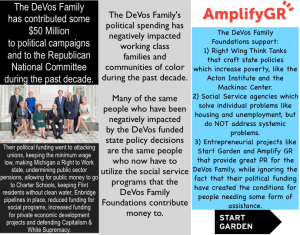 The infographic we provide here is based upon our documentation of the DeVos Family’s collective political contributions over the years, the 990 documents from the various family foundations and the state policies that have been passed by politicians that the DeVos Family has funded.
You can find all of this documented in our 460 page downloadable document, The DeVos Family Reader. For additional sources, please check out the Michigan Campaign Finance Network for election contributions from the DeVos Family or Guidestar for investigating the various DeVos Family Foundations and who they have contributed to.

The Immigrant Justice Movement in Grand Rapids Part I
 (Editor’s note: I am currently working on a book, tentatively entitled, A People’s History of Grand Rapids, which is related to this article.)
I have been in Grand Rapids since 1982. During the past 37 years I have been involved in a variety of activist work and organizing efforts. However, it is important to state up front that activism is often not organizing work.
One thing that differentiates organizing from activism is that, activism is often done singularly and rarely does it have a larger goal. Organizing, on the other hand, is well thought out, with tactics, strategies and goals, especially when it is part of a larger social movement.
Activism can be part of organizing work, but activism by itself is insufficient for the long term goals of social movements. People can be motivated by a singular event or moment in history, like the moment last June when people became aware that the US government was detaining and separating immigrant families just inside the US border. People were outraged when they saw children in cages, and rightfully so. People maybe signed an online petition, donated to a group or attended a rally calling for the end of immigrant family separation.
However, many people didn’t know what to do to sustain their anger and eventually lost interest in what was happening or did not seek out organizations or movements that were addressing the issue of immigrant family separation.
I have participated in several social movements in the Grand Rapids area since the early 1980s, including the Central American Solidarity Movement, the Sanctuary Movement, the Disarmament Movement, the Anti-Globalization Movement, the Anti-Iraq War/Occupation Movement and the Food Justice Movement. I have learned a great deal from the people in those movement and it is what has inspired me to want to write A People’s History of Grand Rapids.
Immigrant Justice Movement
The roots of the current immigrant justice movement really began in 2005. Wisconsin Representative Sensenbrenner had introduced a bill, the the Border Protection, Antiterrorism and Illegal Immigration Control Act of 2005. This bill would criminalize undocumented immigrants and even punish those who offered them any assistance. The proposed bill mobilized people all across the US, including in Grand Rapids.
There were meetings that were being held at the Burton Heights United Methodist Church (which has since been demolished), with 200 – 400 people coming to each meeting over the next several months to discuss what actions to take. In conjunction with a national effort, it was decided by the immigrant community to turn out in large numbers in opposition to the Sensenbrenner bill.
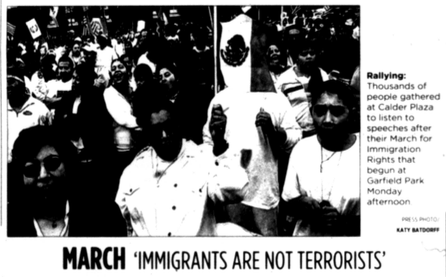 On March 26th, 2006 an estimate 10,000 people marched in Grand Rapids from Garfield Park to downtown Grand Rapids to protest the anti-immigration legislation. Some observers say that this was one of the largest marches in the history of the city, if not the largest. What is more important is that this march was made up of mostly people from the immigrant and undocumented community.
I was at that march in 2006 and wrote about it for an indymedia blog called Media Mouse. The story I wrote at the time, along with how the Grand Rapids Press covered it, is documented in a post on the Grand Rapids People’s History Project site.
There was another action organized as a follow up to this march, which took place on May 1st of 2006. This action also took place at Garfield Park, but it was much smaller, did not involve a march, but was being called Un Dia Sin Imigrantes – A Day Without Immigrants, which I also wrote about for Media Mouse. Unfortunately, after the May Day action, the moment was gone and organizers did not capitalize on the energy and numbers of those who took over the streets 5 weeks earlier.
There were still some meetings that were being organized, but primarily by those in the non-profit sector, religious people and immigration lawyers. These meetings took place primarily at the Hispanic Center and focused on policy rather than organizing the affected community.
By 2007, people began to rally around the idea of Comprehensive Immigration Reform Act of 2007 and the 2008 Presidential Elections. There was a big push within the immigrant community to register people to vote. When it was clear that Barack Obama was going to get the Democratic nomination and if elected, he would make Comprehensive Immigration Reform a priority, which motivated a lot of people.
Barack Obama did become the President and promised to pass Comprehensive Immigration Reform within the first 100 days. This however, did not happen and in fact, it never happened during the 8 years he was in office.
Many people in the immigrant community were disappointed by this outcome and many became disillusioned by electoral politics, especially when the Obama administration escalated the war against the undocumented community, deporting an estimated 3 million during those eight years.
A group that came together during the time, called the West Michigan Coalition for Immigration Reform, began to meet monthly. One of their main goals was to get Comprehensive Immigration Reform passed in Congress. They held a Press Conference in early September of 2009, to kickoff a new campaign to push politicians to embrace Comprehensive Immigration Reform.
The month before, GRIID agreed to conduct a series of interviews from people directly impacted from ICE raids and arrests or those who worked with people impacted, such as lawyers and social workers. Here is one of those interviews with an ALCU lawyer who shared her research on detention center across the US.
A week after their September Press Conference, the West Michigan Coalition for Immigration Reform held a public forum to kickoff their campaign to get Comprehensive Immigration Reform passed and in the minds of millions of Americans. The forum was held at GVSU’s downtown campus and co-sponsored by the Latin American Studies Department. The following month there was another rally held at Garfield Park, just prior to people traveling to DC to lobby Congress on Comprehensive Immigration Reform.
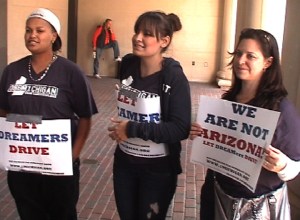 There was limited activity for a few years, until the 2012 Presidential Election, when the argument was made that “people needed to re-elect President Obama in order to achieve Comprehensive Immigration Reform.” However, at the same time there was increased ICE activity in West Michigan and more and more people were being arrested, detained and deported. At the monthly meetings of the West Michigan Coalition for Immigration Reform we kept hearing of arrests, raids and the growing fear that the immigrant community was feeling. There was even an attempt to create a Rapid Response to ICE project, but for a variety of reasons it never got off the ground.
However, in late 2012, there was also dissatisfaction with what was happening at the national level. In November of 2012, about 250 people went to Lansing to demand immigrant rights and Drivers Licenses for All.
In December of 2012, over 200 people showed up at a Grand Rapids City Commission meeting, mostly those from the immigrant community. Again, those who spoke were demanding that the city support their effort to get Drivers Licenses for the undocumented community. A Latino pastor addressed the Grand Rapids City Commission with a passionate plea for Drivers Licenses for All.
Young immigrants were especially disillusioned at this time and began organizing efforts to gain protections for themselves, which eventually lead to the Dream Act. Young immigrants were showing up all over the country whenever President Obama was scheduled to speak. They engaged in action that were disruptive and directly called out the President on his failure to push legislation that would be beneficial to undocumented immigrants.
Comprehensive Immigration Reform was eventually voted on in 2013, but it narrowly lost and there hasn’t been any attempt since then to get something like it passed.
However, there was a valuable lesson learned by these young immigrant organizers. They learned that putting their hopes into an electoral campaign was useless, unless there was a social movement that was organized by those who were most vulnerable to arrest, detention and deportation.
It was in 2014-2015, that immigrant organizers met to discuss and strategize around the importance of creating an immigrant-led movement that was calling for immigrant justice.
In Part II of this article, we will look at what has happened in Grand Rapids around immigrant justice, since Donald Trump was elected in November of 2016 and up until the present.
Acton Institute reports on Trump visit to Grand Rapids: Says Detroit and Flint should be like Grand Rapids
 The March 28 visit to Grand Rapids by President Donald Trump generated a great deal of local and national attention. Some articles focused on the protest that greeted Trump and his supporters outside, while other journalists wrote about what was said inside the Van Andel arena.
Trump’s visit even received a blog post from the Grand Rapids-based far right think tank, the Acton Institute.
In a blog post from last week, Acton research fellow Dylan Pahman chose to focus on one specific thing that Trump said during his visit to Grand Rapids. The headline from Pahman’s article read, President Trump visits Grand Rapids, promises to turn it into Detroit.
It is an interesting topic to focus on, especially since there were so many other things that Trump has to say. However, if you spend any time on the Acton Institute blog, you realize that their writers go out of their way to focus primarily on the wonders of the free market, topped off with some theological justifications for the virtues of capitalism.
Pahman brings up the fact that Trump said that the auto industry is coming back, and then talks about the difference between Detroit and Grand Rapids.
We haven’t put all of our eggs in the basket of the auto industry, that’s why. For one thing, while there has been and still is auto manufacturing in the Grand Rapids area, we were once Furniture City, USA and are now proudly Beer City, USA. Grand Rapids can — and does — boast a dynamic, diversified economy.
There is a great deal to unpack in this statement, so lets begin by saying that the Acton Institute writer leaves out a whole lot of history.
First, Pahman leaves out a decades long history of the Big Three automakers constant attack of organized labor, an attack that is well documented in the book, Detroit: I Do Mind Dying, A Study in Urban Revolution. Another dynamic well documented in Detroit: I Do Mind Dying, is the long-standing structural racism in Detroit that was exposed in the 1967 uprising and the massive white flight (people and investment) that ensued. Since the 1970s, Detroit has been struggling, in part because of the de-industrialization of the mid-west, but also because of the ongoing war being waged against the black community. These dynamics are well documented in the book, The Fifty-Year Rebellion: How the US Political Crisis Began in Detroit.
However, the Acton writer wants to simplify Detroit’s problems around the protectionist policies applied to the auto industry. Pahman completely ignores the fact that White Supremacy and Neoliberal economic policies, including harsh austerity measures has devastated Detroit, particularly black Detroit.
Second, when Pahman says that Grand Rapids went from Furniture City to Beer City, he also ignores the complexities of what has happened over the past century. The Acton writer ignores the exploitative practices of the furniture barons, which gained national attention during the 1911 furniture workers strike. In fact, the capitalist class in Grand Rapids was so freaked out by the 1911 strike that they changed the City Charter, making Grand Rapids go from a 12 ward city to a three ward city, which allowed for the capitalist class to consolidate their control over the political and economic climate.
Third, the Acton writer also ignores the White Supremacy that has plagued Grand Rapids since the 1920s, a dynamic that is well documented in Todd Robinson’s book, A City Within a City: The Black Freedom Struggle in Grand Rapids, Michigan. Robinson argues that Grand Rapids adopt a form of “managerial racism” that was a more subtle and covert form of White Supremacy.
Fourth, while Grand Rapids did not experience the same level of de-industrialization that Detroit did, the wealth was, and continues to be, concentrated in the white community. In fact, Grand Rapids has the largest wealth gap in the entire state, based on a 2016 study. Economic development has primarily benefited the white community, with massive subsidies and other financial incites offered to developers from the City of Grand Rapids and the State of Michigan. This fact flies in the face of what the Acton writer claims about the market freedoms practiced in Grand Rapids, compared to Detroit.
Fifth, the Acton writer then quotes Experience Grand Rapids, which is nothing more than an entity that promotes the city through a Neoliberal economic lens. Here is what Pahman cities from Experience GR:
West Michigan’s global manufacturers supply customers with everything from circuit boards and medical devices, to personal care products, to bullet-proof composites for military and industrial vehicles, to smart rearview mirrors that automatically control a vehicle’s high beam headlights. Grand Rapids’ thriving craft beer industry has even driven manufacturing innovation, with one small startup designing and manufacturing a tool that allows breweries and cideries to can their own beverages for carry out directly from their taproom bars.
While these industries are thriving, they primarily benefit white people and those who are already economically well off. What Experience GR and the Acton Institute do not acknowledge is the profound realities of White Supremacy in Grand Rapids, which is profoundly reflected in the gentrification taking place in numerous parts of the city, coupled with the disproportionately high levels of poverty in the black and latino/latinx communities.
The Acton writer ends his piece with another criticism of Trump by saying:
Rather than promising to turn Grand Rapids into Detroit, the president would do better to encourage Detroit, Flint, and other former auto manufacturing centers in Michigan to reinvent themselves and adapt like we’ve done here.

What the Acton Institute writer is essentially saying is that what Detroit and Flint should do is adopt economic and social policies that benefit white people over communities of color. In fact, this is exactly what Detroit did. The major difference is that there has been more militant resistance from the black community in Detroit and more managerial racism in Grand Rapids. Both cities experience structural racism, its just that Grand Rapids hides it better.
This morning, MLive posted an article about two bill in the Michigan House of Representatives that would prevent local communities from limiting their cooperation with Immigration and Customs Enforcement (ICE).
According to MLive:
The bills (HB 4083 and HB 4090) are sponsored by Republican Reps. Beau LaFave, R-Iron Mountain, and Pamela Hornberger, R-Chesterfield Twp., and are scheduled to be discussed in the House Military, Veterans and Homeland Security Committee – which LaFave chairs – at noon Tuesday, April 9. Previous versions of the legislation cleared a House panel last session but did not get taken up for a vote by the full House.
A useful summary of the two bills are provided by the House Fiscal Agency:
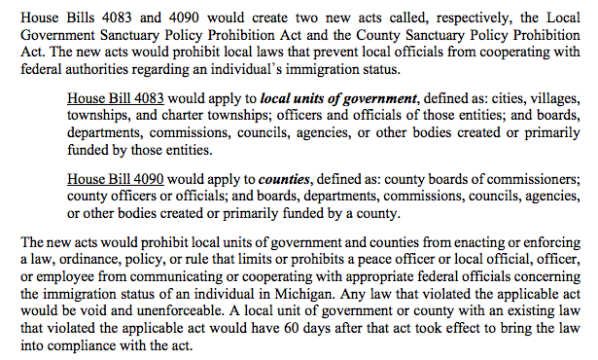
If passed, these bills would undermine local government autonomy and prevent actions taken like the recent Grand Rapids City Commission to suspend Captain VanderKooi for calling ICE while off duty to alert them to the incident involving Jilmar Ramos-Gomez.
 The Grand Rapids based groups, Movimiento Cosecha GR and GR Rapid Response was instrumental in pressuring the City of Grand Rapids on Captain VanderKooi, although they were demanding he be fired. These two groups were also demanding that the City of Grand Rapids end all cooperation with ICE, not allow any city resources to be used for cooperation with ICE and support the Drivers Licenses for All campaign.
House Bill 4083 was introduced by Rep. Pamela Hornberger from the 32nd District and House Bill 4090 was introduced by Rep. Beau LaFave from the 108th District. According to data provided by the Michigan Campaign Finance Network, the DeVos Family is the top contributor to Rep. Hornberger’s campaign ($14,000) and the fourth largest contributor to Rep. LaFave’s campaign ($9,000).
Last week we kicked off a new series of articles that will look at how the economic system has transformed and co-opted language to the benefit of the capitalist class.
We mentioned the new book, Keywords: The New Language of Capitalism, by John Patrick Leary, which provides a wonderful analysis of capitalism’s use of language, along with a list of words that this system uses.
 Just think about the terms that capitalism has created or transformed in recent years to give it an edgy, almost counter-cultural feeling. Words like place making, robust, stakeholder, thought leader, creative class, human capital, curator, best practices and empowerment. All of these words used to mean something else, but now they are used by the capitalist class as the language that best describes what it is they seek to achieve.
Last week we looked at the term accountability in Grand Rapids. This week, lets talk about the word stakeholder, and specifically how it is used by the capitalist class here in Grand Rapids.
Leary says, “Stakeholder’s primary meaning in the OED is an independent person or organization with whom money is deposited, especially when a number of people make a bet or other financial transaction.”
Clearly, the term stakeholder is rooted in the financial world. The author notes that the word stakeholder transition during the 1930s depression, “when calls for economic planning and socialism reached a high point.”
The more contemporary way in which the term stakeholder is being used, combines the financial meaning, with the idea of planning. In Grand Rapids, I have noticed that since the 1980s, the term stakeholder is most often used by systems and structures of power to give the illusion that anyone who is a stakeholder can have a seat at the table. What this often translates to, is that those who are invited are primarily those from the business community, government officials and representatives of non-profit organizations. The “public” might be invited as well, but as we all know when the business community is invites, they take up a lot of space at meetings and they tend to have more power in conversations around issues like economic development.
The stakeholder dynamic is further explored in an article from If The River Swells, which states:
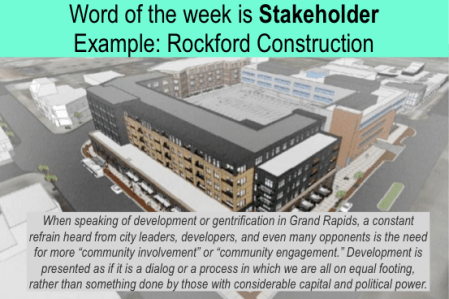
When speaking of development or gentrification in Grand Rapids, a constant refrain heard from city leaders, developers, and even many opponents is the need for more “community involvement” or “community engagement.” Development is presented as if it is a dialog or a process in which we are all on equal footing, rather than something done by those with considerable capital and political power. The appeals for participation are repeated over and over: the city and developers allegedly want to hear from the “community”, while always looking for more ways to get people involved.
 However, what is actually being encouraged is a very specific and narrow form of “involvement” that centers around the process of attending city meetings, meetings with developers, and other such similar events. It’s presented as a type of civic duty akin to voting – if you don’t do it, you don’t have a right to complain. A sort of hyper-local version of “America, Love It or Leave It.” Often when these conversations happen, they involve a considerable amount of blame being placed on those who are critical. The assumption is always that they have chosen “not to be involved” and that because they allegedly aren’t participating their voices aren’t being heard, and therefore, their concerns aren’t being addressed. It’s a charge that has been leveled at us repeatedly over the past year: that if we participated in the allegedly “important meetings” that are happening, “our voice would be heard”.
Of course, our voices, the community’s voices are rarely heard. Instead, those in the capitalist class love to hold public meetings to gain input, even thought the real decisions are being made by those who have the most money (which also means the most power), which are developers. In this sense, using the term stakeholder is merely meant to lull the public into thinking that their voice matters and to present the illusion that private economic development companies want community engagement. In the end, economic development corporations make the decision, not matter who else is “at the table.”
There are numerous examples of entities that use the term stakeholder, but this week’s example of how capitalism uses the term stakeholder is the Rockford Construction Company.
 It is widely known on social media how the TV show Fox & Friends put up a graphic that stated, Trump cuts aid to 3 Mexican Countries. The producers of the show later apologized, but not before the screw-up had saturated social media and even brought the wrath of other news sources who were appalled by the mistake.
One could say that the error is a reflection of the decline in US journalism, a decline that we have witnessed for decades now. However, there are larger (and I believe more important) issues at stake with the US State Department’s announcement that the US would no longer be providing foreign assistance to El Salvador, Honduras and Guatemala.
First, most of the mainstream commercial news media did not provide much information on current foreign aid to the three countries named. For example, the New York Times stated in an article on March 29:
“Currently, the United States spends about $620 million a year for gang prevention programs and other initiatives aimed at helping support civil society in the three countries. Advocates say that cutting the funds will only accelerate the migrant flows into the United States.”
This was the extent of any details on the amount of US aid that was going to El Salvador, Honduras and Guatemala, not did the New York Times provide much information on how the US aid was being used.
Secondly. the New York Times article fails to provide much historical context, in terms of how much US aid has poured into those countries in recent decades and for what purposes.
Lastly, there was limited investigation into how ending foreign assistance to the three countries would limit the number of people who are seeking asylum in the US or what Trump called, an “invasion” of people who were nothing more than conducting a “big fat con job.”
Instead, most of the attention was focused on the error that the news show Fox and Friends made, rather than, 1) providing the public with substantive information on what US aid to Central America has looked like in the past; 2) what it looks like now; and 3) how it will achieve the goal of reducing refugees from seeking political asylum.
Historical Context
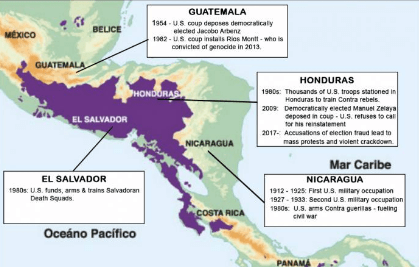 The United States has been giving massive amounts of foreign aid to El Salvador, Honduras and Guatemala for since the the early 20th Century. However, the bulk of the aid money was either military aid, funds to support drug war programs, corporate subsidies, free trade zones and the Central American Free Trade Agreement (CAFTA). For example, all throughout the 1980s, the US was contributing $1million a day in military aid to El Salvador, in order to fight a counterinsurgency war against a popular armed rebellion. In Guatemala in the 1980s and 90s, the US was providing millions in military aid, military advisors and military training to the death-squad government, which resulted in the deaths of roughly 200,000 people and the disappearance of some 60 – 80,000. In fact, the US counterinsurgency wars in El Salvador and Guatemala at that time were the major cause of displacement and a root cause of the refugee crisis that brought hundreds of thousands of Central Americans seeking asylum in the last few decades of the 20th century.
For more background information check out the following resources:
https://medium.com/s/story/timeline-us-intervention-central-america-a9bea9ebc148
http://umich.edu/~ac213/student_projects06/student_projects/usica/main.htm
More Recent History
Since the US sponsored counter-insurgency wars have ended in Central America, US aid to the region has decreased. However, the regional trade policy, known as CAFTA, along with free trade zones and an increase in drug trafficking, has resulted in further destabilization in the region, an increase in poverty and continues to force people out of the El Salvador, Guatemala and Honduras.
Check out the following resources:
https://www.citizen.org/sites/default/files/cafta-fact-sheet-aug-2018.pdf
Current US funding for Central America
 US Foreign Aid to Central America has declined in recent years, towards the end of the Obama administration and now under the Trump administration. According to the Washington Office on Latin America:
The 2018 House bill would cut assistance to Central America by $40 million — all of which would come from the Development Assistance account, through which $279.5 million was funneled to the region in 2017. Development Assistance supports violence-prevention efforts, job-creation programs, and other non-security related programs mostly administered by USAID. For 2018, the House supports $235 million through this account, a $50 million reduction in funds to the Northern Triangle.
As the below tables show, this bill maintains funding levels for security assistance through the Foreign Military Financing (FMF), International Military Education and Training (IMET), Nonproliferation, Anti-terrorism, De-mining and Related Programs (NADR), and International Narcotics Control and Law Enforcement (INCLE) programs. It also keeps funding for Attorneys General from El Salvador, Honduras, and Guatemala, for the International Commission Against Impunity in Guatemala (CICIG), and the Mission to Support the Fight Against Corruption and Impunity in Honduras (MACCIH).
House appropriators kept conditions attached to Central America assistance, putting a hold on at least half of funds until the Secretary of State certifies that countries are taking steps to improve accountability, transparency, justice systems, and security practices, among others. This year, the Committee went a step further and included $20 million for an “Incentive Award” program, which would be given to the single Northern Triangle country that has made the most progress on two or more of the conditions.
This analysis from WOLA tells us a great deal about US foreign assistance to Central America, since it provides not only a dollar amount, but a break down in what kind of programs the funding goes to.
Image if this is how the US news media reported on US foreign policy towards Central America. Not only would we be better informed about what US policy in that region is being used for, we would not be so easily manipulated by the government/corporate media propaganda and misinformation about the refugee caravans from Central America.
Lastly, while the 3 Mexican countries error was from Fox News, this issue of Central America, Central American refugees and US funding in that region have been created from bipartisan US policies and supported by both liberal and conservative news agencies that ultimately supports US foreign policy in Central America. Making fun of Fox & Friends might make us feel superior, but the real problem is that US-based journalism has primarily failed us around complicated and critical issues like the Central American Asylum Seekers, US Foreign Assistance in Central America and what impact US foreign policy has on that region.
West MI Policy Forum one of several groups who wants the minimum wage to only be $12.05 in 2030
 The business class in the US has always understood that there is a real class war happening at all times, even if the working class is unaware of that fact.
In early December, the GOP-led Michigan legislature passed Public Act 368 of 2018, which would increase the minimum wage in Michigan at a grotesquely slow rate over the next decade, reaching a paltry $12.05 in 2030.
This incremental wage increase is insulted to working class people, who cannot live off these kid of wages or even afford the most basic resources in order to have a healthy life.
The Michigan Supreme Court is reviewing this issue right now, since Public Act 368 of 2018 is being challenged. The entities who have been most vocal about defending the legislation passed in 2018 – with a recent court filing – are the Michigan Chamber of Commerce, the Michigan Manufacturers Association, the Michigan Realtors Association and the West Michigan Policy Forum.
In fact, a few days ago, the West Michigan Policy Forum posted on their Facebook page a link to a Detroit News article and bragged about their organization being one of the groups aggressively seeking to maintain the absurdly low minimum wage increase over the next 10 years.
Some of the more prominent people who are the board of directors for the West Michigan Policy Forum are:
Doug DeVos, Peter Secchia, John Kennedy, Mike VanGessel, Michael Jandernoa, JC Huizenga, Steve Van Andel, Johnny Brann Jr, Jim Dunlap and Blake Krueger.
These men make up the Grand Rapids Power Structure, so it is no surprising that they do not support a living wage for working families. Despite their outright war against working class families, those who are part of the West Michigan Policy Forum like to present themselves are benevolent leaders who really care about the community. A week does not go by in the West Michigan news media where we hear about the wonderful things that Start Garden, Rockford Construction, Wolverine Worldwide, Amway, Meijer or Spectrum Health are doing for the little people in the greater Grand Rapids area.
Look, if these people are deliberately pushing state policy to keep wages low, then whatever charity or entrepreneurial shit they are concocting is nothing more than a con they are playing on families in West Michigan who are struggling to pay their mortgage, their rent, health care costs, utilities, transportation costs and other basic necessities.
Remember, that these rich, white men are regularly meeting to plan assaults against working class families and families of color and then turning around and dangling money in front of these same families with their get rich quick entrepreneurial schemes.
The following statements are based on the afternoon session from the Michigan Civil Rights Department hearing in Grand Rapids on Thursday, March 28.
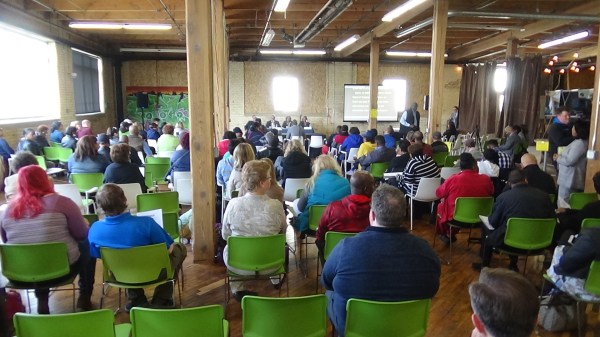
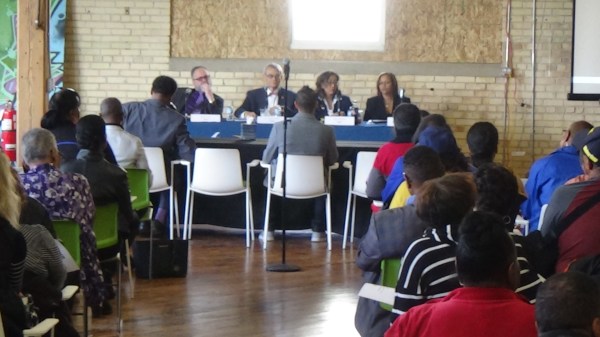
Cle Jackson, with the NAACP, opened up the hearing, referencing recent incidents with the two latino youth and the black motorist who was punched some 30 times. These are however, on two cases that make up dozens of other documented incidents with the GRPD. Jackson, also said that this kind of police abuse & violence directed at black and brown communities, has been happening for decades, and it needs to stop.
A staff member of the Michigan Civil Rights Department (MCRD) then spoke and laid out both the process for those who wanted to speak and somewhat of a framework. The MCRD spokesperson did say that the framework for determining whether civil rights have been violated is the Elliot Larsen Civil Rights Act, which currently does not include the rights of the LGBTQ community.
Depending on the testimony provided, the MCRD may begin an investigation of the GRPD. In addition, it was stated clearly that the MCRD will not tolerate any retaliation against those who speak out, and they specifically mentioned retaliation from an employer, an elected official or anyone else in a position of power against those who offer testimony.
At the very beginning, when people started giving testimony at 1:30pm, there were an estimated 200 people in the room. The people who spoke, filled out a sheet of paper and were called forward to address the MCRD.
- The first speaker was a lawyer with the ACLU, who recently moved to Grand Rapids, specifically the Heritage Hill neighborhood. She shared her experience where the GRPD followed her home in a cruiser, while she and her son were walking home. Then suddenly, a black man was walking in the other direction and the GRPD stopped that man. She ended by saying Grand Rapids is a great place to live, if you are white.
- The second speaker, also with a non-profit advocacy group, addressing two specific cases of police abuse in Grand Rapids, the two latino youth who were held at gunpoint in the southwest part of GR and the black man who was punched nearly 30 times while driving on the westside.
- A black man, who had two relatives who were police officers, said those officers told him that the GRPD is a racist city. He then talked about the two boys who were arrested for walking in the street. He said that, “students from a local high school in his neighborhood always walked in the streets and the track team always ran in the streets, so why were the two latino boys treated the way they were?”
- Another black man spoke, who said he was arrested this past Tuesday by the GRPD. He said there were three police cruisers involved in his arrest. They made him take a sobriety test and one officer said that he appeared to “be on something.” He was detained for 7 hours, since that is the time length to sober up, even though he was not high and never has been.
- A black woman then talked about an incident from February of 2018. She lives in the Adams Park area. A white woman was drinking in her car and making a great deal of noise and this woman and another neighbor asked for her to keep the noise down. This woman called the police and when the police arrived they spoke with the white woman first who told the officer that the woman who called was the problem. The GRPD officer yelled at the black resident, who also said at this point that she felt her safety was in jeopardy. She called 911 a second time and said the officer didn’t even speak with the her, but the response from the dispatcher was to make her feel like she was the problem.
- Another lawyer from the ACLU then spoke, specifically about the GRPD’s relationship with ICE. She read a statement that was released earlier in the day by the ACLU, along with numerous other documents to support their position on several other cases involving Captain Kurt VanderKooi.
 Another black man shared his story about how the GRPD came to his house and one officer forced his way into this man’s house, resulting in his eye being split open. The GRPD tried to get him to not pursue the complaint against them. He also said that bad cops needed to be weeded out and then says that he think there are some good officers.
 - A black man who is a small business owner, then spoke about a friend of his who was harassed, intimidated and accused of being part of a murder. He said he was tired of this happening over and over again, where the GRPD harasses and intimidates people. He said because he has spoken out, he has been stooped by the GRPD 106 times in recent years.
- A black women then shared a story about being intimidated as well. She feels that the GRPD always wants to justify whatever they do and that the black and brown communities feel this is nothing short of abuse. She also brings up the two youth who were stopped for walking in the street and said that there are so many neighborhoods where it is not safe to walk on the sidewalks.
- Another black woman then spoke, sharing stories about a race relations forum in 1991, but felt like nothing good came out of it. She is a criminal justice major and has been pulled over numerous times, for what she stated was “just being black.” The GRPD does not follow their own policy and she shared numerous examples of use of force. For instance, she saw a guy in his wheelchair, who was stopped by the GRPD and forced out of his chair and searched. She also addressed the GRPD pulling of guns on youth in this community.
- A black woman spoke, who lives in Grand Rapids and has raised her kids in this community and feels that they are at risk from the GRPD. She said that body cameras do not work for the public. The GRPD is racially profiling people, and acknowledges that she doesn’t know what to do to keep her children safe.
- A white woman then speaks about what has happened to her. She owns a business on the westside and has witnessed members of the GRPD that has removed people from her store. The GRPD always treated people fairly, no matter who they were. This woman was defending the GRPD. One guy sitting next to me said, she’s at the wrong meeting and numerous people who visibly angered that this white woman not only ignored the previous testimony, but that she felt so entitled to come for the purpose of defending the police. This woman’s testimony was the perfect example of white privilege and white arrogance.
- Another black woman then spoke and said she does not feel safe and has never felt safe whenever interacting with the GRPD. She called the GRPD when she thought someone was trying to break into her home. When the cop arrived she felt unsafe and like he was questioning her, instead of empathizing with her concerns. She recently called the police after her granddaughter had been abused by her daughters boyfriend. The GRPD wanted her to call Children Protective Services and seemed disinterested in the violence against her granddaughter.
- A black man then shares his story about something that happened in the Madison neighborhood. He has been pulled over numerous times and been told by the GRPD that they have been waiting to pull him over with no clear reason. He owns rental property in the neighborhood and that the GRPD has intimidated him, frisking him and physically threatened him, sometimes trying to provoke him so that they could use force. He then told a story that about being given a ticket by the GRPD, and while he was in court to pay a fine, the judge said he swore in the courtroom. When this man said he didn’t and that could he play the courtroom recording back and the judge said no and sentenced him to 10 days in jail.
- A white woman spoke next, sharing two incidents in the past month in the Roosevelt Park neighborhood. The first incident dealt with someone blowing their horn and a neighbor had to move his car. A GRPD officer came and pulled the woman’s neighbor out of the car by force and was then detained by the cops because of how disrespectful he spoke to the cops. The GRPD then dropped the charges and said that their body cam footage was deleted. In the second incident, there were 5 cops with guns pointed at 2 black teenagers.
- A latino man spoke about how his experience with the GRPD is that they want to escalate the situation, not de-escalate. The GRPD was called by his ex-girl friend, even though he had not harmed her, but the GRPD said in these cases, “someone has to go to jail.”
- Another older black man spoke and began by stating that he didn’t think this hearing will result in anything. He wanted to see change and not just a fact finding opportunity. “Nothing has changed over the years,” he said.
- Another black man spoke about a department of justice case, which he believes the charges were completely fabricated. He said he is moving soon and will never live in Grand Rapids ever again.
- A black woman who is a member of Messiah Missionary Baptist Church in the SE part of town, spoke next. In recent weeks, members of her church have been targeted by the GRPD for parking violations, in a neighborhood with numerous churches that have high attendance. Just a few blocks away where there are white churches, where members park on both sides of the street and no one is getting a ticket. The same thing is the case, “with the white gentrified area on Wealthy St, where there are always lots of people parking on the street, but these people are not being targeted for parking violations by the GRPD.”
- A 65 year old black man then talks about it being 2019 and this stuff is still going on. An incident he mentions was in the Oakdale neighborhood, where a car crash had taken place. He says there was clear discrimination. His wife has a nice car and she is always being stopped by the GRPD in the area, “so you can’t have a nice car in this neighborhood without being pulled over? The GRPD has no respect for our community. We pay their salaries. They don’t know us and don’t even try to know us.”
- Another black man who has lived here for 70 years, then spoke about a lack of representation and no organizational representation for black people. He was critical of the NAACP, since he doesn’t think it works for them. He says he is tired of seeing black kids having guns pulled on them, especially since he never sees this happening to white kids. “This is not gonna change until a white kid gets killed by the GRPD.” This guy is a truck driver and he says that truck drivers call this city Racist Rapids.
- A black woman makes the observation that on the same day this hearing is being held, the racist President is in town. She doesn’t take shit from people, so she knows that as a confident black woman she will be targeted by the GRPD. She spoke about having the GRPD called on her in certain businesses. For example, she was arrested in the front of her home, with three cruisers being called and then pulling her out of her car and arrested for no apparent reason. The charges were later dropped, but the damage had been done, especially since her daughter witnessed this abuse.
- Another black woman, who is a retired court magistrate, talked about in her work experience of people of color being arrested for walking in the street. People should not be afraid to just walk around. During her 23 years on the job she, never heard of a white person being arrested for walking in the street.
If people were unable to attend either the afternoon or evenings sessions they can submit written statements electronically now, through 1 p.m. on Friday, April 5, 2019. Statements must include a name, address and a telephone number or email address for contact. Statements can be emailed to Community Engagement Liaison Gwendolyn Moffitt at MoffittG@Michigan.gov.
Michigan Senator Gary Peters uses the same lie about BDS that the Israeli government does
 In 2017, Michigan Senator Gary Peters co-sponsored a bill that would essentially criminalize the BDS movement in the US.
The Israel Anti-Boycott Act (S. 720) was introduced a few months ago and was drafted with input from the American Israel Public Affairs Committee (AIPAC).
The ACLU has sent a letter to the Senators who co-sponsored this legislation stating, “We urge you to refrain from co-sponsoring the legislation because it would punish individuals for no reason other than their political beliefs.”
I sent a message to Senator Peters recently, asking him to vote no on the anti-BDS legislation. Here is part of his response:
On February 5, 2019, the Senate passed the Strengthening America’s Security in the Middle East Act. This bill is a combination of several key U.S. foreign policy initiatives, including authorizing security assistance to Israel, imposing new sanctions on Bashar al-Assad’s regime in Syria, and extending the United States’ existing security partnership with Jordan. Although I had concerns about certain provisions in this bill, I voted in support of it because it will help advance several critical national security priorities. We must make it clear the United States stands with its allies in the Middle East that are confronting violent extremist groups throughout the region.
The bill clarifies U.S. law with regards to the ability of state and local governments to divest from or limit contracting with entities engaged in boycott, divest, and sanction (BDS) campaigns targeting Israel. The underlying purpose of BDS activities is to delegitimize Israel’s sovereign right to exist as a country. I do not support these campaigns, which single out Israel and in effect undermine the prospect of direct peace negotiations to solve territorial disputes.
What Senator Peters says about BDS is the exact same thing that the Israeli Prime Minister Benjamin Netanyahu says and it is a lie.
According to the BDS movement site, their goal is as follows:
Boycott, Divestment, Sanctions (BDS) is a Palestinian-led movement for freedom, justice and equality. BDS upholds the simple principle that Palestinians are entitled to the same rights as the rest of humanity.
Israel is occupying and colonizing Palestinian land, discriminating against Palestinian citizens of Israel and denying Palestinian refugees the right to return to their homes. Inspired by the South African anti-apartheid movement, the BDS call urges action to pressure Israel to comply with international law.
BDS is now a vibrant global movement made up of unions, academic associations, churches and grassroots movements across the world. Eleven years since its launch, BDS is having a major impact and is effectively challenging international support for Israeli apartheid and settler-colonialism.
The fact that Senator Peters voted for the anti-BDS legislation is not surprising, since he , like most of the US Senate receive substantial funding from the Israel Lobby, according to Open Secrets.
In fact, US support for Israel has been a bi-partisan affair since the US began providing billions of dollars in aid to Israel in the mid 1970s.
Another GRPD Press Conference to justify the use of force
 Yesterday, the GRPD once again held a press conference in order to respond to another violent incident involving members of the African American community. You can view the video at the GRPD Facebook page.
The Press Conference lasted just over 7 minutes, with Interim Chief Kiddle making a statement, followed by a few questions from reporters. This most recent Press Conference was no doubt organized to respond to a particular incident, but also because someone had recorded what had happened.
Interim Chief Kiddle and other police officers have made it a point to say that the public recordings of police violence “distorts the public perception” of police actions. No shit, because the videos from residents often conflicts with the narrative that the GRPD wants to provide. And the narrative from yesterday’s GRPD Press Conference was the same as it has been in the past few months – the police officers involved acted appropriately and did things they were trained to do.
This was one of the questions asked by a reporter during the Press Conference, about why the police officer kicked the man. Kiddle responded by saying, “kicking is a police maneuver, a distraction and pain technique, intended to try get someone under control who is resisting arrest.”
If you kick someone, you could be charged with assault, but if the GRPD does it to you, it is simply a technique to get someone under control. Does anyone else see the irony in such a statement coming from the GRPD?
Just within the last month, the GRPD has held two Latino youth at gunpoint for walking in the street, punched a black man at least 30 times, while his child is in the back seat of the car, and in this most recent incident, the GRPD officer pull a man out of the car and kick him because he was resisting arrest.
As someone said during the City Commission meeting last night, “How many more incidents are there of the GRPD using force against residents that are not being recorded by people?”

