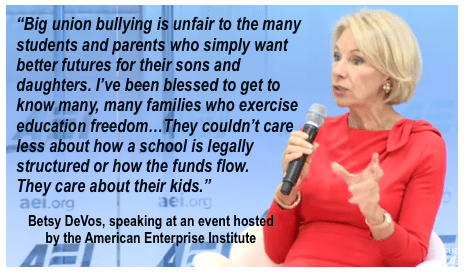
 On Tuesday, US Education Secretary Betsy DeVos, fresh off her “Back to School” tour, where she was promoting the Education Freedom Scholarships program, spoke at a forum hosted by the most influential think tank in the US, the American Enterprise Institute (AEI).
The American Enterprise Institute fully supports the administration’s education policies, policies which have been embraced by the last several administrations, but now accelerated under Betsy DeVos. These education policies are fundamentally promoting a neo-liberal education model, where public schools have seen significant reduction in funding, which leads to public schools adopting a charter-school like approach and partnering with the business community. The neo-liberal education model also means re-directing public funds to private and charter school options, often presented as “school choice.”
The AEI event began with Betsy DeVos making some opening comments about the Education Freedom Scholarships. DeVos made the following statement in regards to those sectors which are not endorsing the Education Freedom Scholarship proposal:
“Big union bullying is unfair to the many students and parents who simply want better futures for their sons and daughters. I’ve been blessed to get to know many, many families who exercise education freedom…They couldn’t care less about how a school is legally structured or how the funds flow. They care about their kids.”
DeVos went on to give an example of how unions are against education freedom, by citing the teacher strike in West Virginia. DeVos said the teacher strike was, “anti-teacher and anti-student.” The fact is, that the teacher strikes in West Virginia were not only led by teachers, but they won on several fronts, which ultimately means that the students won. In fact, students and their parents were involved in the strike, according to Eric Blanc’s recent book, Red State Revolt: The Teachers’ Strikes and Working Class Politics.
After her opening remarks, DeVos was joined on stage by White House Counsel, Kellyanne Conway and a moderator from the American Policy Institute. Conway was rather unimpressive, repeating some of the same talking points that DeVos presented and using the opportunity to criticize Democrats who don’t endorse the Education Freedom Scholarship proposal, which you can read about at this link.
Both Conway and DeVos were later joined on stage by Tennessee Representative John DeBerry (D), Pennsylvania Speaker of the House Mike Turzai (R), and Arizona Treasurer Kimberly Yee (R). Not surprising, each of these three elected officials endorse the Education Freedom Scholarships. Rep. DeBerry has even come under fire from fellow Democrats for supporting school vouchers in Tennessee and Rep. Turzai recently introduced legislation that would allow students in the Harrisburg area (PA’s state capitol) to access public funds to attend private schools.
One of the major things missing from the discussion was any historical context for why public schools were doing so poorly or why they were underfunded. This context is significant, since DeVos and others who spoke at the AEI event kept saying that the Education Freedom Scholarships would benefit “African American and Hispanic students.” Again historical context is critical, since there was no acknowledgement of the fact that after force busing and the de-segregation of schools began in the 1970s, white American and the suburbanization of the country led to white families pulling their kids out of urban public schools and putting them in either more elite, racially segregated public schools or placing their children in private schools.
This shift in education began the steady decline of funding for urban public school systems and created an opening for the charter school/voucher/privatizing education movement that was led by people like Dick & Betsy DeVos and the organizations they helped to create in the 1980s, many of which are rather powerful today.
Of course, I would not expect this kind of information to be shared at a forum hosted by the American Enterprise Institute. If you want to sit through the 2 hour AEI forum with Betsy DeVos, Kellyanne Conway and pro-Education Freedom Scholarship politicians, here you go.
What Independent News Media is saying about Impeaching Trump
 Now that the Democratic Party leadership has finally decided to beginning impeachment proceedings, it might be useful to see what independent news sources and journalists are saying.
We are choosing to look exclusively a independent media sources, especially since the mainstream, corporate media is not likely to challenge any official narratives, even during impeachment proceedings.
From a more liberal end of the spectrum, John Nichols, writing for The Nation, takes a more Democrat vs Republican view of the impeachment proceedings, stating: If the 2020 choice is between Democrats who say they need to win in order to finally put an end to Trump’s abuses and to finish the miserable tenures of those senators who aid and abet his abuses, impeachment will not be a “third-rail” issue for the party. Democrats need to have the confidence of Representative Alexandria Ocasio-Cortez when she says that “the ground has shifted,” and that Democrats have the “ability to organize the public, to educate the public, to talk to the public” about the necessity of impeachment.
Nichols frames the issue of impeachment primarily within he electoral arena. Ryan Grim, the political reporter for The Intercept, also leans towards the electoral framework, but with a more critical assessment. Grim is suggesting that House Speaker Nancy Pelosi made the decision to begin impeachment proceedings, in part, because the Democratic Party-base was becoming so frustrated with the party’s failure to move forward on impeachment, which was leading to grassroots challenges to Democratic Party incumbents.
That grassroots anger was translating into primary challenges, he noted, and needlessly furious constituents. Rep. Cheri Bustos, the chair of the Democratic Congressional Campaign Committee, and a champion of doing nothing when it came to Trump, had recently counted as many as 111 primaries, far more than a typical cycle. The members without official primary challenges were by no means safe, either, as they might soon draw a challenge unless the trajectory of the politics changed. Freshman representative Lori Trahan, from Massachusetts, for instance, came out for impeachment after Dan Koh, whom she beat in a primary by 147 votes in 2018, called on her to do so, with the clear threat that he may run again. The seats of upward of 200 Democrats were being put at risk to protect a handful of loud front-liners, Raskin argued, and it wasn’t obvious that the strategy was actually protecting them from anything. Grassroots activists were demobilizing, Democrats across the board were facing primary challenges, and somehow, someway, Democrats seemed to be losing, again, to Trump. Something had to give.
Mehdi Hasan, also a contributor to The Intercept, also takes a critical look at the impeachment, raising important questions about the possibility that it will fail. Hasan states:
So how then might this end up as a defeat, and not a victory? Think about it. For House Democrats to wait this long and then impeach a reckless, lawless, racist, tax-dodging president only over his interactions with the president of Ukraine would be to effectively give Trump a clean bill of health on everything else. Going into an election year, Democrats would be unilaterally disarming — unable to offer further substantive criticisms of Trump’s crimes and abuses of power across the board. “Why didn’t you impeach him for it?” Republicans will ask.
Anthony DiMaggio, writing for the online indy news source, CounterPunch, also looks at how the impeachment proceedings could stifle more progressive discourse and policies before the 2020 election. DiMaggio states:
There are, of course, dangers that impeachment brings. One is that the 2020 election becomes merely a mandate on Trump, rather than about establishing a progressive vision for policy change. I have no doubt that Biden and Pelosi would love to make the 2020 election into nothing more than a mandate on Trump, which would allow them to divert public attention from the growing support within the Democratic Party for the progressive, New Deal-style reforms promoted by Bernie Sanders and Elizabeth Warren. These policies are strongly opposed by neoliberal establishment types like Pelosi and Biden, so there is a real risk in allowing the impeachment agenda to hijack political discourse in the run-up to 2020.
Lastly, there are two writers who question the whole impeachment proceeding, since they both believe it will undermine the possibility of more systemic and revolutionary changes necessary, even if Trump is impeached. Chris Hedges, writing for Truthdig, states:
Impeachment is about cosmetics. It is about replacing the public face of empire with a political mandarin such as Joe Biden, himself steeped in corruption and obsequious service to the rich and corporate power, who will carry out the same suicidal policies with appropriate regal decorum. The ruling elites have had enough of Trump’s vulgarity, stupidity and staggering ineptitude. They turned on him not over an egregious impeachable offense—there have been numerous impeachable offenses including the use of the presidency for personal enrichment, inciting violence and racism, passing on classified intelligence to foreign officials, obstruction of justice and a pathological inability to tell the truth—but because he made the fatal mistake of trying to take down a fellow member of the ruling elite.
Paul Street, also writing in CounterPunch, makes the point that like Nixon, Trump could get impeached without ever being held accountable for war crimes or violence done to people right here in the US. Nixon, was not facing impeachment for his war crimes in Cambodia, Vietnam or Chile and he was not facing war crimes for giving the FBI the green light to attack members of the Black Panther Party for Self Defense, the American Indian Movement or the Brown Berets, it was because he was spying on the Democrats. Trump will not be impeached for war crimes or eco-cide or all the harm ICE has done to the immigrant community, he will be impeached because election tampering. What we need to do, Street suggests, is learn from what other people have done across the globe:

The best way to remove Trump is not merely through elite procedures designed by wealthy 18th Century slaveholders, merchant capitalists, and publicists for whom democracy was the ultimate nightmare. It is through a sustained mass rebellion by and for those the U.S. Founders and the American ruling class today fears most: We the People, the working-class majority. We should mobilize to bring this regime down in the same way the people of Puerto Rico recently forced out their corrupt and racist-sexist governor Ricky Rosello, the same way the people of Hong Kong won the repeal of an authoritarian extradition law, and the same way the masses of Algeria overthrew an authoritarian regime last year.
Personally, I would advocate for what Street is saying.
The US War/Occupation of Afghanistan is now in its 18th year, and it’s a bipartisan occupation
 This week it will be 18 years since the US bombed, invaded and occupied Afghanistan. Considered the longest US military action, the US war in Afghanistan is complex, but it should be considered a war crime.
After the September 11, 2001, for many people it became difficult to actively speak out against US foreign policy. There were large gatherings in the Grand Rapids area to morn the dead from 9/11, but there was limited organized public conversation about why the US was attacked on 9/11 and even less so in the local news media.
None of the traditional anti-war groups in Grand Rapids, were willing to criticize the US bombing of Afghanistan until months after the US war/occupation had begun.
However, the group People’s Alliance for Justice & Change, didn’t hesitate to speak out and began forming a plan as to what could be done in the immediate aftermath of 9/11 and the US intent to wage war on Afghanistan. For a list of actions that were organized in Grand Rapids during late 2001 and part of 2002, go to this post on the Grand Rapids People’s History Project.
After September 11, 2001, the US quickly moved to take action to blame someone for the terrorist attack. In October of 2001, the US began bombing Afghanistan, even though Afghanistan had nothing to do with 9/11. It is true that members of Al Qaeda were operating from Afghanistan, but the Afghan government did not want to hand over members of Al Qaeda to the US, instead they wanted them to be handed over to a third party, especially since the US had been deeply involved in attempting to influence the Afghani government since the early 1970s.
What follows are a few main points about what the US war/occupation of Afghanistan has been about and what the consequences have been:
The US is not in Afghanistan to bring Democracy – Since 1979, the US has supported anti-democratic forces such as the Mujahadeen, the Northern Alliance, the Taliban and a variety of individual warlords. Since the end of the Soviet occupation of Afghanistan, the US has also supported subsequent Afghan governments, despite the fact that most of them have been rife with corruption.
The US is not in Afghanistan to protect the rights of Women – The groups of armed men that the US has supported for decades, like the Mujahadeen, are some of the most misogynist groups in that country. Even under the current government of Karzai, a law was passed that essentially legalized the rape of women. Afghan Women’s groups like RAWA and the Afghan Women’s Mission have made it very clear that if those of us in the US want to support women in Afghanistan then we should work for an end to the US military occupation of their country.
The US is not in Afghanistan to Prevent Terrorism – Many credible members of the US intelligence community have stated in recent years that there is no link between the Taliban and Al Qaida. The Taliban did not attack the US on September 11, 2001. The Taliban are a nationalist group that wants the US out of their country. In fact, we would say that the US occupation of Afghanistan only gives rise to potential acts of terror and feeds a growing anti-American sentiment.
What the US is doing in Afghanistan has more to do with long-term strategic interests. We believe that the US recognizes that Afghanistan is a bridge between the Middle East and Central Asia, that it borders Iran, Pakistan, China and other important countries. We believe that the US sees Afghanistan as playing an important role in the control of future resources in that region, both because it will likely be a major trans-shipment point to move oil and gas in the region, but also because it can act as a US outpost to prevent China, India and Russia from gaining access to the region’s resources.
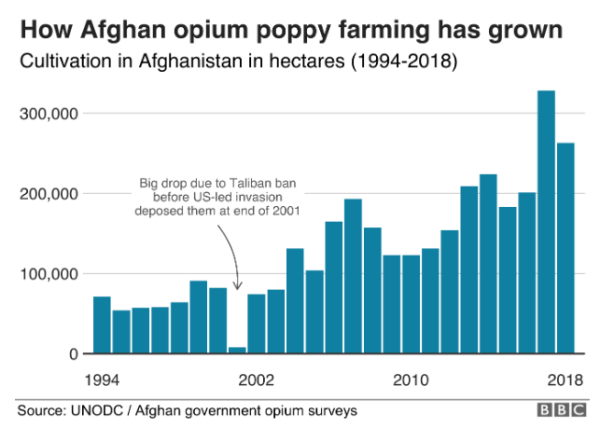
One major consequence of the US war/occupation of Afghanistan has resulted in a massive increase in opium/heroin production. Drug war scholar and historian Alfred McCoy has written a great deal about the connection between the US occupation of Afghanistan and the increase in opium/heroin production. In addition, the graph below provides visual evidence of the the relationship between increased drug production and the US occupation of Afghanistan.
The US war/occupation of Afghanistan has been a bi-partisan effort. The occupation began under the George W. Bush administration, but the Obama administration escalated the number of US troops. In fact, the Democratic Party has consistently made the argument that Afghanistan is where the US War on Terror should be fought since 9/11.
The human cost of the US war/occupation of Afghanistan has been estimated at 31,000 civilian Afghani deaths, according to a recent piece by long-time Middle East journalist, Robert Fisk. In addition, there is a well documented report that came out within the last two weeks from Brown University, entitled, The Human and Financial Costs of the Explosive Remnants of War in Afghanistan.
Lastly, there is the economic cost to the US War on Terror since 2001. The National Priorities Project puts the total economic cost at right around $5 Trillion dollars, which you can follow at this link. The National Priorities Project also allows you to breakdown how much money leaves each community across the country to pay for US wars. In 2018, $32.66 million left Grand Rapids to pay for US wars. The same site also provides trade-off, meaning what that $32.66 million could have paid for if it stayed in Grand Rapids. One example would be, if the money would have stayed in Grand Rapids it could have provided 71,704 Households with Solar Electricity for 1 Year.
So, it might be important to ask yourself why does the US Government continue the current war/occupation of Afghanistan? Why are most politicians not addressing it, and why is there no anti-war movement resisting this brutal, criminal war?
Editor’s note: One good source for news and analysis on Afghanistan is the Afghanistan Analysts Network.
Foundation Watch: How the Jandernoa Foundation functions within the rest of the GR Power Structure strategy
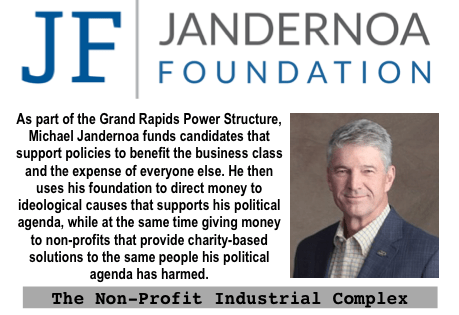 Michael Jandernoa is one of the lesser-known members of the Grand Rapids Power Structure. Jandernoa is the former president of Perrigo. In recent years, Jandernoa has been involved with 42 North Partners, which he created with his wife Sue. In addition, Jandernoa serves as General Partner at Bridge Street Capital Fund I, L.P, where he sits on the Executive Committee with John Kennedy. He is the Co- Founder of Grand Angels, LLC., which is another investment capital entity in Grand Rapids.
In addition, Jandernoa has used his wealth to influence state politics. According to the Michigan Campaign Finance Network, Jandernoa gave $437,500 in the 2015 – 2016 election cycle (the 9th most in the state) to the Republican Party and he contributed $795,000 in the 2017 – 2018 election cycle, most notably to candidates from the Greater Grand Rapids area, like State Senator Peter MacGregor.
Jandernoa also sits on the boards of numerous groups that are part of the Grand Rapids Power Structure, like the West Michigan Policy Forum, Talent 2025, Business Leaders for Michigan and The Education Trust, which is an organization that promotes Charter Schools.
Now that we can see the ways in which Jandernoa works to influence economic policy and the political process in Michigan, let’s look at how his foundation compliments these efforts.
The following data is for 2015 – 2017, based on the 990 documents we obtained from Guidestar, for the Michael and Susan Jandernoa Foundation. This foundation has just over $16 million in assets, according to Guidestar.
Like all members of the Grand Rapids Power Structure, the Jandernoa Foundation does two main things. First, this foundation funds the kinds of things that align with Jandernoa’s ideology, and second, his foundation provides funding to non-profits that offer charity-based solutions for people experiencing poverty. As we have noted in previous Foundation Watch posts, members of the Grand Rapids Power Structure are influencing economic policy at the state level that creates poverty conditions for thousands in West Michigan, but their foundations only provide charity-based solutions that do not address root causes of economic disparities.
The ideologically driven funding that the Jandernoa Foundation provides goes to the following entities:
- Catholic Central $2,300,000
- Junior Achievement $1,125,000
- Mackinac Center for Public Policy $450,000
- Calvin Theological Seminar $400,000
- GVSU $300,000
- Grand Rapids Student Advancement Foundation $109,500
- Grand Action $100,000
- Start Garden Foundation $45,000
- Great Lakes Education Foundation $25,000
All of the above entires either are designed to either; 1) influence educational outcomes – Catholic Central, Calvin Theological Seminary, GVSU and the Grand Rapids Students Advancement Foundation; 2) Pro-capitalist practices – Junior Achievement, Grand Action and Start Garden Foundation, or 3) public policy outcomes – Mackinac Center for Public Policy and the Great Lakes Education Foundation.
In the category of charity-based funding, here are some of the organizations that the Jandernoa Foundation supports:
- Heart of West Michigan United Way $750,000
- Special Olympics Inc. $175,000
- Kids Food Basket $100,000
- Mel Trotter Ministries $75,000
 To be clear, we are not saying that these organizations don’t serve specific needs, but we are also saying that these organizations do not work to end root causes of problems, rather they use charity-based solutions.
As one can see, the Jandernoa Foundation fully complements the more overt political and economic ways that Michael Jandernoa uses his money to influence public policy. In addition, by contributing to groups like Mel Trotter Ministries and Kids Food Basket, the Jandernoa Foundation can count on these same organizations to not challenge or resist the ways in which Jandernoa influences public policy, which ultimately leads to the creation of poverty and hunger.
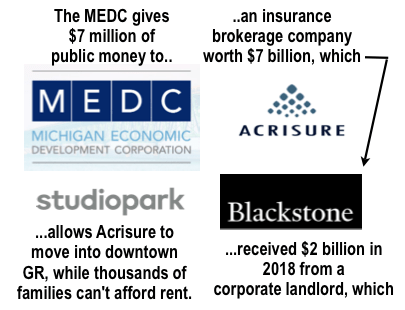 On Monday, MLive reported that the insurance brokerage company Acrisure, will receive $7 million in public money from the State of Michigan, for the company’s decision to move from Caledonia to downtown Grand Rapids.
Acrisure will move their business to the new Studio Park complex, just behind the arena, but the move won’t happen until 2021.
The Michigan Economic Development Corporation has awarded the insurance brokerage the $7 million of public money, $1 million from a Michigan Business Development grant and the other $6 million from the Good Jobs for Michigan Program.
So here is what MLive didn’t report:
First, the board of the Michigan Economic Development Corporation, which granted the $7 million, is made up of a mix of government bureaucrats and corporate representatives.
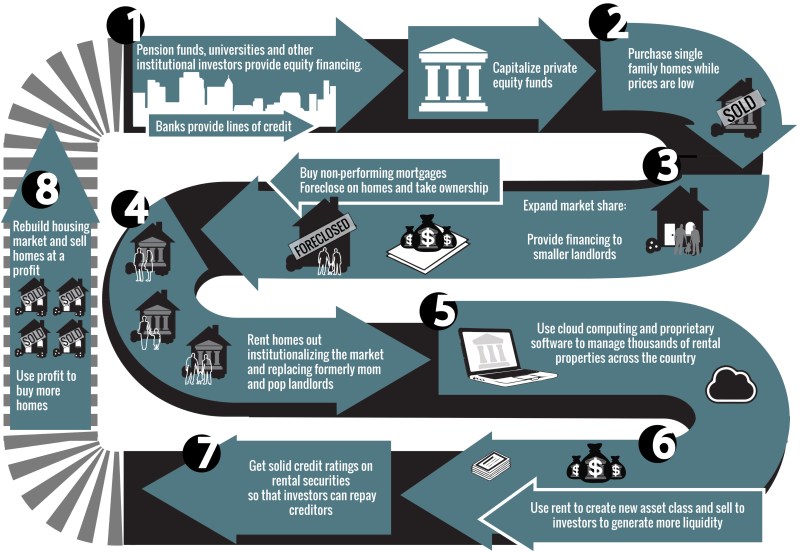
Second, Acrisure, the insurance brokerage firm that received $7 million in public funds, last year got $2 billion from investors that now puts the corporation’s value at about $7 billion. One of the investors was Blackstone, which refers to itself as, one of the “world’s leading investment firms with over $457 billion in assets under management, including investment vehicles focused on private equity, real estate, public debt, and equity, non-investment grade credit, real assets and secondary funds, all on a global basis.” In reality, Blackstone is one of the corporations globally that has bought up tens of thousands of single family home properties and turned them into rental units to make massive profits over the past decade. (see graphic below from Right to the City)
Third, Acrisure will move to Grand Rapids in 2021, being gifted $7 million in public funding, while thousands of families can’t afford rent in a city that considers itself to be a “welcoming city.”
Fourth, a company that is worth $7 billion gets $7 million in public funds because they will pay their employees an average salary of $74,464 a year.
The rich benefit from government subsidies, while the rest of us have to pull ourselves up by the bootstraps and are stuck with Capitalism.
The Acton Institute continues to practice White Supremacy by attacking the 1619 Project
 White Supremacy is an historically based, institutionally perpetuated system of exploitation and oppression of continents, nations, and peoples of color by white peoples and nations of the European continent, for the purpose of maintaining and defending a system of wealth, power, and privilege.
The above statement is a definition of White Supremacy, by the longtime activist and writer Elizabeth Martinez. The statement also reflects the very same kind of ideology that is perpetuated by the Grand Rapids-based Acton Institute.
The Acton Institute denies that structural racism exists and has perpetuated that lie since the organization was founded. They continue to deny the existence of White Supremacy and structural racism in the content on their website and who they invite give lectures or be part of the Acton University. The irony of their denial of White Supremacy is in fact, evidence that they perpetuate White Supremacy.
A recent example of how the Acton Institute perpetuates White Supremacy is with their recent interview with Ismael Hernandez, founder of the Freedom and Virtue Institute. Hernandez was invited to be part of the Acton podcast for the purpose of denouncing the 1619 Project.
In the Acton interview with Hernandez, he says, “It is disheartening to see the New York Times initiate this project. It perpetuates this notion that there is still an ideology of White Supremacy and structural racism.”
Hernandez goes on to say that the 1619 Project, “is a form of paternalism” and “makes people passive, specifically black Americans.”
Lastly, the founder of the Freedom and Virtue Institute says, “The 1619 Project is really a disservice to the new generation of African Americans.”
In contrast to the White Supremacist views of Hernandez and the Acton Institute, it is worth listening to what the creator of the 1619 Project, Nikole Hannah-Jones, has to say. In an article from ColorLines, Hannah-Jones says the 1619 Project:
“aims to reframe the country’s history, understanding 1619 as our true founding, and placing the consequences of slavery and the contributions of Black Americans at the very center of the story we tell ourselves about who we are.”
Nikole Hannah-Jones was also on CBS earlier this year, in this short interview, where she talks about African Americans fulfilling the US experiment in democracy.
There is also an interesting article from the Nation Magazine, just last month, talking about how conservatives organizations, like the Acton Institute, are upset with the 1619 Project. Again, Nikole Hannah-Jones is quoted by saying:
Our Declaration of Independence, approved on July 4, 1776, proclaims that “all men are created equal” and “endowed by their Creator with certain unalienable rights.” But the white men who drafted those words did not believe them to be true for the hundreds of thousands of black people in their midst. “Life, Liberty and the pursuit of Happiness” did not apply to fully one-fifth of the country. Yet despite being violently denied the freedom and justice promised to all, black Americans believed fervently in the American creed. Through centuries of black resistance and protest, we have helped the country live up to its founding ideals. And not only for ourselves—black rights struggles paved the way for every other rights struggle, including women’s and gay rights, immigrant and disability rights.
Unfortunately, the Nation article doesn’t really address why conservatives are so upset by the 1619 Project. In the case of the Acton Institute, their attacks agains the project are rooted in their free-market capitalist fanaticism. The fact that the brand of capitalism that has been practiced in the US is rooted in the theft of indigenous land and the enslavement of Africans, is something that the Acton Institute will not accept. The Acton Institute doesn’t deny that slavery existed, but they want to control the narrative about what the legacy of slavery is in the US and how the system of capitalism has continued to exploit and do other forms of harm to African Americans.
It is impossible to separate White Supremacy from Capitalism or Capitalism from White Supremacy. This is the assessment of numerous scholars and organizers, and it is the message that Ibram X. Kendi is communicating in his most recent book, How to Be an Anti-Racist. Kendi says, “I think in order to truly be antiracist, you also have to truly be anti-capitalist.”
People in Grand Rapids should know who practices and perpetuates White Supremacy. It’s not just the neo-nazi groups, it is a multi-million dollar organization with fancy offices and is run by a Catholic priest.
GM Workers on Strike: History and Opportunity
In has been a week since 50,000 autoworkers decided to go on strike at numerous General Motors facilities across the county. This strike didn’t come out of nowhere, though, as many rank and file members of the UAW have been disgusted with company bosses and union leadership.
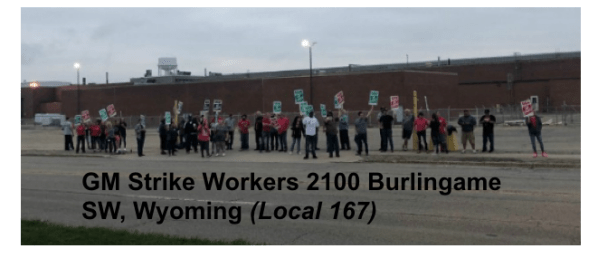
On September 4, Labor Notes reported:
Routine strike votes were taken at the three companies in August. All passed with their usual votes in the high 90 percents. On September 3, the UAW announced that GM would be its first target—the union chooses one company at which to bargain the pattern, which the other two will follow. Contracts expire at midnight September 14.
Some members speculated that union leaders might call a brief strike as a demonstration to the feds that they were not bought off by corruption. Others hoped that deepened mistrust in leaders would encourage members to vote no on a bad tentative agreement, as Chrysler workers did on the last contract in 2015—winning gains for workers at all three companies.
This same Labor Notes article also talked about the level of corruption and collusion between Union leadership and GM bosses.
 For people who have been following big labor’s decline have been aware of how frustrated rank and file workers have become over the past several decades. This frustration grows out of the decision of big labor to embrace capitalism and cooperate with corporate America, for most of the 20th Century, as is well documented in Paul Buhle’s book, Taking Care of Business: Samuel Gompers, George Meany, Lane Kirkland, and the Tragedy of American Labor.
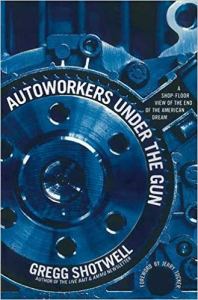
The frustration of UAW rank and file members is also well documented in the book Autoworkers Under the Gun: A Shop Floor View of the End of the American Dream, by Grand Rapids resident and now retired GM worker, Greg Shotwell. GRIID interviewed Shotwell in 2012, and his comments back then are just as relevant now.
Just a few years before Shotwell wrote his book, the Obama administration had bailed out General Motors with $10 billion and yet the UAW leadership accepted major contract concessions. IN the ensuing years, the bailout led to record profits for GM, while workers were not getting the contracts they were fighting for. Now GM wants to cut off health care benefits for thousands of autoworkers.
Writing for the Nation Magazine, Jane McAlevey also talks about the corruption with UAW leadership, but she talks about why this current strike is so important for the workers to win. She writes:
The official press releases from the UAW name other core issues in this strike: keeping US plants open, improving health care and wages. But to win something as huge as forcing GM to reopen plants and reinvest in American workers requires more than eliciting dubious company promises to create more jobs—it requires the kind of strike preparation and strategic thinking that has been absent at the highest levels of the union for far too long.
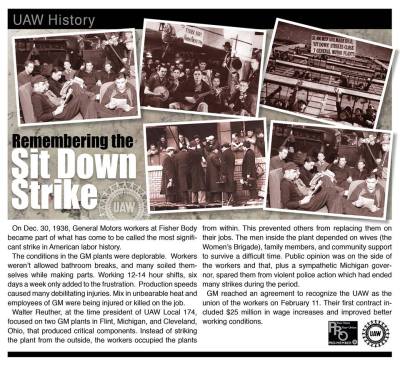 McAlevey also notes in her article that the UAW was at the forefront of radical labor organizing in the 1930s and 40s, with a nod to the wildcat strike in Flint. On December 30, 1936, workers began a wildcat strike in the Fischer Body plant in Flint. A wildcat strike is where workers occupy the factory, thus making it more difficult for management to bring in scab workers. GM attempted to use the courts and police violence to break up the wildcat strike, but workers, their families and their neighbors stepped up to support them and join the resistance. GM even lobbied Michigan’s Governor Frank Murphy to send in the National Guard. Murphy refused and on February 11 of 1937, GM finally conceded to the demands of the workers and recognized the UAW as the worker’s union.
Workers should look to this example of direct action from 1936-37 in Flint and considering escalating their tactic of picketing, to that of a full blow strike. If the UAW leadership does not support it, the public would, as there has already been significant public support for the striking autoworkers and escalating their action would only solidify public support. Either way, it is important that people support the strike in whatever way they can. Public solidarity is vital and it will not only send a strong message to the workers, but it will signal to the larger public that people care about working class struggles.
Reflections on the Climate Strike Action in Grand Rapids
On Friday, I joined the Climate Strike action in Grand Rapids, which began at 10am at at a small park in the southwest part of town.
There was maybe 200 people there just before they began to walk downtown. The crowd was probably 75% youth and it was led by youth. Seeing so many young people with concern over climate change was a refreshing site and as people who are no longer in our youth, we should do whatever we can to affirm and support young people who want to organize and take action.

However, it would be dishonest of me to not address what I believe to be a seriously flawed strategy that the Climate Strike in Grand Rapids was employing. The primary goal of the action I attended was for people to walk over the Senator Peters office and demand that he not accept money from the fossil fuel industry. The irony is that earlier this year, Senator Peters agreed to do just that, but then accepted $5000 from Consumers Energy, which the representatives from the Sunrise Movement said was unacceptable.
Despite the fact that Senator Peters had already violated this agreement, those who organized the Climate Strike action on Friday felt that it was best to go back to his office to demand that he again commit to not taking money from anyone of the fossil fuel companies.
Along with way, as people were walking from the westside to downtown, there were honks from motorists, but it was clear that this action was designed to NOT disrupt business as usual in Grand Rapids. As we are facing record heat, tornados, draught, flooding, increased soil erosion, the death of species on a daily basis, why would we not want to disrupt business as usual. It’s not just the fossil fuel companies that are to blame. We can’t deny that other business sectors have failed us, like the agribusiness sector, the transportation sector, the military industrial complex, etc. In fact, it should be made clear that capitalism – increased profits, constant growth and the pillaging of the planet – is to blame. Add to that local, state and federal governments, which not only have failed us miserably on Climate Change, they have protected and coddled the very system of capitalism that is causing this disaster.
On the Need for Disruption and Direct Action
Going to Senator Peters office and demanding that he not accept money from the fossil fuel industry, while seeming like an important step, in many ways is a inadequate tactic. First, demanding that any politician doesn’t take money from the fossil fuel sector is a drop in the buckets, when so so much of our society is based on the consumption of fossil fuels. For instance, Senator Peters sits on the Armed Services Committee and he voted again, along with most members of Congress, to support the $750 Billion military budget for 2020. The US military is one of the largest non-country entities in terms of their fossil fuel consumption. Going after Peters for supporting the US military industrial complex would not only be more effective, it would bring US militarism’s contribution to Climate Change.
Second, saying that you are going to demand that Senator Peters not take money from the Fossil Fuel industry and then not using tactics to force him to do so, just won’t make it happen. If people chose to occupy his office, yesterday, today and tomorrow, he would eventually agree to their demand. Politicians and systems of power do not make policy decisions that are in the best interest of the public, rather they make policy decisions that benefit those who have the power. We have to be willing to take risks if we want change to happen, especially if we want deep, systemic change to happen.
Just think of what people on the front lines of the climate justice fight are doing. When I say people on the front lines, I mean communities of color – Indigenous, black, latinx – who are fighting for climate justice and fighting in such a way as their life depended on it….because it does. Think about what indigenous people did at Standing Rock. Indigenous people at Standing Rock weren’t asking something of the government, so much as putting their bodies on the line to stop the pipeline company from putting yet another oil pipeline through their lands. This is called direct action and it means taking great risks.
Another example is what Indigenous people in the Amazon are doing now and have been doing for decades, which is to confront loggers, confront cattle ranchers, oil companies and the Brazilian government from harming the Amazon. The indigenous people in the amazon are also not always using non-violence, since they are literally fighting for their lives.
At this point however, it must be acknowledged that maybe it is my generation of activists and organizers who are to blame for the current crisis. Maybe we have not been bold enough or taken enough risks in order to avoid the climate crisis we now face. Maybe we were too comfortable. Maybe we did not recognize that capitalism was the root of the problem and we thought that we could just make it nicer. Maybe we didn’t see how US militarism, the food system, the transportation system and so many other sectors were part of the problem. Maybe we were seduced by representative democracy, thinking that all we needed to do was to vote for the right people and all would be well. Maybe we thought that if we just recycle and eat locally that this would all go away. For the failures of my generation, I apologize. I apologize to the young people today who are now having to fight for their very lives and for the future.
 However, together, we can fight the climate crisis. Together we can organize and resist and engage in direct action to actually disrupt business as usual. Together, we can create new ways of living that doesn’t rely on capitalism. Together we can create a world where we are truly alive and not spending our time as idle consumers, stuck in jobs we despise or thinking that we don’t have the power to change our circumstances.
Let’s do what the Puerto Ricans did recently and just shut things down until we get what we want. Let’s disrupt this filthy, rotten system. Let’s use Direct Action. Let’s practice Mutual Aid. Let’s believe in the power of Collective Liberation!!! Climate Justice NOW!
A solid resource for those organizing against Climate Change and for Climate Justice, is the booklet, Organizing Cools the Planet: Tools and Reflections to Navigate The Climate Crisis, by Hillary Moore & Jaoshua Kahn Russell. https://climateaccess.org/system/files/Moore%20and%20Russell_Organizing%20Cools%20the%20Planet.pdf This booklet offers great organizing tools and put an emphasis on Direct Action as a primary strategy to for achieving Climate Justice.
On the Defensive: New ICE propaganda statement demonstrates that they are feeling all the public opposition
Last week, Immigration and Customs Enforcement (ICE) released a statement to The American Public.
The ICE statement acknowledges that there is growing opposition to ICE practices on immigration issues, but in the first paragraph ICE says, “we want to set the record straight.”
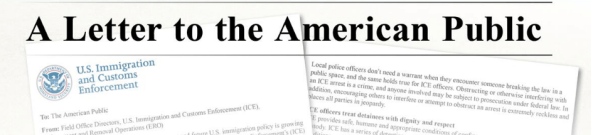
The statement is nothing short of government propaganda, designed to misinform and attack those who are publicly opposed to the violence and abuse that ICE is imposing on the immigrant community across the country.
In the second paragraph, they use a tactic, which is meant to undermine the credibility of the massive public opposition to ICE. ICE states that two of their facilities, “have been the target of lawless gunfire.” By saying there have been gunfire at two ICE facilities, they are hoping that people will ignore the fact that there has been hundreds of demonstrations against ICE in the past two years, often with civil disobedience, sometimes at ICE facilities and sometimes at corporations who have contracts with the government agency. ICE also wants the public to ignore the fact in several hundred communities across the US people have organized to do things like offer sanctuary to undocumented immigrants, created bond funds for immigrants in detention and fought to end ICE contracts with local governments and law enforcement agencies. The intention of identifying incidents where gunfire was used at ICE facilities also is designed to get the public to ignore or minimize the tremendous harm that ICE has perpetrated against the immigrant community.
After the initial framing of the work that ICE does, the statement then presents 4 major talking points, talking points which we will deconstruct:
 ICE makes targeted arrests every day; ICE does not conduct “raids”
No need to get into a semantics fight here, whether ICE calls it targeted arrests or raids is irrelevant. The fact is that ICE makes hundreds of arrests everyday in the US, primarily against people who are undocumented. ICE claims under this heading, “ICE focuses its limited resources first and foremost by targeting those who pose the greatest threat to public safety and border security.” This is patently false, most of the arrests are people who are undocumented but pose NO serious threat to public safety. And most of the undocumented people who end up in ICE custody are those who commit petty misdemeanors like driving without a license.
ICE does not need a warrant to make an arrest
Most people are aware of this fact. In Grand Rapids we share information with the undocumented immigrant community about what to do if ICE comes to your home and we ALWAYS say that ICE does not need a warrant. ICE can come into your home, even break down the door if they want to, which we have documented in several instances. In this section, the ICE statement also makes it a point to say, “Obstructing or otherwise interfering with an ICE arrest is a crime.” GR Rapid Response to ICE is well aware of this threat of obstruction, but they defy this type of intimidation tactic and will actively obstruct ICE in order to prevent them from arresting and detaining an immigrant.
ICE officers treat detainees with dignity and respect
This point is simply a straight up lie. Community groups, like GR Rapid Response to ICE have documented the lack of respect that ICE agents have when interacting with the immigrant community. In addition, there have been numerous groups that have published reports on the poor, often brutal treatment of immigrants at the hands of ICE agents and those that they contract with. Here are just a few of those reports:
Fatal Neglect: How ICE Ignores Deaths in Detention
Recent Reports Documenting Abuse and Corruption in U.S. Immigration Jails
ICE Raids on US Immigrant Families Risk Serious Abuses
ICE officers are aware of the real and emotional impact of immigration enforcement
Again, it is irrelevant of ICE officers are aware of the harm, especially since there is no evidence that stop the arrests, stop the detentions and stop to violence against the immigrant community. Just saying that ICE officers are aware is nothing more than a weak attempt to humanize the ICE agents. However, I don’t think for a moment that ICE officers have any idea of the REAL emotional trauma that their officers perpetrate against the immigrant community. Groups like the American Psychological Association, the Kaiser Family Foundation, the National Council of La Raza and Community Psychology have all documented the emotional trauma that ICE causes the immigrant community.
For ICE to say that they are aware of the emotional impact that their agency has on the immigrant community in nothing more than insulting.
The ICE statement concludes by attempting to once again argue that their actions are rooted in public safety. The fact is that there is a movement all across the country that doesn’t buy into this bullshit propaganda. This movement is growing by the day and is exposing the lies perpetrated by ICE and resisting the harm they cause when they arrest, detain and deport immigrants. La Lucha Sique!!
Fair Food Project in West Michigan: Does it promote Food Justice or West Michigan Nice
 On Saturday, MiBiz published an article announcing that the Non-Profit Migrant Legal Aid has a new program called the Fair Food Project.
According to the Migrant Legal Aid website:
The Fair Food Pledge is a partnership between Migrant Legal aid, food entrepreneurs and agriculture dependent retailers in which vendors and employers are jointly monitored for fair and ethical treatment of farmworkers. If farmworkers are unlawfully treated, this whistleblower program responds to the violation by alerting vendors and agriculture dependent retailers of the violation.
However, the language of the project is rather vague, without specifics about what it means to be treated ethically or fairly.
The Executive Director of Migrant Legal Aid, Teresa Hendricks, who is quoted in the MiBiz article, states:
“The workers have a limited season to make the bulk of their money and the growers have a limited time to get their products to market. Neither one of them would prefer to be in a lawsuit. This is a way that we offer voluntary compliance, immediate action and a market-based remedy.”
A market-based remedy? That simply will not work. Market-based solutions simply do not work. For instance, the farmers can continue to pay farmworkers whatever they want, since there are no minimum wage requirement for farmworkers. This means that workers will continue to be exploited. The Director of Migrant Legal Aid admits this in the MiBiz article saying of migrant farmworkers, “They remain the poorest of the working poor.”
Check out this video produced by Migrant Legal Aid, which briefly explains the Fair Food Project.
The video states that Migrant Legal Aid will be monitoring for unfair treatment, but never says how they will be able to do that. Migrant Legal Aid also states on their website that. this project is inspired by the Coalition of Immokalee Workers located in Florida. However, what the non-profit fails to say is that the Coalition of Immoklee Workers is a worker-based human rights organization that is made up mostly of migrant farmworkers who use boycotts and strikes to hold farmers and the food industry accountable for exploitation and other abuses, unlike the model that Migrant Legal Aid is proposing. This could be because there are no existing unions for migrant farmworkers in West Michigan, which has allowed farm owners to take advantage of farmworkers for decades, despite the fact that West Michigan has some of the highest concentrations of migrant workers in the country.
At the end of the MiBiz article, Hendricks states that the growers benefit from the program by “avoiding strikes and boycotts.” The fact is that historically, the only way that farmworkers have won any form of justice, it is exactly because they have engaged in boycotts and strikes.
Lastly, the Director of Migrant Legal Aid frames this partnership as a way of practicing West Michigan Nice, stating:
“The Fair Food Project is a Midwest-designed program to work the way companies and cultures work here. We’re working with their corporate responsibility departments instead of against them and they’re voluntarily cooperating with us. It’s Midwest Nice: Tell us how to fix it and give us an opportunity to fix it first.”
The reality is that corporations don’t fix it unless they are forced to. This is the entire history of social movements in the US, where workers have forced companies and corporations to agreeing to safer working condition, better wages, benefits, worker safety standards, etc. None of these things were ever a gift from corporations, but only through the struggle of workers.
My fear is that West Michigan retailers will sign the pledge, which is great PR for them, but it will do virtually nothing to fundamentally improve the lives of migrant farmworkers.

