Senator Tom Barrett, drivers licenses for undocumented immigrants and the DeVos Family
 On Friday, in an article published by MLive, it was announced that there will be legislative support for Movimiento Cosecha’s Drivers Licenses for All campaign.
State Senator Stephanie Chang will be introducing legislation in the upcoming weeks that will allow undocumented immigrants the opportunity obtain a drivers license in Michigan. Michigan used to grant undocumented immigrants the right to obtain a drivers license, but that change in 2007, when Michigan Attorney General Mike Cox made a ruling to prevent undocumented immigrants from obtaining a Michigan Drivers License.
The MLive article includes video taken by Movimiento Cosecha that shows a member of Movimiento Cosecha asking Gov. Whitmer if she supports undocumented immigrants and their desire to have a drivers license in Michigan. Whitmer said she would support the granting drivers licenses to undocumented immigrants.
It is important to recognize that the only real reason that some Michigan politicians are willing to support drivers licenses for undocumented immigrants is because of all the organizing that Movimiento Cosecha and other immigrant rights groups have done to make drivers licenses an issue.
However, there are some Michigan legislators, specifically Republican lawmakers, who do not support allowing undocumented immigrants to have a Michigan drivers license. One such politician is Sen. Tom Barrett, a Republican from Charlotte. Barrett was quoted in the MLive article as saying that allowing undocumented immigrants to obtain a drivers license is a,”slippery slope towards granting amnesty or giving them voting rights.” He also stated:
“We have to respect the laws of our country, not encourage or reward people for being here illegally.”
So, lets unpack what Sen. Barrett had to say.
First, on the matter of respecting the laws of the country. Since the founding of the US, most laws have benefitted white people, particularly white people with property. The laws of the US have primarily punished the poor, black, brown and indigenous people. It was legal to own slaves for nearly 100 years in the US. It was legal to disenfranchise communities of color for most of US history and still the system has found ways to prevent people of color from voting. It has been legal in the US to actively discriminate against black, brown and immigrant people. It was legal to deport Chinese immigrants after the Chinese Exclusion Act. It was legal to round up Japanese Americans during WWII and forcibly put them in internment camps. It was legal for white people to take indigenous land.
Second, undocumented immigrants who come to the US are primarily coming out of desperation, fleeing violence, persecution, poverty and climate injustice. Undocumented immigrants risk their very lives to come to the US so they can have a better life.
Third, providing undocumented immigrants the opportunity to obtain a drivers license is not a reward. When undocumented immigrants are allowed to obtain drivers licenses in Michigan, it means they will be able to support their families, contribute to their communities and contribute to broader community safety.
Fourth, does Senator Barrett realize how ridiculous he sounds when he says, giving undocumented immigrants a drivers license is a slippery slope towards granting amnesty or giving them voting rights. How is granting people asylum a slippery slope? As was already stated, people are risking their lives to flee dangerous circumstances and should be able to apply for asylum with the fullest support of the legal system.
Fifth, we all know that only those who have citizenship can vote, so either Senator Barrett doesn’t know the law or he is merely using rhetoric which speaks to his constituents, rhetoric which is rooted in xenophobia, nationalism and white supremacy.
Sixth, Senator Barrett has been a politician only since 2014 and he has won the past few elections primarily because of the amount of money he has raised since becoming a State Representative and State Senator in Michigan. According to the Michigan Campaign Finance Network, the number one family to contribute to Tom Barrett since he first ran for office in 2014, is the DeVos Family. The top two entities to finance Tom Barrett since he first ran for office, have been the House Republican Campaign Committee and the Senate Republican Campaign Committee. The number one contributor to both of those GOP entities has been the DeVos Family.
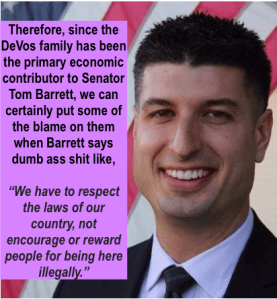
Therefore, since the DeVos Family has been the primary economic contributor to Senator Tom Barrett, we can certainly put some of the blame on them when Barrett says dumb ass shit like, “We have to respect the laws of our country, not encourage or reward people for being here illegally.”
Foundation Watch: What groups received funding from the Van Andel family foundations?
 In the past few months we have made several posts about the various DeVos family foundations and some of the foundations run by those that act as financial advisors to the DeVos family.
Today, we want to look at the family that began a partnership with DeVos, a partnership that led to the creation of Amway. Of course, we are talking about Jay Van Andel and his family. Van Andel was always less of a public figure that Rich DeVos, but that doesn’t mean he wasn’t as politically active in a variety of causes. Even though Jay Van Andel has been dead for years, it is important to note that for several decades he financially supported numerous far right entities in the US, both religious and political.
The two Van Andel family foundations we are examining today, are the David & Carol Van Andel Foundation and the Steve & Amy Van Andel Foundation.
According to Guidestar, the David & Carol Van Andel Foundation states that it has just over $90 million in assets. We looked at the 990 documents between 2014 and 2017. However, both the 2016 and 2017 990s did not provide any information on specific recipients of the David & Carol Foundation. Therefore, the amounts listed below are only from 2014 & 2015.
Some of the larger entities that have received funding from this foundation were:
- Cascade Fellowship CRC $1,200,000
- Grand Rapids Christian Schools $647,000
- GREAAT Schools Inc. $233,000
- Grand Rapids Opera $225,000
- Grand Rapids YMCA $260,000
- Western Theological Seminary $1,000,000
- Grand Action $175,000
The largest recipients of funding from the David & Carol Van Andel Foundation are Christian entities, specifically Cascade Fellowship CRC, Grand Rapids Christian Schools and Western Theological Seminary. These entities fit within the ideological framework of the Van Andel Foundation and the Van Andel family.
Another recipient was Grand Action, which fits within the family’s public/private partnership model, which is essentially a Neoliberal economic model, where the public contributes part of the money, but there is no public oversight. Then there is GREAAT Schools, Inc. According to the Guidestar, “GREAAT Schools Inc. is hands-on in the formation of charter school models from concept to implementation. We are committed to organizing high performing school models, including a college preparatory curriculum and a focus on achievement culture.”
Lastly, the David & Carol Van Andel Foundation contributed to civic entities like the YMCA and Opera Grand Rapids. The Opera is a recipient, since Betty Van Andel, David’s mother gave lots of money before she died, which is why the newer building on East Fulton is named after her.
Steve & Amy Van Andel Foundation
According to Guidestar, the Steve & Amy Van Andel Foundation has assets of $93 million. Like the other Van Andel family foundation, there is significant financial support to Christian organizations. We looked at the 990 documents between 2014 and 2017, so the totals below reflect 4 years of contributions. Here is a list of the larger recipients from the Steve & Amy Van Andel Foundation:
- Hillsdale College $4,800,000
- Holland Home Foundation $1,755,000
- Camp Rogers $1,040,000
- Trillium Institute $500,000
- Grand Rapids Student Advancement Foundation $250,000
- Michigan State University $250,000
- Children’s Healing Center $250,000
- Gerald R. Ford Foundation $200,000
- Meijer Gardens $200,000
- Family Promise $150,000
- Potter’s House $92,500
- American Enterprise Institute $50,000
- Foundation for Michigan Freedom $50,000
- Acton Institute $35,000
Like the rest of the Van Andel family foundations, a great deal of money has been contributed to Christian entities or conservative organizations, both of which fit within the family’s ideological and political history.
Hillsdale College is a great example of the kinds of entities that the Van Andel family has supported over the decades. We wrote about Hillsdale College in late 2017, which included information about how the college has a history of opposing things like public education and affirmative action.
Some of the ideologically driven entities that received funding from the Steve & Amy Van Andel Foundation are the Foundation for Michigan Freedom, which is a political lobby group that is run by the DeVos family operative Greg McNeilly. The American Enterprise Institute is one of the most influential right-wing think tanks in the US and the Acton Institute plays a similar role, since by AEI and Acton elevate market-driven economics as what must be protected and expanded.
On the matter of education, the Steve & Amy Van Andel Foundation, like the other Van Andel and DeVos foundations, supports Christian Schools like Potters House, but also contributed to the GRPS by way of the Grand Rapids Student Advancement Foundation, with the intent of influencing public education to reflect their religious and ideological framework.
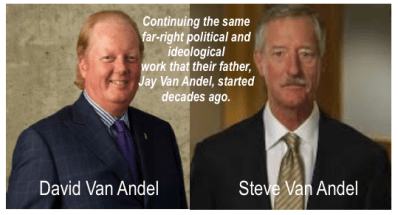
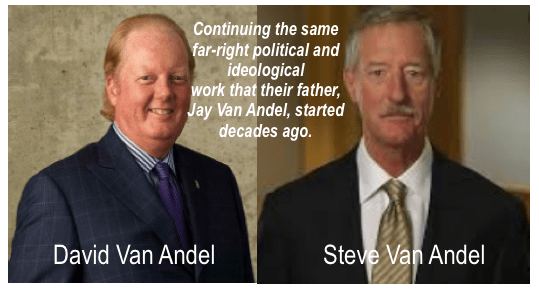
Both of the Van Andel family foundations we have looked at today, continue the same kind of religious and political support that was begun by their father Jay Van Andel. And, like their father, both Steve and David Van Andel do it with less attention than the members of the DeVos family, even though they share the same goals.
 On August 9, WXMI 17, ran a story headlined, Northeast GR named “hottest zip code” in the US. The story, which is modeled after a Realtor.com Press Release for July 31st, only cites a real estate agent for the story and no residents.
It seems that anytime Grand Rapids makes the news by being on some list, the local news media jumps on the opportunity to do a story. However, the stories are always superficial and never challenge or critique whatever list that Grand Rapids is now on. Doing fluff stories is always great for advertisers, since it creates what those in the ad business call, “creating a wonderful climate for consumption.” However, journalism could ask real questions and report on a variety of issues that are raised from this WXMI 17 story.
First, it is important to note that the source of the “hottest zip code” story in from Realtor,com, which is run by the National Association of Realtors (NAR). The NAR is not some neutral do-gooder entity, they are an association made up of companies that are in the business of of making massive profits off of housing. In 2018, the National Association of Realtors spent $72 million to lobby Congress to adopt policy that would be profitable for the members of their association.
Second, the only source cited in the channel 17 story was real estate agent Jesse Baragar. Baragar is quoted as saying, “It’s affordable too, good first-time home buying area but just the parks and community and the walkability is the main reasons.” Let’s face it, this narrative, which is a standard narrative about the housing market, primarily targets white professionals and their families. In addition, it is the narrative used that promotes gentrification.
Third, Baragar goes on to say in the channel 17 story that, “It’s a hot price range, $178,000 is the average sale price in this area, very aggressive sale price.” Of course, the question here is, affordable for whom? There are thousands of people in Grand Rapids who make minimum wage or close to it, which automatically eliminates them from any possibility of buying a house in the 49505 zip code area at $178,000.
Fourth, the danger of stories like this one from Fox 17, is that it encourages more landlords and property management companies to increase rent costs because of the “walkability, breweries and good schools” arguments. (If you watch the Fox 17 story, pay attention to the video footage and who is represented and what location is represented) Increased rental costs means that working class families and individuals will be priced out of the area and be forced to find housing somewhere else. Again, this dynamic will primarily benefit white people, white residents and white business owners, but it is a dynamic that WXMI fails to pursue, since that would take some actual work, whereas reporting on what the National Association of Realtors has to say is a whole lot easier.
Action Alert: Pressure U of M to allow the public access to the papers of John Tanton, the anti-immigrant White Supremacist
 A few weeks ago we wrote a critique of how MLive eulogized a far-right, white supremacist in Michigan, John Tanton.
Tanton was the founder of numerous white supremacist groups and probably had more of an influence on the modern anti-immigrant movement that anyone else. Tanton was the founder of the Federation for American Immigration Reform, an organization that the Southern Poverty Law Center identifies as a hate group.
Since we wrote the July 23 article about Tanton, it has come to our attention that the University of Michigan holds countless documents and papers from John Tanton, but they won’t allow the public to view any of those documents, even though it would likely provide tremendous insight into Tanton’s network and his influence into the modern anti-immigration movement.
A University of Michigan law student, Kerry Martin, has been leading an effort to have U of M make Tanton’s papers public. In a recent message from Martin, he states:
The University of Michigan has now asked the Supreme Court of Michigan to allow it to keep hiding the Tanton Papers. Rather than complying with the Michigan Court of Appeals’ unanimous decision in June, which required U-M to release the papers, U-M is instead digging its heels and taking its fight to the Supreme Court. In doing so, it continues to use our tuition and taxpayer dollars to shield the records of a white supremacist from public scrutiny. This is an outrage.
Please share the petition with your friends and networks, so we can send a strong message to the University of Michigan and its president, Mark Schlissel: Release the Tanton Papers!
You can also watch and share this brand-new video from the immigration attorney and advocate involved in the case, Hassan Ahmad, a video that provides a solid overview of Tanton’s white supremacist legacy.
If you are unaware at this point that the West Michigan Policy Forum wants to push their own agenda for education in Michigan, then maybe it is time to pay attention.
The West Michigan Policy Forum (WMPF), which was founded in 2008, has been vocal about education policy for years. Several years ago, they pushed Michigan legislators to shift public sector teacher pensions from a guaranteed fixed pension to a pension that is at the whim of the speculative market.
On the West Michigan Policy Forum, they list their priorities and education is included on the list. Of course, they don’t generally name it as education, instead they refer to education as Talent. This is primarily because the WMPF is made up of members of the business community who are interested in education to the degree that it impacts the kind of employees they might have. Here is the list of education, or Talent priorities they have:
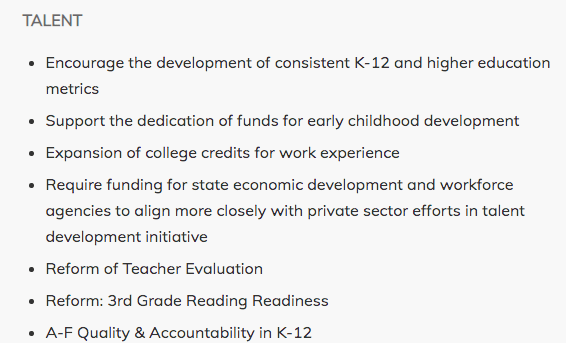
In addition to seeing education as Talent, the WMPF also is committed to pushing a neoliberal education model, which is essentially the model that Betsy DeVos has been promoting the past three decades. A neoliberal education model is one that seeks to radically alter the existing public education system and to utilize more public dollars to fund private and charter school options, which are less regulated.
Last September, the WMPF hosted former Florida Governor Jeb Bush at their conference, which had a heavy emphasis on education policy. We reported on what Bush presented, which was essentially the neoliberal education model.
Most recently, the WMPF posted a short interview conducted by the Grand Rapids Chamber of Commerce with Founder of North 42 Partners and member of the Grand Rapids Power Structure, Michael Jandernoa.
The interview only lasts for 2 minutes and 16 seconds, but some of what Jandernoa has to say should concern those committed to education justice. One of the questions posed to Jandernoa was to comment on the current status of Michigan’s education system. Jandernoa says that it is one of the worst in the country, which is true. However, what he fails to mention is that the decline of the state’s education system was due to significant reduction in state funding, attacks against teacher unions and a push to adopt and expand charter schools.
Another question posed to Jandernoa has to do with why businesses should care about education. Jandernoa provides the talent response, encouraging listeners to get involved in the Chamber’s education advocacy committee.
Lastly, Jandernoa states that the business community is prepared to work with teachers and principals to help improve the education system. The fact is, the business community has been deeply influential in the Grand Rapids Public School system, working with the GRPS leadership to create career-centered educational opportunities and curriculum.
For several years now businesses like Rockford Construction, Amway, Triangle Associated Inc., Huntington Bank and the law firm of Warner Norcross & Judd have been working with the GRPS to develop specialty programs like the Academy of Business, Leadership & Entrepreneurship. Many of these same businesses also are part of the advisory council of the Academy for Business Leadership & Entrepreneurship, where they provide input and can directly influence school curriculum.
Last August, MLive reported that the GRPS was expanding these talent/career focused schools, or what they are calling academies. The first that will be rolled out this fall is the Academy of Culinary Arts and Hospitality and Tourism. Other academies that will follow are:
- Academy of Advance Manufacturing and Supply Chain Management
- Academy of Public Safety, Homeland Security and Cybersecurity
- Academy Physical Therapy and Sports Management
- Academy of Media Production
- Academy of Cosmetology
The Grand Rapids Public Schools will only continue to be radically transformed under the influence of the business community, unless students, parents and community members take a more active role in the future of education in Grand Rapids.
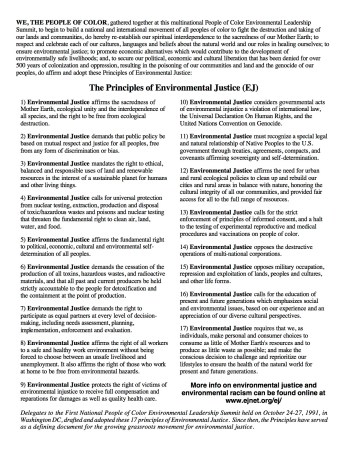 In May, researchers at the University of Michigan published a report entitled, Assessing the State of Environmental Justice in Michigan. The report is 158 pages and is heaving with data and sourcing, but limited in analysis.
Last week, WOOD TV8 did a story based on the findings of the environmental justice report. The channel 8 story did not provide any real context around environmental justice or its principles, even though they did cite the study at the beginning of their story, along with using the phrase that the report, “identifies hot spots of environmental injustice across the state.”
The report looks at numerous factors that determine which communities across the state scored poorly on environmental justice issues. The factors the study looked at were income levels, racial makeup, education levels and language barriers. The report then look at areas that would negatively impact the environments that poor communities of color lived in, such as:
- Air quality
- Exposure to toxics
- Respiratory issues
- Ozone
- Lead paint exposure
- Proximity to high levels of traffic
- Proximity to hazardous waste sites or incinerators
- Wastewater discharge indicators
- Lack of green space
In the conclusion of the report, it states:
The state of Michigan has a long history of manufacturing and industrial activity that has contributed to both the economic development of the state as well as to a culture of strong grassroots movements advocating for environmental quality along with state residents’ health and wellbeing. Additionally, there is along history of correlation between environmental harms and low-income, minority, and indigenous communities. The state of environmental justice in Michigan today can be traced back to these historical factors that shaped the culture and identity of different factions of society in Michigan. Through this research, the team provided evidence that environmental injustice is prevalent in Michigan. However, this study also provides evidence that significant steps can be taken to address environmental inequities.
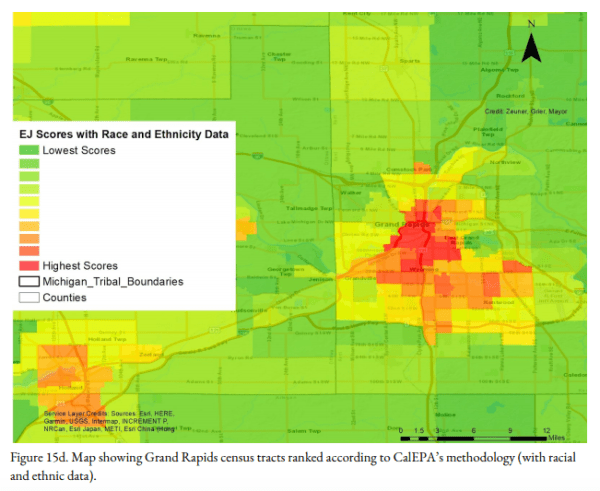
Here is a map of Grand Rapids, included in the report, which provides data-based assessment of neighborhoods that scored high in terms of the risks. Note that these neighborhoods are predominantly black and latinx.
The WOOD TV8 story goes to the Roosevelt Park neighborhood attempting to talk with residents. People did not want to talk to the channel 8 reporter, so they interviewed someone from the neighborhood association and talked to the Executive Director of WMEAC, both of which were white. Utilizing white voices simply perpetuated the problem of how we view environmental justice, which is a movement that was begun by communities of color.
The channel 8 story did acknowledge that the neighborhood is right next to US 131 and there is a waste management facility nearby. However, there is no historical context as to when and how this neighborhood became a primarily latinx neighborhood.
At the end of the story, the WMEAC spokesperson said one way to combat the problem is to build a green wall, with trees and bushes. Calling it a green wall is an unfortunate description of what mostly an immigrant neighborhood could do to start reducing the pollutants in the neighborhood. More importantly, the WMEAC spokesperson did not discuss the issue of poverty in that area nor the structural racism that those residents face on a daily basis, both of which are critical to any analysis of environmental justice.
Grand Rapids and its superstar status: Praising economic growth while ignoring poverty and the wealth gap
Apparently Grand Rapids is continuing to win praise for it’s economic growth. Last week, WGVU radio did a story about how Reuters and Business Facilities Magazine have both identified Grand Rapids as one of “the best midsized cities for economic growth.” 
The Reuters article doesn’t discuss Grand Rapids, they just include Grand Rapids in a map reflecting showing cities where there has been new job growth.
The Business Facilities Magazine does provide more details about Grand Rapids, in an article published on July 24. The article talks a bit about all the new manufacturing jobs in Grand Rapids and identifies a few companies where there is job growth:
Recent manufacturing projects in the Grand Rapids region include a $10 million capital investment by Bissell Inc. that will create 100 new jobs, a $140 million capital investment by Dicastal North America that will create 300 new jobs and a $29 million capital investment from Plasan Carbon Composites expected to generate more than 600 new jobs.
It is interesting that Bissell is mentioned with new job creation, although the article fails to mention that Bissell Inc. outsourced some 300 jobs after NAFTA was implemented in 1994. The article also fails to mention that Plasan Carbon Composites is an Israeli weapons manufacturing company, thus celebrating 600 new jobs for an Israeli military contractor is hardly cause for celebration or “superstar” status. The Business Facilities Magazine article also doesn’t mention that lots of public subsidies have gone to Plasan from the State of Michigan.
Lastly, it is worth noting that the only local source cited in the WGVU radio piece was Birgit Klohs, President of The Right Place Inc, which is an entity that recruits businesses to come to West Michigan and it’s Board of Directors is made up of members of the Grand Rapids Power Structure.
What is missing from the WGVU Radio Story?
There may very well be new jobs created in Grand Rapids, but none of the news sources cited talked about what kind of jobs have been created or are yet to come in Grand Rapids. Are these full-time jobs that will pay a living wage or are they jobs that one could not afford to pay the rental fees in this city? Speaking of rental costs, this too is omitted from the story, along with the amount of gentrification taking place, which has also displaced whole areas across the city.
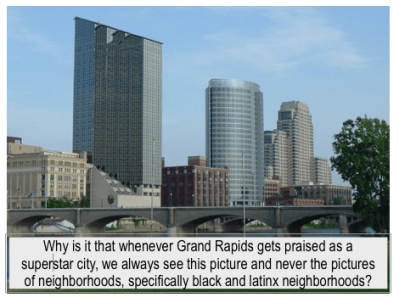 These stories about Grand Rapids, which are quickly celebrated by city officials, always leave out critical and crucial information about this city.
- Based on a 2016 report, Grand Rapids had the largest Wealth Gap in Michigan.
- One out of every 4.5 residents in Grand Rapids Lives in Poverty, which is about 22.5% of the city’s population. The poverty level increases when we talk about the black community, which has 32.1% living in poverty and 36.5% for the latinx community.
- According to a new report from the University of Michigan, some of the worst areas in Michigan, when looking through an environmental justice lens, are in Grand Rapids, specifically in latinx and black neighborhoods.
Grand Rapids will no doubt continue to receive high praise from the business press when talking about economic growth. However, it is always important to ask the question, cui bono, who benefits from this economic growth and who continues to suffer within this neoliberal capitalist framework.
Today is an important day for all of us to reflect on the arrogant display of US imperialism in 1945. On August 6th, the US military dropped a nuclear bomb on the city of Hiroshima, Japan, making the US the first and only country to use a nuclear weapon against a civilian population.
The first time I ever really thought about this atrocity was in 1982. I went with my brother to hear a Catholic priest speak about his experience as a chaplain during WWII. Fr. Charles McCarthy was the chaplain and was on the plane with the US soldiers who dropped the bomb on Hiroshima. Father McCarthy told us he was there to “bless” the mission.
A few weeks later, Fr. McCarthy said he went to Hiroshima, or what was left of it, because he wanted to see for himself what he had happened. Witness the devastation and human suffering, the priest knew that in order to live with himself that he would have to devote the rest of his life to radical non-violence and resist militarism, especially nuclear war.
I remember being blown away by what this priest had to say, not because he was a priest, but because of how witnessing the affects of US militarism, that he then made the radical transformation to resistance. I had never encounter a religious person who actually gave a shit about humanity.
The following year I entered the seminary and thought that it was the best expression of living out my faith. After a few months of being in a catholic seminary I was disappoint and disillusioned.
I left the seminary and became part of a housing collective later named, the Koinonia House in Grand Rapids. However, before we purchased that house, I was involved in organizing against nuclear weapons in Grand Rapids, specifically at the old Lear Siegler plant on Eastern near 36th street. Lear Siegler made guidance systems for nuclear weapons and we were doing regular protests at the factory and handing out literature to workers.
At the same time, my brother was involved in a campaign at Williams International, another company in southeast Michigan that was making parts for nuclear weapons, particularly the Cruise Missile. He was arrested while protesting at the factory in 1983, which led to an ongoing campaign to resist weapons manufacturing at that facility.

The following December, just days before moved into the Koinonia House, I was arrested at Williams International and ended up spending 48 days in jail. The consequences of getting arrested at Williams International were usually handled in the District Court, but an ambitious prosecutor from Wayne County, L. Brooks Patterson, had worked with the weapons manufacturer to post an injunction against future protests at the facility, This gave the company the opportunity to prosecute people protesting at Williams International in Circuit Court. The injunction that the company had posted included at the top of the page a list of defendant, with my brother’s name appearing as part of the injunction. When the judge in our case saw the injunction, he said to me, “are you any relation to Jim Smith.” I said, “he’s my brother.” The judge replied, “so this is a family thing getting arrested.”
What the judge then did was to threaten us with jail if we didn’t sign a document saying that we would never go back and protest at Williams International again. All of us who were arrested that day, refused to sign such a statement, because it would bind our conscience.
We were initially taken to the Wayne County Jail, but eventually they moved us to the Shiawassee County Jail, just west of Flint. I spent the next month there, until Amnesty International decided to identify us as political prisoners, since we were in jail for reasons of conscience and not because of something we did.
I eventually got out and joined the newly formed community of resistance at Koinonia House, a house that practiced radical hospitality, nonviolence and simple living.

For years we would be part of the annual Hiroshima/Nagasaki commemoration, organized by the Institute for Global Education. The picture here above, is from Barb Lester, who was part of the Nuclear Freeze Campaign in the 1980s in Grand Rapids, at an event on Calder Plaza on August 6th. 
I remember one action we did in 1985 on August 6th. There used to be a US Army Recruiting Center at the east end of the Monroe Mall in downtown Grand Rapids. We obtained ground rubber, something that was used for outdoor dancing so that people wouldn’t slip on the surface. Some of us laid down on the ground and then others would pour the ground up rubber around us, leaving the outline of a body. This is what people saw in Hiroshima and Nagasaki, since it was all that was left of the humans that were incinerated at ground zero.
The following year, there was a campaign to close the Strategic Air Command US Military base near Oscoda, Michigan. This base had nuclear weapons on it and would always have B 52 airplanes flying with nuclear weapons so that if the US was attacked, the US would still have nuclear weapons that were not destroyed. This, of course, was sheer madness, so our house became part of the resistance to shut down the base.
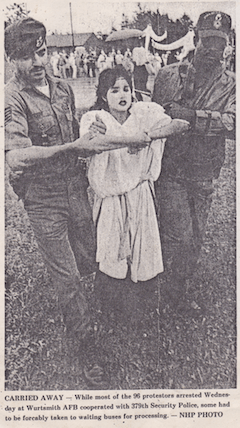 On August 6th, 1987, several of us from West Michigan were part of an action at Wurtsmith Air Force Base, an action that involved street theater and several arrests, which you can see in the picture here.
A few years later, we were part of another action at Wurtsmith, this time using the symbolism I had learned in Guatemala from the Mothers of the Disappeared. Again, several of us were arrested. We were book and then received court dates for sentencing. The judge presiding over these cases was in the National Guard and he consistently sentenced people to 3 months minimum for getting arrested at Wurtsmith. I decided that I would not go to my court date and wrote the judge a letter telling him why I wouldn’t be there.
Weeks later I received a second letter with a new court date. I wrote back and said that I was not coming, so they issued a bench warrant for my arrest. A few days later, federal marshals showed up at my house to arrest me, but I slipped out the back door and had a housemate tell them I wasn’t home.
I then spent the next several months at other people’s homes and generally just trying to lay low. Wendy Jo Carlton, who use to do a show on GRTV, did an interview with me, which is posted here below.
The US was getting ready to go to war with Iraq, so there were protests being organized in Grand Rapids in the fall of 1990. I started coming to those and one day federal marshals spotted me and grabbed me in front of the federal building. I spent the night in a holding cell on the 9th floor of the federal building in Grand Rapids and then went before a judge in the same building.
When I went before the judge I argued that international law compelled me to resist nuclear weapons, since such weapons killed indiscriminately. The judge actually agreed with me, but then said that he could not just let me go, so I ended up getting “community service.” The irony was, everyone else got at least 3 months for cooperating with the courts, while I got community service for going underground.
Two years later Wurtsmith Air Force Base was decommissioned and all the nuclear weapons were removed from the area.
Grand Rapids has a fairly rich history of nuclear resistance, with lots of committed people doing important work, which you can read about on the Grand Rapids People’s History Project.
I know that with the current political climate it can seem overwhelming and hopeless. However, it is important to remember that there have always been resistance movements around the world, made up of people who refused to give in and refuse to allow oppression and despair take over. We have power and we can take direct action to make the change we want. As the great liberation fighter Assata Shakur once said, “Nobody in the world, nobody in history, has ever gotten their freedom by appealing to the moral sense of the people who were oppressing them.”
Money, issues and the Grand Rapids 2nd Ward Commission race
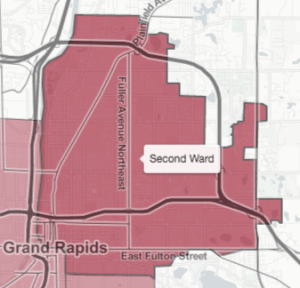 Tomorrow, people in the 2nd Ward of Grand Rapids will have a chance to vote for one of the three candidates running for a City Commission seat.
The City Commission seat is a 4 year term and it is for a seat that Ruth Kelly is vacating.
The three people running are Michael Farage, Wendy Falb and Milinda Ysasi. The only one of the three that has previously held an elected office is Wendy Falb, who served on the Board of the Grand Rapids Public Schools.
Michael Farage, who has run for office on numerous occasions, only has a Facebook page for his candidacy. Farage, who is an anti-tax person, with conservative views on the function of local government, has been a vocal supporter of the Grand Rapids police department in recent months, despite the substantial criticism coming from the Black and Latinx communities over police violence. Farage boasts on his Facebook page over the endorsement from Nigel Farage, the UK leader of the Brexit Party. Nigel Farage has been a very vocal supporter of Donald Trumps presidency.
There is little information on what Michael Farage’s position are on critical issues for Grand Rapids, but you can look at his Facebook page to see what some of his views are.
Wendy Falb has both a Facebook page and her own website, which lists the traditional endorsements, ways to donate and volunteer. There is a tab with the heading issues, but the three items she identifies are vague and do not speak to specifics in terms of what a City Commissioner will vote on.
Milinda Ysasi also has a Facebook page and a separate website for her candidacy. Ysasi’s website has a “vision” section, which identifies a few issues relevant to the City Commission, but the commentary is brief and somewhat vague.
Follow the Money
It is always instructive to see who contributes to candidates and this race one can make some determinations about where allegiances are.
Michael Farage raised $6,600 and has spent most of it, according to the Kent County Clerk’s Office Farage did not have many contributors, but most of them contributed a substantial amount.
- Michael Farage $1,000
- Emilie Farage $1,000
- George Gordon $1,050
- Barbara Gordon $1,050
- Marge Potter $1,000
- Johnny Brann $500
- Joe Carpenter $500
Wendy Falb has raised $37,390 and spent $26,739, according to the Kent County Clerk’s Office. Falb has received contributions from several political entities, such as:
- Grand Rapids Police Officer’s Union PAC $5,000
- Grand Rapids Fire Fighter’s Union PAC $3,000
- Realtor’s PAC of Michigan $1,000
- Rental Property Owner’s Association PAC $500
Some of the larger individual contributors for Falb are:
- Steve Peska $1,500
- Rebecca Smith Hoffman $1,500
- David Edwards $1,200
- Elizabeth Welch $1,000
- Kate Pew Walters $1,000
- Peter Secchia $1,000
- John Brann Jr. $1,000
- Bob Goodrich $700
- Sam Cummings $500
- Scott Bowen $500
- Mary Ann Keeler $500
As one can see from the list of contributors to Falb, she has received financial support from some members of the Grand Rapids Power Structure and political action committees that have a very clear agenda.
Milinda Ysasi has raised a total of $30,180 and spent $18,155, according to the Kent County Clerk’s office. Ysasi has received funding from three political groups:
- Equity PAC $1,500
- Grand Rapids Chamber of Commerce $1,000
- Blue Cross/Blue Shield $500
Some of the larger individual contributions for Ysasi are from:
- William Lewis $1,000
- Jessie Bernal $600
- Raul Ysasi $590
- Kenyatta Brame $500
- Raquel Salas $500
- Paul Doyle $500
Based on the financial contributions it would appear that Milinda Ysasi has received more of her money from contributors who gave smaller amounts, although it is puzzling that the GR Chamber of Commerce would endorse her. The GR Chamber of Commerce only endorses people who are friendly towards the capitalist class and candidates that do not threaten business as usual, so their endorsement of Ysasi seems to conflict with the more grassroots aspect of her campaign supporters.
Wendy Falb is relying on more money from those who are part of political class and from those who have tremendous influence based on their status, such as Secchia and Kate Pew Walters. Farage has raised the least amount and also from a very small number of contributors.
White gunmen, white supremacists and white supremacy
 The most recent shooting that took place in El Paso, Texas, is just another example of a white male engaged in an awful act of gun violence, violence that targeted innocent victims.
A great deal of coverage in the past 24 hours is calling this most recent act of gun violence by a white male, domestic terrorism. This is an appropriate way of naming what happened.
In addition, there are other sources that are calling the gunman a white supremacist, since he has posted statements about what he called the “Hispanic invasion of Texas.” Calling the white gunman in Texas a white supremacist is also appropriate terminology for who Patrick Crusius is.
Identifying Crusius as a white supremacist is accurate, but it is also problematic in the current political climate for two important reasons. First, there has been a great deal more discussion and public discourse on white supremacist groups, a reality that began during the Obama administration and has only increased under the Trump administration. The public discourse is good, but many of these groups have been around for decades, while others like the KKK have been around for more than a century.
One of the reasons white supremacist groups have felt emboldened in recent decades has a lot to do with the push back against the gains of black, indigenous, latinx and other communities of color since the 1960s. This push back has primarily been because of the structural racism within the US and is not a direct result of what are identified as white supremacist groups. The political push back by the systems of power in the US – from Reagan’s push for de-industrialization and the War on Drugs, to the Clinton administration’s expansion of the prison industrial complex and the reduction of the welfare system, to Bush’s War on Terror to increasing the surveillance state, to Obama’s deportation policies and the increase police killings of black people, to Trump’s escalation of all of the previous policies – has benefited what are identified as white supremacist groups, since the rightward policies have provided more political space for the more visibly white supremacist organizations.
The second reason why calling the El Paso shooter a white supremacist is because it has the potential of hiding or even dismissing the white supremacist nature of the US systems of power. In other words, we can easily call the El Paso shooter a white supremacist, but we have a hard time calling police departments as an instrument of white supremacy.
Part of the reason why many of us have a hard time calling law enforcement agencies as white supremacist is because of how we have talked about race in the US. We primarily focus on individual acts of discrimination as opposed to thinking about structural racism. Many people also struggle with naming US systems of power as white supremacist, because white people don’t want to acknowledge that white people have been in control in the US since its founding. Whiteness and white power are the dominant cultural narrative, which is why we need to name US systems of power as systems of White Supremacy.
Longtime anti-racist educator, Elizabeth Martinez, provides a very important definition of what White Supremacy is. She says:
White Supremacy is an historically based, institutionally perpetuated system of exploitation and oppression of continents, nations, and peoples of color by white peoples and nations of the European continent, for the purpose of maintaining and defending a system of wealth, power, and privilege.
When we are able to name White Supremacy as more than just klan members, then we can come to terms with why there are so many structural injustices. For example, the amount of harm that is done to communities of color by the prison industrial complex (PIC) – cops, judges, prosecutors, prison guards, county jails, state prisons, federal prisons, private prisons, detention centers and the hundreds of businesses that make products or provide services for the PIC – overwhelmingly surpasses the harm done by lone white gunmen or white nationalist groups like the Proud Boys.
We must come to see that the wealth gap between white and black people is the result of White Supremacy.
We must come to see that the federal government’s bailout of Wall Street was necessary to support the system of White Supremacy.
We must come to see that the gentrification of our cities is a result of White Supremacist policies.
We must come to see that the US military is essentially a mechanism of White Supremacy.
We must come to see that our food system is rooted in White Supremacy.
We must come to see that the ecological devastation that we wage on the planet is a result of White Supremacy.
We must come to see that our media system – both news & entertainment – produces and benefits White Supremacy.
We must come to see that our electoral system is fundamentally a system of White Supremacy.
If we are not seeing how White Supremacy is part of the very fabric of our society, then we are not paying attention.

