Who are the some of the largest donors to the Student Advancement Foundation and what does that mean for the GRPS?
 The Grand Rapids Student Advancement Foundation is an independent nonprofit organization serving as the strategic fundraising partner of the Grand Rapids Public Schools. Our purpose is to raise, grow and steward funds and other community resources to support the Grand Rapids Public Schools for the benefit of its students.
This above statement is directly from the website of the Grand Rapids Student Advancement Foundation. As someone who constantly examines the members of the Grand Rapids Power Structure and how they use their money to influence public policy, we are regularly looking at the foundations of those who seek to impose their will on the rest of us.
According to the 990 documents of foundations run by some of the most wealthy families in West Michigan, the Grand Rapids Student Advancement Foundation has received roughly $2.5 million from the very sector that is working to undermine teacher’s unions and the very sector that supports a Neo-Liberal education model. Here is a list of the major donors to the Grand Rapids Students Advancement Foundation, based on Foundation records between 2015 & 2017.
- Doug & Maria DeVos Foundation $1,122,800
- Cheri DeVos/CDV 5 Foundation $770,000
- Steven & Amy Van Andel Foundation $250,000
- Jandernoa Foundation $109,500
- Richard & Helen DeVos Foundation $30,000
- Peter Secchia Foundation $25,035
- David & Carol Van Andel Foundation $5,700
I sent an e-mail to the Grand Rapids Student Advancement Foundation (GRSAF), asking them if those who contribute large sums of money have any say in what the money is used for. I will post a response, once they respond.
It is a safe assumption, however, given how foundation money often has strings attached, that these members of the Grand Rapids Power Structure would have some influence in what the GRSAF funds are used for at the Grand Rapids Public Schools. In fact, we should all be asking how this money is used by the GRPS. Does major funding from those within the Grand Rapids Power Structure, who’s members have been promoting a Neo-Liberal education model for years, impact the GRPS in any significant way? Are these wealthy families behind the push to further privatize the GRPS and create charter-like schools? Are they part of the business advisory council that the GRPS has admitted to having and do they have any saying in the curriculum at the new academies, which are clearly designed to create future workers in very specific fields?
The public deserves to know the answers to these questions and students, parents, teachers and community members demand that the Grand Rapids Public Schools practice complete transparency on all of these issues.
MLive editorial says elected officials should be held accountable, yet their coverage of Inequity in the 3rd Ward gives elected officials a free pass
 Last Thursday, the editorial staff of MLive wrote a piece about the lack of equitable funding and investment into the 3rd Ward of Grand Rapids. The opinion piece states earlier on:
Yet the city government has failed – time and again – to invest equally in the Third Ward. And that needs to change now.
However, the editorial piece from MLive doesn’t offer up any conclusions as to why this inequity has occurred, nor do they offer any examples of how it could be fixed. Last Wednesday, we wrote that much of the problem in the third ward stems from the fact that structural racism is deeply rooted in this community and that Neo-Liberal Capitalism is also to blame.
MLive has also published several additional articles about the 3rd ward and the lack of resources and investment going to that part of the city. On October 16, MLive posted a story headlined, Southtown aspires to be ‘secondary downtown’ in Grand Rapids’ oft-ignored ward , which focuses on the Southtown Corridor Improvement District. The Southtown Corridor Improvement District is primarily made up of business owners or representatives of business districts in the third ward, a fact that demonstrates that the city thinks that only business people know anything about investment or community empowerment. MLive repeats the notion that business knows best by suggesting that the 3rd Ward follow the examples of what has happened on Leonard Street, Bridge Street and Wealthy Street. Granted, these areas have been invested in by numerous business people, but we rarely asked who has been the primary beneficiaries of this investment. White people have been the primary beneficiaries, particularly white people who already had class privilege, while people of color and some poor working class whites have been displaced by increased rent costs in those areas or because the places they were living in were bulldozed to make room for new development projects.
Additional articles by MLive were also written last week, articles that came out after the initial piece that pointed out that the 3rd Ward of Grand Rapids was not getting the same kind of government and private investment that the rest of the city was seeing. However, the rest of the MLive pieces tended to focus on what those with power will do and not on what the public, or in this case, what the residents of the 3rd Ward might want.
The October 15th MLive story focuses on what City Manager Mark Washington is planning on doing, partly based on his experience as City Manager in Austin, Texas. The other MLive piece (Oct. 16) is essentially a video tour of the 3rd Ward, narrated by 3rd Ward Commissioner Senita Lenear. The video shows us people from the 3rd Ward, but we never hear from them, instead Commissioner Lenear gets to frame the issue as she sees it. This MLive piece was not what journalism should look like. Reporters should not be sending out video-graphers to films what those with political power want them to see and provide them with a voiceover opportunity. The function of journalism should be to hold those with political and economic power accountable. In fact, in the editorial piece from MLive on October 17, the editorial staff writes:
At the end of the day, it is our elected leaders who we must hold accountable for ensuring that all residents of Grand Rapids are treated fairly and granted equal opportunities, and that includes getting their fair share of parks and city-induced economic development.
Sadly, the reporters who wrote the pieces last week about the lack of equity in the city’s 3rd Ward, did not hold elected leaders accountable, instead they provided them with an uncritical forum to say what they wanted.
 But what would accountability from the news media look like? First, MLive could have looked at all of the City Budget discussions since Senita Lenear was elected in the fall of 2014, to see what the 3rd Ward Commissioner did to fight for more equitable funding for the ward she represents. Second, MLive could have looked at the commissioner’s voting record as it related to funding issues or development projects. Lastly, MLive could have looked at who have been the major campaign funders backing Lenear as she has run for the 3rd Ward seat. There are campaign finance records that are easily accessed from the County Clerk’s office. One section of Commissioner Lenear’s 2014 campaign finance reports tells an interesting story about who back her first campaign.
Almost every contributor in that 2014 document represents individuals or entities that have tremendous power in Grand Rapids and the State of Michigan. The first contributor listed is Charlie Secchia, the son of Peter Secchia, who contributed $500, followed by Stephen Van Andel, who also kicked in $500. Then there are 12 separate contributions that all come from 126 Ottawa Ave. NW, Suite 500. This address belongs to the DeVos Family and RDV Corporation. The 12 separate contributions total $2,850, all coming from DeVos family members or personnel that works for them. Therefore, we have to ask, does this amount of funding from the DeVos family provide them with unlimited access to Commissioner Lenear? Does the 3rd Ward Commissioner seek their counsel? More importantly, which interests does Commissioner Lenear really represent, the residents of the 3rd Ward or the people who pay for her to get elected?
Rep. Lower has proposed legislation in Michigan that would punish schools not cooperating with ICE
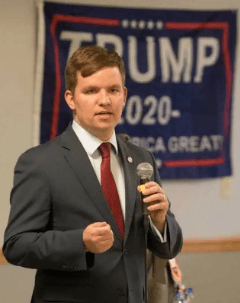 Last month, State Representative Jim Lower introduced legislation in Lansing that would prohibit schools and school districts in Michigan from passing a resolution or adopting policy that would prevent an employee from, “communicating or cooperating with appropriate federal officials concerning the immigration status in this state.”
Rep. Lower introduced HB 4988 on September 17 of this year, just weeks after the Detroit Public Schools adopted a Sanctuary policy, affectively stating that Immigration and Customs Enforcement (ICE) officials were not allowed to enter school property.
Lower’s proposed legislation is clearly a reaction to the Sanctuary policy that was adopted by the Detroit Public Schools, plus it sends a message to other school districts across the state, since the proposed legislation would levy civil fines (between $2,500 – $7,500) against any school district that did not cooperate with ICE agents or other Department of Homeland Security officials.
Lower, a Republican, who represents the 70th House District, is only in his second term of office for that district and has already made a name for himself as part of the Central Michigan Leadership PAC. Rep. Lower is a staunch supporter of the NRA, Michigan Right to Life and has received a 100% voting record with the Michigan Chamber of Commerce and the Michigan Farm Bureau.
Lower has provided a substantial amount of money to his own election campaigns, along with other major campaign funders, such as:
- Michigan Realtors Association PAC $9,500
- DeVos Family $9,000
- DTE Energy PAC $8,500
- Michigan Beer & Wine Wholesalers Association $8,000
- Blue Cross Blue Shield of Michigan $5,000
- CMS Energy $5,000
 In addition to voting for conservative legislation, such as the reactionary HB 4988, Lower announced earlier this year that he is running for the 3rd Congressional District, currently held by Justin Amash. According to Lower’s 3rd Congressional candidacy website, he is running to Stand with President Trump. Check out this video from Lower, which clearly demonstrates his allegiance to far right policies.
HB 4988 is currently in the Education Committee, which is chaired by Pamela Hornberger (R), with no clear timeline when it might be voted on in the House.
In the meantime, there are other communities looking to adopt Sanctuary School policies in the state. In fact, GR Rapid Response to ICE, working with Movimiento Cosecha GR, is providing a Sanctuary School Toolkit to Parents, Students and Stakeholders in Local School Districts. If you would like to obtain a copy of the Toolkit, contact GR Rapid Response to ICE on their Facebook page.
Why do we continue to ignore the role of Structural Racism and Neo-Liberal Capitalism when talking about the black community in Grand Rapids?
 Within the last few days there have been a few news articles that people have been sharing on social media, articles that specifically have to do with economic issues facing the black community in Michigan and in Grand Rapids.
The first article appeared in the online news source Michigan Advance, with the headline, Michigan gets called out for having the most Black children living in concentrated poverty.
The Michigan Advance piece is based upon data in a new report from the Annie E. Casey Foundation, looking at child poverty in the US. According to the report, Michigan has the highest rate of African American children living in poverty than anywhere else in the country.
The second article appeared on MLive yesterday, with a headline that read, Grand Rapids ward with highest black population gets least investment from city.
The MLive article focuses on the City’s 3rd ward and how there has been a lack of investment in that area, both from government and the private sector. The MLive article relies exclusively on former or current city officials, which means that those most impacted by the economic disparity are excluded from having any input.
Third Ward Commissioner Senita Lenear is referenced quite a bit in this article and talks a great deal about the need for equity in the third ward. Having more equity in the third ward would be a good thing, but there is no real conversation about how to create equity, besides advocating for more public and private investment. In fact, what is glaringly absent from both articles is a critique of structural racism and neo-liberal capitalism.
The omission of both structural racism/white supremacy and neo-liberal capitalism should not surprise us, considering most mainstream news sources do not explore these themes. In both of these news articles it is more focuses on how resilient black people are or, in the case of the MLive story, how the third ward can get the private sector to invest in the area. Ironically, calling for more private investment will likely exasperate the problem, since private investment is just one form of neo-liberal capitalism.
In fact, there has been recent private sector interest in the third ward, specifically from AmplifyGR and Start Garden. Of course, both of these entities are DeVos family creations, with AmplifyGR seeking to dictate economic policy in the Boston Square area (by spending millions on buying up property), and Start Garden attempting to convince black people that if they have a great business idea, Start Garden will give them start up money. However, both attempts have serious flaws.
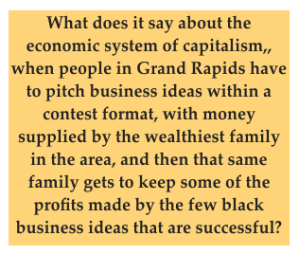
 The AmplifyGR model follows the White Savior model of outside investment, but only on the terms that benefit those doing the saving. The Start Garden model might benefit a few select members of the black community, but it ignores the larger, structural problems caused by white supremacy and capitalism. I mean, what does it say about the economic system of capitalism, when people in Grand Rapids have to pitch business ideas within a contest format, with money supplied by the wealthiest family in the area, and then that same family gets to keep some of the profits made by the few black business ideas that are successful.
There are some real alternatives and solutions. Look at what the Movement for Black Lives has been advocating over the past few years. Their platform is very comprehensive and includes the following: An End to the War on Black People, Reparations, Divest-Invest, Economic Justice, Community Control and Political Power.
Implementing this kind of platform would not only confront structural racism and neo-liberal capitalism, it would eliminate the need for the AmplifyGR and Start Gardens of the world.
 (Editor’s note: I am writing as someone who is a beneficiary of Settler Colonialism and addressing what the State of Michigan did with regards to their declaration. I do not want to downplay how this declaration is viewed by indigenous people, as their views on this matter are theirs.)
Recently it was announced that Michigan’s Governor, Gretchen Whitmer, declared October 14, 2019 as Indigenous People’s Day.
Many non-indigenous people have already declared this to be a great victory of Michigan and a demonstration of equity and inclusion. It is a good start………but a whole lot more needs to happen. In fact, even some of the language within the declaration is problematic, so lets take a look at some of that language.
The second paragraph of the declaration states:
WHEREAS, in 1990, representatives from 120 Indigenous Nations at the First Continental Conference on 500 Years of Indian Resistance unanimously passed a resolution to transform Columbus Day into an opportunity to reveal historical truths about pre-existing indigenous cultures that have survived an often violent colonization process and continue to exist and thrive in present day America; and,
This part of the declaration is not so much problematic, but it does omit something. The European invasion of Turtle Island would more honestly be named as Settler Colonialism. According to Native scholar and activist Roxanne Dunbar-Ortiz, author of the book, An Indigenous People’s History of the United States, there is a major difference between colonialism and settler colonialism.
“Settler colonialism has best been defined as more of an imposed structure than an historical event. This structure is characterized by relationships of domination and subjugation that become woven throughout the fabric of society, and even becomes disguised as paternalistic benevolence. The objective of settler colonialism is always the acquisition of indigenous territories and resources, which means the native must be eliminated. This can be accomplished in overt ways including biological warfare and military domination but also in more subtle ways; for example, through national policies of assimilation.”
In the fourth and sixth paragraphs of the declaration, it acknowledges the Native Nations that are in the area now currently occupied by the State of Michigan.
WHEREAS, the state of Michigan recognizes the presence of the three major groups in our state today, the Chippewa (Ojibwe), Ottawa (Odawa), and Potawatomi (Bodéwadmik), who have lived upon this land since time immemorial, and values the progress our society has accomplished through Native American thought and culture; and,
WHEREAS, the resolution states that Indigenous Peoples Day shall be used to reflect upon the ongoing struggles of Indigenous peoples on this land, and to celebrate the thriving cultures and values that the Odawa, Ojibwe, Potawatomi, and other indigenous peoples contribute to society; and,
Acknowledging the indigenous nations that exist in what is called Michigan is important, but there is no reference in the declaration that names them as nations. The US government entered into treaties with each of the three Native Nations that now exist within Michigan, since governments can only enter into treaties with other sovereign nations. The Odawa, Ojibwe and Potawatomi are not just cultures and people’s, they are sovereign people, a critical point that we can never forget.
In the seventh paragraph of the declaration it says that we should celebrate indigenous contributions:
 WHEREAS, on this second Monday of October, we should honor the historic, cultural, and contemporary significance of Indigenous peoples and their ancestral lands that also became known as the Americas and celebrate their contributions to communities throughout Michigan, the United States, and all over the world;
Ok, sure, we can acknowledge contributions, but framing it this way omits all of the harm. Any declaration that comes from settler colonial powers needs to acknowledge the harm committed by White Settlers. Failure to acknowledge genocidal policies not only erases the brutality, it is designed to make those of us who benefit from Settler Colonialism fell better about ourselves. If we were honest, we would acknowledge the theft of land, the displacement of whole native communities, the forced removal of children who were put into boarding schools, the ongoing impact that mining and the oil pipelines has had on Native communities, plus the fact that indigenous people, in what is now called Michigan, are some of the poorest people in the state.
For the State of Michigan to declare Indigenous People’s Day is a good start, but it is not enough. We have to own this history of Settler Colonialism and we have to work towards dismantling it. Those of us who are the beneficiaries of Settler Colonialism have to listen to what it is that the Native Nations that live on the land currently occupied by the State of Michigan, we have to listen to what it is that they want. One major thing would be to shut down Line 5 in Michigan, something that the Governor said she would do. All the declarations in the world don’t mean anything unless their is direct action that primarily benefits and improves the lives of indigenous people.
Opening up a whole new pool of potential employees: Criminal Justice Reform and the West Michigan Policy Forum
 Last Monday, the Econ Club of Grand Rapids hosted a panel discussion on the topic of criminal justice reform in Michigan.
The panel was moderated by the VP of the Grand Rapids Chamber of Commerce, Andy Johnston, who was quoted in an MLive article stating:
“It will help make us safer, it will spend our taxpayer dollars better, and it opens up a whole new pool of potential employees. We need to increase our workforce participation rate in West Michigan, and one of the ways we can do that is being one of the best communities out there when it comes to getting returning citizens connected with employment.”
Not surprising that someone with the Chamber of Commerce would make criminal justice reform about jobs, or as Johnston stated, “it opens up a whole new pool of potential employees.”
Those on the panel were echoing much of the same sentiment. The panel of three consisted of a CEO, the director of a non-profit criminal justice reform group and a strategist from the neo-liberal think tank, the Mackinac Center for Public Policy.
JT Weis is the CEO of Arbor Industries, a company based in Holland that hires former felons. Weis says his faith dictates that he hire former felons. Indeed, for Weis, his faith is pretty central to who he is. The CEO of Arbor Industries is the School Board President of Sacred Heart Academy in Grand Rapids, a westside Catholic school that has gone through a significant change in recent years, under the leadership of Rev. Robert Sirico. Sirico is the founder and leader of the Acton Institute, also based in Grand Rapids. In addition, Weis and his family are involved in the conservative Catholic radio station Holy Family Radio and they are active participants in the anti-abortion March for Life actions.
Leonore Anderson is the President of the Alliance for Safety & Justice, a rather moderate group that has worked on efforts to reform state legislation in numerous states in the US. The Alliance for Safety & Justice is a mild criminal justice reform non-profit.
The third member of the panel was David Guenthner, a senior strategist with the Mackinac Center. Guenthner, who spent years working for another conservative think tank based in Texas, now works for the Mackinac Center which is a strong supporter of privatizing the prison system.
The MLive did not share many details of the panelists or what they were advocating for during the Econ Club gathering. The MLive story did include some comments from Doug DeVos on the subject, even though the article does not indicate in what capacity DeVos was speaking. We assume that DeVos was speaking on behalf of the West Michigan Policy Forum (WMPF), since he wrote an opinion piece for the Detroit News the day after the MLive article on the Econ Club event.
There is not much compelling information in DeVos’ opinion piece, although he does source specific legislation that the WMPF would like to pass. In fact, the West Michigan Policy Forum has some specific changes they would like to see in the area of Criminal Justice, such as:
- Earned time credits (i.e. job training)
- Removing barriers to employment (licensing reform)
- Raise the age (allow up to 18 yrs. old in juvenile court)
- Civil asset forfeiture (require conviction)
- Cash bail reform (judicial discretion)
Now, these are not bad policies, but they are most definitely mild reforms that do not address more structural issues or root causes. In both the MLive article about the panel discussion and the opinion piece by DeVos, there is not one mention about race, racism or how the current criminal justice system disproportionately impacts black and latinx communities. The West Michigan Policy Forum is not advocating for an end to police violence or ICE repression, they are not calling for a reduction in state or local budgeting for police, they are not calling for an end to private prisons or the end of detention centers for immigrants.
We should not be fooled by the mild criminal justice reforms that the West Michigan Policy Forum are advocating for. These “reforms” do not threatened business as usual politics, but they do benefit the members of the business community that are always looking for new sources of low wage workers and ways to promote the communities where they are based as “safe communities.”
What Michigan and the rest of the country needs is what a growing number of people are gravitating towards, which is a prison abolitionist stance. The Prison Abolition movement states:
Abolition isn’t just about getting rid of buildings full of cages. It’s also about undoing the society we live in because the PIC both feeds on and maintains oppression and inequalities through punishment, violence, and controls millions of people. Because the PIC is not an isolated system, abolition is a broad strategy. An abolitionist vision means that we must build models today that can represent how we want to live in the future. It means developing practical strategies for taking small steps that move us toward making our dreams real and that lead us all to believe that things really could be different. It means living this vision in our daily lives.
In more concrete terms, we can look to the vision of the Movement for Black Lives, which has laid out a very clear vision and platform for what prison abolition would look like. In the section End the War on Black People, they list 10 things that would effectively move in the direction of abolishing prisons. In addition, under the section of Community Control, they are calling for democratic control of local, state and federal law enforcement agencies.
These are the kind of visionary goals that we should be working towards, goals that are rooted in radical imagination and not the neo-liberal agenda of those who are part of the existing systems of power and oppression. When are we going to stop celebrating the vision of those who have most of the wealth in this community, while thousands live in poverty? When are we going to stop listening to those who have historically financed politicians that have promoted mass incarceration? When are we going to act in solidarity with those who have been most affected by the Prison Industrial Complex?
How the local news media reported on the Grand Rapids for Education Justice action on Monday
 On Tuesday, we posted a story about a new community-based effort to challenge what they are calling a two-tiered system of education at the Grand Rapids Public Schools.
The new movement, Grand Rapids for Education Justice, held a press conference prior to the School Board meeting and provided the local news media with a set of statements that they would be presenting to the School Board members that night.
There were four local news agencies that came to the Press Conference and the subsequent School Board meeting, which is the subject of this posting. We will provide a summary of the local news coverage and deconstruct what each news agency reported.
The first piece we look at is a story done by the local NPR affiliate, WGVU radio. In the WGVU story, provides a fairly accurate picture of Grand Rapids for Education Justice, but singles out just one comment, where the group addressed how the GRPS policies in recent years follow those being implemented by Secretary of Education, Betsy DeVos. The WGVU quote is:
“Betsy’s charter ideas are directly related to the school’s transformation plan,” Bierns said. “And that Transformation Plan is changing the look of education in our country today. We are essentially privatizing education in this country and in West Michigan, the home of Betsy DeVos.”
However, the full statement made by GREJ about Betsy DeVos, which the news media had a copy of was the following:
GREJ opposes the significant influence of the business interests on the school curriculum, business interests who even have their own advisory council in our district. We oppose the charter school-like entities that exist within the GRPS system. We see as a threat the furthering of the corporate model as it is being pushed across the country by Secretary of Education Betsy DeVos.
The major difference here has to do with the group’s inclusion of the impact that area businesses are having on school curriculum, not just the influence of Secretary DeVos.
Besides quoting someone from GREJ, the WGVU reporter got a comment from the GRPS communications director John Helmholt, who responded to GREJ’s position that the GRPS was a two-tiered system, saying:
“That is just false and inaccurate, and not really representative of the real numbers,” Helmholdt said. If you look at what we have accomplished under the Transformation Plan, the numbers, graduation rates are up 60 percent, for African-American students, its 75 percent,” he said. Helmholdt added that the district is also investing $17 million to upgrade Ottawa Hills High School.
In the MLive story, the reporter provided more context about GREJ and quoted three different members, each addressing different points about what they found to be problematic about current GRPS policies.
MLive also relied on a canned statement from GRPS director of communications, John Helmholt, who continued to dismiss the issued raised and even went so far as to claim the group has, “a lot of false and misleading information that does not present a fair and accurate picture of the district.’’
The one main difference between the NPR story and the MLive story, is that MLive included a response by one of the School Board members, Kristian Grant, who said, “There are disparities and we know that. We are going to be taking a closer look at some neighborhood schools, the schools that need support, and figuring out how do we position board goals and our mission to help uplift these schools and provide even more wrap around support.”
Here, the school board member was not dismissive of GREJ and acknowledged that there were some disparities that needed to be addressed.
The last point about the MLive article worth mentioning is that John Helmholt mentioned that the school district was investing $17 million into Ottawa Hills, specifically for what the GRPS is calling “career academies.” The one that will be housed at Ottawa Hills will be the Academy for Hospitality and Tourism. These kind of theme schools are specifically designed to direct students into jobs, specifically in the hospitality sector. In an article that appeared about a year ago, the Academy for Hospitality and Tourism will be run by the following partners – GVSU, GRPS, Experience Grand Rapids, and AHC+Hospitality. In addition, there will be, “other industry leaders, who will serve on an advisory board.”
This last point, where members from the business community will have more direct influence on curriculum in these theme schools, is one of the major concerns that GREJ had raised on Monday and will likely be raising in the near future.
There were also two local TV stations that reported on the the group Grand Rapids for Education Justice and their action on Monday night. WZZM 13 included comments from GREJ from the press conference and the statements made during the School Board’s public comment period. Channel 13 also provided plenty of airtime to John Helmholt, who again was dismissive of the GREJ. However, in the WZZM 13 story, Helmholt himself admits that the most vulnerable students in Michigan have been negatively impacted because of how schools are funded, an admission that Helmholt says has been happening for some time now. Those with GREJ would not disagree with this last statement from Helmholt, since many of the members are teachers who spent more than a decade in GRPS and saw first hand how inadequate funding for the most vulnerable students has hurt the GRPS.
WXMI 17 also reported on the actions of GREJ on Monday. There wasn’t much of a difference in their coverage, citing a few of the GREJ members and then giving Helmholt the last word.
Because Helmholt was so defensive in his response to what the members of Grand Rapids for Education Justice had to say, they released the following statement in reaction to Helmholt’s dimissive comments:

(Editor’s Note: Most of this article is adopted from an essay in my book, Sembramos, Comemos, Sembramos: Learning Solidarity on Mayan Time, with a new asylum example at the end.)
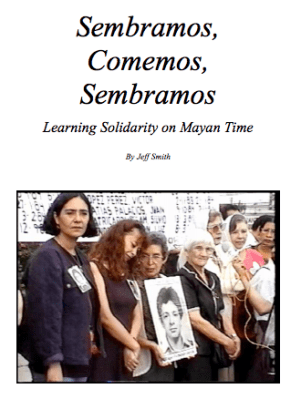 One of the more interesting and frustrating things that I have participating over the past 20 years has been speaking as an expert witness in Asylum cases for Guatemalans. Being an expert on anything seems a bit awkward, but in light of what the government uses as its “sources” I have come to embrace my experience and understanding as more honest than what the State Department says.
Being asked by immigration lawyers to speak to the current situation in Guatemala is one thing, whether or not the judge will allow you to speak in an expert capacity is another. It is a given that the prosecuting attorney for the government will question my credibility, but when judges have done so it has been frustrating. They are quick to point out that I do not have a degree in Latin American studies. I was not aware that having degrees in anything made you an expert. I have been to Guatemala 9 times in the past 13 years and always on trips that were information gathering at a fairly rigorous pace. I have interviewed hundreds of Guatemalans on their personal experiences with human rights abuses. I have written articles on the subject for various publications in the state and have spoken on Guatemala in over 100 different occasions in churches, schools, forums and as a conference presenter. I also try to read current scholarship, current books, articles and reports.
“The US State Department Report for such and such a year says that, even though Guatemala is experiencing a difficult transition to democracy, there is no real evidence that would support an asylum applicants well founded fear of persecution upon return.” This is what the government attorney usually argues. They only rely on the State Department documents, unquestionably a credible source. Granted it has been even more difficult to argue for asylum since the 1996 peace accords were signed between the Guatemalan government and the URNG, but that has primarily meant a cease-fire, more specifically the dismantling of the armed insurgent group. The military has not downgraded its forces, despite that being an accord agreement and they continue to intervene in domestic affairs. Political violence continues to be a problem. Popular movement groups continue to targeted and the murder of Bishop Gerardi the day after he presented the Catholic Church’s report on who was responsible for the violence during the 36-year war, is a clear indication that the military does not want the truth to be known. Gerardi’s murderers were recently found guilty in Guatemalan courts, a huge victory considering the problem of impunity. One of the guilty parties was Col. Lima Estrada was a graduate of the US Army School of the Americas.
I agree that making a case for Guatemalans seeking political asylum is not easy, but the government’s reasoning is equally not substantial. Even during the worst years of the political violence, the Lucas Garcia/Rios Montt years, it was rare for Guatemalans to be granted asylum. The State Department has considered Guatemala a “democracy” since 1954, so for any Guatemalan to claim a well founded fear of persecution would mean to question the political relationship that the US claims it has with this Central American nation.
In addition to the political inequities that exist at these asylum cases there are also other issues that are problematic. Every case I have been involved in has required a translator, since most Guatemalans do not speak English. Quite often the applicant has limited Spanish, so a Mayan translator is required. This raises further complications, in that during any translation it is difficult to have complete accuracy. I have witnessed the judge address the applicant in English, the lawyer address the applicant in Spanish and the translator address the applicant in Q’anjobal. Words and ideas are bound to get lost, hell I don’t claim to understand most of what judges have to say in English let alone through a translator.
One case I remember was an applicant from Huehuetenago who was in fear of returning because of his refusal to participate in the civil patrols during the 80’s and 90’s. (Civil patrols were created during Rios Montt’s dictatorship as a way of using Mayan males as a buffer between the army and the guerillas. (See Persecution By Proxy: The Civil Patrols in Guatemala, Robert F. Kennedy Memorial Center for Human Rights, 1993) This young man spoke Q’anjobal, so a translator based in California was flown in for the case. The translator was from the same part of Huehuetenango and had no problem communicating the judge or the lawyers’ questions.
When the government lawyer was attempting to discredit the applicant I could tell that the translator was becoming quite agitated. For every comment that was dismissing the young Guatemalans’ position I could see that this Q’anjobal translator wanted to jump up and offer his perspective on the matter. I could see him shake his head in dismay at the government’s reasoning for asylum denial.
When all sides were presented we went to the lobby to await the judge’s decision. No sooner were we all out the door, when the translator let out what he had to suppress in the court room. He couldn’t believe that the judge would actually believe the government lawyer, a lawyer who had no particular knowledge of Guatemala and had never visited there. What this man had to say corroborated what the asylum applicant stated were his reasons for well founded fear of persecution. He said my statements and experience were honest and accurate, but then realized that these proceedings were not about the truth. He said quite simply that this case, like many asylum cases was more about politics than about justice.
I remember leaving the courthouse that day feeling like I have on many occasions embarrassed to be a citizen of the US. The lawyer did request an appeal which was granted, giving the Guatemalan man an additional 6 months to work and maybe save money before his eventual deportation. In the end he had resigned himself to this fate, but I could tell by the look on his face that he would do his best to survive. If anything, to survive is what Mayans have done better than most in recent history. I saw in this young Mayan no consuming rage, rather a sense that he would make the best of his situation and embrace it with dignity. Once again I came away from this experience learning a great deal, not just about our so called justice system, but about what it means to struggle in this world and to live with hope.
It’s now the fall of 2019, and I have once again been asked to act as an expert witness for a woman from Guatemala who is seeking asylum. The woman fled Guatemala several years ago, because of increased street violence and because she was the target of street gangs.
In addition, this woman from Guatemala, an woman who is Mayan, from the region of Quetzaltenango, also wants to argue in her asylum case that racism plays a large role in her reason for a well founded fear of persecution if she were to be deported. Racism is definitely a major issue in Guatemala and has been for the past 500 years, since Spain invaded that region. Guatemala continues to be roughly 60-65% Mayan, yet they have very little representation in government. In fact, many scholars argue that Guatemala is a country of racial apartheid, since indigenous people do not get to determine social, economic and government policies.
On the matter of street gangs threatening her life, the US government doesn’t recognize gang violence as a legitimate reason for to grant asylum. However, the existence of gang violence is directly due to the inability of the government in Guatemala to provide safety to civil society, along with the corruption within the Guatemalan military and the national police.
I will do my best to provide compelling evidence as to why this Guatemalan woman should be allowed to stay in the US, but the reality is that so few Guatemalans have been granted asylum, even during the years of massive government repression.
New education justice movement confronts the Grand Rapids Public School Board on what they identify as a two-tiered education system
Last night, parents, teachers and former educators within the Grand Rapids Public School system held a press conference on the steps of the headquarters of the GRPS.
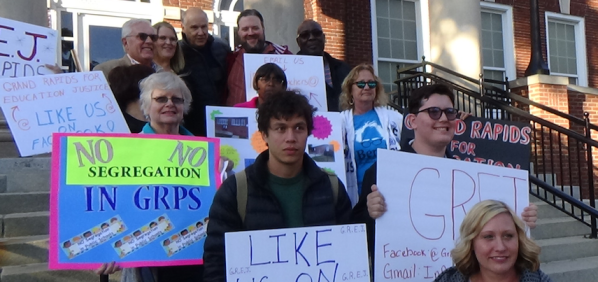
Calling themselves Grand Rapids for Education Justice (GREJ), they addressed what they identified as a two-tiered education system within the Grand Rapids Public Schools district.
Here is a video that reflects the overall position of those who are part of this movement.
In addition, GREJ released several statements, which they also presented to the Grand Rapids Public Schools board members. A broader statement was also released, one that provides a brief articulation of what they mean by a two-tiered education system.
- Grand Rapids for Education Justice (GREJ) is against the two-tier education system that exists with GRPS, where students from poor families and students of color disproportionately have access to fewer resources necessary for a proper education, as well as having second-rate facilities. GREJ also objects to the rise of the corporate education model which has led to the privatization of services at GRPS, such as busing services, custodial services, and curriculum, all with separate boards of oversight.
- GREJ wants to see our teachers be fully respected and with a fair salary, access to their necessary resources, with appropriate classroom sizes and minimal use of substitute teachers as long-term surrogate teachers.
- GREJ wants our students, parents, and other members of our great diverse community to be enabled to have a larger interactive role in the future of PUBLIC education.
- GREJ opposes the significant influence of the business interests on the school curriculum, business interests who even have their own advisory council in our district. We oppose the charter school-like entities that exist within the GRPS system. We see as a threat the furthering of the corporate model as it is being pushed across the country by Secretary of Education Betsy DeVos.
Before members of GREJ addressed the school board, it was instructive to hear one of the agenda items, where they listed several significant financial donations from members of the Grand Rapids Power Structure, such as the DeVos, Cook and Meijer family.
During the school board meeting, several members of GREJ spoke during public comment, providing statements that made clear the issues this movement has identified.
One of the statements read before the school board last night, ends with the following:
Two tier schools are cruel to disadvantaged students. Michigan schools are among the most segregated in the US according to the Detroit News and GRPS suffers from a double segregation with students sequestered by race income and opportunity. We need signs flashing in front of the lower tier buildings like the one shining incessantly in front of City illuminating the accolade of the second best High School in West Michigan. Imagine an accolade in front of our two tier buildings admitting we will not accept our insufficient reading abilities in this school any longer. We will not claim district success when 74% of our k through 8 readers flunk the state m step reading test. This two tier district will be exceptional when it abolishes it’s academic dichotomy. Lets all strive in this room for educational justice for all of our students.
Another statement read before the school board last night makes this point:
We have not come to place blame, but rather have come to ask you what you as a board are going to do to create an equal playing field for all Grand Rapids Public School students. Our group has FOIA’d considerable data and information from the district in order for us to further evaluate and then disseminate information to the public at large what we see as evidence of this Two Tiered System. Our research indicates that this term may have originated from a study conducted by the National Commission on Teaching and America’s Future, May 13, 2004. The study was titled “50 Years After Brown vs. Board Of Education: A Two Tiered Education System”. The study found that low income students and students of color were too often concentrated in separate and unequal schools. It found that holding students accountable for high standards is unacceptable when districts are unwilling to provide adequate resources, technology, educators, support and facilities.
Each of those involved with GREJ spoke passionately, all with a direct experience as former teachers and parents of students within the GRPS system. One speaker closed with these comments:
Our students deserve a fair, equal, and rewarding educational opportunity. We implore the board to seriously consider what we have presented here tonight and come back to the public with a comprehensive plan that will begin to address and correct the inequity, disenfranchisement, and segregation of the district’s student population.
(You can read all 5 of the statements presented last night, by going to this link.)
Of course, the protocol of the school board meetings is that there is no conversation nor immediate responses to those who addressed the board. This process doesn’t foster dialogue nor does it encourage people to want to actively engage this elected body. This is not what democracy is supposed to look like. When given the opportunity at the end of the School Board meeting, the acting Superintendent and the other Board members could have said something, but all chose to simply say, No Comment.
Grand Rapids for Education Justice members were not expecting anything but this kind of response. Those involved have been before this board before in different capacities, but the difference here is that they want to build a movement for education justice. To contact Grand Rapids for Education Justice you can send them an e-mail at informedteachers@gmail.com or follow them on Facebook at https://www.facebook.com/GrandRapidsForEducationJustice/.
Grand Rapids-based Acton Institute commentators attack Greta Thunberg, calling her ideas pathological
 There have been numerous detractors of the young Swedish activist Greta Thunberg over the past few weeks, especially after her speech to heads of state at the United Nations.
Many of the responses to Thunberg have been reactionary, especially when Greta and the growing global climate justice movement places much of the blame for the current climate crisis on the economic system of capitalism.
Therefore, it is no surprise that the Acton Institute for the Study of Religion and Liberty would post recent articles critical of the young Swedish activist. In fact, in addition to their staunch defense of capitalism, the Acton Institute has been part of the climate denial sector on numerous levels.
- According to ExxonSecrects.org, the Acton Institute between 1998 and 2007, received $315,000 from Exxon Mobil. Exxon Mobil funded dozens of groups, Like Acton, for the purpose of climate denial.
- During the same time period( mid-2000s), the Acton Institute showed a climate denial film at the Wealthy Street theater, which was well attended by their members.
- In July of 2016, nineteen U.S. Senators delivered a series of speeches denouncing climate change denial from 32 organizations with links to fossil-fuel interests, including the Acton Institute.
The Acton Institute posted two articles within the past week that were critical of Greta Thunberg and the global movement that she is part of.
One article is from Jordan Ballor, a research fellow at the Acton Institute and someone who got his PH.D. at the Calvin Theological Seminary. Ballor soft pedals his critique of Thunberg early on in the article and attempts to frame the climate issue as religious and moral.
However, towards the end of Ballor’s article he openly defends the nuclear power and renewable and sustainable. The Acton research fellow then states:
Energy policy and practice must also take into account the challenges of the responsible stewardship of fossil fuels and the tradeoffs involved with moves from coal to natural gas, for instance.
There is no responsible use of fossil fuels and the global climate scientist community has made it clear that fossil fuels must be eliminated in the not to distant future, if we are to have a future.
Ballor takes the gloved off at the end of the article and says:
As laudable as the intentions of activists like Thunberg might be, pathos unmoored from reason becomes pathological.
Here, the Acton Institute research fellow clearly seeks to discredit Thunberg and activists like her, concluding that what these activists are calling for is “pathological.”
The second article recently posted on the Acton Institute’s site, is from the director of a Conservative Christian think tank in Sweden, the Clapham Institute. Per Ewert spends the first part of his article making the claim that he may have inspired Greta to become an activist. Once Ewart stops talking about himself, he then sets his sights on bashing Greta and the global climate justice movement. Ewart states:
In her speeches Greta has repeatedly, and apparently with growing frustration, declared that politicians do nothing, and that the causes behind the climate threats are found in the capitalist system. But both claims are untrue. Instead, the climate situation calls for skilled and bold entrepreneurs who can invent, and market, climate-benefitting tools for the twenty-first century. The solution lies in making such decisions that would make a real change, instead of sending general accusations against those who are making a positive impact.
Again, we see an Acton Institute contributor defending the system of capitalism. Well, they don’t actually defend capitalism, because Ewart offers no real evidence that Capitalism is the root cause of climate change, he simply says that Greta’s claim is untrue. Ewart then goes on to say that what is needed are bold entrepreneurs who can invent and market climate-benefiting tools. This is such bullshit! Entrepreneurs operating within the capitalist system are the very cause of the climate crisis, along with the idea that climate-benefiting tools can be invested and marketed. THIS is the problem. We think that technology or anything that can be commodified will save us.
Ewart continues to attack Greta by saying that her comments are the United Nations were “downright dangerous.” Greta said, everything needs to change. And it has to start today.” Ewart considers this dangerous language and then calls it a revolutionary phrase that in the past has turned out bad for people.
The director of the Conservative Christian think tank then concludes with this observation:
Adults need to manage the balance of making wise and reflective decisions, while simultaneously avoiding the perils of panic and adopting a child’s engaged but still limited worldview. Therefore, instead of attacking the capitalist system, both Greta and people of goodwill around the world should be directing our focus against, for instance, China and other large coal users, to make them abandon their coal industry. That would create the real results that the young movement around Greta needs.
Here Ewart demonstrates that he is agist, dismissing youth and claiming that adults are wise. Adults, are in fact, the ones who are responsible for the climate crisis, especially those who are the heads of global corporations and governments. China and India are two of the largest consumers of coal, but that also is related to the fact that they have much larger populations than the US or European countries. In fact, when it comes to per capita fossil fuel consumption, the US is way above all other countries.
Ewart could have made the links between the US military and climate change, especially considering the fact that the Pentagon is the single largest institutional consumer of fossil fuels in the world.
That the Acton commentator simply blames other countries, further demonstrates his bias to not critique the world’s former colonial powers and the most imperialist country on the planet, the United States of American. However, this is consistent with Acton’s ideological framework, which is to defend not only US imperialism, but the sectors of wealth that have benefited greatly from the system of capitalism.

