Armed Self-Defense, White Privilege and White Supremacy in West Michigan
 “A Winchester rifle should have a place of honor in every black home, an it should be used for that protection which the law refuses to give.” Ida B. Wells
Nearly a month ago, I attended an action in Allendale, which was organized by Justice for Black Lives. I wrote a critique of the local news coverage of the action, which featured the American Patriot Council’s freedom march and a counter-demonstration by Justice for Black Lives.
MLive framed there coverage of the events that took place on October 24th, with the following headline, Lots of guns, but simultaneous West Michigan rallies by opposing groups stays peaceful.
This kind of simplistic coverage is not surprising, but it offers no serious look at the major difference between White Supremacists who carry guns and why Black and Indigenous people would bring weapons to a protest.
Likewise, some of the people involved in trying to get Ryan Kelley, co-founder of the American Patriot Movement, removed from his position on the Allendale Planning Commission, also took issue with Black and Indigenous people coming to the protest on October 24th, with arms.
I get that people, meaning white people, might feel uncomfortable with people they are protesting with, who are armed. However, white people have no credibility or moral authority to question whether Black or Indigenous people chose to defend themselves, even if that includes showing up at a protest with guns.
I understand how this might make white people uncomfortable, since I used to embrace a more dogmatic position when it comes to non-violence vs Self-Defense. However, once I started doing solidarity work in Mexico and Central America from 1988 – 2006, I came to see how groups in those countries that used non-violent tactics worked in conjunction with those who had chosen armed self-defense. The group COMADRES in El Salvador, which were essentially families and relatives of the disappeared, worked with the FMLN, the armed insurgent group. In Mexico, the EZLN, which took up arms in 1994, also had the support of millions from civil society and worked directly with groups that embraced non-violence. These are strategic choices that people make, but it doesn’t mean that they can’t work together.
For the rest of this article I want to provide some arguments for why white people should never tell Black and Indigenous people that they cannot engage in armed self-defense.
First, it is important to acknowledge that Black and Indigenous people have a long history of using armed self-defense, especially against state violence in the form of Settler Colonialism and White Supremacy. Do white people honestly think that it is morally superior for Black and Indigenous people to only use non-violence? Think about the tremendous amount of violence that Settler Colonialism and Genocide has brought to First Nations over the past 500 years. Those engaged in Settler Colonialism used brutal force, with guns, scalping, chemical and biological warfare, along with force relocation and forced removal of indigenous children with the dictum, “Kill the Indian, Save the Man.” Do white people actually think that Indigenous people did not have the right to defend themselves, their families and their homes from all of the heinous crimes the US government committed against them? Do you think that Indigenous people should have tried to reason with the like of Col. George Custer? The armed resistance against the US Calvary at the Battle of the Greasy Grass, also known as the Battle of Little Bighorn, was a direct result of the US government’s ongoing war against Native people during the period of what we were all taught in school was, The Indian Wars.
This same history is similar within the Black community, especially since the beginning of slavery in the US. Too often, especially amongst white people, we see the emancipation of those in slavery as coming about with the Civil War. However, as Carter Jackson points out in her book, Force and Freedom: Black Abolitionists and the Politics of Violence, the use of armed self-defense and self-liberation was very much a part of the abolitionist movement. However, even after chattel slavery was abolished, White Supremacy morphed into the Jim Crow era, state-sanctioned apartheid and systemic racism. After WWII, groups of Black men, many who had served in the US military, formed gun clubs for self-defense, the most famous groups were called Deacons for Defense (see The Deacons for Defense: Armed Resistance and  the Civil Rights Movement, by Lance Hill). The most well known Black armed self-defense group, the Black Panther Party for Self Defense, also organized during the Civil Rights era, along with groups like RAM – Revolutionary Action Movement. The consensus amongst historians is that the non-violent groups benefited from the armed self-defense groups, since the power structure now saw the non-violent groups as more reasonable. In other words, the Black armed self-defense groups provided political space for the non-violent groups to accomplish more, since the threat of an armed uprising was now on the minds of the white power structure.
Second, armed self-defense by Black and Indigenous communities is based on their lived experience of how brutal the white power structure has been and can be. If your people were forced off their land, enslaved, your children forcibly removed, your people lynched and discriminated against in every facet of society, do you think that they could ever trust the white power structure?
Third, the Black and Indigenous armed self-defense group that was at the Allendale protest on October 24, were not only protecting themselves against the armed members of the American Patriot Council protest, they were also protecting themselves against the armed cops who were also at the protest. The reality is that Black and Indigenous people know all too well that law enforcement agents, from local police to the FBI, have a long history of murdering, arresting and detaining their community. The white armed participants in the American Patriot Council were probably the main concerns of the armed Black and Indigenous resisters, but the specter of law enforcement is always on their radar.
Fourth, the white people from Allendale, who raised objections to Black & Indigenous people coming to the October 24 protest with arms need to come to terms with the first 3 points raised here. In addition, were the white liberals from Allendale ever concerned or did they object to there always being armed members of local law enforcement at the October 24 protest or any of the previous protests against the Confederate statue in Allendale? I suspect not, which makes them hypocritical for not condemning the armed police and just the armed “militia” who have come to the aid of Ryan Kelley, since this conflict began last summer. Again, cops are more likely to shoot and kill Black and Indigenous people than are white “militia” types.
Of course it would be wonderful if no one came to protests with guns, but this is not the world we live in. The reality is that white people need to come to terms with the long history of state violence against Black and Indigenous people in the US, before they question or judge Black and Indigenous people for armed self-defense. White people, like myself, need to confront our own privilege and our own complicity in the larger systemic role that White Supremacy plays in this society. Lastly, white people have no grounds to ever tell Black and Indigenous people how they should protect themselves or how they show up to a public demonstration.
Settler Colonialism, Genocide and Indigenous Resistance: A Thanksgiving invitation for White People to Learn directly from First Nations people
 Thanksgiving is going to be different for many of us this year. With the COVID pandemic, many of us will have smaller meals, with fewer family members, and lots of us will not be traveling to celebrate the holiday.
However, there is another reason that Thanksgiving is different this year. Ever since the national uprising in the aftermath of the public lynching of George Floyd, those of us who are white, have been forced to think about our privilege and the system of White Supremacy, a system which is at the root of this country’s history.
Black, Indigenous and other communities of color have not only been resisting against police/state violence, they have been attacking symbols of White Supremacy, by bringing down statues, by forcing sports teams to change their names, by forcing corporations to change their product brands and forcing white society to have to re-think our role in perpetuating White Supremacy.
Over the next few days, instead of just enjoying meals with family and friends, I invite White people to engage in some self-reflection and self-education about the history of Settler Colonialism, Genocide an Indigenous Resistance. All of the educational resources that are listed below, are educational and activist resources from indigenous people.
Books
An Indigenous Peoples’ History of the United States, by Roxanne Dunbar Ortiz
A Little Matter of Genocide: Holocaust and Denial in the Americas 1492 to the Present, by War Churchill
Our History Is the Future: Standing Rock Versus the Dakota Access Pipeline, and the Long Tradition of Indigenous Resistance, by Nick Estes
As Long as Grass Grows: The Indigenous Fight for Environmental Justice, from Colonization to Standing Rock, Dina Gilio-Whitaker
All Our Relations: Native Struggles for Land and Life, by Winona LaDuke
Missionary Conquest: The Gospel and Native American Cultural Genocide, by George Tinker

Documentaries
Websites
Indigenous Environmental Network
Zines
Accomplices Not Allies: Abolishing the Ally Industrial Complex
Colonization and Decolonization
Stop saying this is a nation of immigrants
Grand Action 2.0 speaker provides update on new development vision for Grand Rapids: Whiteness, Grand Rapids as a destination and Disaster Capitalism
 Over the past month, there has been more and more information coming forth about Grand Action 2.0 and their desire to build an amphitheater along the Grand River and Market Avenue SW.
In October, we reported on how some groups in the Grand Rapids Power Structure were planning to move forward with a proposal to build a large amphitheater in downtown Grand Rapids.
We also reported that the land in question for the proposed amphitheater, was owned by the DeVos family, specifically the old Charlie’s Crab restaurant and the adjacent land & parking area. One of the properties is owned by 63 Market Avenue Holdings LLC, which was not verified by local news sources, but 63 Market Avenue Holdings LLC is in the same address that houses the DeVos businesses and the various DeVos family foundations – 126 Ottawa Ave NW, Grand Rapids.
On November 10th, we reported on updated details about this proposal, which is even more insidious. During the Grand Rapids City Commission’s Committee of the Whole meeting on Tuesday morning, the City approved a Memorandum of Understanding (MOU), whereby the Amway Hotel Corporation, 63 Market Avenue Holdings LLC, the Grand Rapids-Kent County Convention/Arena Authority and the City of Grand Rapids, have agreed to enter into a private-public agreement to build a 14,000 seat outdoor amphitheater. You can read the details of this agreement from our previous article on this topic, which means that the City of Grand Rapids will spend over $6 million to move offices they have on Market Avenue, just south of the off ramp of US 131, in order to make space for the proposed amphitheater.
On Monday, Grand Action 2.0 brought to town John Kaatz, who works for Conventions, Sports & Leisure International (CSL). Kaatz spoke at the Econ Club meeting, which are meetings that are primarily attended by members of the Grand Rapids Power Structure and the business & professional class from West Michigan.
Dick DeVos and Carol Van Andel, as key members of Grand Action 2.0, both made comments before the scheduled speaker. Grand Action initiated this whole process and Dick DeVos made it clear that Grand Action 2.0 and this current riverfront development conversation was really started in 2016, when they paid consultants to produce a study about expanding the tourism & entertainment industry in Grand Rapids and how to attract and retain talent, which is code for how does GR attract the professional and business class to the area……which is also code for White people.
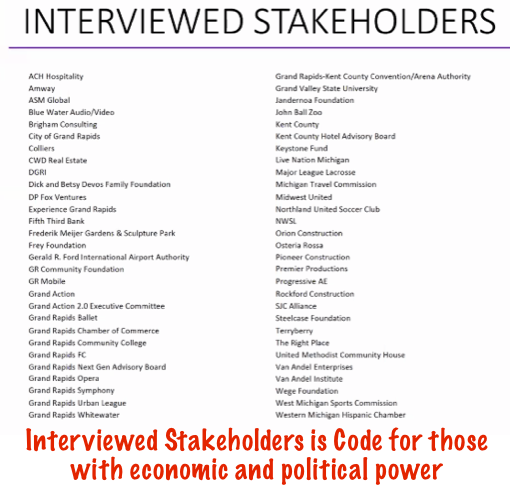 John Kaatz (CSL) then appeared on screen and began to talk more about this new development process and which key stakeholders his company engaged. You can see from the image here, who CSL considers to be stakeholders, which is code for those with economic and political power. The list does not include the public, but as Kaatz said, “potential customers.”
Kaatz then laid out 3 main issues, based on what Grand Action 2.0 wants to see happen:
- Future investment and expansion opportunities that will help preserve and expand the competitive position of the DeVos Place Convention Center.
- Potential development of a new multi-purpose soccer stadium in Grand Rapids that will allow for a higher level professional play, as well as various other sport and entertainment activities.
- Potential development of a new large-scale amphitheater in Grand Rapids, partnered with numerous cultural, entertainment, adventure and other assets that can improve quality of life for regional residents and attract new visitors.
Addressing the first point, Katz said the convention center could add a TV production studio, food & beverage operations within the convention space, specifically for locally sourced products.
On the matter of the second point, developing a plan for a soccer stadium, Kaatz said they are looking at maybe using spaces like the downtown post office, Calder Plaza or other area spaces for expansion. Kaatz also said there would need to be an ownership group, someone to own the team, and that the USL – United Soccer League – is interested in Grand Rapids.
In regards to an Amphitheater, Kaatz could envision maybe 25 concerts a year, maybe picnic at the pops, plus booking other business events at the site. He also said the space should be a community gathering space, that doesn’t necessary need the Amphitheater for events like PRIDE or beer festivals.
Kaatz then talked about what else could go on the site, such as commercial development, which would put activities right on the water front. Kaatz made it clear that this whole development project will tie into the Whitewater project, which would include other activities, like an Urban water park, space to relax, for picnics and an outdoor adventure center.
The Econ Club event was then opened up to a Q&A portion that was facilitated by former Gov. Engler Press Secretary John Truscott. Actually, Truscott did not allow anyone to verbally ask questions and he controlled the content of the questions that were sent to him, often re-phrasing what was asked.
Tom Welch, from Fifth Third Bank and co-chair of Grand Action 2.0, also made it clear that this larger project would follow the public/private partnership, which really means that the private sector gets to be the primary beneficiary, with the public meaning local government, who will provide public dollars, without public input.
There were a few other questions that seemed rather inconsequential and than Dick DeVos wrapped up the comments by stating that, “this is the perfect time to develop ideas.” DeVos then said he saw COVID as a “hiatus.” This comment not only demonstrates that he gets to see the pandemic from a highly privileged position, while thousands contract the disease in Kent County and the death toll climbing daily. Dick DeVos then said he has his own term for COVID, but said he wouldn’t share what it is. As someone who has followed the DeVos family for decades, I would speculate that Dick DeVos sees the pandemic as a form of Disaster Capitalism, which means that the private sector will be able to capitalize on the harm an push things through that will benefit those with power, while the rest of us are just trying to survive.
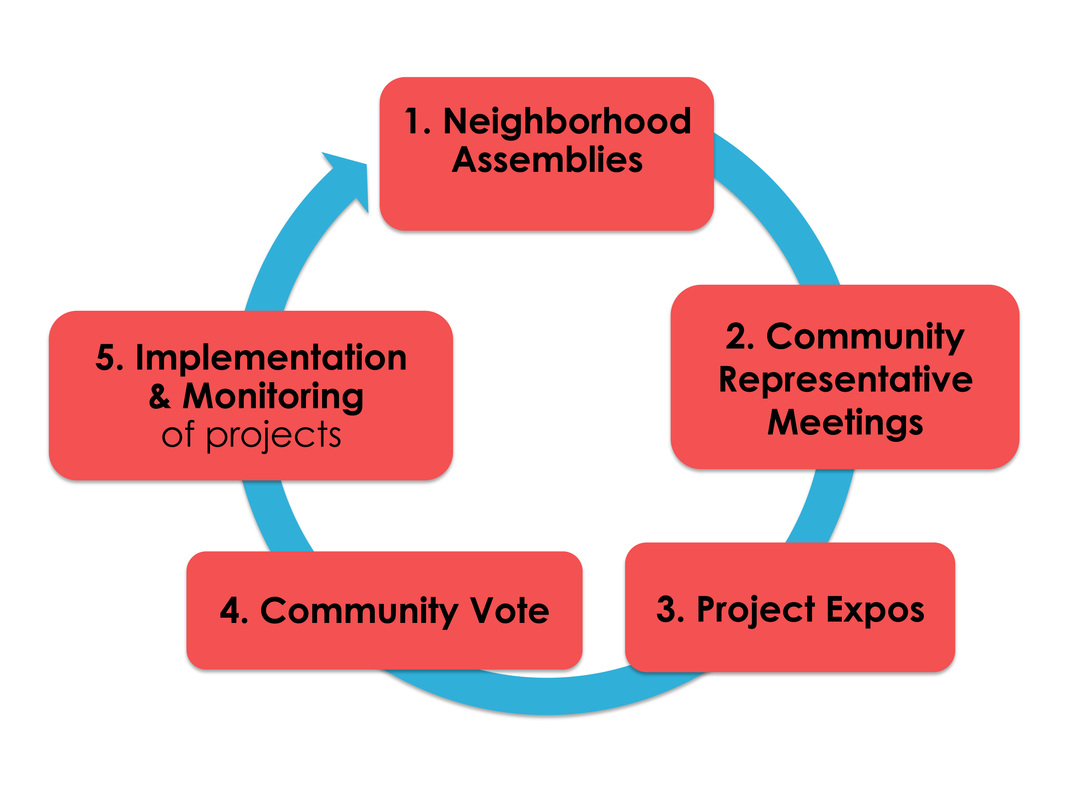
Instead of giving public money to benefit the business class in Grand Rapids, how about we adopt the process of Participatory Budgeting
 During the November 10th City Commission’s Committee of the Whole meeting, city officials agreed to use more public money to assist the retail industry, particularly those in downtown Grand Rapids.
What was decide on at the November 10th meeting, was that the City of Grand Rapids would provide $50,000 to go towards the salary of a Retail Specialist. You read that correctly, the City of Grand Rapids is contributing $50,000 towards the salary of someone who will be working with the Grand Rapids Area Chamber of Commerce.
In addition, the Downtown Development Authority (DDA), will also be contributing $50,000 towards the Retail Specialist’s salary and the GR Chamber of Commerce will offer in kind services. Now, the DDA will also be using tax money that is collected by downtown businesses for this project. However, it must be noted that the DDA board members are not elected, they are appointed, with the public completely excluded from their decision making process, even though the DDA also uses public tax dollars. Here is a list of who sits on the DDA Board of Directors and who they represent:
Richard Winn (Amway Hotel Corporation), Jermale Eddie (Malamiah Juice Bar), Jen Schottke (ABC Western Michigan), Rosalynn Bliss (Mayor, Grand Rapids), Greg McNeilly (Windquest Group), Luis Avila (Varnum Law), Jim Talen (Kent County Commissioner), Kayem Dunn ( Consultant), and Diana Sieger (Grand Rapids Community Foundation).
This Retail Specialist that the City just approved funding for was actually created in October of 2019, when the City approved $100,000 to work in conjunction with the GR Chamber of Commerce. Thus, the City of Grand Rapids has contribute $150,000 over the past 12 months for a salary position that the public is excluded from, all for the benefit of retail businesses. If you include the $50,000 from the DDA, which is tax money, then we are looking at $200,000.
Of course, this who thing of the City using public money to bolster and improve the private business sector is not new. In recent years we have documented the following instances of public money that benefits the business class, with a few examples here:
- In 2011, a business called Levitation, asked the DDA to give them $5,000 to promote shopping in the downtown. The DDA responded by giving them $7,500.
- Millions in public money has been invested in the downtown market, despite the fact that most of what is sol their caters to the professional and business class.
- In 2016, the City of Grand Rapids gave the DeVos-owned entity SG Ecosystem Inc, $725,000 to promote more businesses in the city.
- In 2013, the City of Grand Rapids provided $317,000 in tax abatements to the RDV Corporation (yes, DeVos-owned) to turn the old Morton House into another downtown hotel.
- The City of Grand Rapids literally has provided tens of millions in tax breaks to private developers in the last decade, specifically for developers who are building in or near downtown Grand Rapids.
Now, called me old fashioned, but I thought that capitalists believed in no government interference, since the “market” would decide who can survive and who can’t. The reality is that there are lots of businesses that rely on tax breaks, public funding and public bailouts in order to survive, yet they get bailed out with public money all of the time.
Participatory Budgeting
The City of Grand Rapids also doesn’t do enough to inform the public that they are voting on giving money for retail specialists or any other forms of business subsidies. This is why we need to adopt a practice of participatory budgeting in Grand Rapids, whereby the public would have months to discuss and have input on how they want to see public tax money used in their community.
Imagine what a City budget would look like if the people really had a say in it. Imagine if people actually had a say in how much money can go to the GRPD. Imagine what residents would do if they had to decide on further subsidies and tax breaks to developers or to give money directly to residents to support their housing costs. Imagine what it might look like if the public had a direct say in how tax money was used and how that money could be applied for real needs in neighborhoods, for community-based projects an to support the most vulnerable in our city.
The great thing about participatory budgeting, which I have witnessed being practiced in Guatemala, is that it often leads to people demanding the democratization of more and more of society. If Grand Rapids residents were to demand Participatory Budgeting, it would be one important step towards democratizing the local economy and truly creating equity, which the City of Grand Rapids often claims to care about.
While Rep. Chatfield and Sen. Shirkey meet with Trump, we need to remember who bankrolled them
 As I write this, Representative Lee Chatfield and Senator Mike Shirkey are meeting with President Donald Trump in Washington. Trump is continuing to delay his ouster from the White House in the aftermath of the November 3rd Election, even though it is pretty clear that Biden won the election.
An opinion piece in the magazine Politico, states the following:
The danger to democratic elections is well understood. The Constitution authorizes state legislatures to decide how states choose presidential electors. For more than a century, every state legislature has chosen to do so by popular election. According to one school of thought, though, a state legislature could choose to set aside a popular vote if it doesn’t like the result and choose different electors instead. This is a pretty undemocratic idea, as well as one that misreads the history of election law: the National Review recently described it as “completely insane.” (State legislatures have the power to change the system for choosing electors in future elections, but not to reject an already conducted election just because they don’t like the result.) Nonetheless, the president is pushing for it. By so far refusing to go along with Trump, Republican state legislators have been standing up for the idea that fair, democratic elections are more important than any individual president. If Shirkey and Chatfield are reconsidering that view, they are playing with the possibility of throwing out the results of a free and fair election. That’s not something that the system comes back from easily.
The Trump administration has demonstrated over the past 4 years that they have engage in illegal an corrupt executions of power. These crimes are well known and have been well documented.
However, in the case of Chatfield and Shirkey, we also need to begin to ask who else is responsible, even if this meeting is just for show? In other words, which organizations and which people are responsible for these men getting elected an staying in office?
Rep. Chatfield was first elected in 2012, an according to the Michigan Campaign Finance Network, the largest organizational campaign contributors have been the Michigan Chamber of Commerce, the Michigan Beer & Wine Wholesalers Association and Blue Cross Blue Shield of Michigan PAC.
Then there are individuals and families who have contributed handsomely. Among the names listed are the DeVos family, Peter Secchia and David Van Andel. Now, the DeVos family is listed as having contributed $67,500, but this is misleading, since the number one contributor to Rep. Chatfield is the Republican State Leadership Committee, which has contributed $250,000. The DeVos family, through the Amway Corporation, has contributed $1 million to the Republican State Leadership Committee since Chatfield was elected in 2012, and that doesn’t include contributions for the 2020 election cycle, based on OpenSecrets.org.
In looking at who have been the major contributors to Senator Mike Shirkey, according to the Michigan Campaign Finance Network, we see two prominent members of the Grand Rapids Power Structure listed, with John Kennedy (CEO of Autocam) contributing $200,000 to Shirkey, and the DeVos family contributing $71,000.
So I ask, what responsibility to these groups and these people, like DeVos, Kennedy, Secchia and Van Andel, have in this situation? I would argue that they are complicit in the actions of Rep. Chatfield and Sen. Shirkey, because they were both bankrolled by the members of the Grand Rapids Power Structure. In fact, I would argue that, unless DeVos, Kennedy and others denounce Chatfield and Shirkey for meeting with Trump, they are equally complicit and equally guilty of election fraud.
Betsy DeVos Watch: Schools as a Talent Pipeline for the Private Sector
 Before Betsy DeVos is forced out of the federal government, she is not wasting what few weeks she has left sulking.
“Before the pandemic, there were more than seven million unfilled jobs in the United States waiting for workers with the right skills and a personalized education. And more than 80 percent of HR professionals report they’ve had difficulty finding qualified people for open positions. More than 4 in 5 say this,” said Secretary DeVos. “Employers can’t find enough qualified people to hire because there are too many disconnects between education and the economy, just as there are often too many disconnects between a child and the school they’re assigned to by government.”
Assistant Secretary for the Office of Career Technical and Adult Education, Scott Stump, also stated, “it is our hope that attendees heard and are ready to respond to the call to action to expand employment opportunities for youth as America emerges from the pandemic.”
This is not a new issue or theme for Betsy DeVos. Last year, at the annual US Mayor’s Conference, DeVos had a similar message an was soliciting help from US Mayors to create a Talent Pipeline from schools to the business sector.
Seeing students as workforce talent is dangerous. First, this kind of thinking commodifies students to be used by the private sector. The other reason why the notion of students as workforce talent is dangerous, is because it minimizes and detracts from students being able to develop critical thinking skills that can provide them with the ability to make important decisions an choices about what they want to do with their future.
The same kind of thinking is very much part of the West Michigan ethos, with groups like Talent 2025 and Believe 2 Become, which also produced a report in 2017 and organize a conference on workforce development, where local CEOs were pushing the notion that education was all about talent development for the private sector. Here are what some of the West Michigan CEOs had to say in the report:

For those who value public education, we need to pay attention to the business class and how they want to influence both higher education and K-12 school systems. We also need to resist the business class and their desire to see students as nothing more than profit making talent, a message that Betsy DeVos has been pushing for the past 4 decades.
Gun Violence, Structural Violence and the GRPD
 Over the past few weeks, we have written numerous stories about the Grand Rapids Police Department’s push to obtain the technology known as ShotSpotter, as a tool to reduce gun violence in the city.
On Tuesday, the Grand Rapids City Commissioners voted no on using a $500,000 gift from Kent County, which was funding the county received through the CARES Act. The vote was 3 – 3, which meant that it didn’t pass. However, the GRPD had a memo attached to the city’s resolution on the county funding, a memo which clearly states their intentions to obtain ShotSpotter, beginning with a pilot program:
“Going forward, GRPD will attempt to negotiate a pilot program with ShotSpotter and one or more willing neighborhood in order to evaluate the value of this technology in reducing gun crime. This also will allow GRPD to further engage with residents about where this technology may be deployed and to inform them and receive their feedback on this technology. GRPD will return to the City Commission after negotiation with ShotSpotter and additional engagement with the community to seek approval of a pilot per the City’s surveillance policy. After evaluation of the technology through the pilot, future funding possibilities will be explored.”
Now, I completely understand that the rise in gun violence is a serious issue in Grand Rapids. I also acknowledge that the majority of gun-related homicides have occurred in the southeast part of town, which also has the largest concentration of the Black community. It is completely understandable if people who live in that community are open to wanting ShotSpotter if it results in the reduction of gun violence.
However, the problem with how we respond to violence, gun-related or otherwise, is problematic, mostly because we allow the GRPD to control the narrative on how to respond to violence in Grand Rapids.
The reality is that the GRPD, which is part of a larger system of oppression, relies on force/violence, or the threat of force/violence, when responding to conflict in the community. The ShotSpotter technology should be viewed as just another tool in the police department’s arsenal when responding to violence. The ShotSpotter technology detects gun shots in the city, which, as the GRPD would argue, allows them to potentially respond quicker when gun fire is occurring. Read that point again……it allows the GRPD to potentially respond quicker. In other words, ShotSpotter does not prevent gun violence, which is where the community’s focus should be, violence prevention.
Structural Violence and the GRPD
Before we talk about Structural Violence in Grand Rapids, it is important for us to establish a working definition of what Structural Violence is. One of the best definitions I have come across is from an online site called Structural Violence. Here is their definition:
“Structural violence is one way of describing social arrangements that put individuals and populations in harm’s way… The arrangements are structural because they are embedded in the political and economic organization of our social world; they are violent because they cause injury to people … neither culture nor pure individual will is at fault; rather, historically given (and often economically driven) processes and forces conspire to constrain individual agency. Structural violence is visited upon all those whose social status denies them access to the fruits of scientific and social progress.”
Now that we have a working definition of structural violence, lets look at ways in which structural violence manifests in Grand Rapids, especially when, historically given (and often economically driven) processes and forces conspire to constrain individual agency.
- There are a handful of billionaires in GR, along with one quarter of the population living in poverty.
- There are thousands of people who on’t make a living wage and can’t afford the cost of rent in most neighborhoods.
- Thousands of families are food insecure in Grand Rapids and have little or no health insurance.
- There are countless families who have to decide on paying rent each month or paying their utilities.
- People who still live in places with lead-base paint or lead in their drinking water.
- People who can’t afford to own are car and who don’t have a bus route near their place of residence.
- People who are forced to live near the City owned incinerator, a toxic waste site or other areas that disproportionate have more pollution.
- People who can’t find work or a place to live because of a past criminal record.
- People who live in neighborhoods that are disproportionately policed by the GRPD.
- Black, brown, indigenous and other communities of color that face structural racism, which is also a form of structural violence.
Ok, so here are just 10 ways in which Structural Violence exists in Grand Rapids. At this point we should ask ourselves, if they really want to reduce violence, why is the GRPD not policing or arresting employers who don’t pay a living wage; landlords who charge too much for housing; businesses that pollute the water, air and soil; the food system which keeps people malnourished and sick; billionaires for being, well billionaires; and politicians who vote on policy that benefits the rich and punishes working people?
Aren’t all of the things I have listed an urgent, daily form of violence that plagues our communities? Why is the GRPD not urgently trying to figure out ways to stop these forms of violence? Simple, because the GRPD, which is part of the system of power and state violence, doesn’t care about Structural Violence, they only want to respond to street level violence, because it disrupts business as usual.
However, the thing we need to come to terms with is the fact that people who are harmed by Structural Violence on a daily basis, are often the same people who resort to crime or gun violence out of desperation. I’m not saying that people, even those who experience Structural Violence, have no agency, but if you have ever experienced multiple forms of Structural Violence for much of your life, your options are often quite limited, especially within the systems of White Supremacy and Capitalism.
Lastly, if we want to honestly prevent gun violence in our community, then we have to work towards ending structural violence, in all of its many manifestations. To do so will require lots of hard work, a great deal of creativity, an enormous amount of radical imagination and lots of compassion, since ending structural violence will mean we need to fundamentally re-order society. Of course, if we want to fundamentally re-order society, we will have to contend with those who currently benefit from Structural Violence – rich people, politicians, the business class, landlords, and the GRPD, just to name a few.
International Solidarity in Grand Rapids: Remembering when GR mobilized to protest the US sponsored murder of priests in El Salvador
 Thirty-one years ago, on November 16, 1989, Ignacio Ellacuría, S.J., Ignacio Martín-Baró, S.J., Segundo Montes, S.J., Juan Ramón Moreno, S.J., Joaquín López y López, S.J., Amando López, S.J. and their housekeeper Elba Ramos, and her 15 year-old daughter Celina Ramos, were murdered at the University of Central America in San Salvador, El Salvador.
The murder of the six Jesuits, their house keeper and her daughter, was at the hands of the Salvadoran military. There is clear evidence, based on declassified documents that the order to kill the Jesuits came from the highest levels of the Salvadoran military. In fact, some of the Salvadoran soldiers involved in the 1989 massacre, were also graduates of the notorious US Army School of the Americas.
The Jesuits were targeted, in part, because they were seen as the “intellectual authors” of the Salvadoran left. While there is no clear connection between the Jesuits and the armed insurgents of the 1980s (FMLN), the priests were known for their sharp and ongoing critique of the Salvadoran elite. Some of the comments they make that are in this short video are a clear indication of why they were seen as a threat to the Salvadoran power structure.
Grand Rapids Responds
As soon as word got out to the international community about this most recent atrocity in El Salvador, those involved in the Grand Rapids Central American Solidarity movement mobilized.
About 100 people blocked traffic on Michigan Avenue in front of the Federal building in Grand Rapids. The road blockade consisted of people using two long banners that people held up, with one banner stating, “End US Military Aid to El Salvador.” (The US had been giving El Salvador – a country the size of Massachusetts – $1 million a day in military aid)
After protestors blocked traffic for 30 minutes, the Grand Rapids police came and threatened to arrest people if they did not move. Most of those blocking the trafficking decided to leave the road rather than get arrested. Shortly afterwards another contingent of people went into Congressman Paul Henry’s office and attempted to make a citizen’s arrest against the Congressman and his staff.
Several people held signs about the most recent massacre in El Salvador, while others read the Congressman’s staff their rights. Another protestor leaned over the counter in the congressional office and picked up the phone to call the GRPD, making the claim that there were “violent crimes being committed at 110 Michigan.”
Eventually, the federal building security showed up and demanded that people leave. One by one the security guards dragged people out and the doors to the federal building were locked so no one could get back in.
 Another action was organized a week later, where those resisting US policy in El Salvador built coffins and made cardboard tombstones to draw attention to the US financed murders. One protestor began to dig a grave in the federal building lawn, but before they could did a large enough hole to bury the coffin, federal building security came out a took the shovel away. Those protesting US policy were still able to bury half of the coffin and place the cardboard tombstone next to it, while others held signs by Michigan Avenue.
These actions that took place 31 years ago, were in larger part, due to the nearly decade long Central American Solidarity movement that existed in Grand Rapids. For more on the Grand Rapids Central American Solidarity movement, go to the Grand Rapids People’s History Project.
West Michigan Far Right Watch for the week of November 6 – 14: Celebrating Capitalist Class Election victories and interpretations of fascism
 Welcome to the next installment of West Michigan Far Right Watch, where we keep tabs on the far right in this area and provide a summary of what they are up to and what kind of messages they are promoting in this community.
We have 3 new examples to share with you this week. The first comes to us from the Acton Institute for the Study of Religion and Liberty, which always posts information and opinion that we find detestable. However, the article we want to discuss provides a rundown of some of the ballot initiatives on each state in the country. What is instructive about the Acton position on these ballot initiatives, is that they supported those which passed that gave more power to corporations and those that punished the public. For example, Acton cheered the passage of Prop 22 in California, which kept gig economy workers are contractual, meaning they would not be employees who could receive benefits.
Then there were ballot initiatives like the one in Florida, which increased the minimum wage from $8.56 to $15 by 2026. Not exactly a radical shift, since many people can’t live off of $15 an hour right now. However, the Acton Institute saw this as a defeat, since they never want to concede anything to workers, only to the Capitalist Class.
Our second example of the Far Right for this edition, is the American Patriot Council. While they have been kicked off of Facebook, they still have a blog and a youtube channel for their show with Ryan Kelley and Jason Howland. There are two videos we wanted to point out. The first one is simply a Live streamed video on November 6 in Detroit, where Howland and Kelley were leading Trump supporters in a protest of the election result. As always, their arguments are weak, vague and intellectually simplistic.
The second video is their regular format, where Howland, Kelley and sometimes a guest spew their hate, propaganda and naive understanding of US history. In this video, they use the Webster’s dictionary to look at the definition of fascism:
a political philosophy, movement, or regime (such as that of the Fascisti) that exalts nation and often race above the individual and that stands for a centralized autocratic government headed by a dictatorial leader, severe economic and social regimentation, and forcible suppression of opposition
Based on this definition, Howland and Kelley determined that the “real fascists” in our country are antifa and Black Lives Matter. Are they not aware that antifa literally means anti-fascist? It boggles the mind, but this is the kind of distorted worldview that members of the American Patriot Council embrace.
The 3rd example in our West Michigan Far Right watch for this week is the Great Lakes Education Project (GLEP). Now, GLEP is based in Lansing, but it was founded by none other than Betsy DeVos, which is as West Michigan and Far Right as they come.
GLEP made our list for this week, because they are celebrating all of the Michigan lawmakers who were elected or re-elected recently, specifically the lawmakers who embrace Betsy DeVos’s favorite catch-phrase, School Choice. GLEP writes:
Advocates for students and families turned up and voted for school choice and parental options from one corner of Michigan to the next. When all the votes were counted, pro-student reformers carried the day and maintained a majority in the state House of Representatives.
And now that Betsy DeVos will no longer be attacking public education from inside the government, we can count on her attacking public education from the private sector, and using groups like the Great Lakes Education Project to do just that.
City Resolution to accept $500,000 from the county for crime prevention defeated, GRPD plans to move forward with pursuing ShotSpotter
 At this morning’s Grand Rapids City Commission’s Committee of the Whole meeting, there was a resolution to accept $500,000 from Kent County to be used for crime prevention.
The vote was split, with Mayor Bliss, Commissioners Jones and Moody voting for and Commissioners Ysasi, Lenear and Reppart voting against. Commissioner O’Conner was absent, so the resolution was defeated.
There was a lengthy conversation centered around the resolution, with questions about why there was ShotSpootter information included, along with how the money would be used and how quickly it the CARES Act funds would need to be used.
The City Attorney and City Manager both chimed in on these questions in order to clarify a few points. City Manager Mark Washington stated that the $500,000 could only be used for crime prevention within the GRPD. Washington claimed that the money would likely be used for GRPD payroll, to cover additional costs for officers who have been responding to gun violence in recent months. The City Manager also said they might be able to us the money for the GRPD’s gun buy back program, but the County could reserve the right to reject the proposal to use it for such a program.
On the matter of ShotSpotter, there was lots of confusion and frustration being expressed by several commissioners. Commissioner Reppart and Ysasi both asked why ShotSpotter was included in the resolution, especially if the $500,000 could not be used for this technology. The Mayor acknowledged that it was confusing, but kept saying the resolution language was clear.
Commissioners Ysasi and Reppart both made it clear that all communications they have received about ShotSpotter have been in opposition to the technology, while Commissioner Lenear said that most of the messages she has received were also in opposition, except for some residents in the 3rd Ward who want something to be done about the gun violence, but that they were not naming ShotSpotter as the solution specifically.
In many ways, this is a victory for the public that has been expressing opposition to ShotSpotter and funding for the GRPD. The City of Grand Rapids just lost out on half a million dollars, but they made it clear that that money would likely have been used for GRPD payroll.
There was a memo attached to the resolution on the $500,000, a memo from the GRPD. Here is some of what Chief Payne says in the memo:
“Going forward, GRPD will attempt to negotiate a pilot program with ShotSpotter and one or more willing neighborhood in order to evaluate the value of this technology in reducing gun crime. This also will allow GRPD to further engage with residents about where this technology may be deployed and to inform them and receive their feedback on this technology. GRPD will return to the City Commission after negotiation with ShotSpotter and additional engagement with the community to seek approval of a pilot per the City’s surveillance policy. After evaluation of the technology through the pilot, future funding possibilities will be explored.”
This memo makes it clear that they still want to get ShotSpotter technology, but now they will have to find funding internally. You can read the resolution language and the GRPD memo, by going to this link.
To stay informed and involved in ongoing efforts to defund the GRPD and oppose ShotSpotter technology, follow the Defund the GRPD page on Facebook.

