 Over the next 8 weeks, we will be posting a summary of the class we are facilitating on US Social Movements. These posts will include a summary of the discussion, the questions we presented to frame each social movement that is discussed, a timeline and additional books that are relevant to each movement.
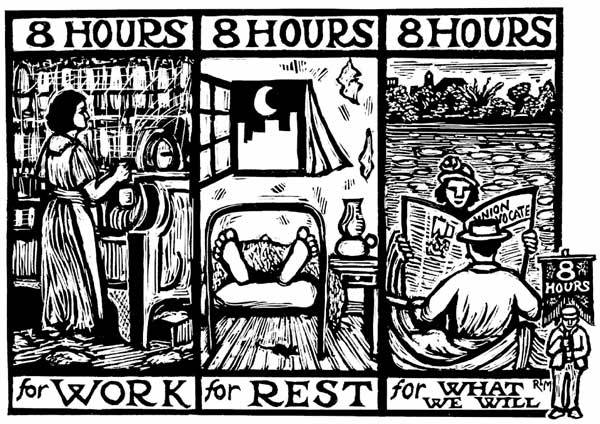
In the 3rd week of the class on US social movements, we looked at the 19th Century US Labor Movement, by reading chapter chapter 11 from Zinn’s book, entitled, Robber Barons and Rebels.
The chapter begins by framing the massive wealth gap that existed in the US, particularly after the Civil War. Zinn discusses how the Capitalist Class amassed wealth, through fraud, through exploitation of workers and by collaborating with politicians to pass laws that would benefit their interests. One example, was the legal system’s interpretation of the 14th Amendment to give corporations personhood, even though it was originally written to provide equal protection under the law for Black people after chattel slavery was abolished.
The rest of the chapter primarily addresses what organized labor was doing to confront the Robber Barons and the evolving system of Capitalism in the US.

Like we have done in pervious posts, we used our 8 framing questions for discussion during the 3rd class.
- What are the systems of power and oppression that existed during the period of history being discussed, and more importantly, what were the systems of power and oppression that the social movement was confronting, challenging or seeking to dismantle? People clearly identified the system of Capitalism as being the primarily system of oppression against workers, but they also talked about human rights and made clear that many of the unions excluded Black people from joining unions, which was a reflection of how deeply embedded White Supremacy was in the US Labor movement.
- What else was happening in the country or around the world that may have influenced how both the systems of power/oppression and the social movement responded? The group discussed how the US push to further Settler Colonial expansion was taking place, the construction of the railroads, immigration policy, specifically towards the Chinese and how US imperialist expansion in Cuba, Puerto Rico and the Philippines impacted working class people.
- In what way(s) did the social movement organize itself. Centralized, decentralized, autonomous, etc. Unions tended to be more centralized in their style of organizing, particularly with craft unions, although there were groups like the IWW who were more autonomous in their organizing approach, where anyone who wasn’t a boss or part of the Capitalist Class could join.
- What were the goal(s), strategies and tactics of the social movement? Unions inherently want to create more democracy in the work place, around wages, working conditions, etc. Only a few unions had the goal to dismantle Capitalism, specifically the IWW or unions that had a more socialist or anarchist critique. The tactics that were used involved strikes, boycott, the creation of worker centered media, attempts to create a worker-centered political party, plus the creation of cooperatives and co-op structures. The group also talked about how unions did not have a problem with the use of force and that the US Labor Movement had a fairly bloody history, particularly because of the types of repression that the Capitalist Class used. The group also talked a bit about the Haymarket Uprising and how it impacted worker organizing, particularly away from business unionism to a socialist or anarchist critique of Capitalism.
- How did the system of power/oppression push back against the demands and gains made by the social movement? The Capitalist Class always tried to undermine or suppress union organizing, sometimes by hiring armed thugs like the Pinkertons or getting politicians to bring in the military to suppress worker uprisings. Industrialists also tried to break strikes by using scab labor, thus pitting workers against each other. It was also mentioned that the Capitalist Class was able to utilize the dominant newspapers to defend the Capitalist Class, especially since most larger newspapers were owned by members of that class.
- Were their intersectional aspects of the struggle the social movement was engaged in? As was mentioned earlier, there were only a few unions who had a more intersectional approach to labor organizing, like the IWW. Too many unions, like the American Federal of Labor were business unions, which were very accommodating to the Capitalist Class.
- How did the social movement impact other existing or future social movements? The US Labor Movement did demonstrate the potential power that organized workers can have, particularly those that had a more socialist or anarchist orientation. We discussed how an organizer like Eugene Debs had evolved during his lifetime, away from craft unionism to a strong critique of Capitalism.
- How was the social movement compromised or co-opted, and by which external forces were they compromised or co-opted? Here we discussed how the worker-centered political parties were often co-opted by the Democrats, how business unions were inherently coopted by the Capitalist Class and how the exclusion of Black people and women in most of the unions at that time worked in favor of those in power.
Here are some addition resources to further explore the US Labor Movement:
100 Years of Labor in the USA, by Daniel Guerin
The History of the Standard Oil Company, by Ida M. Tarbell
The Taming of the American Crowd: From the Stamp Riots to Shopping Sprees, by Al Sandine
From the Folks Who Brought You the Weekend: A Short, Illustrated History of Labor in the US, by Priscilla Mural & A.B. Chitty
Taking Care of Business: Samuel Gompers, George Meany, Lane Kirkland and the Tragedy of American Labor, by Paul Buhle
The Fall of the House of Labor, by David Montgomery
Class War USA: Dispatches from Workers Struggles in American History, by Brandon Weber
For All People: Uncovering the Hidden History of Cooperation, Cooperative Movements, and Communalism in America, by John Curl
Strike! How the Furniture Workers Strike of 1911 Changed Grand Rapids, by Jeffrey Kleiman
Capitalism: A Structural Genocide, by Garry Leech
The 1937 Woolworth’s Sit-Down: Women Strikers Occupy Chain Store, Win Big, by Dana Frank
Wobblies! A Graphic History of the Industrial Workers of the World, edited by Paul Buhle & Nicole Schulman
Household Workers Unite: The Untold Story of African American Women Who Built America, by Premilla Nadasen
Selling Free Enterprise: The Business Assault on Labor and Liberalism 1945 – 1960, by Elizabeth Fones-Wolf
Defending Slavery: Proslavery Thought in the Old South, by Paul Finkelman
A History of America in Ten Strikes, by Eric Loomis
A History of the Labor Movement in the US, by Philip Foner
Haymarket Scrapbook, Edited by Franklin Rosemont & David Roediger
The Wages of Whiteness: Race and the Making of the American Working Class, by David Roediger
Corporations Are Not People, by Jeffrey Clements
The Rich Don’t Always Win: The Forgotten Triumph Over Plutocracy that Created the American Middle Class 1900 – 1970, by Sam Pizzigati
The Age of Acquiescence: The Life and Death of American Resistance to Organized Wealth, by Steve Fraser
A People’s History of Poverty in America, by Stephen Pimpare
All Labor Has Dignity: Martin Luther King Jr., edited by Michael Honey
Strike! By Jeremy Bretcher
Unelected Downtown Development Authority gives more public money to downtown businesses for outdoor dining in the middle of the winter and amidst the pandemic
 On Wednesday, WOOD TV8 reported that the Downtown Development Authority, allocated an additional $250,000 to winterize outdoor dinning in downtown Grand Rapids.
The funding for this project has already reached $625,000, since it was started in October of 2020. The money for the Winter Ready Grants comes directly from the City of Grand Rapids, which has set aside $1 million in economic relief, all of which is reflected in the DDA agenda for the February 10th meeting.
The WOOD TV8 story also includes a list of downtown restaurants that have benefited from this program.
Now, in one sense it may appear that the Downtown Development Authority’s (DDA) decision to provide these funds to restaurants who have been impacted from the COVID crisis, since we know that the restaurant sector has been hit hard with statewide orders making it either illegal to serve food indoors or to limit the amount of patrons in these establishments.
But here is the thing, the DDA is using public money from the City of Grand Rapids, taxpayer money, yet the public has no say in how this money is being allocated. On top of the fact that the public has no say in how public money is being used, there are also issues like the hundreds who have no housing, thousands of families that are facing eviction, thousands of families who are struggling to afford food, utilities and employment, also in the midst of this pandemic.
So, there are really two issues at stake here. First, there is the issue of the public being virtually excluded from making decisions about how this COVID relief money is being used. Would the public, if given the opportunity to really have a say in these matters.- which would probably require the city to adopt a Participatory Budgeting process – would the public decide that outdoor dinning in the middle of the winter be a priority or the housing, food and utility needs of thousands of families be the priority?
The other important issue, which is rarely discussed in the news media, is the fact that the group of people making these decision in regards to downtown Grand Rapids, the Downtown Development Authority (DDA), is a body of unelected people who are appointed by the City, with most of those on the DDA Board representing systems of power. Here is a list of who is currently on the DDA Board, which entities they represent (as listed on the DDA site) and which other entities they are involved in that impact their decision making in this role.
- Mayor Rosalynn Bliss
- Richard Winn – Amway Hotel Corporation, also sits on the board of the Convention Arena Authority
- Luis Avila – Varnum Law Firm
- Kayem Dunn – Professional Consultant
- Jermale Eddie – Owner of Malamiah Juice Bar
- Greg McNeilly – Winquest Group (DeVos), also is the President of the DeVos created Michigan Freedom Fund
- Jim Talen – former Kent County Commissioner
- Diana Sieger – Grand Rapids Community Foundation
- Jen Schottke – ABC Western Michigan (business), also is on the Board of the Grand Rapids Public Schools and has received sizable campaign support from the GR Chamber of Commerce and the Secchia family since 2016.
As long as unelected boards are allowed to exist in this city, it just perpetuates less accountability over how public money is spent.
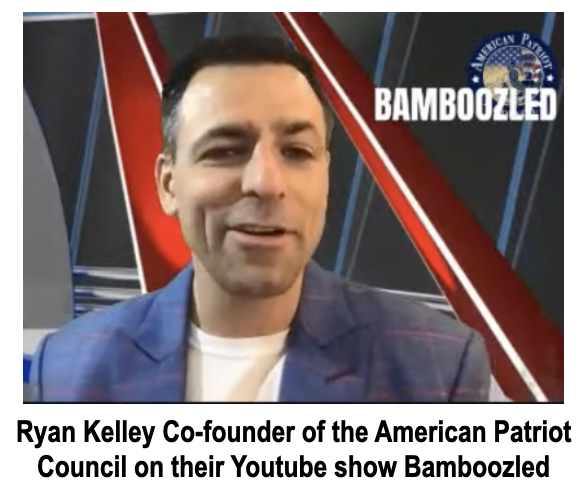 The latest posting from the American Patriot Council, further demonstrates both their loyalty to Donald Trump and their penchant for distorting the truth.
On February 9th, the American Patriot Council post a short piece entitled, FBI Plays Pickle with Truth about Mostly Peaceful Protests At the Capitol.
Despite their misapplied use of a baseball term, the American Patriot Council article is primarily a full on attempt to defend by Donald Trump and those who stormed the US Capitol building on January 6th. Early on in the article it states:
A few bad actors assaulted police, broke windows, and entered the building before police opened the barrier, letting hundreds more inside. The problem for the FBI, is that they have already alleged that some of the protesters planned an “insurrection” in advance. The FBI has vowed to take a hard stance against anyone involved on the 6th. This new, hard line against protestors has already raised questions because they have largely done nothing as terror groups like Antifa and BLM have been rioting steadily since last May. Now, even more questions arise as many ask: if Trump incited the few bad actors on January 6, how did protesters plan it in advance?
Such claims are worth deconstructing. The American Patriot Council writer uses the same phrase – a few bad apples – that has been presented by systems of power and police apologists, whenever police murder Black people. The next sentence demonstrates how morally bankrupt the phrase – a few bad apples – really is, since the American Patriot Council writer then writes, assaulted police, broke windows, and entered the building before police opened the barrier, letting hundreds more inside. Some of the protesters did indeed assault cops and destroyed property, but the writer fails to acknowledge that the protestors also forced their way into the building, thus “letting hundreds more inside.” If the hundreds more were able to enter the US Capitol because other protesters assaulted cops, which included hitting them and knocking them down, then those who entered are also complicit with these assaults by the fact they only enter because of the assaults.
The other major point of misinformation in the American Patriot Council post is the following:
This new, hard line against protestors has already raised questions because they have largely done nothing as terror groups like Antifa and BLM have been rioting steadily since last May.
White Supremacists and White Nationalists have long been known to be the most threatening to people in the US, particularly towards Black, Indigenous and other communities of color. Hell, even the FBI and the Department of Homeland Security have identified these groups as representing domestic terrorism. However, the FBI nor the DHS should be considered credible sources on this matter, since both of the groups have a history of targeting Black, Indigenous and other communities of color. More recently, the FBI has targeted, what they refer to as “Black extremist groups”, and historically Black militants and moderates have been tracked by the US government, from Marcus Garvey to Dr. King. In addition, the FBI created a program named COINTELPRO, which was used to monitor, harass, infiltrate and even assassinated Black Freedom Struggle leaders in the 1960s and 70s. (See The COINTELPRO Papers: Documents from the FBI’s Secret Wars Against Dissent in the United States, by Ward Churchill and Jim Vander Wall.) The Department of Homeland Security, which was created after 9/11, has done a great deal to monitor, suppress and persecute Black, Indigenous and Arab Americans, a practice which was codified after the Patriot Act was adopted in October of 2001.
The American Patriot Council then goes on to say that law enforcement groups have, “done nothing as terror groups like Antifa and BLM have been rioting steadily since last May.” First of all this is patently false. Federal, State and local law enforcement agencies have engaged in significant repression of Black Lives Matter and antifa groups since last May. Even in Grand Rapids, the level of harassment and intimidation against those who have been protesting since the May 30th rebellion is significant, as we have documented.
In communities like Portland, the level of state repression against groups has been significant, which even included federal agents in unmarked vehicles attacking and arresting people involved in the anti-White Supremacy and anti-police brutality protests. Not only are these claims false, we have noted in previous posts that the American Patriot Council has gone out of their way to denounce Black Lives Matter groups, even referring to them as fascists in a video they posted in November.
The rest of the very short and not very well written post from the American Patriot Council consists of; 1) the use of ridiculous language like “radicals in Congress”, which is just code for anyone who didn’t agree with Trump; and 2) a weak argument that Trump was not communicating with those who attacked the US Capitol prior to the January 6th action and that he did not incite them to attack the US Capitol. If people are looking for a connection to the far right and the Trump administration, which have been in communication during the entire four years that Trump was President, then I would suggest you read the newly published book by Brendan O’Connor, Blood Red Lines: How Nativism Fuels the Right.
Undocumented Immigrants are still being targeted for deportation, despite the 100 Day Moratorium, even in Kent County
 On January 22, President Joe Biden signed an Executive Order announcing a 100-day deportation moratorium. However, deportations can still occur under the following conditions:
- You entered the United States on or after November 1, 2020;
- You are engaged or suspected of engaging in terrorism or espionage, or U.S. Immigration and Customs Enforcement (ICE) believes you pose a danger to national security; or
- You choose to be deported.
However, despite the Executive Order signed over two weeks ago by President Biden, there are undocumented immigrants who are still being deported. On February 1st, it was reported in numerous dominant news news sources that undocumented immigrants were still being deported. From US News and World Report:
A federal judge last week ordered the Biden administration not to enforce a 100-day moratorium on deportations, but the ruling did not require the government to schedule them. In recent days, U.S. Immigration and Customs Enforcement has deported immigrants to at least three countries: 15 people to Jamaica on Thursday and 269 people to Guatemala and Honduras on Friday. More deportation flights were scheduled Monday.
Now, there have been reports, like the one in Teen Vogue on January 25th, that ICE officials may not be complying with the Biden administration’s deportation moratorium. Such reports might be true and ICE officials may be refusing to comply with the 100 Day Moratorium on deportations. However, what is important for those who want immigration justice, is that we need to first and foremost center the lived experiences of the undocumented community and their families.
If the undocumented immigrant community is continuing to experience fear, continuing to be arrested, detained and deported by ICE agents, then those of us who claim to be allies/accomplices in their struggle should do whatever we can to challenge this ongoing form of state repression.
ICE Violence in Kent County
Since the beginning of COVID, the level of ICE activity in West Michigan has reduced. Fewer people were contacting GR Rapid Response to ICE and some people were being released from detention centers because of the high risk of contracting COVID in confined spaces, like detention centers, jails and prisons.
However, since the 2020 Election, specifically since the Biden Administration put in place the 100 Day moratorium on deportations, we have been in contact with some undocumented immigrant families that are facing deportation. Like most of us, these members of our community were confused and angered by the fact that they were being targeted for deportation, when a moratorium on deportations has been in place since January 22. One Guatemala I spoke with, told me that their faith in politicians has virtually disappeared, since this person can’t understand why they are being targeted for deportation, while there is a deportation moratorium.
In addition, the Kent Community Bond Fund has also received several recent requests for financial assistance to bond members of the undocumented community out of detention, which is a significant change since last March, when the COVID Stay at Home orders were put in place in Michigan.
Lastly, to add to the harm against the undocumented community, last week the Senate voted to not provide COVID Relief funds to undocumented immigrants. There were 8 Democrats who voted no on supporting undocumented immigrants, with both of Michigan’s Senators – Peters & Stabenow – voting with the GOP on this matter. This is so infuriating, especially since so many in the undocumented community do work that has been deemed essential since the beginning of COVID. This is exactly why groups like GR Rapid Response to ICE and Movimiento Cosecha GR have been making it clear that despite the new US administration, we cannot relax on demanding justice for the estimated 11 million undocumented immigrants living int he US. La Lucha Sigue!
The Devil is in the Details 2/9/2021: Cannabis monopolies and more corporate committee appointments for Grand Rapids
 This is our third installment of this posting, which takes a critical look at Grand Rapids politics and policies, based primarily on the public record, such as committee agendas and minutes.
There are two issues we want to focus on today, Cannabis monopolies and the continued corporate representation on local government committees.
Cannabis monopolies?
We noted in our first installment of this series in early January, the City Planning Commission approved several more recreational cannabis permits to SB VB Grand Rapids, LLC, FPAW Michigan, LLC and AEY Capital LLC. SB VB Grand Rapids LLC is registered in Michigan with its company address being in Plymouth, Michigan. M. Scott Bowen, a former City Commissioner and Grand Rapids and lawyer, was representing SB VB at the Planning Commission meeting in January.
FPAW Michigan, LLC is owned by Michigan Supply and Provisions, and owns several recreational cannabis facilities in cities across Michigan. AEY Capital LLC also has cannabis facilities across the state, with Sterling Heights, Michigan listed as the address for this business.
At the February 11th Planning Commission meeting, there will be public hearings for three more recreational cannabis facilities in Grand Rapids, all owned under the name of Green Skies – Healing Tree LLC. Green Skies – Healing Tree LLC will be represented by Victor Kattoula for all three public hearings. Green Skies – Healing Tree LLC also has numerous facilities in Michigan and in Grand Rapids. The address given for the business is also Sterling Heights, Michigan.
So, it seems that all three public hearings for recreational cannabis facilities during the February 11th, Planning Commission are for businesses that are not based in Grand Rapids. How is this promoting equity in Grand Rapids, and why doesn’t the city have stronger rules around limiting recreational cannabis facility ownership, which should give priority to local and businesses that are Black owned or owned by other individuals from communities of color? Wasn’t there lots of talk about how the decriminalization of cannabis would lead to undoing the harm of the War on Drugs, which disproportionately impacted Black and latinx communities? Why aren’t people more pissed off about this trend?
Corporate representation on GR Government Committees
The other issue we want to draw attention to today, is the re-appointment and new appointments of people from the corporate world to Grand Rapids government committees. There are three notable examples, based on the agenda for the February 9th City Commission meeting.
Mayor Bliss appointed John Van Fossen to serve another term on the Economic Development Corporation/Brownfield Redevelopment Authority. Van Fossen is the Senior Director of Government Affairs at Meijer, and prior to that he was doing similar work with government affairs for several other entities in the corporate world, based on his LinkedIn account. He also sits on the Economic Development Corporation, which serves as the defacto board for the Brownfield Development Authority. According to the City of Grand Rapids, the purpose of the Economic Development Corporation is to:
The Economic Development Corporation (EDC) assists enterprises in locating or expanding in the City of Grand Rapids by establishing project areas and providing financing and other assistance for both industrial development and some non-profit projects. The goal of the EDC is to alleviate and prevent unemployment and to strengthen and revitalize the City and State economy.
While the first part of this description is true, we all should question whether or not such an entity will actually alleviate and prevent unemployment. In addition, why is a Grand Rapids City government committee working to strengthen and revitalize the City and State economy? If this is really true, do we want people who represent corporations sitting at the table?
The second example is the re-appointment of Dante Villarreal to the SmartZone Local Development Finance Authority. Villarreal is the Vice President of Business & Talent Development for the Grand Rapids Chamber of Commerce. Some of you may remember his role of defending the decision to have Kent County Cares Act money for businesses hurt during COVID to go through the GR Chamber of Commerce, instead of allowing groups like the Hispanic Chamber of Commerce share that responsibility. During the January meeting of the SmartZone Local Development Finance Authority, Villarreal voted with his colleagues to extent a contract with the DeVos-created Start Garden to manage the City’s Equitable Economic Development and Mobility Strategic Plan. Start Garden will get another $362,500 for their services through June 30, 2021. Who sits at these tables matters!
The third and last example of who sits on government committees from the corporate world is
Lawrence Zeiser, who was appointment to the Board of Zoning Appeals. Zeiser works for the Wolverine Building Group and also acts as an independent “Management Consulting Professional.”
You can see just by these three examples that there is significant corporate representation on Grand Rapids government committees, specifically committees that have an impact on economic and so-called development issues. And like most local government decisions, this information flies under the radar for most residents, even though public money subsidizes virtually all of these projects.
DeVos controlled Amphitheater Project using public money will be voted on at the February 9th Grand Rapids City Commission meeting
 On Friday, MLive reported, “that the Grand Rapids-Kent County Convention Arena/Authority (CAA) approved an option agreement with the city to purchase part of a 17-acre stretch of property along the Grand River.”
In October, we reported that Grand Action 2.0 was planning to move forward with a proposal to build a large amphitheater in downtown Grand Rapids.
We also reported that the land in question for the proposed amphitheater, was owned by the DeVos family, specifically the old Charlie’s Crab restaurant and the adjacent land & parking area. One of the properties is owned by 63 Market Avenue Holdings LLC, which was not verified by local news sources, but 63 Market Avenue Holdings LLC is in the same address that houses the DeVos businesses and the various DeVos family foundations – 126 Ottawa Ave NW, Grand Rapids.
On November 10th, we reported on updated details about this proposal, which is even more insidious. During the Grand Rapids City Commission’s Committee of the Whole meeting on Tuesday morning, the City approved a Memorandum of Understanding (MOU), whereby the Amway Hotel Corporation, 63 Market Avenue Holdings LLC, the Grand Rapids-Kent County Convention/Arena Authority and the City of Grand Rapids, have agreed to enter into a private-public agreement to build a 14,000 seat outdoor amphitheater. You can read the details of this agreement from our previous article on this topic, which means that the City of Grand Rapids will spend over $6 million to move offices they have on Market Avenue, just south of the off ramp of US 131, in order to make space for the proposed amphitheater.
Friday’s MLive article cites someone from the Convention Arena Authority and it’s partnership with the City on this project, but fails to mention the other entities involved in the project, which we listed above, which includes the Amway Hotel Corporation and 63 Market Avenue Holdings LLC, both of which are controlled by the DeVos family.
 The MLive article also states that the City Commission will be deciding on this project and its use of public money, at their February 9 meeting. However, while the City Commission will be voting on this matter, they will be discussing it at the February 9 Committee of the Whole meeting, which is where these decisions are usually made. The Agenda Packet for the Committee of the Whole meeting, on pages 10 – 12, provides further details about the project and then Memorandum of Understanding (MOU). The Committee of the Whole recommends the adoption of the MOU, which suggests this is merely a formality and the City will once again use public money to support a project that the Convention Arena Authority will likely control.
It should also be reiterated that the Convention Arena Authority, which manages the Van Andel Arena, DeVos Place and the DeVos Performance Hall, is made up of a seven member Board of Directors. The representation of that board consists of 6 people from the corporate world and Mayor Bliss, which should tell you about who really benefits with this kind of representation.
At the Grand Rapids City Commission on the evening of February 9, they will be voting to approve this project. This matter is part of the Agenda for that meeting, so public comment for this project – where public money will again be used for private benefit – will be towards the beginning of the City Commission meeting.
GRIID Class on US Social Movements – Part II: The Civil Rights Movement/Black Freedom Struggle
 Over the next 8 weeks, we will be posting a summary of the class we are facilitating on US Social Movements. These posts will include a summary of the discussion, the questions we presented to frame each social movement that is discussed, a timeline and additional books that are relevant to each movement.
For the second class on US social movements, we discussed chapter 17 from Zinn’s book on the Civil Rights Movement/Black Freedom Struggle, a chapter entitled, “Or Does It Explode?” The chapter begins with a powerful poem by Langston Hughes. However, many of the participants commented on how similar the current Black Lives Matter movement is so similar to what was happening in the 50s, 60s and 70s. We discussed the similarities and the differences, and several people pointed out how systems of power and oppression have figured out more effective means of repression, while promoting diversity.
Some people commented on how heartbreaking all of this information was, which is a very normal and human response to systemic oppression. We also did discuss the amazing courage and commitment of this movement, from the work of people like Ida B. Wellls to Ella Baker, Dr. King to Fred Hampton, along with the countless individuals who participated in the Freedom Rides, the lunch counter sit-ins, the Montgomery Bus Boycott, the Deacons for Defense, the Poor People’s Campaign and the Black Panther Party for Self-Defense.
In the class we used a timeline of the 20th Century, which had critical points of the Civil Rights Movement/Black Freedom Struggle on the top, along with other important aspects of that century, which were connected to this struggle, which were listed on the lower half of the timeline shown here.

In addition, each of the participants were provided with a list of questions to help frame and facilitate a more focused discussion. We will list all 8 of the questions and a brief overview of what was discussed for each question.
- What are the systems of power and oppression that existed during the period of history being discussed, and more importantly, what were the systems of power and oppression that the social movement was confronting, challenging or seeking to dismantle? People responded to this question with the idea that people were fighting for greater equality and against segregation, but also that there was a growing sense during the evolution of the movement that equality and anti-segregation were not enough and that a broader sense of racial justice, equity and abolition of White Supremacy became the work of campaigns like the Poor People’s Campaign, SNCC, the Black Panthers, the League of Revolutionary Workers in Detroit and so many others who moved to adopt more militant direct action responses.
- What else was happening in the country or around the world that may have influenced how both the systems of power/oppression and the social movement responded? People talked about the anti-Colonial Movements around the world and how that influenced what was happening in the US. Again, the post-WWII Universal Declaration of Human Rights framework was important, plus US imperialism displayed in Vietnam, which got people to ask the fundamental question – why should I fight for so-called freedom abroad, when I don’t have it here. The example of boxing greater Muhammad Ali was discussed and his act of draft resistance. There was also some discussion about how Neo-liberall Capitalism was gutting public funding, along with the simultaneous shift from the war on poverty to the war on crime and the war on drugs, which were both designed to suppress Black dissent.
- In what way(s) did the social movement organize itself. Centralized, decentralized, autonomous, etc? Here, people did acknowledge that the movement was fairly decentralized and autonomous, except for larger actions like the 1963 March on Washington or the Poor People’s Campaign, which needed greater buy-in for these actions/campaigns from organizations all across the country.
- What were the goal(s), strategies and tactics of the social movement? It was difficult for people to identify one goal, but people did have a good discussion about the shift from civil rights to human rights, since human rights go further than the concept of civil rights. There were numerous strategies employed during this period, from education, coalition building, training in tactics, and direct action. Tactics included boycotts, marches, sit-ins, riots, voter registration, creating new political parties, civil disobedience, and self-defense.
- How did the system of power/oppression push back against the demands and gains made by the social movement? The system pushed back by adopting repressive programs like COINTELPRO, using infiltrators, pressuring groups to not be too militant, withholding funding, jailing people, using surveillance and the creation of non-profits as a means of diverting revolutionary energy to a more managed professionalism. There was additional discussion around how large foundations like the Rockefeller and Ford Foundations were giving lots of money away to get movements to shift from direct action to adopting a more social service model.
- Were their intersectional aspects of the struggle the social movement was engaged in? There was always a race, class and gender critique within the aspects of the Civil Rights Movement/Black Freedom Struggle. In addition, people identified the Vietnam War Resistance and how the draft impacted the Black Community, the formation of the original Rainbow Coalition and the growing emphasis on economic issues, even challenging Capitalism.
- How did the social movement impact other existing or future social movements? The Civil Rights Movement/Black Freedom Struggle clearly influenced the American Indian Movement, the Chicano Movement, the Young Lords and the anti-war movement. People also talked about how the current Black Lives Matter Movement has been influenced by the Civil Rights Movement/Black Freedom Struggle, although the current movement is not simply mimicking this period, instead the Black Lives Matter Movement is more committed to an abolitionist framework.
- How was the social movement compromised or co-opted, and by which external forces were they compromised or co-opted? Again, people discussed the role of non-profits, some of the more mainstream civil rights groups and even partisan politics, which did little to advance the goals of the Civil Rights Movement/Black Freedom Struggle.
Additional reading resources:
Ella Baker & the Black Freedom Movement: A Radical Democratic Vision, by Barbara Ransby
How Long? How Long?: African American Women in the Struggle for Civil Rights, by Belinda Robnett
Captive Nation: Black Prison Organizing in the Civil Rights Era, by Dan Berger
We Will Return in the Whirlwind: Black Radical Organizations 1960-1975, by Muhammad Ahmad
Radio Free Dixie: Robert Williams & the Roots of Black Power, by Timothy Tyson
The Deacons for Defense: Armed Resistance and the Civil Rights Movement, by Lance Hill
Many Minds, One Heart: SNCC’s Dream for a New America, by Wesley Hogan
Hillbilly Nationalists: Urban Race Rebels and Black Power, by Amy Sonnie and James Tracey
The Black Panthers Speak, by Philip Foner
When Affirmative Action Was White, by Ira Katznelson
The First Civil Right: How Liberals Built Prison America, by Naomi Murakawa
Creating A Movement with Teeth: A Documentary History of the George Jackson Brigade, edited by Daniel Burton Rose
The Speech: The Story Behind Dr. Martin Luther King Jr’s Dream, by Gary Younge
Lessons From Freedom Summer: Ordinary People Building Extraordinary Movements, by Kathy Emery, Linda Reid Gold & Sylvia Braselmann
A More Beautiful and Terrible History: The Uses and Misuses of Civil Rights History, by Jeanne Theoharis
Sundown Towns: A Hidden Dimension of American Racism, by James Loewen
Detroit I Do Mind Dying: A Study in Urban Revolution, by Dan Georgakas & Marvin Surkin
The Color of Law: A Forgotten History of How Our Government Segregated America, by Richard Rothstein
Going Down Jericho Road: The Memphis Strike, Martin Luther King’s Last Campaign, by Michael Honey
Caste: The Origins of Our Discontents, by Isabel Wilkerson
We Want Freedom: A Life in the Black Panther Party, by Mumia Abu-Jamal
The Blood of Emmett Till, by Timothy Tyson
How Europe Underdeveloped Africa, by Walter Rodney
Truth and Revolution: A History of the Sojourner Truth Organization 1969 – 1986, by Michael Staudenmaier
Race, Rape, and Lynching: The Red Record of American Literature, by Sandra Gunning
Martin & Malcolm & America: A Dream or a Nightmare, by James Cone
From the War on Poverty to the War on Crime: The Making of Mass Incarceration in America, by Elizabeth Hinton
Race for Profit: How Banks and the Real Estate Industry Undermined Black Homeownership, by Keeanga-Yamahtta Taylor
The Fifty-Year Rebellion: How the US Political Crisis Began in Detroit, by Scott Kurashige
Hitler’s American Model: The United States and the Making of Nazi Race Law, by James Whitman
This Nonviolent Stuff’ll Get You Killed: How Guns Made the Civil Rights Movement Possible, by Charles Cobb
Black Power : The Politics of Liberation, by Kwame Ture and Charles Hamilton
Films:
Negroes with Guns
King in the Wilderness
Freedom Riders
I Am Not Your Negro
The Black Power Mixtape 1967 – 1975
Slavery by Another Name
Why I think Ryan Kelley’s announcement to run for Governor in Michigan can be a benefit to the anti-racism/Black Lives Matter movement
 There has been a fair amount of coverage lately in West Michigan-based news media about one of the co-founders of the American Patriot Council, Ryan Kelley.
Most of the news coverage has centered around his involvement in the January 6 attack on the US Capitol by White Nationalists, particularly whether or not Kelley entered the building or not. Frankly, I’m not as invested in whether or not Kelley entered the US Capitol on January 6, since I think the more important question is the role that he and fellow American Patriot Council play in fostering a political climate for White Nationalists and White Supremacy, something I pointed out in regards to his connection to some of those arrested for attempting to kidnap Governor Whitmer last Fall.
In addition, Ryan Kelley has been in the news because there is an effort to get him removed from the Allendale Township Planning Commission. Those involved in that effort have tried to get him removed because of his defense of the Civil War statue in Allendale, because of his connection to the Whitmer kidnapping plot and now because of his involvement in the January 6 White Nationalist attack at the US Capitol. Getting Ryan Kelley removed from the Planning Commission would be a win, but the more important goal should be to expose and undermine the American Patriot Council and all groups and institutions that promote White Supremacy.
In some ways, I think it is beneficial to the larger anti-racism/Black Lives Matter movement that Ryan Kelley has decided to run for Governor of Michigan. I say this, because it provides the anti-racism/Black Lives Matter movement an opportunity to talk about, challenge and confront White Supremacy in our communities. Having Ryan Kelley run for Governor will not only provide us with an opportunity to expose him and the American Patriot Council, it will expose those who contribute to his campaign. More importantly, Kelley’s decision to run for Governor should force all other candidates to take a much more radical stance on racial justice and if they don’t, the anti-racism/Black Lives Matter movement should pressure them to do so. Look, we can not be content with with saying, “at least the candidate we will vote for, isn’t a White Nationalist” or “at least our candidate didn’t participate in January 6 attack in the US Capitol.” Movement politics should also work towards moving politics towards a more radical and transformative position instead of being content with business as usual.
With Ryan Kelley entering the race for Governor of Michigan, the anti-racism/Black Lives Matter movement should begin articulating what a vision for racial justice could look like in Michigan and then refuse to back any candidate for office, unless they adopt the platform and vision they put forth. The problem with a lesser evil voting mentality is that we fail to recognize the power we have when using the vote as one of the tactics in movement work. We should not be begging candidates to adopt more progressive platforms, candidates should be begging movements for their platforms and voters should be telling candidates that they will not vote for them unless movement platforms are adopted by candidates. Stop giving your power away!
Is rejoining the Paris Accords really cause for celebration? The Climate Justice Movement says otherwise
 Thank you President Biden for making one of your first priorities to rejoin the Paris Accords! This has been an important issue to Mayors across our country as we believe it is critically important for the United States to being a part of leading the world on climate action.
Grand Rapids Mayor Rosalynn Bliss posted these words on her Facebook page recently, words that are worth examining in this post.
On an emotional level, I get why Mayor Bliss, and anyone else for that matter, would celebrate the fact that the Biden Administration is rejoining the Paris Accords. The level of climate denial in the Trump Administration was off the charts, so returning to the Paris Accords seems like a step in the right direction.
However, just undoing some of the Trump era policies is a pretty low bar. More importantly, as many political commentators have pointed out, the status quo that existed before Trump is what led to Trump. This is especially the case when it comes to Climate Change, Climate Justice and the Paris Accords.
The context of the above comment from Mayor Bliss, is rooted in her role with the Climate Mayors statement, which also celebrated a return to the Paris Accords. But what do we know about the Paris Accords and what does the rejoining of these accords by the Biden administration actually mean for Climate Justice.
Patrick Bond, a South African writer and Climate Justice activist, wrote an important assessment of the Paris Accords, just after the Biden Administration had announced it was rejoining. There are many points that Bond makes in his recent article, but one point he makes is worth including here:
My additional concerns are about how during the 2010s, United Nations Framework Convention on Climate Change (UNFCCC) policy was manipulated by Biden’s climate envoy John Kerry (Secretary of State from 2013-17) and other staff from the Obama-era State Department and U.S. Environmental Protection Agency (including former pro-fracking EPA head Gina McCarthy, now Biden’s senior climate advisor). From Copenhagen’s 2009 United Nations Conference of the Parties COP15 to the 2016 Marrakesh COP22 – and especially at Durban COP17 in 2011 and Paris COP21 in 2015 – their corporate neoliberal agenda held sway. This group’s climate-policy imperialism did enormous harm and it’s vital to recall why.
Bond goes on to identify what the major short comings of the Paris Accord are:
The Paris Climate Agreement failed to:
- adopt sufficiently deep and binding global emissions reduction requirements, fairly distributed (in contrast to voluntary 2015 Nationally Determined Contributions that will cause at minimum 3-degree heating by 2100 – with only vague hopes of ratcheting up ‘ambition’), combined with a make-believe 1.5 degree aspirational target which is simply a talk-left distraction, while walk-right pollution continues unabated;
- establish accountability mechanisms including penalties (e.g. ‘border adjustment tax’ climate sanctions);
- apply carbon taxation judiciously and democratically (not regressively and top-down, as imposed in France and Ecuador in 2018-19), and dispense with failed carbon trading and offset gimmicks (implicit in most scam-riddled ‘net zero’ and ‘carbon-neutral’ claims, within the resurgent emissions-trading markets);
- respect historical ‘polluter-pays’ responsibilities for the ‘climate debt’ to cover ‘loss and damage’ and to compensate for poorer countries’ unused carbon space;
- ensure a job-rich Just Transition away from carbon-addicted economies (thus entailing new commitments to localized, labor-intensive production processes that had been eviscerated by neoliberal globalization);
- allow poor countries to adopt climate-friendly technology without Intellectual Property restrictions;
- convincingly incorporate and cut military, maritime and air-transport sectoral emissions (three areas long considered by imperialist powers as illegitimate for regulation); and
- compel fossil fuel owners to cease new exploration (and most current extraction) and simultaneously revalue their ‘unburnable carbon’ as ‘stranded assets’ accordingly (instead of allowing an extremely chaotic global commodity market and unreliable fossil financiers to bear this burden).
Essentially, what Patrick Bond and other Climate Justice proponents argue is that the Paris Accords are largely a market based solution to the Climate Crisis.
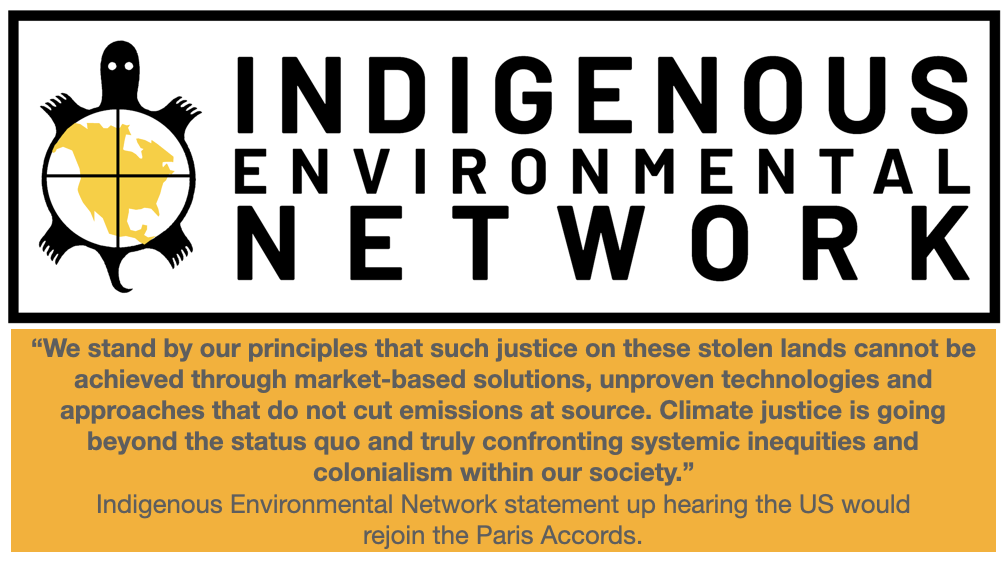
In addition, one thing that is problematic about the Paris Accords is that the agreement was created without consulting frontline communities in the fight for Climate Justice, particularly indigenous community and groups like the Indigenous Environmental Network, which made the following statement about the Biden Administration’s decision to rejoin the Paris Accords:
“We stand by our principles that such justice on these stolen lands cannot be achieved through market-based solutions, unproven technologies and approaches that do not cut emissions at source. Climate justice is going beyond the status quo and truly confronting systemic inequities and colonialism within our society.”
Frontline Climate Justice groups have been making these kinds of statements for several decades and they have consistently been against the Paris Accords because it isn’t a strong enough framework to fight the Climate Crisis. What follows is their assessment of the Paris Accords back in 2015:
The Paris Climate Agreement of December 2015 is a dangerous distraction that threatens all of us. Marked by the heavy influence of the fossil fuel industry, the deal reached at the United Nations Framework Convention on Climate Change (UNFCCC) never mentions the need to curb extractive energy, and sets goals far below those needed to avert a global catastrophe. The agreement signed by 196 countries does acknowledge the global urgency of the climate crisis, and reflects the strength of the climate movement. But the accord that came out of the UNFCC’s 21st Conference of Parties (COP21) ignores the roots of the crisis, and the very people who have the experience and determination to solve it.
Our analysis of the Paris Agreement echoes critiques from social movements around the world, led by those most impacted by both climate disruption and the false promises that governments and corporate interests promote in its wake. In order to effectively develop and support our next organizing steps, we must have a clear and honest understanding of the challenges and conditions we are facing. We have five core concerns with the content of the Paris Agreement:
The Agreement relies on voluntary versus mandatory emission cuts that do not meet targets scientists say are necessary to avoid climate catastrophe.
The Agreement advances pollution trading mechanisms that allow polluters to purchase “offsets” and continue extremely dangerous levels of emissions.
The Agreement relies on dirty energies and false promises including hydraulic fracturing (fracking), nuclear power, agro-fuels, carbon capture and sequestration and other technological proposals that pose serious ecological risks.
The operating text of the Agreement omits any mention of human rights or the rights of Indigenous Peoples and women.
The Agreement weakens or strips the rights of reparations owed to the Global South by the Global North.
Again, we cannot be content with just returning to the business as usual norm. We really need to listen to those on the frontlines of the Climate Justice Movement!
Sponsored Content and Greenwashing: MLive provides a platform for Enbridge to promote themselves as sustainable
On Friday, January 29th, one of the first items that showed up on MLive’s newsfeed was this item from the Enbridge Corporation, shown here below.
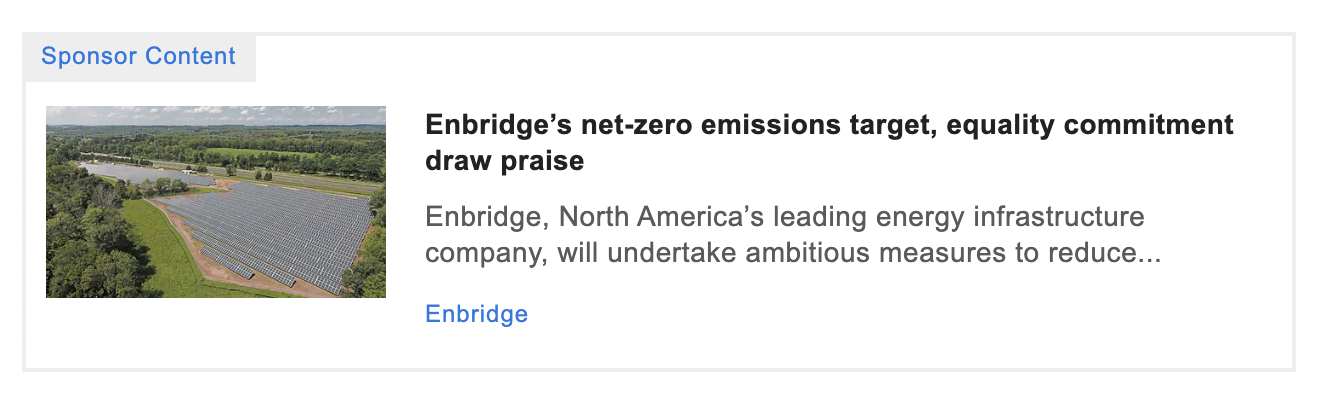
Now this item does say Sponsored Content, yet it is in the normal newsfeed line up. Everything that runs as an advertisement on Live, states that it is an advertisement. In addition, the ads on MLive are stand alone, often to the side and in now way could be confused as part of their regular newsfeed.
It is also instructive that the item from Enbridge is identified as Sponsored Content. Why not just call it an ad, since that is exactly what it is. The so-called Sponsored content from Enbridge is paid for, just like ads are, so why confused readers or blur the lines with the deceptive term sponsored content. All ads are content and all ads are paid for, just like the Enbridge sponsored content that appeared last Friday on MLive.
The Sponsored Content is a Lie
If one were to click on the Sponsored Content that the Enbridge Corporation paid for on MLive, you would go to this link.
The sponsored content from Enbridge is simply a propaganda piece talking about how the company will reduce greenhouse gas emissions in their production process. The paid content by Enbridge also wants you to believe that their involvement in the One Future coalition demonstrates their commitment to sustainability.
While some people might welcome the Enbridge Corporation’s claim to work towards sustainability, their claims should be called out as nothing more than a lie. The Enbridge Corporation’s very existence is to extra and transport fossil fuels, like nature gas and oil. How is it even possible for a company that makes billions off the trafficking of fossil fuels to in any way at all be sustainable? It can’t, but that doesn’t stop the company from engaging in the fraudulent practice of Greenwashing.
 Enbridge is the primary transporter of Alberta Tar Sands oil, which many environmental groups and climate justice groups have identified as the most polluting/greenhouse gas emitting project on the planet.
It’s bad enough that MLive takes money from the Enbridge Corporation, but it is even more insidious to allow them to promote themselves as practicing sustainability. The only way for the Enbridge Corporation to actually practice sustainability, would be to shut down every operation they current are involved in and to undo the harm they have caused for decades, particularly with Indigenous communities all across North America.

