Grand Rapids participates in the 1963 March on Washington: Media Coverage and White Paternalism
Fifty-eight years ago this week, hundreds of thousands of people participated in the 1963 March on Washington. Dozens of people from Grand Rapids also made the trek to demand racial justice, jobs and freedom. In what follows we take a look at the Grand Rapids Press coverage of the march in Detroit (in June of 1963) and the larger march on August 28th in Washington, DC. Here is a link to all of the articles from the GR Press for both marches in 1963.
Detroit march was a testing ground for DC
 There were two articles in the Grand Rapids Press (Pages 1 – 4) about the march on Detroit in June of 1963, some two months before the march on Washington. Neither of the articles on the Detroit march were on the front page and a great deal of the focus was on whether or not the march was peaceful. There was some coverage of the fact that a list of demands on civil rights were made, but only a few of those demands were mentioned in the articles.
The June 23, 1963 march on Detroit was organized primarily by Dr. King’s organization, the Southern Christian Leadership Conference and the UAW. Both Dr. Martin Luther King Jr. and the UAW President Walter Reuther were featured speakers at the march.
In many ways, the Detroit march was held as sort of a test run to see if these organizations could pull off a march with hundreds of thousands of people. Detroit was chosen because the UAW had a large number of union members in the Motor City and Detroit was also one of the most critical northern cities with a major black population that was representative of police violence against blacks and other forms of structural racism.
In Preparation for the 1963 March on Washington
The first article on the 1963 march on Washington, DC, is a piece about the various groups that were organizing delegations to participate. The GR Press article (on page 5) states that the UAW, the NAACP and the Congress on Racial Equality (CORE), were all sending people to participate in the historic march.
The same article in the GR Press mentions that the AFL-CIO, the Grand Rapids Urban League and the Human Relations Commission from the City of Grand Rapids, did not send their members to the historic march.
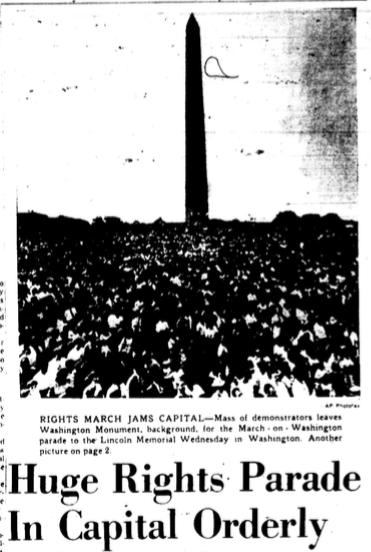 The first article on the march in August of 1963 (page 6) uses a photo of marchers with the Washington Monument in the background, with the headline that read, “Huge Rights Parade in Capital Orderly.”
The national mainstream news coverage of the march on Washington was obsessed with the idea that the only way that the march could be successful would be if it was passive and orderly. In fact, most of the major labor organizations and the Catholic Church told Dr. King and the other Civil Rights leaders that if civil disobedience would be part of the march, they would pull their support.
Another aspect of the march on Washington, DC in 1963, which is rarely discussed or even acknowledged, is that the Federal government had mobilized the military and law enforcement to make sure that people were not going to disrupt business as usual in the nation’s capital.
According to Gary Younge’s book, The Speech, the White House codenamed the March on Washington, Operation Steep Hill. Younge writes, “One thousand troops and 30 helicopters were deployed in the DC area. The Pentagon put 19,000 troops on stand by. The Eighty Second Airborne Division, based in Fort Bragg, North Carolina, stood by with C-82 boxcars loaded with guns, ammunition, and food, ready at a moment’s notice to make the 320 mile trip to Andrews Air Force Base in Maryland, from which soldiers would be dispatched to the Mall by helicopter to quell riots. About six thousand law enforcement officers of different kinds would be deployed that day, all armed with guns, clubs and tear gas. The one concession to civil rights sensitivities was that there would be no dogs.”
This was the context in which the march took place, in terms of what the state was willing to allow, for those that took part in the historic march.
On page 10 of the document, the Grand Rapids Press did publish a list of the 10 demands that the marchers were bringing to the nation’s capital that day.

The very next article on page 11 & 12, shows marchers from Grand Rapids meeting with then Congressman Gerald R. Ford, with a headline reflecting how Congress was not in a hurry to listed to the demands of the marchers.
The subsequent article on page 13 provides some feedback from the Kennedy Administration on the historic march. Kennedy is quoted as saying he thinks the march help to further the “Negro cause.” What the GR Press article does not mention is that President Kennedy pleaded with the organizers of the 1963 march to stress personal responsibility. “It seems to me with all the influence that all you gentlemen have in the Negro community, that we could emphasize, which I think the Jewish community has done, on educating their children, on making them study, making them stay in school and all the rest.” Such sentiment is in direct contradiction of what the march organizers were demanding.
 One final article from the Grand Rapids Press coverage of the 1963 March on Washington, was written after the marchers had returned from DC. The photo that accompanies the article shows 5 people, 4 with the NAACP and one from the UAW, looking at newspaper coverage of the march.
The article that accompanied the photo provided some basic reflection from the 5 featured in the article, about what they liked and what they were impressed by. Unfortunately, the article did not reflect any sense of urgency that the marchers had brought to DC that day, not much of a sense of the efforts put into making the march happen or the larger historical context of the 1963 march on Washington. Besides Gary Younge’s book, The Speech, another excellent resource is, Nobody Turn Me Around: A People’s History of the 1963 March on Washington, by Charles Euchner.
The Grand Rapids Press editorial and White Paternalism
In Jeanne Theoharis’s important book, A More Beautiful and Terrible History: The Uses and Misuses of Civil Rights History, she makes the point that we often look back to events like the 1963 march on Washington and think that the majority of the country supported such events.
The reality is much different. In fact, the federal government was monitoring the organizing leading up to the march and the event that day on August 28, 1963. The federal government was so concerned about what might be said, that they had it set up that they could cut the sound system when necessary, to make sure people were not calling for an uprising that day.
The major news outlets around the country reported on the march with some suspicion, specifically how the march was too polarizing and that it did not reflect what most Americans wanted. This sentiment was true, based on polls taken during the 1960s. According to Theoharis, a Gallup Poll taken in 1961, showed that only 22 percent of Americans polled supported the Freedom Rides. In 1968, another poll that was taken by Gallop, shortly after Dr. King was assassinated, showed that 73% of whites said that blacks in their community were treated the same as whites.
As an example of how the news media played a role in forming public opinion about the Black Freedom Struggle, let’s take a look an editorial from the Grand Rapids Press about the 1963 March on Washington.

Besides the Grand Rapids Press editorial on the 1963 march on Washington, we include three opinion pieces from non-Grand Rapids sources. We include these pieces, because this is what people were reading in the Grand Rapids Press in the editorial section, which also influences how people understand what took place in the summer of 1963 – which are linked here.
The Grand Rapids Press editorial uses supportive language and taken out of context might seem like those who wrote this editorial were endorsing the 1963 march on Washington. However, upon closer review, within historic context, we can see that this editorial is really framed through the lens of White Paternalism.
The Press editorial staff practices White Paternalism by using phrases like, “more orderly and better controlled.” This signals that had there been any civil resistance, the marchers would have lost all credibility in the eyes of the GR Press editorial staff. The fact is, that the Southern Christian Leadership Conference and other black groups involved wanted to have civil disobedience as part of the march, but they were pressured by the Kennedy administration, the AFL-CIO and the Catholic Church not to engage in that kind of action.
The Press editorial writer then goes on to say that “this was a responsible assembly,” and then he compares it to the negative response from David Lawrence’s commentary, which the Press published alongside their editorial. (see link above).
Apparently the restraint exhibited in the marchers was also a demonstration to the world that these kinds of actions need not be violent, which would surely have been the case if this took place in Russia, at least according to the GR Press editorial.
The rest of the editorial again valorizes the fact that there was no violence expressed on the part of the marchers. Nothing is included in the editorial about what it was that those who spoke or the march organizers were demanding from the federal government. In fact, the only person identified by name in the editorial, was Congressman Gerald Ford. Black voices were not centered in this editorial, indeed they were completely absent and seemingly irrelevant.
 Ironically, there was violence at the 1963 march on Washington. The violence was demonstrated on the part of the state, by rigging the microphone to cut off if what was said was not found acceptable. There was the threat of violence with the presence of over 1,000 cops ready to arrest people if they were not “orderly.” Then there was the violence of state surveillance, since we know that the communications between organizers was being monitored and their hotel rooms were being bugged by the FBI. In fact, there were an estimated 150 FBI agents there, just to monitor the crowd, according to Gary Younge’s book, The Speech.
In addition, there was the systemic violence, which is why thousands came to DC, to express their grievances. The segregation, the white supremacy and the brutality of police violence that black people experienced on a regular basis, were the grievances people brought to the nation’s capitol, as Dr. King pointed out in his speech at the march on Washington. King also made it clear that the federal government failed to make good on its promissory note to blacks to be granted equal rights. King makes it clear that the violence of poverty, poor housing and lack of jobs for black people was the violence that the system imposed on black people every day.
As we remember the historic march on Washington in 1963, we should all be asking ourselves why the same grievances are at the forefront of the Black Freedom Struggle 58 years later?
 To date, we have looked at the 990 documents for local foundations in 2021 for the Prince Family, the Richard & Helen DeVos Foundation, the Doug & Maria DeVos Foundation, the Dick & Betsy DeVos Foundation and the Dan and Pamela DeVos Foundation. Today, we want to examine the most recent 990 documents for the Cheri DeVos Foundation, also known as the CDV5 Foundation.
Of all of the DeVos family foundations, CDV5 is the one that people are least likely to know about. Named after Cheri DeVos VanderWeide. She is also a sibling of Dick, Dan and Doug DeVos, yet she has managed to not have the same kind of name recognition that the other children of Richard & Helen DeVos. Despite Cheri’s anonymity, the CDV5 Foundation has assets of $62 million dollars, according to GuideStar. Cheri DeVos has been involved in Amway, RDV Corp and other DeVos-owned entities. She attended 4 years at Hope College and like her siblings, makes significant contributions to the Republican Party every election cycle.
The CDV5 Foundation contributes to many of the same sectors that the other DeVos family foundations do, with a bit more emphasis on contributions that stay in West Michigan. Here is a breakdown of the CDV5 Foundation contributions for 2019, which is the most recent 990 document available to the public.
Conservative Christian groups
Hope Academy of West Michigan $292,885
Base Camp Urban Outreach $40,000
Bridge Street House of Prayer $115,000
Grand Rapids Initiative for Leaders $22,000
Keystone Community Church $400,000
Potters House $75,000
Rehoboth Christian School Association $100,000
Young Life $75,000
Think Tanks and Policy Organizations – These groups all have a documented history of promoting Capitalism, opposing labor unions, undermining public education, and create policy positions that are often adopted by state and federal lawmakers.
Mackinac Center for Public Policy $100,000
Higher Education – Many of these universities or colleges have buildings or business schools named after the DeVos family.
Grand Rapids Community College Foundation $750,000
Grand Valley State University $500,000
Hope College $150,000
Organizations that are run by DeVos Family members
West Michigan Aviation Academy $365,000
ArtPrize $50,000
Orlando Magic Youth Foundation $270,000
The three largest donations from the CDV5 Foundation are Kids Food Basket – $600,000, Grand Rapids White Water Inc. – $525,000, and the George W. Bush Foundation – $500,000. All three of these entities fit within the framework of DeVos foundation contributions, with Kids Food Basket being a charity that does not deal with root causes of hunger; Grand Rapids White Water Inc., which will promote business development/gentrification along the Grand River, particularly in the downtown corridor; and the George W. Bush Foundation, which props up the legacy of a President that embraced Corporate Capitalism and US Militarism.
 Yesterday, the national organization, Moms for America, held a press conference in Grand Rapids, to protest the growing number of schools that now have mask mandates in place because of the growing COVID threat.
Kimberly Fletcher, founder of Moms For America, along with Cindy Chafian, director of coalitions and engagement for Moms for America Action, both spoke during the press conference and were the only sources cited in an MLive article, headlined: Moms for America Action group calls for parents to ‘strike’ against K-12 schools that mandate masking.
Besides quoting two members of Moms for America, the MLive story provided minimal context on mask mandates in West Michigan schools. More importantly, the MLive article provides no information on the history and politics of Moms for America. This omission is significant, especially since Mom’s for America is very much a part of the far right movement in the US that embraces an ideology that places people in danger and contributes to real harm being done to some of the most vulnerable communities in the country.
According to the Moms for America website, it says that the group was founded in 2004 and originally operated out of Dayton Ohio. However, as the organization grew, Mom’s for American now lists Mansfield, Texas as its headquarters.
Moms for America’s mission states:
Our Mission is to build a foundation of liberty in the homes of America, through the mothers of America, to raise a new generation of patriots, and heal our nation from the inside out.
While the mission statement is rather vague, it is clear that Moms for America embrace a far right political perspective. All one has to do is investigate their website, their Facebook page, their Instagram account and their YouTube channel to get a sense of what their organization is all about.
I looked at their Facebook page going back as far as the Spring of 2020, and here are some of the things Mom’s for America has posted:
- Moms for America clearly condemns the Black-led uprisings that took place all over the country after the police murdered George Floyd. In fact, Moms for America regularly refers to Black Lives Matter as a Marxist entity that hates America.
- Moms for America made numerous posts in support of the nomination of Amy Coney Barrett, then celebrated her appointment to the US Supreme Court. Many of their posts also celebrated Barrett’s far right religious views.
- Moms for America condemns the teaching of Critical Race Theory and often posts that the country is being overrun with Socialist, because Marxism is being taught in the public schools.
- In March of 2021, Moms for America held a rally along the US/Mexican border called Secure Our Borders. At this rally they condemned the undocumented immigrants who enter the US, denote the fact that so many of the immigrants coming from Central America and Mexico are mothers with children.
- Moms for America was an integral part of the Stop the Steal protest around the US, thus clearly demonstrating their partisan bias in support of the GOP.
- Moms for America also held a rally near the US Capitol in Washington, DC, on January 5th, the day before hundreds of people stormed the Capitol building. The Mom’s for America organized rally on January 5th was called, Save the Republic.
These bullet points provide a pretty clear picture of what Moms for America is all about. So what about their leadership? The most visible leader within Moms for America is Kimberly Fletcher, who is the founder of the group and the person who spoke yesterday in Grand Rapids. Fletcher is a regular columnist for the online forum called Townhall, which also features columnists such as Ben Shapiro, Ann Coulter, Dinesh D’Souza, John Stossel and Pat Buchanan.
Other members of the leadership team of Moms for America include: Meredith Iler, President of The Strategic Alliance; Rose Tennent, the host of the radio show called Rose Unplugged https://www.roseunplugged.com/; Rebecca Friedrichs, who wrote the book, Standing Up to Goliath: Battling State and National Teachers’ Unions for the Heart and Soul of Our Kids.
All of the information we just provided is the kind of information that the MLive writer should have provided, yet didn’t. In addition, the mLive writer should have asked why Moms for America, a group that is based in Texas, would hold a press conference in Grand Rapids. In fact, this is an important question for all of us, especially for parents, students and community members who have serious concerns about public health and public safety. With Covid cases on the rise in Kent County, we should all be concerned about groups like Moms for America who claim to advocate for freedom, but in reality they threaten the health and safety of everyone in this community.
Misinformation and Copaganda: Why Johnny Brann Sr and Voice for the Badge are full of shit!
 Over the past several years the local group, Voice for the Badge, has made it clear that they will oppose any individual or community based group that is critical of the GRPD. Voice for the Badge first showed up at City Commission meetings when members of the Black community, Movimiento Cosecha GR and GR Rapid Response to ICE began to challenge the actions of the GRPD and even called for Captain VanderKooi to be fired for contacting Immigration and Customs Enforcement (ICE), just because the person was latinx.
In just the past year, Voice for the Badge has complained every time people in the community have called for defunding the GRPD. Not only have they complained when the community calls for defunding the GRPD, Voice for the Badge has made it clear that they are in opposition to the Office of Public Accountability and most of the City officials because they do not worship the GRPD.
Voice for the Badge is not a well organized entity, which relies primarily on their founder, Johnny Brann Sr. In fact, Mr. Brann is the only person who seems to make posts on their Facebook page. This actually makes it easier for those of us who are calling for the GRPD to be defunded, since Mr. Brann doesn’t have a very good analysis of policing, but it’s also because he regularly engages in disseminating misinformation on the VFB Facebook page.
For example, here is what Johnny Brann Sr. posted this past Tuesday, August 17th:
GRPD in the news again!!! Negative of course.
Media – How bout taking a week off and let our men and women in Blue take a breather. Then you can start back up reporting the negatives-like you normally do. If the media will ever report the other side-G.R. citizens would be flabbergasted with the seriousness of the issues in regards to our city being less safe for our citizens and our –GRPD due to many factors.
Make no mistake about it our city is currently less safe and it’s going to get worse.
Thank you,
Johnny Brann Sr
There are several things about this post that just are not based in fact, which we will get to. However, let’s start with the GRPD being in the news again. This reference is to a few news agencies highlighting a virtual public forum that the Grand Rapids Chapter of the NAACP had hosted, a forum that was questioning the efficacy of the GRPD wanting to use drones for surveillance in the city.
The NAACP forum was fundamentally about accountability and to demand that the public have more say on policing, in this case the GRPD’s use of technology. However, for Johnny Brann Sr. it is unacceptable to question the motives of the GRPD, since cops are not only heroes, but they “keep the rest of us safe.” Now, the news coverage in this case was not negative, it was actually a story that demonstrates that people in this city want to be engaged in the democratic process and want more accountability for how their tax dollars are being used. The GRPD gets their budget from Grand Rapids taxpayers, therefore those who live in this community have a duty and a right to question how the GRPD spends their money.
Johnny Brann Sr. doesn’t stop with just this one news story, he goes on to make the claim that news reporting is always negative when covering the GRPD. Maybe this message sells to people who don’t believe in critical thinking, but Johnny Brann Sr’s statement just isn’t based in fact. All one has to do is to look at any given week and you will see plenty of stories that rely exclusively on information given to the news media that comes directly from the GRPD. Every story that has to do with an arrest, a recent shooting, a breaking and entering violation or a high speed chase, are all stories that are based on what the Grand Rapids Police Department shares with the local news agencies. In addition, those stories never question the information coming from the GRPD, nor do those stories seek out community sources that are independent of the GRPD, thus the steady stream of crime stories essentially makes the GRPD the arbiters of truth.
On top of all of the crime-based news that relies on information from the GRPD, there are also regular stories about members of the GRPD who are doing work that is not related to crime, but are purely feel good stories that we often refer to as Copaganda. For example, a few weeks ago there was a story about a GRPD officer who has been helping teenagers who are in the process of getting a driver’s license. These kinds of Copaganda stories are often picked up by local news agencies, plus they are disseminated through various forms of social media.
So basically, Johnny Brann Sr. is full of shit with his Facebook pronouncements. The posts made on the Voice for the Badge page are never supported with facts or data, and often rely on claims that essentially act as misinformation.
Take for instance, the last sentence in the VFB post we shared above, which says:
Make no mistake about it our city is currently less safe and it’s going to get worse. There is no data to support the claim that the city isn’t safe, nor that it is going to get much worse. However, facts and data aren’t necessary, especially if your goal is to get people to blindly believe one of the worst propaganda claims in this country, which says that police departments exist to “protect and to serve.”
Far Right groups collaborate to deregulate requirements for rental properties in Michigan
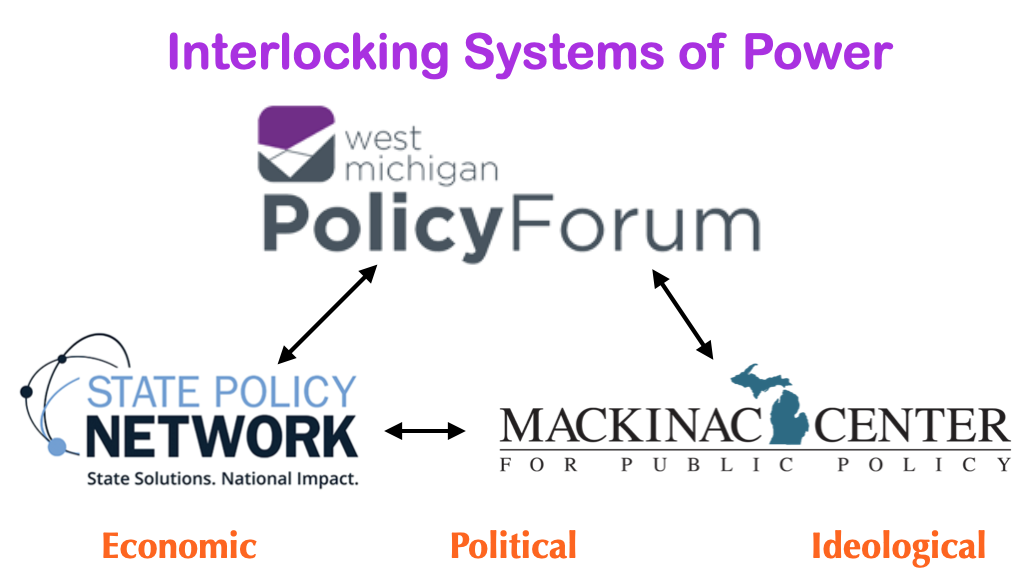 Last week, the West Michigan Policy Forum (WMPF), which is one of the main organizations in the Grand Rapids Power Structure, posted an article on their Facebook page from the Mackinac Center for Public Policy.
The Mackinac Center for Public Policy is a far right Think Tank based in Midland, Michigan and is part of the State Policy Network, which coordinates far right Think Tanks from all around the US and “operates as the policy, communications, and litigation arm of the American Legislative Exchange Council.
The article that the WMPF posted was entitled, You Shouldn’t Need a License to Work as a Property Manager. This article from the Mackinac Center for Public Policy, is essentially about proposed legislation in Michigan to eliminate any licensing requirements for those who want to be a rental property manager. The proposed bill is HB 4549, and was introduced by Rep. Michele Hoitenga (R) from the 102nd District.
The post by the WMPF of the article from the Mackinac Center for Public Policy is significant for two main reasons. First, the WMPF and the Mackinac Center for Public Policy share a similar overall ideology, which is Neoliberal Capitalism. One of the principles of Neoliberal Capitalism is to de-regulate the market, which will reduce government regulation of everything that could diminish profits, including protecting the environment and promoting safety on the job.
This is significant right now in Michigan, as property values and rent costs have risen over the past decade, thus reducing the amount of affordable housing. While housing and rental costs have risen significantly, wages have not, thus forcing hundreds of thousands of Michiganders to be priced out of the housing market. Therefore, eliminating licensing requirements for Property Managers, just makes it easier for more people to exploit the current housing market.
Not surprising, the Rental Property Owners Association of Michigan is also supporting this legislation, as is reflected on their website. The Rental Property Owners Association has spent lots of money to pay lobbyists who work to push this kind of legislation through, as well as contributing lots of money to state legislators who embrace the market-driven aspects of the current housing market in Michigan.
The second reason why it is significant for the West Michigan Policy Forum to post this article (and many others) from the Mackinac Center for Public Policy, is because the main core of the WMPF leadership are major financial contributors to the far right Think Tank. Those from the Executive Committee of the Board of Directors for the WMPF who have contributed hundreds of thousands of dollars in recent years to the Mackinac Center for Public Policy are Doug DeVos, Michael Jandernoa and Peter Secchia. Another member of the WMPF’s Executive Committee, J.C. Huizenga, sits on the Board of Directors of the Mackinac Center for Public Policy.
These types of inter-locking systems of power – financial, political and ideological – are a significant feature of the far right political movement in the US. Therefore, it is important for those of use who stand in opposition to these kinds of policy changes to be aware of how West Michigan-based groups like the West Michigan Policy Forum are connected to groups like the Mackinac Center for Public Policy and the State Policy Network, for the purposes of pushing a broad Neoliberal Capitalist agenda, which impacts most of the issues that grassroots & community-based organizers are working on.
 We recently interviewed Shayna Akanke Marie, the host and creator of the podcast Reachin and Reaching Beyond Bias. https://www.reachingbeyondbias.org/
GRIID – You will be presenting at an upcoming Freed Peoples Teach-in your insights on what many people commonly refer to as West Michigan Nice. Can you give us a working definition of what the phrase means to you?
Shayna – To me, West Michigan Nice is our ability as a community to collectively put on our blinders. Rather than address sensitive issues because they are “too controversial”, we pretend that they are not happening, or we downplay its effects. Our brand of niceness allows some people to maintain guilt-free comfort and status quo while others suffer.
GRIID – In your essay on this topic, you discuss the fact that Grand Rapids is a city that claims to have lots of institutions practicing Diversity and Inclusion, yet the city is still steeped in racialized oppression. Can you talk about the difference between diversity and inclusion practices as opposed to dismantling White Supremacy?
Shayna – The fascinating thing about Grand Rapids is that from the outside looking in, it seems to be very progressive. You see Pride Flags and Black Lives Matter stickers on business store fronts, but then when you ask what life looks like for LGBTQ+ people and / or people of color who work at those establishments, you get a different story. Diversity simply means having people who are “different” represented in a space. Inclusion speaks more to those “others” feeling as though they belong in that space. (Side note – the fact that these “others” are “other” relative to…. Whiteness? Heteronormativity? Says a lot). So, it’s very “nice” to bring different perspectives to the table… to make them “feel” like they belong, but frankly diversity and inclusion does nothing real to address racialized disparities that have been formed throughout the history of this city. I see diversity and inclusion practices as surface-level, box-checking that companies do in order to be considered “not racist.” But when it comes to actively dismantling White Supremacy, well, that doesn’t seem to be in everyone’s best interest. Dismantling White Supremacy goes beyond hiring practices… beyond having a “Holiday Party” at work instead of a “Christmas Party.” Dismantling White Supremacy will require us to identify and be honest about the racial disparities we see in or community… to examine the truth of history and identify pivotal moments that allowed these disparities to grow exponentially… and to actively implement innovative solutions that close these gaps. But when we fail to have honest, critical, and productive dialogues, we fail to acknowledge that these problems are lingering and growing.
GRIID – A friend of mine said that Grand Rapids does charity real good, but they don’t do justice for shit? How does the function of charity and non-profits fit into the framework of West Michigan Nice?
Shayna – Charity and non-profits are a great example of West Michigan Nice in action. We love a good charitable cause and doing the “Lord’s work” but we forget that this God is a God of Justice, too. What we see in Grand Rapids are vastly wealthy institutions / non-profits that put Band-Aids over bullet wounds. We’d love to “feed the homeless”, but we can’t afford the house the houseless. We’d love to paint pretty murals over riot damage, but we ignore why riots are even happening. It almost seems that it would be more beneficial to the benefactors of these organizations to keep things the way that they are. If there are social problems, there are opportunities to fundraise and to amplify these “non-profits,” but what if we work together to solve these problems? Not to say that all non-profits are explicitly harmful, but there is a long, dark history of philanthropy being used as a form of managerial and structural racism, and we don’t talk about it. We don’t talk about them being a tax shelter for the extremely wealthy or the fact that many of these non-profits do not have internal representation of the communities that they claim to serve.
GRIID – What has been your own personal experience as a Black woman living in this area?
Shayna – Although I am a bi-racial Black woman, I have always been keenly aware of my Blackness. I grew up in West Michigan in very white community, and my earliest memory of explicit racism happened when I was in elementary school. I was told by a classmate, nonchalantly, that her father thought it was “disgusting” that my mom was married to a Black man and that I wouldn’t be allowed to attend her birthday party. I was bullied for my body type, my facial features, and my hair for as far back as I can remember. I witnessed my older brother being targeted by a biased school system… and my father being targeted by police. I’ve been told that my natural hair was “unprofessional” by managers, and I’ve been the target of countless “micro-aggressions” (although I prefer the term racist abuse) in just about every workplace I’ve been in. Growing up in a community like this, I always felt ostracized. These experiences became my motivation to educate myself and to understand the root of racism in the United States so that I could be a voice of change. As an adult, I began to see the world through a different lens, and I began to understand how and why these experiences came to be. I have mixed and complicated feelings about living in West Michigan, specifically Grand Rapids. Sometimes I feel defeated because our community is so polarized, and it feels like everything has become a political hot-topic instead of serious issues that need addressing. I wish that more people would genuinely listen to the experiences of others, and I wish that people would understand more about the legacy and history of racism in our city. I’m tired of people acting like we are in a post-racial society and that things would get better if we stopped talking about race. No, things would be better if we had honest conversations about these issues that are turned into solutions and accountability.
GRIID – How does the reality of West Michigan Nice impact people in Grand Rapids, especially African Americans?
Shayna – Ultimately, being West Michigan Nice, means that we are not addressing the issues that affect the community, and we are not being honest about its context or its effects. Many people don’t know about the history of “redlining”, “sundown towns” or the countless other examples of explicit racial discrimination in Grand Rapids because we don’t talk about it. Racism is a public health crisis because of the vast disparities in health outcomes that African American and Latinx citizens face. Many people in this community don’t understand what these disparities are or why they are occurring. Our neighborhoods and schools remain segregated, 60+ years after Brown v Board of Education and we need to ask ourselves: Why? How? From healthcare and housing to education and employment, African Americans face a different reality than our White counterparts.
GRIID – What are some things you think need to happen in Grand Rapids to challenge West Michigan Nice?
Shayna – We have to TALK. We have to be willing to sit down and engage in critical dialogues, not debates, about these issues. People must be willing to learn from each other and to accept that just maybe we are all playing a role in sustaining racial disparities in our community by refusing to acknowledge these realities and to create sustainable changes. We must “see race,” because it is extremely naïve and ignorant to act like race has not shaped every aspect of our society. If we don’t “see race” how, then, do we get past racism?
I think we also need to educate ourselves and the community about the truth of our community’s history. When I read A City Within A City: the Black Freedom Struggle in Grand Rapids, Michigan, it was a bit of a paradigm shift because it provided so many examples of exactly what Black citizens in Grand Rapids have dealt with in terms of their struggles against White Supremacy in the city. When I read Sundown Towns, I realized that “de-facto segregation” is not the reason why the community is still so segregated, but that we are segregated because of decades of racist policy and practices that were designed to maintain White Supremacy. We must reckon with that fact that even if the majority of our White citizens are not “White Supremacists” we still live in a community that is rooted in those ideologies.
I know that these conversations are very uncomfortable, but we cannot be more concerned with our personal comfort than we are about the suffering of entire communities. People need to understand racism if we ever hope to heal from it and move forward. We must accept that when one community is suffering, it affects every single one of us. And we must work together to take massive action against racism and other forms of discrimination in our community. It’s not going to be easy or comfortable, but it will be worth it in the end when everyone, regardless of race, ethnicity, class, gender and sexual orientation, ability, etc. can thrive and live more harmoniously.
We should all be pissed off: The Wealth of Hank & Doug Meijer increased by $900 Million in the past 4 months
 As the COVID pandemic continues and the Delta variant claims more and more lives, the world’s Billionaire Class continue to increase its wealth.
According to a new report from the Institute for Policy Studies, a report that was issue last week:
The world’s 2,690 global billionaires saw their combined wealth rise from $8 trillion on March 18, 2020 to $13.5 trillion as of July 31, 2021, drawing on data from Forbes.
Global billionaire total wealth has increased more over the past 17 months of the pandemic than it did in the 15 years prior to the pandemic.
The fact that the Billionaire Class has continued to increase their wealth while millions continue to die from the COVID virus and millions more go hungry and face being forced out of their housing, should be enough to enrage anyone who has an once of compassion.
We see them same affects right here in West Michigan, where thousands of families continue to experience food insecurity, are unemployed or don’t make wages to enable them to afford the current cost of rent.
In addition, the Centers for Disease Control (CDC), recently announced that Kent County has now moved to a “substantial risk” status, mostly because of the Delta variant and the increase in numbers of those testing positive for the COVID virus. The CDC and the Kent County Health Department are also now recommending that all people, even those who have already been vaccinated, should wear masks while indoors.
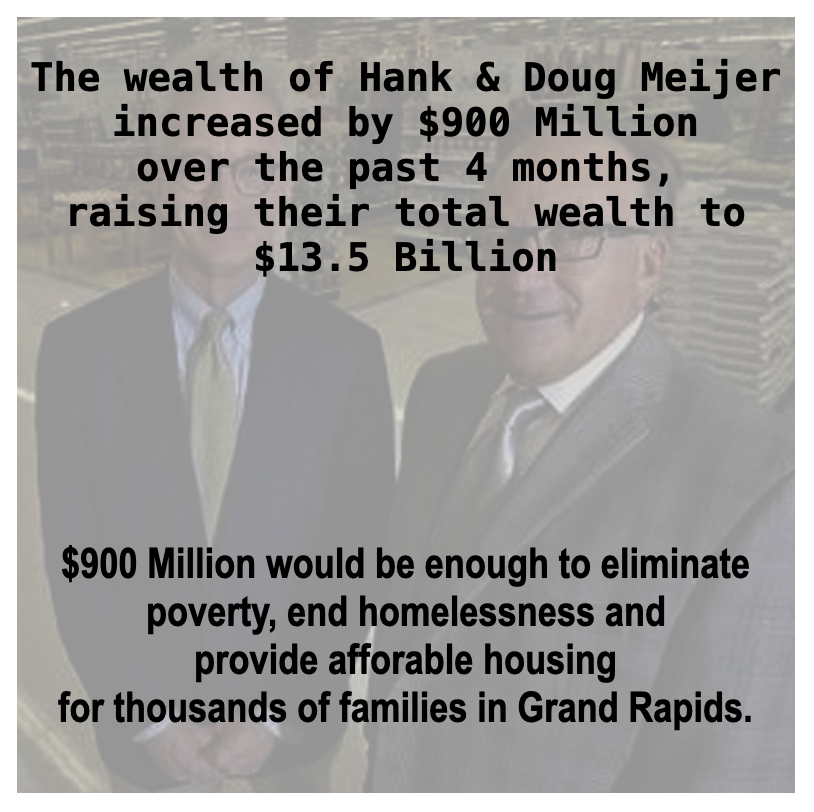
The correlation between the pandemic and wealth accumulation amongst the Billionaire Class can also be seen in West Michigan. In late March, we reported that the wealth of Hank & Doug Meijer had increased from $10.2 to $12.6 billion since the pandemic began. During the past 4 months, the wealth of Hank & Doug Meijer’s wealth has grown nearly a billion more, according to the most recent data from Forbes, which tracks the wealth of billionaires in real time.
The wealth of Hank & Doug Meijer now stands at $13.5 billion. This means that just in the past 4 month, while thousands of families in the Greater Grand Rapids area are unemployed, underemployed, face eviction and are experience food insecurity and malnutrition, the Meijer brothers increased their wealth by $900 million.
Now, we are not supposed to talk about the wealth gap that exists. Instead, we are told that providing social service solutions for the masses who are suffering is the best that we can do. The fact that most of use go along with this shows how effective the current education systems and the news media are at getting us to blame poor people for being poor, instead of demanding a redistribution of wealth.
We are told that if we don’t like the current political climate that we should vote the right people in. This is just another system of control that those in power want us to believe. It is an illusion. Those of us who are not part of the Billionaire Class should be really pissed off at how much money Hank & Doug Meijer continue to amass, while so much suffering happens in this community.
If workers were really pissed off about the disparity of wealth between what they make and the wealth of Hank & Doug Meijer, they would occupy the stores and the warehouses and not leave until their demands to earn $25 dollars an hour are met. This a demand they could win, since we know that the $900 million Hank & Doug Meijer have made just in the past 4 months would be more than enough to pay all their workers that kind of a wage.
For the rest of us, we should be marching on the Meijer corporate headquarters at 2929 Walker Ave NW, Grand Rapids, making other demands about wealth redistribution. Imagine what $900 million could do to relieve the harm that thousands of families are currently experiencing in the Greater Grand Rapids area. $900 million would eliminate poverty, homelessness, food insecurity and provide plenty of health care funding. Demanding that the Meijer family give $900 million to be distributed to the thousands of families in this area who are experiencing poverty, systemic racism and other forms of structural violence would still leave Hank & Doug Meijer with $12.6 billion, which I’m sure they could still support their families on.
Betsy DeVos-created Great Lakes Education Project says CDC recommendation for students to wear masks in school is purely political
 In late July, the Great Lakes Education Project (GLEP), released the following statement:
“This is the worst kind of politics being played on our children. After an emotionally, mentally and physically exhausting school year locked out of classrooms by the likes of Governor Whitmer and the education union bosses, our children are now faced with this latest attack by the CDC.
“This is nothing more than the next step in a line of attacks on families and students. Even in May, emails obtained through FOIA revealed that the American Federation of Teachers lobbied and influenced CDC guidelines on the reopening of schools.
“We are left to wonder what science is leading the CDC decision-making on masks for school-aged children with this new recommendation a week after President Biden speculated that new mask mandates might be coming.”
The narratives that groups create, especially around the COVID pandemic, are very instructive. No one denies that it hasn’t been hard on students, parents and teachers during the pandemic, but to suggest that the CDC is playing politics is just ridiculous. GLEP makes lots of claims about union bosses and the American Federation of Teachers (AFT), but only offers FOIA obtained e-mails, which suggested that the AFT influenced the CDC policy on school reopening. However, what the GLEP Press Release fails to acknowledge is that their organization has consistently endorsed Republican State Legislators, as well as influencing those same politicians with campaign contributions over the years. Who again is playing politics with the lives of students in Michigan?
In addition, the CDC is just making a recommendation and not adopting a mandate on school-aged children being required to wear masks while attending school. A recommendation doesn’t carry the force of law, but it does reflect that with the growing number of delta variant cases across the country, that wearing a mask while indoors is simply sound public health policy.
The Centers for Disease Control have clear and comprehensive guidelines on COVID and K-12 Schools, which you can find at this link. Here are some of the major recommendations for K-12:
- Students benefit from in-person learning, and safely returning to in-person instruction in the fall 2021 is a priority.
- Vaccination is the leading public health prevention strategy to end the COVID-19 pandemic. Promoting vaccination can help schools safely return to in-person learning as well as extracurricular activities and sports.
- Due to the circulating and highly contagious Delta variant, CDC recommends universal indoor masking by all students (age 2 and older), staff, teachers, and visitors to K-12 schools, regardless of vaccination status.
- In addition to universal indoor masking, CDC recommends schools maintain at least 3 feet of physical distance between students within classrooms to reduce transmission risk. When it is not possible to maintain a physical distance of at least 3 feet, such as when schools cannot fully re-open while maintaining these distances, it is especially important to layer multiple other prevention strategies, such as screening testing.
- Screening testing, ventilation, handwashing and respiratory etiquette, staying home when sick and getting tested, contact tracing in combination with quarantine and isolation, and cleaning and disinfection are also important layers of prevention to keep schools safe.
- Students, teachers, and staff should stay home when they have signs of any infectious illness and be referred to their healthcare provider for testing and care.
- Many schools serve children under the age of 12 who are not eligible for vaccination at this time. Therefore, this guidance emphasizes implementing layered prevention strategies (e.g., using multiple prevention strategies together consistently) to protect students, teachers, staff, visitors, and other members of their households and support in-person learning.
- Localities should monitor community transmission, vaccination coverage, screening testing, and occurrence of outbreaks to guide decisions on the level of layered prevention strategies (e.g., physical distancing, screening testing).
All of these recommendations appear to be sound and have prevention and public health concerns as the main focus. Is having the well being of students, teachers, school administrators and parents playing politics or just smart public health?
Dan & Pamela DeVos Foundation: Funding family-run entities and organizations where they are trustees
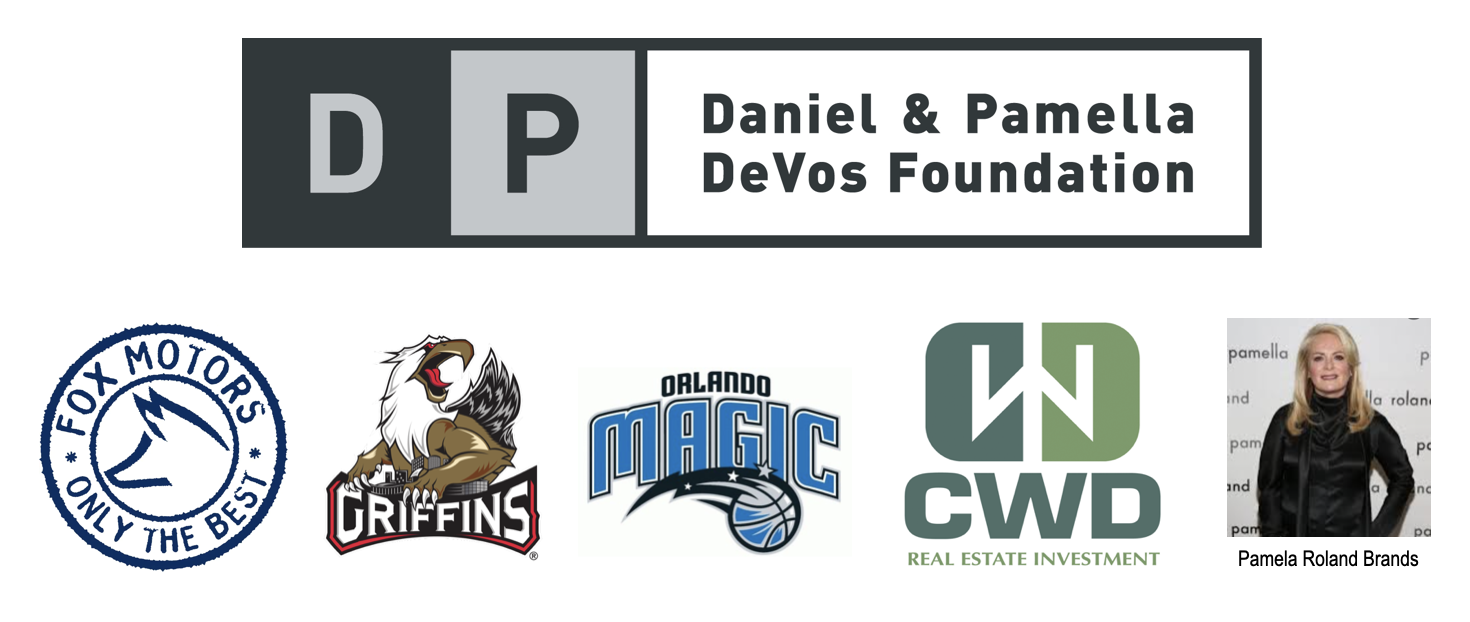 To date, we have looked at the 990 documents for local foundations in 2021 for the Prince Family, the Richard & Helen DeVos Foundation, the Doug & Maria DeVos Foundation and the Dick & Betsy DeVos Foundation. Today we want to examine the Dan and Pamela DeVos Foundation.
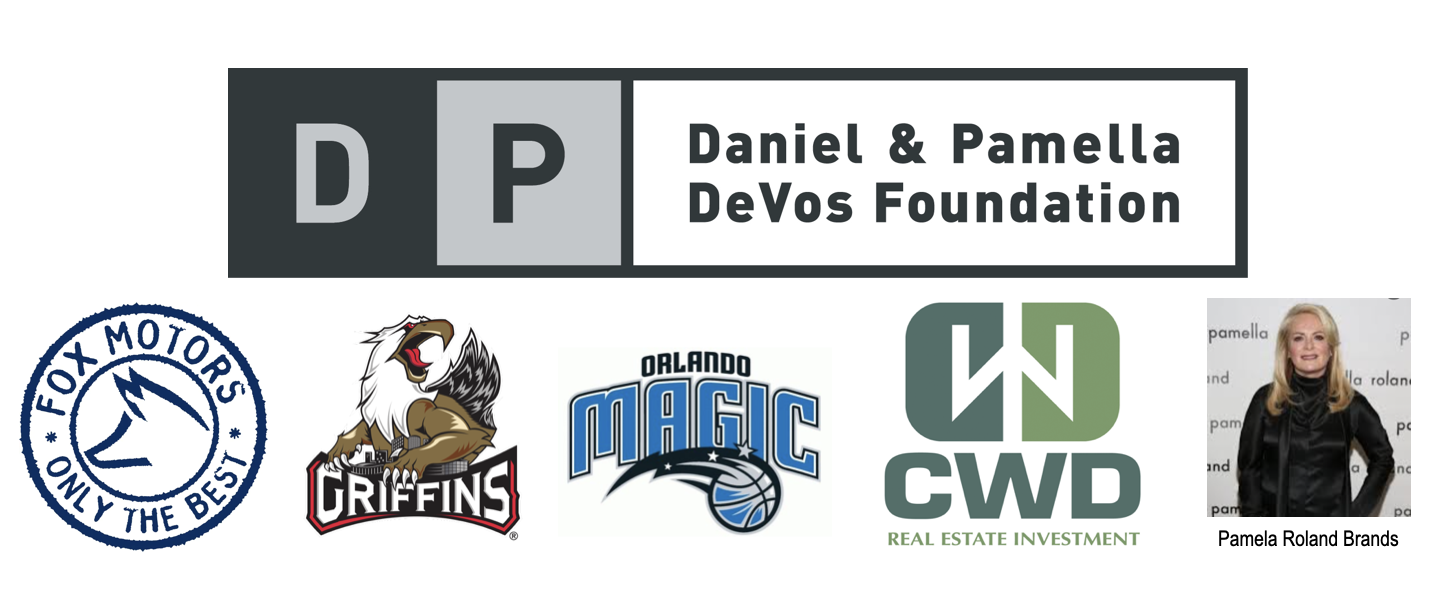
In the graphic above, you can see some of the major entities that Dan and Pamela DeVos own, which is where their Foundation money comes from. Like all wealthy people, foundations are a great way to channel one’s wealth, without having it taxed. In looking at their 990 document for 2019, which is the most recent available, the Dan & Pamela DeVos Foundation contributed just over $12 million to various entities. Here is a breakdown of some of the categories and the larger contributions in each category.
Conservative Christian groups
Keystone Community Church $300,000
Grand Rapids Initiative for Leaders $15,000
Young Life $35.000
70×7 Life Recovery $90,000
Think Tanks and Policy Organizations – These groups all have a documented history of promoting Capitalism, opposing labor unions, undermining public education, and create policy positions that are often adopted by state and federal lawmakers.
Mackinac Center for Public Policy $150,000
Higher Education – Many of these universities or colleges have buildings or business schools named after the DeVos family.
Davenport University $58,500
Ferris State University $51,000
Grand Rapids Community College Foundation $100,000
Grand Valley State University $2,213,000
Northwood University $1,382,500
Organizations that Dan or Pamela DeVos are on the Board of Directors
Whitney Museum of American Art $2,600,000
Northwood University $1,382,500
Great Lakes Center for the Arts $150,000
Grand Rapids Symphony Society $575,000
Hope Network $55,000
John F. Kennedy Center for the Performing Arts $650,000
Orlando Magic Youth Foundation Inc. $275,000
The Joffrey Ballet $325,000
Organizations that are run by DeVos Family members
Orlando Magic Youth Foundation Inc. $275,000
West Michigan Aviation Academy $330,000
ArtPrize $50,000
Grand Rapids Initiative for Leaders $15,000
The Dan & Pamela DeVos Foundation doesn’t have as many overt contributions to entities that are far right and their foundation is smaller than most of the other family members. However, Dan and Pamela DeVos are as committed to the same larger political, religious and ideological goals as the rest of the family, as is evidenced by the political contributions. In the 2020 Election, Dan and Pamela contributed nearly $2 million to candidates at the federal level, $350,000 at the state level and $14,000 at the Kent County level.
 On Sunday, MLive posted an article with the headline, “Grand Rapids police officer finalist for national award for innovative program helping teens get driver’s licenses.”
The article is a feel good story about someone from the GRPD who works with teenagers who are in the process of obtaining a driver’s license. However, there are two glaring omissions in this article. The first significant omission is contextual, since the article doesn’t address why cops are assisting teens in getting their driver’s licenses.
As public school districts have been impacted by less state funding and the ongoing battle over students with Charter Schools and other private, mostly religious schools accessing public money, public schools have cuts numerous programs, like Driver’s Education. Students in public schools are forced to use private Driver’s Training entities, which often means out of pocket money. The very fact that GRPD officers are involved in working with teenagers in the process of obtaining a driver’s license, is a direct result of economic austerity measures that have negatively impacted public schools.
The second glaring omission in this article, is the fact that the GRPD, like most municipal cops, often stop people for minor traffic violations, only to find out the people they pull over are undocumented immigrants who cannot legal obtain a driver’s license in the state of Michigan.
Undocumented immigrants who are stopped by cops, while driving without a license, often end up in jail or in court, which results in the GRPD (and other municipal police) contact Immigration and Customs Enforcement (ICE). Once ICE gets involved, undocumented immigrants often end up in detention centers and could then face deportation.
The GRPD has a direct relationship with Immigration and Customs Enforcement and has a history of contacting ICE when so-called suspects are viewed as Latino or latinx, as in the case of Jilmar Ramos Gomez.
In recent years, with all the organizing that has gone into the immigrant justice movement in Grand Rapids, led by Movimiento Cosecha GR and the GR Rapid Response to ICE, there has not been one story in the local news media about the role of the GRPD plays in stopping and often arresting undocumented immigrants who do not have a driver’s license. This fact is even more astounding, especially since for the past two years, Movimiento Cosecha has made driver’s licenses for the undocumented community their main priority.
For those who are interested in supporting the Campaign to get Driver’s Licenses for undocumented immigrants you can sign this petition. For those wanting to volunteer with Movimiento Cosecha GR you can contact them via their Facebook page.

