Michigan Senator Gary Peters proposes more funding for cops during National Police Week
Last week, during National Police Week, Michigan Senator Gary Peters re-introduces The Strong Communities Act.
The proposed legislation, which was initially introduced in June of 2020, is actually a bill that would amend the 1968 Omnibus Crime Control and Safe Streets Act, which was the Johnson Administration’s response to “urban unrest.” The history of that legislation, which is included in Elizabeth Hinton’s important book, America on Fire: The Untold History of Police Violence and Black Rebellion Since the 1960s.

What Senator Peters’ proposed legislation does is to provide more taxpayer money to “incentivize police recruits,” by funding their education/training to become a police officer, if they agree to serve in the communities they are from. According to the Press Release from Senator Peters’ office:
Many communities across the country are facing both a law enforcement recruitment and a trust crisis. The Strong Communities Act aims to help to facilitate improved relationships between law enforcement and the communities they serve. By recruiting from within the communities, these recruits will know the people they are working to protect.
This legislation that Senator Peters has re-introduced does two main things. First, it further legitimizes the notion of community policing as a positive way of doing policing. However, as Alex Vitale, author of The End of Policing notes:
The research shows that community policing does not empower communities in meaningful ways. It expands police power, but does nothing to reduce the burden of overpricing on people of color and the poor.
In addition, the co-authors of the book, Life During Wartime: Resisting Counterinsurgency, make the argument that Community Policing is primarily about the ability of local police departments to build relationships with residents for the specific purpose of gathering information and engaging in surveillance…..thus community policing is a form of counterinsurgency, especially in response to an organized populace that is making demands of the state.
The second thing that this legislation from Senator Peters and Senator Cornyn does is offer financial incentives to recruit news cops and then have them live in the neighborhood they serve for at least 4 years. Police reform groups have long advocated that police officers should live in the communities that they serve. The group Communities United Against Police Brutality, has this response to that belief:
“Throughout our research, we have never encountered a shred of evidence that requiring or incentivizing police officers to live in the communities in which they work has any positive effect on the quality of policing,”
It is worth noting that just days before Senator Peters first introduced this legislation in June of 2020, he came out strong against the protests taking place across the US, stating:
“The death of George Floyd was a horrific tragedy and justice must be served. While I understand and respect anyone who wants to demonstrate peacefully to bring attention to this injustice, it is discouraging that what was clearly intended to be a peaceful protest quickly devolved into a riot instigated by extremists with an anarchist ideology.”
This statement from Senator Peters is rather hypocritical, especially considering that Peters sits on the Armed Forces Committee, consistently votes for massive levels of US military spending and praises US militarism abroad, such as airstrikes, drone strikes and other forces of violent tactics that often kill innocent civilians.
The last argument for seeing Senator Peters’ re-introduction of the Strong Communities Act as deeply troubling, is the fact that it has received the endorsement of the largest and oldest police organization in the US, the National Fraternal Order of Police.
The National Fraternal Order of Police has a long history of supporting police departments across the US that have a particularly brutal history, has a leadership that is all white, spends millions on lobbying Congress and endorsed Donald Trump in 2016.
In addition to receiving support from the National Fraternal Order of Police, Senator Peters’ proposed legislation was also endorsed by the National Association of Police Organizations (NAPO). The NAPO, which also lobbies Congress on police issues, recently came out in support of President Biden’s Executive Order on Police Reform, since it doesn’t take away qualified immunity for cops.
In the end, for those who want to see systemic change around policing, they cannot be seduced by language of community policing and the notion that cops who live in the communities where they work will make a difference. It just doesn’t matter to people who are harassed, arrested, tasered, beaten or killed by cops, that they live in the same neighborhood as the people they are oppressing.
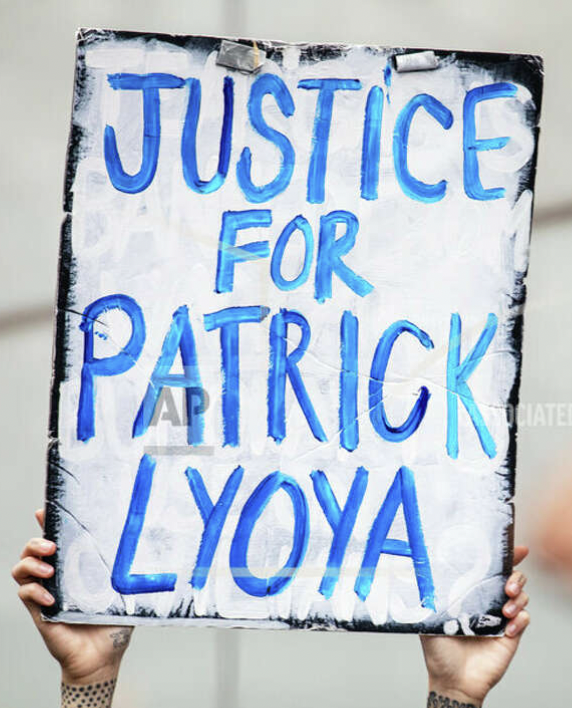 Yesterday, Peter Lyoya, members of the Breonna Taylor family and George Floyd family, were in Washington, DC, during a ceremony where President Biden had signed an executive order on police reform.
The date was also the second anniversary of when George Floyd was murdered by Officer Derek Chauvin in Minneapolis, Minnesota.
Both MLive and WOODTV8 reported on Peter Lyoya being in Washington, DC, along with his friend and translator, as well as the attorneys working with the Lyoya family, Ben Crump and Ven Johnson.
The MLive article did include, ““I just told the president that (Peter’s) son was killed and that (Peter) was asking for reforms and for justice,” Siku said.
So far there has been no justice for Patrick Lyoya and his family.
The WOODTV8 story says, “Lyoya’s family was invited by the White House to attend along with attorney Ben Crump, according to a Facebook post by Kent County Commissioner Robert Womack.” In that Facebook post Commissioner Womack reveals that he was asked to be on a national panel on police reform. Womack ends his post by saying:
I’m working on a national program to educate people on what safe things to do when they are pulled over by police and what rights they have. We will have better police and community relations once we all admit there is a real problem, and that we can all do better. We are fighting for the greatest country in the world to be the greatest example of how the world should treat people. We are not there yet but with your help we will get there!
There is almost too much to unpack there, but one thing that was clearly omitted was the demand to get Justice for Patrick Lyoya.
Biden’s Executive Order on Police Reform
So what exactly, is included in the so-called police reform package that Biden signed yesterday? According to a Press Release from the White House, the Executive Order will include:
- Creating a new national database of police misconduct.
- Strengthens Pattern or Practice Investigations.
- Ensures timely and thorough investigations and consistent discipline.
- Mandates the adoption of body-worn camera policies.
- Bans the use of chokeholds and carotid restraints unless deadly force is authorized, and restricts the use of no-knock entries.
- Requires new standards that limit the use of force and require de-escalation for all federal agencies.
- Restores and expands upon the Obama-Biden Administration’s restrictions on the transfer of military equipment.
- Requires an updated approach to recruitment, hiring, promotion, and retention of law enforcement officers.
- Reimagines Crisis Response.
- Prioritizes Officer Wellness.
- Requires new standards for accreditation and for accrediting bodies.
- Implements a new, evidence-informed annual anti-bias training requirement.
- Tracks data on use of force incidents.
- Studies the impact of use of force incidents on communities.
- Safeguards the use of facial recognition technology and other sophisticated algorithmic tools.
- Enhances data collection and data transparency.
This is a fair lengthy list, but none of it will prevent cops from killing anyone, especially Black people. And let’s be clear, this list is only for federal law enforcement agencies and DOES NOT apply to local or state police agencies.
Another important point about these police reforms is that the Biden Administration worked closely with the National Fraternal Order of Police and the National Association of Police Organizations (NAPO).
The President of the NAPO wrote, “The Executive Order does not recommend Congress take action to eliminate qualified immunity for officers, which is of utmost importance to NAPO as this legal protection for officers is essential.” The National Fraternal Order of Police released their own statement on the Biden Administration’s Police Reform package, stating: “We applaud the Administration for listening to our constructive feedback and incorporating our suggestions into the Executive Order. Our organizations, which represent our nation’s chiefs and the majority of rank-and-file officers, believe that it marks a significant step in our continuing efforts to strengthen the trust of the public in police and the criminal justice system.”
The fact that two of the largest police associations in the country have been in constant contact with the Biden Administration and a pretty happy with the police reform package speaks volumes for how weak these reforms really are. Police reforms have never amounted to anything substantive and they often result in pumping more money into police departments. In the end, as with most issues, we cannot rely on politicians at any level to win Justice for Patrick, we have to achieve that as a movement. #Justice4Patrick
More Billions for war while the planet burns: 5 Reasons why I oppose US Military Aid to Ukraine
Last Thursday, the US Senate passed a $40 Billion Aid package to Ukraine, with a mix of military aid, other forms of security assistance and some form of humanitarian relief funding.
The Senate vote was 86 – 11, with every Democrat voting for the $40 Billion, and a majority of Republicans supporting it. Both Michigan Senators Gary Peters and Debbie Stabenow voted for the $40 Billion package.
This now bring the amount of US military and relief aid to Ukraine at $53 Billion, since the Russian invasion earlier this year. According to an article from Vox, “The Additional Ukraine Supplemental Appropriations Act of 2022, as it’s officially known, sets aside approximately $40 billion in emergency funding for military, economic, and humanitarian assistance to Kyiv, NATO allies, and partners supporting Ukraine.”
The Vox article does not indicate which NATO partners will also be receiving part of the $40 Billion, but the fact that they are including is troubling.

In a recent post on the truthout.org, Mike Ludwig writes:
The horrifying war of attrition threatens to drag on for months or years as fighting in Ukraine’s south and east rages and Russia bombards towns and cities to make away for more attacks. The United States is pumping weapons and military aid into Ukraine at unprecedented levels, raising a sharp debate about whether the U.S. is defending of a war-torn ally or pushing Ukrainians to become cannon fodder for a complex and dangerous proxy war with Russia. Biden administration officials have said the U.S. wants Ukraine to “win” the war and weaken the Russian military, a longstanding goal of the U.S.-led NATO alliance.
The notion that the US desires a regime change in Russia, was also a topic of discussion on Democracy Now last week.
My take on the latest US Military Aid package to Ukraine is that it will not, in the long run, reduce the harm being done since the Russian invasion began. Here are 5 reasons why I think that US military aid to Ukraine is a bad idea.
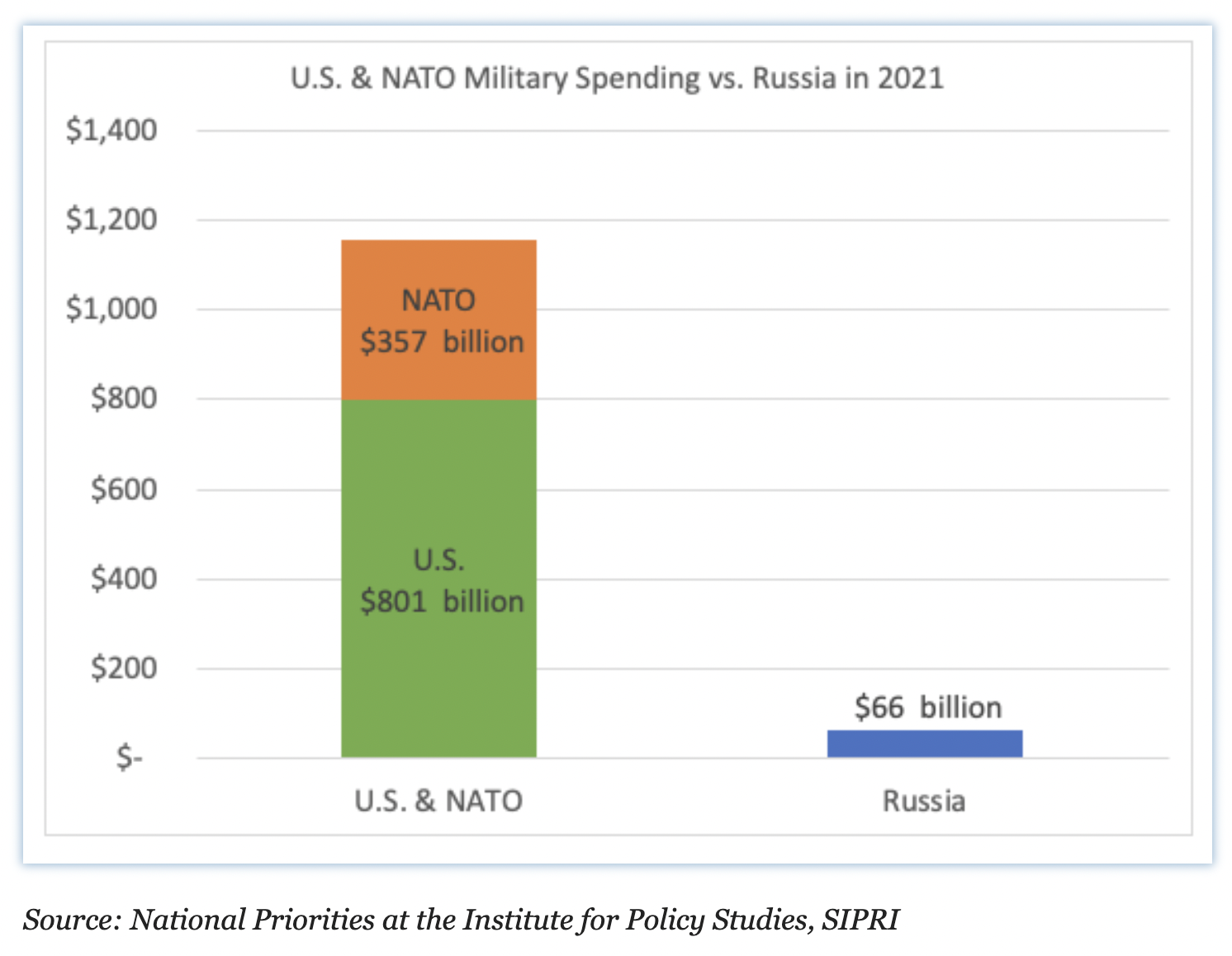
First, there is little evidence that the US Military assistance abroad has historically led to a just or peaceful resolution of conflicts. This is a critical point, since the US is the largest military weapons trafficker around the globe and has the largest military budget. The National Priorities Project recently wrote:
That is to say, that U.S. and NATO military spending totaling nearly $1.2 trillion – more than 17 times as much as Russia spent – failed to dissuade Putin’s aggression toward Ukraine. The U.S. alone spent 12 times as much as Russia.
U.S. military spending had been on an upward trajectory throughout the Trump years, and that trend has continued under the Biden administration, and with a Democrat-controlled Congress.
Just weeks after Congress approved a $782 billion war and military budget, the Biden administration proposed increasing it to $813 billion – higher than at any time under President Trump, and higher than the peak of the Vietnam War or the Cold War.
This is despite the fact that President Biden also ended the nation’s longest active war by bringing troops home from Afghanistan. You might expect war spending to decrease after that, but not this time.
Meanwhile, all this spending failed to dissuade Russia’s Putin from invading Ukraine, even though it sponsored dozens of bases and tens of thousands of troops in Europe, ostensibly to guarantee the continent’s safety.
Second, the US government doesn’t have a moral leg to stand on when it comes to intervention in global affairs. We all know what happened in the illegal US occupations of Iraq and Afghanistan in recent decades, with more than a million dead Iraqis and tens of thousands of Afghanis. In fact, the US has a long history of brutal imperialist interventions around the world. Check out the list that Professor Zoltan Grossman has put together, which provides an excellent chronological list beginning with 1890. Biden, like all past presidents, can say that US military aid is designed to create a peaceful resolution, yet I can’t find one real legitimate example of that ever happening.
Third, the US Military Industrial Complex always benefits and profits from US weapons sales and US military aid abroad, which is why the weapons industry provides millions and millions in campaign contributions and lobbying Congress on an annual basis. One recent example is Lockheed Martin, which contributed $250,000 to politicians while they were deliberating on US military aid to Ukraine.
Fourth, the US Government, media pundits, think tanks and other entities are always saying things like “we can’t afford Medicare for All,” cancel student debt or any number of things that would benefit people living in the US, especially those most marginalized. Yet, Congress never hesitates to provide military spending, like in the case of Ukraine, or the massive and largest US military Budget (for 2023) in US history that the Biden Administration will likely adopt in the near future. Imagine how the billions that goes to US militarism could be used for affordable housing, canceling student debt, providing Medicare for All, create a renewable energy system or provide Black people with the reparations they deserve.
Fifth, the Intergovernmental Panel on Climate Change’s (IPCC) most recent report, released in March, is pretty bleak in terms of the pending Climate disaster. The United Nations Secretary General responded to the lasted Climate Change report and stated:
Today’s IPCC report is an atlas of human suffering and a damning indictment of failed climate leadership. With fact upon fact, this report reveals how people and the planet are getting clobbered by climate change. Nearly half of humanity is living in the danger zone now. Many ecosystems are at the point of no return now. Unchecked carbon pollution is forcing the world’s most vulnerable on a frogmarch to destruction now. The facts are undeniable. This abdication of leadership is criminal. The world’s biggest polluters are guilty of arson on our only home.
Perpetuating war and militarism is taking us in the opposite direction of what we need to do to decrease our collective consumption of fossil fuels and to slow down the harm that Climate Change is already doing, specifically to the most vulnerable populations around the world.
As Dr. Martin Luther King Jr. said, during his powerful speech condemning the Vietnam War in 1967:
A nation that continues year after year to spend more money on military defense than on programs of social uplift is approaching spiritual death.
Lastly, it’s worth pointing out that US Militarism is connected to the ongoing litany of shootings in the US. The US government is the largest trafficker os weapons globally, so it is not surprising that guns are so readily available in the US. The US government models the behavior that violence solves problems around the world, thus it would follow that shootings in the US happen all the time, since violence is so normalized.
The Office of Oversight and Public Accountability (OPA) was created in August of 2019, to “serve as the liaison between public safety and our Grand Rapids community.”
Since the OPA was created there have been numerous incidents of police abuse of residents, with a disproportionate amount of Black residents being the target of GRPD harassment, intimidation and arrest.

In May of 2020, there was a massive uprising in Grand Rapids, with thousands of people hitting streets after the police murder of George Floyd, with cops using tear gas and flashbang canisters, then arresting dozens of people for property destruction. Since the 2020 Uprising, there have been calls to defund the GRPD, with ongoing resistance to GRPD policies, including the more recent GRPD killing of Patrick Lyoya.
During the past three years Office of Oversight and Public Accountability has had plenty of opportunities to hold the GRPD accountable, with numerous incidents of police abuse of Black residents, targeting protesters and the GRPD murder of Patrick Lyoya. During this time, the OPA has not once taken any significant action to hold the GRPD accountable, nor have they published reports that challenge GRPD practices and policies. The only mildly critical thing the OPA has done, was to release a statement complaining about the GRPD’s failure to comply with requests for documents in cases of possible GRPD abuse, in April of 2021.
Since the GRPD murder of Patrick Lyoya, the OPA has consistently agreed with the Grand Rapids Police Department and has not offered to do anything remotely close to what the community has been demanding since the GRPD shot Patrick Lyoya in the back of the head. Therefore, it is difficult for this writer to comprehend how the Office of Oversight and Public Accountability actually benefits the community.
On Tuesday, May 24th, as part of the Fiscal Committee’s Agenda Packet, on pages 2 – 4, the City of Grand Rapids announced that the Kellogg Foundation has awarded a $750,000 grant to the Office of Oversight and Public Accountability to hire two more people to expand the capacity of the the OPA. The document states:
This grant will fund two (2) Justice Analysts (Administrative Analyst I) to work in the Office of Oversight and Public Accountability to help embed long-term system changes in our public safety operations and provide additional engagement opportunities, and educational programs to community. These positions would provide much needed capacity to be engaged and lead efforts that, if done well and equitably, have the power to directly advance positive outcomes in community and change City protocol and practice for long-term change.
So, the City of Grand Rapids will pay 2 people at $125,000 a year each, over a three year period. Based on what we have seen from the Office of Oversight and Public Accountability since August of 2019, we should only expect them to continue to do what they have done so far, which has been to have no real enforcement powers, to be conciliatory towards the GRPD, to continue to be complicit with how the GRPD polices Black, Indigenous and People of Color communities, and to ignore the community demands of Justice for the family of Patrick Lyoya.
Now, imagine how much good could be done to give $750,000 to the Black community. $750,000 could provide lots of relief for families who are renting, who are food insecure, and who have limited access to health care. In addition, what if $750,000 were given to the Black community as compensation for their calls to provide public safety for themselves, as we have been hearing over the past two years and increasingly since Patrick Lyoya was murdered by the GRPD.
When will people realize that the Grand Rapids Office of Oversight and Public Accountability is an ineffectual entity that is designed to placate the public, while they work in partnership with the GRPD to maintain the status quo of policing in this city? Let’s not be fooled by yet another bureaucratic attempt to throw money at a department that more often than not operates as a lapdog for the City Manager and the Grand Rapids Police Department.
MLive article on Officer Christopher Schurr normalizes White Supremacy and White Saviorism
Last Thursday, MLive posted an article with the headline, Officer Christopher Schurr went from college athlete to cop before killing Patrick Lyoya.
I have seen reactions on social media to this MLive article, accusing MLive of posting a fluff piece and attempting to humanize GRPD officer Christopher Schurr, the cop who shot Patrick Lyoya in the back of the head.
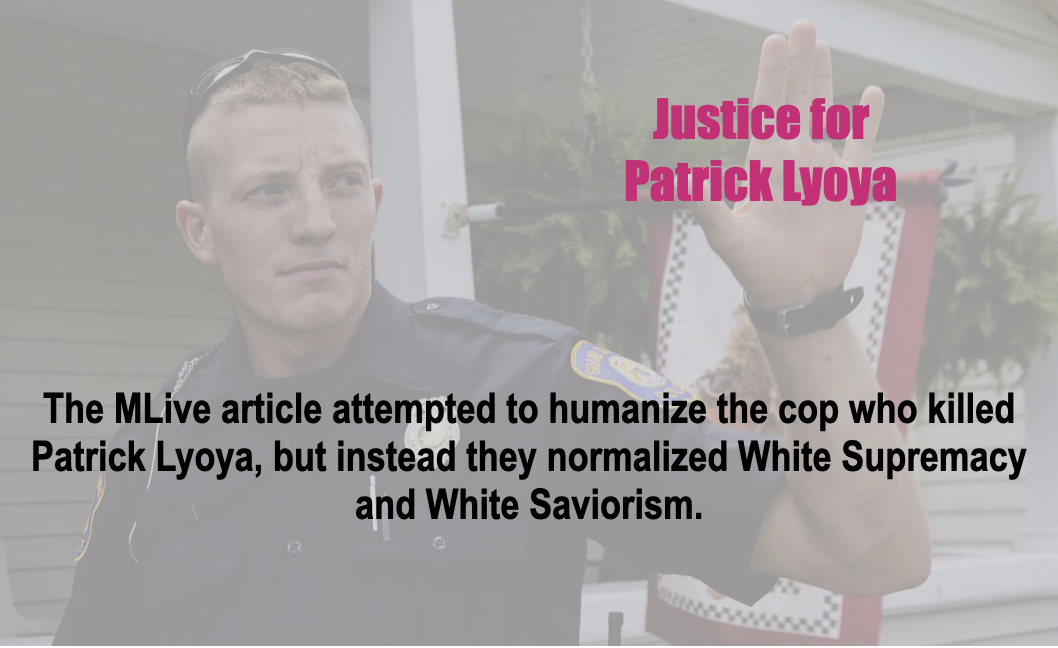
Reading the MLive article is instructive, since it uses language referring to Officer Schurr such as:
- Ideal candidate
- Helping the less fortunate
- Service-minded
- Mission trips
- Serving the community
- A good person
- Not a monster
- Police commendations
All of these terms and phrases are seen by the dominant culture as affirmation or positive reflections on the character of a person. However, through a critical lens, terms like helping the less fortunate, service minded and mission trips often are variations of White Saviorism.
The MLive article does cite several people, all of whom know Christopher Schurr. There were people that Schurr went to college with, an excerpt from the GRPOA statement defending Schurr, and John Riley, a former GRPD cop who now runs a business called Gentle Response Conflict/De-escalation Training.
The former college students who knew Schurr both said he had a temperament that they didn’t think was compatible with being a police officer. Now, I’m not sure what these sources think the temperament of a cop should be, but including their comments does help readers in making any real determinations about the character of the man who shot Patrick Lyoya in the back of the head.
I do not disagree with many of the reactions that people have had about the MLive article centering the life of Christopher Schurr, but I think there is another way to look at the significance of the article.
There are several references used to describe Schurr that are positive and affirming, which on the surface are an attempt to humanize this cop. However, what I think is really happening in the MLive story is that it normalizes what White Supremacy looks like.
Quite often, in reporting about a serial killer or men who are charged with rape or domestic abuse, people interviewed for those stories will regularly say, “he was such a nice guy” or “he seemed like a normal person.” This is because men who rape or assault women don’t generally demonstrate some outward tendency to harm women. This is affirmed by the fact that most men who harm women are the most likely to be the men that women know – co-workers, neighbors, relatives, the pastor, etc. The same dynamic occurs with those who are labeled as racists. You don’t need to be a member fo the KKK or some other White Nationalist group. White Supremacy is embedded in all of our major institutions, like policing. Officer Schurr did what he did to Patrick Lyoya, because of the training he had, not in spite of it. As Alex Vitale states in his important book, The End of Policing:
“Well-trained police following proper procedure are still going to be arresting people for mostly low-level offenses, and the burden will continue to fall primarily on communities of color because that is now the system is designed to operate – not because of the biases or misunderstandings of officers.”
The Grand Rapids Police Officer’s Association statement affirms this reality, as does the person who gets the last word in the mLive article.
John Riley, the founder of Gentle Response Conflict/De-escalation Training said, “said he believes Schurr followed his training properly and did everything he could to try to de-escalate the situation, including telling Lyoya to stop resisting several times.” In fact, Riley had posted three separate opinion pieces about the GRPD killing of Patrick Lyoya on his website. The first entry is a lengthy argument that Officer Schurr did follow de-escalation protocol, stating:
Argue, debate, and pontificate whether or not the shooting was righteous and justified, but do not dare say the officer did not try to successfully and effectively de-escalate and control the situation, first verbally and then physically. Mr. Lyoya’s significant contributing factor to this tragic incident was his own behavior and actions, which guided, lead and turned what would have been a ticket and a few hours in jail into a fatal shooting.
In the second blog post, John Riley is talking about misconceptions of what de-escalation is, stating:
2 misconceptions from the tragic OIS in Grand Rapids. I point out and emphasize in my seminars that there are no magic words or phrases that will just “de-escalate” a person or situation. The other person MUST be able to allow themselves to be de-escalated, and in this tragic incident was a man who clearly did not want to de-escalate, though that officer frantically, then desperately tried very hard to.
In the third, and finally blog post from Riley, where he continues to blame Patrick Lyoya for his own death, he states:
In this sad, tragic incident, an intoxicated driver, whose judgement and decision making abilities are further affected by the amount of alcohol he consumed, chose to physically resist lawful authority. The officer is legally obligated to make an attempt to detain the driver because it’s his job, and can be heard on his body cam saying 7 to 8 times, “Stop!”. Had Patrick Lyoya simply stopped, and surrendered to lawful authority, like his record shows he has done so in the past, the officer would not have found himself in a situation where he believed he was in danger of great bodily harm or death.
The fact that MLive used John Riley as a source and didn’t question or challenge his take on what Officer Schurr did to Patrick Lyoya, further demonstrates how White Supremacy and Structural Racism are normalized in our society.
Cole 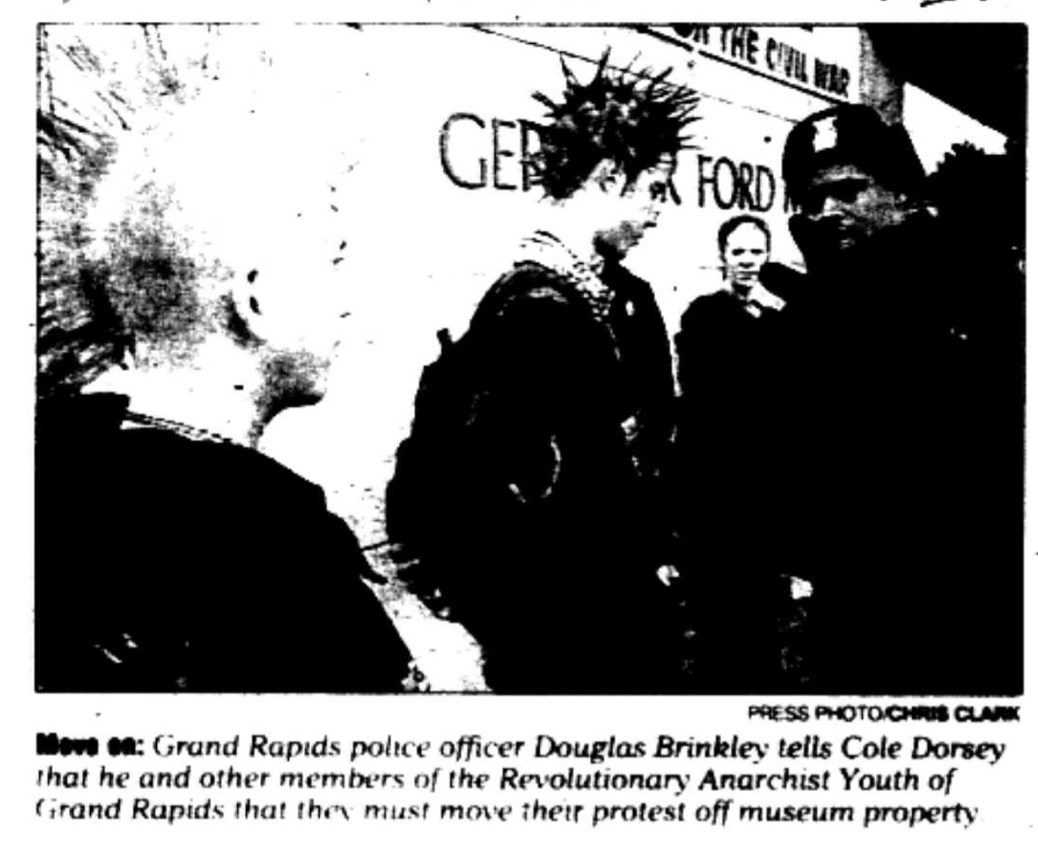 Former US Presidents Jimmy Carter and George H.W. Bush, joined Gerald R. Ford in Grand Rapids for a re-dedication of the Ford Museum. Little did they know that a group of Anarchist Youth would confront the.
According to an article in the Grand Rapids Press from April 18, 1997, about 20 protestors with the group, the Revolutionary Anarchist Youth of Grand Rapids, showed up to confront the ex-Presidents for the oppression they have caused against those living in the US.
Cole Dorsey, a member of the Revolutionary Anarchist Youth of Grand Rapids, was quoted as saying, “We are here are here for all oppressed people in this country.” The group had unfurled a banner with an obscene message, according to the Grand Rapids Press reporter. (see GR Press article below) Cole Dorsey had told me years later that it was “important to protest the re-dedication of the Ford Museum, especially since there were several US Presidents, all of which had committed serious crimes against people in the US and War Crimes against countless civilians in other countries.”
Just the year before, many of the same 20 protestors were involved in several anti-policing actions in Grand Rapids, which was happening at the same tine as the creation of the Civilian Review Board.

For weeks now, there have been calls from the community for the Kent County Prosecutor, Chris Becker, to recuse himself from the case involving the GRPD killing of Patrick Lyoya.

The main issue surrounding the community’s demand that Becker recuse himself from this case has to do with the fact that he has directly received campaign contributions from the Grand Rapids Police Officer’s Association PAC, which is the union that represents the cops in the GRPD. The GRPD union contributed $1,000 to Becker’s campaign in 2016, according to the campaign finance records found online.
However, the GRPD police union is not the only law enforcement entity to contribute to Becker’s campaign over the years. Former Kent Count Sheriff Larry Stelma and current Kent County Sheriff Michelle LaJoye-Young have both made contributions. In addition, there was a $1000 contribution in 2016 from the Kent County Sheriff Law Enforcement (How it was listed on the campaign finance document), which I can only conclude is the Sheriff’s Department union.
Equally important are the contributions that Kent County Prosecutor Chris Becker has received from the legal system. Looking at the records for the past two election cycles, Becker has received campaign contributions from at least 30 different lawyers, with several of them connected to the Kent County Prosecutor’s office, along with 6 current or retired judges.
Then there are the contributions from member of the Grand Rapids Power Structure over the past two election cycles.
2016 Election
- J.C. Huizenga $500
- Peter Secchia $2,500
- Steven Van Andel $500
- Cheri DeVos $1,000
- Dan DeVos $1,000
- Pam DeVos $1,000
- Dick DeVos $1,000
- Betsy DeVos $1,000
- Richard DeVos $1,000
- Helen DeVos $1,000
- Doug DeVos $1,000
- Maria DeVos $1,000
2020 Election
- Cheri DeVos $4,000
- Dick DeVos $2,000
- Dan DeVos $2,000
- Doug & Maria DeVos $4,000
- Pam DeVos $2,000
The DeVos family alone contributed $23,000 to Becker, which is small change for them, but it still makes their family the single largest contributor to Becker’s campaign. There is one point about the contributions in 2020, which I believe to be relevant as well, as it speaks to the longterm interests of Billionaires like the DeVos family.
You can see that the amount of money given by each DeVos family member increased from 2016 to 2020. Richard & Helen did not contribute that year, since both of them had died before then. In looking at the contributions from the DeVos family in 2020, all of those contributions were made on July 10th, 2020. Why is that important? Well, it was only six weeks after the riot/uprising in Grand Rapids because of the police murder of George Floyd. It is my contention that Becker received an increase in campaign funds from the most power family in Grand Rapids, just weeks after the riot/uprising, since the DeVos family knew that Becker would be prosecuting people arrested during the riot/uprising.
The DeVos family has all of their foundation offices, their financial investment firm, RDV Corp, Windquest and the Reserve Bar and the slew of hotels they own, all of which are located in downtown Grand Rapids. The Capitalist Class has vested interests that must be protected by the state and Becker has not disappointed in the cases he presided over around property destruction during the riot/uprising of 2020.
Yes, it is deeply problematic at that the Kent County Prosecutor has not recused himself in the GRPD killing of Patrick Lyoya, especially since Becker received $1,000 from the Grand Rapids Police Officer’s Association PAC. This alone is a solid reason for Becker to recuse himself. However, it is equally troubling that Becker has relied on the DeVos family to get elected to the Prosecutor’s Office, and that their contributions increased after their investments were threatened by protestors in 2020. I can’t help but believe that the DeVos family continues to have conversations with Grand Rapids and Kent County Elected officials over the potential threat to their downtown interests in the aftermath of the GRPD murder of Patrick Lyoya. After all, this is how systems of power function.
It’s time for the annual Meijer sponsored LPGA Golf tournament, scheduled for June 16 – 19 at the Blythefield Country Club.
The Meijer corporation uses this event to promote their own charitable contributions, particularly their Simply Give campaign. Each year they have a different theme for the golf outing. Last year, the theme was “fighting hunger” and this year’s theme is “Let’s Beat Hunger.”
If Meijer or any other entity wanted to actually beat hunger, then raising money for food charity is nothing more than a false solution. Instead of beating hunger, Meijer food charity efforts, and any other food charity efforts, simply perpetuates the problem, since it doesn’t address the root causes of hunger. Here are 5 reasons why food charity does not beat hunger:
- Food Charity is not Food Justice. No amount of donated food will solve the problem, because the issue is not a lack of food but the absence of equity, If people were making a just and living wage, there would not be a need to food pantries or food charity, except maybe during a natural disaster. The problem is what researchers call the Food Charity Industrial Complex, with includes pantries, larger food charity entities like Feeding America and the corporations that donate to them. The Food Charity Industrial Complex doesn’t really want to end hunger, they want to only provide temporary relief for people who are not only food insecure, but who are experiencing poverty.
- If we were being honest, we would name the Meijer Corporation as a Food Cartel, which works with an Agribusiness system, within the larger economic system of Capitalism. (See our Food Justice Workshop for more details.) For example, Meijer has partners for this golf event, which interestingly enough includes other major corporations, specifically other Food Cartels, which benefit from contributing to the Food Industrial Complex as a tax write off, while making billions off of food trafficking, while millions in the US are food insecure.
- Meijer is running ads on TV and radio stations in this market about their charitable event and the local news media is playing right along, since they do not question the merits of the Simply Give event.
- This golfing event (and the Charity Industrial Complex as a whole) is normalizing the way in which society solves problems, which is through charitable efforts for the “less fortunate.” We are not allowed to ask the question, “why are so many people going hungry in our community.” We just have to accept that those who are “in need” are struggling because of some misfortune. We cannot be allowed to have any discussion that seeks to understand the root causes of hunger and the systemic forces that are the beneficiaries of hunger and poverty, like the Meijer Corporation. The normalization of food charity is particularly offensive during the COVID pandemic, which has seen a rise in people utilizing food charity services.
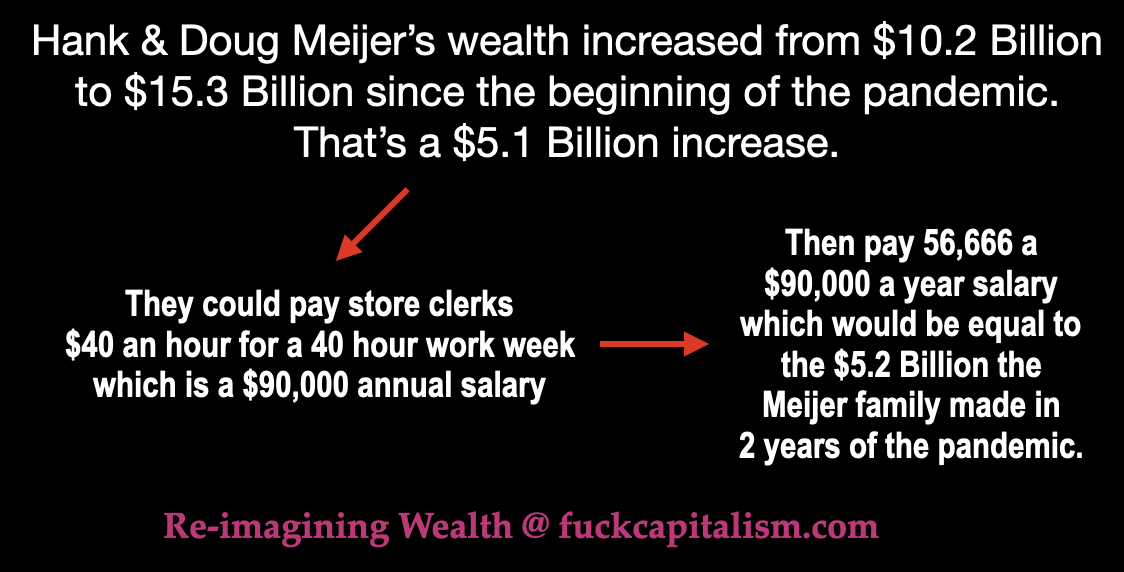
- According to the most recent data on the Forbes Billionaire list, Hank & Doug Meijer are worth $15.3 Billion, making them the 116th richest families in the world. This means that Hank & Doug Meijer’s wealth went from $10.2 Billion at the beginning of the pandemic to $15.3 Billion today. This also means that Hank & Doug Meijer’s wealth increased by $5.1 Billion in the past two years. The reality is that the Meijer family could redistribute equally the $5.1 billion to the people in West Michigan and effectively eliminate food insecurity for the thousands of individuals and families that are experiencing poverty. Hank & Doug Meijer could also pay their employees a living wage of $25 an hour, which would not only mean that their employees would be less likely to need food assistance, it would make the lives of their employee families less stressful. This would still leave Hank & Doug Meijer with $10.2 Billion, which should be more than enough to live on.
On Tuesday, MLive ran an article about Feeding America getting ready to move into a new facility, which would allow them to distribute more food for families “in need.”
 In that same MLive article it states that Feeding America West Michigan received a leading gift of $2 million from longtime supporter, Meijer. While this seems like a a very generous donation, $2 Million from a family that is worth $15.3 Billion is like you and I contributing $20 to something.
Not surprising, the MLive reporter doesn’t question the donation, the Meijer family wealth, the work of Feeding America or the fact that distributing more food to people will not address the root causes of hunger and food insecurity. The MLive reporter had no real incentive to ask these important questions, especially since the MLive article is essentially a re-wording of the Media Release sent out by the Meijer Corporation. Ultimately, the MLive article is not news, it is a Public Relations service they offered for the Meijer Corporation without charging them a cent.
Voice for the Badge finally breaks their silence over the GRPD murder of Patrick Lyoya with the One Bad Apple Theory
 After 43 days of silence, the founder of Voice for the Badge, Johnny Brann Sr., finally responded to the GRPD murder of Patrick Lyoya……..sort of.
On May 16th, this is what the police apologist group, Voice for the Badge posted on their FB page:
Such a tragic and sad situation occurred in our city in early April.
Prayers for all involved and may Patrick Lyoya rest in peace.
I do understand the anger held by many, but should the entire GRPD be treated like they are all bad officers?
No – they should not – but the cop haters –heck they hated our P.D. before and now their hatred has escalated even more.
I value our GRPD and if I thought for one second – our department was what has been said the department is-I would not support the GRPD but I do not believe this so my support for our GRPD remains.
Been said…disband, dissolve the VFB -not happening —No -we have many, many officers that bravely protect us all– as we see on far to many nights in our city.
Hate me if you like but I will never apologize for supporting the good officers of our GRPD-and why should I? The far majority of citizens value our P.D. in every section of our city.
Johnny Brann Sr.
In fact why are haters even on our page?
This is the sort of cowardly and unsubstantiated crap we have come to expect from Voice for the Badge. Here are my responses to such drivel.
- The GRPD murder of Patrick Lyoya wasn’t a “tragic and sad situation,” it was murder by Officer Schurr, who was following the standard protocol for cops.
- VFB offers up prayers, but no thoughts
- Then there is the One Bad Apple justification. As Catherine Caruso wrote after the trial of Derek Chauvin – “At this point, the bad apple theory is nothing but an illusion, a convenient way to brush off and ignore a much more deep-rooted and pervasive problem. It’s time to move past the bad apple theory. It will not end systemic racism or police brutality. It will only be used to continue to justify racist police violence and perpetuate a system of injustice.”
- Another commentator put it this way: The ‘bad apple analysis’ however simply obscures the reality that the criminal (in)justice system is not designed to provide safety to those marginalised and minoritised. It never has been. It’s in fact built on the criminalisation and disposability of black people, people of colour, poor people, trans people, disabled people and beyond, in service of those with wealth and power.
After using the one bad apple theory for the GRPD murder of Patrick Lyoya, Johnny Brann Sr. then rambles on about haters and how he doesn’t believe anything the haters have to say. Instead, Brann says that the cops are here to protect us, without offering up any data, analysis or commentary to substantiate such a claim. Sure the cops motto is to protect and to serve, but do they really protect the public? The GRPD rarely prevents crime, they show up after the fact. Ask Black people if the GRPD protect them. Ask undocumented immigrants if they feel protected by the police, or trans and queer people? What about the unhoused or those who are brutalized by the system of Capitalism, which society refers to as “the poor.” Do you think they feel safe and protected when cops are around?
Once more the founder of Voice for the Badge says that the majority of people value the GRPD, and once more he provides no evidence to substantiate such a claim.
Lastly, Brann signs off by asking the question, “why are haters even on our page?” Well Johnny, speaking for myself, I monitor the Voice for the Badge FB page because I consider your organization as a hate group, a group that perpetuates harm, and a group that is rooted in a White Supremacist ideology.
The Business of the Grand Rapids City Government is Business: The 2023 Budget Priorities
 US President Calvin Coolidge believed that the country’s well-being was best preserved by allowing business to create wealth. His most famous remark was in a speech that he delivered in 1925, in which he stated: “The business of America is business.”
Coolidge presided over a period when taxes and government spending were lowered. The President resisted appeals from Veterans for bonus payments. He vetoed the Soldiers’ Bonus and he was extremely antagonistic to the growing Labor Movement.
Based on the proposed 2023 Grand Rapids City Budget, it would seem that the Business of the Grand Rapids City Commission is business. According to a May 11th announcement from the City of Grand Rapids, the commissioners have already approved at total of $37,884,818 for several economic development committees, committees that are primarily stacked from members of the Business Class. (See Below) It should also be mentioned that these people are not elected, rather they are appointed by members of the Grand Rapids City Commission.
This $37,884,818 of public funding for business interests includes (see breakdown for each of the 12 areas)
- Business Development
- Business District Marketing
- Facade Improvement
- Business District Design
- Business Sponsorships
- Grand River Governance Planning – which is primarily designed to attract tourists and consumers
- Trade Shows
- Real estate development programs
- Infrastructure improvements – which primarily attracts tourists and consumers
- Major capital improvements to Downtown public spaces such as Lyon Square and the Van Andel Arena alley
These twelve groups, which are using nearly $39 million in public money, have a total of 96 current Board members. Of those 96 there are:
- 18 Current or former Government Officials
- 6 Non-Profit representatives
- 8 Educational Institutions
- 4 retired or without status
- 60 Business representatives
Now, if we are talking about how much the City of Grand Rapids has committed to things like Affordable Housing, Anti-Racism Work, or other critical social justice issues, the comparison to business interests is stark.
- We know that the City of Grand Rapids made a deposit of $957,365 for the Affordable Housing Fund in December of 2021.
- According to a document on Community Collaboration on Climate Change, this project is projecting to commit $900,000 over a three year period.
- Anti-Violence funding – the City of Grand Rapids is only a fiduciary for the Cure Violence Program, offering only resources and information.
- Last year, the City of Grand Rapids received $600,000 to advance racial equity in city operations
- Neighborhood Match Fund, which provides funding for neighborhood improvement, particularly around more progressive projects – estimate $100,000 per year
Even with these 5 critical issue areas, the City of Grand Rapids has committed no more than $2.7 Million, and some of that funding is for a three year period. Therefore, the City of Grand Rapids has committed roughly $2 Million for Affordable Housing, anti-racism work, Climate Change, anti-violence and resident-led Neighborhood projects, while the Business-led investment and development projects will be using nearly $39 Million of public money. Of course, this doesn’t even include the roughly $60 Million for policing, which demonstrates the issues that are prioritized by Grand Rapids City officials.
The proposed 2023 Budget for the Brownfield Development Authority is $15,507,194
BDA Board of Directors
Guillermo Cisneros – West Michigan Hispanic Chamber of Commerce
Lynn Rabaut – retired
Kristine Bersche – Natura Architectural Consulting LLC
Troy Butler – Thacker Sleight
Nathaniel Moody – City Commissioner
Dan Barcheski – Chairman of Axios HR
Kim McLaughlin – Wolverine Building Group
Micah Perkins – Retirement Services Officer US Army
John VanFossen – Meijer
Joshua Verhulst – Tech Defenders
The proposed 2023 Budget for the Downtown Development Authority DDA is $16,240,851
Board of Directors
Richard Winn – AHC Hospitality (DeVos-owned)
Mayor Rosalynn Bliss
Luis Avila – Varnum Law
Kayem Dunn – Consultant
Jermale Eddie – Malamiah Juice Bar
Greg McNeilly – Windquest Group (DeVos-owned)
Jim Talen – former Kent County Commissioner
Diana Sieger – Grand Rapids Community Foundation
Jen Schottke – ABC Western Michigan
The proposed 2023 Budget for the SmartZone Local Finance Development Authority is $2,374,546.
SmartZone LFDA Board of Directors
Hal Ostrow – Lawyer, Rhoades McKee
Al Vandeberg – Kent County Administrator
Keith Brophy – Emergent Holdings Inc.
Gerald Callahan – Van Andel Institute
Lisa Freiburger – GRCC
Kristian Grant – GRPS
John Helmholt – GRPS
Mark Washington – City Manager
Jerry Kooiman – MSU
Randy Thelen – The Right Place Inc
Fred Molnar – Michigan Economic Development Corporation
The proposed 2023 Budget for the Economic Development Corporation is $120,296.
Economic Development Corporation Board of Directors is the same as the Brownfield Development Authority.
Guillermo Cisneros – West Michigan Hispanic Chamber of Commerce
Lynn Rabaut – retired
Kristine Bersche – Natura Architectural Consulting LLC
Troy Butler – Thacker Sleight
Nathaniel Moody – City Commissioner
Kim McLaughlin – Wolverine Building Group
Micah Perkins – Retirement Services Officer US Army
John VanFossen – Meijer
Joshua Verhulst – Tech Defenders
The proposed 2023 Budget for the Southtown Corridor Improvement Authority is $647,858
Southtown CIA Board of Directors
Johnathan Farman – JF Consulting
Kristian Grant – GRPS
Helen Harp – Owner Joy Radio
Senita Lenear – City Commissioner
Eric Williams – United Methodist Community House
Nathaniel Moody – City Commissioner
Ruben Ramos – R&R MECHANICAL SERVICES LLC
Darel Ross – Start Garden and Owner Forty Acres Soul Kitchen
The proposed 2023 Budget for the Westside Corridor Improvement Authority is $290,000
Westside CIA Board of Directors
Brent Gibson – Construction Simplified
Johnny Brann Jr. – Brann’s Restaurant
Daniel Grinwis – Oasis of Hope Center
Lisa Haynes – GVSU
Aaron Jenks – Paradigm Design
Jon O’Connor – City Commissioner/Owner of Long Road Distillers
Dave Shaffer – CEO Interphase Interiors
The proposed 2023 Budget for the Uptown Corridor Improvement Authority is $133,505
Uptown CIA Board of Directors
Lynn Happel – owner of Veterinary Clinic
Stephanie Johnson – Urban Exchange LLC
Nathaniel Moody – City Commissioner
Matthew Smith – Open Systems Technologies Inc
Mark Stoddard
Tamara Sytsma – System Wealth Strategies
Peter Jacob – Kind Creative
Joana Hively – Owner Global Infusion
The proposed 2023 Budget for the Uptown Business Improvement District is $133,505
Uptown BID Board of Directors
Lynn Happel – Owner Eastown Veterinary Clinic
Stephanie Johnson – Urban Exchange LLC
Nathaniel Moody – City Commissioner
Matthew Smith – Open Systems Technologies Inc
Tamara Sytsma – System Wealth Strategies
Peter Vanderwier
Ted Lott – Lott3Metz Architecture
Jaye Van Lenten – Co-owner of Spirit Dreams
The proposed 2023 Budget for the Michigan Street Corridor Improvement Authority is $397,500
Michigan Street CIA Board of Directors
Max Benedict – Third Coast Development
Kevin Brant – Developer
Joe Jones – City Commissioner
Thomas Dann – Real Estate Agent
Alexander Lamkin
Jeff Lobdell – Restaurant Partners Inc.
Christopher Swank – GVSU
The proposed 2023 Budget for the South Division/Grandville Corridor Improvement Authority is $218,000.
South Division/Grandville CIA Board of Directors
Amy Brower – Roosevelt Park Neighborhood Association
Fran Dalton – Garfield Park Neighborhood Association
Mary Dengerink – Green Leaf Consulting
Synia Jordan – Real Estate Agent
Kurt Reppart – City Commissioner
Leonard Van Drunen – Calvin University
Angelica Velasquez – owner of La Casa de la Cobija
Marcel Price – Executive Director of The Diatribe
The proposed 2023 Budget for the North Quarter Corridor Improvement Authority is $106,467.
North Quarter CIA Board of Directors
Hannah Berry – Lions and Rabbits Center for the Arts
Kim Bode – Owner and founder of 8THIRTYFOUR
Duane Culver – Culver CPA Group
Brianna Forbes – Urban Massage
Alan Hartline – President Kingma’s Market
Milinda Ysasi – City Commissioner
The proposed 2023 Budget for the Monroe North Tax Incremental Finance Authority is $1,390,901
Monroe North Tax Incremental Finance Authority Board of Directors
Rosalynn Bliss – Mayor of Grand Rapids
James Baldwin – West Michigan Mechanical Contractors Association
Diedre Deering – Literacy Center of West Michigan
Jim Talen – former County Commissioner
Richard Winn – AHC Hospitality (DeVos-owned)

