Yesterday, MLive posted an article entitled, Grand Rapids leaders may make changes to public meetings following disruptions.
The article centers around the fact that since those protesting the GRPD murder of Patrick Lyoya have not practiced West MI Nice during the past two City Commission meetings, the Mayor of Grand Rapids decided to end those meetings. Earlier on in the MLive article, Mayor Bliss said:
“I’ll be meeting with our city attorney and city clerk and we’ll be looking at what options we have under not just the Open Meetings Act but our standing rules and potentially making changes to those.”
Bliss doesn’t provide any additional information or thoughts on what sort of changes or options there are regarding City Commission meeting rules, but it would be safe at this point to assume that those changes would be punitive, restrictive and essentially anti-democratic.
The MLive article then goes on to cite Mayor Bliss at length, who was expressing her dismay at how disrespectful people are and how they do not follow City Commission meeting rules. The article also mentions that there have been other instances during Mayor Bliss’s tenure that meetings have been disrupted, along with citing an example of when County Commission meetings were disrupted in 2018 and 2019 over the issue of the County’s contract with Immigration and Customs Enforcement (ICE).
Recent City and County Commission meeting disruptions
In late 2018, Captain Kurt VanderKooi, the GRPD’s liaison with ICE, while watching a local TV news story, contacted ICE to look into Jilmar Ramos-Gomez. The thing that VanderKooi didn’t know was that Ramos-Gomez was a US citizen and a former US Marine. After VanderKooi’s call to ICE, they detained Ramos-Gomez for several days, until it became public that he was a US citizen and former Marine. Grand Rapids City officials did not suspend VanderKooi, nor did they fire him, even though he also used racist language when talking about Ramos-Gomez to ICE.

In late February of 2019, members of Movimiento Cosecha GR and GR Rapid Response to ICE planned to disrupt the City Commission meeting, by standing in front of the Commissioners and holding signs while the Commission meeting was still in progress. Mayor Bliss adjourned the meeting.
Mayor Bliss was no doubt mimicking what the Kent County Commission had done in June of 2018, when Movimiento Cosecha GR and GR Rapid Response to ICE organized an action during their June 28th meeting. There were over 200 people who packed the County Commission chambers, with many holding signs. When public comment began, several activist moved into the area where the commissioners are seated and held up a banner and began to chant. The County Commission Chair adjourned the meetings shortly after that. Seeing that most of the Commissioners had left, people still got up and shared stories of ICE violence and how they live in constant fear of arrest, detention and deportation.
After that meeting, the County Commission then put up a barrier to deter people from coming near to where the commissioners were seated, so at the next meeting, activist sat down in front of the barrier and again began chanting for an end to the ICE contract. Once again, people brought signs and held them up during the meeting.
In late August, the same activists came to another Kent County Commission meeting after it was announced days before that people could no longer bring signs to the meetings. As a response, activist pinned large patches on their back and then stood up, with their backs facing the County Commissioners during the entire meeting.
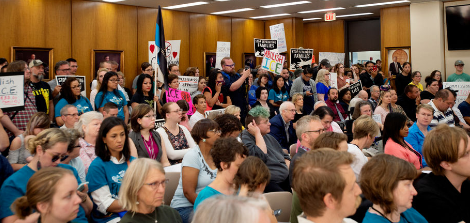
In September, Movimiento Cosecha GR and GR Rapid Response to ICE activists again disrupted the Kent County Commission meeting, by holding their own People’s Commission, in an attempt to model the kind of meeting process that the public might actually benefit from. The Kent County Commission Chair once again adjourned the meeting shortly after the People’s Commission meeting had begun.
Over the next several meetings, the County Commission decided to have a closed meeting and only allow people to watch the proceedings on a TV monitor in a different room.
All of this is to say that it is possible that the Grand Rapids City Commission might follow the actions of the Kent County Commission. Mayor Bliss has already stated that to disrupt the meeting was a misdemeanor and people could be arrested. Whatever actions Grand Rapids City officials take, it will only embolden activists who are demanding Justice for Patrick Lyoya. The more that Mayor Bliss decides to adjourn meetings and not meet the demands of this movement, the more the resistance will continue.
Last night, Grand Rapids Mayor Rosalynn Bliss decided to stop the City Commission meeting because those who came out to protest for Patrick Lyoya would not play by the rules of commission meetings.

Many people addressed the City Commission last night, some more than once. During the first Public Comment portion, where people could speak on agenda items, several people got up to address the issue of the proposed 2023 City Budget. Virtually everyone who spoke at this point shared their disgust and outrage over the fact that the GRPD Budget would not be reduced and that the City was considering purchasing new vehicles for the Police Department. Several of those who spoke made it clear that they wanted the GRPD Budget reduced to the City Charter mandated 32% of the budget, which would be a significant reduction.
What is instructive is the fact that none of the local news agencies – MLive, WOODTV8, WZZM 13 or WXMI 17 – mentioned the demand that the GRPD be defunded to the City Charter mandated 32%. There was some mention in a few of the stories around police funding, but all four of the local news agencies failed to include he clear demand about defunding the GRPD, which has been one of the most consist demands since June of 2020.
Instead, the focus of the coverage was centered around people swearing during the public comment period, where people became “unruly” or didn’t “respect the space” or allow the City to “conduct City business.” Mayor Bliss was repeatedly quoted by the local news agencies and WOODTV8 even did a story they ran before the 7pm City Commission meeting, where Mayor Bliss and Chief Winstrom were provided a platform to verbalize their talking points, even though the Justice4Patrick movement was not afforded the same opportunity to share their thoughts.
Once the Mayor decided to end the meeting, the rest of the coverage focused on but of video footage of protestors in the Commission Chambers, then outside of City Hall, since the GRPD – which had several dozen officers present – threatened people with arrest if they didn’t leave the building.
Several of the news agencies did report that one of the those protesting the GRPD murder of Patrick Lyoya was arrested, but the only source to confirm this was the GRPD. Once again, those with the Justice4Patrick Movement were not asked to provide any comments about the arrest.
The continued reliance by the local commercial news media on official sources – people with political and economic power – is not just a reflection of how journalism is produced in this city, it demonstrates that the local commercial news media doesn’t have a functional relationship with grassroots community organizers. This lack of relationship with grassroots community organizers stems from the fact that the community doesn’t trust the local commercial news agencies, since they often present biased coverage on policing in this city, which is also due to the fact that the local commercial news agencies have internalized the same values of the very systems of power that they are supposed to hold accountable. #Justice4Patrick#
West MI Foundation Watch: Peter & Joan Secchia Foundation – contributions to fit their political agenda
 Even though Peter Secchia, a member of the Grand Rapids Power Structure, died in 2020, his foundation continues to promote the myth that rich white guys really want to make a difference in the world.
For more than 5 decades, Peter Secchia contributed money to the Republican Party, which means that he funded the hateful rhetoric and the harmful policies of the Republican Party, from Ronald Reagan all the way through the neo-fascist Trump Administration.
The Secchia Foundation was created, like all foundations of the Capitalist Class, as a way hide some of their money from being taxed and to generate a positive PR buzz about how generous they are with the money they made off the backs of the workers they exploited.
GRIID just downloaded the 990 documents for the Secchia Foundation for 2020, which is the most recent year to access from GuideStar.
The Peter and Joan Secchia Foundation, like most foundations started by members of the Capitalist Class, contributes some of their money to charitable organizations, organizations which do not challenge structural inequalities nor the families that the foundations are named after. Some of the local charitable organizations that the Secchia Foundation contributed to are:
- Baxter Community Center
- Steepletown Neighborhood Services
- YMCA of Grand Rapids
Secchia was also a member of the Catholic Church, so there are also several contributions to Catholic organizations, like St. Thomas Church and the St. Andrews Cathedral.
Then there are the education institutions that Secchia has contributed to, in the case much larger contributions than the charity groups, such as:
- Davenport University Foundation – $50,000
- GR Community College Foundation – $84,333
- GVSU – $12,500
- West Michigan Aviation Academy (Dick DeVos) – $5,000
Lastly, there are organizations that have an Capitalist Agenda, that the Secchia Foundation has contributed to, such as:
- Downtown Market Ed Fund – $11,000
- Experience Grand Rapids – $12,030
- Grand Rapids Community Legends – $117,392
- Russell Kirk Center – $25,000
The Grand Rapids Community Legends is particularly problematic, as they are the one responsible for most of the statues that have been erected in downtown Grand Rapids, centering around “great leaders,” most of whom are white. The Grand Rapids People’s History Project has written about many of them, including:
As we mentioned in the beginning of this post, the Secchia family has contributed a great deal more money to the Republican Party, but that reality tends to be less of any interesting story to the local news media. The foundation contributions are often what solidify the legacy of Capitalists like Peter Secchia, thus hiding how they made their wealth and how they used it to further their own agenda.
The City of Grand Rapids has already presented a Budget proposal for 2023, submitted to the Commissioners by the City Manager. The City Commission is meeting this morning (Tuesday) in a Budget Workshop session, and then again at 1pm.
There is a 2023 Budget Hearing scheduled for May 17 at 7pm, which is the only public meeting that has been set aside for public input. At the May 24th, Committee of the Whole meeting the Commissioners will then deliberate on the Budget, then adopt the budget later that night, based on the existing schedule.
Based on how the City of Grand Rapids has dealt with the annual budget process, it is safe to assume that they have already adopted the 2023 Budget, despite the window dressing known as a public hearing. When City Manager Mark Washington sent out a press release on May 3, with his 2023 Budget proposal, I believe that he knew then that his proposal would be adopted (with maybe minor tweaks), regardless of whatever comments or input the public provides. This is the kind of political system we have in Grand Rapids, where a handful of City officials get to make decisions that will impact the rest of us, without any real regard for what hopes and aspiration we might have, particularly as it relates to the substantial community desire to defund the GRPD.

Using Radical Imagination for the Abolition of the GRPD
Now, no one is expecting that the GRPD will go away tomorrow or anytime soon. However, if we want to see the GRPD, a known institution of oppression, to be dismantled, then we need some kind of a proposal/plan to make that become a reality. What I am proposing is just an idea, it is not the only idea and it may not even be the right idea. However, we have to begin with an idea to start down the path of actually working towards the abolition of the GRPD.
I am proposing a 6-year defunding plan of the GRPD, where 10% of the current GRPD budget would be defunded and diverted to the African American community to do whatever they decide to do.
The current GRPD Budget, which also includes some grant funded projects is roughly $60 Million annually. This would mean that in year one, the GRPD would be defunded by $10 Million, $20 Million in year two, $30 Million in year three, $40 Million in year four, $50 Million in year five, and $60 million in year six.
We could thus phase out the GRPD within six years, thus acknowledging that such an institution could not be dismantled over night.
At the same time, $10 Million would be given to the Black community in year one, $20 Million in year two, $30 Million in year three, $40 Million in year four, $50 Million in year five and $60 Million in year six. This would mean that the Black community would receive $210 Million in total over a six year period.
Imagine what kind of an impact that $210 Million would have over those six years. According to the most recent census data, about 18% of Grand Rapids identifies as African American out of roughly 200,000 people. This would mean that about 36,000 Grand Rapidians are African American. Considering these numbers, think about how $210 Million over a six year period could contribute to things such as:
- Housing costs – both home ownership and rent
- Health care costs, including preventive care
- Educational scholarships
- Food security
- Transportation costs
- Business start up costs
These are just some of the ways that divesting from the GRPD and investing in the Black community could radically alter the lived experience of the very community that has disproportionately been affected by policing in Grand Rapids.
Lastly, the $60 Million annual GRPD Budget cost would not have to end after the 6 year plan. In fact, the $60 Million annually, after the first six years, could be used in other ways or they could continue to be directed towards the Black community or the BIPOC communities in general, as a form of reparations for the historical exploitation, police abuse, drug war, land theft, etc. that BIPOC communities have experienced since the founding of Grand Rapids. We all can radically imagine how things would be different if such a plan were enacted.

In the agenda for the May 11th meeting of the SmartZone Local Development Finance Authority, which is a committee of the City of Grand Rapids, there was an interesting brief paragraph that was part of the minutes from their April 13th meeting, which read:
City Manager Mark Washington acknowledged the GRPD shooting incident the previous week which resulted in the death of Patrick Lyoya. He stated that he had been asked by members of the business community if the city anticipated any interruptions to normal operations as a result of planned protests and demonstrations. Mr. Washington said that at this point the city did not anticipate any interruptions to City operations.

This is a very revealing and very instructive comment, which we will get to, once we provide some background on this Grand Rapids City Committee.
Now, the mission of this group states: The SmartZone Local Development Finance Authority (LDFA) supports high-technology entrepreneurs and businesses. The SmartZone captures increased property tax dollars and reinvests that money back into the entrepreneurial ecosystem in Grand Rapids.
This means that the City of Grand Rapids has a committee that is represented primarily by those in the business world, who promote businesses in the high tech field, then uses the tax dollars that comes to the City from these very businesses, only to use that money to promote more businesses. Sounds like a great ponzi scheme.
The committee of the SmartZone group is made up of the following people:
- Hal Ostrow, Chair – Lawyer with Rhoades McKee
- Jerry Kooiman, Secretary – Assistant Dean for External Relations at MSU College of Human Medicine
- Al Vanderberg, Treasurer – Kent County Administrator
- Keith Brophy – Chief Operating Officer at ADHD Online, LLC
- Jerry Callahan – Chief Strategy Officer at Van Andel Institute
- Lisa Freiburger – GRCC’s Vice President for Finance and Administration
- Kristian Grant – Real Estate Loan Officer, Investor & Developer, GRPD School Board President
- John Helmholdt – Executive Director of Communications and External Affairs at GRPS
- Randy Thelen – President & CEO of The Right Place
- Mark Washington – Grand Rapids City Manager
- Fred Molnar – Vice President of Entrepreneurship and Innovation at Michigan Economic Development Corporation
In addition, the Agenda Packet for the May 11th meeting also includes a great deal of information about the DeVos-created entity, Smart Garden and Spartan Innovations, which have a joint contract with the City of Grand Rapids. This means that the City of Grand Rapids use public money to pay these two groups to figure out ways to bring more entrepreneurs into the city. This is a perfect example of how Neo-Liberal Capitalism works in Grand Rapids.
Making Grand Rapids Safe for Capitalism
Ok, now we can get back to Mark Washington’s comments to the business community when asked about protests and disruption following the GRPD murder of Patrick Lyoya.
City Manager Mark Washington believes that there will be no “interruptions to normal operations” for both the business in the downtown area, nor the City government. Now, we saw what the City of Grand Rapids did just days after the video was released of the GRPD murder of Patrick Lyoya, which was to barricade the police headquarters and to use salt trucks to block off the roads leading to the police station. These actions on the part of the City sent a clear message about they want to protect, which was primarily the police headquarters.
In terms of the business community, they have no doubt been on high alert since the GRPD killing of Patrick Lyoya, hoping to not see a repeat of the property damage that was done during the May 30th uprising that took place in Grand Rapids because of the national outrage over the police killing of George Floyd.
If there is anything we have learned in recent years it is this…….the City of Grand Rapids and the GRPD will not tolerate any disruption to profit making of any kind, whether it is tourism or just the daily business activities, particularly of those that take place in the downtown area. The City and the GRPD will especially not tolerate any interruptions to profit making, even when police kill civilians, when there is war, when people are protesting White Supremacy, economic inequality or any other form of oppression in the city. Private property and profit making are sacrosanct.
The City of Grand Rapids will be discussing and voting on the proposed 2023 Budget in the coming days and weeks, beginning on May 10. There is already a proposed budget, with specific funding allocations already laid out by City Manager Mark Washington on May 3rd.
This process has been highly questionable, in regards to authentic public input, as the community has experienced, specifically with calls for a reduction in the funding for the Grand Rapids Police Department.
We thought it would be useful to provide a timeline of the work of the group Defund the GRPD, along with other articles that GRIID has posted since June of 2020, when the initial calls for Defunding the GRPD began in response to the national and Grand Rapids uprising against the police killing of George Floyd in late May of 2020.

June 2, 2020 – We wrote a piece about why there needs to be a Defund the GRPD movement in Grand Rapids, where we talked about the City Budget and brief timeline since 2016 of GRPD actions against Black and Brown residents.
June 9, 2020 – On this date we wrote a piece that provided information on which Grand Rapids-based candidates – City Commissioners, County Commissioners, those running for County Prosecutor, judicial seats and state offices – had received funding from the Grand Rapids Police Officer’s Association PAC. We also stated that a Defunding movement would call for people to not vote for those who took police union funding.
 June 11, 2020 – We wrote an article looking at the $54 million annual budget for the GRPD and how that money could be used to benefit the Black community in Grand Rapids, in what the Vision for Black Lives refers to as a divest/invest strategy.
June 15, 2020 – On this date we wrote about what to would look like to not have the GRPD. We looked at numerous resources and examples of community safety that did not rely on cops.
June 16, 2020 – The Movement for Black Lives has recently created a wonderful toolkit for communities that are considering a campaign to defund their police. This toolkit is a great resource and needs to be read by everyone before they make their own declarations about what defunding the police really means.
June 17, 2020 – On this date we wrote a piece about how the City of Grand Rapids changed the City Charter to institutionalize the 32% of the budget funding for the GRPD, which took place in 1995.
June 18, 2020 – The Grand Rapids Police Officer’s Association releases a statement opposing any defunding of the police department.
June 26, 2020 – Defund the GRPD held its first Press Conference, where they announced clear demands for defunding the Grand Rapids Police Department.

July 8, 2020 – After weeks of pressure from community groups to Defund the GRPD, 3 City Commissioners were set to propose defunding the GRPD to the 32% City Charter mandated minimum. However, the City Manager and the City Attorney stepped in and prevent such a vote, making the claim that the City Commission did not have the legal authority to do so. City Manager Mark Washington did say that they would revisit possible reduction in GRPD funding later that year.
July 13, 2020 – The local news media acts as a conduit for the GRPD, by calling actions of local activists calling for the GRPD to be defunded as “vandals.”
July 29. 2020 – The City of Grand Rapids announced that there would be a new Strategic Plan for the GRPD in August, but the announcement made it clear that there is no way for the GRPD to reduce their funding, using recent gun violence as the main justification.
August 10, 2020 – New GRPD Strategic Plan placates those unaffected by police violence and ignores those calling for defunding.
September 24, 2020 – GRPD planned for another riot during a protest to honor Breonna Taylor in Grand Rapids.
November 17, 2020 – Defund the GRPD and other community groups stopped the efforts of the City of Grand Rapids to use Cares Act funding from Kent County to purchase ShotSpotter technology that the GRPD wanted.
December 2, 2020 – A member of the Grand Rapids Power Structure sends the City Commission a letter to oppose any defunding of the GRPD.
December 27 & 30, 2020 – The GRPD police union and supporters increased their efforts to oppose any sort of defunding of the GRPD, making it clear that the efforts of Defund the GRPD were a threat to their institutionalized power.

During the later part of 2020 and the beginning of 2021, Defund the GRPD was also doing work that was less known, such as:
- Creating refrigerator magnets that had resources for people to call other than the GRPD
- Hosting a children’s book giveaway, featuring children’s book by African American authors
- Hosting a Best of the Worst campaign, where people were submitting names of people and organizations that embodied the worst landlord, White Saviorism, worst business, etc.
- All of these efforts were not only a way for Defund the GRPD to practice imagining alternatives to policing, but they were mechanisms to build capacity for future work.
February 24, 2021 – GRPD Strategic Plan revisions claim that Grand Rapids, “will become the safest mid-sized city and most trusted police department in the United States.”
March 9, 2021 – Justice for Black Lives activists were targeted and arrested by the GRPD during a protest, showing how the GRPD engages in selective enforcement of local ordinances.
March 31, 2021 – GRPD rolls out their Operation Safe Neighborhood plan, which involved the use of helicopters terrorizing people in mostly Black and Brown neighborhoods. This so-called community policing approach, is nothing more than a re-packaging of what the GRPD has done for decades.

April 6, 2021 – Local news media talk to GR City Commissioners about the police budget, where they all pretty much oppose any defunding of the GRPD.

April 20, 2021 – Grand Rapids City Officials and the GRPD release a memo, which essentially threatens people who protest the upcoming Derrick Chauvin trial.
April 27, 2021 – Grand Rapids Police Officer’s Association says that the recent viral video of GRPD cops repeatedly punching a black motorists, is simply “fanning the flames of national outrage.
May 3, 2021 – Grand Rapids City Officials hold a 1 hour visual town hall to talk about the 2022 City Budget, which included the budget for the GRPD.
May 9, 2021 – GRPD arrests the wrong Black man who was on the way to a family funeral, but was charged with resisting arrest.
 May 19, 2021 – City Commission hearing on 2022 Budget once again demonstrated how much contempt they have for public input, especially input that challenges their power.
Defund the GRPD did a lot of organizing around the 2022 City Budget proposal, which involved education on the budget, mobilizing people to come to the public hearing on the budget, sending electronic messages to Grand Rapids City Officials, organizing a demonstration with Justice for Black Lives to draw attention to continued police repression in Grand Rapids, and putting out their own list of demands for the 2022 Grand Rapids City Budget.
We are only including the efforts that were put forth to defund the GRPD up to the 2022 Budget discussion/meetings in May of 2021. There has obviously been more that has transpired in the past year, culminating in the GRPD killing of Patrick Lyoya, but the point of this post was to show how much had been done before last year’s City Budget vote and the push back from City Officials and the GRPD.
Recently, WOOD TV 8 sent a FOIA request to the Grand Rapids Police Department, which they ran as a story on April 29, with links to the 4 separate FOIA documents.
Some of the information channel 8 chose to include was useful, but they also missed the opportunity to present other information from the FOIA documents. In addition, channel 8 was very careful not to report on the GRPD through a critical lens.
We have also included these 4 FOIA documents from the GRPD, will provide some critical analysis and include some of the content that is not favorable to the GRPD.
WARNING – SOME OF THIS CONTENT MIGHT BE TRIGGERING OR TRAUMATIC
The first FOIA document is essentially all of the pictures that the GRPD took of the police officer who shot and killed Patrick Lyoya, Christopher Schurr. Most of the items listed, which were photographed, were weapons and other items that Officer Schurr had on his possession that day.
The second FOIA document provides the names and badge numbers of the officers involved, along with the Call Narrative, beginning at 8:11AM through 1:49PM. There were a few lines redacted in this document.
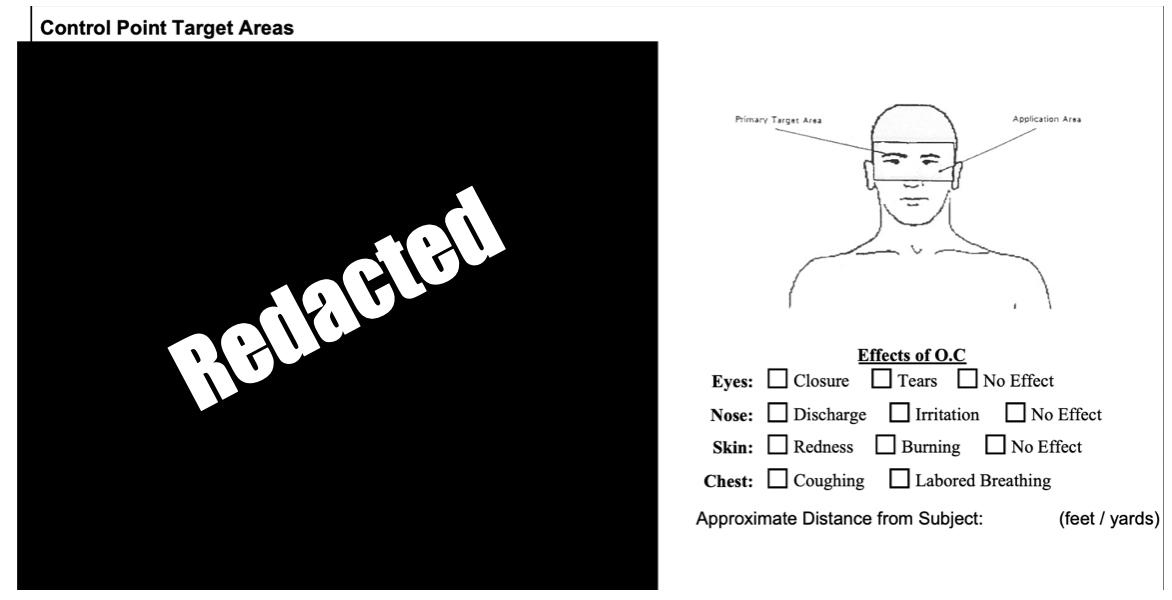
The third FOIA document is exclusively about the “use of force”, which has 99% of the information redacted. The information redacted includes the number of “use of force applications”, the “effectiveness of force”, injuries incurred by “the subject”, the control point target areas, and the officer’s narrative, all of which are redacted.
It is significant that 99% of the information in document 3 is redacted, for the following reasons. First, we do not know the number of “use of force” applications, which would reveal how many times Patrick Lyoya was hit, kicked, tackled, tased and shot. Second, we don’t get to see how the cop determined the “effectiveness” of each application of the use of force. Third, we do not learn where the cop hit, kicked, tased or shot Patrick Lyoya, which prevents us from knowing the scope of the harm done to him. Lastly, we do not get to read the police officer’s narrative about the use of force, which would reveal how Officer Schurr recounted the harm he inflicted on Patrick Lyoya.
The fourth FOIA document (18 pages long) provides a narrative of each GRPD officer involved. Part of Officer Johnston is very revealing, in terms of how police see members of the public. Here is part of what he wrote:
I arrived onscene and saw Officer Schurr taking cover behind a tree on the parkway which was about 20 feet south of the location of his cruiser. I observed one male lying face down in the front yard of 17 Nelson Ave SE. The man’s hand was concealed underneath his body near his waist possibly concealing a weapon. I did not know if the suspect had shot at Officer Schurr, but Officer Schurr had stated that he was “10-4” just before I arrived.
I then approached the downed man while other Officers maintained lethal force coverage while moving up with me. As we approached I observed a black angular object partially visible under the suspect’s left hip and initially thought it was the grip of a handgun, but as I got close enough to grab onto him I then was able to distinguish that it was Officer Schurr’s Body Camera that had apparently been dislodged during the struggle. I rolled the subject over, rolling him to the west and onto his back. I observed that Officer Schurr’s Taser was lying undrneath the suspect where his hand had been and also Officer Schurr’s Body Worn Camera, which was still recording. The Taser had been deployed and the wires and probes were on the ground. The man had blood coming from his nose and I could also see blood on the shoulder area of his sweater.
The tone of this narrative demonstrates the cold and calculated way that cops describe events and how they see people as “suspects.” The narratives also make it clear that the GRPD involved, especially Officer Schurr, believed he was following “proper procedure.” However, from a civilian point of view, this information should not be redacted and the public should be able to read all of the information in the case that doesn’t put witnesses at risk. Making this information public would not change how the police or the legal system will proceed in making their determinations or legal decisions. If the public was exposed to all of the this information, it would certainly increase the amount of public opposition in this case, and rightfully so. If the police and the legal system fear the “court of public opinion,” then that says more about how the system fears the public, especially a a fully informed public. #Justice4Patrick
 In Howard Zinn’s monumental book, A People’s History of the United States, he constantly juxtaposes the amazing things that people did to fight for liberation and the people behind the systems of oppression that social movements were fighting against.
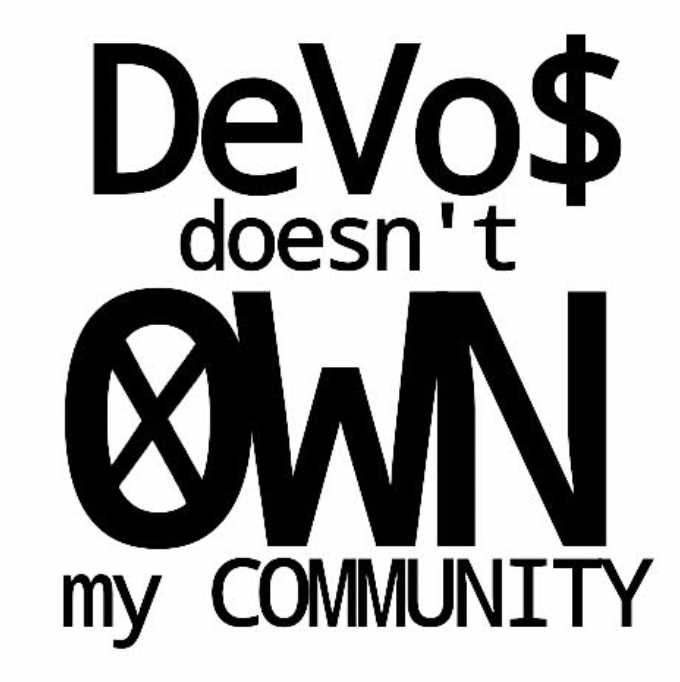
This is exactly why I have spent years monitoring, investigating and critiquing the DeVos Family. They are the most recognizable and powerful manifestation of the systems of power and oppression in West Michigan. Now, I know there are plenty of people who share the belief that without the DeVos Family, Grand Rapids wouldn’t be where it is today. I fully agree with that belief, but for reasons that are the exact opposite of those who hold the most powerful family in West Michigan in high regard.
Twice a year we try to update our DeVos Family Reader, a collection of articles that looks at the family’s history, the influence on election & public policy, their foundations, how they are reported on in the news media, ArtPrize and the section entitled Betsy DeVos Watch.
This updated version of the DeVos Family Reader includes information and analysis on the Betsy DeVos-led effort known as Let Michigan Kids Read, the new Doug DeVos podcast called beLIEve, Always decision to pull their operations out of Ukraine and Russia, coverage of the DeVos-led 14,000 downtown Amphitheater project, plus several stories on campaign contributions at the State level.
The DeVos Family Reader continues to grow and with the most recent update it is roughly 650 pages long. The articles below are in chronological order, beginning with November 7, 2021.
The money behind the candidates in Michigan – Part III: DeVos-funded candidates
 Earlier today, some of the headlines read, Co-response team with police, mental health workers part of Grand Rapids budget, Grand Rapids budget allocating additional funding to OPA; GRPD funding decreased, and Budget shifts some GRPD money to Oversight, other offices.
Some might suggest, as several of the Grand Rapids-based news agencies do, that the so-called reduction in funding for the GRPD is a direct result of the GRPD killing of Patrick Lyoya, which happened exactly one month ago. However, people who are doing boots on the ground organizing and resistance to GRPD practices are not buying any of it.
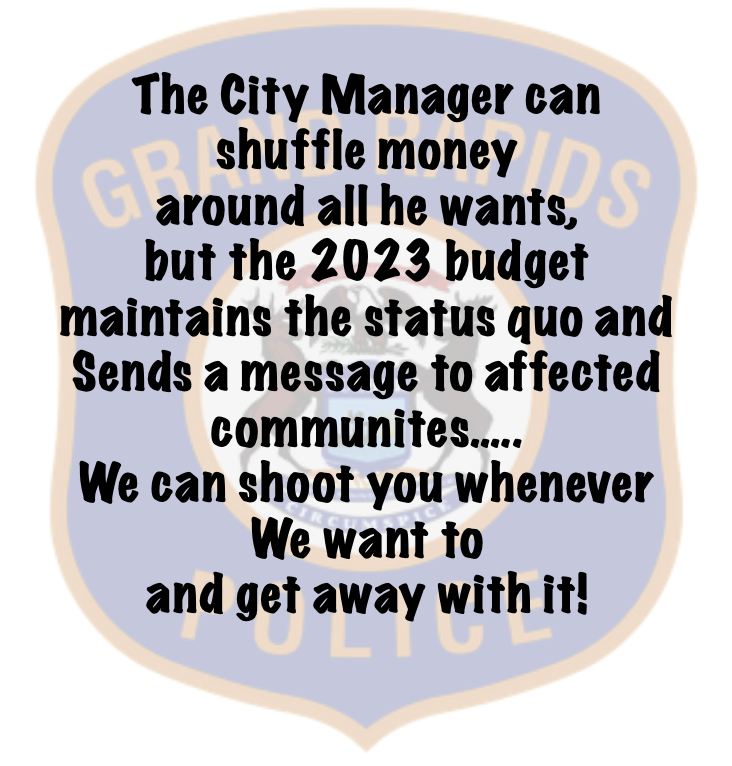
What the City of Grand Rapids is doing is playing chess with the proposed 2023 budget, by moving a measly $130,000 from the GRPD to other offices, such as the Office of Oversight and Public Accountability, which will be responsible for the police department’s body camera program.
In addition, the GRPD will be increasing their partnership with mental health workers, which is a bad idea to have cops – who escalate situations, along with the fact that they are heavily armed and will use deadly force when they feel threatened. Having GRPD cops partner with social workers, mental health workers or with the unhoused community is not only a disastrous idea, it is simply a PR move to make us think that there is real change happening around policing in Grand Rapids. As the father of the Public Relations industry, Edward Bernays, once said – “The engineering of consent is the very essence of the democratic process, the freedom to persuade and suggest.”
In the channel 8 story, Police Chief Winstrom admitted that there will be no police cuts, including no reduction in police officers. This means that the same number of cops will still be disproportionately patrolling in neighborhoods where there are higher levels of poverty, along with neighborhoods that are mostly Black and Latinx residents.
The proposed 2023 Grand Rapids City Budget, particularly as it related to GRPD funding, is nothing more than a sick joke, a deception, and it is an insult to the memory of Patrick Lyoya.
Mark Washington can attempt to play parlor games all he wants with public money, but we will resist it and call for a real Defunding of the GRPD with the reduced GRPD funds to go directly to Black and Brown communities, communities that are most affected by policing in Grand Rapids.
The City of Grand Rapids did send out a Press Release, which lists the schedule for the 2023 City Budget:
Tuesday, May 10 Budget Review Workshop (COW 10 a.m.)
Tuesday, May 10 Budget Review Workshop (1 p.m.)
Tuesday, May 17 City Commission Public Hearing (Budget and Fees) (7 p.m.)
Tuesday, May 24 Budget Discussion and Deliberation (COW 10 a.m.)
Tuesday, May 24 City Commission Adoption (7 p.m.)
This means they will decide in three weeks how to spend our collective money, with only one public hearing on May 17th. Again, this process is a cruel joke that needs to be resisted by any means necessary. It is worth noting that the group DeFund the GRPD made some clear demands last year during the very brief budget process, demands which are relevant for today, which you can read here.
 There is a special election on Tuesday, to fill the seat previously held by Mark Huizenga, who is not a State Senator.
Robert Reagan had won the GOP primary, but after he has made some “controversial comments,” Mike Milanowski Jr. has decided to enter the race as a Republican write-in candidate.
Therefore, the May 3rd election for the 74th District seat is now between Reagan, Milanowski and Democrat Carol Glanville. Glanville, who is currently a Walker City Commissioner, doesn’t have much of a campaign platform, but she has raised a fair amount of money as of the most recent campaign finance data. Some of the larger campaign donors for Glanville are:
- Julie Brixie Blue Wave Fund – $5,000
- Michigan Education Association – $2,500
- Karla Jurvetson (Physician from California) – $1,050
Robert Reagan has a more extensive issues list, although it is pretty clear that he embraces a Trump-like platform. In terms of fundraising, here are the top contributors, based on recent campaign finance data:
- Robert Reagan (he has been his largest single contributor so far) – $1,849
- Kristen Buff (Business Coach) – $1,000
- Bonnie Burke (Designer) – $900
- It is also worth mentioning that former State Represented Dave Agema, who was far right of even many Republicans at the time, contributed $250 to Reagan’s campaign.
Lastly, there is the write-in candidate Mike Milanowski Jr. Milanowski has no issues listed on his campaign page, although there is some information on his Facebook candidacy page. Milanowski has been endorsed by the Michigan Manufacturers Association. In terms of campaign finances, Milanowski has a fairly impressive list of West Michigan power brokers, considering he is a write-in candidate. Here is a list, based on data from the Michigan Secretary pf State:
- Pamela DeVos – $1,000
- Cheri DeVos – $1,000
- Maria DeVos – $1,000
- Steve Ehmann (RDV Corp.) – $1,000
- Doug DeVos – $1,000
- Betsy DeVos – $1,000
- Dick DeVos – $1,000
- Dan DeVos – $1,000
- Friends of West Michigan Business PAC (GR Chamber of Commerce) – $1,000
Clearly, the DeVos family wants to see Milanowski win the 74th District seat, since they and one of their RDV Corp managers have collectively contributed $8,000. This provides Milanowski with funds to do online campaigning and mailers for today’s vote.
 Grand Rapids Institute for Information Democracy