While all the attention was given to the court hearing that began today in the case against the former GRPD officer Christopher Schurr, the cop who shot Patrick Lyoya in the back of the head, there was an organized protest outside the 61st District Court in downtown Grand Rapids.
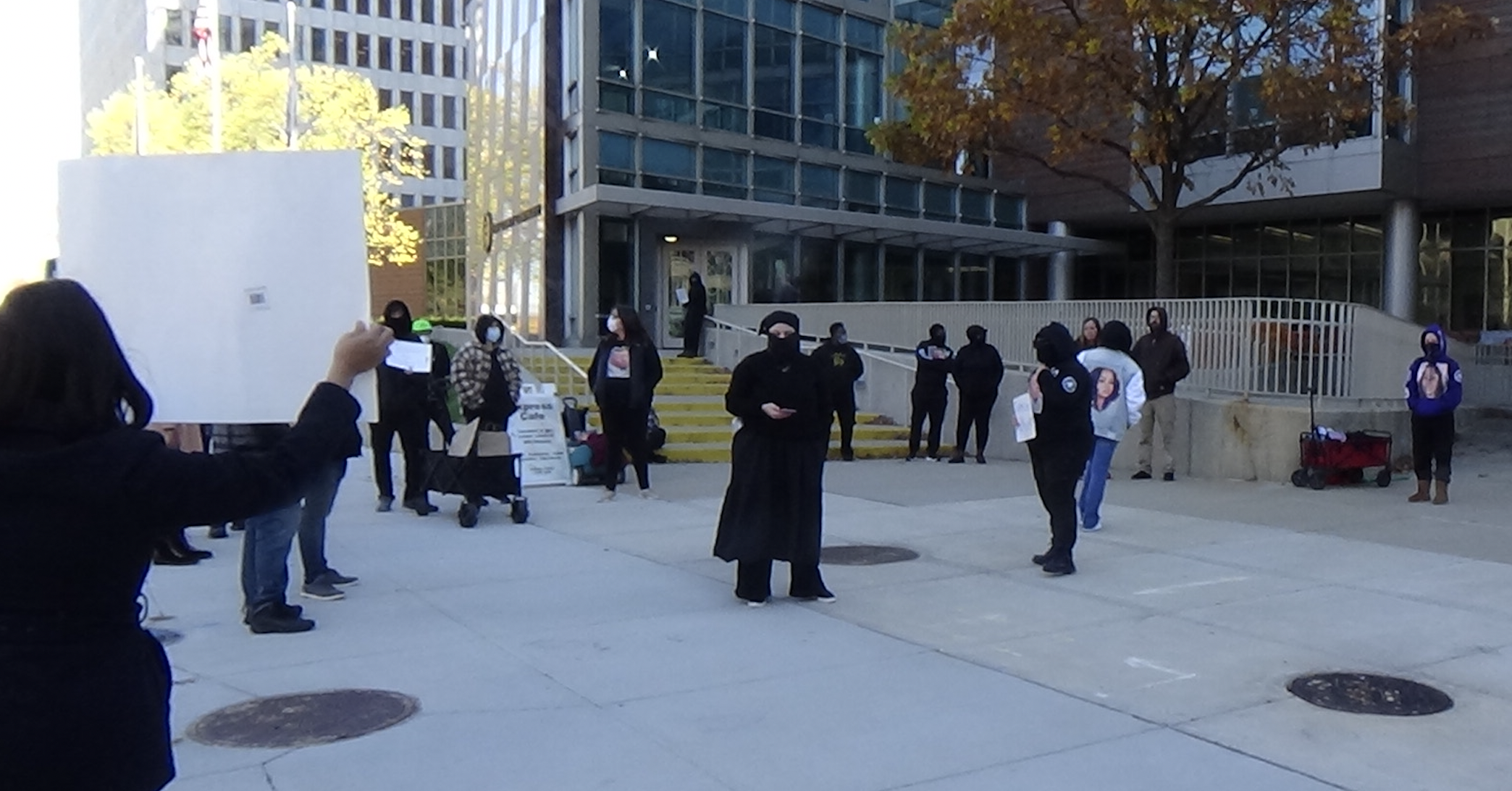
About 30 people began to gather outside of the Kent County Court building around noon on Thursday to continue to public demonstrate solidarity with the Lyoya family. One organizer told this writer that it was important that we continue to take action and apply pressure, any kind of pressure to win justice for Patrick Lyoya’s family.
Some of the people in the Justice4Patrick camp were inside the courtroom, to listen to what was being said and to monitor the process. This information was being shared with activists on the outside, with regular updates.
A brief rally was held outside the 61st District Court, where organizers kept making demands around convicting Schurr, around ending qualified immunity, around greater accountability of the police, and to defund the GRPD. It has been almost 7 months since Patrick Lyoya was pulled over for having an expired license plate on his car, where the cop escalated the situation, used his taser on Lyoya, kicked him repeatedly, then sat on top of him while he laid faced down on the ground and shot him in the back of the head.
There was constant GRPD presence outside during the protest, with cops on foot and cops in cars, monitoring those who were protesting. Eventually, those who had gathered in front of the court building began to walk and chant through downtown Grand Rapids, thus letting those working, shopping or living in downtown that there was still a community of people who were demanding justice for Patrick Lyoya.
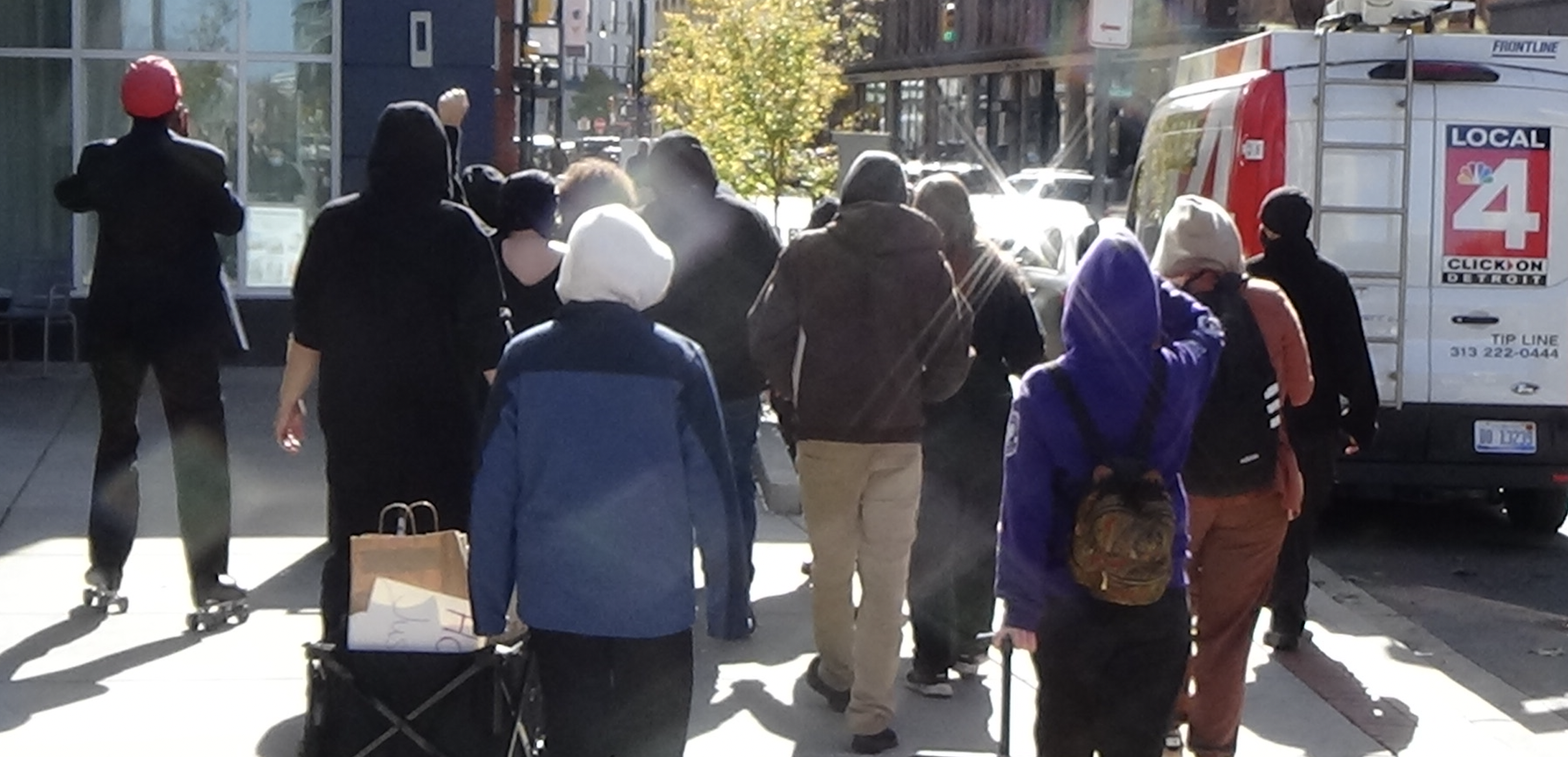
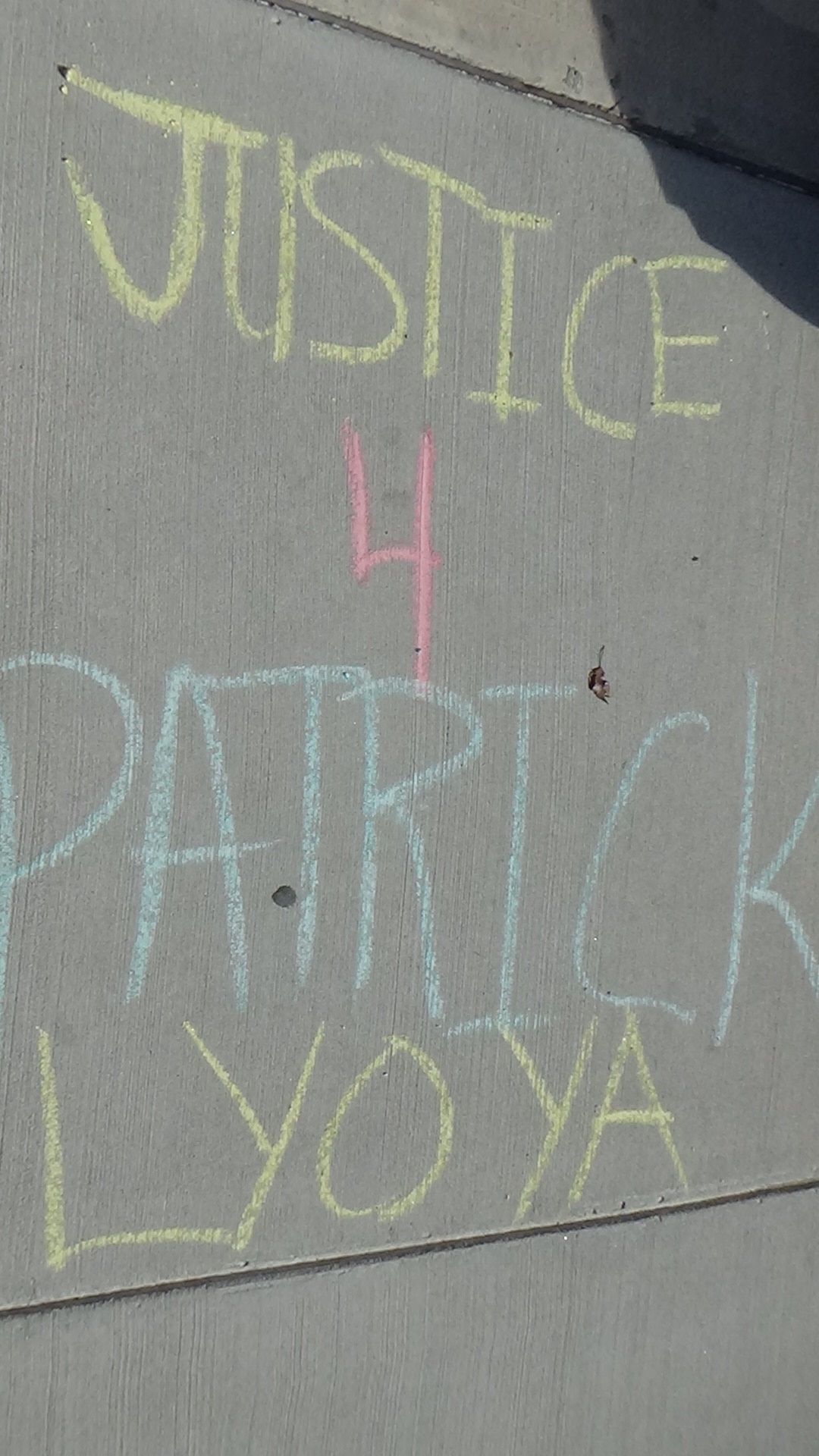 People honked their horns in support, gave a thumbs up and some even yelled in favor of those who were marching for Patrick Lyoya. Not everyone was happy about the protest, nor the march. Some people in cars became impatient with the marchers, having to wait a few seconds more at an intersection, while the march weaved its way through the city. There were also a few people who, walking by the protest in front of the court building, made comments that were critical of those demonstrating. One woman even made the comment that, “he got what he deserved,” referring to Lyoya.
Having been part of the organized resistance since Patrick Lyoya was murdered on April 4th of this year, I was heartened by the turnout on this sunny Fall day. While the so-called justice system is often a system of oppression, I was struck by all the people who came, their passion, their dedication and how much they cared about each other and the affected community.
The preliminary hearing will continue Friday, followed by a timeline for when the actual trial will begin. Considering it is almost November, it seems likely that the trial will not take place until after the New Year. In tomorrow’s post, we will deconstruct the local news coverage of the court proceedings in the case against Chris Schurr for the murder of Patrick Lyoya.
Always follow the money: Real Estate and Rental Property Owners Political Action Committee campaign contributions for the November Election
As we have noted in the past two days, those that have Political Action Committees (PACs) that have a stake in policing – the Grand Rapids Police Officer’s Association, and those that have an interest in making profits from the labor of others – the Grand Rapids Area Chamber of Commerce, have both made significant campaign contributions to candidates in the upcoming election on November 8.
In addition, throughout our coverage of candidates running for City, County and State office, we have always looked at how candidates response to some of the most pressing issues of the day, such as policing and the growing wealth gap in the Greater Grand Rapids area.
Another major issue that has been the topic of much debate in this city is the issue of housing. The cost of housing in Grand Rapids has increased significantly in the past decade, both the cost of buying a home, along with the cost of rent. Many individuals and families have been priced out of the Grand Rapids housing market, both in terms of buying a home and rental fees.
The City of Grand Rapids has made some effort to address the housing disparities, but the amount of money they have allocated for affordable housing is inadequate. City officials continue to provide significant tax breaks and tax incentives to housing developers, who also double dip by applying for state housing funds. This means that the public is making a significant investment in housing, without really have much of a say in it.
Then there is the issue of gentrification, where several neighborhoods have been gentrified, with families being displaced because the; 1) property values/property taxes have gone up, making it difficult or impossible for people to pay the increased property taxes; 2) developers level buildings and housing units that have been allowed to fall apart to make room for newer and costlier housing options; and 3) the process of development proposals happens in such a way as to almost guarantee that residents will not be able to have a say in the housing needs, the design and most importantly the process even before development plans are submitted.
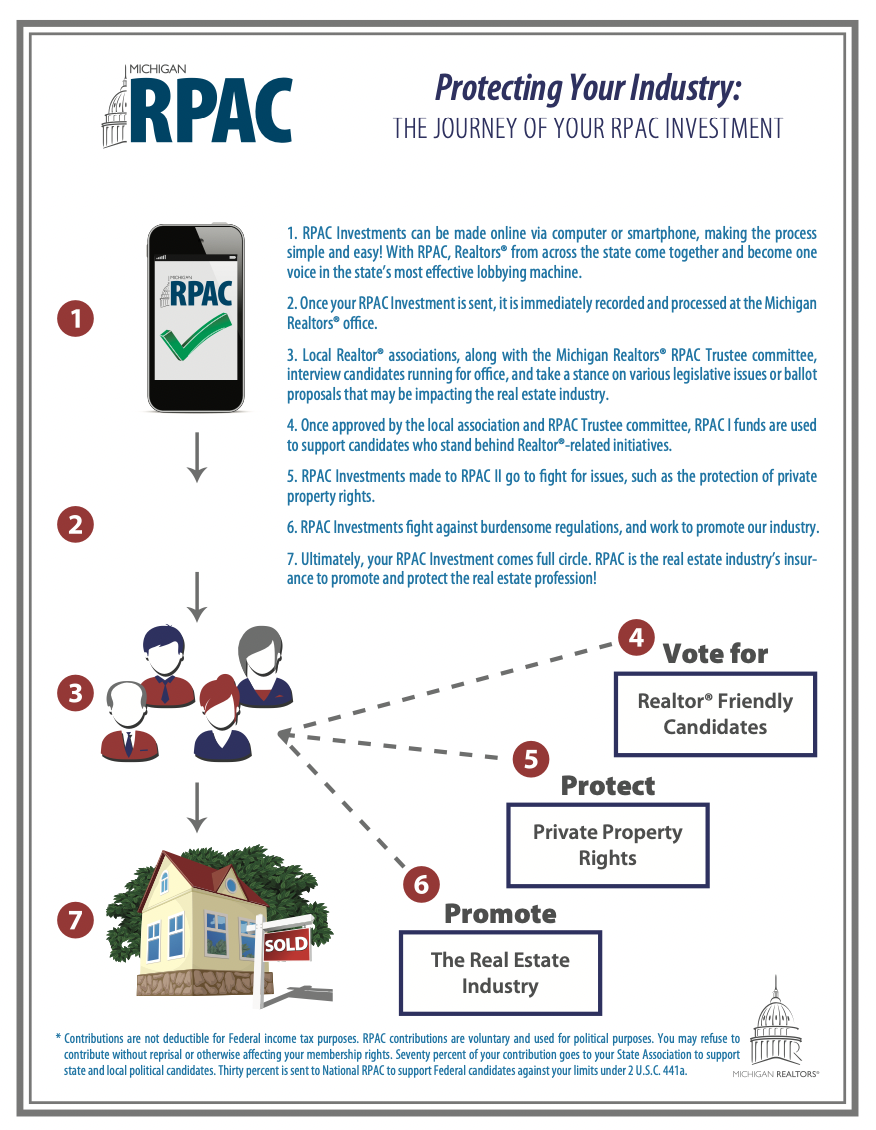
What follows are a list of candidates on the November 8th ballot that have received campaign contributions from the Realtors Political Action Committee Michigan and the Rental Property Owners Association of Kent County. These associations both have as a primary interest the profitability of housing, which means they don’t believe that people have a right to a safe place to live. These associations also have lobbyist that will constantly pressure candidates once they are elected, so that they will adopt legislation that is often crafted by housing industry associations or to defeat proposed legislation that would would be detrimental to their bottom line. One example of legislation that would be detrimental would be rent control, which would regulate the cost of rent to make sure that people could still afford the cost of rent.
These are just some of the reasons that those in the housing for profit industry contribute to political candidates.
Realtors Political Action Committee Michigan – Secretary of State online Campaign Finance data at this link.
Here are a list of candidates the Realtors Political Action Committee Michigan has made campaign contritions to who are running for State seats:
- Thomas Albert – 18th State Senate candidate: $6500
- Mark Huizenga – 28th State Senate candidate: $15,000
- Winnie Brinks – 29th State Senate candidate: $2000
- Kristian Grant – 82nd State Representative candidate: $1500
- Mike Milanowski – 84th State Representative candidate: $3500
- Carol Glanville – 84th State Representative candidate: $250
- Lynn Afendoulis – 81st State Representative candidate: $5150
- Rachel Hood – 81st State Representative candidate: $250
- Bryan Posthumus – 90th State Representative candidate: $8500
 Here are a list of candidates the Realtors Political Action Committee Michigan has made campaign contritions to who are running for Kent County Commission seats:
- Ben Greene – 1st District Kent County Commission candidate: $3000
- Jennifer Merchant – 3rd District Kent County Commission candidate: $2000
- Dave Hildenbrand – 5th District Kent County Commission candidate: $2000
- Stan Stek – 6th District Kent County Commission candidate: $3000
- Stan Ponstein – 7th District Kent County Commission candidate: $500
- Dan Burrill – 8th District Kent County Commission candidate: $3000
- Emily Post Brieve – 10th District Kent County Commission candidate: $3000
- Lindsey Thiel – 11th District Kent County Commission candidate: $3250
- Monica Sparks – 12th District Kent County Commission candidate: $1750
- Tom McKelvey – 13th District Kent County Commission candidate: $2000
- Carol Hennessy – 14th District Kent County Commission candidate: $500
- Melissa LaGrand – 16th District Kent County Commission candidate: $750
- Tony Baker – 17th District Kent County Commission candidate: $750
Here are a list of candidates the Realtors Political Action Committee Michigan has made campaign contritions to who are running for Grand Rapids City Commission seats:
- Andrew Robbins – 1st Ward Grand Rapids City Commission candidate: $1300
- Kenneth Hoskins – 3rd Ward Grand Rapids City Commission candidate: $1300
- Joe Jones – 2nd Ward Grand Rapids City Commission candidate: $800
Rental Property Owners Association of Kent County – Secretary of State online Campaign Finance data at this link.
Here are a list of candidates that the Rental Property Owners Association of Kent County has made campaign contritions to who are running for seats at the State level, with one candidate running for a Grand Rapids City Commission seat.
- Thomas Albert – 18th State Senate candidate: $500
- Mark Huizenga – 28th State Senate candidate: $500
- Tommy Brann – 29th State Senate candidate: $500
- Luke Meerman – 89th State Representative candidate: $500
- Jeffrey Johnson – 80th State Representative candidate: $500
- Lynn Afendoulis – 81st State Representative candidate: $500
- Lisa Dekryger – 83rd State Representative candidate: $500
Kelsey Perdue – 3rd Ward Grand Rapids City Commission candidate: $500
The Grand Rapids Chamber of Commerce, like all Chambers of Commerce, has a long history of supporting political candidates that will represent their interests and the interests of their members, known as the Capitalist Class.
In preparation for the November 8th Election, the Grand Rapids Chamber of Commerce has made campaign contributions to several candidates running for seats at the State, County and City of Grand Rapids level.
Here are a list of candidates the Grand Rapids Chamber of Commerce has made campaign contritions to who are running for State seats:
- Mark Huizenga running for the 30th District State Senate seat has received $1300.
- Lynn Afendoulis running for the 81st District State Representative seat has received $300.
- Mike Milanowski running for the 84th District State Representative seat has received $1100.
Here are a list of candidates the Grand Rapids Chamber of Commerce has made campaign contritions to who are running for Kent County Commission seats:
- Ben Greene running for the 1st District Kent County Commission seat has received $2650.
- Dave Hildenbrand running for the 5th District Kent County Commission seat has received $2500.
- Emily Post Brieve running for the 10th District Kent County Commission seat has received $2000.
- Dan Burrill running for the 8th District Kent County Commission seat has received $1000.
- Stan Stek running for the 6th District Kent County Commission seat has received $1000.
Here are a list of candidates the Grand Rapids Chamber of Commerce has made campaign contritions to who are running for Grand Rapids City Commission seats:
- Andrew Robbins running for the 1st Ward Grand Rapids City Commission seat has received $10,500.
- Kenneth Hoskins running for the 3rd Ward Grand Rapids City Commission seat has received $10,500.
Both Hoskins and Robbins received $5000 in June and an additional $5500 in August from the Grand Rapids Chamber of Commerce.
It is instructive that the more local political races received the larger number, beginning with the Grand Rapids City Commission races, followed by the Kent County Commission races, then those running for State office in this area.
It is also worth noting that the two candidates running for Grand Rapids City Commission seats – Andrew Robbins (1st Ward) and Kenneth Hoskins (3rd Ward) are seen as the candidates that would best represent the interest of the GR Chamber, which centers around business development, tax breaks/subsidies for developers, providing incentives for businesses to relocate to Grand Rapids, creating a Talent pool for business, and making sure that the City is politically and socially stable for these interests – which means lots of police presence to deal with the unhoused, undesirables and social movements that are making demands of the Grand Rapids City Officials.
(All of the above data is based upon information taken from the Michigan Secretary of State site for Campaign Finances. Go to this link to get information on the Grand Rapids Chamber of Commerce, also known as the Friends of West Michigan Business. https://cfrsearch.nictusa.com/committees/000912)
Grand Rapids Police Officer’s Association gave $10,000 to a Grand Rapids City Commission Candidate
For several years now, GRIID has been monitoring the GRPD’s union around numerous issues, like campaign contributions to candidates running for office in the Grand Rapids area.
Even though GRIID has written about the police union’s campaign contributions for the past 5 years, there has been greater scrutiny of this issue since the 2020 uprising that took place in Grand Rapids and cities all across the country.
In June of 2020, GRIID posted an article that looked at the Grand Rapids Police Officer’s Association PAC contributions since 2014. Numerous Grand Rapids City Commission candidates have received anywhere from $500 to $5000 from the local cop union.
However, in looking at the most recent campaign finance records for the Grand Rapids Police Officer’s Association PAC, they only provided one contribution to a candidate in 2022. On August 8th of this year, the police union gave $10,000 to Grand Rapids 1st Ward Candidate Drew Robbins.
Robbins, who is running against incumbent Kurt Reppart, has policing as his #1 campaign priority:
Protecting the community is the number one job of any city. I want to help our new Police Chief, Eric Winstrom, make his changes to the department, to transition from warriors to guardians. Good policing starts with good Commissioners. I want to be your voice on the commission to be helpful, not a hinderance, and to make sure we can all feel we are safe.
The pro-policing stance from Robbins has also earned him endorsements from the former Grand Rapids Chief of Police, the Kent County Sheriff, the Grand Rapids Police Officer’s Association and Johnny Brann Sr. Brann is the President of the police apologist group, Voice for the Badge, which has been denouncing anyone calling for the defunding of the GRPD.
On top of the pro-police position by Robbins, MLive recently revealed that the group SafeGR, has been using Dark Money funds to run a campaign that also denounces anyone who even considers a reduction in the GRPD budget. The SafeGR campaign has also targeted Reppart, even though Robbins claims he is not associated with that group.
As we have been reporting for the past two years, those who are apologists for the GRPD have not only denounced those who are not zealously behind the GRPD, they have used inaccurate and defamatory rhetoric to attack organizations working to radically transform the conversation and the practice of community safety that does not rely on cops.
Lastly, it is worth noting that the Grand Rapids Police Officer’s Association has a Stand with Schurr graphic as their Facebook page banner. The cop union has not only defended the former cop who murdered Patrick Lyoya, they have defended virtually every instance of police abuse directed against Black and Brown residents in Grand Rapids. The fact that the Grand Rapids Police Officer’s Association PAC has contributed $10,000 to Drew Robbins, the most they have ever given to a political candidate, should tell us something about both Robbins and the police union.
Well, another year, and another of the 200 Most Powerful Business Leaders in West Michigan have been chosen. Actually, many on the 200 list were on the list last year.
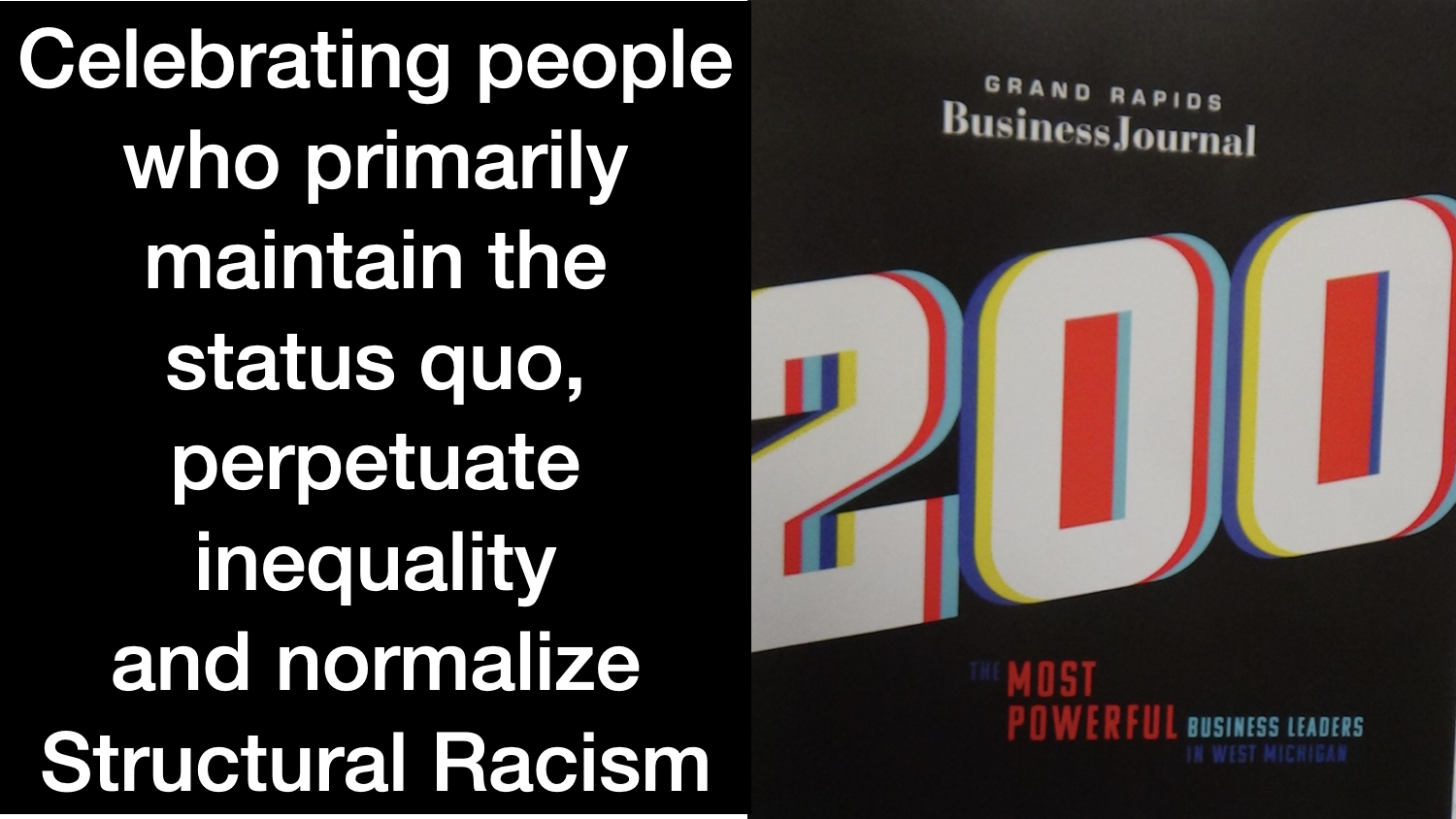
The Grand Rapids Business Journal has chosen their 200 Most Powerful Business Leaders, without providing a definition or criterion for what makes one a leader. However, it might seem obvious to people, if we are thinking in terms of the most powerful. Indeed, there are a great deal of names in this year’s 200 that have significant economic and political power. GRIID has for years monitored that power and written a great deal about what we refer to as the Grand Rapids Power Structure. So let’s try to provide a little perspective on who was chosen to be part of the 200 Most Powerful Business Leaders in West Michigan for 2022.
DeVos Family members and those who manage their assets – 12 people. This family has a long history of being anti-labor union, undermining public education, being anti-LGBTQ, forcing Christianity into the public sphere and funding candidates that support structural racism.
West Michigan Policy Forum Board Members – 17 people. The West Michigan Policy Forum has a history of supporting the interests of the wealthiest in West Michigan – tax breaks for the rich and business community, anti-union, undermining public education, dismantling public services, using public money for private benefit.
Grand Rapids Chamber of Commerce Staff/Board Members – 5 people. The GR Chamber of Commerce is part of the Grand Rapids Power Structure, has consistently opposed labor unions, supported public policy that benefits the Capitalist Class and funds candidates that will protect those interests.
The Economic Club of Grand Rapids – 23 people. This group provides regular “networking” opportunities for the most powerful in West Michigan.
The categories that the Grand Rapids Business Journal includes for those on the Most Powerful 200 list:
Art & Entertainment – primarily venues that cater to those with higher incomes and venues that are driven by profits
Banking & Finance – people who decide who has access to money and how it will be spent.
Business Services – This group includes Chambers of Commerce, PR Firms, Consultants, Security firms, and investment firms.
Civic Leaders – This group includes those who work in government, which is a very narrow definition of what it means to be civic.
Construction & Design – This group consists of developers, construction companies and design agencies.
Economic Development – This group is made up of entities that help “grow the economy”, which means they will threaten the interests of the Capitalist Class.
Education – This group only consists of the Presidents of local colleges and the Superintendent of the Grand Rapids Public Schools – a very narrow definition of education.
Food & Beverage – This group primarily consists those who own restaurants, bars, breweries or distilleries.
Foundations & Philanthropy – Wealthy people hiding some of their wealth from being taxed and providing funds to community groups with strings attached.
Health Care – This group primarily consists of the for-profit health care sector, with a few non-corporate representatives.
Insurance – Companies making money off of the lack of community care.
Law – Private and government attorneys
Manufacturing – companies that use workers to make stuff.
Media – This group consists of corporate media and a few media sources that don’t threaten corporate media interests.
Non-Profits – Organizations that often rely on funding from foundations (money from rich people) and that don’t generally address root causes of problems.
Real Estate Development – Companies that use property/land to make money, in order to purchase even more property/land.
Retail – Companies that rely on low wage workers.
Sports – Business people who make profits off of people being spectators.
Technology – IT people who make profits.
Travel & Tourism – Hotel owners, Ford Airport directors, and ballpark CEOs.
Living Legends – David Frey and Fred Keller – rich White guys.
Lastly, over half pf the 200 Most Powerful Business Leaders in West Michigan document is made up of ads from companies which celebrate the same people who are on the list of 200.
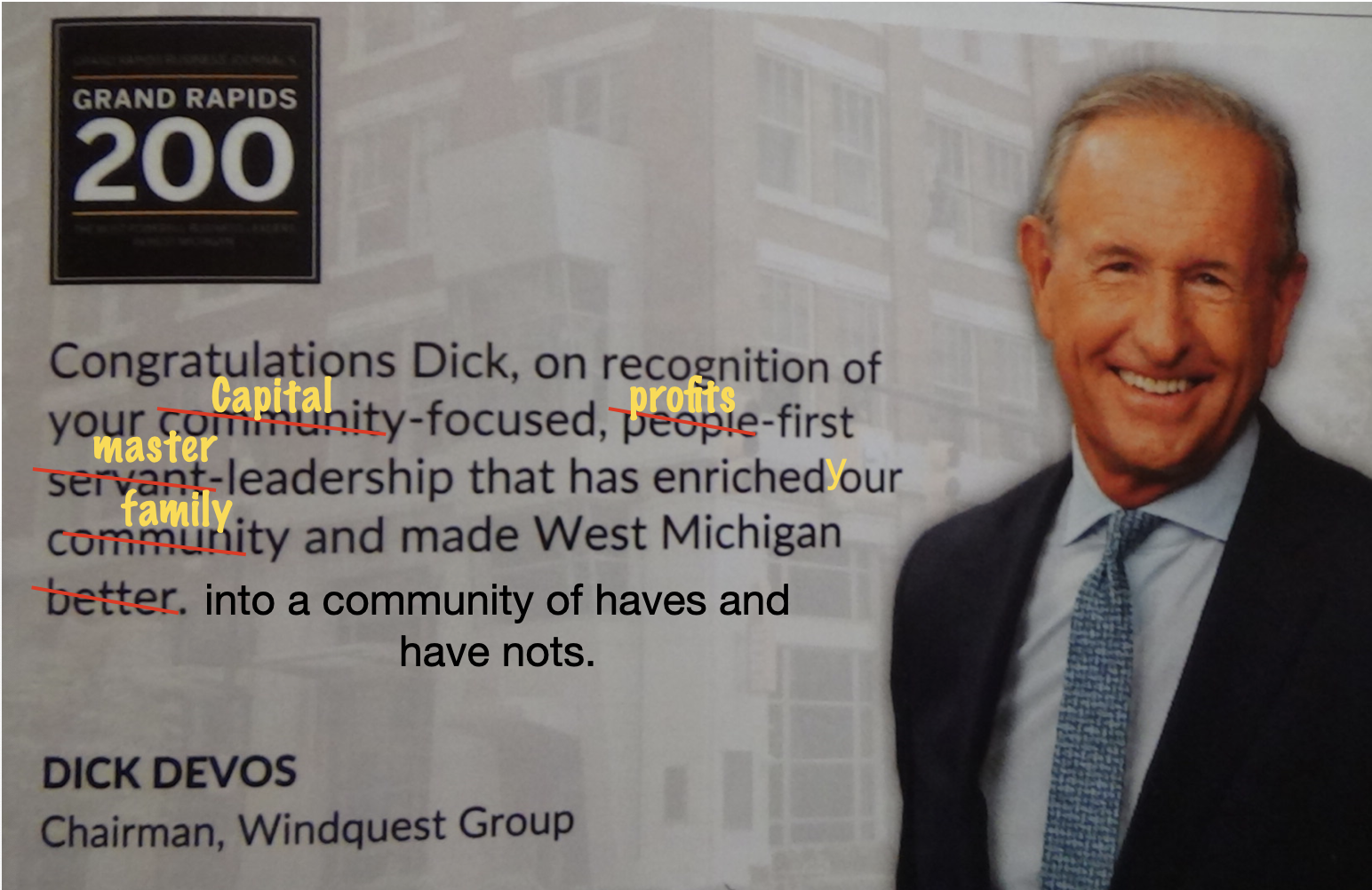
In the end, the 200 Most Powerful Business Leaders in West Michigan is simply another way of normalizing the fact that there is a class of people and organizations that wield tremendous political and economic influence in this area. These so-called leaders also make sure to maintain a business as usual approach to things, which often means they make sure that only a small percentage of people have access to wealth, they perpetuate inequality and they defend and promote structural racism, despite their Neo-liberal diversity, equity and inclusion efforts.
Betsy DeVos, election deniers and campaign contributions: How she doesn’t give a damn about setting an example for children, not when it comes to power
Last week, Betsy DeVos was at the Gerald R. Ford Museum, talking about her new book with the Executive Director of the museum, Gleaves Whitney. DeVos loves this kinds of forum, since she knows that she will not be challenged by the likes of Whitney, who was the former speech writer for Gov. John Engler.
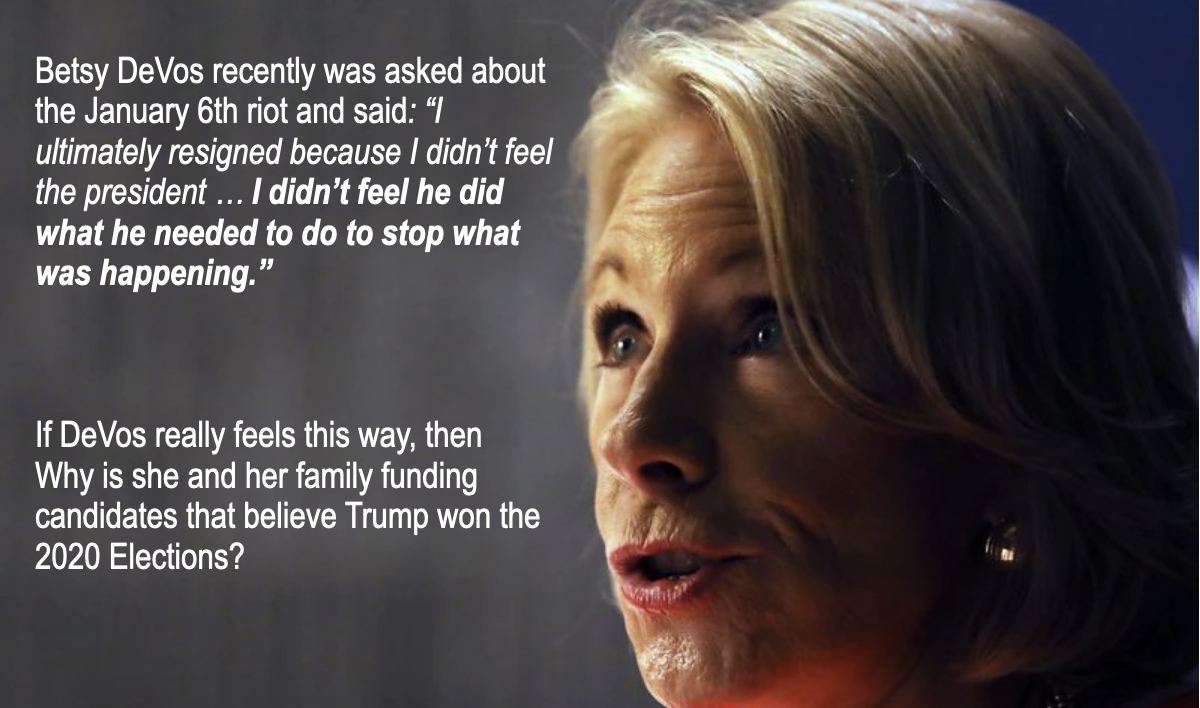
During the Q & A, DeVos was asked about the January 6th riot. According to MLive, this was response from DeVos:
“It was a very tough day,” she said. “I was in my office in the morning, and I could see the Capitol right in my office. I ultimately resigned because I didn’t feel the president … I didn’t feel he did what he needed to do to stop what was happening.”
She added, “I thought about kids watching what was happening on TV and their confusion around that, and just the kind of example that adults were setting in that case or not setting.”
Betsy DeVos sent the Trump Administration a letter of resignation two days after the January 6th riot, on January 8th. Here is what she wrote in that letter:
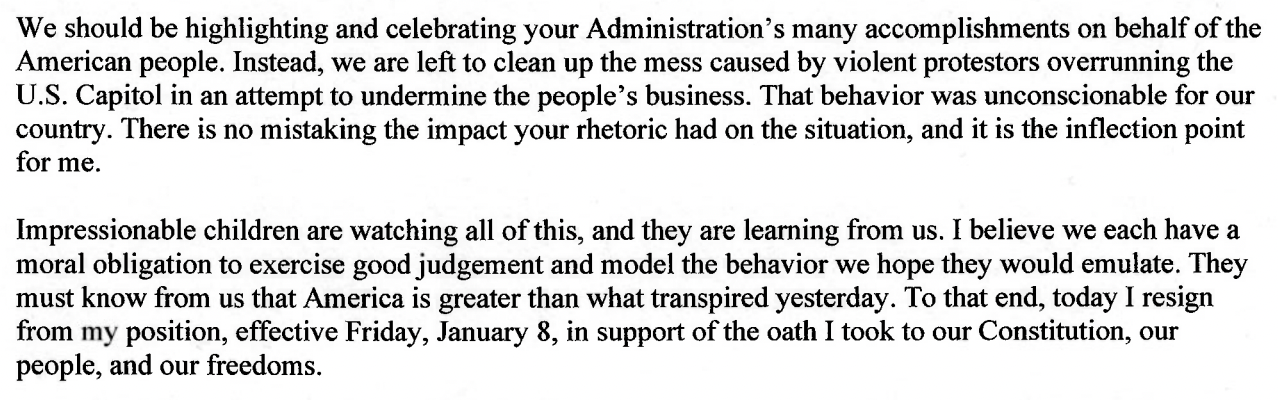
What is instructive about her comments from her resignation letter was the sentence, “There is no mistaking the impact your rhetoric had on the situation.”
Now, considering what DeVos said in her recent talk at the Ford Museum and what she wrote in her letter of resignation – where both statements make former President Trump complicit in what happened on January 6th – why would she and her family members provide significant campaign funding to candidates in the current election cycle, candidates who have publicly stated that they believe the 2020 Election was stolen from Donald Trump?
We know that the GOP Candidate for Governor stated in May that she believed the 2020 Election was stolen from Donald Trump. However, in recent months, Dixon has been more hesitant or even evasive in her response to questions about the 2020 Election. As we reported just after the Primary Election in early August, the DeVos/Prince family had collectively contributed $164,450 to Dixon, even though that number will likely go up after the October 25th campaign finance filing deadline before the November 8 Election.
You can check who Betsy DeVos has directly contributed to in the current election cycle, by going to this link on OpenSecrets.org, then compare that to an article from Michigan Advance that appeared on October 9th, with the headline, Here are the election deniers running for the Michigan House and Senate on Nov. 8.
It’s unfortunate that journalists who were at the Betsy DeVos Ford Museum talk, didn’t press her on the matter of her and her family’s financial backing of candidates who believe that Trump won the 2020 Election. When Betsy DeVos stated at that speaking engagement at the Ford Museum, “I thought about kids watching what was happening on TV and their confusion around that, and just the kind of example that adults were setting in that case or not setting.” Do you think Betsy has thought about the kind of example that her and her family’s campaign contributions to election deniers will have on children? In the end it doesn’t really matter to DeVos or anyone else with that kind of political or economic power, they could care less about setting an example for adults or children.
Earlier this week the national organization Roots Action held demonstrations in numerous cities across the US. The topic of those demonstrations was to pressure the Biden Administration and members of Congress to stop holding nuclear war rehearsals with NATO.

Roots Action also provided an online petition, with the following language:
NATO is rehearsing for nuclear war: flying B-52 long-range bombers from North Dakota to Europe, flying pretend bombing flights over Belgium, the North Sea, and the United Kingdom, and engaging in what NATO calls “a range of realistic and simulated events which can be found in a conflict.” The danger is of provoking an actual nuclear conflict.
The petition also included excellent links to background information, which was listed at the bottom of the petition page. Roots Action director Norman Solomon was also interviewed on Democracy Now! talking about the campaign.
I filled out the petition, since there was no organized action in Grand Rapids, which meant that my petition went to the Biden White House, Rep. Peter Meijer, along with Senator’s Peters & Stabenow.
On Wednesday, I received an e-mail response from Senator Stabenow, which said:
Thank you for contacting me about Russia’s invasion of Ukraine. Your concerns are very important to me as our nation debates how to best address this challenge.
Russia’s unprovoked invasion of Ukraine has created a dire humanitarian crisis. The U.S. has provided over $5 billion in humanitarian assistance to internally displaced Ukrainians and those seeking refuge in neighboring nations. I will keep working to ensure that Ukrainians have the resources they so desperately need during this horrific time.
As one of the Senators who voted against going to war in Iraq, I strongly believe that we must be very thoughtful and deliberate whenever considering the commitment of resources, both financial and military. I will continue to monitor the situation in Ukraine and keep your views in mind whenever considering related legislation in the U.S. Senate.
First, the most glaring thing about the response from Senator Stabenow, is that it completely ignored the text of the petition message, which was centered around the US/NATO nuclear war games.
Second, Senator Stabenow decides to make her response about the Russian invasion of Ukraine, thus not taking any ownership of the role that the US has played in this conflict to date.
Third, while Senator Stabenow acknowledges the US financial commitment to supporting Ukrainians who have been displaced by the war, she completely ignores the larger amount of money the US has provided to the Ukrainian government for weapons, which she has voted for.
Fourth, Senator Stabenow then wants to present herself as an anti-war voice, citing her initial opposition to the US war/invasion of Iraq in 2003. While it is true that Senator Stabenow did vote against that war/invasion initially, she voted for the ongoing US military action in Iraq throughout the rest of the Bush years between 2003 – 2008. This meant that Senator Stabenow voted for more US military spending as the US occupation of Iraq continued, along with the fact that the US was supporting torture at Abu Ghraib and the ongoing funding of US Private Military contractors, who were also guilty of human rights violations.
Lastly, it is worth pointing out that since Senator Stabenow said that the US must be very thoughtful about US military aid, but this ignores the fact that Senator Stabenow has voted in favor of the Defense Department’s military budget every year while being a member of the US Senate. This mens that Senator Stabenow has voted to continue to provide over $3 Billion to the Israeli Apartheid regime, weapons sales to Saudi Arabia, US military action in Syria, Yemen & Afghanistan, and support for repressive military regimes in places like Colombia, Mexico, Honduras, along with supporting the ongoing US blockade of Cuba.
It seems that Senator Stabenow doesn’t want us to know about her support for US militarism abroad and she definitely doesn’t want to do anything to even acknowledge the US nuclear war games that are taking place right now with NATO. In fact, it seems clear that Senator Stabenow is in no way concerned about the threat of nuclear war and how that puts every living thing at risk.
On October 10th, there was some media buzz claiming that Grand Rapids was the “safest” city in Michigan.
A few radio stations in West Michigan did a brief news story, which was based on a Media Release coming from the group WalletHub. In an October 10 posting, WalletHub wrote:

No one can avoid all danger, however, and we take on a certain level of risk based on where we choose to live. Some cities are simply better at protecting their residents from harm. To determine where Americans can feel most secure — in more than one sense — WalletHub compared more than 180 cities across 42 key indicators of safety. Our data set ranges from the percentage of residents who are fully vaccinated and assaults per capita to the unemployment rate and road quality.
The City of Grand Rapids noted the WalletHub study on their Facebook page on October 11. The post provides a brief summary of the WalletHub finding, then the City’s Social media person writes, “You know what? We agree and based on their analysis, we’re 59th in the Country and #1 in Michigan!” The post also includes some commentary by the City’s Economic Development Committee, which writes, “Grand Rapids is a great place to live, enjoy and do business!”
In the WalletHub survey of 180 cities, Grand Rapids ranks 59th safest city in the US and number 1 in Michigan. The survey looked at three major categories – Home & Community Safety, Natural Disaster Risk, and Financial Safety. WalletHub provides a link to the methodology they used for this survey, which includes numerous points for each of the three categories. The Methodology is near the bottom of the page that the rankings are on, just below the list of experts involved in making this determination.
Some things stood out when reading the points for each of the three categories listed in the Methodology, which I think are worth mentioning. First, in the Natural Disaster Risk category, it looks at things like flooding, hurricanes, and earthquakes, but completely omits a larger issue, which is the role that Climate Change is playing on issues like flooding and other extreme weather dynamics. It is pretty common knowledge that Climate Change is a major cause of extreme weather. For example, the Center for Climate and Energy Solutions states:
One of the most visible consequences of a warming world is an increase in the intensity and frequency of extreme weather events. The National Climate Assessment finds that the number of heat waves, heavy downpours, and major hurricanes has increased in the United States, and the strength of these events has increased, too.
A measure of the economic impact of extreme weather is the increasing number of billion-dollar disasters, which is shown below. The map shows all types of weather disasters, some of which are known to be influenced by climate change (floods, tropical storms) and some for which a climate influence is uncertain (tornadoes).
In the Financial Safety category, while there is a measure of poverty, the survey tends to look at averages and ignores how poverty impacts some populations more in the cities WalletHub looked at. Grand Rapids has the highest Wealth Gap in Michigan, and the cost of rent compared to income demonstrates that there are thousands of families not earning enough in wages to afford the average cost of rent in Grand Rapids. There is also an omission about the racial dynamics of poverty and how BIPOC people have higher rates of poverty than white people do.
In the Home & Community Safety category, the only reference to policing is, “Law-Enforcement Employees per Capita.” The WalletHub survey completely ignores anything about how local police departments target certain populations or what the public thinks about the role of policing in their community.
This is interesting, especially since the GRPD has been claiming for the past two years that they are understaffed and that crime rates are out of control. Even the pro-police group, Voice for the Badge, commented on the WalletHub story, saying that the article about Grand Rapids being the safest city in Michigan was dangerous and it puts the GRPD at risk. Our take is fundamentally different, since we would measure how many people, especially in Black and Brown communities, do not feel safe around the GRPD. In fact, there are numerous groups like Defund the GRPD, LineUp, the NAACP and the Urban Core Collective that have also been pointing out the disproportionately high number of BIPOC residents who have been harassed, intimidated and beaten by the GRPD, along with the more recent police murder of Patrick Lyoya.
Like most of these sort of national studies, they do not include the lived experiences of people in the cities being studied, particularly the most marginalized in each community. The notion of safety is too narrow, especially since it doesn’t look at safety in a more comprehensible way, which would include race, gender, LGBTQ, those with disabilities, immigrants, the unhoused, religious minorities or things like incarceration rates.
These studies also tend to look at averages and do not take into account structural issues like racism, economic disparities, and other long-standing historical factors that would more accurately determine the health and well being of cities, but more specifically the most marginalized communities within cities.
More public money for policing: Private company will produce recruitment videos for the GRPD
On Tuesday, Grand Rapids City Officials adopted a resolution to pay Epic Productions LLC up to $200,000 to provide digital recruitment services for the Grand Rapids Police Department.

This resolution came out of the Fiscal Committee and can be read in their October 18 Meeting Agenda, pages 7 – 10. According to the Fiscal Committee Agenda for October 18, it states:
The recommended investment would evolve the recruiting strategy in a way that is consistent with the City’s Strategic Plan and strategic communication plan. It will also assist in accelerating recruiting to enable the department to achieve authorized staffing by balancing on-going recruiting with future retirements. This investment will enable us to connect with a new generation of candidates, seek a larger and more diverse candidate pool and focus on students of key institutions. Today’s job seekers rank social and professional networks as the most useful job search resource. Updating our digital platform will improve our recruiting and community engagement efforts.
What this means is that the City of Grand Rapids will use $200,000 of public money to pay Epic Productions LLC to make some videos, plus create and maintain a website for the primary purpose of recruiting new people to join the GRPD.
Lack of community trust has led to a shortage of cops
In July of 2020, the New York Times reported on a Gallup poll, stating:
For the first time in its 27 years of measuring attitudes toward the police, Gallup found that a majority of American adults do not trust law enforcement.
This lack of trust in cops by Americans was further explored in a Pew Research video, which was based on a survey done at the beginning of 2022, where people were asked about their view of cops in 2020 and 2021. You can view the video survey here, regarding public trust and the police in the US.
This growing lack of trust in Americans, particularly of BIPOC Americans, has led to a shortage in recruiting and retaining cops in police departments all across the US. This is why the 2023 Michigan State Budget, has allocated millions for police retention and recruitment.
It is in this context that the City of Grand Rapids has decided to spend up to $200,000 to have Epic Productions LLC makes videos and a website to recruit more people to join the GRPD. What is instructive about the resolution to spend $200,000 of public money, was not just the decision to hire Epic Productions LLC, but the information about all of the time spent by the GRPD currently on recruiting. Here is what the resolution had to say about what the GRPD has done in the past year:
- This year alone, the department participated and shared recruitment information at 100 community events, which included partnering with Seeds of Promise, Dream Center, Pastors Picnics & Police, the Roosevelt Park Neighborhood Association. Recruiters also attended special events like Rock the Block, the Polish, Hispanic and Glimpse of Africa Festivals.
- Held open houses and pop-up recruiting events in all areas of the city.
- Forty-seven academy, college and university visits including Wayne County Regional Police Academy, Lake Superior State, Delta College Police Academy, Northern Michigan University, Oakland Community College, Ferris State University, Macomb Community College, and Mott Community College.
- Partnerships with Kent County Technical Center, JROTC, Grand Rapids Community College and Grand Valley University where GPRD employees mentor and instruct students interested in criminal justice.
- Continued connections with local military branches throughout the State of Michigan.
- Focus on the grow-our-own progression of Police Explorers, Youth Police Academy, up to and including Police Interns. Over time, the Police Explorers program has generated six police officers with another seven in the police intern pipeline. Recent recruitment for police interns has been strong with thirty-seven applications and is expected to produce a diverse class of eight new interns. Additionally, eight former interns have been hired as police officers in the last two years.
- Home-grown online recruiting fairs did not produce desired results but may be attempted again in a revised format.
- Continued exploration of a focus on recruiting by building partnerships with multi-cultural fraternities and college/university offices of Diversity, Equity, and Inclusion.
It seems that the GRPD spends a great deal of time trying to convince people to join the police force. It is hard to completely determine how many hours all of the above items include, how many members of the GRPD were involved and how much money all of their current efforts cost taxpayers, but it seems substantial to this writer. However, Grand Rapids City Officials don’t think that all of their current recruiting efforts are enough, thus they will spend $200,000 of taxpayer money for more recruiting purposes.
Why Epic Productions LLC?
Fiscal Committee document from 10/18 cites some reasons why the City of Grand Rapids decided to contract with Epic Productions LLC. If one spends any amount of time on the Epic Productions LLC website, you can see that there are several recommendations from other police departments across the country. In fact, their website features many of the police recruiting videos they have produced for other departments, along with a YouTube channel page with a section devoted exclusively to recruitment of cops.
Lastly, it is important to acknowledge what Police Chief Winstrom has to say about the new website that Epic Productions LLC will be creating. Winstrom states:
The new platform can also play a vital role in how the community views the police department and how members of the department view themselves. It can also be beneficial in how we disseminate information about public safety, gather information about crime, and improve community relations.
Based on these comments by Chief Winstrom, it seems that Grand Rapids taxpayers will give $200,000 to Epic Productions LLC so that the GRPD can use the platform as a public relations tool – how the community views the GRPD, a propaganda tool – how to get a controlled narrative out about the GRPD, engage in counter-insurgency tactics – gather information about criminal behavior, and to improve community relations, which means they want to win back the public trust.
Look, spending taxpayer money to con us into thinking that cops actually prevent crime is a meaningless exercise. Instead, why doesn’t the GRPD stop justifying their repressive activities, their disproportionate monitoring of Black, Brown and poor white neighborhoods, their defense of an ex-cop who murdered Patrick Lyoya and their targeting of activists who are demanding Justice4Patrick and the defunding of the GRPD.
Republican Representatives introduce a vicious anti-trans bill in the Michigan State House
Last Tuesday, GOP legislators introduced HB 6454, a piece of legislation that is anti-trans and will criminalize those who in any way assist youth who are in the process of transitioning.
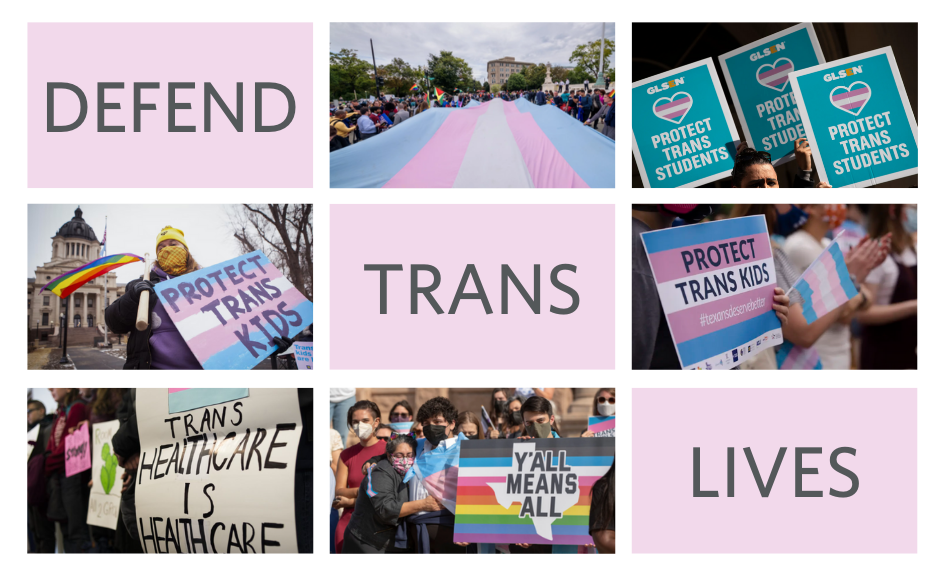
Natasha Lennard, writing for The Intercept, reports that HB 6454 is a cruel piece of legislation that will criminalize those who are supporting and assisting those involved in gender-affirming care to a minor. Here is what Lennard wrote about the legal punishment people would potentially face:
The language applies not only to gender-affirming surgery — which is very rare for teens — but also to hormone treatments and puberty blockers. If found guilty, parents and medical professionals could face a maximum life sentence of 25 years for assisting a minor in obtaining care that has been deemed, again and again, medically necessary by every major pediatric institution in the country. Providing or helping with such treatment would be penalized as child abuse in the first degree, a classification more severe than those for causing intentional or neglectful harm to children.
Beyond barring the provision of new treatment, the legislation also mandates that trans teens in the state who are currently receiving gender-affirming medical care would be forced to stop their treatments and undergo compulsory medical detransition, with potentially deadly psychological consequences.
HB 6454 was introduced on Tuesday, October 11 and sent to the Judiciary Committee on the same day. The bill was introduced by Rep. Ryan Berman, who represents the 39th House District. This reactionary piece of legislation is consistent with other bills that Ryan has introduced, such as HB 6306, which seeks to ban drag shows or drag presentations in K-12 schools. When asked to give an example of drag shows taking place in K-12 Public Schools in Michigan, Berman had no concrete examples.
The co-sponsors that Rep. Berman recruited for HB 6454, are Representatives Steve Carra, Luke Meerman, Beau LaFave and Steve Marino. Last week, Rep. Carra tweeted, “Don’t let them castrate your boys and mutilate your girls without your parental consent.. and don’t consent to them doing it either!”
Not to be outdone by his colleague, Rep. Beau LaFave also tweeted on his support for HB 6454, “The idea that we would be making potentially life-altering changes to 11-, 12-, 13-, 14-, 15-year-old kids when it is illegal for them to have sex is insane. I mean, they’re not ‘responsible enough’ to smoke a cigarette until they’re 21.”
When looking at this list of Republicans who want to punish trans youth and those that support them, it is always worth looking at who financially back them as State Representatives. Those who finance these politicians are equally complicit in these policies, specifically this transphobic piece of legislation.
Rep. Ryan Berman is self-financed, according to records since 2017, but other notable supporters are House Speaker Jason Wentworth, the Chatfield Fund, Rock Holdings Inc. and Realtors PAC of Michigan.
Rep. Steve Carra has also received major campaign support from Jason Wentworth, the Michigan Laborers Political League and Michigan Realtors, according to TransparencyUSA.
Rep. Luke Meerman, according to records since 2017, has also benefited from Jason Wentworth, the Michigan Farm Bureau, Michigan Realtors and a member of the Grand Rapids Power Structure, John Kennedy.
Rep. Beau LaFave, has been bankrolled by the Chatfield Fund, Michigan Realtors, along with Blue Cross and Blue Shield, according to Transparency USA.
Rep. Steve Marino has self-financed, along with major support from the Chatfield Fund and the DeVos Family, according to the Michigan Campaign Finance Network.
Lastly, it is worth noting that in the article by Natasha Lennard mentioned earlier, Rep. Marjorie Taylor Greene, R-Ga, has introduced similar legislation at the federal level.
- Image used is from the Pride Foundation.
 Grand Rapids Institute for Information Democracy