The 1967 riots in Grand Rapids were a response to police violence, poverty, poor housing and other systems of oppression
July 25th – 27th will mark the 56 anniversary of the riots in Grand Rapids. I know that GRIID has posted about the 67 riots on previous occasions, but it vitally important that we never forget what happened, nor the larger socio-economic context in which the riots took place in this city.

Last year GRIID posted a 5 part series on the 1967 riots, which is covered in my book, A People’s History of Grand Rapids. In today’s post we provide a summary of the 5 part series, with links to the entire article.
Remembering the 1967 Riot in Grand Rapids: What is past is present – Part I. In the first part in the series we discuss what sparked the riot, along with how the Grand Rapids Press reported on it.

Remembering the 1967 Riot in Grand Rapids: What is past is present – Part II. In Part II, we look at how the local TV news reported on the riots and how Mayor and the Grand Rapids Police Chief framed the riots.

Remembering the 1967 Riot in Grand Rapids: What is past is present – Part III. In Part III, we showed several  photos that were taken during the riots, photos that some media scholars would refer to as the “white gaze,” since the images were all taken by white people and were primarily consumed by white people.
Remembering the 1967 Riot in Grand Rapids: What is past is present – Part IV. In Part IV, we look at the arrest data during those three days of rioting in Grand Rapids (see map on right), along with a report that was produced months later by a City appointed committee. The report was called Anatomy of a Riot.
Remembering the 1967 Riot in Grand Rapids: What is past is present – Part V. In the last part in the series, we look at a series of articles posted on MLive for the 50th anniversary of the riot in Grand Rapids, plus we challenge the claims about how Grand Rapids is doing so much better now to address racial inequities.
Lastly, we provide some comparisons to the 2020 riot/uprising and how the same dynamics exit now that existed in 1967 – police abuse, poor housing, low paying jobs, a lack of investment in Black neighborhoods and the structural racism that exists in this city.

The Political function of Philanthropy: DeVos Family Foundations – The Jerry & Marcia Tubergen Foundation
 “In any case, the hidden hand of of foundations can control the course of social change and deflect anger to targets other than elite power.”
– Joan Roelofs, Foundations and Public Policy
For the past 10 years, GRIID has been monitoring foundations in West Michigan, particularly the large family foundations that those who are part of the Grand Rapids Power Structure have created. Our monitoring of local foundations has been part of our larger critique of the Non-Profit Industrial complex in Grand Rapids.
GRIID has been providing information and analysis on the various DeVos Family Foundations, using the most recent 990 documents that foundations are legally required to submit. These 990 documents must be submitted within a three-year period, which is why the 990s that we will be examining are from 2020, since most foundations prefer to submit their 990 documents at the last minute, thus minimizing public scrutiny. So far we have posted articles about the Richard and Helen DeVos Foundation, the Dick and Betsy DeVos Foundation, the Doug and Maria DeVos Foundation, the Dan and Pamela DeVos Foundation and the Cheri DeVos Foundation.
The Jerry & Marcia Tubergen Foundation
GRIID has always begun our Foundation Watch work by looking at the foundations associated with the most powerful family in West Michigan, the DeVos family. Now, Jerry and Marcia Tubergen are not directly DeVos Family members, but they have a long and deep connection to the most powerful family in. West Michigan. The Jerry and Marcia Tubergen was founded in 1998. According to GuideStar, in 2020, the Jerry and Marcia Tubergen Foundation contributed $3,418,635, leaving them with $14,695,875 of funds left in their foundation. To see the 990 document for 2020 from the Jerry and Marcia Tubergen Foundation, go here.
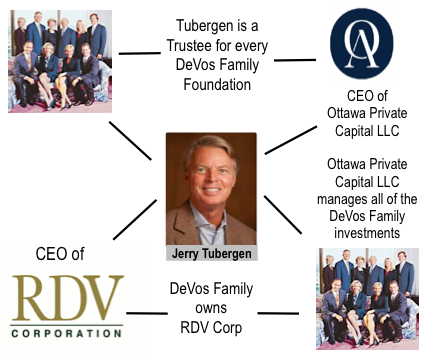
The long standing connection that Jerry and Marica Tubergen have with the DeVos family are as follows. Jerry Tubergen is the CEO of one of the largest components of the DeVos empire, the RDV Corporation. Jerry is also runs the DeVos investment firm, called Ottawa Private Capital LLC. It is also important to point out that Jerry Tubergen is listed as a trustee for every DeVos family foundation, according to the 990 reports.
The Jerry and Marcia Tubergen Foundation made contributions to dozens of entities in 2020, but there are some clear categories of groups they contributed to, such as the Religious Right, Education-centered groups and DeVos created/connected entities. The Jerry and Marcia Tubergen Foundation has a smaller foundation compared to the DeVos family members, but there is some similarities in the groups they fund. Below is a listing of each from these categories, with a dollar amount and a brief analysis.
We also include groups that are DeVos owned or created, along with liberal non-profits. With the liberal non-profits, we believe that funding from foundations like the DeVos family foundations is a form of hush money. When we say hush money, we mean that these entities will not publicly challenge the system of Capitalism, the wealth gap, structural racism and other systems of oppression, which the DeVos family benefits from and perpetuates through their own political funding.
Religious Right
- Center for Faith Sexuality and Gender – $50,000
- Cure International – $1,250,000
- Mel Trotter Ministries – $525,000
- Museum of the Bible – $100,000
- The Colson Center for Christian Worldview. – $25,000
- Young Life – $20,000
Jerry Tubergen sits on the board of Cure International, which is a christian ministry that provides health services for people living in countries in the Global South. Cure International does not challenge or question the political or economic conditions in the Global South and should be viewed a an organization that engages in a form of Saviorism. Mel Trotter Ministries also practices a brand of Saviorism, plus are not interested in solving the root causes of homelessness.
Education-centered groups
- Cornerstone University $205,000
- NorthPointe Christian Schools – $30,000
- Potters House – $30,000
DeVos-owned, created or connected groups
- ArtPrize – $5000
- West Michigan Aviation Academy – $5,000
Groups receiving Hush $
- Heart of West MI United Way – $30,000
- Kids Food Basket – $27,500
- Wedgewood Christian Services – $150,000
Exodus Place ad is not only ignorant of Constitutional Rights, it demonstrates their ideological commitment to Capitalism
 Over the past several days, the Grand Rapids-based Christian group known as Exodus Place, has been running an ad on social media (seen here on the right), with a cruel and reactionary message. The text for the ad reads:
The ACLU’s opposition to proposed amendments targeting Panhandling and Loitering in the Grand Rapids City Code is misguided.
“…..allowing people to panhandle & loiter removed the motivation to find a lasting solution.” Exodus Place President and CEO Robb Munger
Ironically, the Exodus Place ad has a Donate Now button at the bottom, which means they are hypocrites, since they too are asking for money for their programing, which is charity based.
The President and CEO of Exodus Place, Rob Munger, founded the organization in 2009. Prior to founding the Exodus Place, Munger was the interim Executive Director at Guiding Light Mission, but before that he was a broker for 20 years.
Like many people who work with programs that try to deal with those who are unhoused, Munger has no lived experience of what it means to not have a place to live and he believes that jog training and entrepreneurism are the path to fighting homelessness. This makes the Exodus Place part of what GRIID has identified as the Homelessness Industrial Complex, which consists of primarily faith-based non-profits that rarely address the root causes of people ending up on the street, plus they tend to practice a form of saviorism. Saviorism consists of people with privilege thinking they know what those most affected need. On top of that, Saviorism avoids addressing systemic or structural injustices, like poverty and racism.
Deconstructing the Ad
As I stated earlier, the ad run by the Exodus Place is cruel and reactionary. I believe it is cruel because it fails to acknowledge and empathize with people who are asking for money.
The ad is reactionary, because it attempts to call out the ACLU. However, if the Exodus Place people bothered to read the 9 page letter from the ACLU, they would know that the ACLU is not encouraging panhandling and loitering, they are merely pointing out the unconstitutional nature of passing laws or ordinances that prevent people from asking for money or from being in public spaces.
In addition, the comment in the ad that says, “allowing people to panhandle & loiter removed the motivation to find a lasting solution.” First, apparently the CEO of Exodus Place doesn’t understand that if people are hurting, there is nothing wrong with providing some immediate relief, like food, water, shelter, and health care. Second, what Exodus Place does is not a lasting solution. Sure, there might be some people who go through their program, are able to find work that pays enough to support themselves and their families, but such notions of “pulling oneself up by their bootstraps” is part of the mythology of American rugged individualism. (See the book, Bootstrapped: Liberating Ourselves from the American Dream, by Alissa Quart) Most people are poor because so few are so damn wealthy. Those who are wealthy became rich because they exploited workers and communities, often demanding subsidies and tax breaks.
Lastly, it is worth mentioning that in 2011, when the Occupy Wall Street movement was in full swing across the US and in Grand Rapids, there was a pro-Capitalism rally held in December of 2011, a rally that was a direct response to the Occupy Wall Street Movement in Grand Rapids. The call was designed to promote free market capitalism and that is where I met several men who were staying at Exodus Place, because the CEO brought them there to indoctrinate them to lie of Capitalism.
The Exodus Place ad makes complete since, especially since the CEO is a firm ideological believe in Capitalism, and anything that challenges or threats this ideology is seen as an evil that must be squashed.
A Radical Walking Tour of Grand Rapids: An invitation
It has been 4 months since I released my book, A People’s History of Grand Rapids, and the response has been tremendous. I have done several talks, book signings, plus the book is being used as part of a class at WMU this summer. I have a few other invites to speak and sign books, along with doing a session at the Great Lakes History Conference in October.

Part of my excitement around sharing the book is introducing people to the rich history of radical organizing in Grand Rapids, the people involved and the movements that challenged systems of oppression. However, I have been thinking about other ways of sharing some of this history, so I am excited to announce that there will be a Radical Walking Tour of Grand Rapids on Saturday, September 23rd in downtown Grand Rapids. (start time to be determined)
The idea is modeled on what other cities have done, particularly in New York City, which you can read about in Bruce Kayton’s book, Radical Walking Tours of New York City.
What we want to do is organize a Radical Walking Tour of Grand Rapids, where we will visit roughly 32 sites and learn about people, protests and social movements that reflect the rich history of radical organizing in this city. What might make this event even more interesting is the fact that on Saturday, September 23rd, ArtPrize will also be happening at the same time. Doing a Radical Walking Tour of Grand Rapids seems like an interesting thing to do right in the midst of the annual monied spectacle that was originally created by DeVos money and will now be run by the City of Grand Rapids, DGRI and Kendall College of Art and Design of Ferris State University.
An Invitation to help create a Radical Walking Tour of Grand Rapids
In order to make this event happen, we need people who are interested in doing any of the following things:
- Do a short public reading for each of the 33 stops along the radical walking tour. It would be great to have 33 different people do these readings.
- We need to blow up images for each of the stops along the radical walking tour, so if someone has access to places that do this, or we generate a little bit of money to cover the cost of making large images for each stop.
- Someone who can help create a map with all of the locations listed for the Radical Walking Tour.
- Create a Flyer to promote the event, both electronic and paper.
- People to document the event, in pictures, video and possibly live streaming it.
- People to pull carts along the route, with water and snacks to that people can stay hydrated and have something to eat along the way.
- People to play music along the Radical Walking Tour route.
- People to do Crowd Safety, making sure people are safe, especially when we cross intersections along the route.
- Anyone who has experience creating apps, so that we can have the Radical Walking Tour accessible for anyone who can’t attend the in person tour.
- People who will mark the Radical Walking Tour with sidewalk chalk ahead of time, so we can easily find the spots along the tour on Saturday, September 23rd.
- Someone who can follow along the Radical Walking Tour with a vehicle, in case someone needs to take a break or turns an ankle.
- Bullhorns or electronic speaker and mic
We estimate that the Radical Walking Tour of Grand Rapids will take an estimated 3 hours to do, so bring comfortable shoes and plan on setting aside that amount of time. The Radical Walking Tour of Grand Rapids will begin at Ah Nab Awen Park and end up at Heartside Park.
If you are interested in participating in this event and/or helping to organize it, please send an Email to sjeff987@gmail.com. Lets celebrate a People’s History of Grand Rapids!
Proposed Radical Walking Tour locations:
- Ah-Nab-Awen Park – Settler Colonialism
- Gerald R. Ford – The Real story
- Monument to the 1911 Furniture Workers Strike
- 1925 Klan parade on Monroe
- 1995 Klan Rally protest in front of old Hall of Justice
- 1991 Gulf War Protest July 4th
- Gerald R Ford Federal building – 1986 anti-Contra Aid Protest
- Gerald R Ford Federal building – 1989 action against Salvadoran priests who were murdered
- Protest at Rep. Ehlers office 2003 against Iraq war/Trial of Vern Ehlers
- Grand Rapids City Hall – Divests from South African Apartheid 1982
- Kent County building – End the Contract Campaign 2018
- Calder Plaza – 2000 anti-Globalization protest
- Calder Plaza – immigrant justice march 10,000 people 2006
- Ottawa & Lyon – GRPD tries to stop 2003 anti-Iraq War march when Bush was in GR
- Lyon & Monroe – DeVos headquarters
- Monroe Amphitheater/Rosa Parks Circle – 1988 1st Pride Celebration
- Monroe Mall protest in the 1980s – Street theater
- Wolverine Gas & Oil – 2012 anti-fracking protest
- Van Andel Statue in front of Arena
- Corner of Fulton and Commerce – 1995 Grand Prix
- GRPD headquarters – 2020 BLM protest
- Weather Ball Black Nuclear Attack – 1985 anti-nuclear actions
- Veterans Park – 2003 Critical Mass, No Blood for Oil ride
- Fountain Street Church – 1962 Malcolm X speaks
- Park Congregational church – anti-Vietnam speakers
- Acton Institute – Far Right Think Tank
- Bishop Baraga Statue
- Koinonia House – Central American Sanctuary 1980’s
- 1963 – 3,000 people silent march in solidarity with the Birmingham Church bombing victims
- 1967 Riot – Wealthy & Division
- May 10,1891 cable and horse car workers strike
- Heartside Park Eviction 2020
(Images used above were produced by GVSU students from a printmaking class, which you can read about at this link.)
Michigan Democrats make cocktails to go a priority, while immigrant demands for driver’s licenses are ignored
Last week, the Michigan Legislature went on summer recess and won’t be back until after Labor Day.
MLive reported that in the final days before going on summer break, Michigan legislators sent several pieces of legislation to the Governor’s desk. Some of those pieces of legislation have to do with teacher unions and sexual abuse protections, but one piece of legislation caught my eye – legislation that would allow for permanent sale of cocktails to go.

During the height of the COVID pandemic, bars and restaurants were able to get Michigan legislators to allow for cocktails to be sold in to go containers, allowing for alcohol sales when the industry was struggling because of the stay at home orders.
However, being that the bar and restaurant association is fairly powerful, they were able to get State Legislators to propose a permanent allowance for cocktails to be sold in to go containers, because, well, people need their alcohol. The legislation that was passed and is headed to the Governor’s desk is Senate Bill 141.
What I find instructive about this legislation is that it was given priority over numerous other critical issues that the Democratic Party majority claimed to support when they took power in January. Amongst those priorities were granting driver’s licenses to undocumented immigrants, which groups like Movimiento Cosecha have been fighting for since 2018.
Allowing undocumented immigrants to obtain driver’s licenses is an extremely urgent matter, since driving without a license can get undocumented immigrants thrown in detention or worse, deported back to their country of origin.
Senator Winnie Brinks voted for the cocktails to go bill and did the majority of those in the Michigan House and Senate. So why haven’t State Legislators passed a Driver’s Licenses for All bill? Why haven’t the Democrats in Michigan made Driver’s Licenses for All a priority for people who are at risk of arrest, detention and deportation? There is no way the people like Senator Brinks are not aware of what the undocumented immigrant community thinks about such issues, especially since they have come to her office several times since the beginning of 2023, such as the time they came to her office in late March.
In late June, 20 members of Movimiento Cosecha went to the home of Rep. Liberati to communicate the urgency of passing the proposed Driver’s Licenses for All bill, especially before the Michigan Legislature went on summer recess.
How can politicians, especially Democrats claim to represent the most marginalized in our state, communities that have urgent needs, to only turn around and vote to pass cocktails to go legislation that is only a benefit to the bar and restaurant industry? I am hard pressed to see how the Democratic majority in Lansing can claim to really give a shit about those who live in constant fear of detention and deportation.
It was pretty clear to most people that the overwhelming message sent to the Grand Rapids City Commission was to vote no on the proposed ordnances that would further criminalize the unhoused in this city.
MLive put the number of those who spoke out against the proposed ordinances at 50. If you watch the video from yesterday’s Grand Rapids City Commission meeting, the Public Hearing position begins at 1 hour and 12 minutes in and goes for about three and a half hours.
Just prior to the Public Hearing portion of yesterday’s meeting, City staff provided an “overview” of the proposed ordinances. The language that was being used was rather vague, plus one staffer kept saying that these ordinances would not criminalize the unhoused. I overheard someone say that the pre-public hearing commentary was a masterclass in the art of bullshit.
Fortunately, people were not buying the rhetoric from City staff and presented a whole range of reasons and talking points for why the proposed ordinances should be voted down. There were numerous people who challenged the commissioners around the whole principle of what public space means, especially since City staff kept saying that people needed a reason to be in public space. This claim was dismantled by several people, who countered with the belief that no one needs a reason to be in public spaces, especially those who are unhoused.
A representative with the ACLU spoke and pointed out that the City’s proposed ordinances would violate people’s Constitutional rights, and were very similar to the anti-panhandling argument the City used in 2012, which the ACLU defeated. One of the proposed ordinances emphasized the view that people who were asking for money from those who were downtown are now seen as accosting the public. The ACLU had sent a 9 page letter earlier in the week, a letter which is well worth reading.
However, maybe the best statement against the whole “accosting people for money” framing that City staff used was from someone who does political fundraising for candidates. This person stated that the commissioners should be familiar with the notion of asking people for money, since they all ran for public office, essentially making them nothing more than glorified panhandlers.
Another major theme for those opposing the proposed ordinances was around economic realities. Several people pointed out how those who supported the ordinances were not only business people, but those who are members of the Capitalist Class in Grand Rapids. The Capitalist Class wants the downtown of Grand Rapids to be their person play area, which will attract tourists and other consumers to spend time making more money for them. The last thing these people want are unhoused people people who are in public spaces and asking for money.
There were a few of the members of the Capitalist Class who spoke up at the public hearing, along with a few that work on behalf of the Capitalist Class. A few notables were the Executive Director of the Right Place Inc., which is an entity that seeks to attract businesses to the Grand Rapids area. The Right Place Board of Directors is essentially a who’s who of the Grand Rapids Power Structure.
Another member of the Capitalist Class that spoke in favor of the proposed ordinances was the CEO of Rockford Construction, Mike VanGessel. Rockford Construction is the DeVos-preferred developer in this city, especially with their role in the RDV Corp land grab in the Boston Square area working in collaboration with the DeVos-created AmplifyGR group.
There were also several minions from the Grand Rapids Chamber of Commerce who spoke in favor of the ordinance, especially since they were the ones who crafted the horrendous proposed ordinance last December, which deeply influenced the current ordinance proposals from the City of Grand Rapids. Then there was John Helmholt, who works for a company that represents the Capitalist Class, Seyferth PR. Seyferth PR is the preferred PR agency of the Grand Rapids Power Structure and has denied access to GRIID for years in our attempt to report on the Biannual Conference of the West Michigan Policy Forum.
However, maybe my favorite Capitalist to speak was Sam Cummings, with CWD Real Estate. What was almost comical was that Cummings stated, “up until recently he was referred to as one of this city’s greatest champions. Now I’m greedy, cruel, mean spirited, I’m a looter.” Sam went out of his way to say hi to me during the Public Hearing, no doubt because I am the person who named him as a looter, especially after he made some ridiculous claims after the 2020 uprising in downtown Grand Rapids.
Such absurdities from members of the Grand Rapids Power Structure were clearly met with impassioned arguments about why these ordinances should be voted down. A statement from the Grand Rapids Area Tenant Union was read during the Public Hearing, a statement that was signed by 86 people, many representing groups such as the Urban Core Collective, the Grand Rapids Red Project, the Comrades Collective, along with several faith-based groups. In addition, the Grand Rapids Area Tenant Union has created an electronic Action Alert, which has already sent 1200 letters to City officials telling them to vote no on these proposed ordinances. And since the Grand Rapids City Commission did not vote on the proposed ordinances last night, we encourage you to send more messages to City officials by going to this link.
Lastly, since the Grand Rapids City Commission did not vote on the ordinances that would further criminalize the unhoused, we encourage people to follow the Grand Rapids Area Tenant Union on Facebook for updates and future actions that will be necessary to defeat these proposed ordinances.
The Political function of Philanthropy: DeVos Family Foundations – CDV5 Foundation, the Cheri DeVos Foundation
“In any case, the hidden hand of of foundations can control the course of social change and deflect anger to targets other than elite power.”
– Joan Roelofs, Foundations and Public Policy
For the past 10 years, GRIID has been monitoring foundations in West Michigan, particularly the large family foundations that those who are part of the Grand Rapids Power Structure have created. Our monitoring of local foundations has been part of our larger critique of the Non-Profit Industrial complex in Grand Rapids.
GRIID has been providing information and analysis on the various DeVos Family Foundations, using the most recent 990 documents that foundations are legally required to submit. These 990 documents must be submitted within a three-year period, which is why the 990s that we will be examining are from 2020, since most foundations prefer to submit their 990 documents at the last minute, thus minimizing public scrutiny. So far we have posted articles about the Richard and Helen DeVos Foundation, the Dick and Betsy DeVos Foundation, the Doug and Maria DeVos Foundation and the Dan and Pamela DeVos Foundation.
CDV5 – Cheri DeVos Foundation
GRIID has always begun our Foundation Watch work by looking at the foundations associated with the most powerful family in West Michigan, the DeVos family. The Cheri DeVos Foundation has been one of the larger foundations in West Michigan, and was also founded in 1992. According to GuideStar, in 2020, the Cheri DeVos Foundation contributed $8,308,020, leaving them with $62,463,632 of funds left in their foundation. To see the 990 document for 2020 from the Cheri DeVos Foundation, go here.
The Cheri DeVos Foundation made contributions to dozens of entities in 2020, but there are some clear categories of groups they contributed to, such as the Religious Right, Think Tanks, Education-centered groups, and social service entities, to name a few. Below is a listing of each from these categories, with a dollar amount and a brief analysis.
We also include groups that are DeVos owned or created, along with liberal non-profits. With the liberal non-profits, we believe that funding from foundations like the DeVos family foundations is a form of hush money. When we say hush money, we mean that these entities will not publicly challenge the system of Capitalism, the wealth gap, structural racism and other systems of oppression, which the DeVos family benefits from and perpetuates through their own political funding.
Religious Right
- Base Camp Urban Outreach – $30,000
- Bridge St. House of Prayer – $70,000
- Christian Leaders NFP – $50,000
- Mel Trotter Ministries – $25,000
- Partners Worldwide – $30,000
- Young Life – $50,000
- Zuni Christian Mission School – $30,000
Life the other DeVos Family Foundations, contributing money to religious right groups is important for Cheri DeVos. Groups like the Bridge St. House of Prayer and Mel Trotter Ministries prey on those who are financially struggling or unhoused in order to evangelize them, while perpetuating the harm that Capitalism creates that actually is the root cause of economic hardship for thousands in Grand Rapids.
Far Right Think Tanks and Free Market groups
- FII National – $1,225,000
- Greater Grand Rapids Chamber Foundation – $130,000
The DeVos family has always been deeply committed to free market Capitalism. They contributed $1,225,000 to FII National, also known as UpTogether, which believes that poverty is a choice and that people can chose to get out of poverty by starting their own business. Another interesting group is the Greater Grand Rapids Chamber Foundation, which is currently focused on supporting the Housing Next program, which was created by the Grand Rapids Chamber of Commerce and believes that market-based solutions will solve the housing crisis.
Education-centered groups
- Grand Rapids Christian Schools – $160,000
- Grand Rapids Community College Foundation – $250,000
- Grand Rapids Student Advancement Foundation – $720,000
- Grand Valley State University – $200,000
- Hope Academy of West Michigan – $78,500
- Hope College – $50,000
- Potters House – $90,000
- Rehoboth Christian School – $120,000
- Wake Forest University – $25,000
DeVos-owned, created or connected groups
- ArtPrize – $50,000
- Grand Action Foundation – $50,000
- Grand Rapids Initiative for Leaders – $20,500
- Orlando Magic Youth Foundation – $90,000
- Spectrum Health Foundation – $385,000
- West Michigan Aviation Academy – $365,000
Like the other DeVos Family Foundations, the Cheri DeVos Foundation makes it a point to fund other DeVos created projects, which means that DeVos family members are just shuffling money to each other and calling it a charitable contribution.
Groups receiving Hush $
- Baxter Community Center – $40,000
- Bethany Christian Services – $260,000
- Children’s Assessment Center – $40,000
- Dégagé Ministries – $60,000
- Family Promise – $155,000
- Feeding America West MI – $50,000
- Heart of West MI United Way – $345,000
- ICCF – $25,000
- Kent Habitat for Humanity – $300,000
- Kids Food Basket – $150,000
- Safe Haven Ministries – $90,000
- Wedgewood Christian Services – $215,000
Foundations rarely make contributions without strings attached. The Cheri DeVos has a long history of funding far right and religious right groups, which GRIID documented 10 years ago when we started this project. Lastly, it is worth noting that the Cheri DeVos Foundation, like all of the DeVos family foundation, compliments the campaign contributions they make to further impact public policy and promote their religious and capitalist ideologies.
The far right think tank, the Acton Institute for the Study of Religion and Liberty, continues to demonstrate how much they defend the systems of White Supremacy and Institutionalized racism.
Last week, the Acton Institute posted on their blog an article entitled, Affirmative Action and the Imago Dei. Like most groups that defend White Supremacy, the Acton Institute uses religion to justify their position that policies like Affirmative Action are wrong and that the US Supreme Court’s decision to overturn Affirmative Action for college admissions. Here is the concluding comments used to justify the anti-affirmative action policy:
Unfortunately, there are no easy solutions to the racial and social tensions that plague us. But a good starting point is to recognize and respond to the image of God as it presents itself in our neighbors, and to remember that while we are certainly different in big and small ways, we share at least that in common. Our attempts to resolve these tensions will be and have been halting, difficult, and suffer many setbacks. But in solidarity with our neighbors, with whom we share God’s image, we can imperfectly work toward just resolutions that the Constitution of our democratic republic allows the space to pursue.
Now, the person who wrote this post is a white guy named Trey Dimsdale. Dimsdale used to work for the Acton Institute, but is now employed by another far right think tank, known as the First Liberty Institute.
The First Liberty Institute is the largest legal organization in the nation dedicated exclusively to defending religious liberty for all Americans, according to their website. However, if you spend anytime on their website it pretty much means they defend Christians who want to impose their absurd ideological beliefs on the rest of society. In fact, the organization lists as experts and leaders that endorse their work, Ted Cruz, Rick Perry and Mike Huckabee, which speaks volumes.
More anti-Black Lives Matter rhetoric
It wasn’t bad enough that the Acton Institute posted an article justifying the end of Affirmative Action in college admissions, they also provided space for another far right writer to dismiss the Movement for Black Lives.

On July 3rd, there was an interview conducted by the Action Institute with Ian Rowe, a senior fellow at the American Enterprise Institute, which is possibly the most influential conservative policy institute.
Maybe the most outrageous thing that Ian Rowe had to say in the interview with the Acton Institute was,
Since the death of George Floyd, there has been an explosion in completely useless, insulting, and hopelessly ineffective actions that are purportedly intended to make progress toward racial “equity.”
Essentially, what Rowe is saying is that calling for the abolition of systems of power and oppression, engaging in Mutual Aid work, elevating the voices and lived experiences of Black people, resisting institutionalized racism, creating community bond funds, fighting back against groups like the Proud Boys and developing community gardens are “hopelessly ineffective actions.”
What Ian Rowe advocates for is personal responsibility, and for Black people to stop blaming Structural Racism. What is unfortunate is that Ian Rowe is a Black man, or what Malcolm X would refer to as a House Negro, someone who defends the plantation owner. This is just the latest example of how the Acton Institute has nothing but contempt for the Movement for Black Lives.
3 reasons why I don’t believe West Michigan Business leaders when they say that immigrants are good for the economy
A few weeks back, the now monopoly business publication, Crain’s Grand Rapids, post a story with the headline, West Michigan business leaders refocus on immigration to fill talent gap, boost population.
The article begins by stating, “A new collaboration between the Grand Rapids Area Chamber of Commerce, Grand Valley State University and Global Detroit will push policy makers and the business community to embrace immigration as a way to meet talent needs in West Michigan.”
The Crain’s article then goes on to say that one of the first things these business leaders want to do is to gather more data to demonstrate how immigrants benefit the economy. You may remember that in 2018, there was a report on how immigrants benefit the economy. GRIID wrote about that report and made the point that it isn’t so much about immigrants benefiting the economy, instead the issue is who benefits economically from immigrant labor.
Interestingly enough, the President of the Grand Rapids Chamber of Commerce was quoted as saying, “The Grand Rapids Chamber urges our congressional leaders to fix our broken immigration system to support our growing economy. There is no excuse for delay. While we wait for federal action, we look to drive our strategies forward.”
Such a comment from the President of the Grand Rapids Chamber of Commerce is worth looking at, especially through a critical lens. So here are 3 reasons why I don’t believe that the GR Chamber nor West Michigan Business leaders are committed to immigrant justice or immigration policy that would truly benefit immigrants.
First, the Grand Rapids Chamber of Commerce and West Michigan Business leaders have a long track record of primarily endorsing and providing campaign contributions to GOP candidates at all levels of government. The Republican Party has rejected any and all aspects of Immigration Reform over the past several decades, even the mildest of immigration reforms. Not that the Democratic Party embraces any sort of immigration justice, but there have been several attempts since the Obama years to adopt some sort of Immigration Reform policies. (See the book, All-American Nativism: How the Bipartisan War on Immigrants Explains Politics as We Know It, by Daniel Denvir.)
Second, the North America Free Trade Agreement (NAFTA), along with other such trade policies, have undermined workers and displaced small farmers in countries like Mexico, which has led to massive numbers of immigrants coming to the US. These trade policies have been fully endorsed by the US Chamber of Commerce and the regional ones, like the Grand Rapids Chamber of Commerce. I remember attending an event at San Chez in 1995, which was co-sponsored by the GR Chamber, and was all about how businesses can market their products in Mexico after NAFTA had been adopted in 1994. The GR Chamber spokesperson even wore a fucking sombrero during his welcoming remarks to the event attendees.
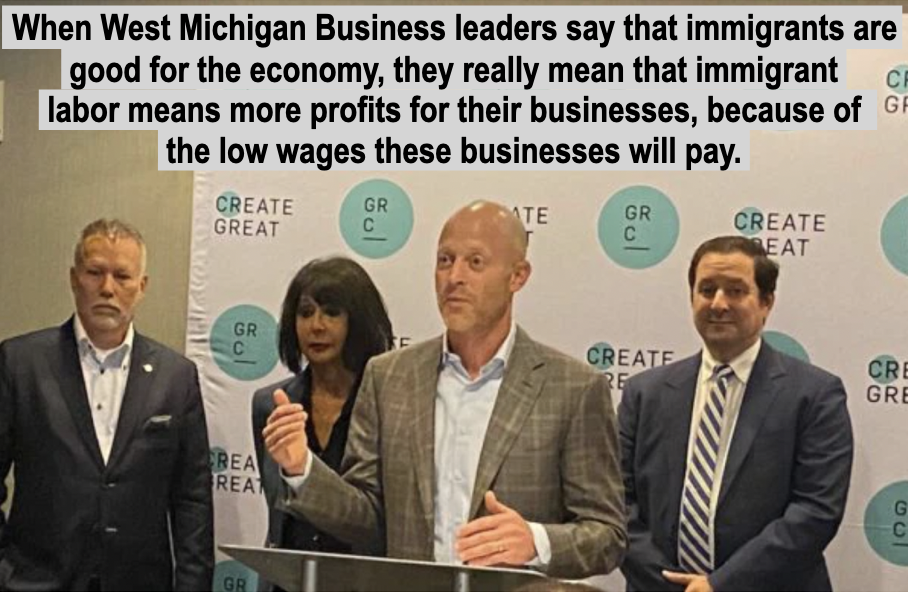
Third, the GR Chamber of Commerce and many West Michigan businesses love immigrant workers, primarily because they are willing to work for low wages. There are literally tens of thousands of migrant workers (mostly of whom are immigrants) in West Michigan that make very little money for doing physically demanding work. Then there are all thousands more in West Michigan that work in the service sector – fast food industry, restaurants, janitorial, construction and hotel workers – all of which make low salaries. If the GR Chamber of Commerce and West Michigan Business leaders wanted to truly celebrate immigrant workers, they would pay people a living wage and be an outspoken advocate for people to earn no less than $20 an hour, regardless of the kind of work they do.
While the President of the GR Chamber of Commerce and the other West Michigan Business leaders talk a good game about US immigration policy, the need to fill the talent pool gap, and how much immigrants benefit the economy, what they really mean is that they are the ones who benefit from immigrant laborers in the current neoliberal capitalist economy.
Over the past six weeks, the City of Grand Rapids and some of their committees have been discussing proposed policy decisions that would negatively impact those who are unhoused in this city.

In May, we wrote:
At the Public Safety Committee’s May 23rd meeting, members of that committee made some pretty awful comments about the unhoused and those struggling with mental health issues.
Just two weeks ago we wrote:
Now the City of Grand Rapids is proposing new ordinances in order to deal with the unhoused, which they see as a nuisance. On top of that, the City’s ordinance proposal shares some of the same language and punishments directed at the unhoused that the Grand Rapids Chamber of Commerce proposed 6 months ago. However, the City of Grand Rapids will not adopt the proposed ordinance before allowing the public to weigh in at their 2pm meeting on July 11, a meeting which is conveniently at a time when most people are unavailable.
The City of Grand Rapids made this decision to host a public hearing during that June 13th meeting of the Committee of the Whole. You can read the newly proposed ordinance language at this link, beginning at page 109. It is worth reading these new proposals side by side with the Grand Rapids Chamber of Commerce proposal, which you can find here.
In response to these proposed ordinances, the Grand Rapids Area Tenant Union and a coalition of other grassroots/autonomous groups have organized a campaign called, Housing Not Jail. The Housing Not Jail campaign not only opposes the proposed ordinances that the City of Grand Rapids is considering, they highlight what is fundamentally wrong with the proposals with these talking points:
- The proposed City ordinances will further criminalize the unhoused, with fines they will be unable to pay and jail time, simply because they are asking people for money or for having their possessions with them in certain public spaces.
- The proposed City ordinances do not address the root causes of people being unhoused, primarily the decades of federal, state and local government austerity measures that have nearly eliminated the safety net for people who are financially insecure.
- The City of Grand Rapids is adopting some of the same language as the Grand Rapids Chamber of Commerce proposed ordinance from last December. These similarities are designed to criminalize the unhoused and to protect the economic interests of the downtown business community, essentially profit over people.
- The Grand Rapids Chamber of Commerce and the many of the 120 signatories in support of the Chamber ordinance proposal, have contributed a great deal of money to candidates/politicians over the years that have implemented economic austerity policies, while simultaneously cutting taxes for businesses and the wealthy.
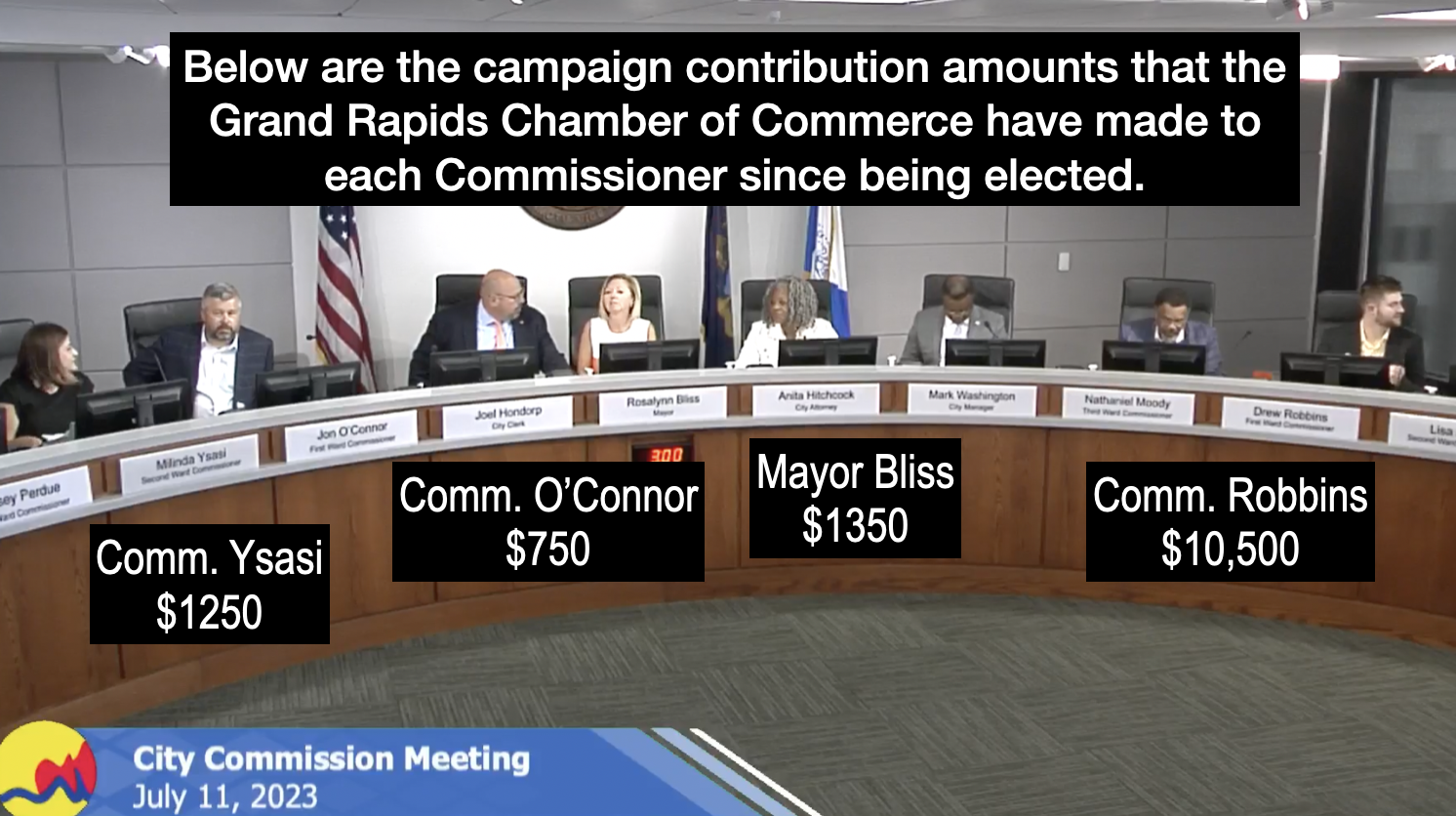
- The Grand Rapids Chamber of Commerce has provided campaign contributions, amount included, to the following City Commissioners who will ultimately vote on whether or not these ordinance proposals will pass: Commissioner Robbins – $10,500, Commissioner O’Connor – $750, Commissioner Ysasi – $1250, Mayor Bliss – $1350.
You can take Action to oppose these proposed ordinances
Write an email by going to this link, sharing on social media and getting your friends to do the same thing. tinyurl.com/HNJEmail
If you are part of an organization or know of organizations to approach, have them sign the statement at this link: tinyurl.com/HNJStatement
Come and speak at the public hearing on Tuesday, July 11, during the 2pm Grand Rapids City Commission meeting. Details can be found here tinyurl.com/HNJHearing

Graphics created by Aly Thee Activist

