Earlier in the week, MLive reported a story about a project in the Southeast part of Grand Rapids, involving SpringGR and Amplify GR, focusing on what is being called an “Incubator kitchen.”
The story shares that there are a few “food entrepreneurs” who will now be able to use the kitchen space at Kazoo Station to prepare food that they will will sell for their budding food businesses. It’s a nice story, with commentary from the small business owners on how such a space will help them expand their businesses.
Now, I don’t begrudge people who want to start their own businesses, as my family had a business that lasted for three generations. But after reading the MLive article and thinking about the fact that the neighborhood that this “Incubator kitchen” is located in, I wanted to think about this issue through a food justice lens.
There are large parts of the urban core of Grand Rapids that are often referred to as food deserts. However, food deserts is a misrepresentation of what actually exists. More and more people are realizing that when we talk about neighborhoods that are short on functional grocery stores, community gardens and space dedicated to making sure that people have easy access to healthy, local food, we need to understand that these realities are based on policies and decisions that are often driven by capitalism. The term that more and more people are using to describe this dynamic is Food Apartheid.
Food apartheid is a system of segregation that divides those with access to an abundance of nutritious food and those who have been denied that access due to systemic injustices, such as the shift from local grocery stores to chain stores, families that do not make a living wage, structural racism, etc.
The new “Incubator kitchen” is located in a part of Grand Rapids that is experiencing food apartheid, and while the “incubator kitchen” will benefit a few people who have food businesses, it will not address the community’s food insecurity.
A spokesperson for Amplify GR was quoted in the MLive article, stating that the “Incubator kitchen” came out of community conversations that were being had as part of the Amplify GR effort to re-develop the Boston Square neighborhood. Now, GRIID has written a great deal about the Doug & Maria DeVos-created organization, Amplify GR, which you can read at this link. One of the themes were have addressed since AmplifyGR was created in 2017, is the fact that the DeVos family promotes the notion of entrepreneurs, which can benefit some people, but it does not address the massive wealth gap that exists in Grand Rapids, nor the longstanding impact that structural poverty has been imposed on communities like Boston Square Neighborhood.
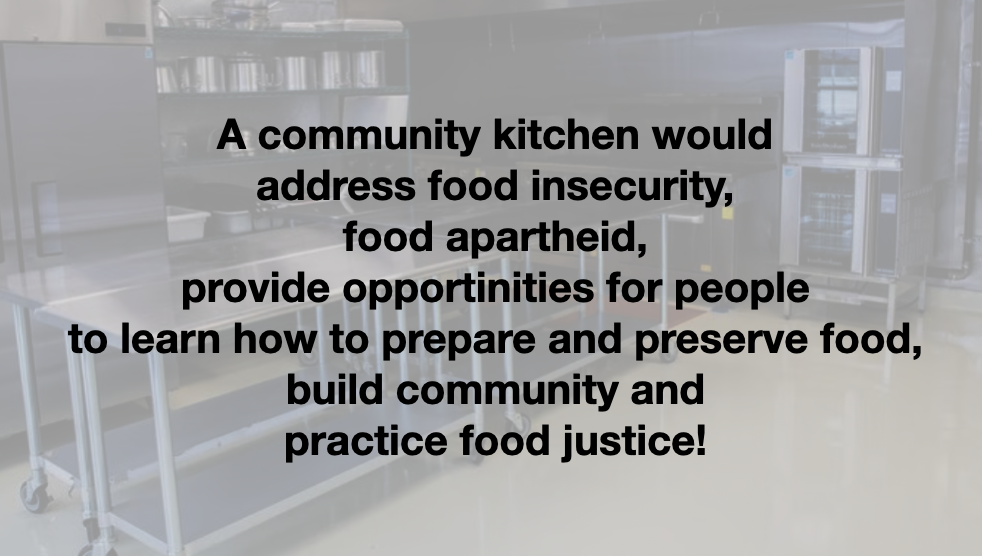
A question I would ask about this process that need to the decision to create the “Incubator kitchen” would be, “were there other options presented about address food insecurity in that neighborhood, like the idea of a community kitchen.” A community kitchen is fundamentally different that an Incubator kitchen, since a community kitchen is more of a cooperative model designed to address food insecurity, food apartheid and build community. The function of a community kitchen is to have a collective space that is owned by the community, where people can cook meals together, send food home with families, share recipes, and provide skill sharing like how to preserve and prepare food.
 Imagine what it would mean to have a community kitchen that took this approach, how often it would be utilized and how many people who have greater access to healthy & nutritious food on a daily basis. In addition, to food sharing and community building, it could provide an opportunity for people to have deeper conversations about the existing food system, a system that does not benefit most people. Here is a link to content that I created over the years when doing Food Justice workshops.
The mLive article says that people who have food businesses can rent the kitchen space for $20 an hour for their food businesses. I have to believe that the space will sit empty for good parts any given week, so why not allow the community to use the space – rent free – as a community kitchen, which could benefit the while community instead of just a handful of business owners?
Meijer family members spread out their wealth to get a lower ranking on the Forbes 400 list
For years, Hank and Doug Meijer would combine their wealth, which made them the wealthiest family in West Michigan.
People might think that the DeVos family is the wealthiest, and they probably are, but the DeVos family has diversified their wealth to such a degree that it is hard to determine what they are worth collectively. Add to their diverse wealth portfolio the fact that they are not big on transparency, and you end up with the Meijer family having the higher ranking on the Forbes 400 list for several years in a row.
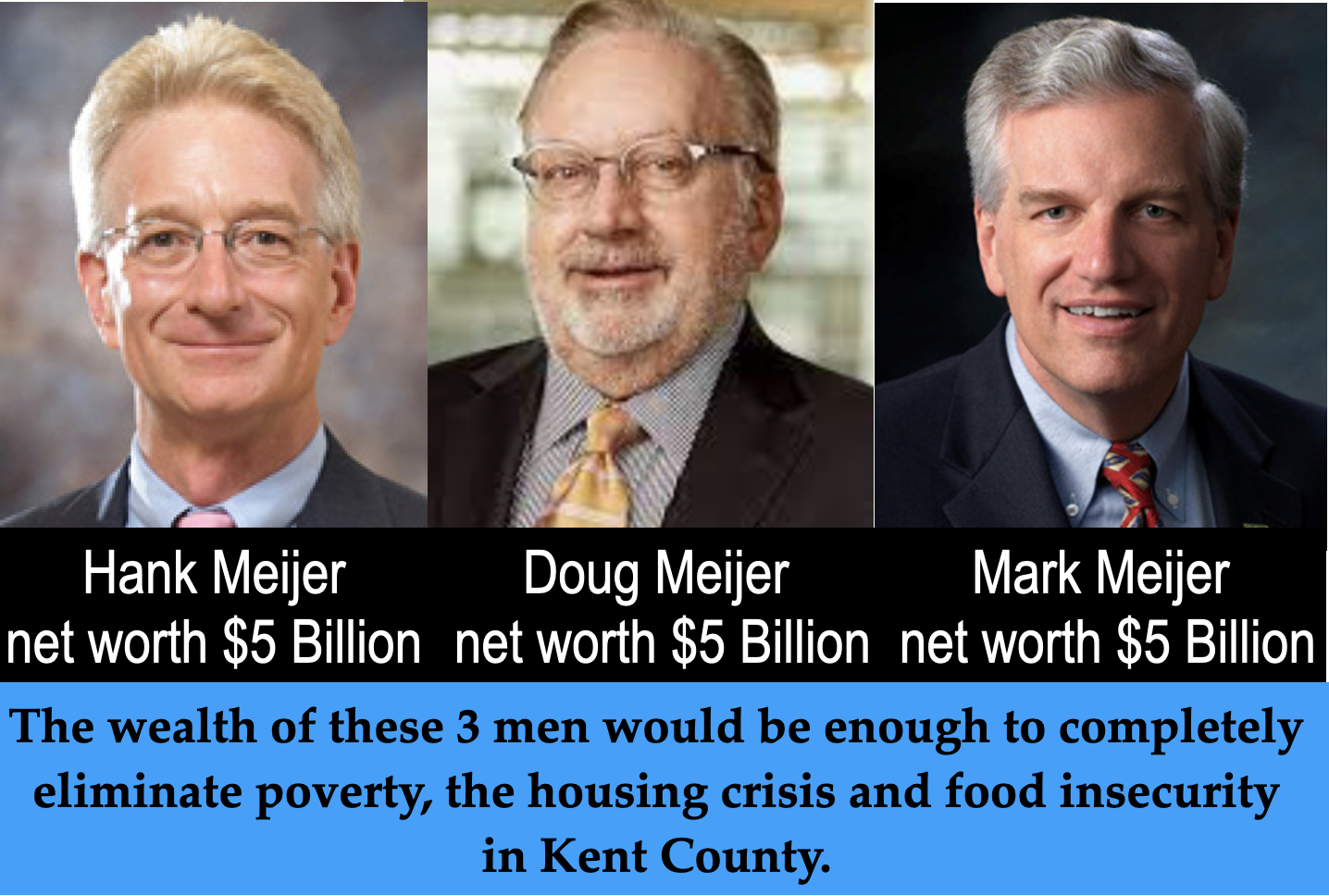
However, the Meijer brothers have also decided to separate their wealth, so that Hank, Doug and Mark Meijer want the public to see their wealth as diminished and separated.
In looking at the most recent Forbes 400 list from 2022, we discover that Hank, Doug and Mark Meijer are tied for the 202nd spot on the Forbes 400 wealthiest Americans, each with $5 Billion to their name. This of course means that they are collectively worth $15 Billion, which is a disgusting level of wealth.
I say disgusting because they have made their wealth off of the labor of their employees and people who work in the agricultural sector, along with those who work in the manufacturing sector. Whether we are talking about people who pick the food sold in Meijer stores, those who make the non-food products sold in Meijer stores, those who stock the shelves or work the cash registers at Meijer stores, all of them give their labor to the Meijer family. Plus, all of these people who give their labor so that Meijer can sell products in their stores, the vast majority of them do not make a livable wage. In fact, many of the make the minimum wage or less, especially those that pick the food sold in Meijer stores.
Now, over the past few years, GRIID has been tracking the wealth of the Meijer family, like when we noted that, during the first 18 months of the COVID pandemic, the wealth of Doug & Hank Meijer had grown by $6.7 Billion. We noted that this increased wealth was taking place when so many people were without work and experiencing food insecurity.
Another way that we have looked at the wealth of the Meijer family in recent years is to re-imagine how just the amount of increased wealth they made during the early part of the pandemic could benefit their employees. We noted that if Meijer paid their employees $40 an hour for a 40 hour work week, that would result in a $90,000 annual salary. If Meijer decided to pay their employees such a wage, they would still be worth BILLIONS, meaning their lives would be ridiculously comfortable. The difference is that their employees would now have a less stressful life and be able to have opportunities they didn’t have before.
In another examination of the Meijer family wealth, we wrote in August of 2021:
For the rest of us, we should be marching on the Meijer corporate headquarters at 2929 Walker Ave NW, Grand Rapids, making other demands about wealth redistribution. Imagine what $900 million could do to relieve the harm that thousands of families are currently experiencing in the Greater Grand Rapids area. $900 million would eliminate poverty, homelessness, food insecurity and provide plenty of health care funding. Demanding that the Meijer family give $900 million to be distributed to the thousands of families in this area who are experiencing poverty, systemic racism and other forms of structural violence would still leave Hank & Doug Meijer with $12.6 billion, which I’m sure they could still support their families on.
Those with tremendous wealth won’t willingly give up millions or billions of dollars, we must demand that they turn in over to the rest of us. Of course we are talking about a sustained organizing effort, a revolutionary effort that would involve tremendous risks, but if we really wanted to engage in systemic change, then such action needs to happen. I mean, look at how much money members of the Capitalist Class spend on buying and lobbying politicians to make sure that their grotesque amounts of wealth are not fairly taxed. Imagine how resistant they would be to the public demand a redistribution of their wealth. Remember, it’s not really their wealth to begin with, since they made it off of the exploitation of those who do the real work.
The West Michigan Policy Forum continues their efforts to undermine public education in Michigan
“If we want our economy to thrive, we must invest in its future: our students. We need to make it clear to our lawmakers: we need change that’s going to drive success for our students and our economy. And this year, with Michigan’s new legislative line-up, we need to be louder than ever.”
The above quote is from a recent article posted on the West Michigan Policy Forum’s website, an article from January 9th. Clearly, the WMPF has concerns about the now Democratic Party control of state government, with their point about the need to be “louder than ever” on education and the economy in Michigan.

For the West Michigan Policy Forum (WMPF), education policy has been a priority for years. GRIID has been documenting this dynamic over the years, such as when the WMPF helped to craft and then support legislation in 2016, which would eliminated public teacher pensions and force them to adopt a 401k plan. In 2018, the WMPF brought former Florida Governor Jeb Bush to Grand Rapids, advocating that Michigan adopt similar policies that Florida did during his tenure as the Florida Governor, policies that would undermine public education and push for more Charter Schools and Private education opportunities.
Last April, the WMPF brought in Corey DeAngelis, who is the Director of Research for the American Federation of Children, who made three issues for the future of education in Michigan:
- Michigan parents and guardians want more options for their students’ education.
- Florida students’ educational achievements have increased dramatically since the introduction of the Florida Tax Credit Scholarship Program.
- 2021 saw increased opportunities for students in 18 states and expanded existing opportunities for education in 21 states.
Lastly, during their Fall 2022 Conference, the WMPF had a session on education, with the headline, Reimagining Michigan’s Failing Education System and Making Michigan a Top 10 State. The 2022 WMPF conference addressed two aspects of what they referred to as a failed education system in Michigan. First, the speakers discussed how to move Michigan more in the direction of what Betsy DeVos has been advocating for over the past 3 decades, a more privatized educational system with charter schools, religious schools and private elite schools. The second aspect of the education-themed conference is to discuss the need to gear education in such a way as to generate talent, specifically labor talent, which is why there were several business people speaking during that session, along with the fact that the majority of those in attendance were business people.
A morning session on education policy at their Fall 2022 Conference was entitled, A Game Plan for K-12 Transformation in Michigan, Next steps for Education Transformation in Michigan. This presentation was given by Don Nielsen, with the American Center for Transforming Education. The American Center for Transforming Education is part of the Discovery Institute, which advocates for Public Education Reform. What they mean by Public Education Reform is to push School Choice, to change education policy, make schools places that work with the business community to meet market demands through talent creation.
At the second morning session on education policy, there was another panel to react to the comments by Don Nielsen. The panel consisted of Rep. Pamela Hornberger, John Kennedy (Autocam Medical) and Kelley Williams-Bolar, School of Choice Advocate. Rep. Hornberger is the Chair of the House Education Committee, and last year she introduced a House resolution on Wednesday condemning the Michigan Department of Education’s teacher training videos on student gender orientation and reaffirming the fundamental right of parents to direct the education of their children. John Kennedy is part of the Executive Board with the WMPF and has been one of the most consisted WMPF members to speak out against Public Teacher Unions. Lastly, Kelley Williams-Bolar, an African American parent, went to jail for sending her kids to a highly ranked school near where her father lives, which was out of her home school district. Now, the far right is using her to push their own education agenda.
If the West Michigan Policy Forum gets their way, they will radically alter education policy in Michigan and effectively undermine public education for decades to come. We all need to know about their policy work and there needs to be a significant effort, even a social movement, to prevent them from achieving their goals for public education in Michigan. Unfortunately, the work of the West Michigan Policy Forum is under-reported and operates outside of the view of the public.
Newly formed Stand with Schurr page perpetuates racist ideology, glorifies state violence and justifies the murder of Patrick Lyoya
 The group that has been organizing financial support for the Christopher Schurr, the ex-GRPD cop who shot Patrick Lyoya in the back of the head, known as Stand with Schurr, now has their own Facebook page.
The Facebook page for Stand with Schurr started just one week ago and as of this writing has 12 separate postings. Some of the posting people might be familiar with, such as the recent brief filed by Schurr’s lawyers asking the court to dismiss the case, the statement from the Grand Rapids Police Officer’s Association from April 26th pf last year, commentary posted from the Gerald R. Ford Metro Lodge #97 – Fraternal Order of Police, and video of a GRPD Captain who testifies that Schurr followed proper training in Lyoya shooting.
The posts on the new Stand with Schurr Facebook page that people may not be familiar with are from groups that are pro-police, embrace far right  ideologies and in varying capacities perpetuate racist stereotypes and ideologies. The three groups that the Stand for Schurr Facebook page is promoting are:
- Legal insurrection
- Before the Court, a webcast hosted on YouTube – “Before The Court aims to dramatically decrease the number of violent interactions between our citizens and the police departments who serve us.”
- Failure to Stop podcast, hosted by Mike the Cop and Eric Tansey

Reading and watching content from each of these sites is not recommended, since they are difficult to stomach, but it is necessary if we want to understand the mindset, indeed the culture of people who defend cops no matter what. It’s one thing for the Stand for Schurr group to raise money for the ex-GRPD cop and his wife, but it is another thing to promote and perpetuate racist ideology and the belief that cops are in our communities to protect and serve. Regardless of the outcome of the trial for the ex-cop that shot Patrick Lyoya in the back of the head, we need to expose groups like Stand for Schurr and counter their glorification of state violence workers, known as cops.
Class Warfare is what the Chamber of Commerce is waging across the US, and in Grand Rapids
Recently, the Supreme Court heard arguments in a case with high-stakes consequences for the US labor movement. The case at issue, Glacier Northwest, Inc. v. International Brotherhood of Teamsters, deals with a 2017 strike at a concrete-mixing company.
According to an article in the Jacobin, If the Supreme Court rules against the Teamsters, it could open the floodgates for corporations to sue unions for economic damages caused by strikes.
One of the groups that is lobbying the US Supreme Court is the national business entity, the USChamber of Commerce. That the US Chamber of Commerce is advocating that the Supreme Court rule in favor the corporation in question is not surprising, in fact, throughout their history, the US Chamber of Commerce has not only been anti-labor union, they have been waging a war against workers and working families.
For decades, the US Chamber of Commerce has spent millions on lobbying Congress, along with millions in campaign contributions to candidates that are anti-union. Amway co-founder, Jay Van Andel, was the chairman of the U.S. Chamber of Commerce in 1979 and 1980. In fact, during Van Andel’s tenure as chairman of the US Chamber of Commerce, he worked on a campaign to counter the consumer-driven work of Ralph Nader and all the advocacy groups that Nader created, like Public Citizen. Under Van Andel’s leadership, the US Chamber of Commerce created chapters of Citizen’s Choice, specifically as an effort to counter the public demands of greater accountability and regulation of businesses and corporations.
Other ways that the US Chamber of Commerce has been engaged in class warfare against working people and working families, has been their opposition to things like raising the minimum wage, paid sick leave, maternity leave, improved health care benefits and progressive Climate Justice policies.
If the US Supreme Court rules in favor of corporations, then workers who chose to fight for workplace democracy will have more of their legal power taken away from them. At the local level, the Grand Rapids Chamber of Commerce is engaged in the same sort of class warfare in West Michigan.
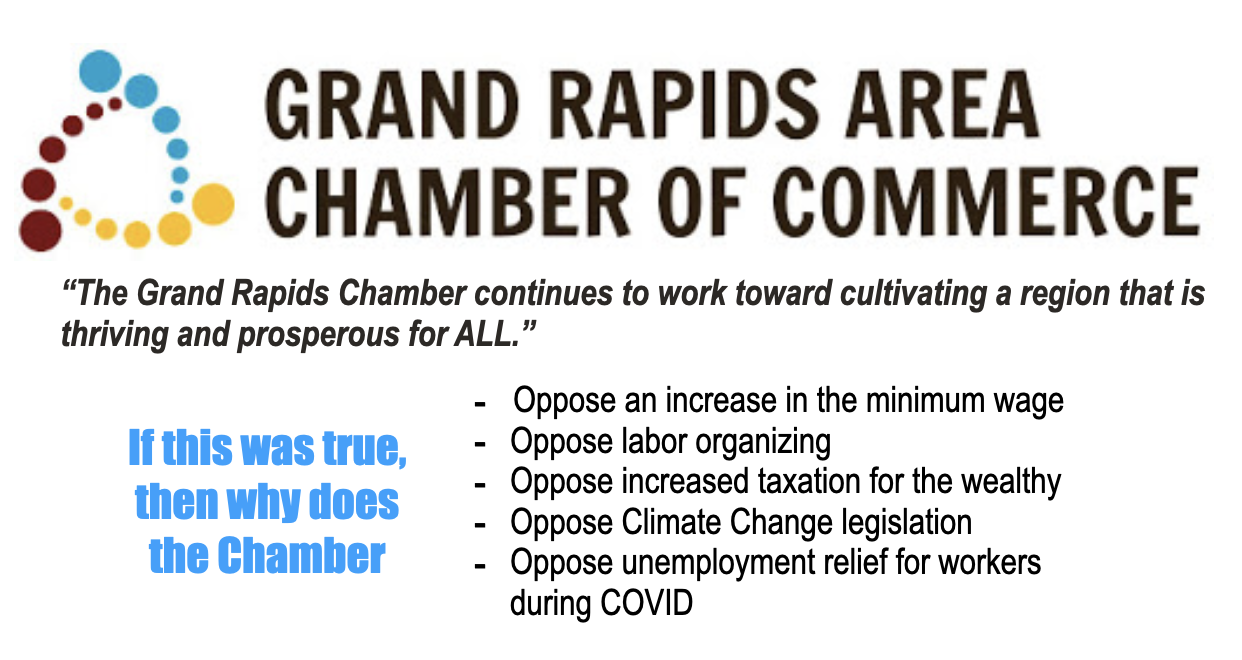
Now, the mission statement of the Grand Rapids Chamber of Commerce states, “The Grand Rapids Chamber continues to work toward cultivating a region that is thriving and prosperous for ALL.” This is an outright lie, especially if one examines the legacy of the GR Chamber and the kind of things they have supported over the decades, which is in step with the US Chamber of Commerce.
The GR Chamber does an annual survey to find out what its members want the Chamber to make as its priorities. Just check out this short video, which lays out the 2021 legislative priorities for the Grand Rapids Chamber of Commerce.
The video makes it clear that the Grand Rapids Chamber of Commerce is “working to shape the policies to support a vibrant business climate.” The video states that the GR Chamber wants:
- Property tax deferment for businesses, which Whitmer has vetoed twice
- Regulatory flexibility
- A possible end to licensing fees
- Eliminate or reduce business unemployment fees
- Improve work search requirements to make people take jobs that don’t pay well
- Education testing to make sure that students are work ready. In other words, the GR Chamber sees education as talent production
- Creating more childcare options to get people back into the workforce and improve productivity
- Criminal Justice reform for the GR Chamber is about getting more formerly incarcerated people into the workforce, which the Chamber also sees as a Talent issue
- Continuation of the Going Pro Program, which transfers public money to private businesses for training purposes
- Wants more housing, but not housing justice
The Grand Rapids Chamber of Commerce made “big news” with their campaign contributions and endorsement of two candidates in the Grand Rapids City Commission race this past November. Of course, the GR Chamber of Commerce also contributed thousands to candidates for county and state offices as well, primarily GOP candidates.
However, it would be a mistake to think that the Grand Rapids Chamber of Commerce only contributes to GOP candidates who are running for office in Kent County. Check out the list of Democratic Party candidates that the GR Chamber of Commerce has contributed to in recent years, which begs the question – why would candidates who claim to support working people and working families, take campaign contributions from an entity that has been waging war on working people and families since they were founded in 1887.
It’s bad enough that the Grand Rapids Chamber of Commerce wants the City of Grand Rapids to adopt a proposed ordinance that would criminalize the unhoused, but this is completely in line with the organizations history of waging class war against working people and families in the greater Grand Rapids area.
Editor’s note: Additional sourcing for this article came from the book, The Influence Machine: The US Chamber of Commerce and the Corporate Capture of American Life, by Alyssa Katz.
Grand Rapids has the 12th worst city in the country for Bed Bugs, not the headline Grand Rapids leaders want to share
It’s not the fun, upbeat list that Grand Rapids like to share about itself, whether we are talking about the city government or the tourism industry, but bed bug infestation is a serious problem in this city.
The pest control company, Orkin, released their annual list of the worst cities for bed bug infestation on January 9th. Not surprising, MLive picked up the story, but pretty much just used the content from Orkin’s Press Release.
Lazy journalism seems to be the norm these days, which is very unfortunate for the public, especially for something like bed bug infestation. The Grand Rapids Area Tenant Union says that they receive calls regularly about bed bug infestation. However, the problem is that they can’t provide much support on the matter, both because, landlords often include language in the lease agreement, which makes tenants responsible for bed bug extermination, regardless if the bed bugs were there before the tenants. The cost of exterminating bed bugs is substantial and tenants have to vacate the premises for at least 24 – 48 hours.
Then there is the issue of there being no state policy around bed bug infestation and who is responsible for said infestation. There is legislation (HB 5412) that was introduced in October of 2021, but that proposed legislation has only been referred to Committee on Regulatory Reform, which has not discussed the matter, nor have they held any public hearings.
The failure to act by state government on this matter is not surprising, for various reasons, one of which is the fact that the Property Management Association has a PAC and makes significant campaign contributions during every election cycle, as you can see from this example from state campaign finance filings from October of 2022. The same is the case for more regional landlords, like the Rental Property Owners Association of Kent County, who made contributions to candidates running in Kent County.
In addition, MLive could have tried to contact tenants to talk about this issue, so that readers could have a better sense of the actual realities of living in a bed bug infested apartment and being forced to pay for the extermination yourself. Doing so would require that MLive would actually practice journalism and not take the easy route of just re-wording industry Press Releases.
20 years ago there was a movement in Grand Rapids to oppose the US war and occupation of Iraq – Part I
 Over the next few months, GRIID will be posting numerous articles in a series that remembers and celebrates the 20th Anniversary of the organized resistance to the US War and Occupation of Iraq.
Opposition to the US government’s decision to go to war against Iraq began in September of 2002, when the group known as the People’s Alliance for Justice and Change hosted its 2nd Annual Teach-In on US foreign policy.
At that teach-in, which was held at Aquinas College, there was a workshop on resisting the rhetoric from the Bush administration about Iraq and its leader, Saddam Hussein. From that workshop, there was consensus that there needed to be public opposition to the possibility of going to war against Iraq. A protest was organized for a Saturday in October, which began at Veteran’s Park and ended up at the Federal building. This was a non-permitted protest, but most of the 400 people marched in the streets, despite the GRPD attempting to move people onto the sidewalks.
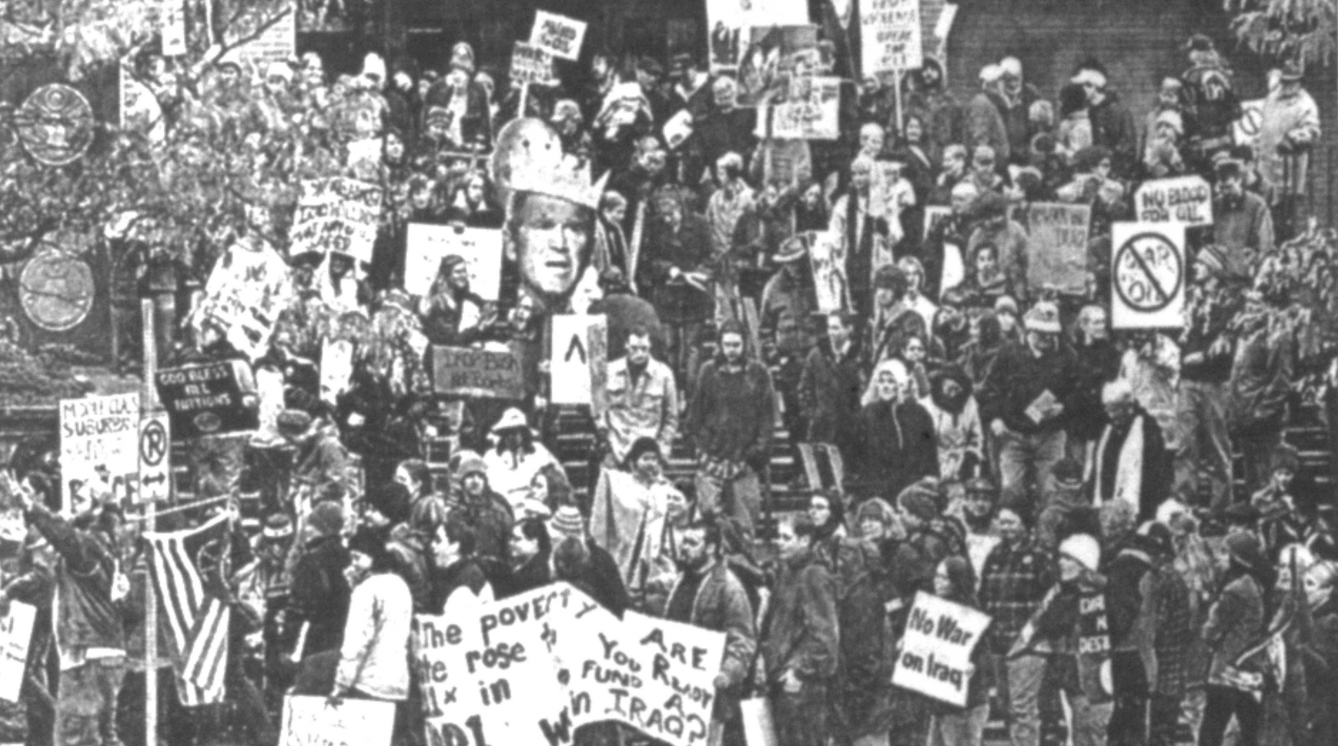
There were a few speakers at the beginning, followed by a few other when the marchers arrived at the federal building. Speakers shared actions that people could take, which included a weekly protest against the build up to the war, letter writing campaigns, workshops for those interested in doing civil disobedience and regular planning meetings to discuss upcoming actions.
During the annual Santa Parade in Grand Rapids, members of the People’s Alliance for Justice and Change handed on quarter sheets about what people could to do oppose the US war in Iraq, along with candy canes. The regular meetings were being held at the Koinonia House, but in early January of 2003, they were moved to the office of the Institute for Global Education (IGE). Unfortunately, moving the meetings made organizers and activists more vulnerable to GRPD infiltrators.
In late 2004, working with the ACLU, activists submitted a request for Freedom of Information documents. This request resulted in near 400 documents being obtained from the GRPD, which provided a paper trail of evidence that the GRPD was monitoring and at times infiltrating this anti-war movement in Grand Rapids. In one FOIA document, the GRPD admitted to sending undercover cops to an anti-war meeting at IGE. Fortunately, some activists recognized the undercover cops, cut the meeting short and even announced that there were undercover cops at that meeting, which essentially outed those who were cops. See FOIA document on the GRPD attempted infiltration.

After the meeting at IGE, we then moved it to the TV studio at the community media center, since one of the organizers worked there. Two undercover cops came, but we meet at the door by organizers who recognized them, then told them they were not allowed to enter.
The next action that was taken was held at Plymouth United Church of Christ, just days before people were departing to attend a mass rally in Washington, DC, to oppose the possible US war/occupation of Iraq.
In Part II of this series on the 20th Anniversary of the resistance to the US war/occupation of Iraq, we will look at the plans to protest President’s Bush’s visit to Grand Rapids the day after his State of the Union address, the protest and the GRPD’s response during that protest.
The Politics of Eggs and Eggs Producers: When Press Releases pass as journalism on MLive
On January 9th, MLive posted an article with the headline, Poultry farm donated 2.2 million eggs in 2022.

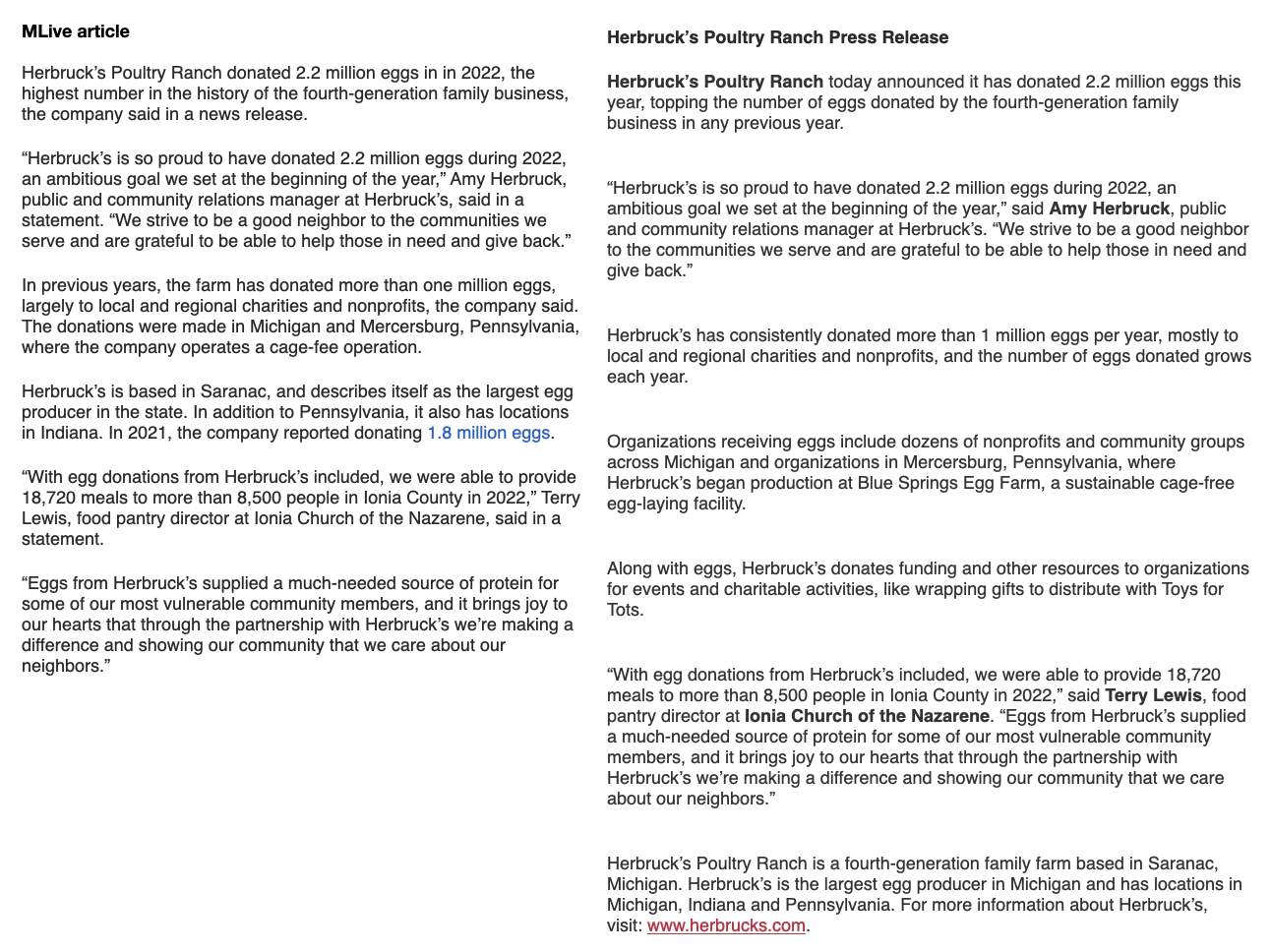
The article, which is short, cites a Herbruck’s family member and talks about how many eggs are donated to food pantries in Ionia. The MLive also says that Herbruck’s sent out a Press release about their eggs donation, so I decided to check their Press Release and compare it to the MLive article. It was is all to common with commercial news media, MLive pretty much just reprinted the Press Release from Herbrucks Poultry Ranch. You can compare the MLive article and the Herbruck’s Press Release, which are side by side at the bottom of this article.
It’s bad enough that MLive wasn’t honest enough with readers to tell that that their posting was essentially a slightly edited version of the Press Release, but MLive could have decided to use the opportunity to do a more investigative piece on the CAFO – Concentrated Animal Farm Operation. Doing a more investigative piece would also be timely considering that the cost of eggs has increased significantly over the past month, going from roughly $2 a dozen to more than double, at $5 a dozen. This increase in a staple food item, just adds to the already ridiculous cost of living for many families in West Michigan.
MLive also could have talked about the fact that Herbruck’s Poultry Ranch, like most large farm operations, has been the recipient of significant subsidies from the federal government’s Farm Bill. According to the Environmental Working Group, between 1995 and 2019, Herbruck’s received $583,391.74 in subsidies.
MLive also might have brought up the issue that got a fair amount of local news coverage in 2010, when the City of Grand Rapids held a public hearing on raising chickens within city limits. Most of the people who spoke at that public hearing were in support of people being able to raise chickens in their back yards, but there were a few exceptions. Here is what we wrote in 2010:
As we mentioned in a previous article, one of the largest egg producers in the state, Herbrucks was opposed to the ordinance change and 3 of the Herbruck’s grandsons addressed the commission. They all spoke about the potential for diseases in an urban setting, but mostly they focused on wanting to protect the profitability of their businesses. After members of the Herbruck’s family spoke, the vice president of production got up and painted a grim picture about avian caused diseases, even though he never cited any documentation to support his position.
Then there is the issue of what the average worker makes at Herbruck’s. Many of the workers who tend to the chickens in jobs that are referred to as crew members start off at $10.40 and hour and on average make $12.25 an hour. Considering how much rental costs are or what a monthly mortgage payment is for people people, $12.25 an hour would not cover the cost of rental fees or monthly mortgage payment. In fact, for those living in the area, they probably need to get food assistance from food pantries, maybe even some of the food pantries that Herbruck’s has donated eggs to.
This is the harsh reality for so many individuals and families in the Greater Grand Rapids area, that the cost of basic necessities, whether that is food, utilities or hosing costs are on the rise, while wages remain stagnant and woefully inadequate.
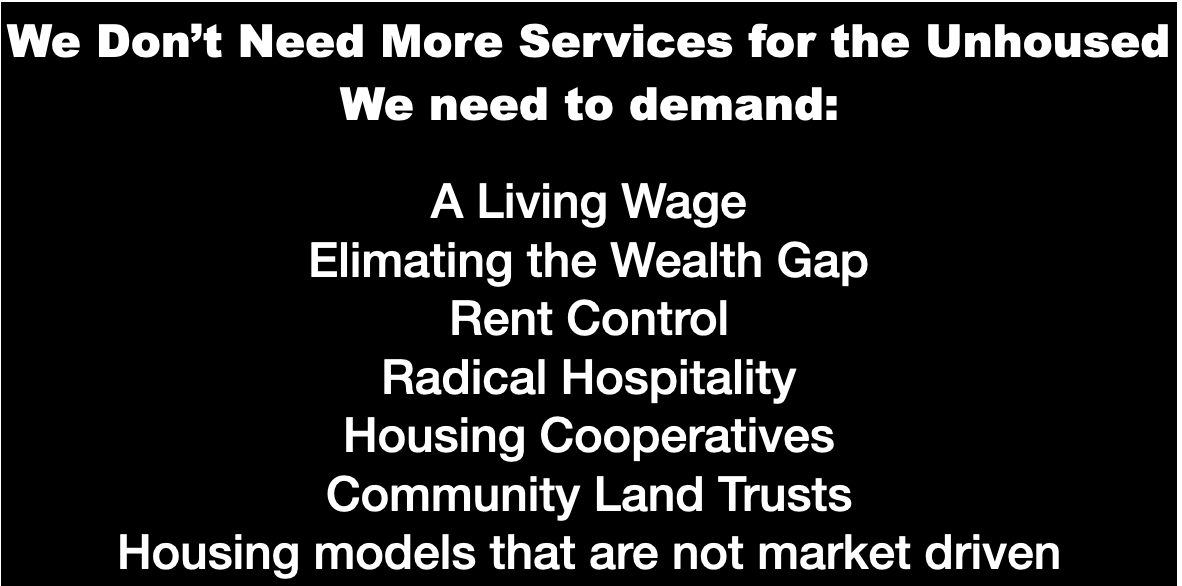
We don’t need more services for the unhoused, we need real policies and practices that will end housing insecurity in Grand Rapids
During last week’s Grand Rapids Committee of the Whole meeting, there was a presentation by City staff, which provided a brief history on homelessness in Grand Rapids, along with a bit about what the federal government was doing beginning in the 1980s. However, just before the presentation, it is worth sharing some comments from City officials.
Mayor Bliss stated, “Today was an important conversation that we needed to have publicly as we talk about, what is the state of the current system, what is working well and what is not working, and how does the city play a role in improving services for individuals experiencing homelessness?”
The Mayor’s statement was then followed by a few comments from City Manager Mark Washington, who said, “We know that this can be an issue that polarizes people based on your perspective. So what we hope to do is just call it like it is, balls and strikes, and share the facts about what’s happening in our community in terms of the people that are partnering in this work, and to look for opportunities in the future to improve on the work that’s going on.”
Beginning at 2:50:40 into the video for the City meetings last week, is when Grand Rapids City staff did their presentation on a history of homelessness and government response. What follows is a critique of that presentation.
Before we get to the critique, I think it is important to stop using terms like homelessness. Homelessness is too limited a term, since not everyone who is facing eviction ends up being homeless. Many people go live with relatives or friends when they are housing insecure. Housing insecurity is a more accurate term, since it doesn’t limit the discussion to just those who are homeless, but those who can’t afford rental costs and those that are facing eviction.
One of the first things that a city staffer said that is worth thinking about, was the City’s 3 pronged approach in dealing with the unhoused: investing in facilities, investing in services and systems, and investing in enforcement. The first two do not address root causes, thereby perpetuating a system of charity and other social services that will never end housing insecurity. The fact that enforcement is the third prong, makes it clear that the City of Grand Rapids will not hesitate to use or involve the GRPD. This third prong in the City’s approach could more accurately be termed the use of force within a larger carceral system.
A second Grand Rapids City staffer then presents some history. They do mention that Mel Trotters has been around since 1900, but fails to critique the White Savior institution that is not interested in ending housing insecurity, rather they want to continue to provide people of faith with an easy opportunity to donate money to an institution that ends up perpetuating inequality and housing insecurity.
In addition, this history of housing insecurity misses so much of the history that needs to be talked about, beginning with the original housing insecurity and housing displacement act, the settler colonialism of indigenous people. See the GRIID article entitled, Housing Justice through a Historic and Intersectional Lens: Looking back, imagining forward and fighting right now.
The City Staff presenter then talks about the 1980s and the various federal government responses, such as creating a task force on homelessness in 1983 or passing the first legislation in 1987 to respond to homelessness. What is painfully missing in this history lesson, is the fact that the Regan administration did everything it could to roll back social policies going back as far as the new deal, to attack unions, to perpetuate systemic racism, and to escalated the war against working families. All of these factors are what contributed to housing insecurity in the 1980s.
Next the presenter talked about policies beginning in 1995 called Continue of Care. These policies were about directing funding to communities that saw an increase in the number of unhoused people. Ironically, the very next year, the Congress passed the Personal Responsibility and Work Opportunity Reconciliation Act of 1996, which essentially ended welfare as we knew it. Coupled with the Crime Bill in 1994, the Clinton Administration escalated the war against working people that the Reagan administration had made a priority in the 1980s.
The City staffer then shifted to talking about Grand Rapids and the unhoused, beginning with groups like to Coalition to End Homelessness, which has been around for nearly three decades. What was not discussed is that the unhoused population and housing insecurity has increased during the past three decades in Grand Rapids. This tells me that what groups like the coalition are doing are ineffective or worse, they are perpetuating the problem.
Since the Coalition to End Homeless has been created there have been other groups like the Essential Needs Task Force at the county level, and more recently the Housing Stability Alliance and Housing Kent. While there have been some positive evolutions with these institutionalized groups/efforts, they have by enlarged failed to address the root causing of housing insecurity.
 Certainly one of the largest factors in perpetuating the housing crisis and housing insecurity is the massive wealth gap that has been happening for decades all across the country, but has increased since the 2008 economic disaster. In 2016, Grand Rapids had the largest wealth gap of any city in Michigan, according to research done by the Economic Policy Institute.
Another factor that contributes to housing insecurity is how so many people do NOT make a living wage. In the last ten years the cost of buying a home and the cost of rent have gone through the roof. Therefore, one solution to ending housing insecurity would be to pay people a livable wage. From all the research I have done on a living wage, there is no consensus on what that would mean in Grand Rapids, but $25 an hour seems to be the minimum to make a living in this city. According to the National Low Income Housing Coalition, people need to earn $20.02 an hour to afford the average cost of rent in Grand Rapids. What is the City of Grand Rapids, all of these groups like to Coalition to End Homelessness and the Essential Needs Task Force, plus all of the shelters like Mel Trotters, along with groups like ICCF, what if they all publicly declared that a great step towards ending housing insecurity would be to pay people no less than $25 an hour? These groups have not made such a public declaration, which leads me to believe that they really don’t want to end housing insecurity.
Next, we need to talk about the need to challenge the power of the Real Estate industry and the Rental Property Owners Associations. Both of these entities have powerful Political Action Committees and make substantial campaign contributions to elected officials, as we documented in 2022.
One concrete policy action that the City of Grand Rapids, the shelters and other non-profit housing groups could support would be to re-institute rent control in Michigan. Rental control can be a useful tool to limit the rental property owners from raising rental fees too high and too fast.
Grand Rapids likes to think of itself as a city with lots of people of faith. If that is the case, then why are congregations not providing radical hospitality – temporary housing – for people who are housing insecure? How many families who identify as religious have empty bedrooms that could be used by people who are currently housing insecure? Faith institutions could also be about the business of creating housing co-operatives, which would not only make it less expensive for people, but also more options for housing that would counter the housing market narrative.
Other options/solutions would be to limit large corporate property management companies of real estate investors from operating in Grand Rapids. This would also be a useful policy for Grand Rapids to adopt, along with matching funds for affordable housing to that of the amount of money that developers get as tax incentives or Brownfield development benefits.
When the City of Grand Rapids says they want to invest in services, invest in facilities and enforcement, they are acknowledging that they do NOT want to end housing insecurity, they only want to do triage and put a bandaid on the problem. These bureaucratic responses are not acceptable and we must make demands, demands that are rooted in justice and social transformation. Here Dr. King had something to say about making demands: “We are now making demands that will cost the nation something. You can’t talk about solving the economic problem of the Negro without talking about billions of dollars. You can’t talk about ending slums without first saying profit must be taken out of slums. You’re really tampering and getting on dangerous ground because you are messing with folk then. You are messing with the captains of industry. Now this means that we are treading in difficult waters, because it really means that we are saying that something is wrong with capitalism. There must be a better distribution of wealth and maybe America must move toward a Democratic Socialism.”
Legal briefs, the use of force laws, the function of policing, and media framing in the ongoing case of an ex-cop who murdered Patrick Lyoya
On Monday, the lawyers who are representing the former GRPD cop who shot Patrick Lyoya in the back of the head while he was face down on the ground, Christopher Schurr, are asking Kent County Circuit Judge Christina Elmore to dismiss the case.
The lawyers representing Schurr submitted a 45 page brief, which people should read. Reading the brief is important, not because I agree with their arguments, but because we have to come to terms with the fact that laws in the US and in Michigan have primarily been created by those with political/financial power and those who benefit from the current system of Racial Capitalism. Let us not forget that the law in US history has endorsed the theft of Indigenous land, the enslavement of Black people, the exploitation of workers, the destruction of the environment, the lack of bodily autonomy, the criminalization of people who are LGBTQ, people with disabilities, the unhoused and undocumented immigrants. In fact, if the US wanted to use nuclear bombs, which indiscriminately murder, that would be perfectly legal.

We have to cone to terms with the fact that police unions make significant campaign contributions to elected officials and have their own lobbyists, so that they can have a say in how laws are crafted and passed, laws that provide them with all sorts of justification to killed people, particularly BIPOC people. We have to be familiar with the Use of Force Laws in Michigan, and we have to come to terms with ideas such as fleeing felonies, which is one of the main arguments used by the lawyers representing the ex-GRPD cop who shot Patrick Lyoya in the back of the head while he was face down on the ground.
People I have met and have had conversations with since Patrick Lyoya was murdered on April 4, 2022, all have the capacity to reason that the decisions that then Officer Schurr made that day was not necessary at all. In fact, if we come to terms with the basic functioning of policing, particularly the policing of Black and Brown neighborhoods, then we will see the real purpose of Schurr being in that southeast neighborhood in the first place. Alex Vitale, author of The End of Policing, states:
Well trained police following proper procedures are still going to be arresting people for mostly low level offenses, and the burden will continue to fall primarily on communities of color because that is how the system is designed to operate, not because of the biases or misunderstandings of officers.
Having said that, what is Schurr had waited for other cops to show up, making it less likely that Lyoya would try to avoid cops, thus significantly reducing the possibility that Patrick would have been shot in the back of the head that day. Schurr didn’t wait because cops are always right and the public should always obey them no matter what. At least this is the mantra of police departments, elected officials, police apologists and most commercial media.
Speaking of the media, it is interesting that all three TV stations in Grand Rapids – WOODTV8, WZZM13 and WXMI 17 – framed the story from the perspective of the lawyers representing Schurr. MLive also tended to frame the story around the arguments submitted in the brief by Schurr’s lawyers. For example, here is how WOODTV8 began their story:
The attorneys for a former Grand Rapids police officer charged with murdering Patrick Lyoya last spring have asked the court to throw out the case. The 45-page motion to quash Chris Schurr’s bind-over to Kent County’s 17th Circuit Court and dismiss the second-degree murder charge against him argues that a lower court was wrong to move the case forward.
However, if we look at how this story was covered outside of Grand Rapids, we tend to get a different kind of coverage. Here is how the Detroit Free Press began their story:
A former Michigan police officer who shot a Black motorist in the back of the head during a struggle over a Taser should not have to stand trial, the defendant’s attorneys argued as they urged a judge to dismiss the case. Ex-Grand Rapids Officer Christopher Schurr is charged with second-degree murder in the death of Patrick Lyoya. On Monday, Schurr’s attorneys filed a motion seeking to toss out a ruling that a jury trial should be held in the case, news outlets reported.
There is a fundamental difference in how it was framed and their use of language. The WOODTV8 story doesn’t say that Lyoya was Black in the opening comments, nor do they say he was shot in the back of the head. Framing the story can make the difference in the world, since it can have an impact on public perception. In addition, most of the local commercial news media used a picture of Schurr in the court room and only WXMI used a picture of Schurr in his orange jail jumpsuit juxtaposed with a picture of Patrick Lyoya. However, what if the local news used a picture of what actually happened to bring this case to court, a picture of Schurr on top of Lyoya just before the ex-cop shot him in the back of the head?

In the end, the lawyers representing the ex-cop who shot Patrick Lyoya in the back of the head filed their brief, in part, as a public relations stunt, since they are well aware of how important it is to control the narrative in these cases, especially since policing has come under greater scrutiny in recent years, with 2022 being a year where the police have killed more civilians than in any year previously recorded in the US.
 Grand Rapids Institute for Information Democracy