In Part I of our series looking back at the 20th anniversary of the public resistance to the US invasion/occupation of Iraq in 2003, we focused on early organizing efforts to build an anti-war movement before the US war on Iraq even began. In Part II, we looked at the protest when President’s Bush’s visited Grand Rapids the day after his State of the Union address and the GRPD’s response during that protest.
In Part III, we looked at the Women in Black actions, the global protest against the war march that took place in Lansing, along with the People’s Alliance for Justice & Change workshops on civil disobedience that were offered to a growing number of people who wanted to do more than just hold signs. Part IV focused on student organizing against the imminent US war against Iraq, along with civil disobedience that was done at Rep. Ehlers office before the war began.
In today’s post, we will look back on some of the plans that anti-war organizers had put in place once the US invasion/occupation of Iraq began. In addition, we will look at the increased surveillance of the GRPD on anti-war organizers and activities prior to the March 20th US bombing campaign against Iraq.
 For the week prior to the beginning of the US war/occupation of Iraq, the group People’s Alliance for Justice & Change had been circulating a flyer that announced plans for several different actions to take place the day of and a few days after the war began. You can see a copy of the flyer here on the right, which was also included in the Freedom of Information Act (FOIA) request regarding what the GRPD was doing to monitor, disrupt and target anti-war activities.
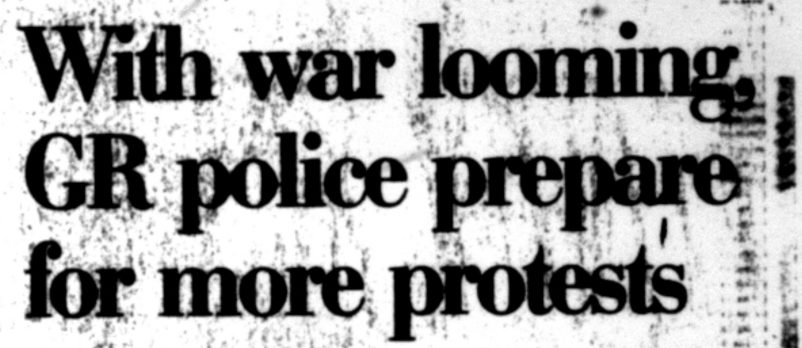
There was also an article in the Grand Rapids Press, entitled, With War looming, GR police prepare for more protests. (See page 16 of the hyperlinked document) Then police chief Harry Dolan made it clear in the Press article that they would be prepared to deal with protestors, including violent protests, which is always code for protests that don’t play by the rules – like civil disobedience, office occupations, blocking traffic, disrupting business as usual. The Press article also mentions that the GRPD was doing additional training and even listed the gear they would have, riot gear, pepper spray, and shield. Dolan also said they were prepared for “mass arrests.”
There was an ACLU lawyer, Pete Walsh who is cited in the article, but the rest of the sources cited were the City Manager, the Mayor and a City Commissioner, all of which were critical of anti-war protesters, some calling them violent for blockading traffic.
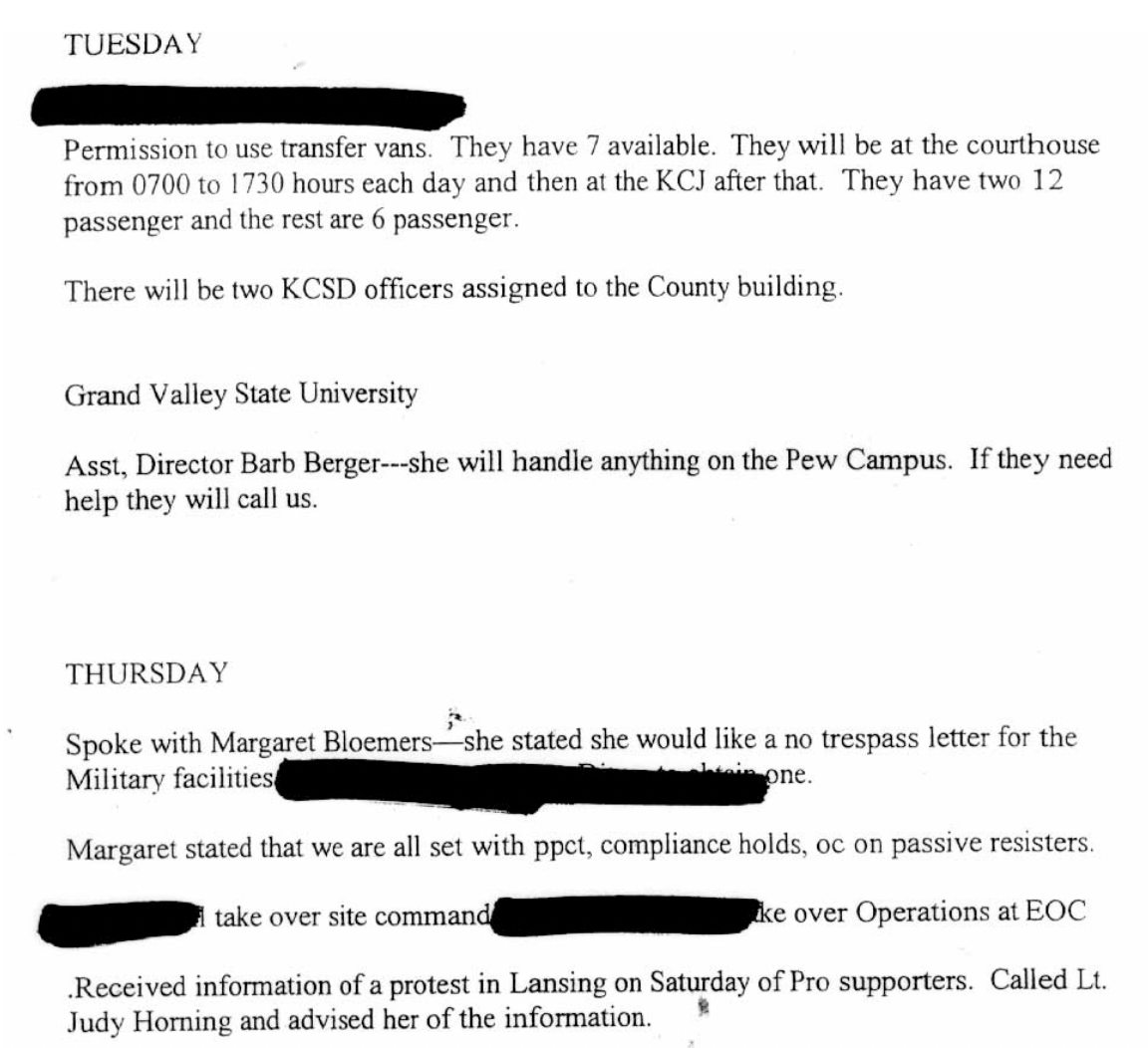
There was also an interesting FOIA document from the GRPD, which included plans to have police vans available, cops assigned to the County building, along with what GVSU security people were planning in case students protested, which you can see here below.
On Monday, we will post Part VI, since March 20th is the actual day that the US war against Iraq began, where we will talk about the anti-war actions on the first few days, plus the ongoing attempts by the GRPD to infiltrate and monitor anti-war organizers.
Yesterday, tenants living at Orchard Place Apartments, along with supporters and members of the Grand Rapids Area Tenant Union, held a protest outside of the office of the Property Manager.
The protest was based on the living conditions of the tenants at Orchard Place Apartments. In October, there was a fire in an adjoining apartment (which is still boarded up), which has caused significant health issues, because of the smoke ash from the fire, which was never cleaned up. Then in December, there was flooding in that same adjoining apartment, which affected their apartment and created black mold that has also not been dealt with by the property management company. In addition, there have been several needed repairs in their apartment, which were ignored for the past 6 months. These tenants had contacted the Grand Rapids Area Tenant Union for support, which provided some logistical support for the protest.

The tenants told us that earlier in the day they had received a call from the Property Manager telling them that if there was a protest that it would not be allowed, since Orchard Place Apartments was private property. Undeterred by the threats, people gather at 2pm, to protest outside of the Property Manager’s office, which is in the middle of the apartment complex.
As people made their way to the Property Manager’s office, they were stopped by someone who was working for a private security company, who again told the tenants that this was private property and that they would call the cops if people chose to protest there. We found out that Orchard Place Apartments had hired two private security guards, both of which had a car, to deal with protestors yesterday. It’s interesting that the company spent money to hire private security people, instead of investing in the repairs and meeting the demands of tenants who had brought numerous complaints to them.
Once people arrived in front of the Property Manager’s office, other tenants began to arrive, partly out of curiosity or because the tenants who organized the protest had dropped off flyers to other residents in the apartments complex. Someone from the Grand Rapids Area Tenant Union was live-streaming the protest (which you can watch at this link https://www.facebook.com/GRATU4Inquilinos/videos/224397420125351) Then tenants who organized the protest shared their story in the video, then as other tenants arrived, they also began to talk about their experience of living at Orchard Place Apartments. The stories were powerful and moving. What became clear to everyone, was that as other tenants arrived they too shared their stories and had very similar experiences with the company that took their money every month, but did little to make repairs or provide other basic resources that are necessary for living in a safe and healthy environment.

After about 30m minutes of protesting and sharing stories, two GRPD cruisers arrived. However, the GRPD officers kept their distance for at least 10 minutes before coming over the speak with the tenants that were protesting. Once the cops did approach people, the Property Manager came out of the office to tell people that they needed to leave, since it was private property. The Property Manager promptly went back into their office and refused to listen to tenant complaints and speak with them about the issues they were raising in the protest.
At one point that GRPD officers were saying that they thought it would be more advantageous for those protesting to go out to Fuller or Knapp and protest, since they would be more visible to the public. One of the members of the Grand Rapids Area Tenant Union responded by saying that, “it was actually more advantageous to protest in front of the office, since they wanted to be seen by other tenants and to make it easier for other tenants to participate.”
People eventually decided to move the protest to Fuller, since no one was prepared to get arrested that day. The protest ended 10m minutes later, since it had achieved what tenants had hoped for.
People began to disperse over the next 10 minutes and by the time that I got home, the tenants who had organized the protest sent a video message showing the Property Manager coming to their apartment to deliver a document. The document they delivered was a notice to quit to recover possession of their property, which is to say they were not going to renew the lease with the tenants who organized the protest. What is interesting is that just last week, the Property Manager said that they would not retaliate against the tenants, which of course was exactly what they did.

There has been a great deal of discussion in Grand Rapids about the housing crisis and the lack of affordable housing. However, what these tenants have been experiencing is the realty that thousands of tenants are facing in Grand Rapids on a daily basis. The real crisis is the ongoing harm that landlords and Property Management Companies are afflicting on tenants on a daily basis and anytime tenants speak up for themselves they are met with threats of eviction or termination of their lease. Until people who care about housing issues in Grand Rapids come to terms with the realities that tenants are facing, there will be no housing justice in this city.
To be part of the Grand Rapids Area Tenant Union, you can leave a message on their Facebook page https://www.facebook.com/GRATU4Inquilinos or send an Email to gratunion@gmail.com.
We’re not going to question you: WZZM 13 interviews GRPD Chief Winstrom and never challenges a single thing he says
It has been a year since Eric Winstrom was hired to be the new Chief of Police in Grand Rapids. On March 9th, WZZM 13 did a story that essentially allowed Winstrom to create his own narrative about what has happened over the past year and want he wants to see happen.

Let’s be clear about this kind of news story, a news story that is a form of stenography, where someone says something and the news media simply presents that narrative with question, without a challenge and without voices and perspectives to counter such a narrative.
The online headline for this story, a story which also aired on WZZM 13, reads: Shooting death of Patrick Lyoya, building trust | GRPD Chief Eric Winstrom reflects on one year in office. These kinds of headlines are important, because it creates a narrative and frames how news stories will often go. The headline is essentially a contradiction. How can you begin by saying, Shooting death of Patrick Lyoya, followed by building trust? This headline is also a play on words, since the headline did not say that the GRPD shot and killed Patrick Lyoya, which would have made it difficult to then say, building trust.
In the WZZM 13 broadcast version of the story, the news reader begins by saying that Police Chief Eric Winstrom is reflecting on his first year as Police Chief in Grand Rapids. The framing of the TV version sets viewers up by telling them that the Windstorm has been reflecting on his year as police chief, but does he actually do that? The news reader then says that a channel 13 reporter sat down with Winstrom to talk about 3 things; the lasting impact of the shooting of Patrick Lyoya, building trust, and what he hopes to accomplish this year.
Before viewers get to hear from Winstrom, the reporter frames the interview around the “controversial officer-involved shooting of Patrick Lyoya.” Again, the news uses the language that the cops use, officer-involved shooting, rather than say that Lyoya was shot in the back of the head by GRPD officer Christopher Schurr, while Schurr sat on Lyoya who was face down on the ground.
Instead of addressing the GRPD shooting of Patrick Lyoya, Winstrom, who has learned well from years of being coached by consultants, the GRPD Chief begins him response by talking about the 2020 riots that took place in Grand Rapids in response to the Minnesota police murder of George Floyd. Winstrom uses the riots to get viewers to sympathize with him on the conundrum he supposedly faced when releasing the video of the GRPD shooting of Patrick Lyoya. WZZM 13’s decision to show images of broken storefront windows from the 2020 uprising effectively gets viewers to think about property damage instead of the Patrick Lyoya being shot in the back of the head in the front yard of a house in the southeast part of Grand Rapids. For the majority white viewers in the West Michigan market, it makes a whole lot of sense to use riot images and damage to property, rather than to hear or see how the Congolese community and the Black community were traumatized by Lyoya’s death.
Winstrom then shits to talking about people “from outside of the city, people with bad intensions, who want to take advantage of an already awful situation.” Again, the well-coached cop makes the riots about individuals with bad intentions, instead of the thousands of people who protested in downtown Grand Rapids, who who were angry and enraged over the police murder of another Black person. Now stop for a moment, and ask yourself, if this was an honest interview, with a reporter that challenged people in power, what could they have done in this situation? A good reporter would questions these comments by Winstrom and provide facts, facts about the systematic murder of Black people by cops across the country or about the failures of performative politics that takes place every god damn time after another Black person is murdered by cops. However, we get none of that, and Winstrom gets to keep on saying that he wants to.
The news reporter than goes on to say that Chief Winstrom was proud that the GRPD was able to “keep the peace.” When people in positions of privilege say keep the peace, this is nothing more than code for maintaining the status quo, business as usual and allowing systems of power and oppression to continue operating without interruption.
We next hear from Winstrom who said, “We didn’t have one officer use force against a protester for these protests out there on Monroe Center. Not one. I’d say that was the biggest accomplishment of mine, but really it was a team effort of the department last year.” Again, the WZZM 13 reporter didn’t question or challenge this statement, despite the fact that there have been several incidents where cops used force on those protesting the GRPD murder of Patrick Lyoya, some of which were witnessed and recorded by other people protesting.
The reporter then continues to go along with the well-crafted narrative that Winstrom was creating by saying that the Police Chief wanted to build trust in the community. “It takes consistent, ethical behavior,” he said. “Showing integrity and showing the police department’s doing the right thing over time. It’s a journey, not a destination to build trust. We’re going to keep doing it for as long as I’m here.” Again, the news reported did not question or challenge Winstrom, nor did they ask for evidence or data around the department’s practice of accountability or transparency. It doesn’t matter what Winstrom says unless he can produce evidence that trust exists with the community, especially the Black community and other affected populations that are regularly targeted by the GRPD.
The news reporter then gets to the third thing that Winstrom wanted to talk about, which was the future of the GRPD and their desire to recruit, retain and diversify the department. Winstrom is then give even more airtime to talk about how the GRPD is recruiting and why he wants increase the number of cops in the department.
What the WZZM 13 reporter allowed Chief Winstrom to do was to essentially dictate the terms of the story, which came down to three over arching messages:
- The GRPD protects the community from bad people with bad intentions.
- The GRPD does not used force against people who are protesting, demonstrating they are accountable to the public.
- The GRPD wants and deserves to increase the number of cops in the City, which will lead to more safety and security.
My Grandma would call this list a load of horse shit. In some ways you have to admire the spin by Chief Winstrom, since he was able to craft whatever narrative he wanted to, a narrative which essentially made the GRPD out to be the saviors of Grand Rapids. But this is exactly what happens when you have reporters who do not question and do not challenge people like Chief Winstrom. What’s even worse, is that there were no other perspectives presented in this story, perspectives could have countered the narrative from Winstrom and challenged his spin of what the GRPD has been doing under his leadership over the past year.
Last Tuesday, the City of Grand Rapids posted an announcement about two upcoming forums that will focus on “public health and safety initiatives.” The two forums will be held on March 20th and 22nd, with details on time and location at this link.

The only local news that picked up this announcement, was MLive, which posted a story on March 9.
The MLive article included the headline, Grand Rapids holding community meetings around homelessness, nuisance behavior downtown. The headline reflects a certain bias or at least it frames the issue in a certain direction, making “homelessness” and “nuisance behavior” central to the forums.
In addition, there was no evidence from the City of Grand Rapids announcement that these forums were specific to downtown Grand Rapids, but the MLive article makes it clear that this is the case, since the article states:
City officials clarified to MLive/The Grand Rapids Press the concerns are related to ongoing discussions around homelessness and issues of aggressive panhandling, public defecation, harassment, people sleeping in doorways and more that downtown business leaders last December petitioned the Grand Rapids City Commission to resolve.
The MLive article goes on to discuss the Grand Rapids Chamber of Commerce role in proposing their own ordinance, which also received a letter of support signed by 130 people, many of whom make up the Grand Rapids Power Structure. The article also only cites City Manager Mark Washington, Deputy City Manager Kate Berens, and Police Chief Eric Winstrom, which completely ignores the fact that numerous people came to city Commission meetings to voice their opposition to the Chamber’s proposed ordinance, along with the fact that there was a protest at the GR Chamber of Commerce office in December and a call by groups to boycott downtown Grand Rapids.
The fact that MLive didn’t talk to community members, people who are impacted by the City policies or those who are organizing around these issues, should tell us something about how the local news crafts their own, often, pre-conceived narratives.
Other issues are also relevant on this matter. First, these forums are being facilitated by the “National Civic League, in collaboration with the City’s Public Safety Committee.” We were these organizations not cited in the MLive article? In addition, besides the City Commissioners that make up the Public Safety Committee, several of those who sit on the committee have a bias in support of the GRPD, like Ed Kettle.
Then there is the issue of why the National Civic League is being brought in to co-facilitate these two forums. Public tax money will no doubt be used to pay members of the National Civil League, money that could go to people who live in Grand Rapids and who actually know the community.
Then there is the issue of how managed these forums will be. Will people be split up in to smaller groups to discuss the issues, which always means that everyone else won’t be able to hear concerns, questions, observations and ideas about to address these issues. I have witnessed first hand how these meetings can often being highly managed, like the forum 2021 when the City was in the process of hiring a new Chief of Police, or the so-called “listening tour” that took place in 2017 around what was framed as “Community-Police relations.”
Even if these forums are not heavily managed, what will happen with the ideas and input from the public? There is no stated process or clear outcomes regarding these two forums, which certainly contributes to a very real level of frustration and refusal to even participate, since certain voices and certain ideas are ignored by those who get to make the decisions.
Last year during Black History month, I made three posts about books dealing with the Black Freedom Struggle that influenced how I saw the world. Now that we are in Women’s History Month, I want to do the same thing in regards to books by women, particularly feminists that influenced my understanding of the world.
I say feminist writers, as Women’s History month has evolved to the point where it is centered on identity politics, rather than the being rooted in the origins of International Women’s Day or the feminist values.
The books in Part I are books that I read in the 80s and early 90s that challenged my understanding of myself and the world around me.

Women, Race & Class, by Angela Davis
Gyn/Ecology: The Metaethics of Radical Feminism, by Mary Daly
Ain’t I a Woman: Black Women and Feminism, by bell hooks
Patriarchy: Notes of an Expert Witness, by Phyllis Chesler
Backlash: The Undeclared War Against American Women, by Susan Faludi
Feminist Theory: From Margin to Center, by bell hooks
Woman Hating, by Andrea Dworkin
The Chalice and the Blade: Our History, Our Future, by Riane Eisler
Women Respond to the Men’s Movement: A Feminist Collection, Edited by Kay Leigh Hagan
Bananas, Beaches and Bases: Making Feminist Sense of International Politics, by Cynthia Enloe
The Agribusiness model of the 2023 US Farm Bill as presented by MiBiz vs a Food Justice model
Our current food system is not inevitable. Decades of misguided farm policy designed by agribusiness and unchecked corporate consolidation have wreaked havoc on family farmers, food workers, rural communities, and public health. Today, one in seven households with children is food-insecure; median farm income is negative; slaughterhouse workers suffer double the rate of reported injuries and illnesses than workers in the manufacturing sector as a whole; and rural communities continue to decline as factory farms expand.
The above paragraph comes from the introduction of a report by Food & Water Watch entitled, A Fair Farm Bill For All.
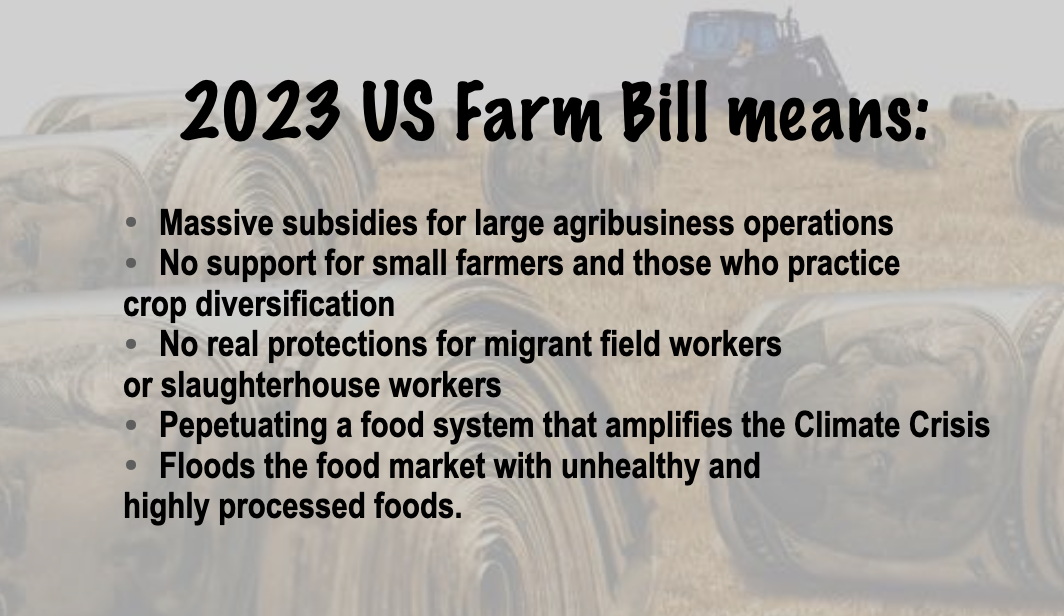
The US Farm Bill, which is the primary policy that determines how most of the food grown/raised in the US takes place.
Another excellent resource is the, “Farm Subsidy Database shows that federal farm subsidies between 1995 and 2021 totaled $478 billion. This huge amount of taxpayer money does almost nothing to help farmers reduce their greenhouse gas emissions or adapt to adverse weather conditions caused by the climate crisis,” from the Environmental Working Group. You can search to see which farms are being subsidized in you state and county. According to the Environmental Working Group, “most farm subsidies go to commodity crops, such as corn and soybeans, which are not grown to feed people, and to the largest and wealthiest farms.”
The last time the Farm Bill was decided upon was in 2018, where policy makers dictated how $428 Billion of taxpayer dollars were spent. Many of the same policy makers will determine once again how public money will be used.
This brings us to the question of what is happening in West Michigan around the US Farm Bill. A little over a week ago, MiBiz posted an article entitled, Michigan ag interests reach national stage in 2023 Farm Bill.
 In many ways, the headline conveys the overall sentiment, which is that it recognizes that Michigan is a major food commodity produce, plus Agribusiness interests will determine who benefits and who doesn’t.
The MiBiz article cites s few larger farm operations, someone from the MSU Food & Agricultural Policy department and a representative from the Michigan Farm Bureau. All of the sources cited have a vested interest in maintaining the same heavily subsidized food system that benefits the largest agribusinesses and perpetuates industrial food production that is detrimental to the top soil, contributes significantly to climate change, abuses migrant workers (in both the fields and slaughterhouses) and causes serious public health issues because of how food is processed/created in the commodity markets.
The MiBiz article also praises Senator Stabenow, who has been chair of the Senate Committee on Agriculture, Nutrition, and Forestry. However, the praise comes from those who benefit most from the farm subsidies in the Farm Bill, it doesn’t come from small farmers or community groups that are pushing for a food justice/food sovereignty model in the US. This praise of Stabenow was also misplaced in 2018, as we noted in a GRIID article 5 years ago.
The Food & Water Watch report mentioned earlier in this post, does have a section at the end that proposes some interesting policy changes around the Farm Bill. However, until the current Agribusiness system is radically transformed, the US Farm Bill will continue to prop up a food system that harms workers, destroys ecosystems and makes most of us unhealthy. We need to adopt policies and practices that are rooted in food justice and food sovereignty.
Check out the GRIID produced Food Justice Workshop slides, which we have presented on numerous occasions throughout West Michigan.

The uses and abuses of International Women’s Day in Grand Rapids: From Bread and Roses to Corporate sponsorships
 On Wednesday, March 8th, people around the world will celebrate International Women’s Day (IWD). However, there is a growing tendency to ignore the origins of IWD and merely use the day or Women’s History Month as a marketing opportunity or to acknowledge the accomplishments of women, even if they conflict with the spirit of International Women’s Day or simply promote a vague notion of identity politics.
International Women’s Day evolved out of a growing effort amongst women’s and working class groups to fight for more equality for women at the end of the 19th century and the beginning of the 20th century.
In 1908, 15,000 women marched in New York City demanding shorter work hours, better wages and the right to vote. In 1909, the Socialist Party of America designated February 28 as the first National Women’s Day, which was to be celebrated on the last Sunday of every February.
In 1910, at the Second International Conference for Working Women, there was a proposal to have an international women’s day, where women around the world would press for their demands on the same day. The proposal was not adopted until the following year and International Women’s Day (IWD) was celebrated in several countries around the world. However, something happened just one week later that would galvanize this new international movement.
On March 25, a fire began at the Triangle factory in New York City. It was common practice for factory owners to lock the workers inside until the work day ended and because of that practice 140 women, most Jewish and Italian immigrants, burned to death in that fire. The international women’s movement, labor and socialist movements mobilized around the world to mourn these women and to organize for worker and women’s rights.
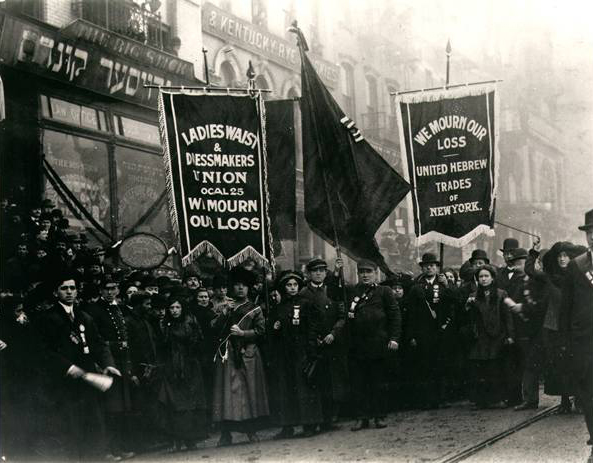 For years after the first, the Triangle factory fire became the focus of International Women’s Day and gave birth to the Bread and Roses Campaign. The Bread and Roses Campaign was begun by workers (mostly women) who went on strike at a textile factory in Lawrence, Massachusetts. This strike was organized by the Industrial Workers of the World (IWW) with the slogan, “We want Bread, but we want Roses too!” In other words, the history of International Women’s Day is rooted in the working class struggle, not in some nebulous notion of gender equality.
Unfortunately, International Women’s Day is often celebrated or acknowledged by organizations and entities that are NOT rooted in the same history and the same struggle that IWD was founded on. For instance, MLive posted an article on Tuesday about a Wednesday march and rally to commemorate International Women’s Day.
The MLive piece says that the nonprofit group SowHope is hosting the rally and march for International Women’s Day. SowHope’s approach to dealing with women’s issues, appears to be rooted in the usual non-profit world framework, which is to offer support without challenging systems of power and oppression, based on their history.
What is worse is that the only two speakers that have been identified for the rally are GVSU’s President Philomena Mantella and WGVU Public Radio personality Shelley Irwin. If SowHope was interested in honoring the history of International Women’s Day, they would be inviting women who are fighting economic, social and political justice, such as workers being exploited or women led movements, like Movimiento Cosecha GR or women who are part of labor unions fighting against exploitation.
Instead, we can see from the event, which has its own Facebook page, there are opportunities for corporate sponsorship. Corporate sponsorships are the exact opposite of what International Women’s Day has historically been all about. Then again, this is just another manifestation of West MI Nice!
As an alternative, there is an event at the corner of Fulton and Division for International Women’s Day, which is being hosted by the Freedom Road Socialist Organization, which also has their own Facebook event page.
The Grand Rapids Business Journal invited a front group for the Koch family to speak in Grand Rapids recently
Last Friday, the Grand Rapids Business Journal posted a Guest Column by David J. Bobb, who is president and CEO of the Bill of Rights Institute.
Bobb’s guest column was not particularly compelling, but it was based in part on his visit to Grand Rapids on Election Day in November 2022. The president and CEO of the Bill of Rights Institute was speaking to “business and community leaders” (none were identified) on the importance of civics education.

In the article, Bobb talked about why it is important for business owners to hire people who have what he called are “soft skills,” such as having a functioning understanding of how government works and the basic principles and values that the United States was founded on. In fact, most of the article provided information about a, “2021 report from the Association of American Colleges and Universities asked employers which education skills they highly value.”
In many ways, the column by the president and CEO of the Bill of Rights Institute seemed odd and just left me with lots of questions. Within minutes, my suspicions about the Bill of Rights Institute were confirmed. What the Guest Column in the Grand Rapids Business Journal did not reveal to readers, was the fact that the Bill of Rights Institute was founded and financed in 1999, by the Charles G. Koch Foundation, which is a Virginia based nonprofit launched by Koch Family Foundations that promotes a teaching a conservative interpretation of the Constitution in schools, according to the site SourceWatch.
Now the Guest Column from the president and CEO of the Bill of Rights Institute begins to make sense. Of course it makes sense for far right groups like the Koch Family Foundations to create a fund groups like the Bill of Rights Institute, because it provides a great cover to share a slanted view of civics and promote aspects of US history that fit a particular ideology framework.
If you look at who makes up the three member Board of Directors for the Bill of Rights Institute, you can see how how deeply involved the Koch Brothers are. The three board members are:
- Mark Humphrey, Senior Vice President of Koch Industries
- Ryan Stowers, Director of higher education programs at the Charles G. Koch Charitable Foundation
- Todd Zywicki, Professor of Law at George Mason University
It should be noted that Todd Zywicki, besides being a board member of the Bill of Rights Institute, also is involved in other far right institutions such as the Federalist Society, the Competitive Enterprise Institute, the Goldwater Institute, and the Hoover Institution.
In many ways, one could argue that the Bill of Rights Institute is an Astroturf organization. Astroturf refers to apparently grassroots-based citizen groups or coalitions that are primarily conceived, created and/or funded by corporations, industry trade associations, political interests or public relations firms.
It’s unfortunate that the Grand Rapids Business Journal was not transparent about the fact that the Koch Brothers are using the Bill of Rights Institute as front group to promote their own ideological agenda. However, we shouldn’t be surprised that the Grand Rapids Business Journal even invited the Bill of Rights Institute to present to an audience of business owners, since Capitalism and a right-leaning/conservative worldview go hand in hand.
Police collaborators and apologists: The Acton Institute provides a platform for iCI Nation to promote their agenda
I have been monitoring the Acton Institute for the Study of Religion and Liberty since the early 1990s. Most of what they talk about is a defense of Capitalism, the Judeo-Christian tradition, with a regular critique of all things that are politically left.

It is rare for the Acton Institute, their writers, or those who host their podcast, the Acton Line, to address issues or topics that are specific to Grand Rapids or West Michigan. This was not the case with their most recent Acton Line podcast for March 1st, which has the following text included as a narrative to compliment the guest on the show.
When people think of interactions between the police and the public these days, for many, the first thoughts that come to mind are of horrific incidents like the deaths of George Floyd or Brianna Taylor. Here in Grand Rapids, Michigan, where the Acton Institute is headquartered, a police officer is currently awaiting trial in the shooting death of 26-year old Patrick Lyoya.
These incidents, and the rifts they have created between members of the community and members of law enforcement, highlight some of the challenges of modern policing. How can we bridge the divide between the police, who serve and important and necessary function in our society, and the public, to whom they are ultimately responsible.
Enter iCI Nation, an organization based here in Grand Rapids that brings communities together by uniting citizens, law enforcement & community organizations to foster a healthy environment for community to build trust with law enforcement. iCI is lead by founder and executive director Jennifer Franson, who in just two years has facilitated over 100 connections with law enforcement and community building new relationships and trust. This momentum has continued to snowball as her membership has quadrupled in size and now has the FBI coming to her to ask for help building relationships with their community.
GRIID has written several article about iCI Nation in recent years, specifically because of their role as apologists for the GRPD, plus the fact that the local news media doesn’t question or challenge the role they play and the racist nature of their work. 
The interview that the iCI Nation founder had with the Acton Line host wasn’t terribly engaging. Jennifer Franson talked about how she was going through a divorce 10 years ago, and that is when she decided to get involved in support cops. Franson also said that she wanted to organize activities to say “Thank you” to the cops and other acts of appreciation.
The Acton Line interviewer also didn’t ask challenging or engaging questions. In fact, his questions were so superficial that it almost seemed that he recognized that Franson didn’t have the capacity to articulate any of the complexities about the function of policing in the US. What follows are some of the questions posed to the iCI Nation founder and her responses.
Acton Line – What are some of the activities that you do to support cops? Franson talked about hosting events at the 4 largest police departments in the county, prayer meetings, connecting people with cops, and promoting all the good that cops do in the community. Like most of Franson’s responses she did not have any real evidence to support her claims, only anecdotes.
Action Line – What are cops concerns? Franson said that Cops just want to connect with people. She also acknowledged the death of Patrick Lyoya, but used the phrase, “Officer involved shooting here in Grand Rapids,” without even mentioning Lyoya by name. She thinks that the cops get a bad rap in the news media, again without any imperial evidence. GRIID has been documenting how the local news media has been reporting on the GRPD, which is overwhelmingly positive, especially when the GRPD sends out Media Releases, where the local news media just parrots what the GRPD has to say. There was one thing she did say that was instructive. Apparently there are 35 Chiefs of Police in this area and they meet monthly to work to, “keep me blissfully ignorant of how they keep me safe,” said Franson. Franson also said that these Chiefs are already planning for how to respond to the outcome of the trial for the former cop, Christopher Schurr, who shot and killed Patrick Lyoya.

Acton Line then asked about the current sloganeering, like defunding the police. What are communities in Grand Rapids asking from cops? Franson claimed that people in the communities she has talked with (she doesn’t name specific communities) if they want to connect with cops. Franson believes that they want to connect with cops. She then went on to say that the Defund groups don’t sit down with cops, they stay at odds because they don’t want to move forward.
Acton Line – How are communities changing and how is policing changing? Franson believes that the police are much more into community engagement, that they are truly community based. She also stated that current policing efforts are more wholistic and valuing the life of everybody, even through she once again provided no evidence to support such claims. It is certainly true that the GRPD has been emphasizing more community engagement, but that is a direct response to the Movement for Black Lives, especially after the George Floyd uprisings and the GRPD shooting of Patrick Lyoya. In fact, cops always do the “we want to connect with the community” mantra when more and more of the public is questioning or challenging their functions as violence workers. Franson did say that the FBI has a “community outreach specialist,” which she met, who said they are interested in having the iCI working with them to build relationships. This is something that should concern activists and organizers who have been challenging the GRPD and the Kent County Sheriff’s Department in recent years.
Acton Line – Are we asking for too much from cops, by dealing with social and economic issues? Franson said that more staff is definitely needed. She then said that the cops play basketball with kids on the street, as if that addresses socio-economic issues. In fact, cops playing basketball is about two things. First, by playing basketball with them, cops want to normalize with marginalized kids that they too are just like them, which is of course ridiculous. The second benefit of cops playing basketball with kids is to win their trust, specifically so that they can get kids to share information, to snitch and assist cops in surveillance work.
Acton Line – What is one thing you wish from people, who have not had a positive experience of the cops, for them to see cops differently. Franson says she does ride alongs with the cops regularly and then said “real live violence is ugly. “People lie or act crazy when interacting with cops. I can’t believe how calm and respectful cops are when interacting with people who are lying or being crazy.”
Acton Line – How did Clergy on Patrol come about in Grand Rapids? Franson said that Clergy on Patrol came about because of iCI Nation, who visited a similar program in Kalamazoo, and then bringing that information back to the GRPD. She said there are 5 Pastors and 2 Rabbis who serve as Clergy on Patrol.
Acton Line – What is the biggest thing you have learned from doing this work? Franson said she is a “big faith girl, so I just keep my eyes on God. Doors keep opening, like with the FBI.”
Acton Line – For people in the community, people who are skeptical, what is one thing you want them to know and understand to change how they view cops? Franson said that she thinks that people need to know that they have a voice at the table. You have to be willing to put yourself out there in order to be at the table. People need to be moving forward and not just yelling. This last line, was of course a dig at the defund the GRPD types and those who have been in the streets in recent years either demanding greater police accountability, defunding of police budgets or calling for the abolition of policing.
What we can learn about this Acton Line interview with a police apologist and collaborator with state violence workers, is that it is consistent with the anti-Black Lives Matter stance that the Acton Institute has taken in recent years. In addition, we should see the Acton Line interview as further evidence that they have a commitment to business as usual worldview and will support any group that normalizing state repression that comes from cops. Providing the founder of the iCI Nation a platform on their podcast means that will increase the likelihood that Franson’s group will not only gain moral support from the Capitalist Class members who make up the Acton Institute, it could lead to additional funding for the work that Franson does through collaboration with cops in Kent County and the FBI.
What the end of COVID Food Assistance benefits means for millions in America and in West Michigan
As of March 1st, the emergency allotment for individuals and households enrolled in the federal Supplemental Nutrition Assistance Program, or SNAP, will end in 32 states, the District of Columbia, Guam and the U.S. Virgin Islands.

That means recipient households will see their monthly grocery allocations reduced by at least $95, according to the Center on Budget and Policy Priorities. In daily terms, that equates to trimming the roughly $9 per-person average to about $6.10. And the change comes when food prices in January increased 10% over the same month last year.
The Center on Budget and Policy Priorities also reported that the pandemic-related SNAP increase kept millions out of poverty.
The temporary benefits pushed back against hunger and hardship during COVID. A study estimated that EAs kept 4.2 million people above the poverty line in the last quarter of 2021, reducing poverty by 10 percent ― and child poverty by 14 percent ― in states with EAs at the time. The estimated reduction in poverty rates due to EAs was highest for Black and Latino people.
This data shared by the center on Budget and Policy Priorities is sobering, but it also omits the fact that millions of Americans are food insecure and that number will only increase with the reduction in SNAP benefits as of March 1st. This means that more people will have to rely on food banks and pantries in order to be able to feed themselves and their families.
On Wednesday, WOODTV8 interviewed Ken Estelle, the president and CEO of Feeding America West Michigan to get his thoughts on the reduction in SNAP benefits. Estelle said:
“People have been relying on this for the past three years. Unfortunately, we think there are going to be some folks that are surprised by this. Even going back to what it was before, food costs more. So even what they used to get may not go as far as it used to. And over the last year, 2022, the inflation impact has really hit us. And so we’ve seen a continual month-on-month increase of the number of people coming for help, I think mainly driven by the inflation element. Recently, we’ve done an analysis and we’re actually able to take $1 and make 12 meals out of $1 now. So, we’ve really been looking at how can we stretch our dollars to feed as many people as possible? We know we’re actually helping more people today than we were a year ago.”
The President and CEO of Feeding American West Michigan acknowledges that the reduction in SNAP benefits is a bad thing. However, most of what he has to say, which is centered on the increase in people relying of food pantries and the increase in food costs due to inflation – both of which are true – are rooted in a food charity model.
Estelle invites people to be involved in supporting emergency food programs and food pantries, but he says nothing about the root causes of the national food insecurity problem. The President and CEO of Feeding American West Michigan doesn’t say anything about the national food insecurity problem because he advocates a Food Charity response instead of a Food Justice response.
While I support people being able to access food pantries and other forms of food assistance, it is not a long term solution. In fact, Food Charity is a false solution, both because it doesn’t address root causes of the problem of food insecurity and because it can deceive people into thinking that volunteering at a food pantry or supporting the latest food drive is enough.
What food charity organizations need to start doing is address root causes of the problem of food insecurity and offering up more than “just donate your canned goods.” Here are a few suggestions for how groups that do Food Charity work can move in the direction of doing Food Justice work:
- It would be important for any and all groups who do food triage work to acknowledge that just providing food assistance on a regular basis does not solve the problem. I’m not saying that people shouldn’t practice mutual aid and assist people in a time of crisis. We absolutely should practice mutual aid when we can. However, it is not enough to just provide charity, we must work towards transformative justice.
- Once organizations can acknowledge that hunger is a much larger and systemic economic and racial problem, then they can, with other like-minded groups, begin to develop multi-pronged strategies to fight for economic and racial justice.
- Food Charity groups should end partnerships with corporations and families which are part of the local power structure, which supports candidates who pass policies that create more poverty.
- Food Charity groups should participate in a Living Wage campaign at the city/county level. These groups should call for people to make a Living Wage. In Grand Rapids, the average cost of rent in this market is such that people would have to earn at least $20.02 per hour if they were working full time. Therefore, it seems that Food Charity groups should be advocating that people earn $25 an hour, which would not only allow people to afford the food they need to feed themselves and their families, it would force us to have a much more substantial conversation about economic policy and the larger wealth gap in this community.
- Wealth re-distribution in the form of reparations. Those families, communities and corporations which have exploited workers and communities for decades, should be required to pay back the communities, families and individuals they have exploited. This is especially the case in the African American community, which has been exploited for centuries and where reparations should begin. Food Charity organizations should call for reparations.
- Food Charity organizations need to adopt clear racial justice policies that recognize historical racism and how it currently is manifested in West Michigan. For instance, how is it that the people who pick most of our food in West Michigan, migrant farmworkers, have a high rate of poverty?

If Food Charity groups began to move towards a Food Justice model and then take these kinds of stances collectively, they would be a formidable force that could create the necessary changes needed to address longterm solutions to food insecurity. However, until these things happen, thousands of families in West Michigan, particularly in BIPOC communities, will continue to experience food insecurity. If Food Charity groups are unwilling to move in the Food Justice direction, then we have to pressure them into doing so, plus we need to create our own models for how to practice and promote Food Justice and Food Sovereignty.
 Grand Rapids Institute for Information Democracy