A brief history of Pride in Grand Rapids
Pride Month is once again upon us and I thought it might be useful to share the history about the fight to celebrate Pride in Grand Rapids, primarily through the words of those who did the work to make Pride celebrations possible in this city.
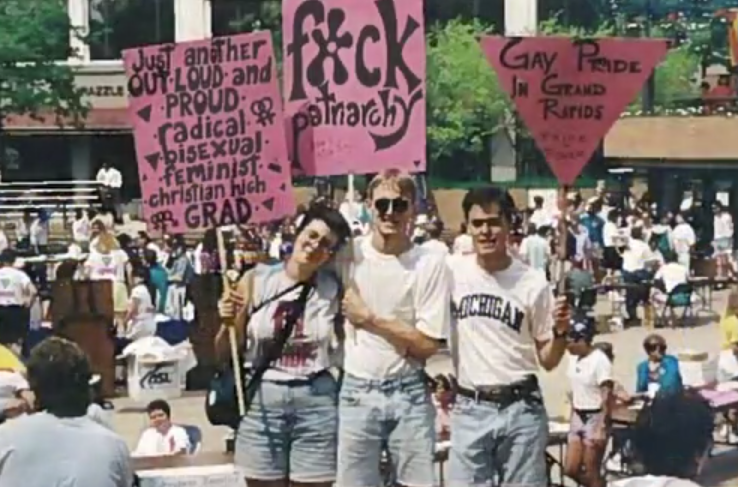
The Lesbian and Gay Community Network of Western Michigan, along with Dignity and Aradia organized the first ever Pride Celebration in Grand Rapids in June of 1988.
The event featured speakers, poetry, music and numerous Lesbian and Gay organizations, which were tabling at the event. The Pride Celebration was held at the old Monroe Amphitheater in downtown Grand Rapids.
In this video you will hear Bryan Ribbons read a proclamation, since the Mayor at that time, Gerry Helmholt, refused to recognize and support the first ever Pride Celebration.
The video also documents that there were a small group of religious extremists, which came to the event to harass and intimidate those who came to celebrate with pride.
In 1989, The Network tried again to get a Mayoral Proclamation and again Helmholt denied such a request. Members of The Network attended a City Commission meeting on June 6, 1989 asking for the 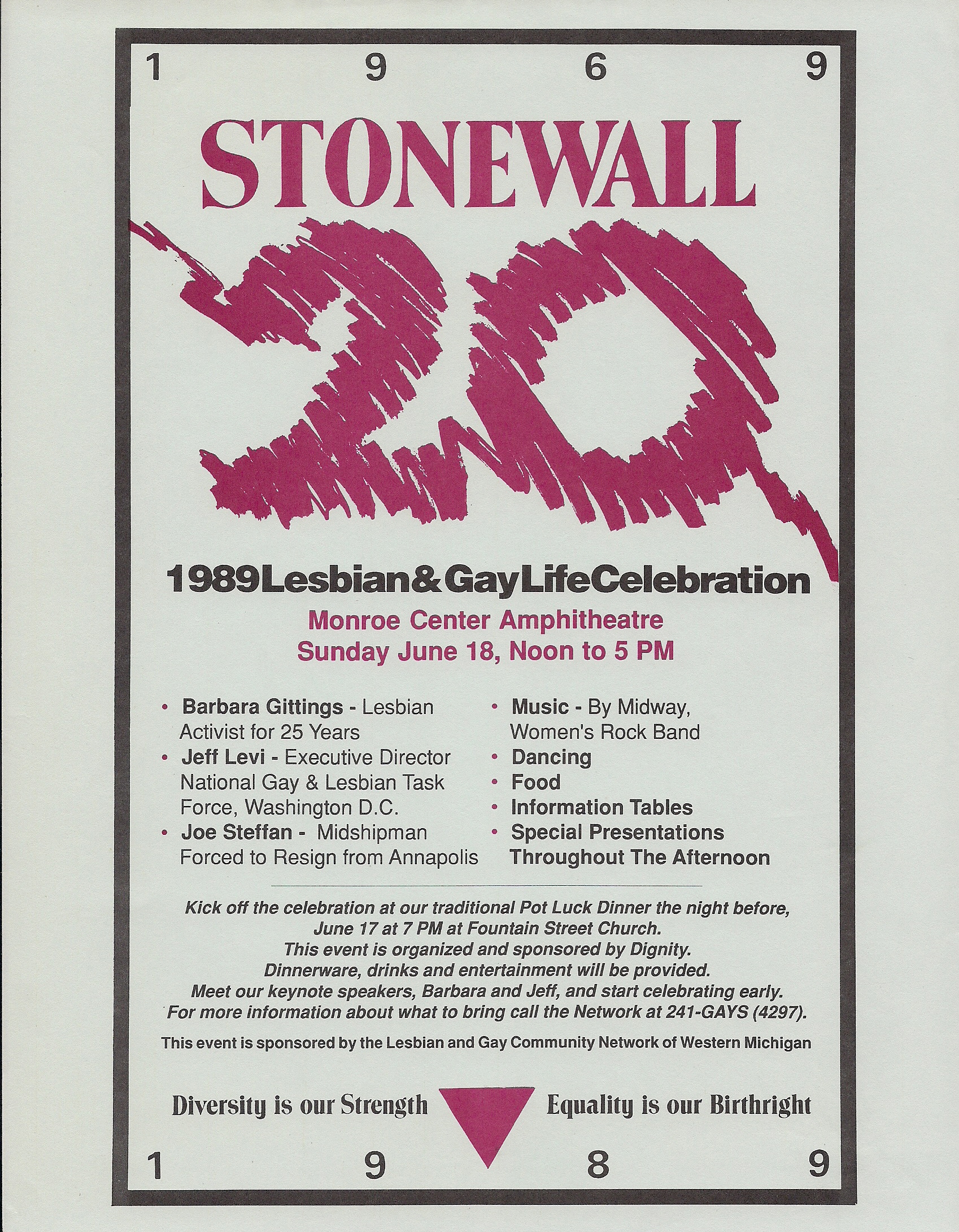 proclamation. The Network Newsletter documented that event and cited several members who spoke during the commission meeting.
Network members reminded the Mayor that this was the then 20th Anniversary of the Stonewall uprising and that Gay and Lesbians deserved equal rights and recognition. Rev. Bruce Roller responded to Helmholt’s denial for a Mayor Proclamation by saying, “I’m real angry and real tired of having our God’s name used to oppress lesbians and gays.”
In that same issue of the Network News the group pointed out that Mayor Helmholt had granted at least 119 proclamations since the group’s first request in 1988. Among the groups/events that Helmholt wrote proclamations for were: Michigan Beverage News Week, Family Sexuality Education Month, Polish Heritage Month, National Roofing Week and Bozo Show Day.
Here is a WOOD TV 8 interview with Mayor Helmholt in 1988 who stated that he denied proclamations to other groups besides Gays and Lesbians, namely Nazis.
In 1990, the Grand Rapids Pride Celebration invited AIDS Quilt founder Cleve Jones to speak about his work to educate the public about HIV/AIDS.
Jones, who was a close friend of the late Harvey Milk, spoke with Bryan Ribbens about his experience of being in Grand Rapids in the video below.
Another example is this powerful video of a Network event in 1992 billed as a discussion about the lessons learned from Stonewall. In this video (below), Holly VanScoy and Dennis Komack facilitate a discussion, which covers a whole range of topics, such as the Lesbian influence in the local movement, how Grand Rapids responded to the AIDS crisis, dealing with the reactionary right in West Michigan and the evolution of Pride events.
At one point in the discussion, one of the participants makes the point about “necessary radical thought.” This comment stands out in many ways, because what the person was saying is that it is absolutely necessary that we not only continue to reflect on where we came from as a community, but that we continue to challenge our understanding of who we are and where we are going. Movements for social change are resilient to the degree that they can embrace the idea of necessary radical thought.
Here is this powerful video from 1992 that should inspire all of us to continue to reflect and challenge what it means to be liberated in a world that either despises us or wants to co-opt us.
Eventually, the Pride celebration became too big for the Monroe Amphitheater and moved to Calder Plaza, then to Riverside Park, eventually making its way back to Calder Plaza. Grand Rapids Pride has indeed evolved over the years, but there always seems to be members of the Religious Right who want to disrupt the celebration and engage in spiritual violence.
Lastly, for those who have not seen our documentary on the history of the LGBTQ community inn Grand Rapids, you can view it here below and share it with your communities. #thefirstpridewasariot
Last week MLive posted an article with the headline, Sales tax fund would help Michigan police fight violent crime. The article states, “Democrats in the legislature want to divert millions of dollars of sales tax revenue to fight violent crime in Michigan’s worst-affected cities,” even though there are no sources cited in the article to support the increase in violent crime.

As for the legislation itself, the MLive article states:
House Bills 4605 and 4606 would create a “public safety and violence prevention fund” to give monthly payments to municipalities proportional to their share of violent crime in the state.
These two bills proposed by Michigan Democrats primarily focus on how the sales tax funding would occur, but nothing about violence prevention or public safety is included, since there is bipartisan belief that police actually prevent crime and stop violence. The problem with the belief that more funding for cops leads to less violence is; 1) more funding for cops means less funding for housing, education, health care and other basic necessities for communities; and 2) research has shown that more policing does not lead to safer communities. See the excellent report by the group Interrupting Criminalization entitled, Cops Don’t Stop Violence: Combating narratives used to defend police instead of defunding them.
The MLive article is just another example of how commercial news outlets don’t question or challenge systemic issues and how to combat them. In addition, if one reads the MLive story and then reads the Media Release from the Michigan House Democrats, there isn’t much of a difference in what was reported and what the Democrats wanted the news to know. This type of journalism, which is called stenography journalism, not only is lazy journalism, it does the public a tremendous disservice by not being more combative of those in power.
Lastly, this decision by Michigan Democrats to propose legislation to get more funding for cops in nothing knew, since the Democratic Party has for decades been equally committed to funding the police as their GOP counterparts have been, as we have shown in previous GRIID articles.
3rd Anniversary of the Uprising in Grand Rapids – Violence against property vs Structural Violence
It has been three years since thousands of people rose up against police violence in Grand Rapids, which was just one of the hundreds of protests that took place across the globe after a Minneapolis cop killed George Floyd.
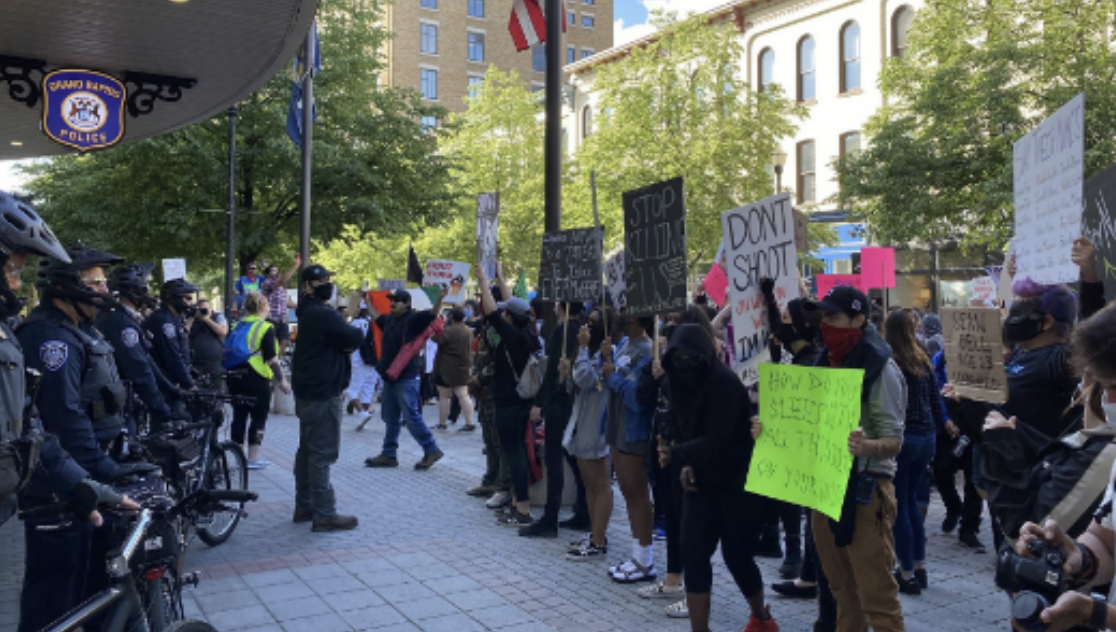
From the very beginning, Grand Rapids City officials sought to control the narrative about what happened on May 30th, 2020. Those with political power sought to demonize those who engaged in property destruction and differentiate peaceful protesters from violent protestors.
In addition, for the first time since the 1967 riot, Grand Rapids City officials called for a curfew and brought in the Michigan National Guard to protect property in the downtown area. In addition, the Grand Rapids-based commercial news media also mimicked the government narrative, elevating government, police and business voices over those who took to the streets during the uprising. On top of that, members of the Grand Rapids Power Structure also used the May 30th uprising as an opportunity to engage in their own form of propaganda.

In a Grand Rapids Business Journal article on June 1st, Sam Cummings, one of the partners with CWD, provided his reaction to Saturday’s uprising in Grand Rapids. The article was entitled, CWD Real Estate sees silver lining in aftermath of violent protests, with Cummings stating:
Sam Cummings, managing partner with CWD, said he was “mad as hell” Saturday night and Sunday morning, but witnessing the community outreach and cleanup afterward restored his faith in West Michigan.
“That is not who we are, and that was confirmed by talking to some folks on the police force,” Cummings said. “Who we were was (Sunday).”
“The peaceful gatherings are a justified, honorable and rightful thing to have occur,” Cummings said. “Those things should be protected, but when they escalate to damaging small businesses — we got guys who have had their entire inventory wiped out — when they escalate to damaging other people’s property or their employees, it’s not acceptable.”
GRIID wrote a response to the bullshit that oozed from the mouth of Cummings in an article entitled, One of the biggest looters in Grand Rapids has a problem with the recent protests.
Over the past three years, these kinds of narratives have dominated any and all discussion about the 2020 uprising in Grand Rapids, always making sure that the attention centers on the issue of property destruction as opposed to the structural violence that exists in Grand Rapids, particularly for Black, Indigenous and other commentates of color. Even Grand Rapids Police Chief Eric Winstrom, even though he did not get hired until 2022, has made it a point to frame the 2020 uprising as a violent protest, such as he did in an interview this part March.

Property Destruction vs the daily forms of structural violence in Grand Rapids
Before we talk about Structural Violence in Grand Rapids, it is important for us to establish a working definition of what Structural Violence is. One of the best definitions I have come across is from an online site called Structural Violence. Here is their definition:
“Structural violence is one way of describing social arrangements that put individuals and populations in harm’s way… The arrangements are structural because they are embedded in the political and economic organization of our social world; they are violent because they cause injury to people … neither culture nor pure individual will is at fault; rather, historically given (and often economically driven) processes and forces conspire to constrain individual agency. Structural violence is visited upon all those whose social status denies them access to the fruits of scientific and social progress.”
Now that we have a working definition of structural violence, lets look at ways in which structural violence manifests in Grand Rapids, especially when, historically given (and often economically driven) processes and forces conspire to constrain individual agency.
- There are a handful of billionaires in GR, along with one quarter of the population living in poverty. One example is from an article we wrote pointing out how the wealth of Hank and Doug Meijer grew by $6.7 Billion in the first 18 months of the pandemic, while thousands in Grand Rapids became even more impoverished.
- There are thousands of people who don’t make a living wage and can’t afford the cost of rent in most neighborhoods. We point this form of structural violence in an article entitled, The un-affordability of housing in Grand Rapids.
- Thousands of families are food insecure in Grand Rapids and have little or no health insurance. The structural violence of food insecurity is stark in Grand Rapids and is often perpetuated by food charity groups that do not address the root causes of hunger and food insecurity.
- There are countless families who have to decide on paying rent each month or paying their utilities, transportation or health care costs. This kind of structural violence is one of the more insidious forms of violence, where people are forced to make these kinds of difficult decisions.
- People who still live in places with lead-based paint or lead in their drinking water, is also a manifestation of structural violence.
- People who can’t afford to own a car and who don’t have a bus route near their place of residence is a form of structural violence, since limited mobility options are by design.
- People who are forced to live near the City owned incinerator, a toxic waste site or other areas that disproportionate have more pollution is form of structural violence, often called environmental racism.
- People who can’t find work or a place to live because of a past criminal record. When people are marginalized because of criminal history, they are not afforded a second chance and end up in a cycle of structural violence.
- People who live in neighborhoods that are disproportionately policed by the GRPD. As Alex Vitale, author of The End of Policing makes clear, “The origins and function of the police are intimately tied to the management of inequalities of race and class. The suppression of workers and the tight surveillance and micromanagement of race and class. The suppression of workers and the tight surveillance and micromanagement of black and brown lives have always been at the center of policing.”
- Black, Brown, Indigenous and other communities of color that face structural racism on a daily basis is a manifestation of structural violence.
Ok, so here are just 10 ways in which Structural Violence exists in Grand Rapids. At this point we should ask ourselves, if Grand Rapids City officials really want to reduce violence, and why is the GRPD not policing or arresting employers who don’t pay a living wage, landlords who exploit tenants, businesses that pollute the water, air and soil, those who control a food system which keeps people malnourished and sick, billionaires for being, well billionaires, and politicians who vote on policy that benefits the rich and punishes working people, especially BIPOC people?
Aren’t all of the things I have listed an urgent, daily form of violence that plagues our communities? Why is the GRPD not urgently trying to figure out ways to stop these forms of violence? Two reasons. First, because the GRPD, which is part of the system of power and the enforcement mechanism of state violence, doesn’t care about Structural Violence, they only want to respond to street level violence, because it disrupts business as usual. Second, the GRPD will not stop structural violence because it is by design. Think about it. Every time workers go on strike, the cops are there to protect the company or corporation. Every time there is a protest against landlords or property management companies, the cops are always there to protect landlords and property management companies. Every time there is protest against an oil pipeline that will run through Indigenous land, the cops are always there to protect the oil companies. Every time there is a protest against corporates that knowingly pollute, the cops are there to protect the corporations from the public. Cops don’t give a shit about the every day violence that is structural, because that is not their function within the system of power they operate in. We should never expect this dynamic to change, which is exactly why the GRPD should be defunded and abolished. #Justice4Patrick
Additional Sources:
The George Floyd Uprising, edited by the Vortex Group
No More Police: A Case for Abolition, by Mariame Kaba and Andrea Ritchie
In Defense of Looting: A Riotous History of Uncivil Action, by Vicky Osterweil
After Black Lives Matter, by Cedric Johnson
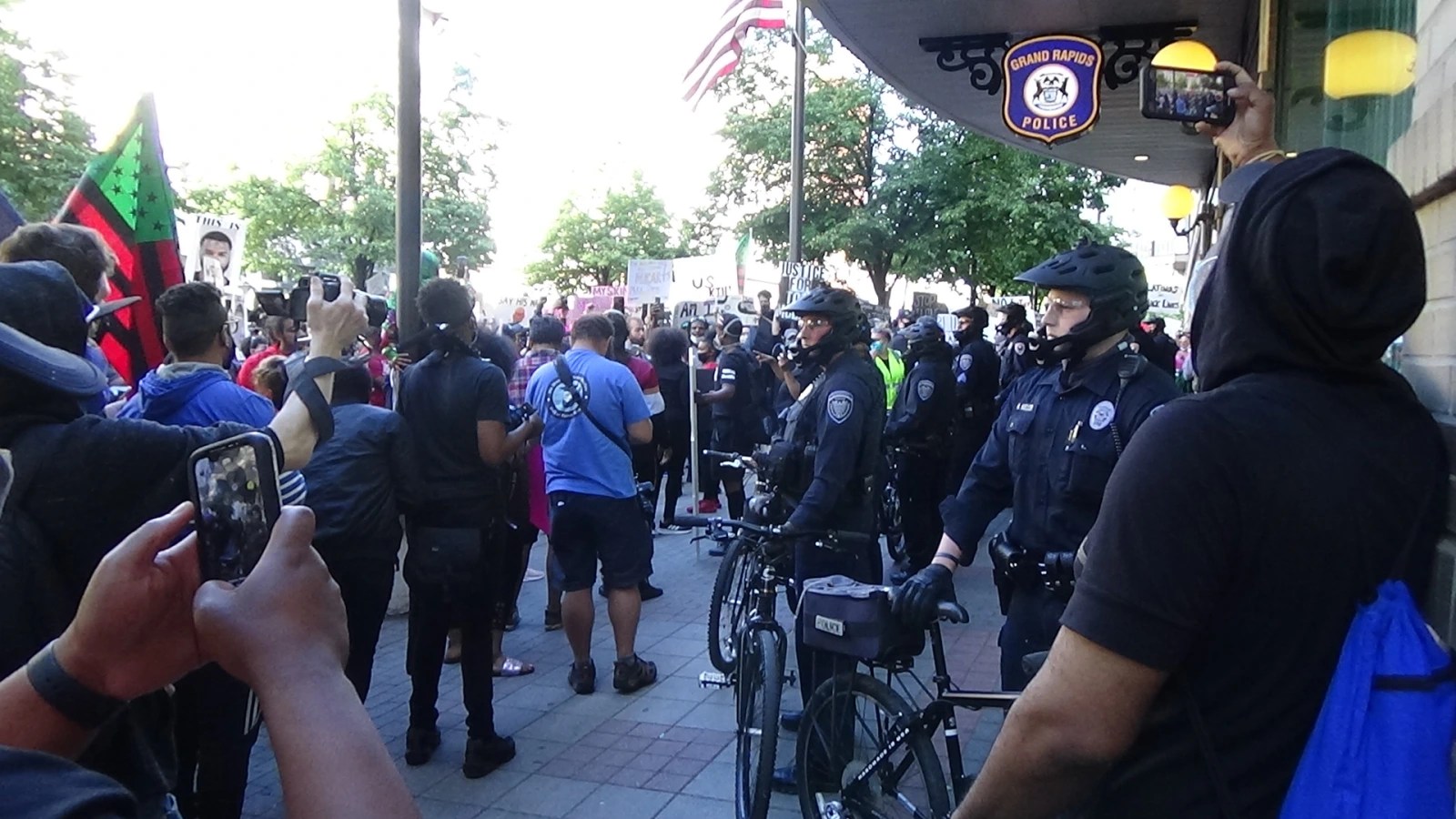
Another video of GRPD Chief Winstrom dismissing people who challenge policing in Grand Rapids
A video interview that MLive did with Grand Rapids Police Chief Eric Winstrom on March 7th of this year, has been circulating on social media quite a bit during the past week. This is primarily because activists who have been critical of the GRPD have shared it on various social media platforms.
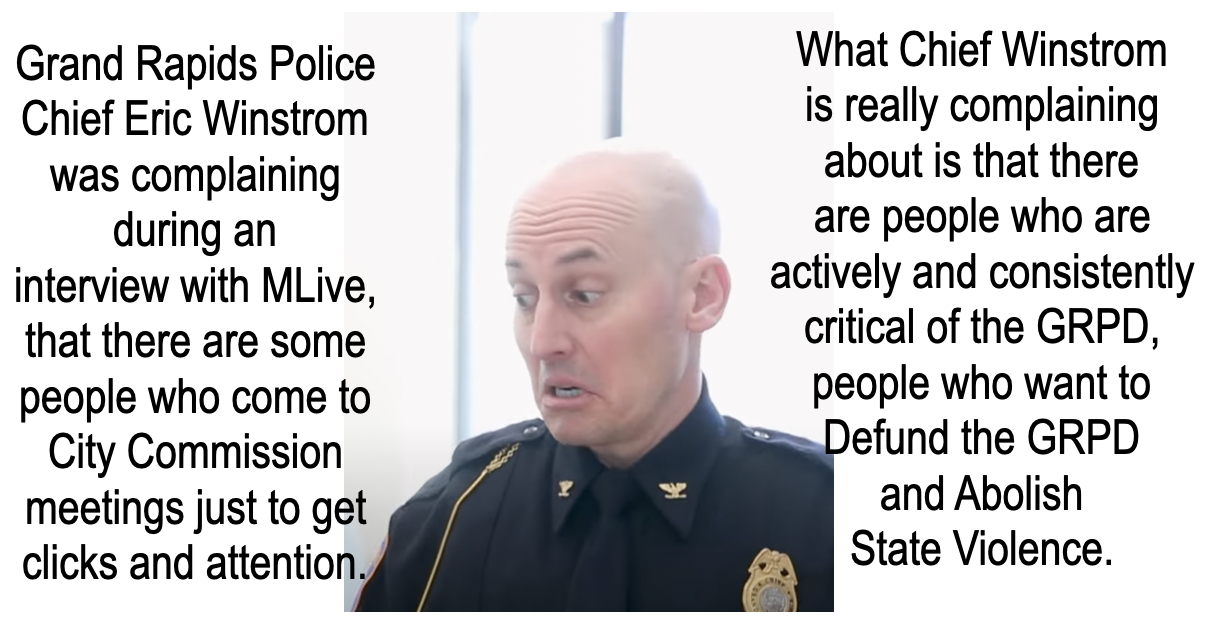
The 2 minutes and 11 second video that MLive posted on March 7th, simply features Chief Winstrom talking about how there are loud people who come to City Commission meetings just to get attention. Winstrom claims that people are at City Commission meetings just to insult Grand Rapids City officials, which is just not the case. Sure, some people might be a bit snarky, but the people who have been coming to City Commission meetings are there because they have an important critique about policing in Grand Rapids and because they have a deep commitment to issues like racial equality and housing justice.
Chief Winstrom goes on to say that he asks those who challenge Grand Rapids City policies, particularly how the GRPD function, if they want to talk. Winstrom says they don’t want to talk they just want to get on TV and that that is their end goal.
In fact, the rest of the video Winstrom essentially wants to convince those who watch this unedited, unfiltered video from MLive, that there is a small minority of people who are unreasonable, just want to get more social media clicks and have no policy suggestions. Clearly Chief Winstrom wants to marginalize these activists who have been calling for the Defunding of the GRPD since June of 2020, just weeks after the uprising in Grand Rapids. But the fact that he says that “these people” have no policy suggestions is ridiculous. Here are just a few things activists have been saying since June of 2020:
- Calling for a reduction of the GRPD Budget to the 33% of the City’s Budget, as was adopted in the 1995 Grand Rapids City Charter Change.
- Once the GRPD budget is reduced it should be redirected to issues like housing, health care, education, particularly in communities most impacted by policing, specifically Black and Latinx communities, which was presented in April of 2021.
- Activists demanded that Federal Funds that came to Kent County NOT be spent on the ShotSpotter technology for the GRPD, a campaign that they won.
- Activists have denounced the use of the GRPD to harass, intimidate and clear out unhoused encampments, like the encampment that the GRPD shut down at the Heartside Park.
- Activists have demanded that the City of Grand Rapids stop targeting BIPOC organizers who have been publicly challenging the function of the GRPD in recent years, specifically after Patrick Lyoya was murdered by a GRPD cop, a demand that even a group of local clergy has endorsed.
- There have also been numerous policy demands made by activists since the GRPD murdered Patrick Lyoya in April of 2022, like Kent County Prosecutor Chris Becker should recuse himself from prosecuting the former cop who murdered Patrick Lyoya, since Becker has received campaign contributions from GRPD police union.
Lastly, it is important to note that the demand to Defund the GRPD is also part of a larger, more longterm goal of police abolition, which has been a clear policy demand that the Movement for Black Lives have been calling for since they produced their Defund the Police/Fund our Communities Toolkit. Chief Winstrom fails to point out these facts, since doing so would undermine his efforts to marginalize those who want to hold him and the GRPD accountable.
On Tuesday, the Grand Rapids City Commission adopted the 2024 City Budget, which according to their 2024 Budget document is a total of $634,553,651. To access budget information, go to this link, which provides the entire budget and a Resident’s Guide to the Budget, which is a much shorter document.

Interestingly enough, the headline that MLive posted on the 2024 City Budget reads, Affordable housing a priority with $644M Grand Rapids budget approval. After reading the headline I quickly read through the article to see how much affordable housing was a priority. The MLive article states:
One focus area receiving additional money is the Affordable Housing Fund, which helps fund vetted affordable housing developments and homelessness prevention programs in the city.
Roughly $5 million was allocated to the fund for the next fiscal year, which will boost the grand total to about $11.5 million.
This means that $5 million is being allocated for affordable housing in the 2024 Grand Rapids City Budget, which is the only number that is worth noting regarding the priorities of the 2024 Budget. If one thinks about what $5 Million means in regards to the $644 Million City Budget, then affordable housing is 0.78% of the total 2024 City Budget. Now, I’m not a math genius, but it seems to me that 0.78% of the City’s budget is hardly a priority.
Looking at this graph below which is from the City’s 2024 Resident’s Guide to the Budget, you can see which categories are the real priorities, like policing.

GRIID pointed out the issue of priorities in an article we posted on May 15th, where we stated:
“During the May 9th Grand Rapids Committee of the Whole meeting, there were numerous 2024 budget items that were excepted without question, all of which centered around business development or business districts. Here is the breakdown for these 2024 budget items, which you can read in detail at this link. Number 7 on the Agenda for the May 9th Committee of the Whole meeting says:
Overview of FY2024 budgets for boards and authorities administered by the Economic Development Department and Downtown Grand Rapids, Inc. with appropriation requests totaling $45,375,682.”
This means that the $45 Million is going to business districts, for improvements that will benefit the Business Community, along with continuing to emphasize making Grand Rapids a “destination place”, which means they want tourist dollars. Again, compared to only $5 Million for affordable housing, the business districts are significantly more of a priority than the intent to provide safe and quality housing for people who do not make a livable wage.
Lastly, it is worth noting that City Manager Mark Washington was quoted in the MLive article stating, “There’s often more challenges than there is funding. Those are tough choices we have to make and we continue to evaluate both resources as well as issues. I’m looking forward to the continued implementation of the budget.” Like a true politician, Washington laments the lack of funding, but the reality is that it’s not about how much money the City of Grand Rapids uses, it is always about priorities. In the 2024 City Budget, the City of Grand Rapids prioritizes funding for cops and businesses over affordable housing.
GRIID Interview with Rita Vogel: Proposing a Malcolm X Day in Mason, Michigan, pushback and Institutional Racism
On Saturday, GRIID conducted an interview with Mason City Council member, Rita Vogel. In February, Rita proposed that the City of Mason adopt a Malcolm X Day of Observation.

Malcolm X spent two years in Mason, Michigan, after his father was murdered and his mother was send to the Kalamazoo State Hospital. After Malcolm’s father was murdered, his mother struggled with not only making ends meet to support Malcolm and his siblings, but also the trauma of having her husband murdered by White Supremacists. Malcolm and his siblings were place in white family homes and Malcolm ended up with being sent to a white family living in Mason, Michigan.
The day that Rita Vogel proposed that the City of Mason adopt a Malcolm X Day of Observation, it was voted down, with a 5 – 2 vote. Since then, there has been significant push back against City Council member Rita Vogel, from fellow city officials and from other white people in the city that object to honoring the legacy of Malcolm X, which we discuss in the interview.
Southpaws Radio Show had been speaking with Rita Vogel, in order to set up an interview with them. The radio show had found a location to host the interview and Press Conference, which then canceled. Southpaws then found a church in Mason that was willing to host the show with Rita, but then backed out of their offer after there was pressure from political forces in the City of Mason. Finally, a person who had a private recording studio in a town adjacent to Mason, offered Southpaws Radio Show an opportunity to use their space and to record the show.
The interview below was just one of the interviews conducted by Southpaws Radio Show, even through GRIID did the interview with Rita, they conducted an additional interview with a former Mason Public School teacher who was pressured by the school administration to not use Black Lives Matter resources in their classroom. You can listen to that interview, along with the interview with Rita Vogel by going to the Facebook page of Southpaws.
Here is the 25 minutes interview that GRIID conducted with Mason City Council member Rita Vogel.
Editor’s Note: I grew up in Central Pennsylvania and moved to Michigan the exact same day that the Three Mile Island nuclear disaster happened. The public health consequences and environmental contamination of that disaster has had lasting implications for people and eco-systems in Central Pennsylvania.
On Monday, MLive ran an article entitled, Granholm ‘hopeful’ about $1B in federal loans to restart Palisades nuclear plant.
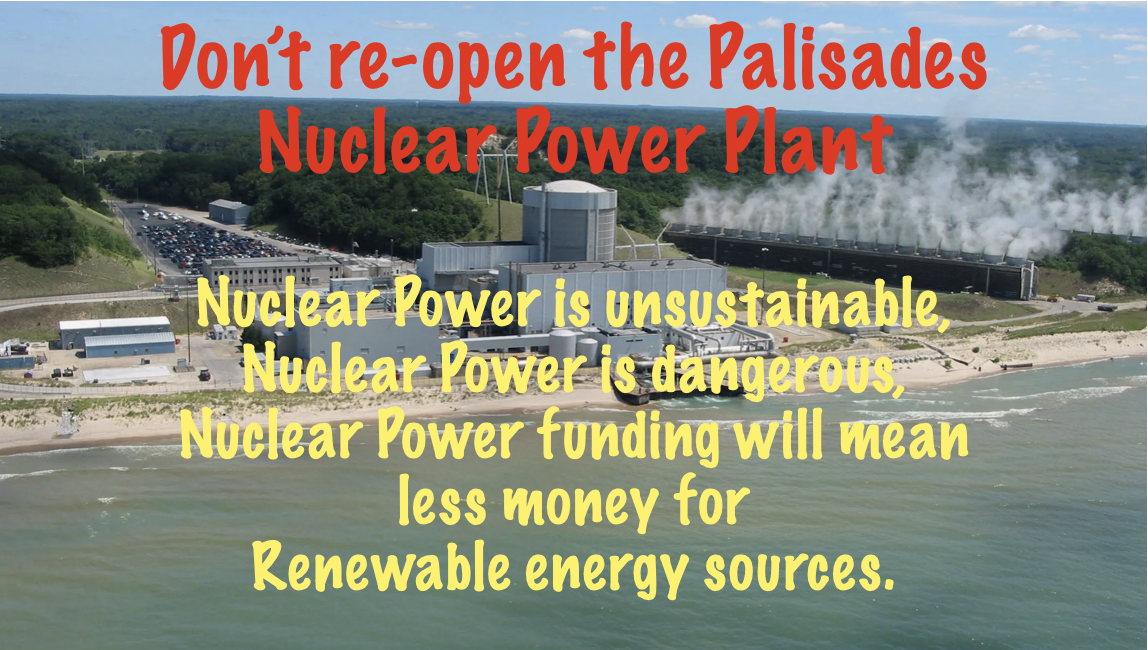
The article, primarily provides perspectives on why funding the re-opening of the Palisades nuclear plant would be a good thing. There are a total of five different people who are cited in the article, with the first four being people who are supportive of nuclear power, including U.S. Energy Secretary Jennifer Granholm; Nick Culp, a spokesperson for Holtec International, which owns the Palisades plant; Matt Helm, spokesperson for the Michigan Public Service Commission; and Brian Wheeler, a spokesperson for Consumer’s Energy.
The fifth voice to be cited in the article, which was the only critical voice on nuclear power, was Kevin Kamps, radioactive waste specialist for a group called Beyond Nuclear. The Beyond Nuclear perspective was only provided at the end of the article, with an emphasis on nuclear waste, even though there are numerous reasons to oppose nuclear power. For example, GreenPeace provides 6 main arguments against the use of Nuclear power. There is also an excellent article from Beyond Nuclear, which appeared on the site Truthout, which not only refers to the unsustainable nature of nuclear power, but the author makes it clear that even the progressive wing of the Democratic Party is pushing nuclear power, stating:
Embracing or remaining agnostic on nuclear power may also delay the transition to renewables, as running these power plants requires subsidies, starving renewables of funding. There are now even efforts to include nuclear power in state Renewable Energy Portfolios — designed to increase a state’s percentage of electricity generation from renewable energy sources — which will divert available funds away from renewables and to a financially failing industry that is far from “renewable.” Renewables will reduce more carbon emissions faster and for less cost than other energy choices, especially nuclear. Propping up unreliable, financially failing nuclear power plants impedes progress on climate change and is counter-productive to the goals of the GND (Green New Deal).
So why have I not seen any pushback from Climate groups or other Environmental non-profits with this new announcement from Energy Secretary Granholm? I looked at all the major environmental organizations across the state and could find nothing on the plans by the Biden Administration to provide $1 Billion for the Palisades Nuclear Power Plant. Of course, this should not comes as a surprise, since most of these same statewide environmental groups praised Biden’s nomination of Granholm to be the Energy Secretary. GRIID was critical of this choice back in December of 2020, where we provided reasons why Granholm did not have a great track record on major ecological issues while Governor of Michigan. We wrote:
- As Governor, Granholm worked with the Obama administration on the bailout of the auto industry. This led to forcing auto workers to accept further cuts to benefits and wages, but it also meant that the fossil fuel-dependent auto industry would get public money to continue to produce gas guzzling vehicles, thus normalizing fossil fuel consumption.
- Granholm was the Governor in Michigan during the Enbridge Kalamazoo River oil crimes. Granholm was critical of the clean up efforts by Granholm, but there was NO call by the Granholm administration to shut down the Enbridge Line 5 in Michigan. Not calling for a shut down of Line 5 after the disastrous oil crime in the Kalamazoo River basin should give us all reason to not blindly celebrate the Biden nomination of Granholm.
- While some eco-groups are claiming that Granholm opposed the Keystone XL an the Dakota Access pipelines, I am unaware of her actual participation in resisting these pipelines and actively supporting the indigenous-led resistance that continues to this day.
We should also push back against the argument that closing nuclear power plants would necessarily mean bringing on more fossil fuels. For example, New York State is on target to meet its 100 percent zero carbon by 2040 climate goals, despite closing its Indian Point 2 and 3 reactors in 2020 and 2021. This is due to political foresight and planning which saw New York enact “ambitious climate and clean energy legislation” in 2019, which will achieve these goals regardless of a nuclear shutdown, according to the Natural Resources Defense Council.
Senator Tommy Tuberville has been in the news in the past week, for comments he made about White Nationalists in the US Military.
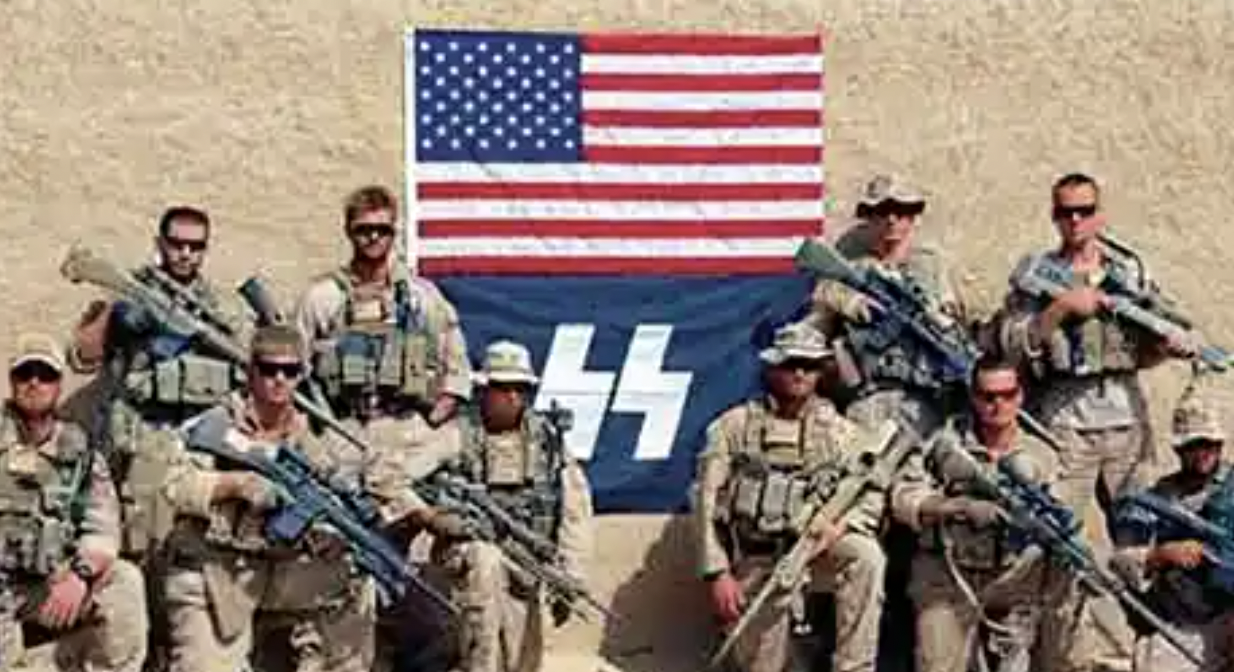
In an interview that aired on NPR member station WBHM in Alabama, here is the exchange between Senator Tuberville and Richard Banks, who is with WBHM.
SEN. TOMMY TUBERVILLE: We are losing in the military so fast our readiness in terms of recruitment. And why? I’ll tell you why: because the Democrats are attacking our military, saying, “We need to get out the white extremists, the white nationalists, people that don’t — don’t believe in our agenda, as the Joe Biden agenda.” They’re destroying it.
RICHARD BANKS: You mentioned the Biden administration trying to prevent white nationalists from being in the military. Do you believe they should allow white nationalists in the military?
SEN. TOMMY TUBERVILLE: Well, they call them that. I call them Americans.
Tuberville, you might recall, made another outlandish comment just after he was elected in November of 2020, when he said: “I tell people, my Dad fought 76 years ago in Europe to free Europe of Socialism.” Tuberville made this comment during his acceptance speech, when he won the Senatorial seat in Alabama. At the time, GRIID wrote about Tuberville’s lack of understanding about history, but also that he received substantial support from the DeVos family during his 2020 election bid. Here is part of what we wrote:
The DeVos cartel contributed nearly $1 million to the Republican Senate Leadership Fund, which contributed money to several key GOP Senate candidates, like Tommy Tuberville in Alabama. Tuberville, the former Auburn football coach, also received $14,000 in campaign contributions from individual members of the DeVos cartel.
A distorted view of US Military History
Now, it is important to examine the comments of Senator Tuberville, specifically about White Nationalists in the US Military. According to a 2022 article in The Guardian: One in five applicants to the white supremacist group Patriot Front claimed to hold current or former ties to the US military, according to leaked documents published and reviewed by the Southern Poverty Law Center and alternative media collective Unicorn Riot.
White Nationalists groups in the US have been know to join the US military as a way to recruit people to their cause and to promote White Supremacy. Hell, even an October 2020 report from the Pentagon acknowledges that White Nationals and White Supremacists have infiltrated the US Military. According to one source on the Pentagon’s report:
The Pentagon report said U.S. military personnel and veterans are “highly prized” recruits for supremacist groups, and leaders of those groups try to join the military themselves and get those already in their groups to enlist. Their goal is to obtain weapons and skills and to try to borrow the military’s bravado and cachet, the authors suggested.
Therefore, Tuberville’s comments above are either a reflection of his failure to acknowledge even the Pentagon’s assertion about White Nationalists or the Senator from Alabama embraces White Nationalism and White Supremacy. My guess is that it is a bit of both.
The US Military and White Supremacy
However, I have a fundamental problem with how this issue is being discussed. Yes, it seems clear that White Nationalists are encouraging their members to join the US military, to learn skills, and to recruit new members. But, if we think about White Nationalism and White Supremacy as systems and not as what individuals embrace, then we might have a different understanding of what the function of the US Military is.
Long time educator and activist, Elizabeth Martinez, who has been part of the Challenging White Supremacy Workshops over the years, provides us with this definition of White Supremacy.

With this definition, I would argue that the US Military, since it was founded, has been about the business of oppressing and exploiting other nations, beginning with Native Nations, for the purpose of defending a system of wealth, power and privilege.
Look at the excellent chronological list of US military interventions that Professor Zoltan Grossman has put together, then tell me that these interventions overwhelmingly meet the definition of White Supremacy from Elizabeth Martinez.
The US Military has always been about expanding US territory, expanding access to resources for US-based Capitalists and in most cases intervening in non-White dominated countries. While I agree it is important to discuss and investigate White Nationalist infiltration of the US Military, we need to have an honest conversation about how the US Military has been used as a mechanism to conquer and amass wealth by those who benefit from a system of White Supremacy.
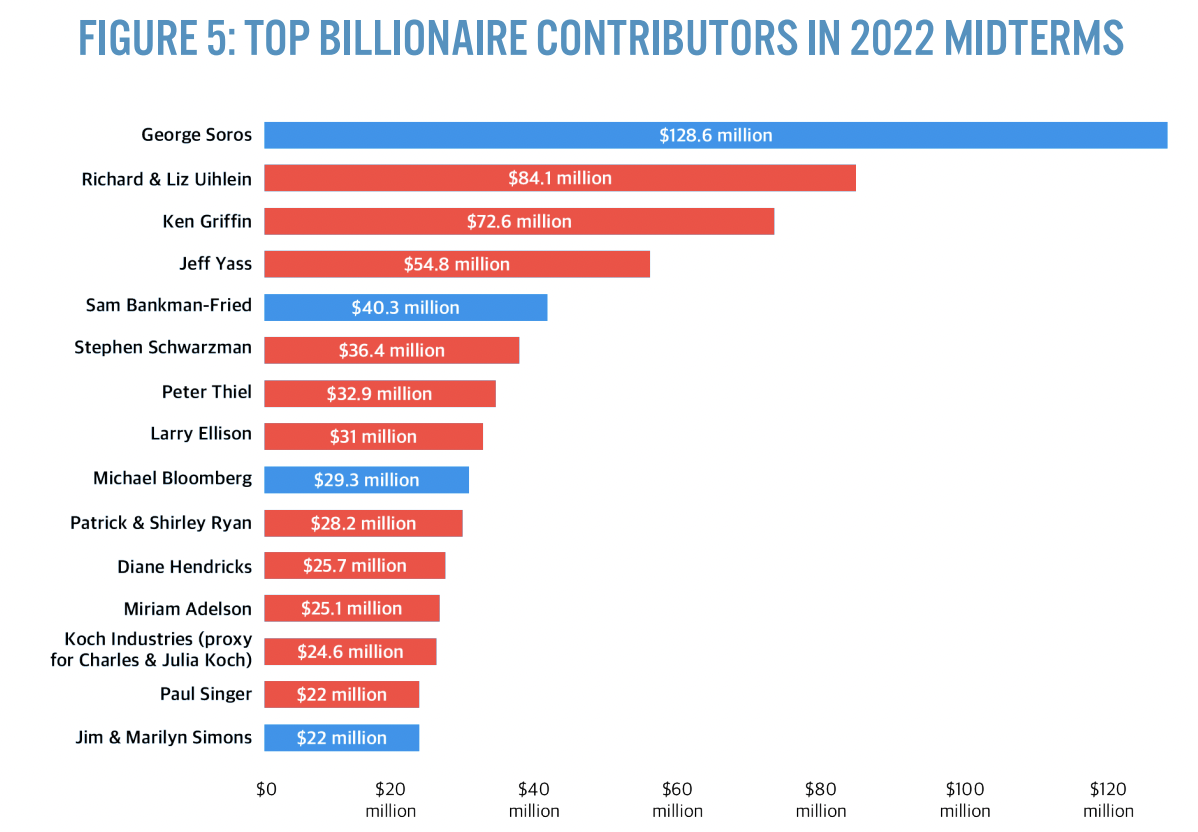
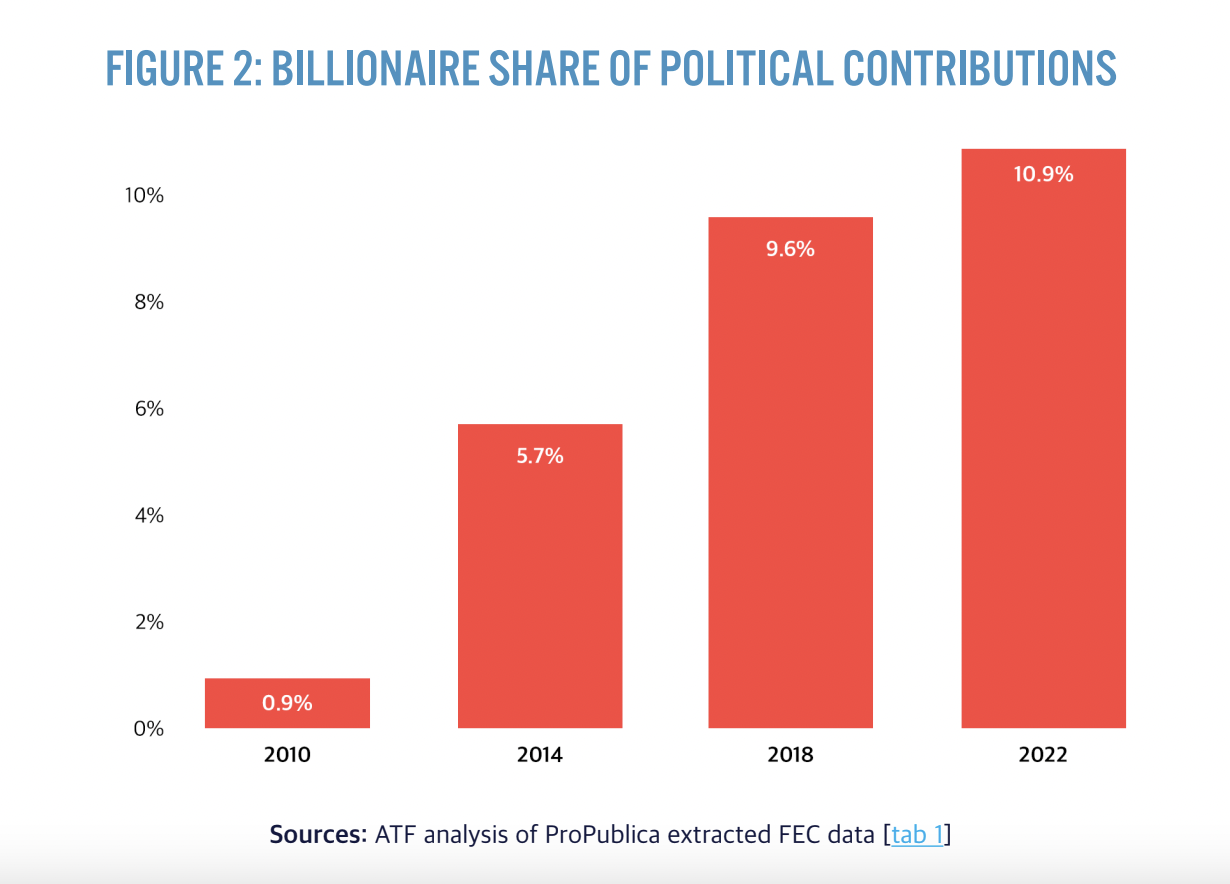 According to a new report from Americans for Tax Fairness, US Billionaires spent over $1 Billion in the 2022 Midterm Elections, which is the most the Billionaire class has ever spent during any election cycle.
In the introduction to this new report, it states:
Billionaires have plenty of money with which to try to buy elections, their net worth increased by 58% to a staggering $4.7 trillion during the roughly three years of the pandemic alone. The failure of America’s tax system to fairly tax the income and wealth of billionaires leaves the with lots of excess cash to spend on candidates and causes. Meanwhile, the breakdown of campaign-finance controls since the Supreme Court’s notorious Citizens United decision in 2010 has made it easy for tycoons to translate their economic clout into political power.
Billionaires in Michigan also contributed significantly to this increase in campaign funding by Billionaires, with Dan Gilbert, the Stryker family, and Hank & Doug Meijer among those who influenced the 2022 Elections. However, of all the members of the Billionaire Class in Michigan, the DeVos family contributed the most in the 2022 Midterm Elections.
As we documented in November of 2022, the DeVos family spent $12,304,750 to influence electoral outcomes, and that was just in Michigan. The DeVos family has also contributed millions to political candidates in other states, which you can research at https://www.opensecrets.org/donor-lookup. Lastly, there is Dark Money contributions that the DeVos family has made, but are difficult to track since many of these Dark Money groups do not reveal who their contributors are. For more on Dark Money groups, go here https://www.opensecrets.org/dark-money/basics.
The Americans for Tac Fairness report concludes by saying:
We must end the vicious cycle of the ultra-wealthy using their vast fortunes to exploit a broken campaign finance system to support candidates who will cut their taxes, allowing them to amass even greater wealth which they can use to continue the process. When billionaires throw huge sums of money into elections, they shape the debate to their liking and in the process distort what limited form of democracy that exists in the US.
Of course, like all necessary changes, this will have to happen from the bottom up, since neither the Republican or Democratic Parties are interested in limiting the role that the Billionaire Class plays in Electoral Politics or Public Policy.
Funding priorities for the City of Grand Rapids: Business Districts are a priority, Affordable Housing not so much
For years now, there has been a growing demand from the public to get the City of Grand Rapids to do more around the issue of housing, particularly affordable housing.

This push from the public has happened in part because of the push back against the gentrification of numerous neighborhoods throughout Grand Rapids. However, the demands around housing have also come as a result of the increased number of those who are unhoused, and how the City of Grand Rapids has in many ways criminalized those who are unhoused. Lastly, the so-called housing market in this city has seen the cost of housing, whether it is the cost of buying a home or the cost of rent, increase at such a pace that is staggering.
Therefore, push back on all three fronts – resistance to gentrification, how the unhoused are treated, and the increase in housing/rental costs – has pushed the City of Grand Rapids to craft some newer policies around housing, along with a new Affordable Housing Fund that was created in the Fall of 2021.
The Affordable Housing Fund has set aside $5 Million to fund affordable housing and homelessness prevention projects in the city, according to an MLive story that was posted earlier this year. The city’s relatively new Affordable Housing Fund Board is seeking applications from organizations that could use a share of $5 million in federal stimulus dollars to complete that work.
One could certainly say that for the City of Grand Rapids to tackle the issue of Affordable Housing, setting aside $5 Million, is a victory for those who have been pushing for these demands over the past decade. However, in the big scheme of things, $5 Million dollars isn’t a great deal of money, especially considering the size of the annual City Budget, which for the 2023 fiscal year was $597,859,508. This means that with a City budget just shy of $600 Million, setting aside $5 Million for Affordable Housing seems rather small.
In looking at a comparison to the $5 Million for the Affordable Housing Fund and put that next to budget allocations for business development, the amount for the Affordable Housing Fund is almost an embarrassment.
During the May 9th Grand Rapids Committee of the Whole meeting, there were numerous 2024 budget items that were excepted without question, all of which centered around business development or business districts. Here is the breakdown for these 2024 budget items, which you can read in detail at this link. Number 7 on the Agenda for the May 9th Committee of the Whole meeting says:
Overview of FY2024 budgets for boards and authorities administered by the Economic Development Department and Downtown Grand Rapids, Inc. with appropriation requests totaling $45,375,682.
Here is the breakdown of that $45,375,682:
- City of Grand Rapids Brownfield Redevelopment Authority – $22,829,602
- City of Grand Rapids Downtown Development Authority – $15,382,500
- City of Grand Rapids Economic Development Corporation – $120,201
- City of Grand Rapids Michigan Street Corridor Improvement Authority – $505,000
- City of Grand Rapids Monroe North Tax Increment Finance Authority – $875,124
- City of Grand Rapids North Quarter Corridor Improvement Authority – $155,000
- City of Grand Rapids SmartZone Local Development Finance Authority – $2,746,522 City of Grand Rapids South Division- Grandville Corridor Improvement Authority – $384,000
- City of Grand Rapids Southtown Corridor Improvement Authority – $750,432
- City of Grand Rapids Uptown Business Improvement District – $122,840
- City of Grand Rapids Uptown Corridor Improvement Authority – $534,461
- City of Grand Rapids West Side Corridor Improvement Authority – $970,000
This is a great deal of money that is fundamentally going to subsidize economic development, business districts, etc. So, why is the City of Grand Rapids willing to provide $45 Million and change for business districts, yet only $5 Million for Affordable Housing?
Another way of framing the issue could be, it is the responsibility of local government to give priority to individuals and families that are subjected to poverty as opposed to those involved in Capitalist enterprises? I always thought that Capitalists believed in competition and that the free market should not be regulated by the government. Why do taxpayers have to foot the bill, by paying out more than $45 Million for business districts and other economic development project in the City? And we don’t we get to vote on these matters?
My conclusion is that the the City of Grand Rapids is only recently involved in the business of Affordable Housing – primarily because of public pressure – whereas, the City doesn’t think twice on being about the business of business development. As it is with most budgetary matters in government, it is not a question of there not being enough money to fund projects, it is always about priorities, and right now the City of Grand Rapids prioritizes funding business districts and tourism for downtown Grand Rapids over Affordable Housing.
 Grand Rapids Institute for Information Democracy