History of US Immigration Policy: Summary of GRIID Class week #8 – ICE contracts, profiting from pain and family separation
For anyone who could not join the class tonight or who couldn’t find time to be part of this class, I want to share a summary of what was discussed. I also want to provide links and resources for anyone who wants to do their own investigation on the history of US immigration policy.
As with each of the 8 weeks of this class we will rely on the Popular Education resource I created and update regularly. The Popular Education resource provides an important overview of this history, along with a list of books and online resources that can help us with developing a robust analysis of the history of US immigration policy and how to frame it.

In week #1 we relied heavily on the book, No One is Illegal: Fighting Racism and State Violence on the US/Mexican border, which look at the way that Mexicans, Chinese, Japanese, Jewish and even German immigrants have been treated since the mid-1800s.
In week #2 we the responded to the question about why so many immigrants were coming, especially those who were risking their lives to enter the US/Mexican border at unsanctioned border points.
For week #3 I focused heavily on the anti-immigrant narrative or the xenophobic narrative(s) about immigrants that politicians and US news media companies use when talking about undocumented immigrants.
In week #4 we talked about why people are taking the risk of coming to the US without documentation and what the root causes of displacement are. We all read an overview article on the history of US interventions in Central America and discussed the motives of the US government for their support of US corporate interests and regional control of Central America. We then did a more detailed account of the US History with Guatemala.
For week #5 we continued our discussion on the root causes of why people are fleeing Central America and Mexico and taking the risk to come to the US as undocumented immigrants. In week #4 we talked about the history of US foreign policy in that region, along with economic factors, but for week #5 we discussed Climate Change and the so-called War on Drugs as factors of displacement.
First we all read part of Todd Miller’s book, Storming the Wall: Climate Change, Migration and Homeland Security. We also read an interview with Miller about the same topic, but with additional information and analysis.
Second, we read an article from Dawn Paley, an article that beautify summarizes her book, Drug War Capitalism. Paley’s article is entitled, Militarization & Economic Transformation in Colombia & Mexico. In that article she states:
Reconsidering the so-called drug wars requires — in part — evaluating how they have encouraged the expansion of foreign direct investment and extractive industries in Colombia, Mexico and Central America.
Paley discusses how the US used the same model to fight the so-called War on Drugs in Mexico that was used in Colombia.
For week #6 we discussed the ICE detention system in the US. First, we read a chapter from the book Immigration Detention Inc.: The Big Business of Locking up Migrants. This chapter covered the growth of the ICE detention system from the Reagan years through the Biden years, demonstrating how the ICE detention system has always had bipartisan support and how it has continued to grow over the past 45 years.
We also discussed two articles from The Intercepted, one on private detention companies getting bank loans for expansion and one on the use of bounty hunters to track down immigrants for ICE.
In addition, we looked at the data on the GEO Group from OpenSecrets, which shows how much money they contribute to political campaigns and how much they spend on lobbying. Then there was an article on the rapid growth of the detention system that was from August of this year that NPR did. Lastly, we looked at the GEO Group site and their map of detention center locations.
In week #7 we focused on the system of deportation that the US government has used since the late 19th century. The primary text we used was a chapter from Adam Goodman’s book, The Deportation Machine: America’s Long History of Expelling Immigrants.
Two important aspects of the chapter from Goodman’s book were the increase in deportations and the bipartisan nature of deportation as policy.
“Between fiscal years 1986 and 2013, the number of formal deportations (known in bureaucratic parlance as “removals”) rose from around 24,600 to a historic high of around 433,000, while the number of voluntary departures (or “returns”) dropped from more than 1.58 million to just under 179,000. By 2011, formal deportations outnumbered voluntary departures for the first time in seven decades; five years later, they made up three out of every four expulsions from the United States. During this period, formal removals came to resemble voluntary departures in their expedited nature and their restrictions on due processbut they carried much harsher consequences. This shift in how officials deported people represented aradical break from the past century of immigration enforcement policy and practice.”
As for the bipartisan nature of US deportations, the author states:
“In his second term, some migrant activists and advocates took to calling Barack Obama the “Deporterin-Chief.” The moniker stemmed from the fact that formal deportations reached unprecedented levels during his presidency.85 But total expulsions dropped. Assigning responsibility to a particular president or solely focusing on how many people he expelled does not explain immigration enforcement’s punitive turn. It is only by examining the cumulative policy changes under both Republican and Democratic administrations since 1986 -from the unprecedented spending on enforcement, militarization of the border, and increased reliance on expedited formal deportations to the criminalization of migration, externalization of migration control, and expansion of immigration detention-that we can begin to understand the recent transformation of the deportation machine.”
The other resource on deportation we used for week #7 was the site https://mappingdeportations.com/. There are several good videos on this site, along with excellent data and analysis.
Other great resources of information on the https://mappingdeportations.com/ site are the timelines of deportation, maps and the excellent visuals they have created to communicate the realities of who is most impacted by deportation from the US in recent decades.
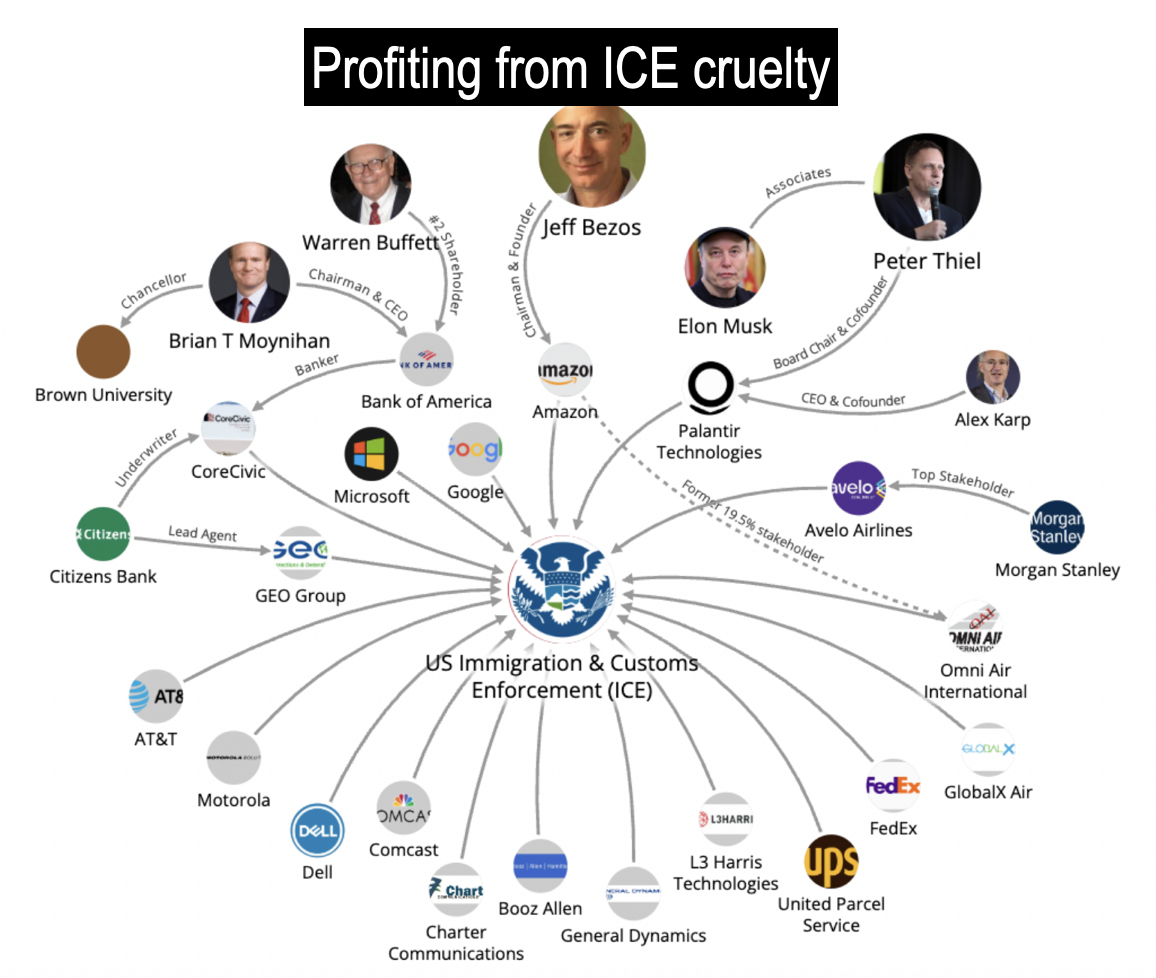
For our final week of this class, week #8, we discussed how private companies are profiting from ICE contracts, contracts that are ultimately paid for by taxpayers.
First, we discussed an article from the ACLU about the company Palantir and their contract with ICE, in an article entitled All the Ways Palantir is Assisting Trump’s Abusive Removal Campaign. The four ways Palantir assists ICE are:
“ELITE” system for data on targets – Palantir’s Enhanced Leads Identification and Targeting for Enforcement (“ELITE”) system is used in immigration enforcement operations for “identifying and prioritizing high-value targets through advanced analytics.
The Investigative Case Management platform – DHS’s Investigative Case Management (ICM) platform functions as the backbone of the agency’s immigration enforcement apparatus in the United States. As the name suggests, the ICM is for managing cases — supporting ICE through the lifetime of a criminal or civil detention and deportation case.
ImmigrationOS to monitor and track immigrants – According to ICE contract documents, the Immigration Operating System or ImmigrationOS is an augmentation of the ICM, possibly using AI, that seeks to parse vast amounts of data in service of three main priorities of the Trump Administration’s mass deportation agenda.
ICE Tip Processing – The 2025 DHS AI Use Case Inventory also makes mention of a newly deployed “AI-Enhanced ICE Tip Processing” program purchased from Palantir. The software uses generative AI to summarize and categorize incoming tips to ICE, as well as translate non-English tips into English.
Next, we discussed a GRIID article from earlier this year that looks at ICE contracts in Grand Rapids.
Finally, we looked at a three-part short video series from Lawfare Media. The first video is entitled, Deportation, Inc.: The Rise of the Immigration Enforcement Economy. This first video provides an introduction into how ICE came about and the bipartisan funding that has increased over the past two decades.
In the second video the focus is on the immigration detention system.
In the third video the focus is on what is referred to as Removal.


Comments are closed.