Once again Movimiento Cosecha visits Sen. Brinks in Lansing without a commitment to passing legislation providing undocumented immigrants with drivers licenses
Since 2018, Movimiento Cosecha Michigan has made drivers licenses for the undocumented community one of its top priorities.

Legislation was initially introduced in 2019, primarily because of the organizing done by Movimiento Cosecha and other immigrants rights groups.
After the Democratic Party took control of the Governor’s office, the State Senate and the State House in early 2023, Movimiento Cosecha, along with many immigrant justice groups believed that passing legislation to allow undocumented immigrants to obtain drivers licenses would be a priority of the party that claims to stand for those most marginalized in our society.
In March of 2023, Movimiento Cosecha went to Lansing, specifically to speak with Senator Brinks, especially since she became the Senate majority leader at the beginning of 2023. However, upon speaking with staff members of Senator Brinks, they came away frustrated, especially since Senator Brinks’ staff could not make any promises on passing what is now called the Drive Michigan Forward bill.
In early May, GRIID posted a piece entitled, Elected officials need to participate in the social movements that are being led by BIPOC communities in Grand Rapids. In that article we stated:
Now, some might say that since Senator Brinks, who has introduced a bill in support of Driver’s Licenses, doesn’t need to attend Movimiento Cosecha events. People are aware of the fact that Senator Brinks has introduced legislation, but the undocumented community, who can’t obtain Driver’s Licenses, also cannot vote. Therefore, it seems to me that regardless of whether or not people can vote, if they are some of the most vulnerable people in the state, then elected officials should make it a priority to develop relationships with them.
In looking at Senator Brinks’ Facebook page, it is clear that she attended several other events last week and even a local coffee shop that was just a few blocks from where the May Day march had been walking in the rain last Monday. People in positions of power and privilege need to interact with, develop relationships with, and be in solidarity with undocumented immigrants. Proposing legislation and even passing legislation are not enough, since they can learn a great deal from those who facing family separation on a daily basis.
In June, Movimiento Cosecha made a trip to the Detroit area, to pay a visit to Rep. Tullio Liberati’s home, since the Democratic Representative had not yet committed to supporting the Drive Michigan Forward bill. No one came to the door at Rep. Liberati’s home, but Cosecha organizers left a message and encouraged people to call his office to pressure him to support the legislation that would provide undocumented immigrants the right to obtain a drivers license.

Earlier today, roughly 40 Movimiento Cosecha Michigan members took a bus to Lansing to once again visit with the Senate Majority Leader Winnie Brinks and urge her to make the Drive Forward Michigan bill a priority for 2023.
Movimiento Cosecha members arrived at Senator’s Brinks’ office and walked in with the idea of sharing a clear message about what passing this bill was so important, along with several members who planned to share testimonies about how difficult it was to feel safe and take care of their families without a drivers license. You can see in the picture above, all of the Movimiento Cosecha Members packed into the Senator’s office.
Within minutes, about a half a dozen capitol police showed up, forcing their way in and demanding that Movimiento Cosecha members removed themselves from the office. All 40 of those who were in the office, slowly filed out and then gathered in the hallway, where they were then met by the Senator’s staff who asked them to share their concerns. What was interesting is that several of the capitol police/security guards were flanking the Senator’s staff, to make sure there was no harm done to them. (See picture below) This was ridiculous, especially since Movimiento Cosecha Michigan has always taken a stance of non-violence since they began organizing in 2017.

Several people did speak up and share the urgent message that they did not want to hear any more promises made from politicians or their staff about drivers licenses, rather they wanted a verbal commitment to pass the Drive Forward Michigan bill this fall, especially now that the Democrats control all three branches of the State government.
There were other people who shared more personal messages, like one man who worked 3rd shift last night, came home, and then went straight to where Movimiento Cosecha had a bus lined up to take people. Another young man talked about having a brother with a disability, which further complicated the fact that his parents did not have a drivers license, limiting how they could get around for medical appointments for his brother. He also mentioned that he would have to get up a couple of hours earlier for school to walk to the nearest bus stop and then catch a bus to go to school. These dynamics, all due his parents not having a driver’s license, caused tremendous stress, and that was on top of the fact that ICE agents could arrest, detain and deport family members at any time.
The staff members from Senator Brinks’ office never made any commitments, nor could they promise that Senator Brinks would make passing the Drive Forward Michigan bill this fall. The only thing they said they would do would be to schedule a meeting with members of Movimiento Cosecha Michigan, which meant they provided a sheet of paper for anyone who wanted to provide their contact information.You could see that many people felt frustrated and demoralized, by the look on their faces. People began saying to each other, “What else do we have to do to make it clear to these politicians that it is a life and death matter for their families have drivers licenses.”
After leaving the capitol building, the Cosecha community members shared food, beverages, and some music. After about 30 minutes of communal food sharing, Cosecha Michigan organizer Gema Lowe let everyone know about the next actions that were being planned and that they were not giving up the fight to win drivers licenses for all in Michigan.
On Wednesday, I was invited to speak to a group of GVSU students about the history of Environmental Movements in Grand Rapids
My presentation to the students was a sorter version of chapter 8 in my book, A People’s History of Grand Rapids. Many thanks to the GVSU professors who invited me to speak, specifically Professor Melba Velez Ortiz. Mil Gracias!!!!
Like all cities, Grand Rapids has its own history of environmental destruction. An example of this can be seen quite simply, and possibly innocently, in the former title of Grand Rapids being the “Furniture City.” To look underneath this name, however, reveals the productive necessity of clearcutting trees in West Michigan, in northern Michigan, and as far away as parts of northwestern states, this according to records documenting from where the furniture barons of Grand Rapids were importing lumber.
We could also talk about the increased levels of industrial pollution that ended up in the Grand River, since a great deal of industry was positioned along the river for decades. In addition, we could identify the increased use of automobile use in Grand Rapids, which later resulted in the construction of US 131 and 196 highways that intersect near downtown Grand Rapids.
The recognition of the increasing levels of air pollution, water pollution, industrial waste and other consequences of industrialization and hyper-consumerism, eventually led to a growing awareness that the destruction of ecological systems would result in our own destruction as human beings.
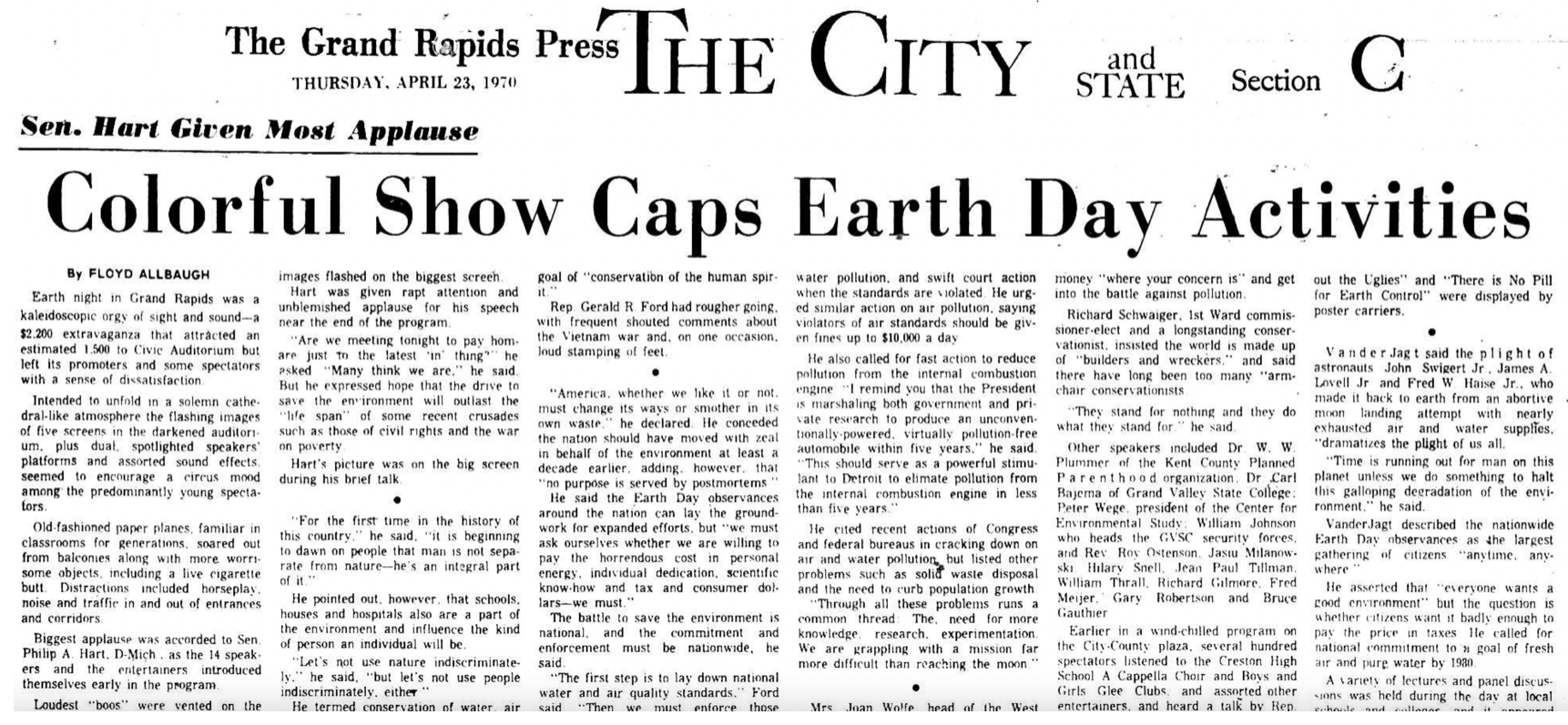
The First Earth Day took place in communities all across the US in April of 1970, including right here in Grand Rapids. There were several events/actions that took place on that day in 1970, which in many ways would set the tone for the future of the environmental movement.
In the afternoon, there was an event with song and signs at the Calder Plaza, with the featured speaker being Rep. Guy VanderJagt, a Republican from Cadillac. The comments by VanderJagt, as reported in the Grand Rapids Press, spoke of the urgency to take action. However, the representative from Cadillac framed the environmental urgency in terms of how much people would be willing to pay in taxes to get clean air and clean water.
There was also a large community event, with an estimated 1,500 people in attendance at the Civic Auditorium in the evening. The event featured images on the big screen, musicians and speakers, including Rep. Gerald Ford. When Ford spoke, he received boos, loud comments about the war in Vietnam and sometimes Ford’s comments were greeted with loud stomping of feet. According to the GR Press, Ford suggested that we need to make personal sacrifices, including consumer spending and taxes. Ford also suggested that people should “reduce pollution from the internal combustion engine.” He claimed that President Nixon, along with the private sector, would be creating a “virtually pollution-free automobile within five years.”
Besides the two informational/educational events, there was also a student-led protest at a Grand Rapids meat factory. Students from Grand Rapids Junior College chose to protest at a meat factory because of the pollution the business was emitting as a result of how the company cured the meat. The factory had been the target of complaints from neighbors for years because of the pollution. One student who was interviewed in the Grand Rapids Press stated that the protest was not singling out this particular factory. It was to protest air pollution in general. One of the signs that was used during the protest read, “Smoking Killed Hogs Brings Killing Smoke Smog.”

This last action, organized by students, is more reflective of the kinds of actions people were taking across the country, which focused attention on corporate pollution or structural pollution. In fact, in its early years, Earth Day actions were either to engage in collective projects that would promote ecological sustainability or to confront those most responsible for environmental destruction, such as the corporations and militarism.
From that first Earth Day in 1970 to the present, those involved in doing environmental work have either focused on personal lifestyle choices, voting or on whatever the non-profit environmental groups were involved. However, this is not what social movements are traditionally centered around. Movements challenge systems of power and oppression that are the root cause of the problems that a movement choses to address.
There have also been greater efforts to organize around Food Justice work, especially in the past 20 years, organizing that was born out of an Environmental Justice Movement framework. In addition, there has been organizing to fight for climate justice, most recently from student-led efforts like the Sunshine Movement. Climate Justice organizing has taken on numerous forms in the past 20 years, but one example of this organizing that is worth looking at was the anti-fracking movement. The anti-fracking movement is certainly one component of the larger Climate Justice Movement. This movement begins around 2010 and owes some of its expansion to the documentary film Gasland, by Josh Fox.
Deep hydraulic fracturing became a technological process being used by the fossil fuel industry, which allowed corporation to drill deeper than normal in search of methane gas that was trapped in the earth. The technique of fracking opened up new possibilities for corporations to extract gas, which also led to a mad scramble to either purchase land or to lease land from the state.
Beginning in late 2011 in the Grand Rapids area, people began to meet and talk about forming an autonomous group that would promote and practice radical environmentalism. This group, who later called themselves, Mutual Aid GR, first crafted their own organizing document, which not only provided their framework for organizing, but also provided analysis on larger areas of concern such as food, transportation and energy.
Shortly after producing this document, Mutual Aid GR hosted their own People’s Assembly for Radical Sustainability. This event was designed to not only create more conversation around critical environmental issues, but to build a greater capacity for doing the necessary organizing work in Grand Rapids. By the fall of 2012, the group already organized its first major action coinciding with the International Day Against Fracking, which was action at Wolverine Oil & Gas, a local company that had a history of fracking. Three members of Mutual Aid GR occupied the offices of Wolverine Oil & Gas and were later arrested by the GRPD. The group released a statement, which in part read:
“Today, we occupy the offices of Wolverine Oil & Gas as one action against the consequences of oil and gas extraction in Michigan. We are confronting Wolverine Oil & Gas because they have a history of profiting from environmental destruction and particularly their use of the natural gas extraction method known as hydraulic fracturing.
We are occupying Wolverine Oil & Gas to demand that they release all information about the type and amount of chemicals they have used in fracking to date and the amount of water used; to release information on the location of all oil and gas wells they own and operate in Michigan, and to stop the practice of fracking where ever they engage in this practice.
No Compromise in Defense of Mother Earth!”
A month after the Wolverine Oil & Gas occupation, Mutual Aid GR began doing research into companies that were applying for land leases in order to engage in fracking. The group found that there were some large multinational corporations that had already entered into lease agreements in Kent County, such as Shell Oil, AMOCO, Uniroyal Inc., and Western Land Services.
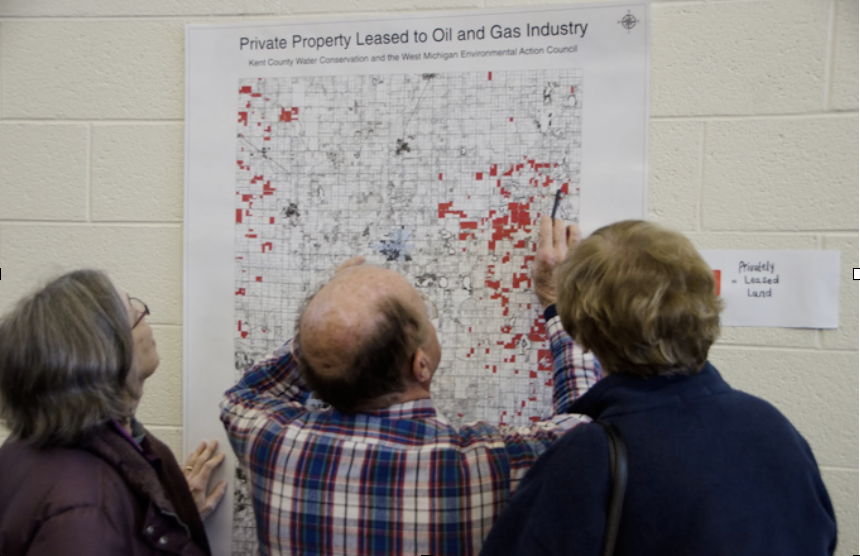 In the same month that Mutual Aid GR was researching land leases in Kent County for fracking, the Michigan Department of Natural Resources (DNR) hosted one of its bi-annual auctions for leasing mineral rights for oil & gas companies across the state in Lansing. Mutual Aid GR and other radical environmental groups decided to attend the state auction, with the goal of trying to prevent the State of Michigan from leasing land to oil & gas companies who wanted to engage in fracking.
As people were entering the room where the state land auction was being held, they had to pass by a crowd of people lined up with anti-fracking signs. In addition to those who protested outside, some people released a banner that was attached to balloons inside, while others who sat in the room where the auction was taking place began to disrupt the meeting by making statements. At one point, several people stepped over the divider separating the public seating and the bidder seating, locked arms and sat on the floor in an act of civil disobedience. Simultaneously, there were some noise tools released to disrupt the auction and then the whole room began chanting in opposition to fracking and the arrest of those who sat down.
Mutual Aid GR continued organizing educational events and participating in direct action against the fracking industry for another 12 months after the actions in Grand Rapids and Lansing. However, they eventually folded. Yet, before they folded, they were instrumental in getting the largest environmental non-profit in Grand Rapids, WMEAC, to finally take a public stance against hydraulic fracturing.
Students, parents and community members have their own list of demands for the Grand Rapids Public Schools during the school bond event last night
Last night a group of students, parents and community members came out to show support for the upcoming Grand Rapids Public Schools bond initiative that will be on the ballot in November. However, in recent years they haven’t seen relief on chronic issues that cause a lot of harm to students, parents, and staff.
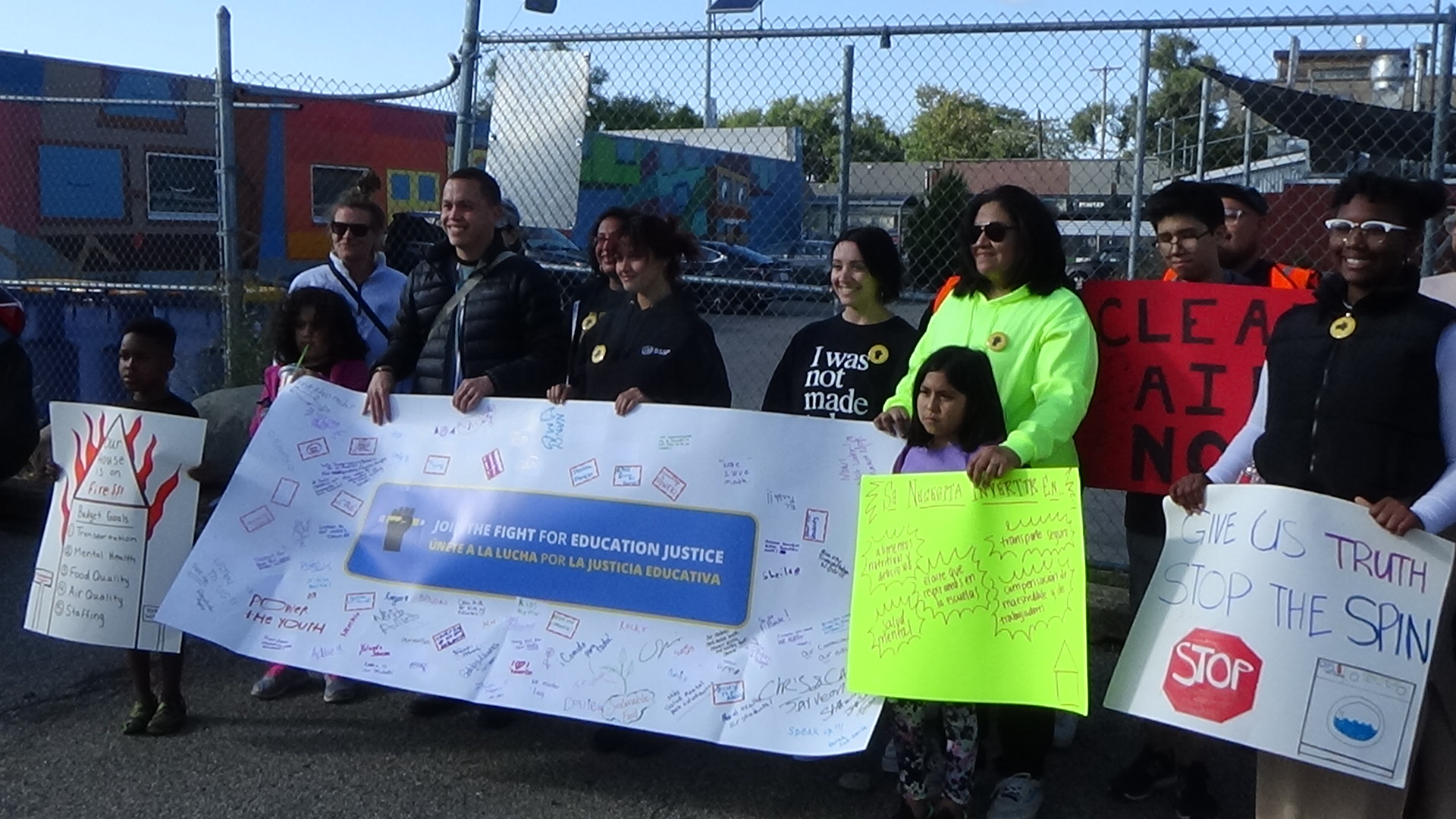
The Urban Core Collective brought together last night the group of students, parents and community members to show support for the upcoming bond vote, but they also wanted to make it very clear that there are an urgent set of issues that cannot be contingent on bond funding in order to be implemented.
One parent, Marta Johnson, who has been working with the Urban Core Collective, came out last night to say:
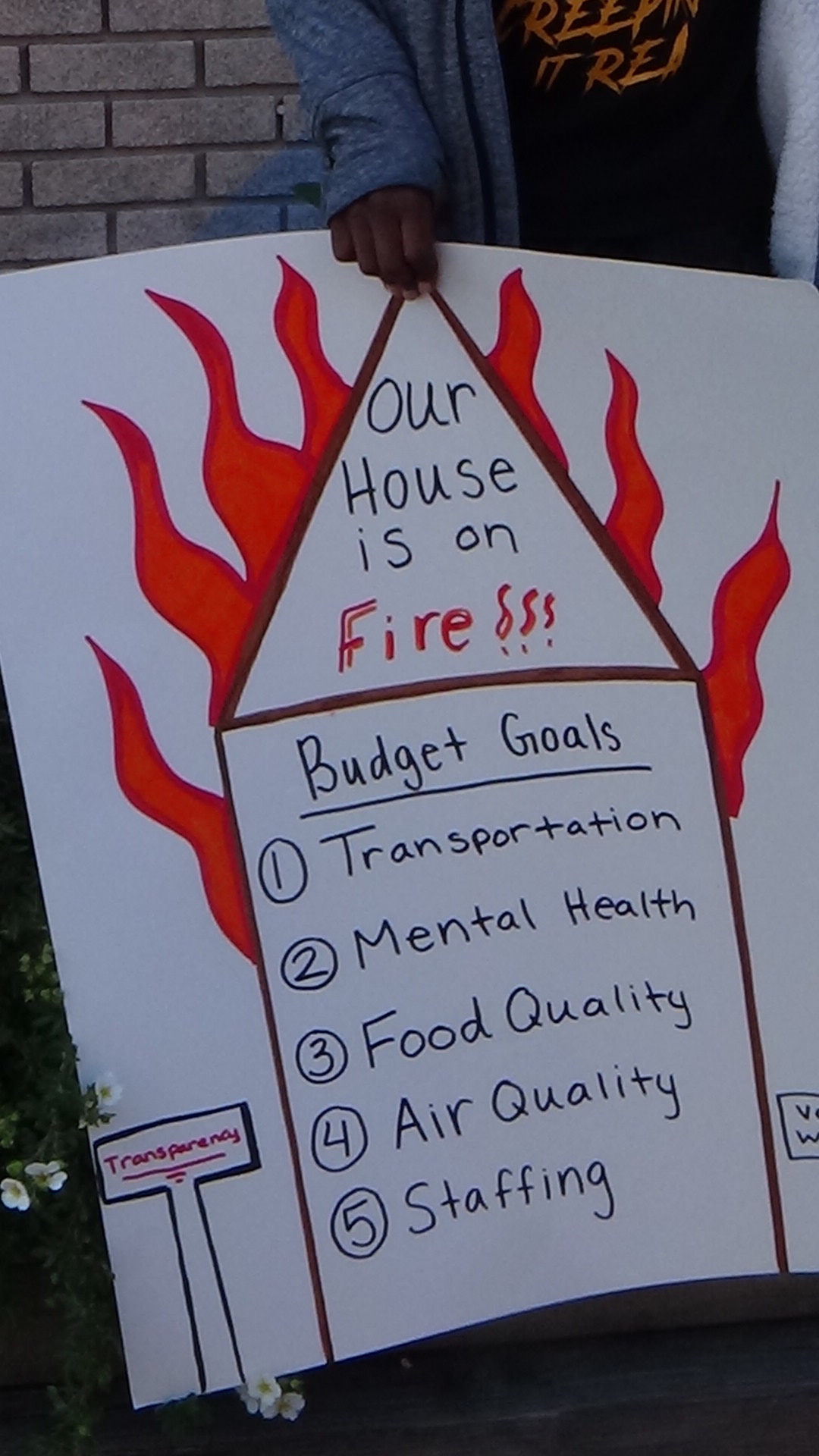
“Our house is on fire and we can’t just watch it burn. We cannot wait for bond dollars or a Facilities Master Plan to begin effecting change. We need GRPS administration to take immediate action on issues of air quality, transportation, teacher compensation, school food and mental health services.”
This list of demands can be viewed in more detail at this link, demands that were presented to the Grand Rapids Public School Board back in June, when the Urban Core Collective hosted a rally/march to the School Board meeting and presented these same demands to school officials.
In addition, it was stated last night that community members are calling on the Grand Rapids Public School’s Board of Education to conduct a thirty, sixty, ninety day evaluation on key issues that have previously been named and now reiterated in the district’s recent Public Engagement Report and to make immediate financial investments for the current school year.
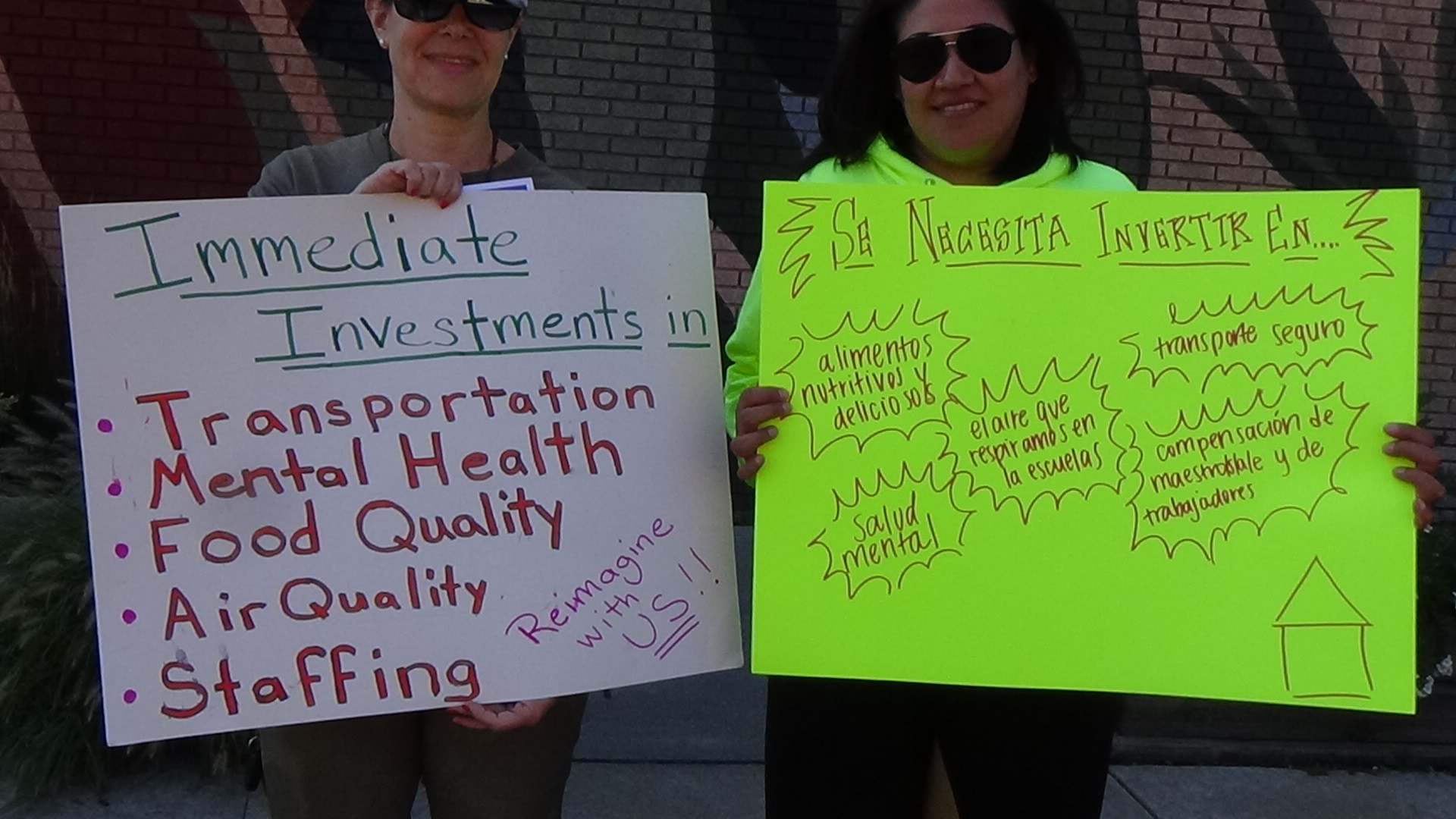
The Urban Core Collective also did a livestream of their action saying, “We’re live outside Long Road Distillers where Grand Rapids Public Schools is holding a fundraiser for the no tax increase infrastructure bond on the ballot in November. We’re here to tell GRPS we support the bond, but we also want to see action and accountability from the district about key community concerns, including transportation, air quality, food, mental health and safety, and staffing, as well as a plan to address the scholar, parent/caregiver, and community partner issues outlined in the Eureka report. Learn more at bit.ly/EurekaReportFull and bit.ly/grpsbudgetresponse or reach out to us with a message!” You can watch the short video here.
 You can also sign on to an Action Alert that will be sent to GRPS officials to demand action that the community is calling for before the November 7 bond vote takes place.
MLive did show up to the event last night, but their article almost exclusively focused on those attending the event organized by the bond committee, Yes for GR Kids. The MLive article mentioned that several elected officials were in attendance, along with GRPS officials, as well as the fact that the Yes for GR Kids Ballot Committee was already touting several endorsement, from groups like the Grand Rapids Chamber of Commerce. It wasn’t until the very end of the article that MLive even mentioned that the Urban Core Collective was outside during the event wanting to make their demands known.
One thing that I found instructive about the Yes for GR Kids Ballot Committee, is that it was being headed up by John Helmholdt. Helmholdt, who now works for SeyferthPR (the PR agency for the rich and powerful in GR) was the former communications person for the Grand Rapids Public Schools. Finding out that Helmholdt was orchestrating the Yes for GR Kids Ballot Committee now made sense, especially in regards to the sponsors of their event, which we wrote about on Monday.
What the people want and what the politicians want in regards to housing issues are not at all the same
Last week, GRIID attended and wrote about the Rent is Too Damn High rally held in Lansing.
The several hundred people from across Michigan who showed up had a list of very clear demands, which we cited in our article. These demands were not mild reforms, but they do provide a clear alternative to the market-driven housing crisis that always put profits over people.

On Sunday, MLive posted an article entitled, Back In The Cap’tol Again: Your guide to Michigan politics. The article lists several issues that state legislators, particularly Democratic Party legislators will tackle this fall.
The article does mention the Rent is Too Damn High Rally held in Lansing. Which stated:
Housing advocates and tenant rights groups called for legal reforms as rents increase. Average Michigan rent has risen 22% in three years, and some speakers complained of $100+ hikes in one year.
“Many people don’t want to buy a house,” rally co-organizer Jonathan Evans told MLive, “and they can live a happy, fulfilling life renting, but not when they’re being constantly overcharged.”
When the article states “Housing advocates and tenant rights groups called for legal reforms,” the MLive reporter misrepresents what the rally organizers were calling for. The article goes on to cite Rep. Emily Dievendorf, D-Lansing, who said there are going to be 15 – 20 bills that will focus on the following issues:
- Clarifying tenants’ rights to organize
- Requiring landlords pay for relocating tenants with red-tagged buildings
- Establishing standard criteria for what is a safe and livable dwelling
What is instructive is that the items listed by the Democratic State Legislator were not really part of the demands that the statewide coalition were making, besides some vague language around tenant rights. And for those who don’t remember or never saw demands from the Rent is Too Damn High rally, here are those 4 demands:
Rent Control – Remove the state-wide ban on rent control so municipalities can take action to stabilize rents and protect tenants. Rent control is any policy that directly regulates or limits landlords’ ability to raise rents on an annual basis. For instance, a city may limit increases to a certain percentage, or according to some other formula. Rent control provides tenants with the security of knowing they won’t be priced out due to arbitrary and excessive increases in rent. These types of local policies were banned by the state legislature in 1988. We support a repeal of this ban on rent control.
Social Housing – $4 billion for social housing in FY25 state budget. “Social housing is a public option for housing that is permanently affordable, protected from the private market, and publicly owned by the government or under democratic community control by non-profit and cooperative entities. Around the world, robust social housing programs have ended affordable housing shortages; expanded democratic accountability and equitable housing access; and raised populations out of poverty and into prosperity.” Social housing is built to house people well, rather than deliver a profit to developers & managers. States and municipalities in the US are initiating social housing programs anchored by a new generation of public-sector housing development agencies. We support a $4 billion state infusion into social housing, to be administered regionally by public developers. This amount could directly support approximately 40-50,000 new social housing units, which would make significant progress towards the state-established goal of building 75,000 total new homes over the next 5 years.
Housing First – $1 billion for people experiencing and at risk of homelessness in FY25 state budget. Housing First is a successful and evidence-based approach to reducing homelessness that focuses on providing housing to people, rather than criminalizing or pathologizing them. We support a $1 billion state infusion into programs of direct service, rapid rehousing, and permanent supportive housing, with a housing first lens. These funds should be distributed and administered regionally.
A Renter’s Bill of Rights – Renters around the country are insisting on more protections against landlord abuse and empowerment of renters as a class. Michigan renters need these rights and protections as much as any. A Renters Bill of Rights may include fair chance housing for returning citizens, tenants’ right to organize and have counsel, relocation assistance in case of red tagging, increased safety inspection standards, legal protection against discrimination based on housing status, just cause eviction, renter agency for repairs, a ban on hidden rental fees, and other such policies.
There was also a hyperlink to a previous article where Rep. Emily Dievendorf, D-Lansing was talking about the list of housing bills they were going to put forth in the fall. At one point in that article she states:
“All of the legislation we will have introduced in the fall related to housing are meant to function in complementary ways in order to ensure that we really are getting to the root of homelessness, making housing more affordable, making it more accessible and keeping people in safe and livable homes.”
While these comments sound positive, the bills they are proposing will not address root causes, nor will it make housing truly affordable for most renters who are being priced out in the current housing crisis, since the root cause is the fact that housing is driven by profits rather than being a human right.
Never Forget 9/11 – 1973: Why we don’t know about the CIA coup that ended the democratically elected government in Chile
Of course the local and national news media in the US are laser focused on 9/11, 2001. I can understand the need to focus on that attack, which happened 22 years ago. However, one major flaw in the reporting and how US society responded to that event in 2001, was the failure to learn from a critical examination of US foreign policy.
Instead, the response from the Bush Administration, with near unanimous bi-partisan support, was to use 9/11, 2001 as a pretext to continue to engage in an imperialist foreign policy that resulted in millions of mostly civilian deaths.
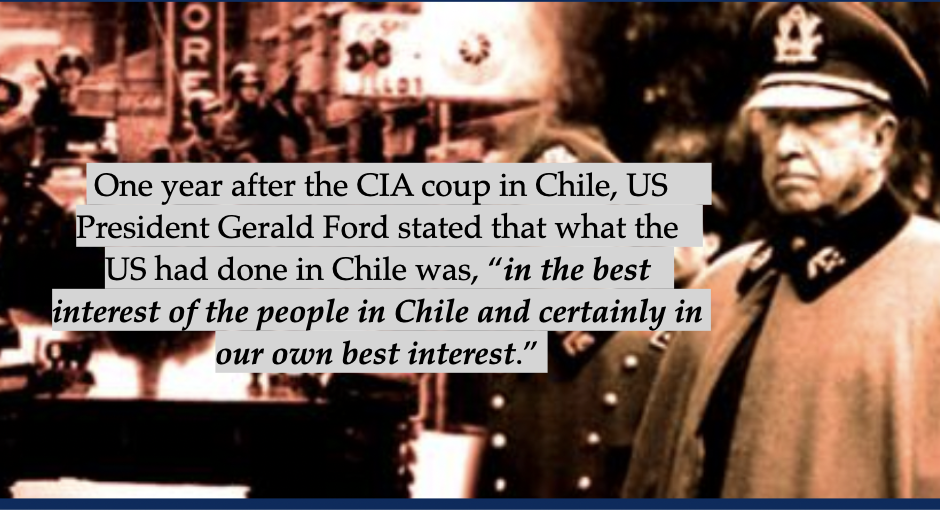
Therefore, it is no surprise that it is not common knowledge that on September 11, 1973, the CIA, with full support from the Nixon Administration, perpetrated a coup against the democratically elected government of Chile and the ousting of President Salvador Allende. The CIA then created a space to replace Allende with one of the worst dictators in Latin American History, General Augusto Pinochet.
One year after the CIA coup in Chile, US President Gerald Ford stated that what the US had done in Chile was, “in the best interest of the people in Chile and certainly in our own best interest.”
 There has been a great deal of analysis of the 1973 CIA coup in Chile, so this post in primarily designed to direct people to several of what I think are some of the best resources on this topic. I also think that it is critically important that we come to terms with this history, since what the US did in Chile is standard practice for the US and has been since the US began taking land from Indigenous nations in what we now call North America.
People might want to start with the excellent resources from the National Security Archives, which requests, collects and publishes US Declassified documents on US foreign policy. Their section on Chile is invaluable.
Some of the information collected by the National Security Archives on Chile has been published in book form, including declassified documents and analysis by staff members, such as the book by Peter Kornbluh, The Pinochet File: A Decalssified Dossier on Atrocity and Accountability.
Another excellent resources in the book by William Blum, Killing Hope: US Military and CIA Interventions Since World War II, particularly chapter 34.
Some excellent documentaries to watch on this subject are:
The Trials of Henry Kissinger, which has a section on the 1973 CIA coup in Chile, which you can watch at this link.
 Then there is the 4 DVD set entitled, The Battle of Chile, produced by Patricio Guzman.
Earlier today, Democracy Now! Devoted a segment of their show on the 50th Anniversary of the CIA coup in Chile, which featured the Argentine-Chilean writer Ariel Dorfman.
In addition, here are two other book titles worth exploring:
The Nixon Administration and the Death of Allende’s Chile, by Jonathan Haslam
Chile and the Nazis: From Hitler to Pinochet, by Graeme S. Mount
Yes for GR Kids Ballot Committee event include an awful list of sponsors
On Tuesday, the Grand Rapids Public Schools will host a kickoff event for their November school bond, which the public will be voting for on November 7th.
The event will take place from 5 – 7pm at Long Road Distillers, a bar which is co-owned by Grand Rapids City Commissioner Jon O’Connor. Last month, the Grand Rapids Area Tenant Union kicked off a boycott campaign against Long Road Distillers, because Commissioner O’Connor voted in favor of 2 City ordinances in late July, which will criminalized the unhoused.
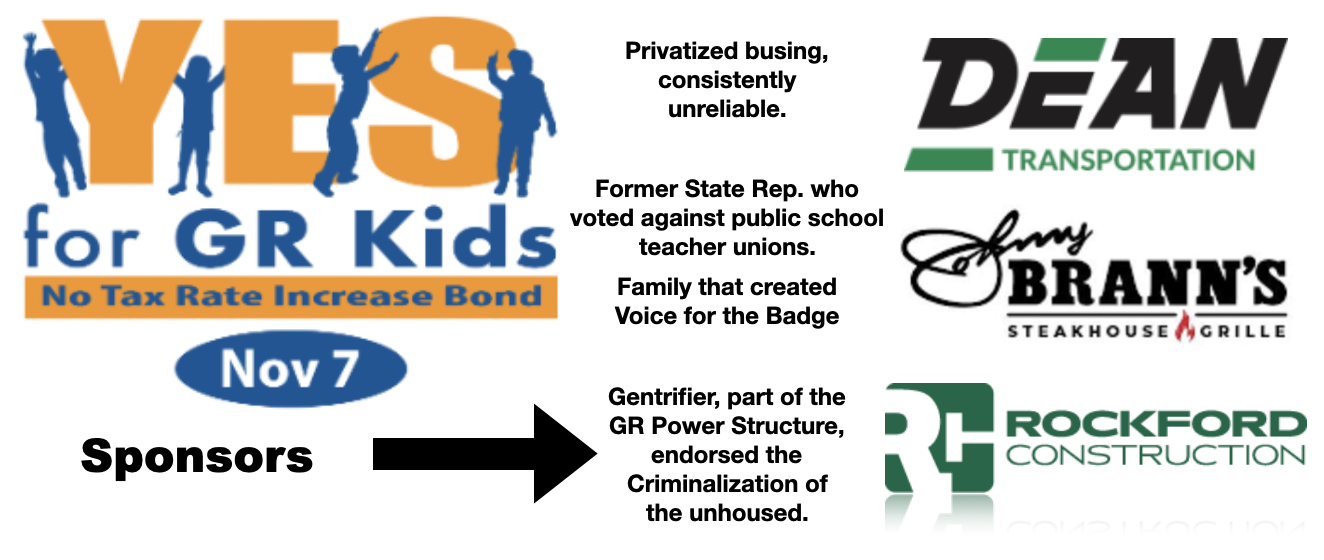
More importantly, the sponsors of the kick-off event, organized by the Yes for GR Kids Ballot Committee, are all entities with deeply problematic histories. The three sponsors are Dean Transportation, Tommy Brann’s Steakhouse and Grille, and Rockford Construction.
The optics of these three sponsors are deeply troubling, which leads me to believe that the Yes for GR Kids Ballot Committee members are either willfully ignorant or in denial about the harm that each of these sponsors have perpetrated on some of the most vulnerable in the Grand Rapids Community.
Dean Transportation
Dean Transportation is a company that was founded in the early 1950s with an emphasis on providing transportation for students with special needs. However, the company expanded at the same time of the rise of Charter Schools, the far right attacks attacks on Public Education, and the imposed austerity measures on education funding at the state level, Dean Transportation has stepped in to take over busing needs of school districts that could no longer afford to provide their on busing services.
The Grand Rapids Public Schools once had their own bus fleet and bus drivers who were paid well, with benefits. More importantly, when the GRPS operated their own busing, they had drivers who were from this community and had a deep connection to the students and families that were part of the Grand Rapids Public School District.
This changed in 2005, when Dean Transportation signed an initial five-year contract with the GRPS. About 100 of the drivers that were hired were former GRPS bus drivers, who were represented by the Grand Rapids Education Support Personnel Association, an affiliate of the Michigan Education Association (MEA), the union for public education employees in Michigan. Dean Transportation disagreed, so the MEA sued Dean Transportation, which was later settled out of court, where Dean Transportation paid $600,000 to the union. However, contract issues between Dean Transportation and the GRPS continued for years after the initial contract.
Another important point about Dean Transportation has been the reliability of their bus drivers with students that attend GRPS schools. In fact, a Facebook page called Parents for Safe and Reliable School Transportation, which was created a few years ago, is filled with examples of parents talking about their child(ren) getting to school late, being left off at the wrong place or getting brought home way too late. Their FB page says, “As Grand Rapids Public School parents whose children use the Dean Transportation bus system to get to and from school, we have significant concerns about the quality of care provided by Dean Transportation, and are here to share stories and document problems. Whether it’s buses consistently arriving 20 minutes late or more, or mistreatment of our children by bus drivers, we want to hold Dean Transportation accountable.”
Tommy Brann’s Steakhouse and Grille
The Brann family has a contentious history with Grand Rapids. First, Tommy Brann used to be a State Representative in the Grand Rapids area, who supported state policies that would undermine public education teachers and their union. As a State Representative, Brann also consistently voted for policies that would take away funding from public education, and policies that would negatively impact children, particularly BIPOC children, since many of these policies would increase the wealth gap in Michigan.
Then there is Tommy Brann’s father, Johnny Brann Sr. Johnny Brann Sr. founded a group several years ago called Voice for the Badge. Voice for the Badge is a police apologist group that believes that the police can do no wrong and that anybody who doesn’t supports the cops is the problem.
Voice for the Badge has been very opposed to any of the numerous community efforts to reduce the amount of money allocated for the GRPD in the annual city budget, along with the fact that this group has publicly defended the GRPD even after the murder of Patrick Lyoya in April of 2022.
Lastly, the Brann family has made significant campaign contributions to City candidates that have run on pro-police and pro-Capitalist platforms, like in the case of Andrew Robbins, who was elected in 2022 as a First Ward City Commissioner. Robbins not only received several thousand dollars from the Brann family, but even more from the DeVos family, the Grand Rapids Police Officer’s Association and the Grand Rapids Chamber of Commerce.
Rockford Construction
In 2020, Rockford Construction ran a paid ad in the now defunct business publication, MiBiz, where the company talked about how they “curate and nature community.” GRIID wrote a response to that claim, which included some of the following questions and analysis:
Does curating and nurturing community mean partnering with the DeVos family and spending millions to acquire property in the southeast part of Grand Rapids, a few years before even telling the mostly Black residents in that part of the city what they were up to?
Does curating and nurturing community mean turning the near-westside of Grand Rapids on Bridge St. into an entertainment, shopping and residential neighborhood, which is what CEO Mike VanGessel said back in 2016.
By curating and nurturing community, does Rockford Construction mean displacing residents, as we saw in 2016?
Maybe what Rockford Construction means by curating and nurturing community is using public money (through subsidies) to construct primarily housing that benefits the professional class and ignores those who are struggling.
Or is it possible that when they say curate and nurture community, Rockford Construction means hosting public forums to pacify people, when the reality is that they are going to do whatever they want because they own the land and have friends with lots of political power?
Since then Rockford Construction has taken an active role in the various efforts to criminalize the unhoused, especially in downtown GR. When the Grand Rapids Chamber of Commerce proposed an ordinance to the City in December of 2022, Rockford Construction signed on to a letter in support of that awful ordinance proposal.
In July of this year, the City of Grand Rapids took elements of the GR Chamber ordinance proposal and crafted their own two ordinances that would criminalize the unhoused. These ordinances was adopted in late July, by a 5-2 vote. A few weeks after the City voted in favor of the two ordinances that would criminalize the unhoused, the CEO of Rockford Construction, Mike VanGessel, wrote a letter to Grand Rapids City Officials praising them for protecting his interests and the interest of other powerful business leaders who have a stake in the ongoing development of the downtown and near downtown part of Grand Rapids.
Lastly, it is worth noting that the GRPS bond vote in November, will most likely include funding for new building projects, projects that Rockford Construction might be in line for, and Dean Transportation relies on contracts with the GRPS, which explains why at least 2 of the three sponsors have contributed to the Yes for GR Kids Ballot event on Tuesday.
Bias in the narrative and the optics: Deconstructing the local news coverage of the Patrick Lyoya legal case
On Wednesday morning, the Michigan Court of Appeals heard arguments from the lawyers representing the former GRPD cop Christopher Schurr, who shot Patrick Lyoya in the back of the head, along with someone from the Kent County Prosecutors office, which charged Schurr with second degree murder in this case.
There was a panel of three judges that heard from both sides of the case, Kathleen Feeney, Colleen O’Brien and Brock Swartzle. These appellate panel members will make a determination on whether or not a trial should move forward in the case against Christopher Schurr’s killing of Patrick Lyoya.
You can watch the court proceeding from Wednesday morning, by going to this link.
In addition, to the recording of the proceedings, the four major daily Grand Rapids commercial news agencies reported on this story, MLive, WOODTV8, WZZM 13 and WXMI 17. What follows is a deconstruction of the coverage.
With the MLive story, there is a fair amount of biased coverage, beginning with the headline, which read, Ex-Grand Rapids police officer acted reasonably in fatal shooting of Patrick Lyoya, attorney tells appeals panel. Having a headline which centers the legal argument that favors the ex-cop Christopher Schurr is deeply problematic, since it sets a clear tone for the story and frames the issue in support of what Schurr did to Patrick Lyoya.
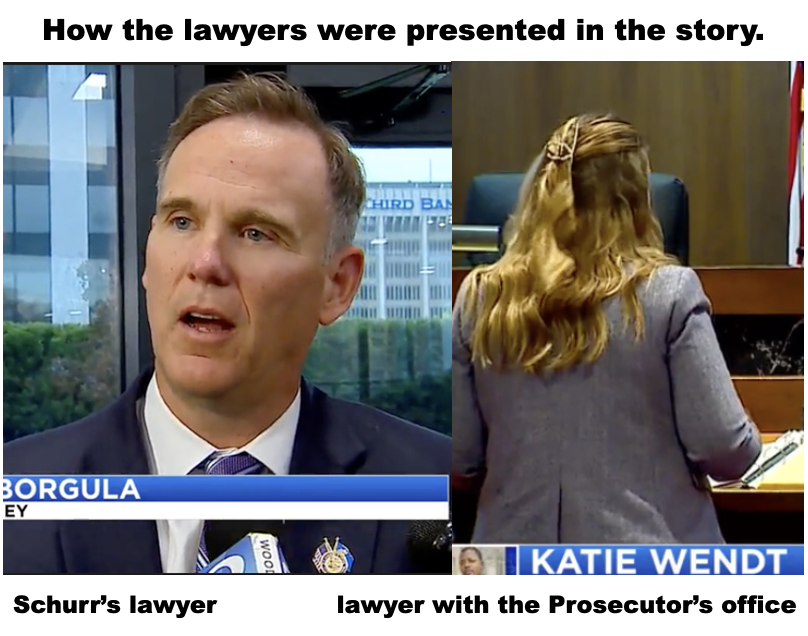
In addition, the MLive article leads with commentary from Schurr’s lawyer, along with the fact that there is way more space devoted to comments from Schurr’s lawyer, as opposed to comments from the lawyer with the Kent County Prosector’s office.
Lastly, at the end of the article, it stated:
The Michigan Fraternal Order of Police, Grand Rapids Police Officers Association and Michigan Association of Police Organizations have filed amicus curiae briefs in the appeals case arguing that the charge should be dismissed.
Unfortunately, the MLive article does not provide adequate context for these police groups, how much they influence public policy with campaign contributions to political candidates, nor do they provide hyperlinks to the three websites.
The Channel 8 story was not much better than the MLive article. There is the story that was broadcast, but also a written version of the story, which has a headline stating, Court hears ex-officer’s appeal in Patrick Lyoya case.
The WOODTV8 story is 2 minutes and 33 seconds in length. After providing a basic upfront narrative, the channel 8 reporter then cites some of the arguments from Schurr’s lawyer, followed by 22 seconds of Schurr’s lawyer making comments. In contrast the reporter used less commentary from the lawyer with the Kent County Prosecutor’s office, followed by 18 seconds of hearing that lawyer. One other difference, is that with the lawyer from Kent County Prosecutor’s office, the footage is from behind her, so viewers aren’t looking at directly at the lawyer as she speak, but with Schurr’s lawyer, the footage that channel 8 used was outside of the courtroom, where the lawyer was facing forward, as if talking to the public. Therefore, the optics of how this story was constructed plays a role in how the public navigates this story.
In the case of WZZM 13, there was less bias in how the story was presented, being more rooted in the legal process of the case. The channel 13 story did lead with comments from Schurr’s lawyer, but both lawyers in this case were only heard while they addressed the appellate panel. This means from a TV/video viewer perspective, both lawyer had their backs facing the public.
 The WXMI 17 story was significantly different than the rest of the coverage, in that they posted the video of the entire legal proceedings at the top of the page, followed by a short narrative of the legal case.
At the bottom of the page for Fox 17, they also ran a short video, where people can hear chanting from those who support Patrick Lyoya. As you can see from the still image here it says there were supporters from both sides, but only at the end is the footage of Schurr supporters, even though they are not identified.
Several of the news outlets mentioned that it might take months for the three judges panel to make a ruling on this case. It has already been 18 months since Patrick Lyoya was shot in the back of the head by Christopher Schurr, but there is no clear timeline for when a trial might happen, or even if a trial will ever happen.
Reflections on the Rent is Too Damn High Rally in Lansing
I spent a good chunk of the day at the Rent is Too Damn High Rally at the Lansing State Capital on Tuesday.
There were several hundred people in attendance, from communities all across Michigan, some of them organized with tenant unions and others with non-profits who have made housing a priority for the populations they work with.

The rally featured several speakers, some who were part of organizing the rally and some from other community-based groups. However, some of the most powerful comments came directly from tenants, those who are most impacted by the increased costs of living in rental units that are driven by landlords and property management companies that put profit before people.
The Rent is Too Damn High is a growing statewide coalition, which presented its list of demands at the beginning of the rally, demands that some might consider ambitious. However, these demands are based on the collective lived experiences of tenants across the state and across the country. The four demands are as follows, which are taken directly from this link.
Rent Control – Remove the state-wide ban on rent control so municipalities can take action to stabilize rents and protect tenants. Rent control is any policy that directly regulates or limits landlords’ ability to raise rents on an annual basis. For instance, a city may limit increases to a certain percentage, or according to some other formula. Rent control provides tenants with the security of knowing they won’t be priced out due to arbitrary and excessive increases in rent. These types of local policies were banned by the state legislature in 1988. We support a repeal of this ban on rent control.
Social Housing – $4 billion for social housing in FY25 state budget. “Social housing is a public option for housing that is permanently affordable, protected from the private market, and publicly owned by the government or under democratic community control by non-profit and cooperative entities. Around the world, robust social housing programs have ended affordable housing shortages; expanded democratic accountability and equitable housing access; and raised populations out of poverty and into prosperity.” Social housing is built to house people well, rather than deliver a profit to developers & managers. States and municipalities in the US are initiating social housing programs anchored by a new generation of public-sector housing development agencies. We support a $4 billion state infusion into social housing, to be administered regionally by public developers. This amount could directly support approximately 40-50,000 new social housing units, which would make significant progress towards the state-established goal of building 75,000 total new homes over the next 5 years.
Housing First – $1 billion for people experiencing and at risk of homelessness in FY25 state budget. Housing First is a successful and evidence-based approach to reducing homelessness that focuses on providing housing to people, rather than criminalizing or pathologizing them. We support a $1 billion state infusion into programs of direct service, rapid rehousing, and permanent supportive housing, with a housing first lens. These funds should be distributed and administered regionally.
A Renter’s Bill of Rights – Renters around the country are insisting on more protections against landlord abuse and empowerment of renters as a class. Michigan renters need these rights and protections as much as any. A Renters Bill of Rights may include fair chance housing for returning citizens, tenants’ right to organize and have counsel, relocation assistance in case of red tagging, increased safety inspection standards, legal protection against discrimination based on housing status, just cause eviction, renter agency for repairs, a ban on hidden rental fees, and other such policies.

After listening to several tenants and community-based organizers, the several hundred strong rally participants went inside the State Capital to occupy the gallery spaces for both the State House and State Senate. In those spaces there were more speakers and chants, but a great deal of the attention was directed at the Michigan Democratic Party. The Michigan Democratic Party has made it a point to talk about how they now control the State House, the State Senate and the Governor’s office, yet there agenda since taking power in Michigan has NOT included any of the 4 demands from the statewide Rent is Too Damn High coalition.
Now, some might argue that the $5 billion of housing investment that the Rent is Too Damn High coalition is not very practical. However, we know that the State of Michigan is providing subsidies in the amount of $1.63 Billion to Ford and GM for EV production, roughly one-third of the cost in the Rent is Too Damn High demands.
Another way of thinking about how much tax money goes to things other than housing can be found at the National Priorities Project, which provides a clear breakdown of tax money leaving each state to fund the US military Budget. For the 2023 US Military Budget, $24.07 billion of taxpayers money left Michigan to fund the US Military. This amount of taxes from Michigan that is used to fund the US military is almost 5 times the amount that the Rent is Too Damn High coalition is demanding. It’s never a question of there being enough money for important things like housing, rather it is a matter of priorities. A bloated military budget is more important that housing.
They locked the doors on us
After we occupied the Capital, those of us from Grand Rapids decided that it was probably a useful tactic to go and visit the office of the Senate Majority Leader, Winnie Brinks.
While waiting for all of our GR people, I noticed that there were people looking through the glass window on the door for Senator Brinks’ office. At one point, someone even opened the door to peak out into the hallway. Once we had all of the GR contingent with us, we decided to that we would share some tenant stories and demand that Senator Brinks make the 4 demands an immediate priority, we decided to enter her office. When we turned the doorknob it was clear that the office was now locked. We then began to knock on the door to see if someone would come out, but still nothing. One of the State Capital security people came over and said that they could go in through a different door and see if the staff from Senator Brinks’ office would speak with us. After a few minutes, the security person returned and said that the staffers for Senator Brinks would not speak with us, since they had spoken with two other people from Grand Rapids an hour ago. This of course was a bullshit answer, since this was a new group, which had clear demands and should have been granted access to speak with her staff. Denying her constituents the opportunity to speak with staff sends the wrong message about community engagement and embracing community-driven policy changes. This all felt very similar to an action organized by Movimiento Cosecha two years earlier.
While the experience with Senator Brinks’ staff might have left a bad taste in our mouth, most of the day was invigorating and even inspiring, particularly with the turnout and the energy that was demonstrated by those participating in the rally. Housing justice certainly requires that we radically re-imagine what a non-market housing model might look like, but it also means we have to continue to center the lived experiences of individuals and families that are exploited by landlords and property management companies. People over Profits!

I was invited by All Souls Community Church to talk about A People’s History of Grand Rapids, so here is my non-sermon
This past Sunday, the good people of All Soul Community Church invited me to talk about my book, in place of where the sermon would normally go. The community was very welcoming and they were very receptive and affirming of what I had to say. Here is the non-sermon that I delivered on Sunday.
I wrote A People’s History of Grand Rapids for several reasons. First, I wanted to provide a counter-narrative to the official version of the City’s history, a history based primarily on Rich White men, most of whom identified as Christians, you know, the men who have their names on buildings all across the city.

Second, I wanted to demonstrate that despite the conservative label that Grand Rapids gets, there is a rich history of organized resistance against oppression, whether we are talking about Indigenous people resisting Settler Colonialism, workers fighting against exploitation, the African American community engaging in the Black Freedom Struggle, community members opposing war, those fighting for environmental justice and those in the LGBTQ community resisting heterosexism, homophobia and transphobia.
Third, I want to write a book that adequately provides historical context for the various social movements throughout the history of Grand Rapids, that each of these movements were fighting against systems of power and oppression that I would argue are central to Grand Rapids, from its founding to the present.
Lastly, I wanted to write a book for the current and future generations. I do a fair amount of organizing with young activist/organizers in Grand Rapids, and I wanted them to know that their actions are an extension of the struggle for justice that has been going on for two centuries in this community. Their resistance to current injustices is part of this powerful legacy of resistance.
However, since the country will be celebrating Labor Day on Monday, I wanted to talk a bit about the legacy of radical organizing within the labor movement and the movement for economic justice.
Again, despite the claims that Grand Rapids is conservative, there have always been workers that have challenged the Capitalist Class in this community. The first effort to organize around an 8-hour workday, was done by city workers in 1867. Remember, the whole point of a labor union is to democratize our workplaces, not just to fight for better wages.
In May of 1891, both cable and horse car workers went on strike for higher wages and union contracts. The street railway company began hiring scab workers immediately. As the week progressed, workers tried to keep cars from running, first by inducing others not to take their jobs, but later by blocking the cars directly. This was a tactic that falls under the strategy known as Direct Action. Direct Action is when people decide to take matters into their own hands to make change, rather than just appeal to those in positions of authority or those in power. This is why I chose that quote from the great freedom fighter Assata Shakur, where she said, “Nobody in the world, nobody in history, has ever gotten their freedom by appealing to the moral sense of the people who were oppressing them.”
The reading for today was a summary of the great 1911 Grand Rapids Furniture Workers Strike. It is important to note a couple of other things about that strike that was not included in the reading. Also, I would encourage people to read Jeffrey Kleiman’s book entitled, Strike!: How the Furniture Workers Strike of 1911 Changed Grand Rapids.

Not everyone in a position of power took the side of the furniture barons. The Catholic Bishop of Grand Rapids, Bishop Joseph Schrembs, spoke out against the injustice being done to the workers. He said, “I consider the present labor situation in our city as a most deplorable one from every point of view. I would welcome and hasten the day when compulsory arbitration will force men dealing with their fellow men to let fairness and justice come to their own through reasonable methods rather than through the cowering of men’s hearts through the cruel pangs of hunger of their wives and children.”
Such a demonstration of solidarity did not come without a cost. Because he sided with workers, the Vatican had Schrembs reassigned to the Diocese of Toledo.

Now, the 1911 Furniture workers strike did not end in victory, but it did pave the way for future labor organizing and it demonstrating the importance of solidarity and community care that workers and their families participated in. Just 1 month after the strike ended, 10,000 people marched in the Labor Day parade, which was about 10% of the population of the city at that time. This doesn’t even include the people greeting them along the parade route, cheering for them and thanking them for their courage.
In addition, it is important that we recognize that the Furniture Barons were so threatened by the strike, that they decided to change the City’s Charter in 1916. During the strike, Grand Rapids had a 12 ward political system, with many of the wards divided along ethnic lines – German, Polish, Lithuanian, Dutch, etc. The Furniture Barons put forth a ballot initiative to change the 12 war system into a 3 ward system and to end having a strong mayor to a mayor that would be nothing more than a glorified commissioner. The initiative passed and the Capitalist Class won that round of class warfare, thus consolidating political power in the city.
Another theme in my book is the idea that when people take bold action or engage in radical imagination, it tends to open up new spaces for other people to do the same thing. What I mean by Radical Imagination is best said by the great Puerto Rican poet, Martin Espada, who stated, “No change for the good ever happens without it being imagined first, even if that change seems hopeless or impossible in the present.”
At the end of 1936, autoworkers in Flint did something that had not been seen in the US, they engaged in a wildcat strike, where workers occupied the factories and would not allow production to happen until they won their demands. The wildcat strike was so successful that is was repeated all across the country, even in Grand Rapids. Workers at the Kelvinator refrigerator and domestic appliances factory were victorious in their fight to unionize in 1937, because they used a wildcat strike model.
However, after WWII, with the anti-communist purges brought on by the McCarthy Hearings and then the passage of the Taft-Hartley Act, which made it illegal for workers to go on strike, the labor movement became less militant. On top of that, most of the mainstream labor groups began to redirect union dues to fund Democratic Party candidates, which has not affectively won them any significant labor battles over the pas 60 years.
Some of the labor complacency changed after the Reagan years, as more and more labor rights were being undermined. In 1994, when the Clinton Administration adopted the North America Free Trade Agreement, there was a massive relocation of manufacturing jobs to Mexico, which gutted union membership. Two years later, the Clinton Administration adopted the Personal Responsibility and Work Opportunity Reconciliation Act, which essentially dismantled much of the welfare system that provided a safety net to working class families.
 It wasn’t until the WTO protests in 1999 in Seattle, that the labor movement and economic justice struggles were beginning to gain attention. In Grand Rapids there were campaigns to challenge global trade policies, efforts to expose the realities of sweatshops that made our clothing and increased efforts to shine the light on service workers that have been exploited for decades. Now we know about efforts among Amazon and Starbucks workers to unionize their workplace, but it is important that these current campaigns were because of worker groups like the IWW, which first began a campaign to unionize baristas at Starbucks in 2006. More importantly, this campaign to unionize Starbucks baristas began in Grand Rapids.
I wanted to end by saying that over the past four decades of being part of social movements and researching this two century history in Grand Rapids, that when injustice exists, there are always people who will rise up to fight it. I have also seen long lasting relationships blossom between people who have engaged in these struggles for liberation. While at times it may seem like we are not making the necessary changes to create more freedom and justice and equity, please know that you are part of a long standing tradition of fighting for collective liberation, even when we don’t see an immediate outcome.
People I have met in the struggle for justice want to win, but what I have witnessed is that when people engage in these struggles they are transformed because of the struggle. While I was in Chiapas, a young Mayan told me, “my people have not only endured 500 years of oppression, we have never lost sight of who we are as a people.” In the end, maybe that is enough.
“It is better to die on your feet fighting, than to live on your knees in submission.” Emiliano Zapata
Those in power have been telling us behind closed doors not make any noise about the murder of Patrick Lyoya
Recently, a federal judge has dismissed Grand Rapids City as a defendant in a lawsuit seeking millions after a police officer fatally shot Congolese immigrant Patrick Lyoya.
On the heels of this recent legal setback, the father of Patrick Lyoya, lawyer Ben Crump and former Kent County Commissioner Robert Womack, along with the support of the Grand Rapids Alliance Against Racist and Political Repression, held a rally and a march in downtown Grand Rapids.

With an estimated 60 people turning out, participants marched from Calder Plaza to the Kent County Courthouse to demand justice for Patrick Lyoya, the young Congolese man who was shot in the back of the head by a GRPD cop after being pulled over during a routine traffic stop.
The march went past the federal building and crossed at Ottawa, where people doing crowd safety made sure that traffic did not put people in danger. Motorists who were on Ottawa crossing Michigan had to wait 30-40 seconds, while the mostly Black marchers crossed the road. Despite such a short amount of time it took for motorists to cross, some were visibly upset and other yelled at those marching once they were cleared to cross the road. It was yet another clear example of privileged people being upset over their day being interrupted by those who are seeking justice for a victim of state violence.

Once the marchers reached the Kent County Courthouse, people began to gather to hear speakers. A sound system was provided by members of the Stagehands Union, IATSE. The speakers included Peter Lyoya, a representative from the Grand Rapids Chapter of the NAACP, a local Black Pastor, Robert Womack, Ben Crump, a member of the Comrade Collective, someone from the Black Lives Matter group in Lansing and a few others. What follows are some of the themes that were addressed by those that spoke.
- Patrick Lyoya was a father who just wanted to go home and see his family. He tried to get away from the cop that pulled him over, resisted while being tased, but was eventually shot in the back of the head while lying face down on the ground.
- People should not give up in this fight for justice.
- The video footage of the murder of Patrick Lyoya clearly demonstrates that he was not a threat to the GRPD cop who shot him.
- The GRPD cop who shot Patrick, Christopher Schurr, is not the only problem. The larger, more systemic problem is the function of policing in the US, particularly as it is applied to the Black community.
- People should stop voting for elected officials that have remained silent on this issue and refused to participate in the campaign to win justice for Patrick Lyoya. There was only one local elected official at the rally.
- Local politicians have been meeting behind closed doors with the family of Patrick Lyoya and some of the organization supporting this fight, urging them to trust the process and to not burn down the city. We see what the process has got us…..no justice for Patrick Lyoya!
Lastly, people who attended the rally were urged to show up on Wednesday, September 6th at the Kent County Courthouse for another short rally at 9am, then to pack the courtroom where the Michigan State Court of Appeals will be hearing arguments related to the case of “People of MI v. Christopher Paul Schurr.” Here is a link to that event.
 Grand Rapids Institute for Information Democracy