Who doesn’t support paid family and medical leave in Michigan? The West Michigan Policy Forum
In May, Senate Bill 332 was introduced, legislation that would provide paid family and medical leave. In a September 6th statement from Governor Whitmer’s office, it states:
Too many Michiganders cannot be there for their families without sacrificing a paycheck. No one should have to choose between their health, their newborn, or a sick relative and paying the bills and putting food on the table.

In May, the proposed legislation went to the Housing and Human Services Committee, but there has been no public hearing on the matter as of yet, thus it remains in that committee.
In Whitmer’s address to state lawmakers in late August, the Governor had this to say about the paid family and medical leave bill:
“It helps workers be there for their families. It gives you breathing room to get better when you’re sick, to bond with your baby or care for a family member. Right now, 77% of Michigan workers do not have access to paid family, medical leave.”
The Michigan Chamber of Commerce has come out against the proposed legislation, which is consistent with their position on anything that would benefit workers. You can read their position on the issue here, then click on SB 332.
One of the organizations that makes up the Grand Rapids Power Structure has taken notice of SB 332, and has posted 3 articles within the past week alone. The West Michigan Policy Forum (WMPF), which is the leading right wing organization in West Michigan on public policy in Michigan.
In the first article from the WMPF, they are making an old argument, which says that the proposed legislation will negatively impact small businesses. This is one of the oldest and most common arguments from groups like the Chamber of Commerce and the West MI Policy Forum. The reality is that these entities don’t really care about small businesses, which have virtually no representation on their boards. Also, what were these pro-businesses doing to help prevent small businesses from going under during the peak of the COVID pandemic?
In a second article on the West Michigan Policy Forum’s website, they are making the argument that it will negatively hurt the working families around the issue of taxes. This article says nothing about how the current tax policies in Michigan overwhelmingly benefit the business class over workers, plus they don’t acknowledge that one of the first priorities of the West Michigan Policy Forum was to eliminate the business tax back in 2011.
The third, and final article, features WMPF’s Board Chair John Kennedy, who argues that if SB 332 were to be adopted that it “would be disastrous” for Michigan. What Kennedy really means is that SB 332 would likely increase taxes on Michigan businesses and allow for greater flexibility for when people can take family and medical leave. All of this would of course be beneficial for workers and their families, which people like Autocam Medical’s CEO John Kennedy doesn’t make a priority.
What is important to note about John Kennedy and other members of the West Michigan Policy Forum is their consistent commitment to putting profits over workers, their role in the interlocking systems of power in Grand Rapids and their significant campaign contributions to Republican candidates and incumbents, all of which support their policy platforms that line up with the WMPF vision – like Right to Work, undermining Public Education, attacking public sector unions, increasing austerity measures in state policies and supporting tax policies that benefit those with the most wealth. This is just one of the many reasons why those who identify as being part of the left or even progressives, should not ignore what groups like the West Michigan Policy Forum are doing.
A negative view of Christianity, legalized pot and people’s lack of faith in institutions is why America is in chaos, claims Doug DeVos’ podcast guest
It has been about 10 months since I last posted about Doug DeVos’s podcast called Believe!. In the podcast, DeVos interview former US Vice President and Presidential Candidate in 2024, Mike Pence. In true Orwellian fashion, DeVos and Pence were both talking about “leadership.”
There have only been five new podcasts in the past 10 months, but you have to remember that Doug DeVos is very busy figuring out ways to continue to expand his family’s wealth.

In today’s post, I want to talk about one of the more recent podcast from September 6th, with Aaron Renn as the guest. Renn used to be a senior fellow at the Manhattan Institute for Policy Research. The Manhattan Institute for Policy Research is a far right think tank that was founded by Reagan’s CIA Director, William Casey. Like most far right think tanks, the Manhattan Institute opposed Critical Race Theory, LGBTQ equality, was a big supporter of the US War on Terrorism, plays a significant role in denying Climate Change and is a member of the American Legislative Exchange Council. However, the think tank’s bread and butter is to promote free market capitalism.
Since Renn left Manhattan Institute for Policy Research, he joined the more Christian-focused organization known as American Reformer. As an example of where the American Reformer is coming from, here is an excerpt from their most recent article about 10 days ago, entitled, Manning the cultural ramparts. Here is the first paragraph in that article:
Despite the lawlessness, violence, and anarchy that was unleashed by Floyd’s death, America did not fundamentally change on that day. What had been there under the surface for quite some time, however, was revealed in all of its ferocious malice. May 25th, 2020 was, as it were, the storming of the Bastille of the American left’s cultural revolution. It is a revolution still underway, though there are some encouraging signs that a counter-revolution has begun.
Apparently, the problem all along has been the American left, not the cops, not structural racism, not debilitating poverty of the corruption that permeates electoral politics.
The topic of discussion between Renn and Doug DeVos is, When Did The World Start Going Crazy? In the synopsis that is provided about the show it states:
Aaron Renn blames the 1960s. That’s when traditional morality began to decline, going from a positive thing to a neutral thing in people’s lives. Now the situation is even worse: morality is largely viewed in a negative light – with disastrous effects on people’s health and happiness.
Here are some of the main comments in the discussion and my responses.
- Christianity used to be the norm and Christian morality was the dominant view in the country. Now, Christianity is viewed negatively. I would argue that Christianity as an institution began to be more questioned and rightfully so. More importantly, the dominance of Christian values in the US is still very present, particularly in major institutions.
- People who identify as Christians in a public way are marginalized or stigmatized. Renn doesn’t really provide concrete evidence to support this claim. My experience as someone who used to identify with Christianity and then rejected it, is that, particularly in West Michigan, in most circles, cultural, social, etc. is that being outwardly Christian does not marginalize you, it makes you part of the club. I work at Hope Network, which is a Christian non-profit. I don’t know how many times that when people ask me something about myself and I talk about the years I spent in Latin America, they just assumed I was doing missionary work. My response used to be I did human rights work, but now I say, I was actually doing work that was anti-missionary work. See my documentary, Reversing the Missionary Position: Learning Solidarity on Mayan Time.
- Doug DeVos asks what are the implications for us today with a country that is falling apart? Some of Renn’s response was that there are too many single moms or that marriage rates are falling. And of course, he thinks that this has a great deal to do with the “decline of Christianity.” Renn only offers antidotes, without any real analysis.
- At about 38 minutes into the conversation, Doug DeVos raises the question of “why am I here?” DeVos then says that if people don’t have faith, then how can they cope in the world or feel like they have meaning. This observation really struck me as a very infantile view of the world and of one’s self. Again, my experience is just the opposition. When I no longer identified with Christianity (or any spiritual tradition) I began to be even more fully human and the world was a much more interesting and exiting place.
- At around 45 minutes in DeVos and Renn began to talk about immigration, sort of the Ellis Island dynamic, where the country became more tolerant. I would suggest that there is a much different narrative about new immigrants, a narrative that is presented in the book, American Intolerance: Our Dark History of Demonizing Immigrants.
- DeVos then wants Renn to talk about Grand Rapids, even though Renn is not from here. This hasn’t stopped Renn from talking about Grand Rapids, as he does in an article from 2018 in the online publication City Journal, entitled, Manufacturing a Comeback, Grand Rapids has become a midwestern economic star and is generating new industrial jobs. This article is essentially looking at Grand Rapids through a pro-business lens, where the DeVos and Van Andel families are thought of as gods.
- At 54 minutes into the conversation, Renn then decides to gush about the DeVos family, saying that they are deeply rooted in this community. Renn uses the example of when Calvin had a new President come in and wanted to do a capital campaign to get rid of a $25 million debt. He said the Calvin President was able to raise the money in 8 months, where people with money came forward and didn’t want their name on a building. First, the effort was to pay off a debt, not to build a new building. Second, most of the names of buildings on Calvin’s campus has the name of particular religious families with very deep pockets.
Like all of Doug DeVos’s guests, Renn provided little analysis, made vague claims about what’s wrong with this country and blamed it on the lack of Christianity in society. And like all guests, Renn did not want to speak ill about the US, but he did heap a great deal of praise on free market capitalism, something that made Doug DeVos very happy.
Purchasing naming rights and following the legacy of the DeVos & Van Andel families: Acrisure and the primacy of free market capitalism in Grand Rapids
On Friday, it was announced by all of the area commercial news sources that Acrisure had purchased the naming rights for the downtown outdoor amphitheater. Grand Rapids Mayor, Rosalynn Bliss gushed over the announcement, saying on Facebook, “Super excited about this announcement today and the progress we are making on the amphitheater! We are so fortunate that Acrisure calls Grand Rapids home.”
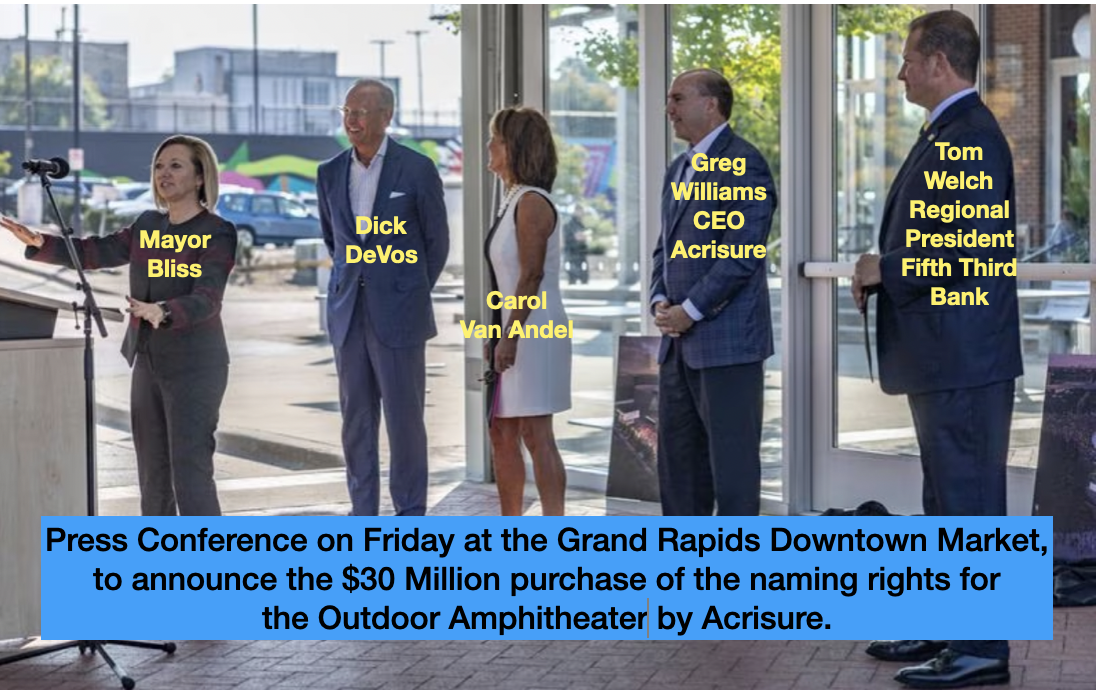
The announcement was made at the Grand Rapids Downtown Market, which makes complete sense, since the market, like the new amphitheater, used mostly public money for a facility that primarily catered to business class interests.
Acrisure purchased the naming rights for the new amphitheater for $30 million. To put this into perspective:
- The City Affordable Housing Fund is currently $17.5 Million.
- Acrisure is currently valued at $25 Billion, which means that purchasing the naming rights at $30 million is like most of us contributing $20 and then getting our name on a building.
- When Acrisure moved their headquarters to Grand Rapids, they were provided $7 million in economic incentives.
- The $30 Million from Acrisure for naming rights for the outdoor amphitheater is equal to the cost of rent for a year for 1,042 families, if those families monthly rental fees were $2000.
Following the legacy of Grand Rapids Oligarchs
In a separate MLive story related to the Acrisure naming rights purchase, the reported shared the following from the company’s CEO Greg Williams:
During Friday’s event, Williams paid tribute to the DeVos and Van Andel families, saying he’s learned from their history of community involvement and philanthropy.
“At the end of the day, we’re just following the lead that you and your families had established years ago,” he said, addressing members of the two families. “I’ve learned from what you’ve done, and I think this community obviously has been a huge benefactor. Hopefully, Acrisure can continue that role and play a role in some of those things going forward.”
Such a statement is rather instructive. If we are to be honest about what the DeVos and Van Andel families have done with their money over the years, what their legacies are, then we can draw some conclusions about what Acrisure might want to emulate in Grand Rapids.
The DeVos and Van Andel families have done the following:
- Made their initial billions in the form of a pyramid scheme known as the Amway Corporation.
- Have been the largest campaign contributors to the GOP in Michigan since the 1980s, which has translated to public policies that have been devastating to working class families, BIPOC families and other communities that are exploited under neoliberal capitalism.
- They have used their wealth to imposed their ideological values on the rest of the city, values that have done concrete harm to the LGBTQ community, promoted the privatization of public services, attacked reproductive rights, undermined public education, have subjected all of us to their brand of Christianity, and increased the wealth gap in Grand Rapids.
- Using their wealth to influence City and County officials to design the the downtown in ways that will primarily benefit their interests. Plus, they have done this hiding behind so-called Public/Private partnerships, meaning that they get the public to cough up millions for their pet projects without public consent or public input.
As for Greg Williams, who is CEO and Co-Founder of Acrisure, his current net worth is $56.5 million. Now, that is a meager amount, especially compared to the DeVos and Van Andel families, but Williams no doubt has greater aspirations.
In regards to what it is that Acrisure does, well it’s not entirely clear. Acrisure often refers to themselves as an insurance brokerage. However, the company also states that they offer retirement and cyber services, along with tech-driven financial services. In other words, Acrisure doesn’t produce anything, they only provide services that ultimately rely on market forces and speculative capital.
Greg Williams did sign on to the letter in support of the Grand Rapids Chamber of Commerce ordinance proposal to criminalize the unhoused last December. It would appear that the Acrisure CEO is indeed following the same political and business model as the DeVos and Van Andel families.
3 white dudes with no labor organizing experience talk shit about the UAW strike: Acton Institute podcast and the celebration of greed
When workers organize to fight for a better living, that is when people will often take sides on economic issues.
On Monday, the focus in their weekly podcast, Acton Unwind, the right wing think thank, the Acton Institute for the Study of Religion and Liberty, certainly showed us where they stand on the UAW strike.
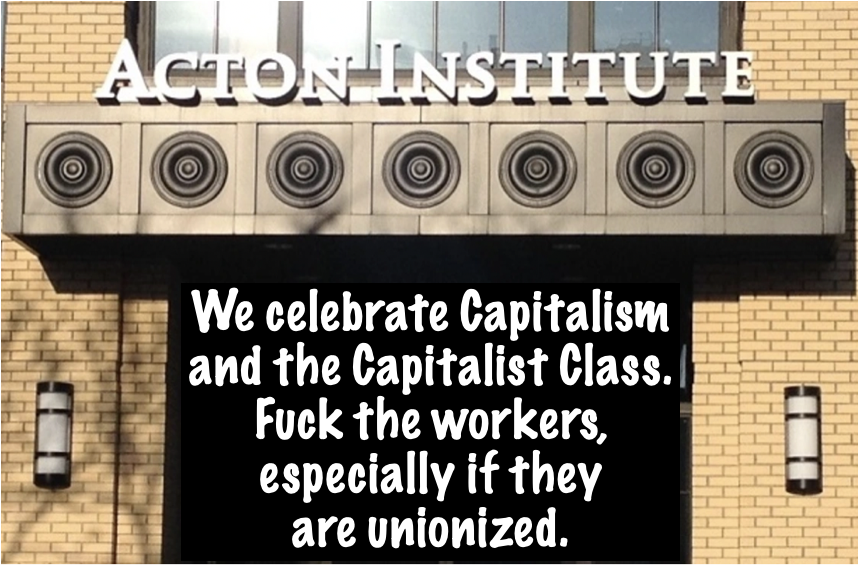
Their weekly podcast had the headline, Has Organized Labor Overplayed Its Hand? Again? Of course, this was to be expected, since the Acton Institute, founded in the early 1990s by Roman Catholic Priest Fr. Robert Sirico, has always preached that Capitalism and Christianity are perfect bedfellows.
3 White Dudes with no experience with organized labor
I’ll provide a brief analysis of the content of the podcast, but before that I think it is important to mention something about who was on this week’s podcast. The show is produced by Eric Kohn, who is Director of Marketing & Communications at the Acton Institute. Kohn is also often the host of the show. Before coming to the Acton Institute, Kohn was at another right wing think tank, Illinois Policy, which promote Right to Work policies and took a hardline anti-union stance. Kohn was also on the board of Chicago group known as America’s Future. America’s Future was founded in 1995, with the goal of provide future generations an opportunity to learn about and practice Capitalism.
A second guest on the show was Dylan Pahman, who is a research fellow at the Acton Institute. Pahman claimed during the podcast that he always got a better deal as an employee, especially better wages when he worked in the manufacturing sector. However, according to Pahman’s Linkedin profile, he only worked in the manufacturing sector for one company, Medbio, LLC, for only 11 months. It seems that Pahman was stretching his claim about “always” finding a better deal when working in the manufacturing sector.
The other guest on the podcast was Dan Hugger. Hugger is a librarian and research associate at the Acton Institute, along with the author of two books on the pillars of free market Capitalism, specifically Lord Acton.
Talking Points from the 9/18 Acton Unwind podcast
- Someone listed the demands of the UAW, and one demand was read with a sarcastic tone stating that the UAW wanted to have their members paid for 40 hours, but only work 32. Later in the show someone referred to this demand as “ridiculous.”
- Another person made the claim that if the Big 3 auto companies hire more people who are part of the UAW and demanding better wages, that they will be forced hire more temp workers. I think the podcast guys meant to say that the auto companies would chose to hire temp workers, as a way to avoid paying people a livable wage with benefits.
- A third claim was centered on the idea that the Big 3 auto companies needed to remain competitive, which meant a flexible workforce and more automation. If not, then they will repeat what happened in cities like Flint and Detroit. This was a curious and completely false claim, since the fact that Flint and Detroit lost auto manufacturing jobs over the years was always a policy decision by the Big 3 auto companies to find cheaper wages, non-unionized workers and move to state that had Right to Work policies, or countries that provided free trade zones to operate in. Free Trade Zones are essentially gated communities for corporations that had legal protections and were often provided huge economic incentives to relocate.
- At one point the 3 white dudes began to talk about how they loathed public sector unions, even though it had nothing to do with the UAW strike. In addition, they all made the claim that public sector unions were nothing more than private political organizations.
- The 3 white dudes also praised Elon Musk and the Tesla Corporation, but derided UAW retirees.
Not asking the more appropriate questions
So much of how commercial media and pro-Capitalist media is determined by how they frame critical issues of the day, like the current UAW strike. Here are the questions they sought to answer in the 9/18 podcast:
- Are the demands from the UAW reasonable?
- How should we think about trade unionization in America today?
- Are there any risks to the new strategy that the UAW is engaging in?
Now, these questions are not necessarily unreasonable questions, but they always put the onus on workers and never on the corporations. What kind of a discussion do you think would happen if these questions were asked?
- Ford, General Motors and Stellantis made a combined $21 billion in profits in just the first six months of this year. Should those profits we shared with auto workers?
- There are multiple lower wage tiers, such as the workers in parts distribution centers and many of those making components for electric vehicles. Should these tiers be done away with?
- The CEO salaries at the Big 3 auto companies are $29 million for GM’s Mary Barra, $21 million for Ford’s Jim Farley and $24.8 million for Stellantis. Don’t the workers deserve a more equitable wage, considering how much the CEOs make?
It’s clear that the Acton Institute, with their institutionalized bias in favor of Capitalism, would do a podcast that essentially demonized labor unions and autoworkers. We wouldn’t expect anything different, but at the same time we believe it to be important to know where organizations and institutions stand on issues like worker rights, economic justice and the growing wealth gap between the Capitalist Class and the Working Class.
Radical Walking Tour of Grand Rapids document for those who are unable to join us Saturday in person
 From the introduction to a Radical Walking Tour of Grand Rapids:
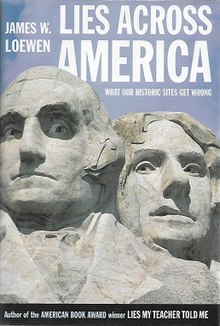
In his insightful book, Lies Across America: What Our Historic Sites Get Wrong. radical historian James Loewen takes us on an enlightening tour of the US and examines historical markers in big cities and small towns to see what lens history is presented in.
Grand Rapids also has many historical markers, especially in the downtown area, most of which have been sanctioned by Grand Rapids City officials or by other entities that are reflective of those who run this city.
An example of numerous historical markers, are the series of statues that have been created over the past two decades, known as the Grand Rapids Community Legends Project. The Community Legends Project was the brainchild Peter Secchia, former US Ambassador to Italy, former CEO of Universal Forrest Products and a member of what I identify as the Grand Rapids Power Structure.
Most of the statues are of people who have historically been part of the local power structure, although there are a few exceptions. What I want to do in this book, is to provide a counter-narrative to what those in power have sanctioned.
The locations that I have chosen follow more of a people’s history of Grand Rapids, whether we are talking about individuals, social movements or historical events that have taken place in the downtown area of Grand Rapids, or at least near downtown Grand Rapids.
I chose this book title, A Radical Walking Tour of Grand Rapids, in part because it could be part of an actual walking tour, indeed even performance art, that deconstructs the dominant narratives about Grand Rapids and allows us to collectively imagine how we might think about Grand Rapids if the stories of social movements and acts of resistance were how we talk about this community.
However, this book will also be an online tour that people can traverse virtually, whether you live in the area or not. There are a total of 34 locations on this radical tour, with a mix of historical markers and historical events. A Radical Walking Tour of Grand Rapids, is also a companion book to my book, A People’s History of Grand Rapids.
My hope is that this book will not only get you to think differently about Grand Rapids, but that it might inspire other radical walking tours throughout the city, where we can share more history from below, instead of the kind of history we are told to believe.

We recognize that spending several hours on a Saturday afternoon participating in a Radical Walking Tour of Grand Rapids, might not be the most appealing thing to do. We do believe that it is important that people become more familiar with the Radical History of Grand Rapids, since it is a fairly rich history that is often suppressed.
We plan to livestream the Radical Walking Tour, post photos, create a YouTube channel of videos for each of the stops along the tour, possibly create an app that people can access and do the tour on their own, plus it might even become another book.
In the meantime, we have put together a PDF of the Radical Walking Tour of Grand Rapids, which you can access at this link. Besides the text/scripts we will be using on Saturday, there are numerous images of either the location of each stop or other graphics that reflect what was happening on the date(s) when these actions happened.
We hope you find this useful and we plan to add many more for a final version of the Radical Walking Tour of Grand Rapids. We are also grateful for everyone who has provided some creative energy, their time, resources and passion for helping to make the Radical Walking Tour of Grand Rapids a reality.
Love & Rage!
Mel Trotter Ministries receives an additional $200,000 for storage bins for the unhoused, which makes them an accomplice in the criminalization of the unhoused
On Tuesday, Grand Rapids City officials approved a resolution that will give Mel Trotter Ministries up to $200,000 to continue their personal storage program. This is according to the Agenda Packet (pages 31 – 33) for the Fiscal Committee meeting for September 19th.

The $200,000 that the City of Grand Rapids is giving to Mel Trotter Ministries for personal items bin storage, will go into effect on October 1, 2023 and continue until September 30th, 2024.
Now, to those who have not been following the issue of how the City of Grand Rapids and faith-based non-profits have been responding to the unhoused, providing storage bins to people might seem like a compassionate response. However, if we look at the totality of why people become unhoused, we can clearly see that entities like Mel Trotter Ministries are in no way interested in eliminating the housing crisis, especially for the unhoused, in Grand Rapids. In fact, as GRIID has written before, we refer to entities like Mel Trotter Ministries as part of the Homelessness Industrial Complex in Grand Rapids.
Mel Trotter Ministries has been around for more than a century and they have always only practiced charity work and in no way are interested in addressing the root causes of the current housing crisis. Like many faith-based groups, particularly Christian groups, they practice a form of White Saviorism, where the often refer to “helping the homeless as helping Jesus, since Jesus can be scene in the homeless.”
Mel Trotter Ministries does not want to address the root causes of the current housing crisis, since that would require them to challenge the market-driven for profit hosing system that put profits over people. This is why Mel Trotter Ministries CEO signed on the letter last December, in support of the Grand Rapids Chamber of Commerce proposed ordinance, which would criminalize the unhoused.
If by chance Mel Trotter Ministries would address the root causes of the current housing crisis, they would also likely lose most of the current funding, especially from the large family foundations. For example, just within the most recent round of 990 document disclosure from numerous local family foundations, there has been……..Here is a list from the most recent 990 foundation document contributions to Mel Trotter Ministries.
- Richard & Helen DeVos Foundation – $25,000
- Dick & Betsy DeVos Foundation – $5000
- Cheri DeVos Foundation – $25,000
- Jerry & Marcia Tubergen – $525,000
- David and Carol Van Andel Foundation – $1,500,000
- Jandernoa Foundation – $187,500
Just with these few local family foundations, all of which are part of the Grand Rapids Power Structure, Mel Trotter Ministries received over $2 Million in one year. If Mel Trotter Ministries suddenly decided to challenge the for-profit driven housing market system or began to advocate that people earn $25 – 30 an hour for their work, then the money from the above foundations would dry up.
Lastly, it is important to note that one of the ordinances adopted by the City of Grand Rapids in late July, has to do with unhoused people who have their possessions with them. Yes, Mel Trotter Ministries has bins for people to store their possession, but not everyone trusts that their possessions will be safe with Mel Trotter Ministries. The ordinance also states that people will not be fined up to 30 days, as long as they reclaim those possessions. Not everyone, especially the unhoused have the means to reclaim said possessions, especially if those possession are not easily accessible.
More importantly, since Mel Trotter Ministries benefits from public funding (through this contract with the City) they have little incentive to see these types of contracts end. In addition, the very fact that Mel Trotter Ministries is a link in the system that criminalizes the unhoused, they are clearly an accomplice to the criminalization of the unhoused. The only way for Mel Trotter Ministries to not be an accomplice in this instance, would be to make it a goal of their to confront the root causes of the housing crisis, with the goal of closing their doors, since if there are no unhoused people, then they would have no reason to exist.
Rockford Construction’s commitment to the principle of Profits Over People, got them the $12 Million contract to manage the redevelopment of Lyon Square
In August, GRIID post an article entitled, $12 Million to redevelop a small riverfront park in Grand Rapids is more money than the amount of money the City has set aside for their Affordable Housing Fund.
In that GRIID article from August 9, we wrote in part:
However, the point I want to make is that compared to several years of putting together an $11.5 Million budget for Affordable Housing, the City of Grand Rapids approved $12 Million to redevelop a small downtown park with one simple vote. The $12 Million for Lyon Square will not be used for housing, but for a park space that will primarily benefit tourists and members of the Capitalist Class.
Now imagine for a moment that the DeVos family would foot the bill for the Lyon Square project and the $12 Million that the City will now be borrowing, would instead go directly to affordable housing. Affordable Housing is a relative term, but let’s say that for a new modest home for a family of 4, it would cost $250,000. With $12 Million, the amount they will be spending on redeveloping a small park, that amount of money could cover the cost of building a $250,000 home for 48 families.
Forward 5 weeks and we read in the Agenda Packet for the Community Development Committee for September 19 (pages 5 – 8), that Rockford Construction is being awarded $12 million dollars in a Professional Services Agreement for Construction Management services for Lyon Square.
In the Agenda Packet of the Community Development Committee for September 19th, it states:
A Qualification Based Selection (QBS) process was used to solicit respondents and evaluate final procurement of a construction manager by an evaluation team consisting of City staff, Amway Hotel Corporation representatives, Downtown Grand Rapids, Inc. (DGRI) staff, and ASM Global representatives. The evaluation team selected Rockford Construction Co. (Rockford) as the highest qualified firm from a short-listed group of respondents. Subsequently, as part of the QBS process, a proposal was received and, on February 12, 2019 (Proceeding No. 88470), the City Commission approved preconstruction services for Rockford. Having completed those services, they are now prepared to move into the construction work based upon subcontractor bids received on August 10, 2023.
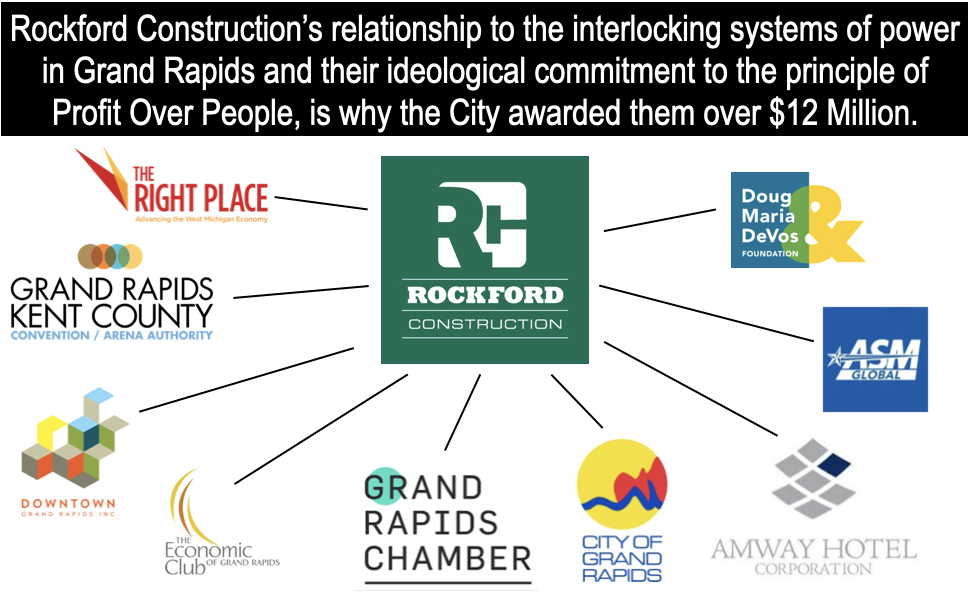
So, an evaluation team made up of City staff, Amway Hotel Corporation representatives, DGRI and ASM Global chose Rockford Construction to receive the initial funding in 2019. Now, GR City staff have always been partial to those with deep pockets, so no surprise that they would choose Rockford Construction. The Amway Hotel Corporation choosing Rockford Construction is a no-brainer, considering the longterm relationship/partnership that the DeVos family has had with Rockford Construction. The DGRI Board of Directors is primarily made up of representatives from entities that make up the Grand Rapids Power Structure, which also includes a staff member of Rockford Construction. ASM Global manages the Van Andel Arena and DeVos Place, which are under the control of the Grand Rapids-Kent County Convention/Arena Authority (CAA). The CAA is also represented by members of the Grand Rapids Power Structure, and includes Michael Verhulst with Acrisure Benefits, but he was the Vice President of Rockford Construction from 2017 – through April of 2022.
Companies like Rockford Construction often are chosen because they are part of the inter-locking systems of power in this city. Besides the fact that Rockford Construction is part of the GR Power Structure, they also get these kinds of contracts because of their ideological commitments to Capitalism. This has been on full display in the past 9 months, since Rockford Construction has been front and center to the profits over people dynamic with how downtown Grand Rapids Companies have responded to the unhoused population. Specifically, Rockford Construction has been a complete backer of the interests of the downtown business community that was manifested in the Grand Rapids Chamber of Commerce ordinance proposal in December of 2022, followed by the letter of endorsers of said ordinance proposal, followed by the backing of the City of Grand Rapids ordinances (a modified version of the GR Chamber’s proposal) adoption this past July.
The CEO of Rockford Construction was present when the City adopted the two ordinances that will further criminalize the unhoused. I posted an article the following day, which included these comments: Right after the vote to adopt the criminalizing ordinances, I got up to leave. Sitting two rows behind me was Rockford Construction’s CEO Mike VanGessel. VanGessel was sitting with another white guy and I just simply said, “well boys, you got what you wanted and what you paid for.” VanGessel is part of the Chamber of Commerce and is the chair of the municipal council, which represents 130 businesses downtown. VanGessel didn’t bother to speak during public comment, as he would prefer to let his money speak for him.
The fact that Grand Rapids will award a total pf $10,321,660 with a total amount not-to-exceed $12,462,996 to Rockford Construction is completely expected, considering the company’s relationship to the interlocking systems of power in Grand Rapids and their deep commitment to the principle of Profits Over People.
Legislation has been proposed that would allow Rent Control in Michigan, but will it get enough support?
The Rent is Too Damn High Rally that happened on September 5th in Lansing, has already pushed politicians to proposed legislation to allow for Rent Control in Michigan.

The statewide coalition of groups that came together to push politicians with 4 demands, is already gained some traction, since on September 7th, Rep. Carrie Rheingans proposed HB 4947, which states:
A bill to repeal 1988 PA 226, entitled “An act to limit the powers of a local governmental unit regarding the leasing of private residential property,” (MCL 123.411).
THE PEOPLE OF THE STATE OF MICHIGAN ENACT: 1 Enacting section 1. 1988 PA 226, MCL 123.411, is repealed. 2 Enacting section 2. This amendatory act takes effect 90 days 3 after the date it is enacted into law.
Now, this is just a proposal, which means it will have to go through the normal legislative process. On September 7th, HB 4947 was referred to Committee on Economic Development and Small Business, which is made up of 13 members, 8 Democrats and 5 Republicans. Once this committee discusses the matter, they are likely to hold a public hearing on the issue.
While there is a growing coalition centered around renters rights and rent control, you can bet that the Real Estate industry and the Property Owners Associations across the state will be lobbying state legislators heavily in the coming months, along with making sizable campaign contributions to candidates and incumbents for the 2024 elections. In fact, the Realtors Political Action Committee of Michigan has already contributed $10,000 to the Michigan Senate Democratic Fund, $10,000 to the Michigan House Democratic Fund, $5,000 to the House Republican Campaign Committee, $5,000 to the Senate Republican Campaign Committee and several candidates running for office in 2024, most of which are incumbents, according to State Campaign Finance records for just the July 2023 campaign contributions.
The other question to consider is how quickly any public hearing will be held and whether or not they issue will be taken up this fall? If the proposed legislation that would allow communities to put in place rent control in their communities doesn’t happen before the end of 2023, we might now see any action in 2024. Rent Control might be seen as too radical and political candidates, especially incumbents do not want to be seen as supporting policies that are “radical” – meaning that such policies really serve the people.
However, if the growing Rent is Too Damn High statewide coalition can continue to apply the necessary pressure on current state officials, then maybe we can get a hearing on Rent Control in Michigan before the end of the year.
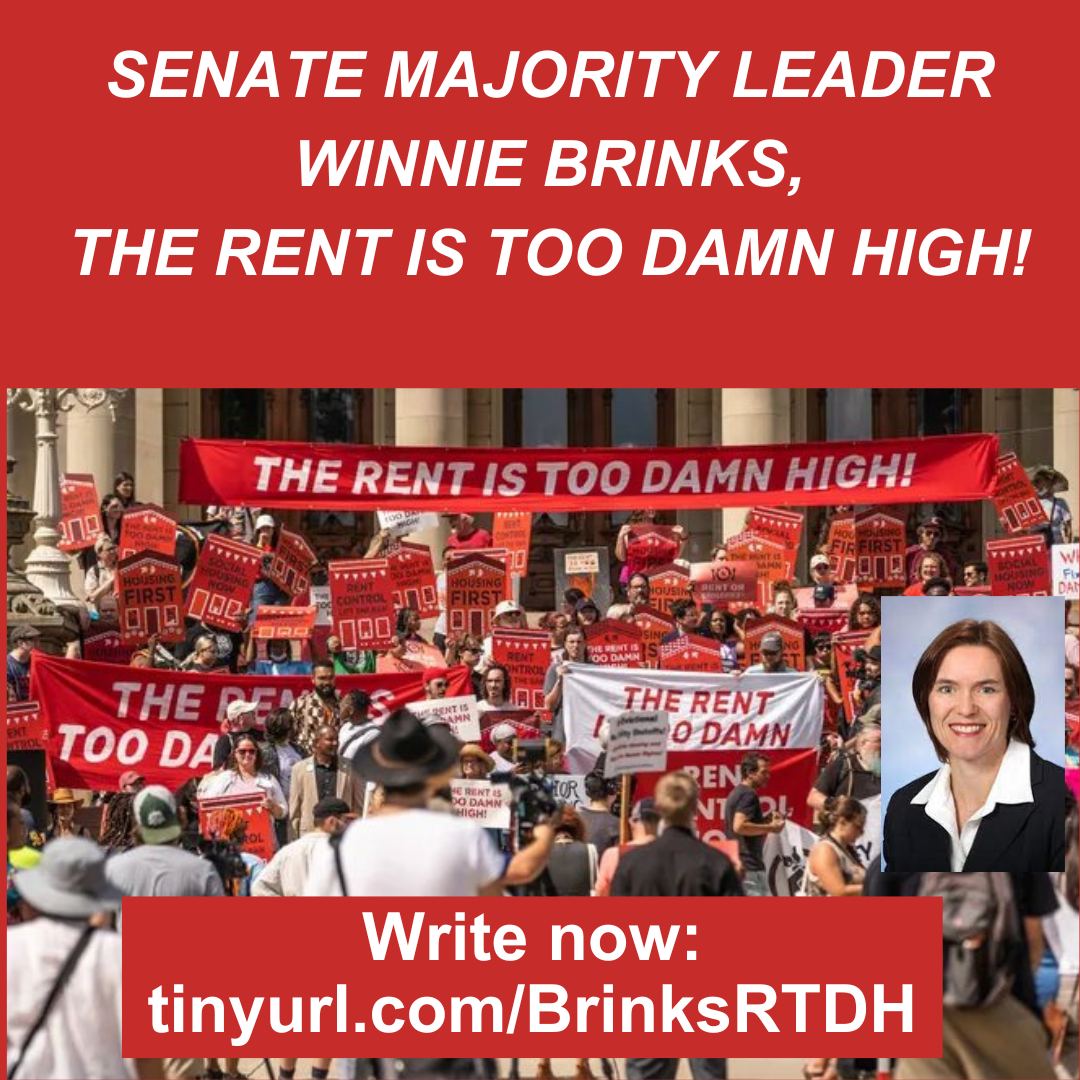
Locally, the Grand Rapids Area Tenant Union is encouraging people to sign on to an Action Alert that would pressure Senator Brinks, who is the current Senate Majority Leader, to embrace the four demands of the statewide Rent is Too Damn High coalition. Just go to this link to sign a digital letter to Senator Brinks, then share it with your social media circles.
However, even if the state efforts to win Rent Control won’t happen through legislation, that doesn’t mean we can’t be working on Rent Control right now on a local level. Rent control campaigns have been won by getting tenants from specific Landlords or Property Management Companies, when tenants are organized.
What a landlord/Property Management Company rent control campaign would look like, is to organize tenants in a particular community who all rent from the same landlord or Property Management Company. If we begin to identify Landlords and Property Management Companies that own multiple properties, we could also connect with other communities in the state to see if these same Landlords and Property Management Companies have tenants in their cities. Building a statewide movement for rent control could also happen like this.
 In fact, no tenant movement should put all their eggs in the basket of getting governments to adopt rent control, since we can do the work directly in our own communities right now. We can work on a rent control strategy that is 2 pronged, both government and landlord/Property Management Company as targets. Plus, the advantage of targeting Landlords and Property Management Companies is that you can demand more than just rent control, thus tackling multiple demands that would make any tenant movement more robust.
If you are a renter and this is something that you want to be involved in, then please contact the Grand Rapids Area Tenant Union by sending an e-mail to gratunion@gmail.com or leaving a message on their Facebook page.
UAW workers go on strike: Celebrating the legacy of UAW organizing in Grand Rapids
The current UAW workers strike is being called historic, especially since it is the first time that unionized workers in all three of the auto companies have been on strike together.
Alex Press, writing for the Jacobin, says that the UAW workers strike should matter to all working class people in the US. Press writes, “The entire working class will be watching to see if autoworkers can claw back decades of concessions and win a transformative contract.”

To honor this historic strike by UAW workers, we thought it would be important to provide some background on the history of UAW organizing in Grand Rapids, particularly after the Great Depression. What follows is an except from chapter 3 of my book, A People’s History of Grand Rapids.
Pushing Grand Rapids Left
Still reeling from their defeat during the 1911 furniture workers strike, Grand Rapids unions were not effectively mobilized to respond to the growing power of industrial capitalists. However, the insurgent labor organizing by the UAW and the CIO provided new inspiration and new opportunities for workers to challenge the business community in Grand Rapids.
In the Spring of 1937, the UAW called for strikes at the Robert Irwin Co., the Macey Co., and Irwin Seating, all based in Grand Rapids, which involved roughly 1,000 workers over a five-week period. In September of that same year, more strikes would break out at the Furniture Shops of America, John Widdicomb, Grand Rapids Chair, and other furniture factories in the area. In each of these instances the union won a closed shop contract guaranteeing to hire only union workers. The unions also won a check-off procedure, meaning union dues would be automatically deducted from the pay of authorizing employees, and, perhaps the cause of the most celebration to many of the workers, they won wage increases.
After a failed attempt to organize a union at the Kelvinator refrigerator and domestic appliances plant, the UAW tried again in 1937 and won their first contract, which included the recognition of the union and wage increases. Known as Local 206, this UAW organizing effort became a model for many of the other labor organizing efforts across the city of Grand Rapids. In some cases, workers defied local courts’ anti-picketing injunctions, and many workers went to jail for brief periods in order to win labor contracts and build worker power from the ground up.
While most of the labor organizing in Grand Rapids involved walk-out strikes and picketing that made significant gains, workers at the Atwood Brass Works held a wildcat strike and factory occupation that lasted for three days, following Flint’s example.
The radical direct-action efforts of the workers in Flint scared the business community enough to be willing to negotiate with angry workers in Grand Rapids out of fear that a wildcat strike might break out here. When people engage in radical direct action it pushes everything to the left. Workers in Grand Rapids were able to seize the moment created by the wildcat strike in Flint and mobilize workers (that had been labeled as “not radical enough” and “conservative”) to demand their rights and to unionize several thousand workers over the next several decades.
After the UAW and the CIO began organizing in Grand Rapids, union membership grew significantly. Yet union leadership at the national level made a deal with business leaders and the Roosevelt administration. The result was that the unions agreed to not strike while the US was involved in World War II.
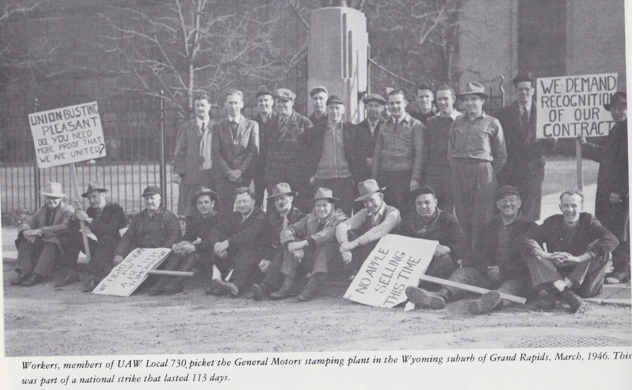
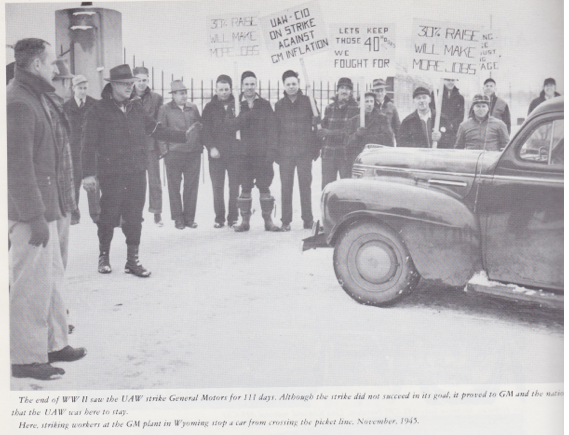
Despite the no-strike pledge, union membership in the US grew from 7.2 million in 1940 to 14.5 million at the end of WWII. The strikes began almost the moment that the bombs stopped dropping on Japan. In September 1945, 43,000 petroleum workers and 200,000 coal workers went on strike. In October, 44,000 lumber workers, 70,000 teamsters, and 40,000 machinists joined them. Then in November 1945, the UAW called its first major strike against GM since the company was unionized in 1937. Nearly a quarter of a million men walked out. Grand Rapids saw the same dynamic: workers who experienced years of frustrations during the no-strike pledge of WWII began to challenge the capitalist class by engaging in walkouts and strikes. In 1946, workers at the UAW Local 730 at the GM plant in Wyoming, Michigan were part of the national UAW strike that lasted for 113 days. The UAW striking workers were fighting for better wages, pensions, and improved working conditions, all of which were denied them during the no-strike pledge of WWII.
What this brief history of UAW organizing in Grand Rapids reveals to us is that working class people must always remain vigilant in the fight against the Capitalist Class, especially since they are relentless in their efforts to exploit workers whenever they can in order to increase profits for the owners and the shareholders.
Another GR Chamber report on immigrant contributions to the economy means they love the profits their members make from cheap labor
On Tuesday, MLive posted an article entitled, ‘Our economy wouldn’t work without them.’ Report shows how immigrants contribute to Kent County. This headline is accurate, but not in the way that the Grand Rapids Chamber of Commerce sees it.
The US economy, thus the local economy is built on exploiting immigrant and migrant labor. However, this is not the content of a new report published by the Grand Rapids Chamber of Commerce and the American Immigration Council, Economic Impact Report of New Americans in Kent County.
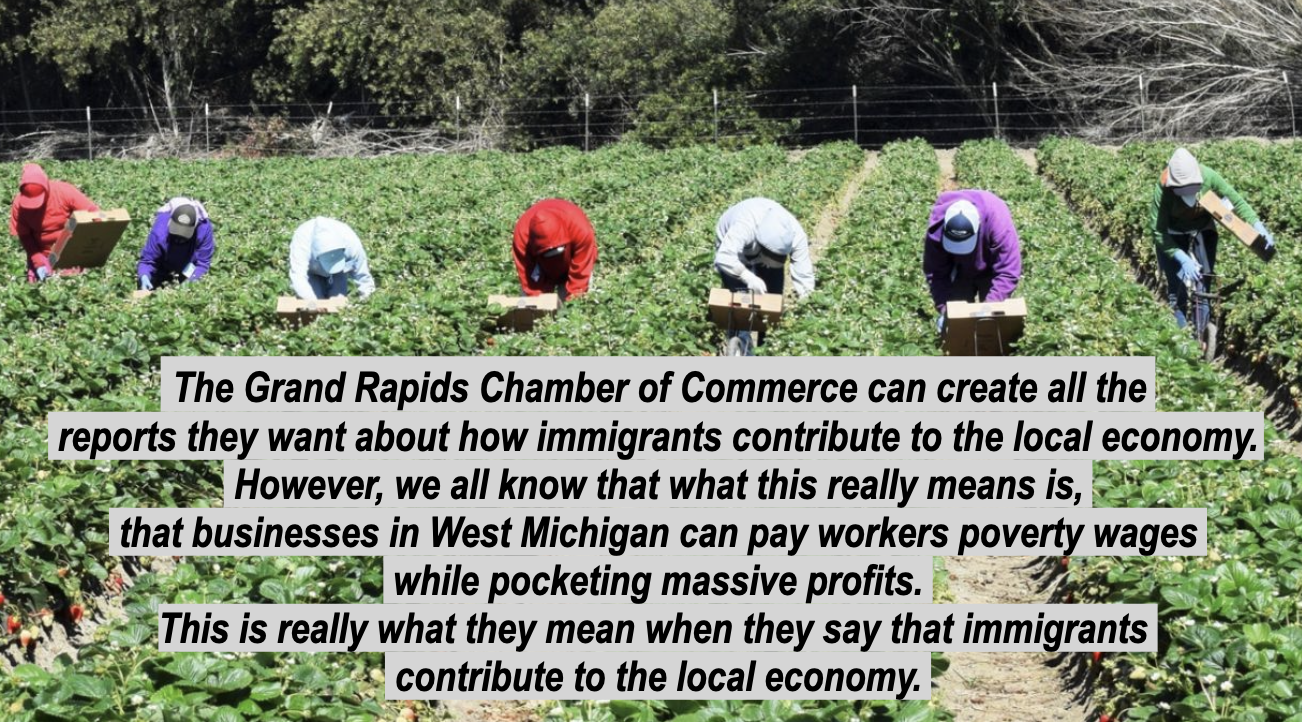
This new report from that the Grand Rapids Chamber of Commerce co-authored has the following four findings, with GRIID responses to each:
- Immigrants are helping the county meet its labor force demands. In 2019, immigrants were 27.3 percent more likely to be of working age than their U.S.-born counterparts, allowing them to actively participate in the labor force and contribute to the economy as taxpayers and consumers. GRIID – This point is just stating the obvious, but with no qualifiers. It is true that immigrants are part of the labor force, but they are also disproportionately exploited, with wages that are at poverty levels.
- Immigrants support the federal safety net. In 2021, they contributed $192.3 million to Social Security and $47.8 million to Medicare. GRIID – Again, the point here is true in terms of what immigrants paid into social security and Medicare, even though those who are undocumented are often unable to access these social benefits. According to Aviva Chomsky’s book, “They Take Our Jobs!”: and 20 Other Myths about Immigration, undocumented immigrants contribute billions of dollars annually to Social Security, yet they will never be able to access what they have contributed to.
- Immigrants are helping Kent County meet its rising labor needs in key industries. While making up 8.9 percent of the county’s overall population in 2019, immigrants represented 53.1 percent of agriculture workers, 15.3 percent of construction workers, and 14.8 percent of transportation and warehouse workers. GRIID – Again, just providing data is fairly meaningless, especially in this case, since agricultural workers and warehouse workers are some of the most exploited in the US. In fact, agricultural workers are one of only two labor sectors where businesses do not need to pay even a minimum wage.
- Immigrants in Kent County help create or preserve local manufacturing jobs. Immigrants strengthened the local job market by allowing companies to keep jobs on U.S. soil, helping preserve or create 2,600 local manufacturing jobs that would have otherwise been eliminated or moved elsewhere by 2019. GRIID – The context of immigrants allowing companies to keep jobs in the US is primarily because they can pay immigrants less, since most new immigrants are not unionized. Just think about the recent scandal in Grand Rapids, where immigrant youth were being exploited by companies who were paying them poverty-level wages, as reported on by the New York Times. This type of exploitation is more common than is often reported in the news media, which is the main reason why many manufacturing companies will keep their operations in the US, since they can exploit workers with ease.
This same issue was the topic of discussion with the Grand Rapids Chamber of Commerce back in early July, which we reported on. In that post, we identified three reasons why the Chamber’s celebration of immigrant labor is superficial and often harmful.
First, the Grand Rapids Chamber of Commerce and West Michigan Business leaders have a long track record of primarily endorsing and providing campaign contributions to GOP candidates at all levels of government. The Republican Party has rejected any and all aspects of Immigration Reform over the past several decades, even the mildest of immigration reforms. Not that the Democratic Party embraces any sort of immigration justice, but there have been several attempts since the Obama years to adopt some sort of Immigration Reform policies. (See the book, All-American Nativism: How the Bipartisan War on Immigrants Explains Politics as We Know It, by Daniel Denvir.)
Second, the North America Free Trade Agreement (NAFTA), along with other such trade policies, have undermined workers and displaced small farmers in countries like Mexico, which has led to massive numbers of immigrants coming to the US. These trade policies have been fully endorsed by the US Chamber of Commerce and the regional ones, like the Grand Rapids Chamber of Commerce. I remember attending an event at San Chez in 1995, which was co-sponsored by the GR Chamber, and was all about how businesses can market their products in Mexico after NAFTA had been adopted in 1994. The GR Chamber spokesperson even wore a fucking sombrero during his welcoming remarks to the event attendees.
Third, the GR Chamber of Commerce and many West Michigan businesses love immigrant workers, primarily because they are willing to work for low wages. There are literally tens of thousands of migrant workers (mostly of whom are immigrants) in West Michigan that make very little money for doing physically demanding work. Then there are all thousands more in West Michigan that work in the service sector – fast food industry, restaurants, janitorial, construction and hotel workers – all of which make low salaries. If the GR Chamber of Commerce and West Michigan Business leaders wanted to truly celebrate immigrant workers, they would pay people a living wage and be an outspoken advocate for people to earn no less than $25 an hour, regardless of the kind of work they do.
Since I wrote these reasons in July, I would like to add a fourth reason why I don’t trust the Grand Rapids Chamber of Commerce to really celebrate immigrant workers and their contribution to the economy. The fourth reason is simply this – the Grand Rapids Chamber of Commerce has been silent and arguably complicit in the anti-immigrant climate in West Michigan, since they have contributed significantly to GOP candidates and they have never spoken out against the state violence perpetrated by Immigration and Customs Enforcement (ICE), even though there has been strong opposition to this violence for several decades as I noted in chapter 9 of my book, A People’s History of Grand Rapids.
While the President of the GR Chamber of Commerce and the other West Michigan Business leaders talk a good game about US immigration policy, the need to fill the talent pool gap, and how much immigrants benefit the economy, what they really mean is that they are the ones who primarily benefit from immigrant labor in the current neoliberal capitalist economy.
 Grand Rapids Institute for Information Democracy