Media Bites – Ford Trucks & Masculinity
This week’s Media Bites takes a look at a recent Ford Truck commercial that features comedian Dennis Leary. The spot is in many ways about masculinity, with it’s use of images and language. We contrast the hyper-masculine commercial with the downsizing of workers by Ford and its relationship to power in Washington.
An evolving internal monologue, now published: Brett’s addition to the ArtPrize “Conversation”
(This article is submitted by Brett Colley, an Associate Professor of Art & Design at Grand Valley State University, and an exhibiting participant in ArtPrize.)
In its efforts to “reboot the public conversation between artists and audiences”, ArtPrize has raised into stark relief the tensions between two broad groups: Those with no formal art education who produce and/or patronize art, and those with credentials and/or careers connected to its preservation, theory, and production. Of course, members of each group are equally entitled to their opinions and practices.
I know from my experiences as an educator that mutual animosity between such factions is not intrinsic to a dialogue regarding contemporary art or its cultural value. However, the lack of organized forums (relative to other ArtPrize programming) for substantive public discourse concerning the art currently on display in downtown Grand Rapids has drawn out the suspicion and misgivings of each group.
In the past week, I have witnessed emotionally charged exchanges at both Kendall’s Lunchbox discussion with the ArtPrize team, and at the Battle for the Top 10 Critical Discourse, hosted by the UICA on Friday evening.
From the “General Voting Public”, there has been contempt projected toward the “Art Experts” who question the quality or legitimacy of some popular entries.
From the Expert crowd, there has been obvious disdain directed at the Voting Public for making what they perceive as poor choices. The model of a popular vote to determine the outcome has purposefully stripped those with years of education and experience of any exceptional role in assessing the contestants, and increases the likelihood that winners will not be representative of the high critical standards of the field. In an era that has seen the conflation of “High” and “Low” art/culture, does this really matter? Later in this essay, I’ll argue that it does.
Given the source of the idea (ArtPrize) and conditions that deliberately humble them, it is hardly surprising that area Art Experts (academics, professionals, et.al.) would brace with trepidation as their discipline was deemed the subject of a grand “social experiment” funded by one of the region’s wealthiest, most infamously conservative families.
It is equally unsurprising that the General Public has grown at best suspicious, and at worst resentful of Art Experts, and now feels exceedingly grateful to Rick Devos and company for restoring the validity/power of their own tastes (at least that’s a popular perception.)
After decades of assorted media-hyped “art controversies” (Robert Mapplethorpe, Andre Serrano’s Piss Christ, the Sensation show at the Brooklyn Museum), being fed vacuous rhetoric (“beauty is in the eye of the beholder”, or “I know what I like”) as if it were philosophical comfort food, and then being told what is “good” or worth lots of money (but seldom, if ever why) who can blame the G.P. for feeling indignant?
So much of the conflict is simply built into the subject at hand, or ”conversation”. (Which makes the structure for negotiating it all the more critical.) As my colleague Paul Wittenbraker recently and succinctly observed:
“Art is many things to many people simultaneously. This is one of the great powers of art, but also grounds for confusion and stress…The presumption that we can bring diverse art worlds together under the pretense of a unified outcome is problematic.”
Resolutions to the conflict are not simple, and the onus is on both groups – as well as the ArtPrize team itself – to enact them. I will go on to suggest some of the actions I believe necessary for resolution, but first it is important to cite some of the conditions that have brought this conflict to the forefront of the ArtPrize conversation:
By assigning value to the arts primarily through their ability to drive our economy, and incentivizing artists with prize money and wide-scale exposure, the organizers of ArtPrize have skewed both the event and the ensuing conversation toward creative works that are easily accessed (physically and conceptually) and commodified, and have marginalized many credentialed artists and critics with divergent ideas and practices.
The local news outlets (press and television) have focused overwhelmingly on the event’s positive impact for businesses in downtown GR, and treated the actual competition and entries as if discussions of quality were irrelevant. Their biased coverage quickly established the tenor of the conversation and has further rendered the event almost unassailable by critics. Those who don’t support ArtPrize unconditionally are tagged with the dreaded “e-word” (elitist) and regarded with suspicion.
I cannot delve into all the complexities of ArtPrize at once, as compelled as I am to do so. Thus, I won’t attempt to untangle the thorny “elitist/expert” knot in this essay. Suffice it to say: We live in an increasingly specialized world. The next time we need brain surgery or a general to orchestrate our troops in wartime, we will surely call upon a specialist with education and experience relevant to the task at hand.
I suspect that one reason the General Public perceives those of us who’ve expressed reservations about ArtPrize (or its potentially negative impact on area art) as “elitist” is because they believe we are merely trying to preserve our own authority and power within the culture of Art.
While I cannot deny that any “authority” I may have in this field has been hard-won (through 8 years of post-secondary education and 15 years of professional experience) and does indeed have value to me, it has not been my motivation in critiquing either ArtPrize or the quality of the contestants.
The undermining of my authority does have consequences, in that it potentially compromises my ability as an educator to convince students to grow beyond clichés, refine their craft, and reflect critically upon their impulses as young artists. I can certainly imagine future situations in which the “popular” winners of past ArtPrizes will render that task more difficult.
However, I do not aspire to assert opinions about art that will prevail over all others, nor do I expect to persuade 35,000 other voters to adopt my tastes.
My critiques (of the current ArtPrize model) stem from my sincere desire (evidenced by more than a decade of similar efforts in the classroom) to inspire and preserve high-quality visual culture. Again, I am not seeking to defend my own platform of authority, but I do wish to protect our visual environment from the repercussions of rewarding ill-considered or badly constructed work, and celebrating simplistic spectacle over subtlety and sophistication. Such repercussions would be felt by children, adults, amateurs and professionals alike, for it is evident that poor-quality creative culture degrades the experience and discourse of public life.
An intellectually lazy citizenry is the foundation of a weakened democracy.
In other words, all citizens have something at stake in this, knowingly or not.
On the evening news, I have watched Jeff Meeuwsen implore ArtPrize voters to carefully consider their decisions, and help shape an outcome they can be proud of. I believe that Jeff and I share an understanding with respect to the significance of what is judged as “good”. We each recognize the potential consequences of this social experiment for our immediate and long-term environment.
Rather than tuck my head in for fear of being labeled the “e-word”, I am offering my expertise to facilitate such “good” judgment.
Having made that offer, it is imperative that I and other Art Experts (academics, professionals) who share this aspiration find useful terms with which to engage the General Public. Recognizing that I am writing primarily to an audience of my peers, I will suggest that we engage those who lack formal training with language that is honest, reflects our shared humanity, shows respect, and which openly communicates our desire to produce and preserve a quality culture for the benefit of all. We each need to formulate ways of expressing the true value of the arts, in order to promote appreciation for both our convictions and our specialized work.
In short, we needn’t apologize, nor should we patronize.
I believe that every artist, art educator, or student of the arts should be capable of mounting an immediate, uncomplicated argument for the cultural value of what they do – an argument that does not lean on economic viability, marketable skills, or the intrinsic value of self-expression. (As an aside, I contend that there is nothing inherently beneficial to self-expression. For example, does anyone value Mahmoud Amademajad’s expressions of disbelief concerning the Holocaust?)
Historically, the arts have been inextricably linked to technological and conceptual innovation. Artists think through and with materials and contribute to the language and scholarship of other disciplines. We have looked to the arts in order to expand our capacity for communicating difficult concepts, or to share ideas we cannot otherwise express. Art can serve to catalyze public discourse regarding complex issues (in this instance, “Art” itself!) Art reminds us that problems can have more than one solution, that small changes can make big differences, that words and numbers are incapable of expressing all that we know, and that the world is comprised of multiple, diverse perspectives.
(These are values – lessons the arts teach – that have been clearly articulated by Stanford Professsor Emeritus of Art and Art Education, Elliot Eisner. If you don’t know him, look him up.)
Blunt, creative spectacles that captivate by virtue of bright colors, moving parts, and sheer scale often lack these more redeeming characteristics of art. One does not attend (or erect) a theme park with the intention of personal or societal growth, but for entertainment. Many of the 2009 ArtPrize entries operate on this level – they are rooted firmly in the familiar and presume our desire for nothing more than action movies and amusement parks. Art and entertainment are often, easily, and sometimes effectively conflated. But is presenting art as entertainment the mission of ArtPrize?
Several artists responsible for the “entertainment” in this year’s competition have readily admitted to employing spectacle as a strategy to capture the public attention and vote, working big and adopting popular, unchallenging subject matter. After all, one was overheard to say at Friday night’s “Battle for the Top 10”, “This is a popular vote, so we wanted to make something big and fun.”
If one pauses to fully consider that sentiment, one may begin to see why and how a capitalist model for art can so effectively break down the quality of art/culture and the discourse surrounding it. It is valuable, even imperative, that art production flourish outside the arena of capitalism in order to contribute freely to the intellectual and spiritual growth of our citizenry. Competitions structured as the 2009 ArtPrize has been structured serve (unintentionally) to further disenfranchise those artists working outside the sphere of populist appeal and the marketplace.
As long as the arts are viewed and applied as fuel in the economic engine, their value will be assessed thusly*. Art ideally teaches qualitative assessment skills, and yet so many of the measures for assessing the success of ArtPrize have been quantifiable: The number of voters, votes, gallery patrons, contest participants, restaurant profits, etc.
*(This is the unfortunate blowback of Richard Florida’s research. If you don’t know him, look him up.)
As an artist, educator, and citizen of Grand Rapids, I support all initiatives to reboot the conversation between artists and audiences, and ask simply that we continue to question this particular mechanism.
As future iterations of ArtPrize transpire, I hope that a structure is realized that places less emphasis on the competition/prize and successfully incorporates more opportunities for (adult) art education and moderated public critiques of the exhibited work. In Kendall’s Lunchbox Series – an aspect of ArtPrize that respectfully showcases the expertise and scholarship of the field – both content and discussion have veered toward the social experiment, rather than the actual exhibitors. I believe the real teaching/learning opportunities reside within the art itself.
The education day for area students, K-12, the audio guides, and the tutorial on contemporary art included in the preview party at the Old Federal Building have all been exemplary programming. But the UICA staff cannot – should not – do it all.
With respect to the conversation that happens inside this structure, arts professionals need to clearly understand the (non-monetary) value of what they do, develop an effective vocabulary with which to address “fans” and detractors alike, and (learn to) lead in efforts to inform our democracy, through reasonable, respectful discourse. The first language of artists and non-artists alike should be empathy. Embrace it or not, ArtPrize is now here, and has left us little room to hide behind our cynicism and doubts.
Support Internet Neutrality
The National Media Reform is asking people to sign an online petition to get your members of Congress to support legislation that would prevent corporations from creating an unequal Internet system.

Their petition states:
“The FCC has taken a big step forward to protect a free and open Internet, and now Congress needs to follow suit.
The phone and cable companies are scrambling to kill Net Neutrality so they can inspect and filter content, and overcharge you for using the Web in ways they don’t like. These companies have hired 500 lobbyists in Washington to try to stop this bill from becoming law.
It’s up to you to tell your members of Congress to side with the public — not with the corporate lobbyists — and take a final stand for an open Internet by supporting the Internet Freedom Preservation Act of 2009 (H.R. 3458).”
Share this information with friends and watch the short video that the Save the Internet Campaign developed.
Rethinking Afghanistan Screening Prompts Lively Discussion
Last night about 35 people came to Plymouth Congregational United Church of Christ to view a screening of the new 6-part documentary from Robert Greenwald, Rethink Afghanistan.
The documentary explores issues like human rights, security, women, Pakistan and the cost of war in Afghanistan. After the screening there was interesting discussion around the motive for the US occupation of Afghanistan now that it has lasted 8 years. Some people felt that there was no clear objective and that the US should either end the occupation or put the focus on doing development and anti-poverty work.

Most people were quite aware of the current discussion within the Obama administration over whether or not to send additional US troops, as is being suggested by Gen. McChrystal. Some US officials, like Michigan Senator Carl Levin, are advocating for more emphasis on training Afghani police and soldiers, but it was pointed out that this is just a tactical difference and not a disagreement on the larger strategy to win the “War on Terror” in Afghanistan.
Someone suggested that focusing on the monetary cost of the US occupation in Afghanistan might be the best way to reach people. A member of the group Brunch & Revolution talked about a recent march they held in Grand Rapids, where they handed out flyers with information on what the cost to taxpayers has been from Grand Rapids. According to the National Priorities Project (NPP), there has been a total of $479.2 million in tax dollars that have left Grand Rapids to fund the wars in Iraq & Afghanistan. The NPP also provides a breakdown of how that money could have been spent for health care, housing and education if it stayed in Grand Rapids.
Other issues that were raised dealt with the US efforts to respond to the skyrocketing opium production that is taking place in Afghanistan, US militarism and the US geo-political and natural resource interest in that part of the world as well.
One thing that many people seemed to agree on was that the information that was presented in the film is not a perspective that the US news media is providing. GRIID confirms that observation with our most recent study of the Grand Rapids Press and its coverage of Afghanistan.
You can view the 6-part documentary online and in light of the recent information coming out of Washington, we think that part 6 is particularly relevant since it speaks to the issue of policy and security.
The Press misses Greenwashing Campaign by Coca Cola in their partnership with local environmental group
On the front page of the region section in today’s (10/3) Grand Rapids Press there is a story about how barrels that were once used for soft drink syrup are now being used by local residents to catch rainwater. The story is framed as a good example of how people can reuse industrial waste and promote sustainability.

According to Press reporter Jim Harger, the Coca Cola Bottling Company of Michigan (Grand Rapids facility) contacted the West Michigan Environmental Action Council (WMEAC) about using their old barrels for a residential rainwater program. WMEAC was delighted to partner with Coca Cola and this effort fits into what the Coke plant manager John Bryne says was “part of the company’s Corporate Responsibility and Sustainability Week.” In fact, the rain barrel campaign is part of a larger effort by the Coca Cola Company to paint themselves as an environmentally sustainable corporation. The Coke website is filled with information and images about all the wonderful things they do to protect the environment and help communities.
What is unfortunate about this Grand Rapids Press article is that the reporter never bothered to investigate or challenge whether or not the company does indeed engage in sustainable practices. In the documentary Blue Gold: World Water Wars, Coca Cola and several other bottled water companies are exposed for their efforts to privatize public water to secure greater access to resources for their beverage sales. Maude Barlow in her book Blue Gold: The Fight to Stop the Corporate Theft of the World’s Water says that Coca Cola has been stealing water from communities for decades and since they got in the business of selling bottled water this theft has increased.

Take the case of India for example, where local communities and farmer have been battling companies like Coca Cola for years. According to the India Resource Center, Coca Cola has been taking needed water from communities all across India and contaminating the soil with factory waste. The case of India is but one example and Coke Cola has been the target of numerous local and international campaigns to challenge to company’s environmental and human rights practices.
It is unfortunate that the Grand Rapids Press didn’t bother to investigate why Coca Cola was partnering with a local environmental group during its Corporate Responsibility and Sustainability Week PR campaign. Had the Press looked into this issue they might have discovered that Coca Cola is doing nothing more than engaging an effective Greenwashing campaign.
Rethinking Afghanistan Film Screening October 4
This Sunday, October 4 there will be a free public screening of the documentary “Rethinking Afghanistan.” This six part documentary questions the 8 year US/NATO occupation of Afghanistan by investigating themes such as history, civilian casualties, how the occupation is impacting Pakistan, women in Afghanistan and who the insurgents are. A discussion will follow about the film and local efforts to organize against the war.

Sunday, October 4
7:00PM
Plymouth Congregational United Church of Christ
4010 Kalamazoo SE
Hosted by: Plymouth Justice & Peace Task Force, Brunch & Revolution, The Bloom Collective
Vigil Kicks Off Domestic Violence Awareness Month
About 50 people gathered at the downtown YWCA West Central Michigan facility for a candlelight vigil to kick off Domestic Violence Awareness Month. The YWCA has hosted this event for more than a decade.

Eileen McKeever with the YWCA welcomed the crowd and talked a bit about the statistical reality for domestic violence victims across the US. According to the most recent Department of Justice statistics (2005), more than 1,200 people died from domestic violence. Another sobering statistic was that when looking at male and female murder victims in the US, 33% of all women who were murdered last year were murdered by an intimate partner, but in the case of men who were murdered only 3% were murdered by an intimate partner.
In addition to these comments, several women from the community who work in the area of domestic violence prevention and victim services each read the names and information about 16 women who were murdered as a result of domestic in Michigan. The list of 16 was only a partial listing for 2009. In addition, those present watched a YouTube video that stressed the importance of thinking about how Domestic Violence is a learned behavior with children.
We spoke with Eileen McKeever after the event……
What Will the Media Report on After ArtPrize?
The first voting phase of ArtPrize has just been completed and before we know it the finally tallies will be in and ArtPrize will be over. Based on the type of and amount of local news coverage this event has generated, we thought it might be useful to place ArtPrize coverage next to other issues of importance to the community.
Before making any comparisons, it is worth looking at the ongoing coverage of ArtPrize in recent weeks. We have already looked at the ArtPrize media phenomenon is a previous posting from September 19, but here are some observations since then.
The local TV stations continue to provide daily coverage of ArtPrize with specific ArtPrize sections on their web sites like this one at WOODTV8. Most of the local news outlets tended to mimic each other’s coverage, like the story about how downtown restaurants were overwhelmed by the weekend traffic generated by ArtPrize. The FOX 17 story was typical, with lots of language about this being the most amazing event Grand Rapids has ever experienced, but with emphasis on how restaurant owners made out like bandits.

WZZM 13 had a few other elements that were tapping into the ArtPrize buzz. First, the added to the web site banner in big letters “The Place to See ArtPrize.” They also included on their main page a banner and link to their own photo contest under the heading “What is Art?” The contest is also based on voting, with the winner receiving $1,300. WZZM 13 partnered with local furniture company Haworth to promote their own contest.
The Grand Rapids Press has in many ways been the most zealous of ArtPrize supporters in local media. Beyond what we have already documented, the very first day they altered the design of the front page so that it looked like an ArtPrize magazine cover. They continue to provide daily front-page coverage and several other pages full of stories and photos.
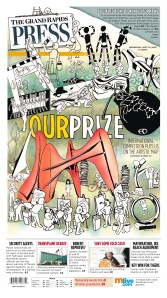
The most egregious example to date was the Monday, September 28 coverage, driven mostly by the reporting on the Rob Bliss paper airplane spectacle. The Press did several stories about this ArtPrize entry days before it happened, but the coverage afterwards was pretty astounding. The main story on 9/28 gushed with praise of the event created by what the Press reported has dubbed “urban event organizer Rob Bliss.”
There has been plenty of online discussion about whether or not the paper airplane drop was art or not, but as we have said all along the real beneficiaries of the ArtPrize phenomenon has been the downtown business and property owners. The financial incentive is tremendous, which is exactly why the local media has created so much content around ArtPrize, because this is what they believe will bring people to their web sites and thus, bring visitors to see the multitude of ads that inhabit those electronic destinations. As in the print version of the Press and the broadcast channels of the tv stations, advertising is king, because advertising is where they make their money. These news entities would not even entertain hosting a website if it was not driven by the advertising that pays for the sites.
Imagine ArtPrize-like coverage for other issues
Since it is painfully clear that local media coverage of ArtPrize has been all ArtPrize all the time, lets turn our attention to what this might look like with other issues of import to the local community.
A month from now there will be elections for local political office and several ballot proposals. According to the Kent County Clerk’s office, there are 45 candidates running for local office in Grand Rapids and other communities in Kent County. Imagine how what it would look like over the next few weeks if the local news media paid as much attention to the candidates, people who will make decisions that impact our lives everyday, as they have to ArtPrize.
There could be lead stories on the TV stations everyday with details about the candidates and particularly about the incumbents and what their voting records have meant for the people thus far. The GR Press could run front-page stories that featured in-depth analysis of the candidates and the issues they face with current budget problems, unemployment and sustainability efforts. Would this type of coverage translate into more people showing up at the polls on November 3? We will probably never know, since the coverage of local elections that we have documented over the past 10 years has been abysmal.
Imagine if the local news media was reporting on the lives of people, which number in the thousands in Kent County, who have lost jobs or are about to lose their unemployment benefits. How would we all perceive what is going on in our community if we were made aware of in detail the hardships that these people face?
The same could be said about the thousands of Kent County residents that currently have no health care insurance. Imagine if these thousands of people who are at greater risk of disease and suffering because they can’t afford health care got the same attention as the thousands of paper airplanes that kind of floated down to the streets of Grand Rapids. How would this type of coverage how we view our community?
“60 Minutes” Gives Gen. McChrystal a Free Pass on Proposed US Troop Increases in Afghanistan
On Sunday, the CBS news show “60 Minutes” featured an interview with President Obama’s top military general speaking on Afghanistan. Despite the popular notion that “60 Minutes” is a hard hitting and investigative program, reporter David Martin did not challenge McChrystal on the eve of the 8th anniversary of the US occupation of Afghanistan.

Online journal editor Bruce Jackson provides some excellent analysis of the “60 Minutes” episode in a piece that was posted on CounterPunch. Jackson states early on in the piece,
“The interview was more than just another “60 Minutes” puff piece. Four-star battlefront generals don’t put on dog-and-pony shows for reporters without a very good reason for doing so, and he put on a very fancy show for Martin, with stops at his room, his office, his briefing room, trips in his helicopter and SUV, and much more. It’s difficult to imagine that McChrystal’s reason was anything other than putting pressure on the Obama administration to give him the series of very large troop increases he thinks he needs to win his war.”
With growing public opposition to the US war in Afghanistan and McChrystal asking for an additional 40,000 US troops, it is no time for the news media to fail the public on asking hard questions to people who will make decisions that will affect us all.
We encourage you to watch the “60 Minutes” interview and judge for yourself.
Media Bites – Levi’s & Corporate Branding
This week’s Media Bites takes a look at a Levi’s commercial, which is part of their new “Go Forth” campaign. The spot uses crisp clean images of average Americans while viewers hear the words of a Walt Whitman poem called “America.” This Levi’s campaign has a significant web component as well, but the irony of the emphasis on America in the Levi’s campaign is that they no longer produce jeans in the US. This commercial is a great example of how corporations are always trying to brand themselves.

