Naomi Klein Issues Haiti Disaster Capitalism Alert
Naomi Klein, author of The Shock Doctrine: The Rise of Disaster Capitalism, addresses in this short video the push to economically take advantage of the earthquake disaster in Haiti. Klein cites a document by the Heritage Foundation, a right-wing think tank, that advocates the US promote economic privatization and neo-liberal economic policies in Haiti that will be beneficial to foreign investor.
Readers of the The Shock Doctrine know that the Heritage Foundation has been one of the leading advocates of exploiting disasters to push through their unpopular pro-corporate policies. From this document, they’re at it again, not even waiting one day to use the devastating earthquake in Haiti to push for their so-called reforms. The following quote was hastily yanked by the Heritage Foundation and replaced with a more diplomatic quote, but their first instinct is revealing:
“In addition to providing immediate humanitarian assistance, the U.S. response to the tragic earthquake in Haiti earthquake offers opportunities to re-shape Haiti’s long-dysfunctional government and economy as well as to improve the public image of the United States in the region.”
Disaster News: The Earthquake in Haiti
The recent earthquake in Haiti has brought that small Caribbean country back into the news with stories and pictures of devastation. West Michigan news agencies are even giving airtime or print space this story, with a particular emphasis on humanitarian responses.

WOOD TV 8 spoke with a Haitian refugee, whose family does mission work in Haiti, WZZM 13 aired stories about local churches sending people to help with relief work and others who are praying for the dead and dying, and Fox 17 is featuring a story on way people can help in response to the devastation brought about through the earthquake.
The Grand Rapids Press also ran a story on page 2 of Wednesday’s paper about an East Grand Rapids photographer who was documenting a Christian mission’s work in Haiti, as well as another article about West Michigan connections to Haiti. All of these stories featuring devastating pictures and commentary about the loss of life and the anticipation others are feeling as they await word about the status of loved ones.
This type of coverage is certainly understandable, given the urgency of gathering information brought about by the earthquake. Unfortunately, it is generally the case that once the urgency of the devastation is over Haiti will fall out of news coverage, particularly with local news agencies.
A second problem with the current disaster-focused reporting is that it doesn’t provide any historical context for which people can judge current events. One reason why the suffering in Haiti is compounded from the earthquake is that it is one of the poorest countries in the world. People are already weak and malnourished. Add the devastation of an earthquake and it only increases the intensity of the daily suffering.
Another problem is that Haiti’s government infrastructure is weak, due in part to decades long corruption, but also because as a country they have been forced by the World Bank and IMF to adopt neo-liberal structural adjustment policies. These policies required Haiti to adjust its economy to benefit foreign investors, but it also meant that Haiti’s government reduced or eliminated social service programs.
The Grand Rapids Press did run a front-page story yesterday, attempting to provide some historical context to the current devastation. The Associated Press article was headlined, “More misery for suffering nation.” The story does mention some important aspects of Haitian history. The AP writer acknowledges that Haiti has the first successful slave rebellion in 1804, that the country lived under the lengthy dictatorship of both Papa Doc Duvalier and his son Baby Doc.

What the article failed to point out is that the numerous US administrations provided financial, military and diplomatic support to the Duvalier dictatorship that last from 1957 until 1986, when Baby Doc was forced to leave the country because of a popular rebellion. (see The Uses of Haiti, by Paul Farmer)
The AP story says, “Political turmoil prompted US Marines to occupy Haiti from 1915 to 1934.” Political turmoil in this instance meant that US interests were being threatened and it does not honestly explain what a 19-year US military occupation actually meant to the people of Haiti. The AP version of this history omits the fact that US troops killed thousands of Haitians during the occupation.
The AP article goes on to say that Haiti had its first democratically elected President in 1990, when Jean-Bertrand Aristide, a priest, overwhelming won the election. Again, the Associated Press article fails to mention that the US was anti-Aristide and had back a candidate that was willing to do the biding of Washington. CIA-backed death squads known as the Tonton Macoutes ousted President Aristide in a coup in 1991.
The AP article states that, “President Clinton sent 20,000 US troops to Haiti in 1994 to restore Aristide.” This is only a partially true statement, since it does not mention that this was only under the condition that Aristide adopt IMF/World Bank policies.
The AP article makes one final misleading statement by saying that after Aristide was re-elected in 2000, his party was accused of “rigged legislative elections, pocketing millions of dollars in foreign aid and sent gangsters to attack opponents.” This is the version that the US State Department and the Bush administration put forward, but this is not based in historical fact.
Investigative reporter Amy Goodman interviewed Aristide shortly after the US backed 2004 coup in Haiti and Aristide makes in clear that the US was deeply involved in the ousting of the popular president. Many other investigations contradict the US government’s position on the 2004 coup.
The Associated Press article is a serious distortion of US policy towards Haiti over the past century and only feeds into this perception that US citizens who are in that country – as missionaries & NGO workers – are there merely to help the poor. As long as mainstream media continues to do disaster news and refuses to ask fundamental questions, like why people in countries such as Haiti are perpetually poor, US news consumers will never see anything beyond the missionary point of view.
Bi-lingual event organized around Immigration Reform

(Photos provided by Alicia Duque)
Last night, an estimated 300 people gathered at Nuevo Esperanza Church on Burton near Division in Grand Rapids. They came out to hear stories and get information about the struggle for immigration justice at an event that was co-sponsored by the Michigan Organizing Project, the West Michigan Coalition for Comprehensive Immigration Reform and the national group Reform Immigration for America, which is sponsoring hundreds of events like this one all across the country this week.
The opening speaker was Martin Padilla, a leader with the Michigan Organizing Project (MOP). Martin said he was in the US without papers. He talked about how since he was eight years old he had worked, beginning in Mexico and then in the US.
Martin spoke with a shaky voice as he shared his story of coming to the US in desperation looking for work, which separated him from his family. He spoke about the difficulties of crossing the border and not knowing if he would live or die.
Martin has been in the US for several years and has always worked to support himself and to send money home to his family. The speaker then asked the audience why this government treats people who are immigrants as terrorists? He says that they live in fear and that “we all need to work hard to change how immigrants, both people with papers and those without are treated.”

The next speaker was a woman who works as a DJ at a local Spanish language radio station. She began by saying that now that the health care debate is winding down there no longer is a justification not to move forward on immigration reform.
Analuisa said that there is movement in the legislature, but more importantly we need to be organized and mobilized to make sure that there is real immigration reform. She asked those in attendance, “what are you going to do to make this happen? Are you going to be informed, attend rallies, and help get the word out?”
Another DJ with one of the Spanish language radio stations also spoke briefly about his experience as a migrant to the US. He came here with papers, but found out that once his visa had expired that the system was not very tolerant of his limited understanding of immigration law. The speaker recognized that there are people from all over Latin America, but “no matter which country we are from we need to create an alliance and work towards the common goal of living peacefully in the US.”
Other radio station representatives also addressed the crowd and wanted to assure people that they would use their station to support and promote the immigration reform. Yet one last Dj said, “If you look on the faces of those of us who are immigrants, we have that expression which says, Ya Basta! (Enough!) It’s time for a change.”
Next there was a group of people from three different churches who are studying this issue based on their faith and wanting to stand in solidarity with people living in fear of the current immigration policy. They want to stand with people who are being discriminated against and to speak out when they are being abuse. They also said they will participate in the campaign to pressure legislators to pass an immigration reform bill.
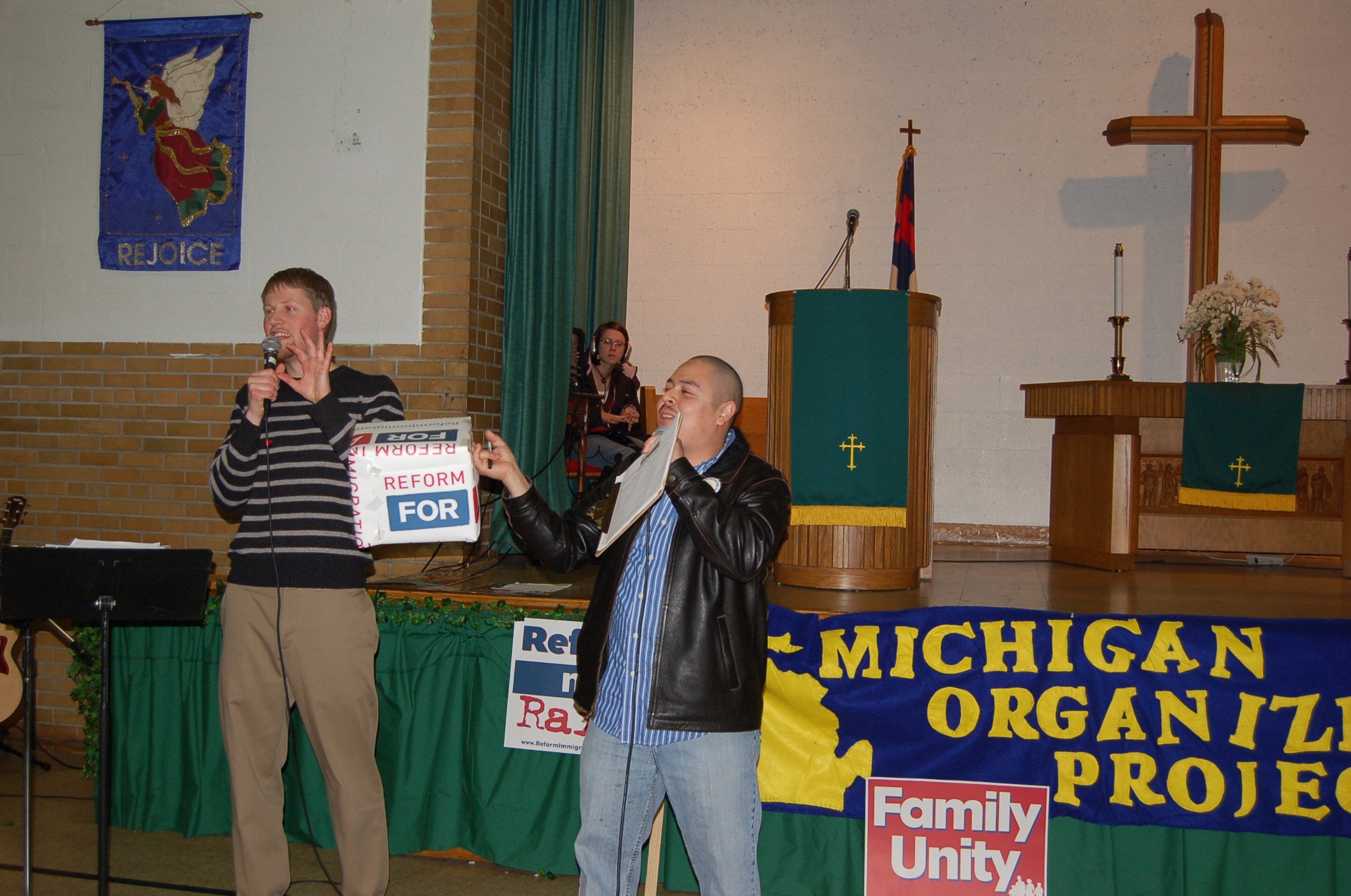
A woman named Gema then shared her story about participating in a program called democracy schools. It is an organizers training program that teaches people about US history, US laws and the rich history of civil rights organizing in this country. She said she learned that struggle for justice is never easy, never quick, but it is work that is necessary and important. She invited anyone in attendance to participate in the next round of classes that are being offered. Gema ended her comments by quoting the famous Mexican revolutionary Emiliano Zapata who said, “It is better to die on your feet than to live on your knees.”
The last speaker Rigo Rodriguez, let people know about the ongoing campaign that is being organized locally for immigration reform. There is a text message campaign, so that people can get regular updates on the campaign. He also said there was literature that people were encouraged to take and put up around town in stores and coffee shops.
Rigo also encouraged people to make a commitment to bring three people to another rally that is being planned for this Sunday at Madison Square Christian Reformed Church. They want to fill the church and send a strong message to Congress that they want immigration reform. The event begins at 6pm and is located at 1441 Madison Ave SE in Grand Rapids.
Detroit to host US Social Forum in June
 “Another world is possible; Another United States is Necessary.” Those words describe the goals of the 2010 United States Social Forum (USSF). An expected 20,000 to 30,000 thousand individuals and groups will converge on Detroit June 22 through 26 for the USSF, with main events held in downtown Detroit at Cobo Hall and Hart Plaza. It will also host events at the Wayne County Community College District Downtown Campus and Wayne State University. What is the USSF? According to its Web site,
The US Social Forum is more than a conference, more than a networking bonanza, more than a reaction to war and repression. The USSF will provide space to build relationships, learn from each other’s experiences, share our analysis of the problems our communities face, and bring renewed insight and inspiration. It will help develop leadership and develop consciousness, vision, and strategy needed to realize another world . . . The US Social Forum is a very special kind of gathering: one that has never taken place in this country up to now. It isn’t a conference with an agenda and a program of events; it’s a gathering whose participants produce our own agenda and our own programs.
To date, 900 activists involved in planning the USSF have developed the following list of themes:
- Capitalism in crisis/economic alternatives

- Climate justice
- Indigenous sovereignty
- Displacement/(im)migration
- Democracy
- Understanding right-wing opposition
- Building left/progressive movements
- Community-based strategies
- Labor
- Media justice/communications
- Transformative justice/healing

- Anti-war/militarization/criminalization
International solidarity and responsibility - Detroit and the rust belt
The USSF is an outgrowth of the annual World Social Forum, first held in Porto Alegre, Brazil in 2001. Every year since, this forum has worked to develop just alternatives to the neoliberal policies and globalization that continue to plunge poor countries into debt and millions into poverty while feeding the war machine and destroying the environment.
Registration for USSF opens January 20. Organizations that want to take a more active role can join the National Planning Committee or People’s Movement Assembly. They can also propose workshops for the program along a range of themes (and cross-cutting threads). Individuals can join one of the USSF’s working groups, the USSF Writer’s Workshop or build regional and local committees. Watch GRIID Indy News for continuing updates.
Another world is possible!
Media Bites – VISA & the 2010 Winter Olympics
This week’s Media Bites takes a look at recent VISA commercials celebrating the upcoming 2010 Winter Olympics. We look at the celebratory elements in the VISA commercial, but more importantly we discuss the organized opposition to the 2010 Winter Olympics, particularly by Native communities.
In addition, for more background information on organized opposition to Olympics historically check out Just Say No to the Olympics – a panel of speakers, which included Dave Zirin (Edge of Sports), Bob Quellos (Not in Chicago), and Chris Shaw with the 2010 Olympic Watch Committee.
Kids Count Report Gets Superficial Coverage in Local Media
The Michigan League for Human Services released today its annual report on the status of children in Michigan. The report, Kids Count, has received a great deal of attention from local media, but the coverage is quite superficial.

The story on channel 13 was only 80 seconds long and provided a broad overview of some of the data. The only source they used for the story was Amy Turner-Thole, speaking on behalf of a group called First Steps. Turner-Thole, a former reported at WXMI 17, did say that the data on children in poverty can be misleading and her organization estimates that “two out of every five children in Kent County and across the state are considered low income.”
The WOOD TV 8 story was longer and did explore more of the data. For a local resource they brought in to the TV studio Lynn Heemstra with the City of Grand Rapids. Heemstra made some vague remarks about what is causing the increase in child poverty and abuse rates, but offered no real support for her claims.
The Grand Rapids Press article followed a similar pattern by providing a summary of the data as it relates to Kent County. They also relied on spokespersons from First Steps, but in addition they talked to Sue Toman with the Child and Family Resource Council. Toman was quoted as saying; “There’s a connection between an increase in poverty and increase in neglect.”
Unfortunately, the Press reported did not explore what those connections are, instead they end on a somewhat “positive” note from a First Steps spokesperson who says the funding cuts to many of the child focused groups has forced them to work together. In the WOOD TV 8 story, Lynn Heemstra also went out of her way to say we should be celebrating the minor decrease in areas like teen school drop out.
What is interesting in all of this is that there seemed to be little alarm displayed or any sense of urgency considering that 40% of children in the state of Michigan live in poverty. Imagine what kind of coverage there would be if a single grade school child was shot in Michigan or was a contestant on American Idol. It’s hard to say with a certainty whether or not these issues will receive coverage in the upcoming weeks, but based on our 12 years of monitoring news in West Michigan it is safe to say that child poverty will not receive adequate and ongoing coverage.
Furthermore, the data they were citing was from 2007 and 2008. Considering the economic recession that has hit the country and the state in late 2008, one could reasonably speculate that the numbers for children living in poverty are worse.
The coverage also does not discuss the discrepancies along racial lines with the Kids Count data, nor the differences between rural and urban children, even though these distinctions are clear in the report.
Lastly, the report did not prompt local newsrooms to ask the larger questions of wealthy disparity within Kent County and the State of Michigan, which might lead one to some answers about the causes of increased child poverty.
The Dingells’ Love Affair With GM
(This article is from the Center for Responsible Politics www.opensecrets.org)

Is the Dingell family too close for political comfort? Rep. John Dingell is the longest-serving member of the U.S. House of Representatives. His wife, Debbie Dingell, is a powerful lobbyist for General Motors. And when General Motors does well, both Dingells financially benefit, write the Washington Post‘s Kimberly Kindy and Robert E. O’Harrow.
“The couple accumulated millions in GM holdings in the early 2000s through Debbie Dingell’s job …” the Post duo notes. “At the same time, John Dingell was Detroit’s staunchest ally, fighting against emissions and fuel-economy standards that would have hurt the short-term profitability of automakers. In the past year, he advocated for five bailouts for GM and Chrysler.”
A Center for Responsive Politics analysis indicates that, as a group, people and political action committees associates with the automotive industry represent Dingell’s third-largest campaign bankroller over the past two decades, behind health professionals and electric utilities.
Here is a breakdown by industry of financial contributions to Rep. John Dingell.
| Industry | Total |
|---|---|
| Electric Utilities | $1,225,297 |
| Health Professionals | $1,071,058 |
| Automotive | $956,465 |
| Lawyers/Law Firms | $888,505 |
| TV/Movies/Music | $741,621 |
| Pharmaceuticals/Health Products | $736,734 |
| Lobbyists | $589,047 |
| Telephone Utilities | $539,409 |
| Securities & Investment | $518,079 |
| Insurance | $501,850 |
| Oil & Gas | $410,091 |
| Industrial Unions | $375,965 |
| Transportation Unions | $341,510 |
| Public Sector Unions | $298,425 |
| Building Trade Unions | $268,550 |
| Telecom Services & Equipment | $264,159 |
| Real Estate | $259,209 |
| Chemical & Related Manufacturing | $217,700 |
| Hospitals/Nursing Homes | $191,400 |
| Beer, Wine & Liquor | $186,046 |
Worthy and Unworthy Immigrant Stories
From December 27 – January 2nd the Grand Rapids Press ran a series of stories featuring recent immigrants who have started there own business in West Michigan. The articles tell compelling stories about people who have been able to achieve some success after coming to this country.
Yesterday, Press Business Editor Nancy Crawley’s column commented on these recent stories and added her own thoughts on what lessons we can learn from these recent immigrants.

The first “lesson” Crawley identifies is that the recent immigrants featured in the Press series “delivered a message loud and clear about the grit and courage needed to get where they are.” In other words, if anyone is to succeed they just need to have courage and work hard. If that is the case, what do you call migrant workers who spent 10-12 hours a day in the fields making below poverty wages?
Clearly, it takes grit to work in the hot sun, doing back-breaking work, with no benefits and often living in substandard housing. Many of these workers travel long distances and sometimes leave families behind to do this seasonal work. Could we call that courageous?
“Though this area is often criticized as not welcoming to newcomers, these business people were delighted and surprised at the well wishes and kindness they received after their stories were published.” This was the second lesson that Crawley identifies in her column. It is true that not all immigrants are treated badly, but the fact that the people featured in the Press series are business owners and not workers might have something to do with the public response to their presence.
There is a tremendous amount of anti-immigrant sentiment that exists in this country and in this community. Recent immigrants are often blamed for taking away jobs for “real Americans,” even though quite often the work that recent immigrants do is work that most Americans who are born here would never do.
Crawley’s column, like much of the economic coverage in the Grand Rapids Press, focuses on what the business community does to benefit West Michigan. However, there are far more recent immigrants who are workers in this community than business owners. What would a series of stories in the Press about these people look like? Would it present them as people with grit and courage? Would they get the same kind of positive feedback from readers as the immigrant entrepreneurs?
These recent immigrant workers would be easy to find and would have compelling stories about what they have endured to come to this country. Many of these recent immigrant workers will be at a public meeting for immigrant rights this Tuesday (January 12, 7pm). This is an open meeting at Nuevo Esperanza Church located at 100 Burton SE in Grand Rapids. Maybe Nancy Crawley could send some of her reporters to talk with these immigrants and see what lessons could be learned.
Blackwater Wants $1 Billion to Train the New Afghan Police Force
Published on Sunday, January 10, 2010 by Firedoglake.com
That’s right. $1 billion:
Blackwater Worldwide’s legal woes haven’t dimmed the company’s prospects in Afghanistan, where it’s a contender to be a key part of President Barack Obama’s strategy for stabilizing the country.

Now called Xe Services, the company is in the running for a Pentagon contract potentially worth $1 billion to train Afghanistan’s troubled national police force. Xe has been shifting to training, aviation and logistics work after its security guards were accused of killing unarmed Iraqi civilians more than two years ago.
Yet even with a new name and focus, the expanded role would seem an unlikely one for Xe because Democrats have held such a negative opinion of the company following the Iraqi deaths, which are still reverberating in Baghdad and Washington.
Blackwater was basically kicked out of Iraq for wantonly killing civilians in Baghdadwhile providing “security” for the State Department in 2007. Even though a US court failed to bring them to justice, Iraq is still pursuing the case and has so little trust in Blackwater or the people it hires that the government has explicitly said former Blackwater employees are not welcome in the country.
American forces are already on thin ice with the Afghan populace because we’re killing civilians left and right with, among other things, our drones. Now Blackwater, mercenaries known around the world for their brutality, might get the contract to train the Afghan police? In what world does this seem like a good idea?
It very well may be impossible to train a functioning Afghan police force, especially on the timeline the administration wants. Any incidents with Blackwater employees in Afghanistan would only make the situation worse, and I’m fairly sure the Afghan people don’t want their new police force trained in Blackwater techniques anyway, given their history.
If Blackwater gets this contract, which hopefully they will not, I can only see more anger from the Afghan people directed at America in the future.
The Greening of Health Care?
The January 7 – 13 issue of the Grand Rapids Business Journal (GRBJ) has a short interview with Gary Cohen, founder and director of Health Care Without Harm. Cohen was in Grand Rapids for a day-long event where he spoke to Spectrum Health staff.

Before the interview begins, the GRBJ reporter tells readers that there is a growing movement “advocating for environmental responsibility in health care.” The article states that there are 1,000 hospitals and health care systems groups, which have joined a networking group called Practice Greenhealth.
One of the members of Practice Greenhealth is Hospital Corporation of America, the nation’s largest health system, with 163 hospitals in 20 states. Some of the goals and objectives that this network of hospitals and health systems in the country are advocating for are a reduction in their use of toxic chemicals, more energy efficient buildings, increased recycling, and serving healthier food.
The interview with Cohen explores some of these issues, but on a very superficial level. Cohen talks about the need for hospitals to recycle, but never states what it is they can and should recycle. Hospitals generate a tremendous amount of waste, particularly hazardous waste.
The only specific issue that Cohen addressed in this interview was the environmental impact of pharmaceuticals. When you take prescribed drugs much of what is contained in the drug leave your body when you urinate, which means that these drugs end up in the water system and eventually into the soil. According to Derrick Jensen, author of What We Leave Behind, the pharmaceuticals that end up in our ecosystems cause tremendous harm to the water, soil, plants, animals and human who are increasingly being saturated with these drugs.
This underscores an important point about the limited view of groups such as PracticeGreenhealth. It seems that these hospitals and health industry sectors can not just focus on recycling and making their buildings LEED certified, they must see the inter-relatedness of all the environmental problems we face and how it impacts human health. In other words, health care providers should not just be concerned with their own organizational sustainability efforts, they must confront and challenge any industry, which pollutes or contaminates the environment.

For instance, it would have greater impact for health care providers to condemn the production and use of chemical pesticides worldwide. Chemical pesticides are a leading cause of cancer, so instead of just treating cancer patients why not put your efforts into stopping the causes of cancer?
Another area where health care systems should be a leader is in the reduction of carbon, which causes global warming. Global warming has increased poor air quality, the increase of asthma and the spread of more infectious diseases worldwide. Since global warming has serious health consequences, wouldn’t it make sense for the health care industry to confront the major carbon producers? This would mean that hospitals should challenge the use of coal, both mining and burning. For that matter they should condemn the mining and use of uranium for nuclear energy production. Health care systems might even want to stand against the use of depleted uranium that the US military has put into weapons that have been used since the early 90’s and has resulted in the deaths of countless thousands around the world.
Some people might say that these are political questions that should be left to politicians and not doctors and hospitals. However, unless we address the root causes of both health and environmental problems everything else we do seems to be just putting a bandage on deep wound. Besides, doesn’t the Hippocratic oath say, “first do no harm.”

