Grand Rapids Poverty rates and the GR Press
The lead story in the Grand Rapids Press today was based on a recent study by the Brookings Institute on the increase in levels of poverty for Grand Rapids and its surrounding suburbs.

According to the data the percentage of people living in poverty in Grand Rapids increased by 8.9% since 2000 and for those in its surrounding communities the rate increased 4.9%. The total amount of people living in poverty for Grand Rapids now stands at 24.7%, meaning one-quarter of the population, which saw the steepest rise in poverty rates of the 95 cities investigated in the Brookings study. The percentage of the population in the surrounding communities now stands at 11.2%.
Considering such alarming numbers, whom does the Press reporter talk to for reactions? First, they quote one of the Brookings research analysts, Elizabeth Kneebone who says, “It is putting additional strain on a safety net that is not as well developed.”
Next the Press reporter talks to Steve Gibson who works for a social service agency in Byron Center. Gibson said that many of the people they serve no used to be middle class. “I hear it over and over and over again, that we used to donate to you,” Gibson said.
The only other source cited in the story was George Erickcek, senior analyst for the Kalamazoo-based Upjohn Institute for Employment Research. Erickcek is a regular source for the Press and acts as its unofficial economic expert. His response to the findings of the Brookings report was, “It penalizes you for being low at the start. Grand Rapids is worse than before. But it’s definitely not a basket case. The manufacturing sector has been hard hit. I’m not surprised to see an increase in poverty. But for me, it’s more important to see the total level of poverty.”
What do you suppose Erickcek means by the “total level of poverty.” My suspicion is that he is not talking about the harsh reality of living in poverty that goes beyond statistics and this is what is missing from the Press article. We do now get the perspective of people living in poverty. There is not person or family that lives in poverty that is source in this story. We do not hear their perspective on the realities of poverty but we do hear an economic “expert” who doesn’t seem to be “surprised to see an increase in poverty.”
The Privilege of Richard DeVos
I forced myself to go hear Amway co-founder Rich DeVos give a lecture today as part of Calvin College’s January Series. It’s important to hear people with power, especially for independent media, since one of the fundamental tenets of journalism is to scrutinize power.
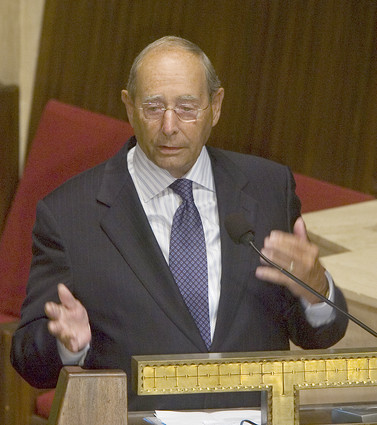
DeVos focused on his most recent book, Ten Powerful Phrases for Positive People. The phrases are not anything new or terribly enlightening, they are just phrases that we all have been taught by parents or teachers at some point in our life. Phrases like, “you can do it,” “I believe in you,” “I trust you,” and “I respect you.”
DeVos shared personal stories about how he has tried to apply each of the ten phrases he wrote about in his book and much of the discourse was framed in his interpretation of the Christian faith. DeVos kept saying, “our task as Christians is to be life enrichers.”
However, as he kept sharing stories and reflecting on his own life I couldn’t help but think about what a privileged life he has led. When I say privileged I don’t mean, “what a privilege it is to be here.” I am talking about the kind of privilege that few people in the world have, privilege that comes with wealth and power. DeVos has been a millionaire then billionaire for more than 50 years. He has traveled around the world countless times and has had access to those in political power for decades.
Several times he shared stories about conversations with US presidents and other stories about interactions with prominent business leaders. DeVos even had the arrogance to begin his talk by thanking the crowd for such a warm welcome and then saying that it surprises him sometimes because, “a prophet is never welcomed in his own country.” That phrase was historically attributed to the Hebrew prophets because they challenged and condemned the power structures of their day.
As he kept talking and trying to weave small pearls of wisdom with his phrases he would eventually say things that to this writer really reflected who Rich DeVos is. When talking about the phrase “I need you,” DeVos mentioned that Amway was sending supplies to Haiti because “the Haitians need us.” He also added that we shouldn’t give them everything because then they won’t learn to do for themselves. Apparently, DeVos think that Haitians are just chronic charity cases who are only looking for handouts.
When discussing the phrases “I believe in you,” DeVos shared the story about how he went to the Grand Rapids Press once to chastise then editor Mike Lloyd for criticizing the amount of money Arendt Lubbers was receiving as the GVSU President. DeVos said we need men like Lubbers and then said he was upset with the way that Wall Street executives were being treated now. “Wall Street people have done a great deal to build up this country.” DeVos went on to say that he was recently talking to former President Clinton and expressing his frustration with Obama and his “anti-Wall Street” positions. I’m not sure what DeVos means since the Obama administration has been fine with handing over billions of taxpayer’s dollars to bailout Wall Street for their corrupt financial practices.
Another phrase that DeVos mentioned was “Thank You.” During his reflections on this phrase he talked about how he was against the most recent government push for health care reform. He said, “we tried all kinds of things to defeat it and then along came this guy from Massachusetts. The hand of God is so evident.” DeVos was referring to the recent victory of Republican Scott Brown who is replacing a seat in the Senate vacated by the death of Edward Kennedy. It is believed that Scott’s victory will signal a defeat of the President’s health care plan in the Senate.
The last phrase that DeVos touched on was, “I Love You.” In reflecting on this phrase DeVos recounted how much family support he received while in England where he had a heart transplant. At one point DeVos went as far as saying that the new heart was a gift from God. Apparently his financial wealth had nothing to do with it.
DeVos finished his talk by reading a Christian bible phrase and a story about how he told a group of US Marines recently to keep the quote on a piece of paper while serving in the next tour of duty. The phrase was, “Rejoice in the Lord always.” I wondered to myself if this is what these young men would be thinking while shooting Afghani civilians.
In the end I was glad I went. This way I could share with some people a perspective that is not likely to appear in any of the other news media in West Michigan, as is evidenced in a short piece that appeared on the Grand Rapids Press online source this afternoon.
This Friday and Saturday Calvin College is hosting its annual event that tries to draw the connections to animal rights, food justice and sustainability. The Two-day event is called Wake Up Weekend and will feature events at both the Calvin College Campus and in downtown Grand Rapids.

Wake Up Weekend 2010—Tentative Schedule
Friday, January 22, 2010
2:30-5:30 pm The Many Faces of Food Activism
Commons Annex Lecture Hall, Calvin College
Harold Brown (Farm Kind, NY)
Brett Colley (Grand Valley State University)
Ben DeVries (Not One Sparrow)
Lisa Oliver King (Our Kitchen Table)
Paul Shapiro (Humane Society of the United States)
5:30-7:00 pm Compassionate Comestibles Potluck
Commons Annex Lecture Hall, Calvin College
Hosted by Calvin College Students for Compassionate Living
7:30-9:30 pm Animals and the Kingdom of God Lecture
The Chapel Undercroft, Calvin College
“Animal Sacrifices”
Dr. John E. Hare, Yale University
A reception and book signing follows the lecture.
Saturday, January 23, 2010
11:00 am Bryant Terry’s Vegan Soul Kitchen
Brick Road Pizza Company, 1017 Wealthy Street SE
Cooking Demonstration, book signing, and vegan brunch*
(*Demo is open to the public; $10 brunch buffet is optional.)
2:30 pm Lecture
(106) South Division, Grand Rapids
“Justice for Animals: What May We Hope?”
Dr. Andrew Chignell, Cornell University
3:30 pm Panel Discussion
(106) South Division, Grand Rapids
Just Eating: Making a Difference in YOUR TOWN, USA
5:30 pm Open Studios
(106) South Division, Grand Rapids
Named and Nameless
Division Avenue Arts Collective, 115 South Division, Grand Rapids
The Artist Is the Human Is The Animal
7:00 pm Vegan Chili Cook-off
(106) South Division, Grand Rapids
9:30 pm Film Screening
Division Avenue Arts Collective, 115 South Division, Grand Rapids
Fowl Play: The Untold Story Behind Your Breakfast
Several hundred people gathered early this afternoon at the Allendale campus of Grand Valley State University to participate in the annual Martin Luther King Jr. event. The event began with a silent march from library to field house, with signs along the way acknowledging historical moments in King’s life.
After a few songs and comments from GVSU administrators, the keynote speaker, Randal Pinkett, was invited to the podium. Pinkett is, according to his website, founder, chairman and CEO of BCT Partners, a multimillion dollar consulting firm based in Newark, NJ, that specializes in information technology, organizational development and public policy. So what did a man who has made millions doing consulting work for Microsoft, Pfizer & Hewlett-Packard have to say to people on MLK day?
Pinkett used the metaphor from Robert Frost’s poem, The Road Not Taken, to communicate his idea that we all can be trailblazers and create our own road in life. The speaker felt that children have this sense that they can do anything they want because of their innocence and that we should all nurture that desire. Pinkett said that this was the message that Dr. King gave us……that we all can achieve anything that we can imagine.
At one level I wasn’t disagreeing with many of the statements that Pinkett made, but as I thought about them I came to the conclusion that most of the statements he made were shallow phrases, phrases that we always share with students in order to give them some hope about the future. Of course many people want to believe that we can achieve anything if we just try really hard, but this has little to do with the message and legacy of Dr. King.
Pinkett said he was going to address the issue of Wealth Creation, something he has written about in books like Campus CEO and No Money Down CEO. However, the speaker never addressed this issue. In response, it might be worth looking at what Dr. King had to say about wealth and economic justice.
King began with a focus on civil rights, but eventually evolved to a more mature vision of economic justice. Once King moved his base of operations to the North he began to reflect on the devastating and systemic poverty that Blacks lived in. In Chicago King began working on an anti-slums campaign and soon realized that there were economic forces that criticized King. This criticism lead King to write:
“You can’t talk about ending slums without first saying profit must be taken out of slums. You’re really tampering and getting on dangerous ground because you are messing with folk then. You are messing with the captains of industry….Now this means that we are treading in difficult waters, because it really means that we are saying that something is wrong…with capitalism.”
King believed that the nation owed Black people for the years of free labor under slavery and the years of underpaid labor in the free market system. King didn’t necessarily call what the nation owed Black people reparations; rather he called it a Bill of Rights for the Disadvantaged.
“No amount of gold could provide an adequate compensation for the exploitation and humiliation of the Negro in America down through the centuries. Not all the wealth of this affluent society could meet the bill. Yet a price can be placed on unpaid wages. The ancient common law has always provided a remedy for the appropriation of the labor of one human being by another. This law should be made to apply for American Negroes. The payment should be in the form of a massive program by the government of special, compensatory measures, which could be regarded as a settlement in accordance with the accepted practice of common law. Such measures would certainly be less expensive than any computation based on two centuries of unpaid wages and accumulated interest. I am proposing, therefore, that just as we granted a GI Bill of Rights to war veterans, America launch a broad-based and gigantic Bill of Rights for the Disadvantaged, our veterans of the long siege of denial.” (From Why We Can’t Wait)
Another important aspect of King’s insights about economic justice was his critique of military spending versus funding social programs. In his Beyond Vietnam speech King said that the US spends thousands to kill each enemy combatant in South East Asia, but spends only a few dozen on each poor person in the US. King understood that the Vietnam War was not only immoral, but it also stole precious resources from the Black community.
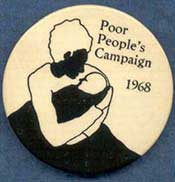
Lastly, it is important to note that King’s last months were spent working on the Poor People’s Campaign. The Poor People’s Campaign said nothing about Wealth Creation or Black Entrepreneurs, it was a campaign that demanded economic justice for the poor that would have used the tactic of mass civil disobedience, had King not been assassinated.
For Grand Valley State University to invite someone who has made millions of dollars as a consultant to corporate America to speak at its MLK Day celebration is questionable at best. I for one felt that the speaker cheapened the memory of Dr. King.
The Dr. King We Rarely Hear About
“I am sorry to have to say that the vast majority of white Americans are racists, either consciously or unconsciously.”
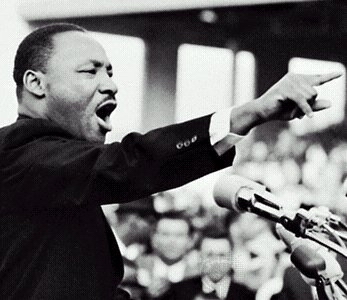
This quote from Dr. Martin Luther King Jr. is one that we are not likely to see or hear today as the nation celebrates his birthday. Most news coverage and unfortunately most public events will remember the “I Have a Dream” King.
It is easier to remember the King who had faith in this country to solve its racial problems. We all want to think about a future where White children and Black children will play together in harmony. However, this would be a dishonest view of Dr. King. We must look at the whole person and particularly the last years of King to understand his own evolution.
Once King brought his civil rights campaign to the North in 1965 he realized that liberals in the North were just as racist as they were in the south. The quote we began with is from a 1967 speech King gave entitled, “Which Way Its Soul Shall Go,” and it is as applicable today as it was in 1967.
When we honestly reflect on the economic and social condition of Blacks, Latinos, Asians, Arabs, Native Americans and other minorities in the US today it should be a signal to us that racism and White Supremacy is still deeply entrenched in our country. This is exactly the point that anti-racism writer and activist Time Wise was making in his most recent book, Between Barack and a Hard Place. Wise believes that while we can celebrate the country’s first Black President, racism is still firmly entrenched in our society. This is also a theme that radical historian Paul Street addresses in a recent essay comparing Dr. King and Barack Obama.
Saying that most Americans are racists wasn’t the only issue that King challenged people on in his later years. By 1965, King had identified what he considered the “triple evils”; White Supremacy, Capitalism and Militarism.
King had come to understand that he could no longer speak out about racism without challenging the economic and political structures in this country, which perpetuated and benefited from racism. In an essay from 1967, King provides astute analysis of why capitalism doesn’t work.
“We are now making demands that will cost the nation something. You can’t talk about solving the economic problem of the Negro without talking about billions of dollars. You can’t talk about ending slums without first saying profit must be taken out of slums. You’re really tampering and getting on dangerous ground because you are messing with folk then. You are messing with the captains of industry….Now this means that we are treading in difficult waters, because it really means that we are saying that something is wrong…with capitalism…here must be a better distribution of wealth and maybe America must move toward a Democratic Socialism.”
Ask yourself, why this statement has not received the same kind of annual attention as the “I Have a Dream” speech?
The third evil, militarism, was most manifested in King’s day with the Vietnam War. In 1967 – 68 King became one of its most vocal opponents. King’s 1967 speech at Riverside Church (Beyond Vietnam: A Time to Break Silence) is one of the best critiques of war from any American writer.
King not only spoke out against the immorality of the war, he addressed the economic and racist implications of war. In addition, King saw through the imperialist propaganda of the US and rightly identified the US, not as a nation promoting democracy, but a nation he called “the great purveyor of violence” on the planet.
In this video excerpt from his Beyond Vietnam speech we can hear King’s critique of a country that spends more money on militarism than social uplift.
Secretive North Korea Unveiled
In a desperate shout for attention, North Korea, the world’s most elusive nation, continues to flaunt its nuclear abilities. Discussing this and other issues surrounding North Korea at Calvin College’s January Series was Tony Namkung, an expert on US-Asian relations who has visited North Korea over 30 times.

The lecture ranged from the policies that would have opened up North Korea under the reign of Kim Il-Sung, to the role of protestant Christians within North Korea’s history, to the current nuclear issues under Kim Jong-Il.
Around 1990 Kim Il-Sung began work on policies that would have turned around North Korea’s current trajectory. Namkung spoke of this as a “fundamental reversal of their long time policies. . .one was to normalize relations with long time foes the US and Japan, second was to seek peaceful coexistence, distinct from unification, which had been a long standing North Korea demand that the peninsula needed to be reunified immediately with South Korea, third was market reforms to a highly centralized market economy”. This was soon followed by the Agreement on Reconciliation between North and South Korea that would have seen a total reversal of policy including diplomatic recognition, arms reductions, and an end to nuclear testing and materials possession. As the current state of affairs between North and South Korea can tell us, these policies were never implemented. What happened? Namkung suggests a few reasons for the reversal, including the end of the Cold War, the democratic revival of South Korea, and the resurgence of China, all of which threatened the political stability of North Korea.
Speaking at a Christian Reformed college, Namkung discussed how protestant Christianity shaped the early life of Kim Il-Sung, as both his parents were active in the church. Many Christians in North Korea at this time were working against the Japanese occupation that finally ended in 1945. However, Christians continue to be persecuted in North Korea today, as any form of religion needs to be state approved and practiced.
The topic of North Korea’s nuclear ambitions wasn’t discussed as much as hoped, but Namkung did offer some insights into the veil of secrecy surrounding their motives. Namkung suggests, as do others in his field, that North Korea’s nuclear testing and missile launches are an elaborate chess game to them, used as a pawn in political negotiations. Diplomat Georgy Toloraya believes that ”North Korean behavior is the consequence of dissatisfaction with the policies and the actions (or lack of them) of its adversaries. It cannot be explained simply in terms of the ‘unpredictability’ of the Pyongyang regime or its attempts at ‘blackmail.’”
Namkung said North Korea has consistently tried to garner a relationship with the United States, mainly to seek the protection of the United States against North Korea’s traditional foes, China and Japan. Strange thing then for this country to be thwarting all the requirements the United States has placed upon it. But Namkung sees this as North Korea’s attempt to jump start talks and negotiations, since the majority of the acts of aggression occur during stalemates. With a closed off society and a failing economy, the nuclear issue is the only real bargaining device left to North Korea.
So what’s next then? How should the world and particularly the United States approach North Korea, especially since the Six Party talks have been disbanded? With an open mind, says Namkung. The United States should not focus solely on the nuclear issue, as it has done in the past, but pay attention rather to the issues underlying this threat display, such as economic decline, a failing infrastructure, and humanitarian crises. Namkung thinks our new policies should keep in mind that we need “to abandon the sticks and carrots methods. . .and to get away from the notion that the end is near for North Korea, that they are only starving and selling arms to prop up their regime or prop up a corrupt elite and Kim Jong-Il’s only purpose in life is sheer survival using the nuclear card.” The United States should also serve as a facilitator between North and South Korea, though this may be difficult due to South Korea’s conservative new leader. But Namkung believes it would be of strategic importance for the US to have friendly relations with North and South Korea if China or Japan start vying for power in the region.
Little is known about North Korea, but what is known is that the United States needs to change how it deals with this elusive country while tensions continue to thaw. Some good resources on US/North Korean relations are Foreign Policy in Focus and for a good historical introduction see John Feffer’s North Korea/South Korea: U.S. Policy & the Korean Peninsula.
Israeli Assault on Gaza topic of Film this Monday

To Shoot an Elephant is a film portrait of Gaza under the Israeli embargo. Director Alberto Arce was embedded with the International Solidarity movement, one of the few aid organizations still operating in the area. We are given insight into everyday life in the region through a series of vignettes he filmed between December 25, 2008 and January 16, 2009, focusing particularly on the ambulance services that pick up the wounded and the dead (always referred to as “martyrs”) from the streets. The aid workers are risking their own lives, too, because in contravention of the Geneva Convention, the Israeli forces shoot to kill.
Although Mohammad Rujailah, the filmcrews’ fixer, is credited as co-director, he is also one of the film’s central figures. Calmly, but making no attempt to disguise his despair and rage, he calls the international community — and by extension the audience — to account. The film’s title refers to “Shooting an Elephant,” a 1936 essay by George Orwell in which he denounces colonial politics — as the author does throughout his oeuvre. And just as in Orwell’s historical fiction, To Shoot an Elephant presents broad political issues through a small cross-section of, in this case Palestinian, everyday life.
The film is showing Monday, January 18 at 7pm – Free Admission
Plymouth Congregational UCC 4010 Kalamazoo SE
The event is co-sponsored by the Plymouth Justice & Peace Task Force, Brunch & Revolution and the Bloom Collective.
To Shoot and Elephant Trailer
The Language of War: The Press and the Framing of Soldier Deaths
War always has consequences beyond the loss of life. One of those consequences is how it impacts how we talk about it. This is particularly the case in recent decades, as wars have now become much larger media spectacles.

We have all heard new terms that both the Pentagon and the media use when discussing aspects of war. In the aftermath of the US invasion of Panama, the Pentagon began using the term “collateral damage” to refer to civilians killed in a bombing raid. Other terms that have become part of our vocabulary are smart bombs, water-boarding, peace-keeping forces, and joy-stick soldiers.
All of these terms inform our perception of what is happening in war, even though it may contribute to a distortion of what is actually taking place. During the US war in the Persian Gulf it was widely reported in the US media that smart bombs were being used to minimize the amount of civilians killed or injured. Years later it was reported that these “smart bombs” were in fact not very accurate.
The use of buzzwords and propaganda was taken to a new level with the most recent “War on Terror,” according to the book Collateral Language: A User’s Guide to Americas New War, co-authored by John Collins and Ross Glover. Collins and Glover provide an excellent collection of essays that systematically investigate words being used by the Pentagon and the news media in the US since 9/11 and how that affects the way we talk about war.
The GR Press and Collateral Language
Yesterday, the Grand Rapids Press applied its own form of collateral language in a front-page story about a former Lowell high school student who was killed in Afghanistan.
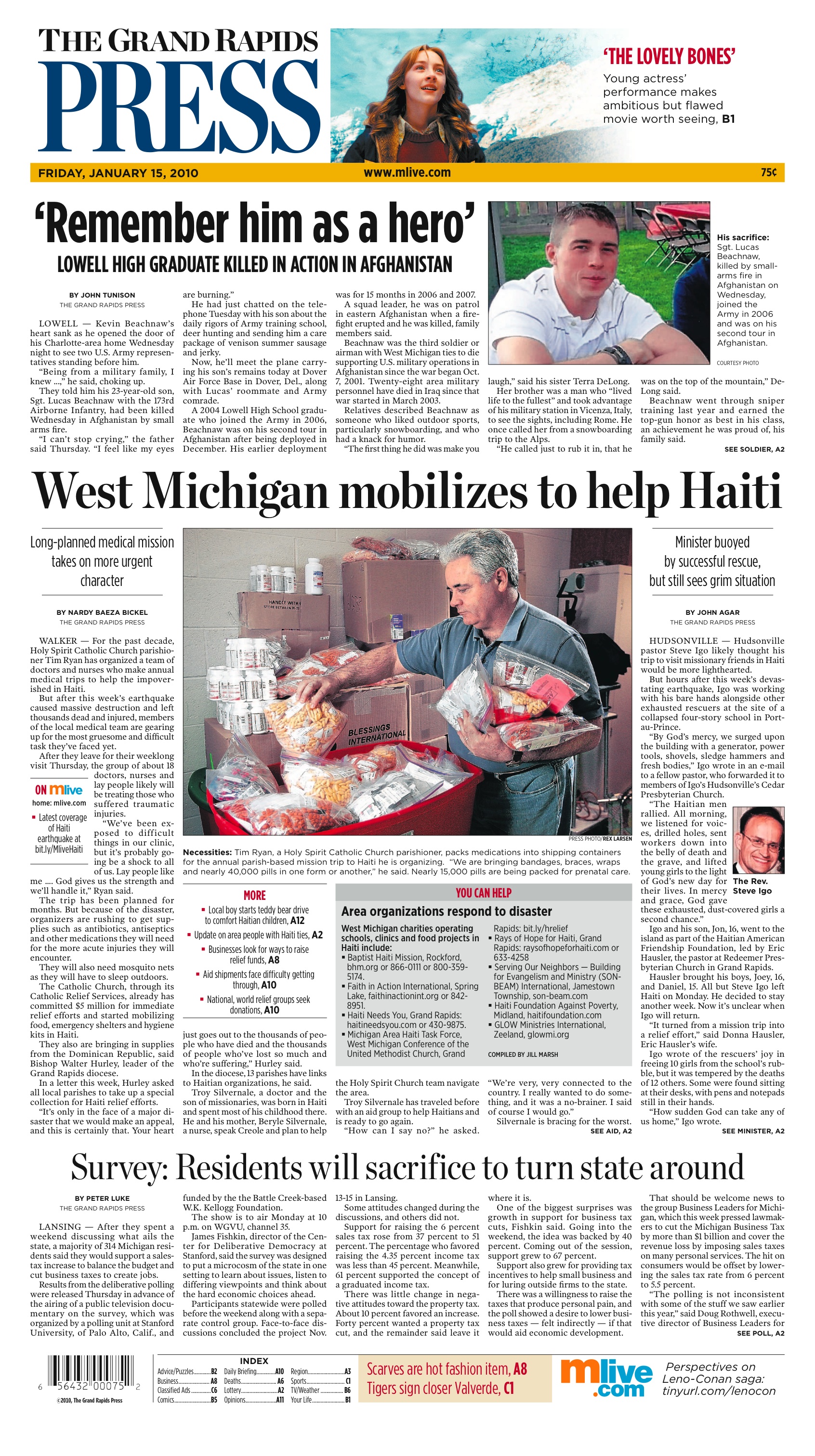
The story itself focuses mostly on what the death of this soldier meant to his family. The reporter talked about what kind of person Lucas Beachnaw was growing up, his relationship to his family and that his last stint in Afghanistan was his second time.
The headline of the story read as, “Remember him as a hero.” This headline was a direct quote from Beachnaw’s sister, which one can understand how a family member might feel that way about a brother killed in war. However, does that mean that the news media uses these terms just because someone close to them dies?
The article said that Beachnaw had some training in “helicopter landing zones” and last year he “went through sniper training.” The story doesn’t provide much information about the circumstances of his death, other than to say “he was on patrol in eastern Afghanistan when a firefight erupted and he was killed.”
We don’t know if Beachnaw saved individual Afghanis or did anything in particular that could be considered heroic. In fact, as someone with sniper training he could have spent his time shooting Afghanis who were suspected of being members of the Taliban or sympathizers of the insurgents. There have been many documented cases of civilian deaths at the hands of US soldiers since the US occupation began in October of 2001, like the most recent report of US troops killing Afghani children.
What we cannot assume and must not assume is that anyone participating in war is a hero. We should expect and demand that our news media not do the same thing. It is one thing for family members to consider loved ones heroes, but an entirely different matter when the news media portrays US soldiers as heroes.
Obama asking for $33 Billion on top of $708 Billion for War
The Center for Research on Globalization reported, “The Obama administration plans to ask Congress for an additional $33 billion to fight unpopular wars in Afghanistan and Iraq, on top of a record request for $708 billion for the Defense Department next year, The Associated Press has learned.”
This news comes at a time when the nation is still faced with an economic depression. Communities like Grand Rapids have to cut back on basic services and the lay off city staff. According to the National Priorities Project (as of January 15), $547.9 million dollars in taxes have left Grand Rapids to fund the US wars in Iraq and Afghanistan.
The group Rethink Afghanistan has produced a new short video discussing the implications of this new announcement for an addition $300 billion for war as well as some analysis of the Obama administration.

