Angela Davis and the Struggle for Freedom
Last night, author, activist and abolitionist Angela Davis spoke at Fountain Street Church as part of the Grand Rapids Community College’s Diversity Lecture Series. Davis’s talk dealt with the theme of freedom, which is based on her forthcoming book from City Lights Books entitled, The Meaning of Freedom.

Professor Davis began her remarks by acknowledging the land where people gathered to hear her and who this land used to belong to. Davis thinks that it is important to always practice this kind of historical memory, so that we do not forget the genocidal realities of the history of repression against Indigenous peoples.
Davis said that her understanding of Black history month “is a time when we are able to talk about the history of freedom, not just for Black people, but for all people.” She said we also use this time to celebrate the resistance to slavery, to colonialism even the resistance to capitalism, which perpetuated slavery. “We also should remember the slave uprisings around the country and around the world.” Davis then goes on to say that Haiti gave us the best example of a slave uprising, a particularly important point considering what is happening in Haiti right now.
Professor Davis continued with other examples of resistance to slavery, such as the Underground Railroad and the Abolitionist Movement. She says that W. E. B. DuBois book on reconstruction has been deeply influential with her understanding of the Civil War and its aftermath. DuBois argued that it was Black soldiers who really won the war. The Civil War really has to do with the economic future of the country. Davis said that DuBois section in the book called “The General Strike” deals with the economic transition from slavery to northern industrialism.
Davis went on to say that the narrative of the Civil War is usually around the Great Emancipator, Lincoln. For Davis, Lincoln was not an emancipator. The author/activist stressed that the real Civil War narrative was primarily about self-emancipation, meaning that Black primarily liberated themselves. She also mentions that these self-emancipators were inspired by the Haitian slave rebellion.
Professor Davis then talked about what she called the Master/Slaver narrative, where the Master is always dependent on the slave, a notion that even influenced the writings of Hegel. Davis asserts that Black people would not be where they are today if it were not for the Haitian rebellion and how interesting it is that there is no discussion of the history of US relations with Haiti from the past two centuries. The news media, Davis said, does not discuss the US military occupations, the support of dictatorships and the collusion of US-based corporations in the exploitation and repression of Haiti.
The author then says that the theme of her talk was around the idea that slavery was never abolished. “What DuBois says was that in abolition democracy, slavery was never ended, which is why people then had to struggle and fight for civil rights.” As a person who came of age during the civil rights era, what she sought to do was not to just achieve civil rights or full citizenship. This is why King was organizing the Poor People’s Campaign, because economic freedom was also necessary if people were really going to be liberated.

The Civil Rights Movement, Davis said, was actually called the Freedom Movement, because it was much more than just gaining civil rights. It was a freedom movement that was organized by women and participated in by women. This is the only reason it succeeded is because of the women, the poor black women. “It is hard for us to imagine that we are where we are today because of the work that these Black women/domestic workers did to liberate us all. Even when we talk about the Civil Rights Movements we generally don’t recall these people, we don’t keep them in our historical memory.”
“Civil Rights,” Davis said, “is of course still a struggle today in the US. We have not won the civil rights of prisoners and former prisoners, undocumented immigrants, and of course there is the question of gay marriage. So we can see that the struggles that began with the Haitian revolution continues to today with the various civil rights movements. This is why when we talk about freedom and the freedom movement is much broader than people’s individual rights.”
Because our notion of freedom needs to be expanded, Davis thinks we need to talk about how we did not recognize the importance of thinking about gender in the struggle for freedom. “We began to realize if the movement were to look different, with women as leaders that it would mean that the movement would look different. Then we realized that a gendered lens is not enough, with our growing understanding of trans-gendered and non-gendered people. And what do we do as a society with these people in the prison system, which loves to categorize everything? We put them in either male or female cells.”
“Our sense of freedom has to be large enough to contain the dreams and aspirations of everyone. Justice is indivisible and freedom is indivisible. We therefore should discuss the ongoing struggle of freedom around the world since our understanding needs to always expand.” Davis even mentions the struggle for the freedom of Palestine, which she acknowledges people are afraid to address for fear of being label anti-Semitic.
Davis also said that this struggle for freedom must also include the disability struggle for freedom and the struggle for how we see our environment and that freedom struggles also apply to non-human species.

Professor Davis then talked about an issue that her last two books have dealt with, the idea of the need to recognize that the current punishment industry is really a perpetuation of slavery. Davis thinks it is important for us to call it the prison industrial complex. She mentions how many states still shackle women during labor in prison and then recounts the story of a woman who was shackled during delivery, who could not open her legs during delivery. “If this does not force us, compel us to think about slavery, I don’t know what will.”
Davis concluded her remarks by talking a bit about the significance of the election of Barack Obama. “I know that this time last year there was a state of collective euphoria because they thought that one Black man in the White House would do away with all of the violence. It was probably the only time in the history of this country that people felt so connected. The problem was that we had a Messiah complex. We projected all of our power onto one individual. We did not do what we should have done to prevent him from not sending more troops to Afghanistan.
She also mentioned the incident where Harvard Professor Henry Louis Gates was arrested trying to get into his own home. Davis felt that it was a very disturbing moment when Obama invited Gates and the cop to talk about racialized state violence. “First, it was a masculinist approach. And then when the media talked about it, it was about the beer. It was designed to shut down the discussion of institutional racism.”
There was a Q&A session in which Professor Davis addressed a variety of topics, from reparations to gang violence, Black identity and the importance of education. One of the most inspiring things she said was, “In the process of struggling together we learn how to glimpse new possibilities, which we never would have thought about had we not come together in our struggle for freedom. So, our job is to continue to narrativize and engage in struggles for a radical democracy, indeed a radical socialist democracy!”
Super Bowl Ads, Attack Ads and the Michigan Governor’s Race
In the past few days there has been plenty of coverage of candidates running for the Michigan Governor’s seat. The Democrats have a new candidate and the GOP field seems to be spending a great deal of time attacking each other.
However, let’s start with a look at the 60-second political ad that Rick Snyder ran during the Super Bowl. Snyder, a self-proclaimed venture capitalist, aired his first TV ad of the campaign.
The Grand Rapids Press published a story about the ad in Monday’s paper. In this story, writer Jeff Cranson begins the story by talking about how people who attended a Super Bowl party he was at reacted to Snyder’s political ad. The story provides a very brief overview of the ad, but does not investigate any of the claims made by Snyder.
In Tuesday’s Press, political writer Peter Luke has an analysis piece on the same Snyder ad. Luke discusses the strategic merits of Snyder’s campaign message, which presents himself as a smart nerd and successful businessman in contrast to career politicians. However, Luke spends a great deal of time quoting John Weaver, Snyder’s campaign strategist instead of actually analyzing the candidate’s campaign.
Rick Snyder says on his website that Michigan needs to “re-invent itself,” not just fix it. Snyder has a 10-point plan that he believes can “create an era of innovation in Michigan.” The 10-point plan reads like a typical political campaign with lots of rhetoric and little substance.
The first point for Snyder is to Create More and Better Jobs. While no one would likely dispute the need for more jobs in Michigan, Snyder doesn’t really say how his administration would create more jobs other than reform the Michigan Economic Development Corporation. Snyder also touts his own record of “creating jobs” as the former CEO of Gateway, but neither of these points are enough to guarantee employment for the tens of thousands of unemployed and underemployed in Michigan.
Another point in Snyder’s 10-point plan is to protect Michigan’s environment. Snyder’s White Paper on this matter primarily promotes tourism and developing new technologies & renewable energy. Snyder does not address water diversion, sulfide mining in the UP, or pollution caused by the coal powered electricity plants in Michigan. Unfortunately, this is not the kind of analysis you will find in the local news media at this point in the campaign season.
Other Candidate Coverage
MLive.com has posted two stories in the past few days about the announcement of Lansing Mayor Virg Bernero as a Democratic candidate for the Governor’s seat. In both posting, there is no substantive information about what Bernero’s campaign strategy is, just that he has been a strong voice for auto workers in the past.
MLive.com also has a “guest column” by GOP candidate Mike Bouchard who says the state needs more public/private partnerships. Bouchard’s idea – turn the state’s rest stops over the private hands in order to make them “a productive, revenue-generating asset.” There is also a story about Bouchard hiring a media consultant known for attack ads. The article is based on a story from the independent news source, the Michigan Messenger.
The Michigan Messenger article is a good example of the type of investigative reporting that would be beneficial to Michigan voters. This is in contrast to the weak articles that MLive.com has run about GOP attack ad starting “too soon” or a story with the Snyder campaign responding to ads from the Cox campaign. What voters in West Michigan have not seen so far is much investigative coverage into the platforms and voting records of the numerous candidates running for the Michigan Governor’s seat.
Media Bites – Coca Cola & The Simpsons
In this week’s Media Bites we dissect a Coca Cola commercial that aired during the 2010 Super Bowl. The Coke ad shows the Billionaire businessman Mr. Burns as down on his luck, so the people of Springfield give him a Coke to make him feel all better.
In the real world, it is working class families who are losing their homes and taxpayers are bailing out the very financial institutions that brought about the economic collapse in the first place, according to a report by the Center for Public Integrity.

According to a new project from the US Campaign to End the Israeli Occupation the US government has already promised the State of Israel $30 billion in military aid from FY 2009 – 2018.
The campaign now has a new online resource to help people in the US figure out how much of their tax dollars will be used to fund Israel. According to this new resource taxpayers from the state of Michigan will give $728,813,339.85 in Military Aid to Israel over the next 10 years.
This money could have been spent instead to:
Provide 8,849 households per year w/affordable housing grants OR
Provide 12,098 job seekers per year w/green jobs training OR
Provide 21,549 children per year w/ early reading education OR
Provide 590,228 people per year w/primary health care.
The US Campaign to end the Israeli Occupation also is encouraging people to sign a petition to send to Senators Levin, Stabenow and the Congressperson representing your district.
We also encourage you to share this information with people through your own networks. How many people do you know who are hurting economically would be supportive of this much of their tax dollars going to Israel?
New York Times columnist speaks to the Econ Club of Grand Rapids
Earlier today, New York Times columnist David Brooks spoke at a luncheon hosted by the Economic Club of Grand Rapids. Amway Chief Executive Doug DeVos joined Brooks at the podium. The topic of the luncheon presentation was “Building the Case for Investments in Children.”

Brooks, a self-described political conservative, was once a liberal who even did a parody piece on the icon of US conservatives, William F. Buckley. Brooks has written two books and writes a regular column for the New York Times, as well as other Washington-based publications.
In a recent Times column Brooks derided Haitian culture as the root problem facing the ability of Haitians to rid themselves of poverty. Brooks believes that Haitians are “progress-resistant” in part, because they practice voodoo religion. Brooks also makes the sweeping claim that “we don’t know how to use aid to reduce poverty.” The columnist never articulates who “we” are, but towards the end of the column he advocates for aid programs abroad that embrace the philosophy of organizations such as Harlem Children’s Zone and the No Excuses schools. I mention Brook’s comments on Haiti since it was relevant to the topic that he addressed with the Economic Club.
Brooks was brought to Grand Rapids to speak about the importance early childhood education. Everyone in attendance was given a folder with information about a local program called First Steps, which is co-chaired by Doug DeVos. First Steps of Kent County is an effort to provide some comprehensive planning to promote better opportunities for early childhood education and development.
Brooks spent the first part of his presentation telling jokes about Washington politicians, which seemed to get the crowd in a good mood. However, he spent around thirty minutes speaking about education in America. Brooks made the claim that the US became the richest nation in the world because it had the most educated country. Brooks did not support this statement with any sources, but he went on to say that in the past 30 years the US has squandered its commitment to education.
The New York Times columnist went on to say that now there are some examples of educational models that seem to understand what it takes to make kids successful. Here Brooks cites some of the same organizations he did in his article on Haiti, like the Harlem Children’s Zone.
Most of what Brooks talked about was how recent research has shed new light on how we understand child development. He mentioned new research on brain development, conscious and unconscious thinking amongst children, cognitive development, attachment theory and how children can learn while they are in the womb. All of this sounded interesting, but what was the point of sharing this information with members of the Economic Club of Grand Rapids?
Brooks spoke to why child development was important to the business community at the very end of his talk and during the Question and Answer period. He said that parents who are taking their kids everywhere from sports practice to piano lessons and other extra-curricular activities will have children that learn the importance of competition. “These kids will develop a healthy work ethic, whereas in working class environments, kids don’t learn to compete.” Brooks also said that these kids are likely to make more money when they grow up because of their exposure to competitiveness.
This idea fit well into some of the information that was in the packets provided to everyone in attendance. There was one document put together by the Committee for Economic Development, which was headlined, “The Economic Promise of Investing in High-Quality Preschool.” This document was based on a study by the Committee for Economic Development. The study said that, “In the future, ensuring US economic competitiveness and growth will require a highly educated and skilled workforce.” Thus it was made clear that today’s business leaders need to see that early childhood education is important to future US economic competitiveness and a worthwhile investment.
Now the purpose of the talk by David Brooks became much clearer. This clarity was affirmed by the first question from the audience, which asked about the effectiveness of the Choice program in Milwaukee and how the voucher system works better. This is the type of education that the DeVos’s have been supporting for years, particularly Dick & Betsy DeVos through the organization that Betsy chair’s, All Children Matter. All Children Matter has been promoting a privatized, voucher system of education.
The next questioner asked, “How do we get the unions to embrace this kind of educational model?” Brooks responded by saying that this is not likely to happen and that the unions are one of the main barriers to moving this type of education mode forward. Brooks also said that the political cycle and Washington politics is a significant barrier, because politicians would “rather talk about Wall Street and Afghanistan than talk about educating children.”
All in all what Brooks had to say was some what of a mixed bag in terms of what needs to happen to improve education for children in this country. However, it seemed clear that those who organized the event were interested in focusing on a specific outcome of investing in early childhood education……..how will it make the US economically competitive for the future.
The Yes Men Fix the World – Movie Review
I just came back from watching a very entertaining, and at the same time, very inspiring film. The Yes Men Fix the World made me laugh and made me think about what people can do to confront power.
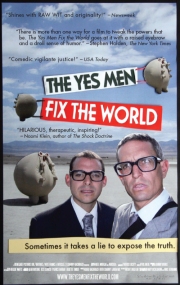
The Yes Men, for those who are not familiar with them, are two guys who engage in a form of street theater, where the often pose as corporate or government spokespersons and present proposals they would like these centers of power to enact.
In The Yes Men Fix the World they create a fake website for Dow Chemical and then get invited by the BBC for an interviewed based on the website. On this fake website the Yes Men claim that Dow Chemical, which bought out Union Carbide, will now pay out $12 billion dollars to the thousands of people who have suffered from the chemical accident in Bhopal, India in 1984. The BBC took them seriously and this announcement was news worldwide even after it was discovered that this was a staged action.
The film looks at several instances in recent years where the Yes Men have fooled people in power or news agencies by passing themselves off as representatives of big oil or the US government. The actions are well thought out and very creative.
More importantly, the film challenges the fundamental tenets of free market capitalism. The Yes Men present the audience with a critique of the economic philosophy, and the idea that markets make us free. As part of the documentary, they go an interview several “experts” from economic think tanks (like the American Enterprise Institute and the CATO Institute) to get their take on the importance of the free market.
In many ways this film is an artist version of an analysis of the free market system that Naomi Klein provides in her groundbreaking book, The Shock Doctrine: The Rise of Disaster Capitalism. The Yes Men take one of the lessons learned from Klein’s book and expose the hypocrisy of the private sector in collaboration with the US Department of Housing and Urban Development (HUD). HUD was working in New Orleans after Hurricane Katrina to demolish public housing and turn over property to private contractors to build more upscale housing.
Overall, The Yes Men Fix the World is a well-produced film that will make you laugh out loud and inspire you to challenge power. The film will be showing 3 more times in Grand Rapids this week at the Urban Institute for Contemporary Arts (UICA) – Tuesday, Wednesday and Thursday at 5pm. If you have a chance to see it we highly recommend it.
Super Bowl Censorship
As millions of people get set to watch the 2010 Super Bowl in Miami, Florida, people may be unaware that the station broadcasting the football game will be allowing one controversial ad and censoring another.

CBS, which is one of the largest media conglomerates in the US, has decided it will air a Pro-life ad being paid for by the religious right organization Focus on the Family. The ad will feature former Florida Gators quarterback Tim Tebow and his mother talking about why she did not have an abortion.
Tebow not only is featured in this Focus on the Family ad, but the far right organization also promotes the football player’s foundation. CBS’s decision to air the controversial ad has been questioned by many national organizations such as the Women’s Media Center.
At the same time CBS is refusing to air another controversial ad, one that was submitted by a gay men’s group called Mancrunch.com. So why the double standard? Boston Globe writer Derrick Jackson points out that this is not the first time that CBS has rejected ads from groups supportive of LGBT rights. The national broadcaster rejected an ad from the United Church of Christ in 2004, which welcomed gay and lesbian people into their congregation.
Censorship usually doesn’t work as a tactic and will no doubt lead to more attention to the Super Bowl ad that was censored. GRIID encourages our readers to take action by supporting what the NARAL Pro-Choice America organization is advocating.
We also have posted the ad that CBS is censoring.
US News Media, Copenhagen and Beyond
We are almost two months removed from the global climate summit that took place in Copenhagen, Denmark. In December, we provided some analysis of how the climate summit was reported on in the West Michigan news media.

Since mid-December there has been virtually no local news coverage around the issue of global warming. If one looks at the online environmental page of the Grand Rapids Press, the last local story about global warming was in October of 2009, when students organized a rally and march in Grand Rapids.
The rest of the local news media remains silent on this issue and does not have any special sections on their web pages focusing on what might be considered the most urgent issue of our day. However, one can find online opportunities to sign up for contests or browse any number of Lifestyle sections.
Media as Usual as the Earth Simmers
If one is looking to the national news media for better coverage around the issue of global warming, they will be sorely disappointed. Fairness & Accuracy in Reporting dedicated its most recent issue of Extra! magazine to the topic of national news coverage of the international climate summit.

In their February issue, FAIR contributors look at topics such as Climate coverage over the past decade in the US, how Newsweek deals with oil industry lobbyists and the New York Times coverage of global warming. Miranda Spencer has an interesting piece entitled, “Environmental Journalism in the Greenhouse Era.” Spencer notes that while the urgency of global warming and other environmental issues has increased, many news agencies have downsized their reporting or eliminated positions.
“CNN’s standalone science and environment team was eliminated (SEJ.org, 1/15/09), and the Weather Channel’s weekly climate program, Forecast Earth, was canceled (WashingtonPost.com, 11/21/08).”
How, Spencer also points out that while mainstream media is cutting back on its commitment to environmental journalism and global warming reporting, there are some emerging news media that focus on these issues. The most promising according to Spencer is Climate Central, a small group of scientists and communicators dedicated to “providing clear, honest, nonpartisan, and up-to-date information to help people make sound decisions about climate and energy.”
Another good article in the recent issue of Extra! looks at the climate e-mails that were released before Copenhagen ended up overshadowing the summit. Writer Julie Hollar dissects what the mainstream media referred to as “Climategate.” The problem with the story being the focus of much of the coverage is that it provided an opportunity for global warming deniers to communicate their propaganda that minimizes the seriousness of global warming.
One last article worth mentioning is a piece by Neil deMause. His article, Sidelining Cap and Trade’s Green Critics, contends that there was a double standard in reporting on the issue of carbon trading when looking how pro-business lobbies criticism was reported compared to green critics.
The whole issue of the February 2010 Extra! magazine is worth reading and can provide readers with a better sense of how to read environmental news coverage and why there seems to be less of it.
White Supremacists and next week’s visit by Angela Davis
This Wednesday, the Grand Rapids Community College Diversity Lecture Series continues with author and activists Angela Davis. Davis will speak at Fountain Street Church on February 10 at 7pm. The lecture is free and open to the public.

Angela Davis has been a writer, speaker and activists for over four decades now. Angela became involved in the Civil Rights movement in the 1960s, was a member of the Communist Party in the US and later active in the Black Panther Party for Self Defense.
In the early 70s she was on the FBI’s 10 Most Wanted list and a target of the agency’s COITELPRO campaign – a counter-intelligence campaign that sought to discredit, harass, imprison or assassinate dissidents in the US. In 1972, Davis became a political prisoner in the State of California.
Since her time in prison Angela Davis has been a professor at several universities in the country, teaching feminist studies and Black history. Davis is the author of several books and has focused her attention and scholarship on the issue of prisons in the US, what she calls the Prison Industrial Complex.
The most recent books by Angela Davis are Abolition Democracy: Beyond Empire, Prisons and Torture, Are Prisons Absolete?, and she wrote an introduction to a new edition of the Narrative of the Life of Frederick Douglas. Later this month, City Lights Books will publish her newest book, The Meaning of Freedom.
White Supremacists and other opposition
When it was announced last summer what the schedule for the 2009-2010 GRCC Diversity Lecture series, objections to Davis being a presenter were made public. Grand Rapids Community College Trustee Richard Ryskamp publicly condemned the school’s decision to include Davis on the schedule. Ryskamp was quoted in the Grand Rapids Press as saying, “Angela Davis has been a member of the Black Panthers and the Community Party, violent hate groups. She supplied weapons to groups that used them to kill people, and the communists have killed tens of millions of people over the years.”
Ryskamp, who was elected recently as a GRCC trustee, is not shy about his conservative christian worldview, but he was not the only person to object to Davis’s visit. If you read some of the online comments at Mlive.com in response to the article about Ryskamp, you can see that some people have clear issues with Davis speaking in Grand Rapids.
One respondent said, “Funny how when a Black Racist comes to town they are welcomed with open arms and hailed as a champion of free speech. I wonder many of these hypocrites would be defending a KKK member or Neo Nazi if they were speaking. I am willing to bet a lot of money that the same people who idolize this racist would be demanding that the KKK members be barred.”

However, MLive was not the only place that people voiced their objections to Angela Davis. The White Supremacist and white Nationalist website Stormfront also generated a significant amount of coverage at the time of the Press article. Here are a few comments from the site:
“Angela Davis is a communist. Feminist. Former Black Panther. She ran for vice president in 1984 in the Communist Party US. Let’s get involved and stand against filth like this.”
“Is that n**ger still around?!!! Hope you create a major turnout-best of luck to you all!!”
One posting has a quote from John Wilkes Booth – “This country was formed for the White not for the Black man. And looking upon African slavery from the same stand-point, as held by those noble framers of our constitution, I, for one, have ever considered it one of the greatest blessings that God ever bestowed upon a favoured nation.”
It is important for people who attend this lecture to be aware that White Supremacists may be in attendance and might ask questions about “diversity.”
American Casino documents how deregulation stole the American dream
The Foreclosure Response screening of American Casino brought a good size crowd to the Celebration Cinema theatre. The film documented how, beginning with deregulation in 1980, predatory lending practices began defrauding Americans of their homes. The American dream became an American nightmare as crooked mortgage loan officers learned they could easily falsifying mortgage applications—without the applicant’s knowledge or consent; bring a totally different loan and payment amount to the closing table than previously discussed; and high pressure folks into trusting and signing on the dotted lines.
In a nut shell, deregulation actually made people losing their homes a profitable venture for investors at the top of the chain. When banks realized the guarantees they sold were going to leave them with gigantic losses, they conned insurance firms, like AIG, into insuring the guarantees. Who bails them out? The same American taxpayers that deregulation screwed over in the first place. The film stated that by the time we are done bailing these giants out from their own failed craps shoot, it will cost every American $42,000.
American Casino documents how large financial firms, like Wells Fargo, specifically targeted minority homeowners. The film profiles a young high school social studies teacher, a middle aged social worker and a minister. All are well educated, good hearted, articulate African Americans—and all were victims of predatory lending. Two end up losing their homes, one remains homeless, sleeping in a friend’s car.
The film also discusses the effects of foreclosures on neighborhoods. Lowered property values cause more foreclosures. As homes stand vacant, meth labs, rats and, in California, disease-carrying mosquitos breed illness, crime and high costs for municipalities.
After the film, panelists Darel Ross, Lighthouse Communities, Inc.; John Smith, Legal Aid of West Michigan; and Tracie Coffman, Home Repair Services fielded audience questions. The discussion started out well but would have fared better had more homeowners asked questions rather than professionals. One query that brought concurrence among the crowd was “Why don’t the mortgage companies share in the devaluation of a home along with the homeowner?”
Of course, the panelists had no answer for this one. While these and other agencies are providing homeowners facing foreclosure with excellent guidance with new federal programs designed to keep folks in their homes, the elephant remains in the room.
People who already lost their homes will never get them back. Another wave of foreclosures is eminent. The investors, who made billions by defrauding millions of Americans, go unpunished and are still making their million dollar bonuses. Few new regulations are being put in place. And, while keeping people in their homes, programs to help homeowners don’t give a cent to homeowners stuck with sub-prime mortgages. They only adjust the mortgages so the people can pay a little less interest or take longer paying them off.
Foreclosure Response is tackling the job of working with city and state governments to implement measures that will help Michigan neighborhoods overcome blight and reduced property values. They are also enlisting neighbors to join the Eyes Wide Open Vacant Building Watch. Other opportunities for action will be posted on http://www.ForeclosureResponse.org in the coming months.

