News Coverage of the State of the State Address
There is no shortage of local news coverage of last night’s State of the State address by Governor Granholm. News agencies in the Grand Rapids market all provided stories that gave a summary of what the Governor had to say, with most of the emphasis on jobs and state budget cuts.

Most local news agencies also had stories that focused on reactions from politicians and candidates. WXMI 17 ran a story that included comments from two State Representative and one State Senator. There comments tended to follow along parties lines, some with criticism and no concrete solutions to the issues addressed in the Governor’s speech.
The Grand Rapids Press also had a reaction piece, with seven responses from State legislators from West Michigan. Most of these responses were critical of the Governor’s speech, but some of the elected officials did acknowledge their willingness to work on some of the proposals put forth.
A WOOD radio story included reactions to the Governor’s speech from a few State Representatives and three of the Republican candidates for Governor. All three of the GOP gubernatorial candidates had negative responses to Granholm’s speech.
One thing that was missing from all the coverage was that there were no non-partisan perspectives. The WOOD radio story included a comment from the Mackinac Center, but one would be hard pressed to say that this organization did not have a partisan bias in favor of Republicans.
Protestors
In addition to reaction from legislators and candidates there was a fair amount of coverage about the various citizen groups that came to the State Capitol to express their views before the State of the State address. However, there were several different groups represented their, a fact that sometimes got lost in the coverage.
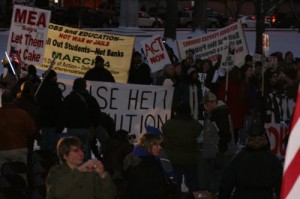
The WOOD radio story said that the protestors gathered outside in what “they had said would be about the State of the Citizen.” The Clear Channel station makes no distinction between the groups that had gathered. The Fox 17 story also at times doesn’t make any clear distinction in their story about protestors, not until their was a conflict between some of the groups present.
The Press ran an AP story that did acknowledge some of the groups protesting outside the capital, such as the Michigan Taxpayers Alliance and the Detroit-based group Moratorium Now Coalition. The article also acknowledges that there was a student group at the capitol protesting education cuts, but it is not clear how this group was organized. The student group was with the MSU Undergraduate Alliance.
The best coverage we found on the groups protesting was from the independent online news site, The Michigan Messenger. Reporter Todd Heywood provided readers with a good balance of comments from several groups on the lawn of the State Capitol. Heywood also did a nice job of verifying some of the claims made by protestors based on their what the Governor actual said in her speech.
Another good indication of the independent journalism provided by The Michigan Messenger was their investigation into some of the material being handed out by those organized by the Michigan Taxpayer Alliance. Heywood said there “was passing out DVDs which he said every American needed to see. Among the five videos were two outlining the Jewish conspiracy to destroy America (Missing Link and Know Your Enemy) and one on the need to be a member of a militia or be tried and hung for treason (Constitutional Militia).”
Courting Disaster: The Weise v Casper Decision
A collapsing economy. A massive earthquake in the long-suffering country of Haiti. The Supreme Court inviting corporations to control our elections. Health care “reform” turned into a gigantic gift to the health insurance and pharmaceutical industries. With all this in the current news cycle, why should we turn our attention to a court case in Colorado that seems to be about—bumper stickers?

On January 27, the United States Court of Appeals, Tenth Circuit, ruled on Weise v Casper. This case, which got little mainstream media attention, is actually a significant First Amendment case that was brought into court with the help of the ACLU. It addresses one of the many staggering violations of citizens’ rights to free speech that occurred during the last decade.
In 2005, George W. Bush gave a speech at a museum in Colorado. It was a public event, funded by the government. But as usual, the Bush White House vetted the audience. Even though the tickets were supposedly handed out on a first-come first-served basis, Secret Service agents turned away audience members who might possibly disagree with Bush’s speech. Anyone who ever attempted to attend a George W. Bush event during his presidency is thoroughly familiar with this “perimeter of protection.” It denied not only protesters but any non-conservatives the right to hear their president speak—while all taxpayers footed the bill for the appearances.
At the museum event, Leslie Weise and Alex Young, who’d been given their tickets by their congressional representative, were kicked out before the speech started. Alex Young was physically dragged from the building, and Leslie Weise was “escorted” out after him. Why? Because Secret Service agents noticed that they’d arrived in a car with a ‘No More Blood for Oil” bumper sticker on it. And now a federal appeals court has said that there’s no problem with that treatment.
Never mind that a similar case, involving a protester’s sign during the Vietnam War era, came to a completely different conclusion because, the court said, the sign represented the protester’s own views and therefore “was entitled to the greatest constitutional protection.” This decision also ignores another groundbreaking case, New York Times v Sullivan, in which the court stated, “The right of an American citizen to criticize public officials and policies and to advocate peacefully ideas for change is the central meaning of the First Amendment.” And while we’re at it, let’s shove aside dozens of other rulings in the past 30 years that have consistently protected free speech in this country.
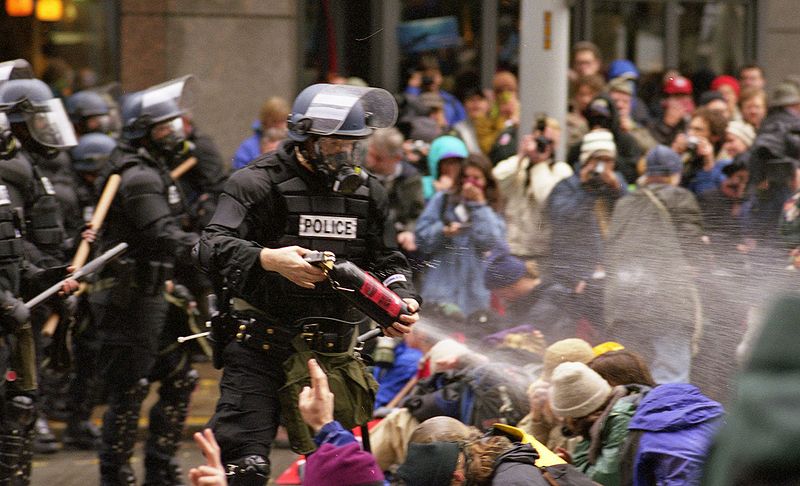
The 10th Circuit Court knows better. It has now decided that the bumper sticker was immaterial; that Weise and Young did not have any “inherent right” to hear their president speak; and that the Secret Service had the right to throw them out of the museum because, even though it was a public event, it was held on private property. Plus (where have you heard this argument before?) the Secret Service agents were just following orders.
One judge on the case, William Holloway, was so appalled by the majority decision that he wrote an unusually blunt dissenting opinion. In it, he pointed out that Weise and Young had gotten their tickets openly, had not done anything to disrupt the event or even indicate that they planned to disrupt it—that their sole “crime” was that they made it plain via a bumper sticker that they disagreed with Bush’s policies.
First Holloway slammed Bush by stating, “It is simply astounding that any member of the executive branch could have believed that our Constitution justified this egregious violation of plaintiffs’ rights.”
Then Holloway turned on his fellow judges and called them “misguided,” adding, “We address here speech that is unquestionably protected, or more accurately, entitled to be protected under the First Amendment. It is severely distressing that such protection is not forthcoming from this court.”
Why is this case important? It sets a precedent that other conservatives can use to attack free speech in the court system. This decision clearly ignores basic First Amendment rights—since the bumper sticker, just like the protester’s sign, is an expression of an individual opinion. As the decisions pile up, they will take on the authority of case law—and be followed routinely in future court rulings.
Just as importantly, the outcome of this case is another example of how the last decade’s far-right-wing appointees to the judicial bench are going to change the way that we are able to express our opinions and exercise our rights as citizens for years to come.
If the ACLU is not successful in finding a way to get this decision overturned, you can bet that Weise v Caspar will haunt future cases for a long time to come. In the meantime, think about what you put on your car bumper, carry in a march, or write to a newspaper. In the not-so-distant future, thanks to the 10th Circuit Court, you may find that speaking your mind is no longer your protected right under the law.
Action Alert on Afghanistan

The Rethink Afghanistan group is asking people to take action today to pressure Washington on the dangers of sending additional US troops to Afghanistan. They write:
“The New York Times recently published the full text of U.S. Ambassador Karl Eikenberry’s memo to President Obama detailing his deep reservations about sending more troops to Afghanistan. The White House ignored his warnings and sent troops anyway.
With the House Armed Services Committee set to begin the 2011 Defense Department budget process on Wednesday, February 3rd, it’s essential that its members read Eikenberry’s warnings about the dangers of deepening U.S. military involvement in the Afghanistan war.”
The anti-war in Afghanistan group is asking people to sign a petition on Twitter and then send the message to friends. There is also a short video they produced which accompanies the action alert.
Rethink Afghanistan screening 2/4 at Aquinas College

This Thursday, February 4, the documentary Rethink Afghanistan will be screened at Aquinas College. The hour long documentary will begin at 7pm at Aquinas College in Albertus Hall – room 119. Albertus Hall is the first building on the right once you enter the Aquinas Campus off of Robinson Rd. Parking is available off of Robinson Rd. by Albertus Hall the the Preforming Arts Center.
The film screening is free and open to the public. The Aquinas College student Social Action Committee (SAC) is hosting the screening. A discussion of US policy in Afghanistan will follow the film.
Media Bites – Bush/Clinton Haiti Ad
In this week’s Media Bites we look at a recent public service announcement with former President’s Bush and Clinton asking for people to donate to their Haiti Relief fund. We take a critical look at the history of US policy towards Haiti, particularly during the Clinton and Bush years, something the mainstream news media has not done during the disaster coverage of Haiti since the earthquake.
Film event reveals causes of foreclosure crisis, provides homeowners help and presents advocacy options
Foreclosure Response presents: American Casino
Celebration Cinema North, Knapps Corners
Thursday Feb. 4
• 6:30 – 7:00 p.m. Browse information from nonprofits, agencies and government officials. Staff will be on hand to answer questions.
• 7 – 8:40 p.m. American Casino.
Reserve free tickets at www.ForeclosureResponse.org.
• 8:30 – 9:30 Q&A/panel discussion about local efforts to stop the foreclosure crisis.

The film, American Casino, lays out how the mortgage industry turned the US into a casino that gambled away millions of American’s homes. Since 2004, 6,773 homes have been lost to foreclosure in the city of Grand Rapids alone. The rate of foreclosure is slowing some. In the past year (September 2008 – September 2009), 1,353 foreclosures went through. The decrease in foreclosures is due to federal and state of Michigan measures that have extended some protections to homeowners.
“Our foreclosure rates were lower than the previous two years,” says Kym Spring, spokesperson for Foreclosure Response. “Part of the reason is attributed to the outstanding job that our housing counselors have been doing. We passed a law in Michigan last July that mandates a 90 day mediation period between the homeowner or the housing counselor representing them. That has really helped as well.”
Spring notes that local housing counselors, such as those at Home Repair Services, have an outstanding success rate; 47% of the homeowners HRS has counseled have managed to hold on to their homes. What many homeowners do not realize, housing counseling is available to anyone in foreclosure, no matter what their income.
“If people are experiencing this financial strain, housing counseling can offer those that can’t stay in their homes a good choice of options,” Spring explains. “It can be very confusing. At least they can make an informed decision about next steps.”
The new Michigan regulations have provided more protections for those renting their homes, as well. A renter in good standing can stay in a foreclosed home. The new owner has to let them sign a new lease, unless the owner occupies the home. In that case, the renter can remain in the home for 90 days.
Screwed or laid off.
As the documentary will show, the majority of people are losing their homes through no fault of their own. They were hoodwinked into signing a mortgage that misled them about costs and payments. Or, they lost their homes as a result of losing their jobs. “ They got screwed or laid off,” Spring says. “The reality is loss of income or escalated mortgage payment. It was not in their control.”
The film also documents how people of color were targeted by subprime mortgages, no matter what their income level. Spring says that local statistics bear this out, showing that mortgage companies did indeed target African American and Hispanic families in the Grand Rapids area.
Spring notes that after targeting people of color, these lenders turned next to senior citizens. She predicts that a second wave of home foreclosures among this population in the coming months.
More citizen action needed.
Spring calls the companies behind the subprime mortgage scandal “Slime.” “They are going to continue to figure out ways to seed their greed unless we put in some serious stop gap measures and regulations. Reagan started the deregulation and Clinton put the nails in the coffin, in terms of talking away consumer protections.”
The State of Michigan passed legislation to help homeowners facing foreclosure only because constituents and groups like Foreclosure Response put pressure on their legislators. The measure passed in spite of intense lobbying by banks and lending institutions. Continuing grass roots citizen action is needed to enact more and better laws to protect not only those facing foreclosure, but also the neighborhoods where they live.
Foreclosures reduce property values, create blight and increase crime. “For all those reasons, it’s important that everyone in the community be exposed to this information and look at what they can do,” Spring says. Foreclosure Response will provide options for taking action on their Website in upcoming weeks. “You can also just help spread the word. If you have missed even one payment, get in to see a housing counselor. Beware of scams. Go to a nonprofit housing counseling service. They don’t charge and they don’t care what your income level is.”
Money in the 2010 Michigan Elections
The Grand Rapids Press has two front-page stories in today’s paper about candidate fundraising in Michigan. One article provides some data on how much money has been raised in the Michigan Governor’s race and a second article looks at the Congressional candidates running to fill Rep. Pete Hoekstra’s seat.

According to the Press article on Gubernatorial candidates, Rick Synder has raised the most money so far ($3.3 million), followed by Mike Cox ($1.8 million), John Cherry ($1.36 million – dropped out), Mike Bouchard ($888,149), Pete Hoekstra ($475,807), Tom George ($199,791), John Freeman ($84,688 – dropped out), and Alma Wheeler ($36,245). This means that all the candidates have raised a combined $8 million thus far.
The Press article on the amount of money raised by candidates for governor provide a brief summary from the candidates on their financial status, with little information on who has donated money to the various candidates at this point. The article also mentions that Rick Snyder plans to air a TV ad during the Super Bowl this Sunday. According to one Lansing-based Republican consultant, “It’ll give him a boost and will get people to look at his campaign when nobody else is on the tube.”
The story on the amount of money raised by those seeking the seat that Rep. Pete Hoekstra will vacate also focuses on the lead fundraiser. To date, Jay Riemersma has raised the most ($352,050), followed by Bill Cooper ($206,722), Bill Huizenga ($151,387), Wayne Kuipers ($57,915), and Fred Johnson ($7,291). Besides monies raised the story focuses on what candidates and other political insiders think about why the “non-traditional candidates” are raising more money.
What are excluded from these stories are two main issues for voters. First, there was no information on the platforms of candidates or the voting record of candidates who have or currently serve in office. Secondly, there is no investigation into why certain individuals, organizations and political action committees have donated to specific candidates and what they expect in return if their candidate is elected. To ignore this is to ignore a great deal of how politics works in this country.
GRIID plans on following the political races for 2010 and will attempt to provide some analysis of the media coverage as well as investigation into candidate platforms and campaign finances. For those wanting to investigate the data on their own you can go to the Michigan Secretary of State’s office for campaign finance updates or check out the monitoring work of the Michigan Campaign Finance Network.
The Press and Michigan’s Economic Future
Starting this past Sunday, the Grand Rapids Press is running a 10-part series on how Michigan can jump-start its economy. The series is called Michigan 10.0 and the first few stories in the series are already indicating what the Press means by improving Michigan’s economy.
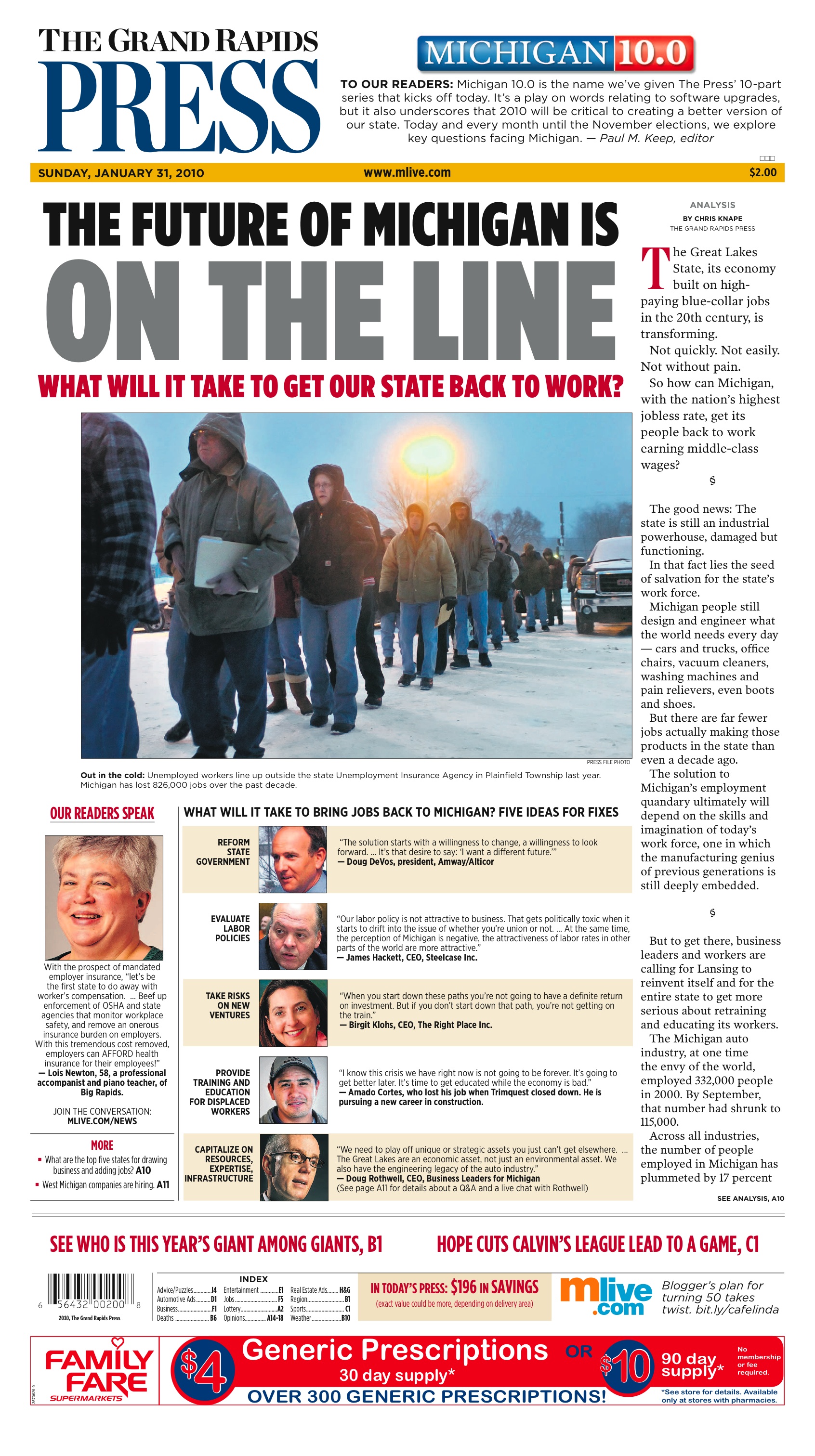
The lead story on Sunday, entitled “What Will It Take to Get Our State Back to Work?,” almost exclusively uses business and economic consultants as sources for the story. There is a separate article in the Sunday Press, which focuses on workers, but that article only talk with and about workers from the point of view that workers need to be re-training in the new economy.
The main article in this Press series focuses on what business leaders are advocating, people like Steelcase CEO Jim Hacket, Amway President Doug DeVos and CEO of the Right Place, Birgit Klohs. The strategy that these business leaders propose is a five-point plan:
- Reform State government with an emphasis on downsizing it.
- Reform Labor policy that will be attractive to businesses.
- Focus on education & training – keeping students in school and providing training for new jobs.
- Capitalize on infrastructure, resources and expertise.
- Build policies geared toward helping small businesses.
Interestingly enough, this 5-point plan is very similar to the same 5-point plan that the West Michigan Regional Policy Conference came up with last year. The only major differences in these two 5-point plans is that the West Michigan Regional Policy group was advocating that Michigan become a right to work state….a non-union state.
This idea that organized labor makes the state unattractive to businesses is affirmed in a statement by Steelcase CEO Jim Hacket in Sunday’s Press story, where he says, “Our labor policy is not attractive to business. That gets politically toxic when it starts to drift into the issue of whether you’re union or not. I see it as a long-haul problem. At the same time, the perception of Michigan is negative, the attractiveness of labor rates in other parts of the world are more attractive.”
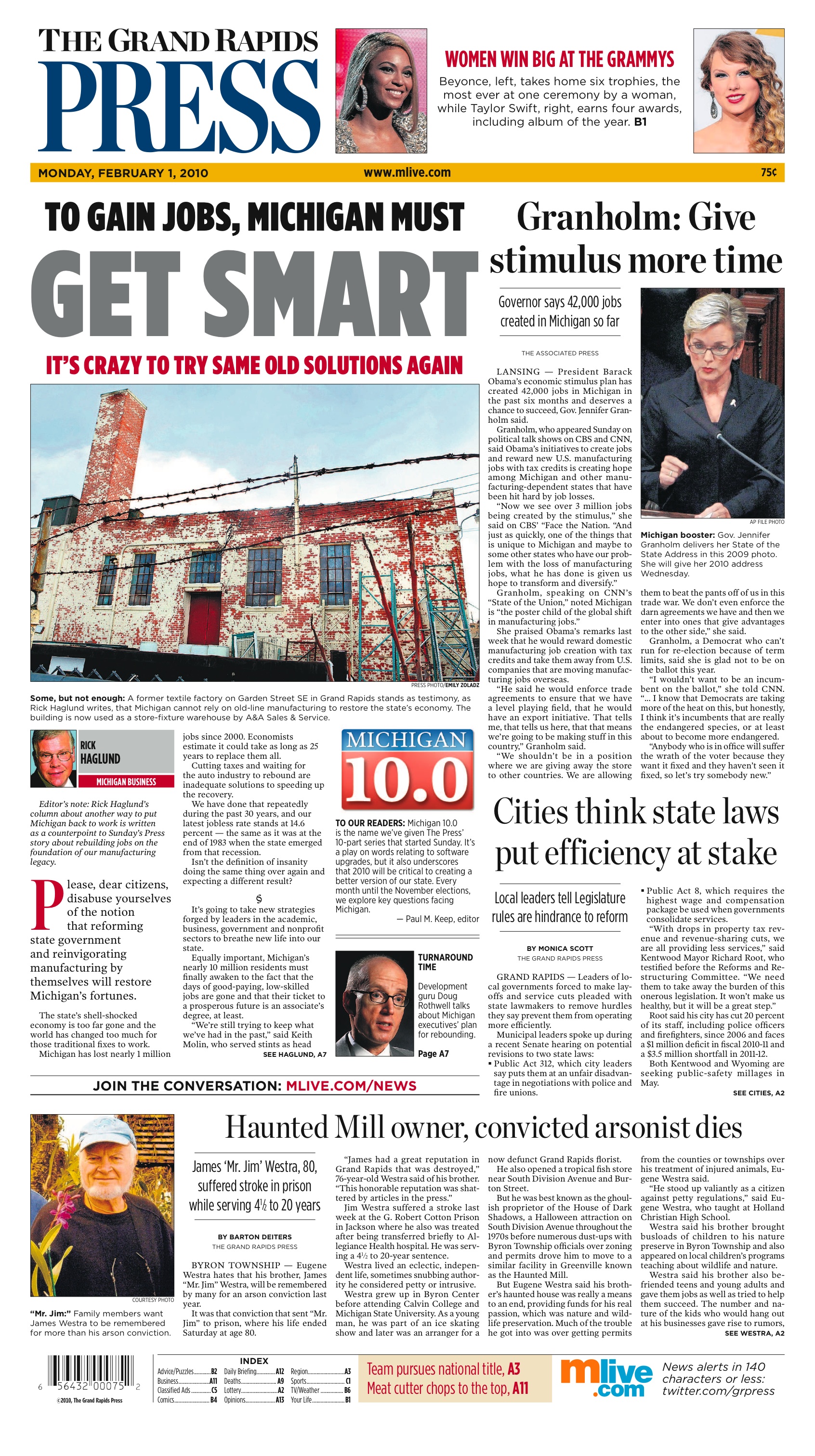
In today’s Grand Rapids Press there is another front-page piece that is part of this series, but it’s not a story, rather an opinion piece by Press writer Rich Haglund. The preface to the story says that Haglund’s piece is “written as a counterpoint” to the main story in the series that began Sunday.
While it is true that Haglund disagrees with some of the points of view articulated in the original article, he does not offer any real plan other than to say that Michigan can no longer rely on manufacturing, particularly the auto industry. Haglund believes Michigan needs to replace manufacturing jobs with “knowledge” jobs. Haglund still is arguing that Michigan’s economy must improve within a free market framework.
The emphasis on a free-market approach to saving Michigan’s economy is affirmed by an interview in Monday’s Press, which is part of the Michigan 10.0 series. The interview is with Doug Rothwell, CEO of Business Leaders for Michigan. The Business Leaders for Michigan group also has its own 5-point plan for turning Michigan’s economy around, called Michigan Turnaround Plan.
After reading the content of the first several articles in this Press series it seems clear that what the sources cited so far are saying is that in order for Michigan’s economy to thrive it needs to follow a free market plan – downsize government, minimize or eliminate organized labor and invest in education for the purpose of creating knowledge workers.
What the articles in this series so far have ignored is the tremendous role that workers have played in creating wealth in this state over the past century. The series so far has also not acknowledged the role that trade policy has played in impacting Michigan’s economic decline. By 2001 it was well documented by the Economic Policy Institute that Michigan had lost over 46,000 jobs due to NAFTA. It is no coincidence that job loss in Michigan due to NAFTA happens during the same time that Michigan’s economy has taken a downturn.
As the rest of the series unfolds in the Press, we will continue to provide some analysis of Press sources and how the paper is framing the issue of Michigan’s economy.
GR Press business editor gloats over Bissell CEO
The business editor for the Grand Rapids Press, Nancy Crawley, wrote what was essentially and promotional piece for business owner Mark Bissell in her weekly Sunday column.

The editorial salutes Bissell Inc.’s decision to not leave Michigan during tough economic times and the company’s creativity in creating new jobs with what Crawley calls “knowledge workers.”
In her editorial Crawley states, “Bissell Inc. shed hundreds of factory workers when its production moved offshore, but now employs 350 knowledge workers to push the innovation envelope.” It is interesting that Crawley chose to use the word shed as opposed to being more up front and say that the company fired hundreds of workers.
A few paragraphs later Crawley does acknowledge that workers were fired, but she frames it in neo-liberal terms of the company’s need to remain competitive. “The fourth-generation of his family to lead the business, Bissell faced a critical decision five years ago. To keep the price of his carpet cleaners and sweepers low enough to compete, he had to move the remainder of his U.S. manufacturing to Mexico and fire 200 loyal workers.”
Crawley then quotes Bissell CEO, Mark Bissell, who says, “For us, the question was how do we in Michigan leverage the global economy and not hide from it.” Bissell also uses neo-liberal language, which is code for how can we find cheap labor in the global economy.
However, Bissell turned right around and hired hundreds of engineers, industrial designers, market researchers and data analysts. These are the “knowledge workers” that Crawley was referring to in her column. Since Bissell has hired the “knowledge workers” the company has moved from number 2 in sales amongst vacuum cleaner companies to number 1.
Crawley goes on to say that the company has invested $9 million dollars in its new Innovation Center on Walker Avenue. The new center has almost as many workers as they did when vacuum cleaners were actually being manufactured here.
This all begs the question, if Bissell can invest $9 million in a new building and hire hundreds of “knowledge workers,” why couldn’t they just keep the hundreds of manufacturing workers who actually made the product and not just talked about it? Crawley’s column does not provide readers with any comparisons to what the former wage workers made assembling vacuum cleaners as opposed to what the knowledge workers make, but it is safe to assume that the knowledge workers make equally as much as the former workers if not more.
We also don’t know where the knowledge workers are coming from. Were they all living in Michigan before being hired by Bissell or were they recruited from out of state? The former Bissell assembly workers were certainly Michigan residents, so how does this kind of treatment of local workers fit into Crawley’s notion that the company is a “model for succeeding in Michigan.”
Lastly, Crawley’s column also doesn’t address the fact that Bissell recently fired 70 workers in Chicago at a warehouse because the workers were trying to organize a union and had filed some complaints against the company with the state. It seems that Bissell is more interested in people to think about their products than those who actually make or transport what workers in Mexico make for the company.
Lobbyists and the Obama Administration
During his campaign for President in 2008, Barack Obama promised to make it more difficult for Lobbyists to operate in Washington politics. The President also made putting restrictions on Lobbyists part of his State of the Union address last week, but what was the track record of Lobbyist in the first year of the new administration.

A few days ago the Center for Responsive Politics reported that, “More than 15,600 companies and organizations spent at least $3.2 billion on federal lobbying in 2009.”
“Additionally, CRP preliminarily found that the health- and health insurance-related companies and organizations spent more than $537.5 million on federal lobbying in 2009, an increase of about four percent above their 2008 spending — a sum that will certainly increase after the final reports are tallied.”
The data certainly shows there has been an increase of Lobbyist spending in the first year of the Obama administration and it should be noted that not all the data for 2009 on lobby spending has been reported yet.
“Pharmaceutical and health product companies look to be the largest industry spender on lobbying in 2009, spending at least $245 million. Other big spenders include the oil and gas industry, the insurance industry and electric utilities, all of which spent more than $135 million on lobbying in 2009.
The top lobbying clients were all groups that have actively opposed or tried to water down major legislative proposals pushed by President Barack Obama and the Democratic Congress: the U.S. Chamber of Commerce, with $144.46 million spent on lobbying; Exxon Mobil, with $27.43 million spent on federal lobbying and the drug industry trade group Pharmaceutical Research and Manufacturers of America (PhRMA), which spent $26.15 million.”
The US Chamber of Commerce is always near the top of lobbying efforts since they represent broad business interests, and it should not be surprising that big oil and drug companies are also at the top of the list considering that the White House and Congress proposed both Health Care and Climate legislation.

