Race, Race Relations, and Racism: Stories from the Jim Crow Museum
On Tuesday, as part of the Race & Ethnicity conference at GRCC, David Pilgrim with the Jim Crow Museum at Ferris State University spoke to an audience of 75 people about racism in the US.
Dr. Pilgrim talks about racism by using the artifacts that they have at the Jim Crow Museum. The museum consists of objects and historical examples of media that promote racism and White Supremacy.
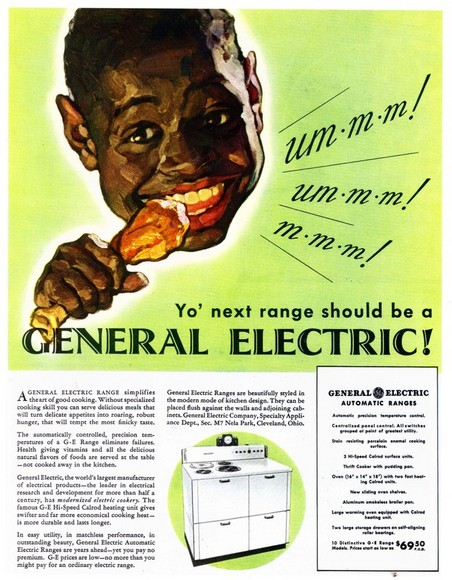
The first example he shows the audience is an ad by General Electric selling a stove using a black boy with a piece of chicken in his hand. Another example is a small bank with a black image and the words Greedy Nigger Boy. An additional example was a still picture from the Bugs Bunny cartoon, where a Black man is shown in the cartoon with stereotypical features, particularly disproportionately large lips.
The museum, Dr. Pilgrim said, uses these tactics in order to get people to honestly talk about race and racism. He encourages people to go to ebay or other online auction sites and enter race-baiting terms and you will find that there are a tremendous amount of items for sale. Many of the items being sold use both old and contemporary racist images. He gives the example of a t-shirt that came out on CafePress as a result of the Don Imus statement directed at the Rutgers women’s basketball team. I went to CafePress and typed in Nappy Headed Ho and there were pages of items for sale.
Another example that Dr. Pilgrim gave was from when Obama was Senator and he called a news reporter sweetie, which led to items online calling Obama a pimp. The speaker then went on to ask how many people in the audience have been to a Pimp & Ho Party? Lots of people raised their hands. Then he asked, from whom did people learn pimp behavior from? One person yelled out Snoop Doggy Dogg. Dr. Pilgrim said that most of us have a clear association with the word pimp to that of a Black man.
Sticking to the discussion about racist representation as it relates to President Obama, Dr.Pilgrim say that some of the criticism of Obama is often framed in racialized language. He gives a list of anti-Black male caricatures over the past 200 years that are still used today, such as Tom, Brute, Sambo, Buck, Coon, Savage, Nat and Magic Negro. He then talks about how these caricatures are manifested today – in the news, movies, video games and music videos.
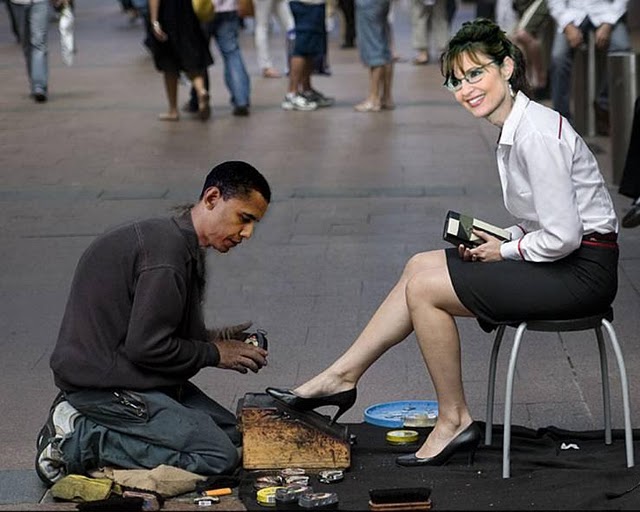
He then looks at examples of images using President Obama that continue these caricatures. One has Obama shining Sarah Palin’s shoes. He also shows a Tea Party sign of Obama bowing to the Saudi King sucking his jewels. In another image Obama was presented as a buffoon. A website called Chimpout.com has Obama as a thug.
Other examples with the President are a cartoon of Obama eating chicken, which is an image in the film Birth of a Nation. One image was a poster a woman had that said, “The Zoo has an African and the White House has a Lyin’ African.” Another sign Dr. Pilgrim shows the audience says, “Obama’s Plan = White Slavery.” This fits in with what Glen Beck said on his TV show last year, which was that Obama has a deep-seated hatred of White people and White culture.

The same kind of analysis was presented about traditional Anti-Black female caricatures like Mammy and Aunt Jemima. Dr. Pilgrim then looked at these caricatures as it relates to Michele Obama. One example was a T-shirt comparing Cindy McCain and Michele Obama, called Beauty and the Beast. There was another image of the First Lady as a Hoochee-Mama. Another image was a tote bag you could buy with a picture of Michele Obama and the phrase, “We’re planting melons in the White House garden.” In fact, Dr. Pilgrim said if you Google Michele Obama the first image was of Michele as a chimp.

At this point Dr. Pilgrim asks the audience if they thought that since the election of President Obama has the country moved into a post-racial society. His response to the question was to tell a story about a recent visit he had to a gun show at the Deltaplex in Grand Rapids. He asked one vendor if he could buy the most popular paper shooting target the guy sold. The man showed him this one called the “Official Running Nigger target.”
At the very end of his talk, Dr. Pilgrim stressed that these kinds of racist images were “not only a black thing.” He showed the audience a Halloween costume called Kung Fool that was sold at WalMart. He also had an image of Hillary Clinton as a man, standing at a men’s urinal. Then there was a whole series of Anti-immigrant images. Dr. Pilgrim even said there is a Border Patrol video game where Mexicans are presented as violent nationalists, drug smugglers and breeders.
By way of concluding, Dr. Pilgrim just wanted to reiterate that the purpose of looking at these images and the purpose of the Jim Crow Museum was to try to get Americans to have open and honest discussion about how pervasive racism still is in this country.
Obama says Public Option off the table before Health Care Summit
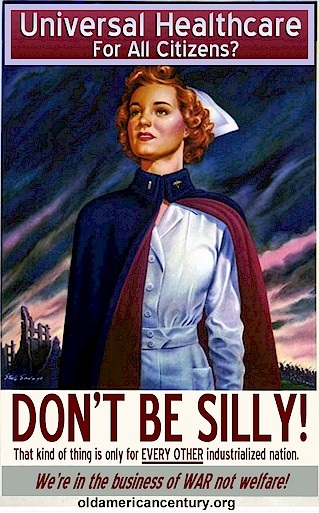
The Huffington Post is reporting that President Barack Obama, despite growing support in the Senate for the Public Option to be included in the Health Care plan, has decided to exclude it from the latest proposal from the White House.
“Obama’s decision not to push for the public option does not preclude it from being included. Indeed, any member of the Senate can introduce it as an amendment to a package moving through under the rules of reconciliation, a parliamentary process that precludes a filibuster.”
Some polling suggests that Americans still support a public option and many progressive Democrats would rather see the public option included even if the proposed legislation did not have bipartisan support.
However, one aspect of the health care debate that is being overlooked before Thursday’s “Health Care Summit,” is how much the health care industry is lobbying the government.
According to the Center for Responsive Politics (CRP), “health care-related companies and special interest groups spent more than $544 million on federal lobbying efforts — obliterating their previous high from the year before.”
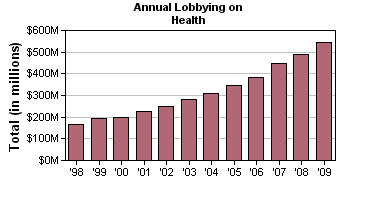 The CRP also notes that the entities which have lobbied the most – “the U.S. Chamber of Commerce, Pharmaceutical Research and Manufacturers of America, AARP, Pfizer, Blue Cross/Blue Shield, the American Medical Association — all rank within the United States’ top 10 federal lobbying clients of 2009.” It should also be mentioned that the data for the first quarter of 2010 lobbying will not be in until mid-April, but as of last week the Democrats had received over $20 million from health care lobbyists compared to just over $13 million for Republicans.
Lastly, Physicians for a National Health Program (PNHP), which represents 17,000 physicians who support a Single Payer health care plan, sent a request to the White House to be invited to Thursday’s Summit. The White House declined their request.
Comparing Coverage of the US “Surge” in Afghanistan
It has been a little more than a week since the new US military offensive began in the city of Marjah, Afghanistan. US military planners have hot the news circuit to discuss these plans and the mainstream media has tended to follow the script.
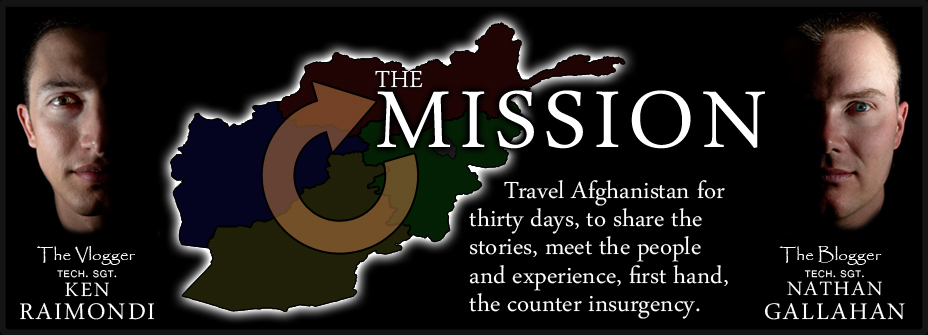
In yesterdays Grand Rapids Press there were two articles from the Associated Press that illustrated how the mainstream media often reflects the position of the US Department of Defense, much like the DOD’s blog 30 Days Through Afghanistan.
The first story appeared on page A10 and was headlined, “Taliban town skeptical of allies’ promises.” In some ways the article was better than the typical AP story in that readers do get to hear from Afghani civilians, some of which have bigger problems with the US/NATO occupation than they do with the Taliban.
The article does present general skepticism from Afghani villagers but the US military campaign is not questioned or presented in terms of a violation of international law or as an imperialist campaign. On top of these omissions, the article comes with a picture of US Marines shaking hands with people from the village, thus presenting a benign view of the US military campaign in Marjah.
The second AP article is actually presented as an “analysis” piece. In this piece, the AP writers follow the US script in the new military campaign. The article asks questions about whether or not the Taliban will retake Marjah and the role that Afghan soldiers are playing in this campaign, but it is still presented through a lens that accepts the US premise.
This second AP article also includes comments from Richard Nelson, whom the story identifies as a “former White House counter-terrorism expert.” Nelson is actually with the Center for Strategic and International Studies, a Pro-US think tank that includes on its board of directors Henry Kissinger, Sam Nunn and Brent Scowcroft.
News and Analysis from the Independent and International Press
Comparatively, when reading news media that doesn’t follow the US script, one is presented with a significantly different point of view. Jason Ditz, writing on Antiwar.com, says that the US campaign in Marjah is causing serious humanitarian concerns. Villagers have been forced to stay in doors for over a week due to the fighting and cannot get access to food and medicine. Farmers are also frustrated that they cannot gain access to their fields in order to tend to crops.
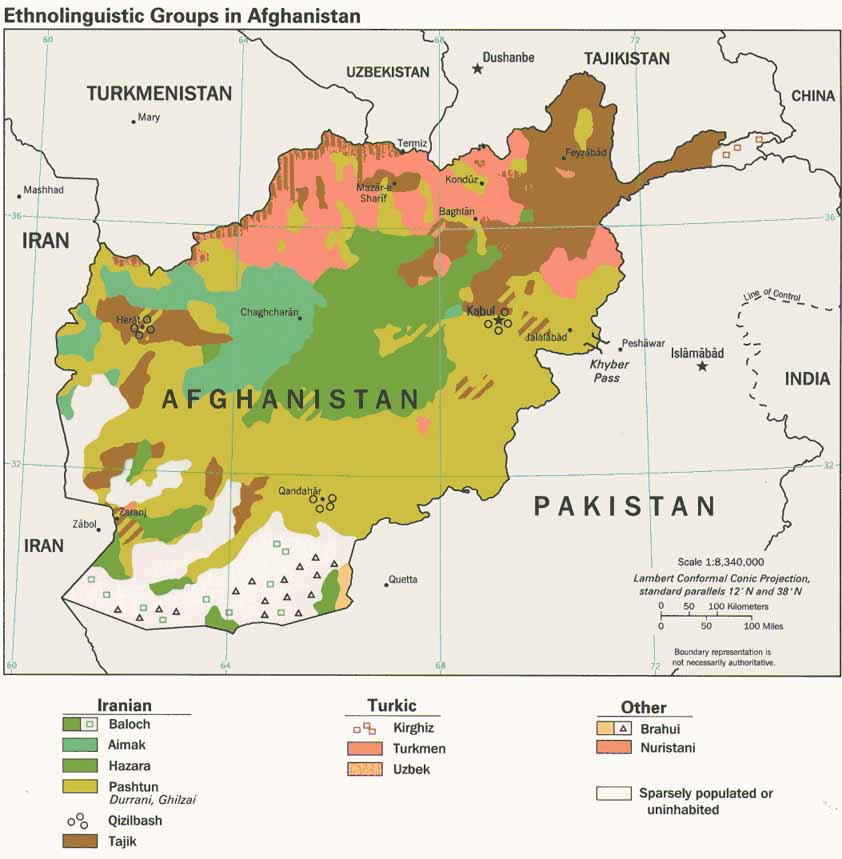
Author Juan Cole, who writes the Informed Comment blog, has his own analysis piece after the first week of the US campaign in Marjah. Cole has his own set of questions about whether or not the “Afghan Surge” will work.
Cole asks questions like will the US be able to secure and hold villages in predominantly Pashtun areas of Afghanistan? Cole doesn’t think this is possible and says that even in Marjah the community members are not showing much support for the US military presence. Another question Cole explores is whether or not the Afghan military will be effective in the long run? Again, the writer thinks that this is not likely. First, many of those in the Afghan army are not literate and have not shown much initiative in fighting. Second, the majority of those in the military are Tajiks, which leads Cole to conclude that since there are serious tensions between Pashtuns and Tajiks the Afghan army will not be successful in the areas, which are now controlled by the Taliban, which are predominantly Pashtun.
Another news that doesn’t fir into the US script on Afghanistan is what was presented on Democracy Now today. The independent news organization reported that the Dutch government is pulling its troops out of Afghanistan, that there is growing anti-war sentiment in Germany and that another US/NATO air strike killed 33 Afghan civilians yesterday.
Lastly, it is worth hearing directly from Afghanis in this video provided by Al Jazeera. In this video civilians fleeing Marjah express their fears about the US military campaign.
Bloom Movie Night – Negroes with Guns: Rob Williams and Black Power
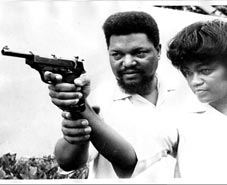
Robert F. Williams was the forefather of the Black Power movement and broke dramatic new ground by internationalizing the African American struggle. Negroes with Guns is not only an electrifying look at an historically erased leader, but also provides a thought-provoking examination of Black radicalism and resistance and serves as a launching pad for the study of Black liberation philosophies. Insightful interviews with historian Clayborne Carson, biographer Timothy Tyson, Julian Bond, and a first person account by Mabel Williams, Robert’s wife, bring the story to life.
The Bloom Collective will be screening Negroes With Guns this Thursday, February 25. This California Newsreel film is a powerful, which will be followed by discussion.
Negroes with Guns
Thursday, February 25
7pm
Bloom Collective – 1134 Wealthy
$3 suggested donation
Remembering Malcolm X
“America is guilty of image making through the press to justify anything they have in mind to do.” Malcolm X
Forty-five years ago today, Malcolm X was assassinated just as he began his opening remarks at the Audubon Ball Room in New York City. The talk Malcolm X was about to give was for the Organization of Afro-American Unity (OAAU), which had been former the previous year in 1964.
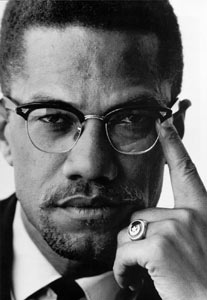 Malcolm X is one of the most misunderstood figures in struggle for Civil Rights and the Black Power Movement. He is still viewed in dominant culture as a race hater and as someone who advocated violence, but Malcolm X was much more complex and was coming through a tremendous awakening in just the last few years of his life.
One of the things that make Malcolm X so relevant to people working for radical social change was his transformation in prison from common thief to a person of deep self-awareness. Malcolm’s transformation came about because of his acceptance of the religious teachings of the Nation of Islam.
The young convert came into his own quickly and realized his gifts as an intellectual, public speaker and organizer. Malcolm helped the nation of Islam build numerous new mosques around the country, gain new members and national notoriety. However, divisions within the Nation itself led to factions arrayed against Malcolm as well as the fear that Elijah Muhammad (leader of the Nation of Islam) had with Malcolm’s politics.
The event that demonstrated to Malcolm the limitations of the Nation of Islam was when he was silenced for weeks after his comments on President Kennedy’s assassination. Malcolm was asked what he thought about the President’s death and Malcolm basically said that he was not surprised since he felt that the if the US was going to support repressive policies around the world and engage in political assassination that Kennedy’s death was a natural outcome of those kinds of policies – what Malcolm referred to as “chickens coming home to roost.”
Shortly after he silencing Malcolm became aware of Elijah Muhammad’s misuse of power by fathering numerous kids from several different young women within the Nation of Islam. This revelation led Malcolm to leave the Nation and begin his second major transformation.
Part of his new transformation included traveling to Africa and the Middle East. In these travels Malcolm came to see that Islam was a world religion that had the potential to unite people regardless of race. Malcolm X also met with leaders of anti-colonialist movements, which influenced his understanding of US policy and the importance of solidarity.

Upon his return Malcolm began the Organization of Afro-American Unity (OAAU), which sought to build a much broader movement around civil rights, human rights and economic rights. Malcolm began to question more the economic exploitation under a capitalist model and felt that economic oppression is what would ultimately unit people.
“I believe that there will ultimately be a clash between the oppressed and those that do the oppressing. I believe that there will be a clash between those who want freedom, justice and equality for everyone and those who want to continue the systems of exploitation.”
In the last years of hi life Malcolm X became more ecumenical in his thinking and wanted to build bridges with other religious and social organizations. He began to be invited by radical labor groups and socialist organizations to speak about systems of oppression and Malcolm X was one of the first to acknowledge that we need to move beyond civil rights and start thinking about human rights.
His assassination forty-five years ago robbed us of what he might have evolved to and what greater impact the OAAU could have had on the civil rights/black power movements.
Here is an excerpt from a debate he took part of at Oxford University in December of 1964. This is an excellent example of his skills as a public speaker, but more importantly his analysis of the US is still quite relevant for us today.
Media Alert: Nuclear Industry Gets a Free Pass in Media Coverage
(This media alert is from Fairness & Accuracy in Reporting)

On February 16, ABC World News and NBC Nightly News aired incomplete and unbalanced reports following Barack Obama’s announcement of $8 billion in new loan guarantees for a nuclear power plant in Georgia.
ABC reporter Jake Tapper announced that, “for years leading Democrats and liberals opposed nuclear energy. No new nukes, was the cry. So some may have been surprised to hear President Obama say today, essentially, yes, new nukes.”
But after that nod, nuclear opponents mostly disappeared from the piece, which showed Tapper stressing industry claims about job creation for this new plant (“3,500 on-site construction jobs and 800 permanent operations jobs”) and the amount of energy the plant will generate–enough “for 550,000 homes, 2,200 megawatts worth of electricity that would offset about 30 million barrels of oil.” He also quoted two anonymous Georgia residents saying their town needs the jobs.
One critic–Greenpeace’s Jim Riccio–made a short comment about safety concerns, but was countered by Tapper: “Nuclear power advocates say since then plant design and equipment requirements have been upgraded.” Tapper then quoted nuclear industry lobbyist Patrick Moore, introducing him with his past credentials: “Back then, he was an anti-nuclear power activist and a founder of Greenpeace. Today, he lobbies for nuclear energy.” After Moore claimed that, “nuclear industry is generally one of the safest industries we have,” Tapper concluded that, “he’s not the only one who’s changed his mind.”
Moore’s former Greenpeace ties make him a media favorite, but he wasn’t actually a founder, just an early activist–Extra!, 1-2/08–and it’s worth noting that, as PR Watch pointed out (3/14/07), “Moore has now spent more time working as a PR consultant to the logging, mining, biotech, nuclear and other industries…than he did as an environmental activist.”
The report by NBC Nightly News suffered from some of the same problems: Three sources are quoted supporting the nuclear plan, with only one critic (Erich Pica of Friends of the Earth). In attempting to discuss safety concerns, NBC mentioned Chernobyl and the 1979 partial meltdown at Three Mile Island (Extra!, 7-8/93). Neither network mentioned the current problems with nuclear reactors; the Vermont Yankee nuclear plant, for example, is leaking radioactive tritium into the groundwater, a safety hazard that is being documented at other nuclear sites around the country (Associated Press, 2/2/10; Greenpeace Blog, 1/28/10).

NBC also has bigger issues: its parent company General Electric is a major player in the industry, and has done business with the company planning to build the Georgia plant (southerncompany.com)–a major fact NBC neglected to mention in its report.
While both reports mentioned that the Georgia plant would be the first built in the U.S. in three decades, neither gave much of an explanation as to why this would be the case. But as nuclear power critics have documented for years, the plants have proven to be financial disasters, with severe cost overruns and a general reluctance among investors to foot the bill for projects that are unlikely to be profitable (Greenpeace, 10/15/08). Obama’s pledge of multi-billion dollar loan guarantees should have caused reporters to wonder why the industry, after decades of experience, needs so much government assistance in the first place.
ACTION: Please ask ABC and NBC why their reporting on the White House’s nuclear power plans omitted important facts about nuclear power in favor of the optimistic projections of the nuclear industry. And, in NBC‘s case, why the report failed to disclose its parent company’s financial ties to the nuclear industry.
CONTACT:
NBC Nightly News
ABC World News with Diane Sawyer
Web Form: http://abcnews.go.com/Site/page?id=3271346&cat=World%20News%20with%20Diane%20Sawyer
Michigan Legislators raised $6 million in 2009
According to a recent Press Release from the Michigan Campaign Finance Network, current Michigan legislators running for office raised nearly $6 million in 2009.
“Incumbent representatives raised $2,621,369 for their House campaign committees, and another $1,280,518 for new committees for higher offices, mostly State Senate. When transfers from the House accounts are subtracted from the totals for new committees, net fundraising by incumbent representatives totaled $3,587,946 for the year.
Incumbent senators raised $1,727,551 since their last reports and have now raised $4,329,326 for their Senate campaign accounts since they last faced they electorate in 2006. Of the 38 senators, 29 are term-limited and cannot run again for their Senate seat. Including fundraising for new committees for higher offices, the 38 incumbents have raised a net of $2,391,774 over calendar year 2010.”
West Michigan Representatives varied in the amount they raised as incumbents. Roy Schmidt had as a balance at the end of 2009 – ($40,325), Arlan Meekof ($29,601), Mary Valentine ($24,982) Dave Agema ($24,854), Robert Dean ($15,068), Justin Amash ($3,150), Dave Hildenbrand ($2,670), Kevin Green ($1.812), and Tom Pearce ($1,491).
State Senators from West Michigan had a balance in their budgets for campaign funds at the end of 2009, with Senator Mark Jansen having the most at ($40,595) and Senator Wayne Kuipers at ($17,267). Since Senator Bill Hardiman is term limited he only had $371 in his balance for 2009.
“Two things jump out of these reports,” said Rich Robinson of the Michigan Campaign Finance Network. “First, a year is too long to go between fundraising reports by incumbent officeholders. Our legislators raised $6 million last year, and we shouldn’t have to wait a year to know it.”
“Secondly, when you look at the level of debt in the new campaign committees of aspiring candidates, and recognize that those figures are a reflection of self-funding, you have to wonder whether running for office is being priced out of the reach of persons of ordinary means.”
Front page rules: Commercial interests, not worker rights
Yesterday, the Grand Rapids Press ran a front-page story, complete with 3 photos, about the opening of a boat show at the Grand Rapids convention center.
The story was framed as a great opportunity for boat dealers, since they were offering big discounts on new boats. The story cited several boat dealers and even included a sidebar with the article giving price listings for some of the boat models. In many ways, once could argue that this was not a news story, rather it was advertising that looked like news.

In the same addition of the Press, there was a short story on page 9 headlined, Report: Conditions slip for farm workers. The story (no photos accompany this story) is based on a new report that makes the claim that working conditions for migrant workers is worse today than it was 40 years ago.
The Michigan Civil Rights Commission will be reviewing the 1,000-page report at a public meeting on March 22, according to the Press article. The article also stated that based on investigations from last summer civil rights investigators found serious violation.
“What they found were several instances where farmworkers were being forced to live in dangerous and unsanitary housing and being taken advantage of, or mistreated by unscrupulous employers, officials at the meeting said.”
While it is good that the Press ran this story, why did they choose to place it on page 9? What makes a boat show front-page news and worker conditions not front-page news? How many people in West Michigan can afford to buy a boat and how many people are working people? The answer to that should tell us something about who the Grand Rapids Press wants to buy their paper.
Media Alert: No More PR Pundits
(This Media Alert is from the national news watchdog organization Fairness and Accuracy in Reporting – FAIR)
Scores of pundits appearing on cable news networks are paid corporate lobbyists and PR flaks–and the networks aren’t disclosing their corporate ties. In a new report in the Nation reporter Sebastian Jones writes:

“Since 2007 at least 75 registered lobbyists, public relations representatives and corporate officials–people paid by companies and trade groups to manage their public image and promote their financial and political interests–have appeared on MSNBC, Fox News, CNN, CNBC and Fox Business Network with no disclosure of the corporate interests that had paid them. Many have been regulars on more than one of the cable networks, turning in dozens–and in some cases hundreds–of appearances.”
For example, during the collapse of insurance giant AIG–and the ensuing government bailout–some pundits appearing to discuss the story were, unbeknown to viewers, actually working for AIG, as lobbyists or public relations advisers. And as the healthcare debate unfolded throughout the past year, a number of pundits and former lawmakers have made numerous appearances to talk about health insurance reform–all the while employed by insurance and pharmaceutical companies. In almost all cases, viewers had no way of knowing the affiliations of these guests.
The allegedly liberal-leaning MSNBC, writes Jones, had the most egregious instances of airing guests with conflicts of interest. Only on MSNBC did Todd Boulanger, a Jack Abramoff-connected lobbyist working for Cassidy and Associates, go on a TV rehabilitation tour with no identification of his work, all while he was under investigation for corruption. (He pleaded guilty in January 2009.) Only on MSNBC was a prime-time program, Countdown, hosted by public relations operative Richard Wolffe and later by a pharmaceutical company consultant, former Gov. Howard Dean, with no mention of the outside work either man was engaged in. And MSNBC has yet to introduce DynCorp’s Barry McCaffrey as anything but a “military analyst.”
Some networks have written policies demanding that contributors and analysts reveal their conflicts of interest. But it’s hard to take those guidelines very seriously; as Jones points out, one MSNBC official suggested that their idea of disclosure might be to post relevant information about their guests on the MSNBC website. In a media system already dominated by official sources from government and big business, why are cable channels relying on paid spokespeople and lobbyists as commentators? And why are these channels hiding the affiliations of their pundits? Join FAIR to demand answers and accountability. Sign our petition to MSNBC, Fox News, CNN, CNBC and Fox Business Channel, demanding that they come clean about their corporate-sponsored pundits.
FAIR is asking people to sign an online petition that will be send to these cable networks.
City Publicizes Citizen Input on Budget Crisis
Today, the City of Grand Rapids published the results of the community meetings held last fall, where residents, businesses and the faith community shared their ideas on how the city can save money or generate income to offset the budget deficit.

The public feedback was organized into three categories; ideas the City has already implemented, frequently asked questions and the Top 20 Budget Gathering Suggestions.
In the section on ideas the city has already completed or continues to work on, there were 65 suggestions. Some of these ideas were: better enforcement for fines or parking tickets; pay extra for police when at public events; sell off city assets; use court community workers for park maintenance; cut some police and fire programs; and eliminate city staff perks like use of city vehicles and limit city staff who attend conferences in Michigan.
There were also ideas that have already been embraced that are not just about eliminating costs or making government more efficient, instead they advocate for privatization of city services. Some of these services that have already been privatized are corporate sponsors of City pools and item number 23 in the document states, “The City contracts with private firms to provide hundreds of services. We continue to examine City services to understand if they can be provided as effectively and for less cost by a private firm.”
The document identified as the Top 20 Budget Gathering Suggestions continues this trend of privatization and downsizing of government. Here are the Top 20 suggestions as determined by the city:
1) Reduce the wages and benefits of city employees
2) Reduce the number of city employees
3) Increase efficiencies in providing City services
4) Increase flexibility in City employee deployment
5) Reduce expenses; take home vehicles, travel, meals, and purchases
6) Privatize City services
7) Seek grants from the State and Federal government and foundations
8) Sell City assets
9) Generate financial sponsorships to support City services
10) Assure that the full cost of services are identified and adjust fees towards full cost recovery where possible and appropriate
11) Charge non-residents higher fees
12) Allow the public to donate to support City services
13) Assess a fee for collecting taxes for other public entities
14) Collect outstanding fines for parking tickets
15) Collect local sales taxes
16) Increase personal income tax
17) Eliminate or consolidate departments and consolidate services with other public entities
18) Eliminate impediments to consolidation of services within the City and partnering with other entities
19) Engage individuals, organizations, and businesses in providing services
20) Increase transparency in City service operations and performance
I attended one of these public input meetings on the city budget and offered a suggestion that was not included in their final report. I suggested that the city look at cutting or eliminating the amount of money they provide to businesses in the form of subsidies, tax breaks and abatements. The city argues that these subsidies and tax breaks are necessary to have businesses come to Grand Rapids in order to create jobs. However, there is no evidence on the City’s website that these subsidies have indeed been an economic benefit to the city. A good resource on this issue is the book The Great American Job Scam: Corporate Tax Dodging the Myth of Job Creation, by Greg LeRoy.
Another suggestion that was offered up at the meeting (also not included in the report) I attended was from Mike Saunders who said the city should enter into talks with Congressman Ehlers and Senators Stabenow and Levin on the matter of how much tax money is leaving Grand Rapids to fund the US wars in Iraq and Afghanistan. As of today, according to the National Priorities Project, the amount of tax money leaving GR to fund these two wars since 2001 is $503,636,680.00.
One last issue that should be raised is an evaluation of the process the city took. Even though an estimated 500 people participated in the community meetings in November and December the public had no say in how to prioritize the suggestions and ideas they provided. One process that could be adopted by the City of Grand Rapids is the Participatory Budgeting Project model. In this model the public directly participates in deciding how municipalities use tax dollars. The model began in Brazil in 1989 and is widely used throughout the world and in the US.


