US House and Senate Approve Extension for Patriot Act

This week, both the US House of Representative and the Senate voted to extend the Patriot Act for an additional year. The House voted 315 to 97 to extend major provisions of the USA Patriot Act.
The three sections of the Patriot Act that would stay in force are:
- Authorize court-approved roving wiretaps that permit surveillance on multiple phones.
- Allow court-approved seizure of records and property in anti-terrorism operations.
- Permit surveillance against a so-called “lone wolf,” a non-U.S. citizen engaged in terrorism who may not be part of a recognized terrorist group.
The American Civil Liberties Union Responded by saying, “Congress refuses to make reforming the Patriot Act a priority and continues to punt this crucial issue down the road. Once again, we have missed an opportunity to put the proper civil liberties and privacy protections into this bill. Congress should respect the rule of law and should have taken this opportunity to better protect the privacy and freedom of innocent Americans. We shouldn’t have to live under these unconstitutional provisions for another year.”
In addition, the ACLU acknowledged that, “Since the Patriot Act’s passage in 2001, there have been several consecutive reports (including one released in January) from the Department of Justice Office of the Inspector General that have outlined widespread and blatant abuse of the statute.”
This is just the most recent example of despite both the House and the Senate being a majority of Democrats that progressive action is not taking place in Washington, DC.
March 13 Iraq War Protest marks 7th Anniversary of the US Occupation
Iraq War Protest
Saturday March 13, 2010
Noon to 3 p.m.
Fulton & Division, Downtown Grand Rapids

March 2010 marks the seventh year of US occupation and brutalization in Iraq. While the names of the US offensive have changed to protect the guilty (media relations experts have dubbed the next phase of the Iraqi occupation “New Dawn” ) the US funded violence remains the same.
The group of local citizens organizing the protest made this statement:
We are coming up on another anniversary of the illegal US invasion of Iraq, and we are seeing now more clearly than ever that the Democratic Party has been little more than a redecorating party for US imperialism and corporate domination. The war(s) raging on in the Middle East are unjust, unwarranted, and unacceptable, and they are sucking money and power from the common people at a disgusting rate. The resources funding this despicable show of capitalist imperialism could totally revolutionize the socioeconomic landscape of the US and of the world if redirected properly.
But we’ve seen time and time again that those in charge will not willingly let go of those resources for the good of the people. The corporate interests manipulating this war will continue to destroy for profit as long as the people continue to play their games and buy into their lies. Electoral politics, lobbying, and passive spectator culture have led us deeper and deeper into war and devastation.
But radical organizing, consciousness-raising, and direct action give us hope for change. Not the “hope” and “change” so perversely and cleverly marketed to us in the most recent presidential election, but something truly different. People–not corporations, not governments, not even apparently independent “grassroots” political bids for power–can make the difference between a world of destruction and oppression and one of trust and mutual aid.
Meet at the park at the corner of Division and Fulton in downtown Grand Rapids on Saturday, March 13. Bring banners, signs, flags, puppets, art, street theater performances, leaflets, fliers, chalk, paint, and anything else beautiful and eye-catching. Also, bring drums, buckets, sticks, whistles, instruments, megaphones, boom-boxes, and other tools for making huge amounts of noise. Most importantly, bring friends.
Iraqis and Afghan civilians and American troops are dying—and American taxpayers are watching their public schools and universities, social assistance programs and cities slash budgets and reduce services. To date, the US has spent nearly $966 billion dollars on the occupations of Iraq and Afghanistan—with another $150 billion slated for military operations in 2011. Come downtown March 13 and make your voice heard.
Get the US out of Iraq!
Get the US out of Afghanistan!
What We Are Reading
Below is a list of books that we have read in the past month. The comments are not a review of the books, instead sort of an endorsement of ideas and investigations that can provide solid analysis and even inspiration in the struggle for change. All these books are available at The Bloom Collective, so check them out and stimulate your mind.

A Woman Among Warlords: The Extraordinary Story of an Afghan Who Dared to Raise Her Voice, by Malalia Joya – This amazing book consists of the personal experiences of Malalia Joya, an Afghan woman who became the youngest person to be elected to the Afghan parliament. Raised in refugee camps, this woman represents the best of Afghanistan in that she advocates for the real liberation of women and actively opposes the US/NATO occupation of her country. Malalia also has spoken out consistently against the Afghan warlords, some of which are part of Karzai’s inner circle and for this she was suspended from parliament in 2007 and has had numerous assassination attempts made on her life.

Against Ratizinger, by an Anonymous writer – This book, written by an anonymous Italian writer is an interesting look at the current head of the Roman Catholic Church, Pope Benedict XVI. The writer takes a look at the Pope’s involvement in the Nazi Party, his climb to power within the Catholic Church and his role in cracking down on priests and theologians who advocated Liberation Theology during the 1980 – 90s, particularly in Latin America.

Venezuela Speaks: Voices from the Grassroots, by Carlos Martinez, Michael Fox & JoJo Farrell – Venezuela Speaks is an extremely inspirational collection of interviews with people in Venezuela that are the real protagonists in the Bolivarian Revolution. While, the mainstream press and to some degree the left media gives a great deal of attention to President Chavez, this book rightfully puts the focus of union organizers, students, women’s organizations, indigenous groups, community based entities and cooperatives.

Seeds of Terror: How Heroin is Bankrolling the Taliban and Al Qaeda, by Gretchen Peters – This is must reading for anyone who wants to understand the US/NATO occupation of Afghanistan. Peters not only documents how opium and heroin production has flourished since the US/NATO occupation began in 2001, but how the US has downplayed the role that this illegal substance has played in financing the Taliban’s campaign against the occupation. Peters uses lots of first hand sources and gives readers a first hand account since she has spent years talking to people throughout Afghanistan and Pakistan.

Che Guevara: A Life, by Nick Caistor – There has been many books written about the Argentine-born revolutionary Che Guevara, but Nick Caistor has done a much better job of capturing the essential aspects of Che’s life and political thought. While not an exhaustive investigation, this book provides readers with an important investigation of someone who has influenced recent generations, both in terms of intellectual inquiry and revolutionary courage. Caistor does paint Guevara as a stale icon, but as someone who believed that the only way to develop revolutionary consciousness was by example.
Sunrise or Sunset for Iraq?
(This article is by Frida Berrigan and is reposted from Foreign Policy in Focus)
Operation New Dawn. That is the name the U.S. military will give its operations in Iraq when U.S. military operations in that country end this September.

Wait, what? Okay, once more, a little more slowly. The United States has nearly 100,000 military personnel in Iraq right now. In keeping with the January 2009 Security Agreement between Washington and Baghdad, the United States will withdraw all forces and contractors and turn over military installations to the Iraqi government by the end of 2011.
In order to meet this goal, the Obama administration will begin moving troops out of Iraq this spring. The president promised to remove all combat personnel by August. In September, the United States will reduce its troop levels to 48,000 troops and bring down the number of contractors from 120-130,000 to 75,000. That new arrangement will be dubbed Operation New Dawn.
Why Now?
Operation Dawn was first used in a memo from Defense Secretary Robert Gates to U.S. Central Command head General Davis Petraeus last week. In the memo Gates says that the name change “sends a strong signal” and “presents opportunities to synchronize strategic communication initiatives, reinforce our commitment to honor the Security Agreement, and recognize our evolving relationship with the Government of Iraq.” Okay, but why in February, months before this transition even begins?
The announcement has some obvious liabilities. For one, it reminds the U.S. people that there is a war in Iraq — an expensive, bloody, and protracted conflict that the president campaigned to end. No one wants to be reminded of this conflict, especially when there’s another expensive, bloody, and protracted conflict in Afghanistan dominating the front pages of the newspaper.
Operation New Dawn also opens the administration up for renewed derision at its clumsy rebranding efforts. One can’t help but be reminded of the Obama administration’s efforts to replace the bombastic “Global War on Terror” and its robust shorthand GWOT with the tepid moniker “overseas contingency operations.”
In light of these and other drawbacks, the name change is happening now because — in part — Iraq is preparing for elections in the first week of March, and those preparations aren’t going well. Sunni groups might sit it out, violence is once again spiraling out of control, and voter turnout is expected to be light.
Against this less-than-bright-new-dawn rising, the United States military appears to be trying to remind everyone it is on its way out.
Just as the Pentagon is preparing its exit plan — or at least the rhetoric for its exit plan — pressure is mounting for the military to stay. In a recent New York Times op-ed, long-time journalist and critic of Iraq War policies Thomas Ricks wrote that staying might be the new leaving. “I think leaders in both countries may come to recognize that the best way to deter a return to civil war is to find a way to keep 30,000 to 50,000 United States service members in Iraq for many years to come,” he wrote. Kenneth Pollack of Brookings compared U.S. military forces in Iraq to a cast on a broken arm, saying “we can’t know for certain when Iraq’s bones have healed, we need to be very careful about how and when we remove the cast.” This is a compelling argument only if one forgets that the cast broke the arm in the first place.
A Real New Dawn
The name change, in addition to being “extremely cheesy,” is at best premature, according to Raed Jarrar, an Iraqi-born political analyst at Peace Action. For the Obama administration, New Dawn marks the beginning of U.S. forces withdrawal. But, he says, “The bottom line is that for the majority of Iraqis, the New Dawn will only rise when all U.S. forces are gone and the occupation over.”
March will mark seven years since the Bush administration’s invasion of Iraq. But Joshua Brollier, co-director of Voices for Creative Nonviolence, points out that the people of Iraq have endured 19 years of economic and military warfare at the hands of the United States. Thus, “it is hard to genuinely say what a New Dawn could look like for the people of Iraq, especially when it comes to U.S. involvement in the lives of Iraqis.”
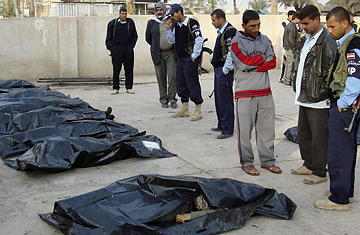
Brollier contrasts the $150 billion that the United States will spend on military operations in Iraq and Afghanistan in fiscal year 2011 with the $330 million set aside for Iraqi refugee assistance. “If these excessive and ineffective combat funds were redirected to refugee assistance, locally directed projects and much-needed infrastructure, maybe then a crack could open up for reconciliation and trust to be built between the people of Iraq and the United States,” he writes. “Changing our troop designation from combat brigades to advisors will not suffice; neither will a new name for more of the same.”
Brollier’s colleague Kathy Kelly reacted to the New Dawn name change by imagining what a real new dawn would look like for the Iraqi people: “Suppose Iraqis awakened to news that, as a clear sign of repentance for the suffering the United States has caused Iraqis, the U.S. plans to pay just and fair reparations, and that the funds would be directed away from U.S. military operations in Iraq and instead entrusted to an Iraqi reconstruction fund under the oversight of experts and world leaders who have demonstrated that they have no interest in exploiting Iraq’s people or its resources. That is a new dawn.”
Vice President Joe Biden recently expressed that he was “very optimistic” about and “impressed” by Iraq, and that it “could be one of the great achievements of this administration.” But Operation New Dawn could well become known as “Obama’s Other War.” And that doesn’t have a very nice ring to it, does it?
Newsweek Misleads on Who the World’s Arms Merchant Is
(This is a piece by Jim Naureckas, reposted from www.fair.org)
 Mac Margolis, Newsweek‘s right-wing Latin America correspondent (Extra!, 1/10) has a small piece in the latest issue (3/1/10) that misleads in a big way. Under the headline “A Killer Deal for Russia,” Margolis declares:
Russia’s campaign to balance U.S. power and prestige around the globe has found a new and willing partner–Latin America–and Washington may be the unwitting facilitator…. Moscow is cutting deals across the region, selling the latest hardware, from rifles to fighter jets, in exchange for influence and access to the area’s plentiful oil and gas reserves.
And the United States has only itself and its pesky ethics to blame:
Ironically, one reason for the budding East/West axis may be Washington’s own rigid security agenda. The U.S. has imposed restrictions on arms sales to many nations suspected of being soft on terrorism or roiled by internal conflict. So, many on that watch list have turned to Moscow, which asks no questions. Venezuela’s Hugo Chávez, for example, has snapped up some $4 billion in Russian weapons in recent years.
Reality check: The United States is by far the world’s largest arms dealer, making $37.8 billion in arms deals in 2008–68 percent of the world’s arms traffic for that year, according to the Congressional Research Service (New York Times, 9/6/09). Russia was a distant third with $3.5 billion.
And the United States did not actually limit its weapon sales to peaceful nations. Among countries “roiled by internal conflicts” that have bought U.S. arms in recent years are Colombia, Morocco, Pakistan, India, Indonesia, Iraq, Yemen, Armenia, Azerbaijan…. The list goes on. Apparently unlike Moscow, Washington does ask questions–like, “Is your credit good?”
How a Bill becomes a Law: Green Businesses write Legislation
In the early 1980s you may remember that during Saturday morning cartoons, there were animated informational spots called Schoolhouse Rock. One of my favorites from that series was called, “How a Bill becomes a Law.” Yesterday, a reporter wrote an article that may contradict what we were taught as kids about how government works.

On Wednesday, the Grand Rapids Press ran an article by reporter Matt Vande Bunte about proposed Michigan legislation that would provide “tax breaks for new construction and building rehabilitations that achieve certification for Leadership in Energy and Environmental Design, or LEED.”
The article states that Michigan Senators Jason Allen, Wayne Kuipers and Patty Birkholz have introduced a package of bills this month that “would give a tax abatement of up to 50 percent on LEED-certified construction and allow upfront costs for certain “green” items such as wind turbines, geothermal energy systems and underground parking to be paid with future tax revenue.”
The reporter also mentions that the “package of bills has been referred to the Senate’s Tourism and Commerce Committee. Committee Chairman Jason Allen, R-Traverse City, was in Grand Rapids earlier this month to vet the bills at a Grand Rapids Area Chamber of Commerce forum.” This basically means that Senator Allen was seeking the approval of the GR Chamber of Commerce, which begs the question if Senator Allen sought the approval from the general public?
However, the main focus of the story had to do with who benefits from the proposed legislation. The story leads off by having local businessman Guy Bazzani saying he would probably wait on plans to build another new building in Grand Rapids if it meant that his company would receive the benefits of tax breaks as proposed in the legislation.
In addition, the article states that Bazzani helped write the legislation that the Michigan senators are expected to introduce. Therefore, it would appear that legislation that will benefit people in the construction business was written people someone in the construction business. How is this possible and what does this say about how democracy works in this state?
He online version of the story includes an addition information box with some details on what tax benefits there would be. The source of information on the details on the tax breaks in the article were provided by the law firm Warner, Norcross & Judd. Interestingly enough Warner, Norcross & Judd has several areas in which their law form practices, one of them being construction.
In early February, one of the lawyers with Warner, Norcross & Judd wrote a short piece announcing that some legislators would be in Grand Rapids to discuss the proposed legislation. The same lawyer, John V. Byl, had written a longer piece last year discussing the benefits to legislation that would provide incentives to “green” construction.
The document states that numerous groups had been meeting to discuss the benefits and that “the Michigan chapter of the National Brownfield Association (NBA) organized a stakeholders group in spring 2008 to develop legislation that would promote green construction through financial incentives.” Some of these stakeholders were banks, government agencies, the Michigan Municipal League and members of the US Green Building Council.

Clearly, Warner, Norcross & Judd has a stake in promoting such legislation since their clients will be the beneficiaries of such policies. It is also worth mentioning that this law firm was the 144th largest entity to lobby Michigan legislators in 2009, according to the Michigan Campaign Finance Network (MCFN). MCFN records show that Warner, Norcross & Judd had spent $44,812 in 2009 lobbying Michigan legislators, which was up 18% from what they spent in 2008. However, we don’t know who were the recipients of the law firm’s lobby funds.
It is unfortunate that the Grand Rapids Press did not further investigate these dynamics, especially when they reported that those who will benefit most from this legislation had a hand in writing it.
Blackwater Took Hundreds of Guns From U.S. Military, Afghan Police
(The article is reposted from the Washington Independent)
Employees of the CIA-connected private security corporation Blackwater diverted hundreds of weapons, including more than 500 AK-47 assault rifles, from a U.S. weapons bunker in Afghanistan intended to equip Afghan policemen, according to an investigation by the Senate Armed Services Committee. On at least one occasion, an individual claiming to work for the company evidently signed for a weapons shipment using the name of a “South Park” cartoon character. And Blackwater has yet to return hundreds of the guns to the military.
A Blackwater subsidiary known as Paravant that until recently operated in Afghanistan acquired the weapons for its employees’ “personal use,” according to committee staffers, as did other non-Paravant employees of Blackwater. Yet contractors in Afghanistan are not permitted to operate weapons without explicit permission from U.S. Central Command, something Blackwater never obtained. A November 2008 email from a Paravant vice president named Brian McCracken, obtained by the committee, nevertheless reads: “We have not received formal permission from the Army to carry weapons yet but I will take my chances.”
As a result of Blackwater’s disregard for U.S. military restrictions on contractor firearms, four employees of Paravant — which held a subcontract from defense giant Raytheon to train Afghan soldiers — under the influence of alcohol opened fire on a car carrying four Afghan civilians on May 5, 2009, wounding two. That incident, occurring less than two years after Blackwater guards killed 17 Iraqi civilians in Baghdad, prompted the committee’s investigation.
“In the fight against the Taliban, the perception that the Afghans have of us is critical,” Sen. Carl Levin (D-Mich.), the chairman of the committee, told reporters Tuesday afternoon. “It’s clear to me that if we’re going to win that struggle, we need to know that contractor personnel are adequately screened, they’re adequately supervised and they’re adequately held accountable.” Levin will hold a hearing on Blackwater’s Afghanistan contracts Wednesday morning.
The committee’s investigation points to the contrary. Blackwater personnel appear to have gone to exceptional lengths to obtain weapons from U.S. military weapons storehouses intended for use by the Afghan police. According to the committee, at the behest of the company’s Afghanistan country manager, Ricky Chambers, Blackwater on at least two occasions acquired hundreds of rifles and pistols from a U.S. military facility near Kabul called 22 Bunkers by the military and Pol-e Charki by the Afghans. Gen. David Petraeus, the commander of all U.S. military forces in the Middle East and South Asia, wrote to the committee to explain that “there is no current or past written policy, order, directive, or instruction that allows U.S. Military contractors or subcontractors in Afghanistan to use weapons stored at 22 Bunkers.”

On one of those occasions, in September 2008, Chief Warrant Officer Greg Sailer, who worked at 22 Bunkers and is a friend of a Blackwater officer working in Afghanistan, signed over more than 200 AK-47s to an individual identified as “Eric Cartman” or possibly “Carjman” from Blackwater’s Counter Narcotics Training Unit. A Blackwater lawyer told committee staff that no one by those names has ever been employed by the company. Eric Cartman is the name of an obnoxious character from Comedy Central’s popular “South Park” cartoon.
Blackwater personnel invoked their Fifth Amendment rights against self-incrimination when approached by the committee to explain the weapons acquisitions from 22 Bunkers, according to committee staff. Sailer, who is still deployed to Afghanistan, told the committee that he thought Blackwater was signing for the weapons to train Afghan police, a task it has never conducted.
Not all of the guns received from Blackwater have been returned to the Afghan government — and, according to committee staff, many only began to be returned after staff approached the company for an explanation. “It was represented to us that all the weapons had been returned” to 22 Bunkers, Levin said. “That is not true. Hundreds of them were not returned.” Asked if that meant Blackwater lied to Congress, Levin replied, “They misrepresented the facts, and I’d like to leave it at that.”
Raytheon did not renew Paravant’s contract for training the Afghan army, which expired in September. Blackwater still holds a contract with the State Department worth millions of dollars to protect diplomats in Afghanistan. While that contract expires this year, Politico reported on Tuesday that Blackwater, now renamed Xe Services, might acquire a new multimillion-dollar contract from the Defense Department to train Afghan police — the same police force that Blackwater’s weapons diversions from 22 Bunkers deprived of hundreds of pistols and rifles.
This is not the first time Blackwater has faced allegations of diverted weapons. In 2007, company employees came under federal investigation for improperly shipping hundreds of weapons to Iraq, some of which are believed to have been sold on the black market and acquired by a Kurdish terrorist group. A Blackwater statement at the time said allegations that the company was “in any way associated or complicit in unlawful arms activities are baseless.” The New York Times reported in November that the company is negotiating with regulators over “hundreds of millions of dollars in fines” associated with the illicit weapons shipments.
In January, Blackwater’s founder, Erik Prince, confirmed to Vanity Fair that his 12-year-old company — which has earned more than a billion dollars through government contracts in the past decade — was involved in a nascent terrorist assassination program run by the CIA, among other CIA activities. “I’m paying for all sorts of intelligence activities to support American national security, out of my own pocket,” Prince told the magazine. Additionally, The Nation recently reported that Blackwater assists the Joint Special Operations Command with the terrorist manhunt in Afghanistan and Pakistan, including with the operations of JSOC’s armed unmanned drones.
Levin said his inquiry had uncovered “inadequate oversight by the Army over this contract.” The Florida-based Army office supposedly overseeing the contract did not even have a contracting officer representative in Afghanistan when the Paravant employees shot at Afghan civilians on May 5, 2009. Yet as early as December 2008, concerned Raytheon personnel informed that Army office that Paravant personnel were carrying unapproved weapons. An officer in Afghanistan responsible for training Afghan soldiers told the committee, “We should have had better control.”
Additionally, Blackwater personnel in Afghanistan, including those involved in both the May shooting and an earlier improper weapons discharge from December 2008, have been cited for, among other infractions, drug and alcohol abuse and, in one case, an “extensive criminal history.”
Wednesday’s hearing was expected to receive testimony from current and former Blackwater/Paravant officers, including Brian C. McCracken, the former Paravant vice president who now serves as Raytheon’s chief Afghanistan program officer; Fred Roitz, a Blackwater vice president; and John Walker, a former Paravant program officer.
A History of Immigration to Grand Rapids
As the issue of immigration and immigration reform continues to be an extreme point of contention in America, it’s very important to put it into a historical context. Grand Rapids Community College Professor and Grand Rapids Historian Emeritus Gordon Olson did just that on Monday night. Olson gave a talk titled “Fellow Immigrants: Ethnicity, Race, and the Peopling of Grand Rapids”.
Olson set the tone for his talk early on by relating a story about President Franklin Roosevelt addressing the Daughters of the American Revolution. The Daughters believed that the US needed to close its doors to further immigration. The story goes that Roosevelt addressed the group as “fellow immigrants” and reminded them that all of us are the children of immigrants one way or another.
Olson said that much of the immigration history of Grand Rapids began around 1780 when French fur traders and missionaries came here. In order to make room for more settlers, several treaties were signed to remove Native Americans from their indigenous lands. Olson specifically cited the Treaty of Detroit which he said “gave the Odawa a choice: either move north or west to Kansas.” He said the majority moved to an area around what is now Hart, north of Muskegon, where there is still a large Odawa reservation. Olson made it very clear that this was not the Odawa’s idea.

Olson said that during the period of 1865 to 1925 about 35 million people immigrated to the US. He specifically cited many crop diseases, like the infamous potato famine in Ireland as a reason for so many who came to America. He also said many were fleeing various “monarchs, aristocrats, and despots” in Europe. Olson made a point of dispelling the popular myth that all immigrants came through New York’s Ellis Island, which did not open till 1892. He said most actually immigrated through Castle Gardens, also in New York.
Much of Olson’s talk was devoted to many of the patterns that all of the immigrant groups went through. “Exploitation was always part of the immigrant experience” he said. Olson explained how whether you had just gotten off the boat in New York or had arrived here in Grand Rapids by train, there were people waiting for new arrivals offering help to find lodging or work, but always for fees, which could sometimes be crippling. Olsen said that if new immigrants accepted this help, you “were beholden to the company.”
While many new arrivals were farmers, especially amongst the Dutch, several immigrants chose to start their own small businesses, particularly restaurants, and neighborhood grocery stores. Olson said this was due to the fact that you could open for relatively cheap and they were businesses that the whole family could pitch in on.
As more immigrants began arriving in Grand Rapids, one of the clearest patterns that began was the neighborhoods in which people settled. For instance much of the Polish population set up neighborhoods around the Michigan St. and Diamond Ave. areas, as well as West Fulton. Various social clubs and street names in these areas still display much of this history.
Another persistent pattern Olson pointed to was hostility that all new immigrant groups received from those who got here before them. He said there was always a question from the older groups asking, “Will these people be as good a citizen as I am?”
Olson showed some pictures of many of the newer immigrant groups of the time, such as Lithuanians and Italians receiving “citizenship classes” often from earlier Dutch and Germans. He said these were often held in the back of factories, after workers had just finished ten-hour days.

I took a chance to ask Professor Olson about any tactics used through history to combat some of this hostility and racism that is still prevalent today, especially towards Latino immigrants. He said that throughout history, the tactic used most was for the newest group to assimilate into American culture and wait for the next group to show up.
Olson also devoted some time in his talk to the history of African-Americans in Grand Rapids. He said that Michigan was a wanted destination for the Underground Railroad because the state did not cooperate with returning escaped slaves. He also talked about how in 1872, William Hardy was elected to be the Gaines Township supervisor, and is believed to be the first African-American to hold public office in the state. He said that the Hardy family still owns a farm in the Gaines area, but due to construction of M-6 and other development, it has been getting increasingly smaller.
Olson said that as it got to be the 1950s and 60s, De Facto segregation became a problem here just as it did in most of the rest of the country. He said that in the summers of 1967 and 68, there were race riots along Jefferson Ave, in which looting and fires occurred.
Professor Olson finished his talk with a little bit of up to date history, such as immigration to Grand Rapids of Latinos, Vietnamese, and other groups displaced by wars around the world. He said that these groups are pretty much going through the same patterns as other immigrant groups, from forming their own neighborhoods and small businesses, to experiencing hostility and racism from other one time immigrants.
Whether or not America has ever been the Land of Opportunity is a matter of serious debate, but people displaced from all over the world have been immigrating to America for centuries and its pretty clear that the Grand Rapids history of immigration correlates pretty closely to the rest of the country.
Facing foreclosure? Free help is available.
Free film screening: American Casino
The Boardwalk, 940 Monroe NW
7 p.m. Weds. March 3, 2010

Learn how the housing crisis happened and what we can do about it in Kent County. Kym Spring from Foreclosure Response will answer questions and provide help. People can get help before it is too late if they are worried about a foreclosure.
The film, American Casino, lays out how the mortgage industry turned the US into a casino that gambled away millions of American’s homes. Since 2004, 6,773 homes have been lost to foreclosure in the city of Grand Rapids alone.
Locally, free housing counselors, such as those at Home Repair Services, have had an outstanding success rate; 47% of the homeowners HRS has counseled have managed to hold on to their homes. What many homeowners do not realize, housing counseling is available to anyone in foreclosure, no matter what their income.
New Michigan regulations have provided more protections for those renting their homes, as well. A renter in good standing can stay in a foreclosed home. The new owner has to let them sign a new lease, unless the owner occupies the home. In that case, the renter can remain in the home for 90 days. Legal Aid of West Michigan offers assistance for renters in foreclosed properties.
For information, visit the Foreclosure Response Web site.

