Book Review: Revolt on Goose Island
(This review was submitted by Micah Williams)
Just over a year ago, as the financial crisis wrought havoc and destroyed lives around the world, something strange happened. While blows kept coming to workers already pummeled to exhaustion, a small group of Chicago workers popped up in the news. It was a story about a factory going out of business—old hat in the postindustrial American economy. But this factory was not closing. It was, in fact, still open: in the kind of militant move rarely seen since the 1930’s, its laid-off workers were occupying it.
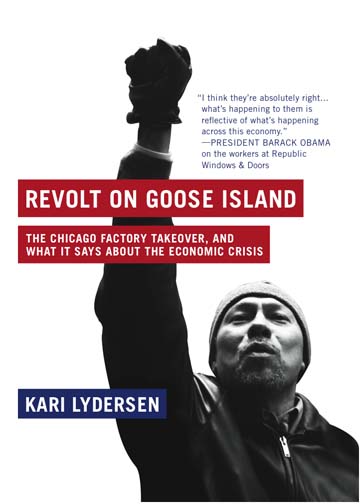
In Revolt on Goose Island: The Chicago Factory Takeover, and What It Says About the Economic Crisis (Mellville House, 2009), Kari Lydersen recounts the stirring story of Chicago workers at the Republic Windows and Doors factory, members of United Electrical, Radio and Machine Workers of America (UE) Local 1110, and their December, 2008, plant occupation. Her book brings the exhilarating energy of the workers’ struggle alive while offering poignant lessons to unions, community organizers, and other fighters for social justice in the context of the global economic meltdown.
The back-story to the drama that unfolded across newspaper and television headlines is a fascinating one. Portrayed as a parable of pissed-off workers pushed past the breaking point when employer abuse went a step too far, Local 1110 members’ nine-day factory occupation was seen as a spontaneous fit of rage. But Lydersen shows that behind the sit-down was tireless organizing by workers and their union. In 2004, disgusted with their uninvolved and organized crime-affiliated former union, the Central States Joint Board, workers voted UE as their new representative body. With a union listening to their demands for the first time, Republic employees became emboldened, constantly going to battle with managers—even marching to their homes—over grievances.
This history of militant organizing was behind the decision to occupy the plant when the company began removing machinery in the dead of night to sell off before the factory’s shuttering. Hatched a month before the actual occupation (at a time when workers were still unsure whether their jobs would be lost), the plan was discussed by workers at length. On Tuesday, December 2, workers’ suspicions were confirmed: the plant would close—in a mere three days. A shutdown was expected, but such short notice was not. Their incomes and health insurance suddenly gone, workers had little to lose: they would sit in at the factory.
The decision made to occupy the plant, workers and union staffers enlisted key supporters; these groups sprang into action once the plant was actually occupied. Lydersen’s account of local politicians and community organizations strategizing with them offers insight into the future of such struggles: if workers are to engage in high-profile fights with bosses and win, they must be backed by a wide variety of supporters. The ad-hoc coalition focused their efforts on Bank of America, the recipient of $45 billion in bailout money who closed Republic’s line of credit; workers demanded the credit line be reopened and their back pay and wages and benefits for the next two months be paid, in accordance with federal labor law. After nine days of occupying the plant, rallies and protests outside the Republic factory and Bank of America’s Chicago headquarters, tense negotiation sessions with the bank and factory owners, and a nation-wide outcry in support of the fired workers—all attended and reported on by Lydersen—UE members emerged victorious.
The book’s exploration of the union itself is fascinating. She quotes UE eastern region president Andrew Dinkalaker, saying, “Workers are at the breaking point where they are willing to take more drastic action. The question becomes, if they take drastic action, are they with an organization that will support them internally?” His framing reveals much about UE as an organization. Unlike most American unions, UE is led by its members, not staffers; in the case of the plant occupation, workers made decisions about their course of action, and staff played a supportive role. According to Dinkalaker,
“Most unions are top down—you have union bosses who can nix it if workers want to strike. The UE is set up democratically, so if its membership is interested and willing to take on a fight, the whole organization backs them and consults about the best way to achieve victory. It’s not seen as the workers needing approval from the national organization.”
The descriptions of rank-and-file democracy and transparency in UE, coupled with its willingness to fight and its organizers’ unflinching dedication to struggle, are refreshing to read when so many unions remain top-heavy and unresponsive to members.
As a witness to the Republic takeover, reading Lydersen’s vivid descriptions of the scenes at the factory and protests made me recall my visit to the plant. I arrived on a Monday, almost a week before the fight was won, in the midst of a typically miserable Chicago slush-rain to see a brigade of workers and supporters tossing donated food from a truck from one person to the next. Despite the weather, the animated atmosphere among the crowd gathered near the factory’s entrance was palpable: there was a clear sense that we were witnessing history directly before us. I tried to enter the factory to see exactly what was transpiring there (I think I envisioned some sort of liberated workers’ utopia—what exactly that would look like in a windows and doors factory, I’m not sure), but was turned away by a worker who appeared tired of turning young, giddy activists like me away. Still, morale was extremely high among workers and onlookers. As I conversed with supporters (some of whom had, upon hearing about the occupation, dropped what they were doing and driven to Chicago from neighboring states like Missouri), around a fire in a trash drum, we all agreed: we hadn’t seen anything like this in our lifetimes.
Revolt on Goose Island inspires such feelings. The book is a testament to what is possible when workers and community members organize and fight. It shows that in the midst of bleak economic times when we aren’t accustomed to hearing about organizing victories, workers can still fight and win.
(In November of last year, GRIID posted a story on a talk by Republic and Windows & Doors Workers in Grand Rapids.)
Tomorrow Night’s State of the Union and What Won’t Be Said
Tomorrow President Barack Obama will address the nation in his first State of the Union address. He will address the nation on the heels of a new poll showing that only 26% of those polled strongly approve of what President Obama has done so far in the White House.

Some news reports say that the President will focus on the nation’s budget deficit. According to Monday’s New York Times, “President Obama will call for a three-year freeze in spending on many domestic programs, and for increases no greater than inflation after that, an initiative intended to signal his seriousness about cutting the budget deficit, administration officials said Monday.”
Locally, the Grand Rapids Press today has a story with area reactions to the President’s plan to talk about “middle class tax relief” in tomorrow’s State of the Union address. The Press also published today a short piece from the Associated Press that, like the NY Times, focuses on what the President will say about the budget deficit.
WOOD TV 8 posted the same AP story on their website today and WOOD Radio is featuring on their main page a story similar to the GR Press, one that focuses on the President’s proposed tax cuts for the middle class.
The international media has a different take on what President Obama will address tomorrow in his State of the Union address. The Guardian reported that the President might scale back some of his plans considering low approval ratings and last week’s Massachusetts election defeat. “Although the White House denied Obama was scaling back his plans, the tone will be more populist and tightly focused on jobs and the economy.”
The Guardian also reported that the President might downplay the importance of climate legislation or omit that issue completely from his address tomorrow night.
With all the stated focus on budget deficits and tax relief for the middle class, one independent journalist is pointing out why there is no discussion of the bloated US military budget. Glenn Greenwald points out that while the President is calling for spending freezes in regards to domestic programs, but not in the area of military spending.
Greenwald says, “all security-related programs are exempted from the freeze, which means it does not apply to military spending, the intelligence budget, the Surveillance State, or foreign military aid. As always, the notion of decreasing the deficit and national debt through reductions in military spending is one of the most absolute Washington taboos.”
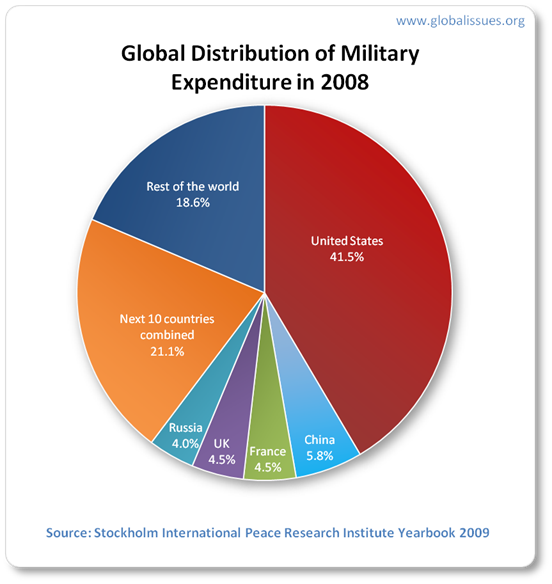
According to the group Global Security, the US spends about the same on the military as the rest of the world’s countries do combined. This is an incredible fact, but the question is why this is not an issue for most US reporters considering the nation is faced with major economic and budgetary issues? It is certainly a question to think about while watching or listening to the President tomorrow night. We should all pay attention to see if military spending comes up and if the news coverage of the speech raises that issue.
The Human Impact of the Palestine Conflict

This Thursday (January 28), three time Nobel Peace Prize nominee Archbishop Elias Chacour will speak in Grand Rapids about the human impact of the Palestine conflict.
Chacour is the founder of the Mar Elias Education Institutions and author of the acclaimed book Blood Brothers. He has traveled and spoke on the consequences of violence in the Israeli/Palestinian conflict and is a strong advocate for non-violence.
Chacour will speak at the Cultural Center of St. Nicholas Antiochian Orthodox Church located at 2250 East Paris SE in Grand Rapids. The presentation begins at 7:30 pm and is sponsored by Healing Children of Conflict.
Healing Children of Conflict is a Grand Rapids-based group that is sponsoring Palestinian and Iraqi children that have been seriously wounded by the US military or US weapons. The children will be brought to Grand Rapids in order to receive medical treatment.
Thursday’s event is free and open to the public.
Documentary on Argentina at the Bloom Collective 1/28

This Thursday, the Bloom Collective will host a screening of the documentary film Argentina: Hope in Hard Times. “What would you do if you lost your job, they closed the banks so you couldn’t access your savings, and the government seemed unable to help? In Argentina they stormed supermarkets for food; the police gunned down 30 people in just one day. But what happened next was truly extraordinary.”
ARGENTINA – HOPE IN HARD TIMES joins in the processions and protests, attends street-corner neighborhood assemblies, visits workers’ cooperatives and urban gardens, taking a close-up look at the ways in which Argentines are picking up the pieces of their devastated economy and creating new possibilities for the future. A spare narrative, informal interview settings, and candid street scenes allow the pervasive strength, humor, and resilience of the Argentine people to tell these tales. These are their inspiring stories – of a failed economy and distrusted politicians, of heartache and hard times, of a resurgence of grassroots democracy and the spirit of community – told in resonant detail.
Thursday, January 28 7pm
Bloom Collective 1134 Wealthy (back space)
Suggested donation of $3 Discussion will follow
The local news media continues to report on local humanitarian responses to the crisis in Haiti and that certainly says something about people’s capacity to do good. Anytime people raise money for emergency relief efforts it has the possibility of relieving someone’s suffering.

However, along with humanitarian relief comes the responsibility to understand the historical and political context of the current crisis in Haiti, particularly when it comes to US policy.
Today the Grand Rapids Press has an interesting editorial entitled “From here to Haiti.” The editorial points out the positive response from West Michigan to the crisis in Haiti, most notably the Haitian orphans who were brought to town with the help of Amway corporate jets. Bethany Christian Services is the agency heading up this adoption project.
Then the Press article highlights some local longstanding West Michigan/Haiti partnerships that were initiated by the Christian Reformed World Relief Committee, an Aquinas College education project and a recent (2008) Cornerstone University anti-poverty project.
The editorial concludes with more praises for West Michigan’s commitment to philanthropy and this final paragraph:
“It’s been uplifting to see this country lead the world in the rush to ease Haiti’s suffering during an unfathomable tragedy. But for Haiti to have a better tomorrow, the world will need to be there next month, next year, and next decade. Because of our ties and commitment, West Michigan must resolve to help ourselves, as well as our nation and our world, remember and remain.”
While I agree in general with this statement it ignores two things. First, it ignores some of the West Michigan connections that have not been a positive influence on Haiti. In the 1990s the children’s clothing manufacturer H.H. Cutler closed down their manufacturing operation in West Michigan and moved much of it to Haiti, since labor costs were a fraction of what they are here.

The labor conditions in Haiti have been well documented by groups like the National Labor Committee, which has classified the labor conditions there as sweatshops conditions. Another local connection is with the Haiti Baptist Mission based in Rockford, Michigan. In her book, The Rainy Season: Haiti Since Duvalier, author Amy Wilentz talks about the corrupt practices of the religious leaders from the Haiti Baptist Mission working in Haiti.
These are just a few examples, so while I salute the current humanitarian efforts from West Michigan in support of Haitians that the Grand Rapids Press acknowledges it does a disservice to its readers to not include local organizations that have contributed to Haiti’s ongoing poverty.
Independent News Coverage of Haiti
The second thing that the Press editorial ignores is the role that current US media coverage of the crisis in Haiti plays in terms of the public understanding of this crisis.
Much of the coverage, as we already have noted, has little historical context of the US relationship to Haiti or the motives behind this country’s policy in the small Caribbean country. In the US, some of the best coverage of what is going on in Haiti has come from Democracy Now!, which has sent a news team to that country for daily reports.
Independent reporter Jeremy Scahill has also been writing about Haiti, particularly what role private security forces are playing in “relief” work. Scahill reported on this phenomenon after Hurricane Katrina hit New Orleans and is now uncovering similar patterns in Haiti.
A recent article by author Nikolas Kozloff points out that the news coverage coming from Latin America and the Middle East is much different that that of the US in their coverage of Haiti. Kozloff says, “Watch the U.S. media and its coverage of the crisis in Haiti, and you get the impression that Washington is a benevolent power doing its utmost to help with emergency relief in the Caribbean island nation. But tune into al-Jazeera English or South American news network Telesur and you come away with a very different view.”
Kozloff has a link to this excellent story by al-Jazeera. When watching this story think about how it compares to US-based news reporting.
Supreme Court ruling is a blow to democracy
Yesterday the US Supreme Court ruled to overturn a ban on direct corporate spending on elections. According to an article in the Los Angeles Times, “In a 5-4 decision, the court’s conservative bloc said corporations have the same 1st Amendment rights as individuals and, for that reason, the government may not stop corporations from spending freely to influence the outcome of federal elections.”

The federal ban had been in effect since 1907 and prevented corporations and unions from spending their own treasury funds on broadcast ads or billboards that urge the election or defeat of a federal candidate.
Corporate and special interests groups already have tremendous influence during elections and this Supreme Court decision will only exacerbate the problem. Fortunately, some public interest groups are responding with campaigns to confront the court’s decision.
The Center for Media & Democracy (CDM) responded to the Supreme Court decision by saying they “strongly oppose this radical decision by a bare majority of the Supreme Court to rewrite the First Amendment and give corporations even greater influence in elections and public policy. With this decision, huge corporations like Goldman Sachs and AIG will be able to use their enormous wealth to run campaigns against the president or any person who might oppose their agenda.”
CDM has created an online petition encouraging people to express the voice their opposition to this decision. The Center for Media & Democracy will also have a new “portal” they are launching in SourceWatch to help educate the general public about these issues and provide a gateway for getting more involved.
In addition, Public Citizen has also begun a petition campaign in response to the Supreme Court decision. However, Public Citizen thinks that what will ultimately have to happen would be to “pass a constitutional amendment to ensure corporate money does not overwhelm our democracy and clarify that the First Amendment is for people — not corporations.”
Public Citizen also posted a short video message from their President Robert Weissman, explaining their strategy.
Grand Rapids Poverty rates and the GR Press
The lead story in the Grand Rapids Press today was based on a recent study by the Brookings Institute on the increase in levels of poverty for Grand Rapids and its surrounding suburbs.

According to the data the percentage of people living in poverty in Grand Rapids increased by 8.9% since 2000 and for those in its surrounding communities the rate increased 4.9%. The total amount of people living in poverty for Grand Rapids now stands at 24.7%, meaning one-quarter of the population, which saw the steepest rise in poverty rates of the 95 cities investigated in the Brookings study. The percentage of the population in the surrounding communities now stands at 11.2%.
Considering such alarming numbers, whom does the Press reporter talk to for reactions? First, they quote one of the Brookings research analysts, Elizabeth Kneebone who says, “It is putting additional strain on a safety net that is not as well developed.”
Next the Press reporter talks to Steve Gibson who works for a social service agency in Byron Center. Gibson said that many of the people they serve no used to be middle class. “I hear it over and over and over again, that we used to donate to you,” Gibson said.
The only other source cited in the story was George Erickcek, senior analyst for the Kalamazoo-based Upjohn Institute for Employment Research. Erickcek is a regular source for the Press and acts as its unofficial economic expert. His response to the findings of the Brookings report was, “It penalizes you for being low at the start. Grand Rapids is worse than before. But it’s definitely not a basket case. The manufacturing sector has been hard hit. I’m not surprised to see an increase in poverty. But for me, it’s more important to see the total level of poverty.”
What do you suppose Erickcek means by the “total level of poverty.” My suspicion is that he is not talking about the harsh reality of living in poverty that goes beyond statistics and this is what is missing from the Press article. We do now get the perspective of people living in poverty. There is not person or family that lives in poverty that is source in this story. We do not hear their perspective on the realities of poverty but we do hear an economic “expert” who doesn’t seem to be “surprised to see an increase in poverty.”
The Privilege of Richard DeVos
I forced myself to go hear Amway co-founder Rich DeVos give a lecture today as part of Calvin College’s January Series. It’s important to hear people with power, especially for independent media, since one of the fundamental tenets of journalism is to scrutinize power.
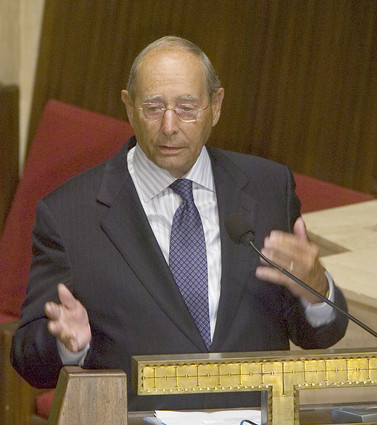
DeVos focused on his most recent book, Ten Powerful Phrases for Positive People. The phrases are not anything new or terribly enlightening, they are just phrases that we all have been taught by parents or teachers at some point in our life. Phrases like, “you can do it,” “I believe in you,” “I trust you,” and “I respect you.”
DeVos shared personal stories about how he has tried to apply each of the ten phrases he wrote about in his book and much of the discourse was framed in his interpretation of the Christian faith. DeVos kept saying, “our task as Christians is to be life enrichers.”
However, as he kept sharing stories and reflecting on his own life I couldn’t help but think about what a privileged life he has led. When I say privileged I don’t mean, “what a privilege it is to be here.” I am talking about the kind of privilege that few people in the world have, privilege that comes with wealth and power. DeVos has been a millionaire then billionaire for more than 50 years. He has traveled around the world countless times and has had access to those in political power for decades.
Several times he shared stories about conversations with US presidents and other stories about interactions with prominent business leaders. DeVos even had the arrogance to begin his talk by thanking the crowd for such a warm welcome and then saying that it surprises him sometimes because, “a prophet is never welcomed in his own country.” That phrase was historically attributed to the Hebrew prophets because they challenged and condemned the power structures of their day.
As he kept talking and trying to weave small pearls of wisdom with his phrases he would eventually say things that to this writer really reflected who Rich DeVos is. When talking about the phrase “I need you,” DeVos mentioned that Amway was sending supplies to Haiti because “the Haitians need us.” He also added that we shouldn’t give them everything because then they won’t learn to do for themselves. Apparently, DeVos think that Haitians are just chronic charity cases who are only looking for handouts.
When discussing the phrases “I believe in you,” DeVos shared the story about how he went to the Grand Rapids Press once to chastise then editor Mike Lloyd for criticizing the amount of money Arendt Lubbers was receiving as the GVSU President. DeVos said we need men like Lubbers and then said he was upset with the way that Wall Street executives were being treated now. “Wall Street people have done a great deal to build up this country.” DeVos went on to say that he was recently talking to former President Clinton and expressing his frustration with Obama and his “anti-Wall Street” positions. I’m not sure what DeVos means since the Obama administration has been fine with handing over billions of taxpayer’s dollars to bailout Wall Street for their corrupt financial practices.
Another phrase that DeVos mentioned was “Thank You.” During his reflections on this phrase he talked about how he was against the most recent government push for health care reform. He said, “we tried all kinds of things to defeat it and then along came this guy from Massachusetts. The hand of God is so evident.” DeVos was referring to the recent victory of Republican Scott Brown who is replacing a seat in the Senate vacated by the death of Edward Kennedy. It is believed that Scott’s victory will signal a defeat of the President’s health care plan in the Senate.
The last phrase that DeVos touched on was, “I Love You.” In reflecting on this phrase DeVos recounted how much family support he received while in England where he had a heart transplant. At one point DeVos went as far as saying that the new heart was a gift from God. Apparently his financial wealth had nothing to do with it.
DeVos finished his talk by reading a Christian bible phrase and a story about how he told a group of US Marines recently to keep the quote on a piece of paper while serving in the next tour of duty. The phrase was, “Rejoice in the Lord always.” I wondered to myself if this is what these young men would be thinking while shooting Afghani civilians.
In the end I was glad I went. This way I could share with some people a perspective that is not likely to appear in any of the other news media in West Michigan, as is evidenced in a short piece that appeared on the Grand Rapids Press online source this afternoon.
This Friday and Saturday Calvin College is hosting its annual event that tries to draw the connections to animal rights, food justice and sustainability. The Two-day event is called Wake Up Weekend and will feature events at both the Calvin College Campus and in downtown Grand Rapids.

Wake Up Weekend 2010—Tentative Schedule
Friday, January 22, 2010
2:30-5:30 pm The Many Faces of Food Activism
Commons Annex Lecture Hall, Calvin College
Harold Brown (Farm Kind, NY)
Brett Colley (Grand Valley State University)
Ben DeVries (Not One Sparrow)
Lisa Oliver King (Our Kitchen Table)
Paul Shapiro (Humane Society of the United States)
5:30-7:00 pm Compassionate Comestibles Potluck
Commons Annex Lecture Hall, Calvin College
Hosted by Calvin College Students for Compassionate Living
7:30-9:30 pm Animals and the Kingdom of God Lecture
The Chapel Undercroft, Calvin College
“Animal Sacrifices”
Dr. John E. Hare, Yale University
A reception and book signing follows the lecture.
Saturday, January 23, 2010
11:00 am Bryant Terry’s Vegan Soul Kitchen
Brick Road Pizza Company, 1017 Wealthy Street SE
Cooking Demonstration, book signing, and vegan brunch*
(*Demo is open to the public; $10 brunch buffet is optional.)
2:30 pm Lecture
(106) South Division, Grand Rapids
“Justice for Animals: What May We Hope?”
Dr. Andrew Chignell, Cornell University
3:30 pm Panel Discussion
(106) South Division, Grand Rapids
Just Eating: Making a Difference in YOUR TOWN, USA
5:30 pm Open Studios
(106) South Division, Grand Rapids
Named and Nameless
Division Avenue Arts Collective, 115 South Division, Grand Rapids
The Artist Is the Human Is The Animal
7:00 pm Vegan Chili Cook-off
(106) South Division, Grand Rapids
9:30 pm Film Screening
Division Avenue Arts Collective, 115 South Division, Grand Rapids
Fowl Play: The Untold Story Behind Your Breakfast
 Grand Rapids Institute for Information Democracy
