Several hundred people gathered early this afternoon at the Allendale campus of Grand Valley State University to participate in the annual Martin Luther King Jr. event. The event began with a silent march from library to field house, with signs along the way acknowledging historical moments in King’s life.
After a few songs and comments from GVSU administrators, the keynote speaker, Randal Pinkett, was invited to the podium. Pinkett is, according to his website, founder, chairman and CEO of BCT Partners, a multimillion dollar consulting firm based in Newark, NJ, that specializes in information technology, organizational development and public policy. So what did a man who has made millions doing consulting work for Microsoft, Pfizer & Hewlett-Packard have to say to people on MLK day?
Pinkett used the metaphor from Robert Frost’s poem, The Road Not Taken, to communicate his idea that we all can be trailblazers and create our own road in life. The speaker felt that children have this sense that they can do anything they want because of their innocence and that we should all nurture that desire. Pinkett said that this was the message that Dr. King gave us……that we all can achieve anything that we can imagine.
At one level I wasn’t disagreeing with many of the statements that Pinkett made, but as I thought about them I came to the conclusion that most of the statements he made were shallow phrases, phrases that we always share with students in order to give them some hope about the future. Of course many people want to believe that we can achieve anything if we just try really hard, but this has little to do with the message and legacy of Dr. King.
Pinkett said he was going to address the issue of Wealth Creation, something he has written about in books like Campus CEO and No Money Down CEO. However, the speaker never addressed this issue. In response, it might be worth looking at what Dr. King had to say about wealth and economic justice.
King began with a focus on civil rights, but eventually evolved to a more mature vision of economic justice. Once King moved his base of operations to the North he began to reflect on the devastating and systemic poverty that Blacks lived in. In Chicago King began working on an anti-slums campaign and soon realized that there were economic forces that criticized King. This criticism lead King to write:
“You can’t talk about ending slums without first saying profit must be taken out of slums. You’re really tampering and getting on dangerous ground because you are messing with folk then. You are messing with the captains of industry….Now this means that we are treading in difficult waters, because it really means that we are saying that something is wrong…with capitalism.”
King believed that the nation owed Black people for the years of free labor under slavery and the years of underpaid labor in the free market system. King didn’t necessarily call what the nation owed Black people reparations; rather he called it a Bill of Rights for the Disadvantaged.
“No amount of gold could provide an adequate compensation for the exploitation and humiliation of the Negro in America down through the centuries. Not all the wealth of this affluent society could meet the bill. Yet a price can be placed on unpaid wages. The ancient common law has always provided a remedy for the appropriation of the labor of one human being by another. This law should be made to apply for American Negroes. The payment should be in the form of a massive program by the government of special, compensatory measures, which could be regarded as a settlement in accordance with the accepted practice of common law. Such measures would certainly be less expensive than any computation based on two centuries of unpaid wages and accumulated interest. I am proposing, therefore, that just as we granted a GI Bill of Rights to war veterans, America launch a broad-based and gigantic Bill of Rights for the Disadvantaged, our veterans of the long siege of denial.” (From Why We Can’t Wait)
Another important aspect of King’s insights about economic justice was his critique of military spending versus funding social programs. In his Beyond Vietnam speech King said that the US spends thousands to kill each enemy combatant in South East Asia, but spends only a few dozen on each poor person in the US. King understood that the Vietnam War was not only immoral, but it also stole precious resources from the Black community.
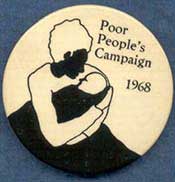
Lastly, it is important to note that King’s last months were spent working on the Poor People’s Campaign. The Poor People’s Campaign said nothing about Wealth Creation or Black Entrepreneurs, it was a campaign that demanded economic justice for the poor that would have used the tactic of mass civil disobedience, had King not been assassinated.
For Grand Valley State University to invite someone who has made millions of dollars as a consultant to corporate America to speak at its MLK Day celebration is questionable at best. I for one felt that the speaker cheapened the memory of Dr. King.
The Dr. King We Rarely Hear About
“I am sorry to have to say that the vast majority of white Americans are racists, either consciously or unconsciously.”
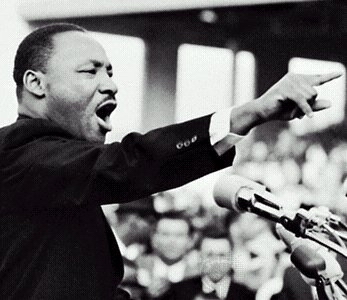
This quote from Dr. Martin Luther King Jr. is one that we are not likely to see or hear today as the nation celebrates his birthday. Most news coverage and unfortunately most public events will remember the “I Have a Dream” King.
It is easier to remember the King who had faith in this country to solve its racial problems. We all want to think about a future where White children and Black children will play together in harmony. However, this would be a dishonest view of Dr. King. We must look at the whole person and particularly the last years of King to understand his own evolution.
Once King brought his civil rights campaign to the North in 1965 he realized that liberals in the North were just as racist as they were in the south. The quote we began with is from a 1967 speech King gave entitled, “Which Way Its Soul Shall Go,” and it is as applicable today as it was in 1967.
When we honestly reflect on the economic and social condition of Blacks, Latinos, Asians, Arabs, Native Americans and other minorities in the US today it should be a signal to us that racism and White Supremacy is still deeply entrenched in our country. This is exactly the point that anti-racism writer and activist Time Wise was making in his most recent book, Between Barack and a Hard Place. Wise believes that while we can celebrate the country’s first Black President, racism is still firmly entrenched in our society. This is also a theme that radical historian Paul Street addresses in a recent essay comparing Dr. King and Barack Obama.
Saying that most Americans are racists wasn’t the only issue that King challenged people on in his later years. By 1965, King had identified what he considered the “triple evils”; White Supremacy, Capitalism and Militarism.
King had come to understand that he could no longer speak out about racism without challenging the economic and political structures in this country, which perpetuated and benefited from racism. In an essay from 1967, King provides astute analysis of why capitalism doesn’t work.
“We are now making demands that will cost the nation something. You can’t talk about solving the economic problem of the Negro without talking about billions of dollars. You can’t talk about ending slums without first saying profit must be taken out of slums. You’re really tampering and getting on dangerous ground because you are messing with folk then. You are messing with the captains of industry….Now this means that we are treading in difficult waters, because it really means that we are saying that something is wrong…with capitalism…here must be a better distribution of wealth and maybe America must move toward a Democratic Socialism.”
Ask yourself, why this statement has not received the same kind of annual attention as the “I Have a Dream” speech?
The third evil, militarism, was most manifested in King’s day with the Vietnam War. In 1967 – 68 King became one of its most vocal opponents. King’s 1967 speech at Riverside Church (Beyond Vietnam: A Time to Break Silence) is one of the best critiques of war from any American writer.
King not only spoke out against the immorality of the war, he addressed the economic and racist implications of war. In addition, King saw through the imperialist propaganda of the US and rightly identified the US, not as a nation promoting democracy, but a nation he called “the great purveyor of violence” on the planet.
In this video excerpt from his Beyond Vietnam speech we can hear King’s critique of a country that spends more money on militarism than social uplift.
Secretive North Korea Unveiled
In a desperate shout for attention, North Korea, the world’s most elusive nation, continues to flaunt its nuclear abilities. Discussing this and other issues surrounding North Korea at Calvin College’s January Series was Tony Namkung, an expert on US-Asian relations who has visited North Korea over 30 times.

The lecture ranged from the policies that would have opened up North Korea under the reign of Kim Il-Sung, to the role of protestant Christians within North Korea’s history, to the current nuclear issues under Kim Jong-Il.
Around 1990 Kim Il-Sung began work on policies that would have turned around North Korea’s current trajectory. Namkung spoke of this as a “fundamental reversal of their long time policies. . .one was to normalize relations with long time foes the US and Japan, second was to seek peaceful coexistence, distinct from unification, which had been a long standing North Korea demand that the peninsula needed to be reunified immediately with South Korea, third was market reforms to a highly centralized market economy”. This was soon followed by the Agreement on Reconciliation between North and South Korea that would have seen a total reversal of policy including diplomatic recognition, arms reductions, and an end to nuclear testing and materials possession. As the current state of affairs between North and South Korea can tell us, these policies were never implemented. What happened? Namkung suggests a few reasons for the reversal, including the end of the Cold War, the democratic revival of South Korea, and the resurgence of China, all of which threatened the political stability of North Korea.
Speaking at a Christian Reformed college, Namkung discussed how protestant Christianity shaped the early life of Kim Il-Sung, as both his parents were active in the church. Many Christians in North Korea at this time were working against the Japanese occupation that finally ended in 1945. However, Christians continue to be persecuted in North Korea today, as any form of religion needs to be state approved and practiced.
The topic of North Korea’s nuclear ambitions wasn’t discussed as much as hoped, but Namkung did offer some insights into the veil of secrecy surrounding their motives. Namkung suggests, as do others in his field, that North Korea’s nuclear testing and missile launches are an elaborate chess game to them, used as a pawn in political negotiations. Diplomat Georgy Toloraya believes that ”North Korean behavior is the consequence of dissatisfaction with the policies and the actions (or lack of them) of its adversaries. It cannot be explained simply in terms of the ‘unpredictability’ of the Pyongyang regime or its attempts at ‘blackmail.’”
Namkung said North Korea has consistently tried to garner a relationship with the United States, mainly to seek the protection of the United States against North Korea’s traditional foes, China and Japan. Strange thing then for this country to be thwarting all the requirements the United States has placed upon it. But Namkung sees this as North Korea’s attempt to jump start talks and negotiations, since the majority of the acts of aggression occur during stalemates. With a closed off society and a failing economy, the nuclear issue is the only real bargaining device left to North Korea.
So what’s next then? How should the world and particularly the United States approach North Korea, especially since the Six Party talks have been disbanded? With an open mind, says Namkung. The United States should not focus solely on the nuclear issue, as it has done in the past, but pay attention rather to the issues underlying this threat display, such as economic decline, a failing infrastructure, and humanitarian crises. Namkung thinks our new policies should keep in mind that we need “to abandon the sticks and carrots methods. . .and to get away from the notion that the end is near for North Korea, that they are only starving and selling arms to prop up their regime or prop up a corrupt elite and Kim Jong-Il’s only purpose in life is sheer survival using the nuclear card.” The United States should also serve as a facilitator between North and South Korea, though this may be difficult due to South Korea’s conservative new leader. But Namkung believes it would be of strategic importance for the US to have friendly relations with North and South Korea if China or Japan start vying for power in the region.
Little is known about North Korea, but what is known is that the United States needs to change how it deals with this elusive country while tensions continue to thaw. Some good resources on US/North Korean relations are Foreign Policy in Focus and for a good historical introduction see John Feffer’s North Korea/South Korea: U.S. Policy & the Korean Peninsula.
Israeli Assault on Gaza topic of Film this Monday

To Shoot an Elephant is a film portrait of Gaza under the Israeli embargo. Director Alberto Arce was embedded with the International Solidarity movement, one of the few aid organizations still operating in the area. We are given insight into everyday life in the region through a series of vignettes he filmed between December 25, 2008 and January 16, 2009, focusing particularly on the ambulance services that pick up the wounded and the dead (always referred to as “martyrs”) from the streets. The aid workers are risking their own lives, too, because in contravention of the Geneva Convention, the Israeli forces shoot to kill.
Although Mohammad Rujailah, the filmcrews’ fixer, is credited as co-director, he is also one of the film’s central figures. Calmly, but making no attempt to disguise his despair and rage, he calls the international community — and by extension the audience — to account. The film’s title refers to “Shooting an Elephant,” a 1936 essay by George Orwell in which he denounces colonial politics — as the author does throughout his oeuvre. And just as in Orwell’s historical fiction, To Shoot an Elephant presents broad political issues through a small cross-section of, in this case Palestinian, everyday life.
The film is showing Monday, January 18 at 7pm – Free Admission
Plymouth Congregational UCC 4010 Kalamazoo SE
The event is co-sponsored by the Plymouth Justice & Peace Task Force, Brunch & Revolution and the Bloom Collective.
To Shoot and Elephant Trailer
The Language of War: The Press and the Framing of Soldier Deaths
War always has consequences beyond the loss of life. One of those consequences is how it impacts how we talk about it. This is particularly the case in recent decades, as wars have now become much larger media spectacles.

We have all heard new terms that both the Pentagon and the media use when discussing aspects of war. In the aftermath of the US invasion of Panama, the Pentagon began using the term “collateral damage” to refer to civilians killed in a bombing raid. Other terms that have become part of our vocabulary are smart bombs, water-boarding, peace-keeping forces, and joy-stick soldiers.
All of these terms inform our perception of what is happening in war, even though it may contribute to a distortion of what is actually taking place. During the US war in the Persian Gulf it was widely reported in the US media that smart bombs were being used to minimize the amount of civilians killed or injured. Years later it was reported that these “smart bombs” were in fact not very accurate.
The use of buzzwords and propaganda was taken to a new level with the most recent “War on Terror,” according to the book Collateral Language: A User’s Guide to Americas New War, co-authored by John Collins and Ross Glover. Collins and Glover provide an excellent collection of essays that systematically investigate words being used by the Pentagon and the news media in the US since 9/11 and how that affects the way we talk about war.
The GR Press and Collateral Language
Yesterday, the Grand Rapids Press applied its own form of collateral language in a front-page story about a former Lowell high school student who was killed in Afghanistan.
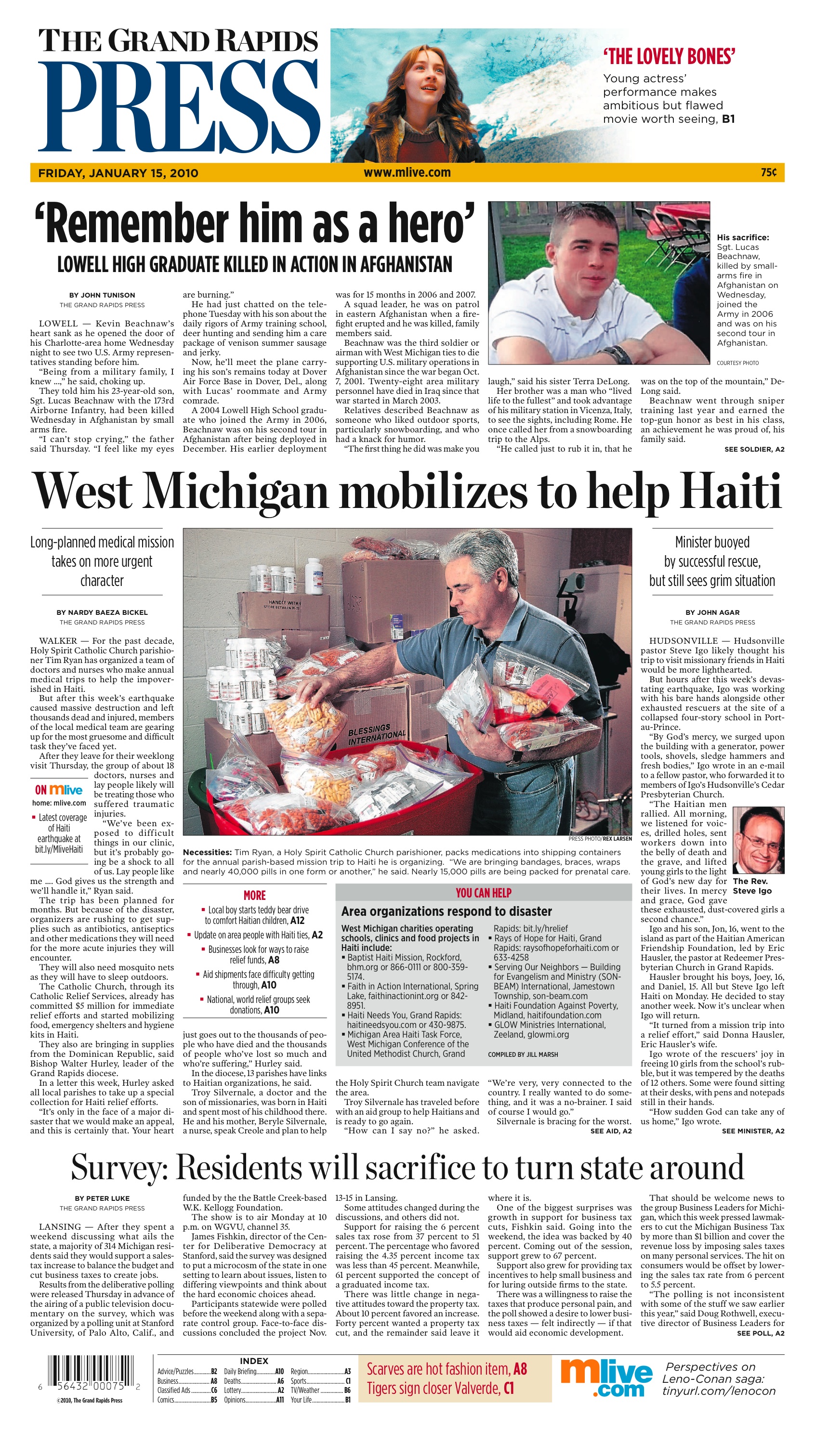
The story itself focuses mostly on what the death of this soldier meant to his family. The reporter talked about what kind of person Lucas Beachnaw was growing up, his relationship to his family and that his last stint in Afghanistan was his second time.
The headline of the story read as, “Remember him as a hero.” This headline was a direct quote from Beachnaw’s sister, which one can understand how a family member might feel that way about a brother killed in war. However, does that mean that the news media uses these terms just because someone close to them dies?
The article said that Beachnaw had some training in “helicopter landing zones” and last year he “went through sniper training.” The story doesn’t provide much information about the circumstances of his death, other than to say “he was on patrol in eastern Afghanistan when a firefight erupted and he was killed.”
We don’t know if Beachnaw saved individual Afghanis or did anything in particular that could be considered heroic. In fact, as someone with sniper training he could have spent his time shooting Afghanis who were suspected of being members of the Taliban or sympathizers of the insurgents. There have been many documented cases of civilian deaths at the hands of US soldiers since the US occupation began in October of 2001, like the most recent report of US troops killing Afghani children.
What we cannot assume and must not assume is that anyone participating in war is a hero. We should expect and demand that our news media not do the same thing. It is one thing for family members to consider loved ones heroes, but an entirely different matter when the news media portrays US soldiers as heroes.
Obama asking for $33 Billion on top of $708 Billion for War
The Center for Research on Globalization reported, “The Obama administration plans to ask Congress for an additional $33 billion to fight unpopular wars in Afghanistan and Iraq, on top of a record request for $708 billion for the Defense Department next year, The Associated Press has learned.”
This news comes at a time when the nation is still faced with an economic depression. Communities like Grand Rapids have to cut back on basic services and the lay off city staff. According to the National Priorities Project (as of January 15), $547.9 million dollars in taxes have left Grand Rapids to fund the US wars in Iraq and Afghanistan.
The group Rethink Afghanistan has produced a new short video discussing the implications of this new announcement for an addition $300 billion for war as well as some analysis of the Obama administration.
Naomi Klein Issues Haiti Disaster Capitalism Alert
Naomi Klein, author of The Shock Doctrine: The Rise of Disaster Capitalism, addresses in this short video the push to economically take advantage of the earthquake disaster in Haiti. Klein cites a document by the Heritage Foundation, a right-wing think tank, that advocates the US promote economic privatization and neo-liberal economic policies in Haiti that will be beneficial to foreign investor.
Readers of the The Shock Doctrine know that the Heritage Foundation has been one of the leading advocates of exploiting disasters to push through their unpopular pro-corporate policies. From this document, they’re at it again, not even waiting one day to use the devastating earthquake in Haiti to push for their so-called reforms. The following quote was hastily yanked by the Heritage Foundation and replaced with a more diplomatic quote, but their first instinct is revealing:
“In addition to providing immediate humanitarian assistance, the U.S. response to the tragic earthquake in Haiti earthquake offers opportunities to re-shape Haiti’s long-dysfunctional government and economy as well as to improve the public image of the United States in the region.”
Disaster News: The Earthquake in Haiti
The recent earthquake in Haiti has brought that small Caribbean country back into the news with stories and pictures of devastation. West Michigan news agencies are even giving airtime or print space this story, with a particular emphasis on humanitarian responses.

WOOD TV 8 spoke with a Haitian refugee, whose family does mission work in Haiti, WZZM 13 aired stories about local churches sending people to help with relief work and others who are praying for the dead and dying, and Fox 17 is featuring a story on way people can help in response to the devastation brought about through the earthquake.
The Grand Rapids Press also ran a story on page 2 of Wednesday’s paper about an East Grand Rapids photographer who was documenting a Christian mission’s work in Haiti, as well as another article about West Michigan connections to Haiti. All of these stories featuring devastating pictures and commentary about the loss of life and the anticipation others are feeling as they await word about the status of loved ones.
This type of coverage is certainly understandable, given the urgency of gathering information brought about by the earthquake. Unfortunately, it is generally the case that once the urgency of the devastation is over Haiti will fall out of news coverage, particularly with local news agencies.
A second problem with the current disaster-focused reporting is that it doesn’t provide any historical context for which people can judge current events. One reason why the suffering in Haiti is compounded from the earthquake is that it is one of the poorest countries in the world. People are already weak and malnourished. Add the devastation of an earthquake and it only increases the intensity of the daily suffering.
Another problem is that Haiti’s government infrastructure is weak, due in part to decades long corruption, but also because as a country they have been forced by the World Bank and IMF to adopt neo-liberal structural adjustment policies. These policies required Haiti to adjust its economy to benefit foreign investors, but it also meant that Haiti’s government reduced or eliminated social service programs.
The Grand Rapids Press did run a front-page story yesterday, attempting to provide some historical context to the current devastation. The Associated Press article was headlined, “More misery for suffering nation.” The story does mention some important aspects of Haitian history. The AP writer acknowledges that Haiti has the first successful slave rebellion in 1804, that the country lived under the lengthy dictatorship of both Papa Doc Duvalier and his son Baby Doc.

What the article failed to point out is that the numerous US administrations provided financial, military and diplomatic support to the Duvalier dictatorship that last from 1957 until 1986, when Baby Doc was forced to leave the country because of a popular rebellion. (see The Uses of Haiti, by Paul Farmer)
The AP story says, “Political turmoil prompted US Marines to occupy Haiti from 1915 to 1934.” Political turmoil in this instance meant that US interests were being threatened and it does not honestly explain what a 19-year US military occupation actually meant to the people of Haiti. The AP version of this history omits the fact that US troops killed thousands of Haitians during the occupation.
The AP article goes on to say that Haiti had its first democratically elected President in 1990, when Jean-Bertrand Aristide, a priest, overwhelming won the election. Again, the Associated Press article fails to mention that the US was anti-Aristide and had back a candidate that was willing to do the biding of Washington. CIA-backed death squads known as the Tonton Macoutes ousted President Aristide in a coup in 1991.
The AP article states that, “President Clinton sent 20,000 US troops to Haiti in 1994 to restore Aristide.” This is only a partially true statement, since it does not mention that this was only under the condition that Aristide adopt IMF/World Bank policies.
The AP article makes one final misleading statement by saying that after Aristide was re-elected in 2000, his party was accused of “rigged legislative elections, pocketing millions of dollars in foreign aid and sent gangsters to attack opponents.” This is the version that the US State Department and the Bush administration put forward, but this is not based in historical fact.
Investigative reporter Amy Goodman interviewed Aristide shortly after the US backed 2004 coup in Haiti and Aristide makes in clear that the US was deeply involved in the ousting of the popular president. Many other investigations contradict the US government’s position on the 2004 coup.
The Associated Press article is a serious distortion of US policy towards Haiti over the past century and only feeds into this perception that US citizens who are in that country – as missionaries & NGO workers – are there merely to help the poor. As long as mainstream media continues to do disaster news and refuses to ask fundamental questions, like why people in countries such as Haiti are perpetually poor, US news consumers will never see anything beyond the missionary point of view.
Bi-lingual event organized around Immigration Reform

(Photos provided by Alicia Duque)
Last night, an estimated 300 people gathered at Nuevo Esperanza Church on Burton near Division in Grand Rapids. They came out to hear stories and get information about the struggle for immigration justice at an event that was co-sponsored by the Michigan Organizing Project, the West Michigan Coalition for Comprehensive Immigration Reform and the national group Reform Immigration for America, which is sponsoring hundreds of events like this one all across the country this week.
The opening speaker was Martin Padilla, a leader with the Michigan Organizing Project (MOP). Martin said he was in the US without papers. He talked about how since he was eight years old he had worked, beginning in Mexico and then in the US.
Martin spoke with a shaky voice as he shared his story of coming to the US in desperation looking for work, which separated him from his family. He spoke about the difficulties of crossing the border and not knowing if he would live or die.
Martin has been in the US for several years and has always worked to support himself and to send money home to his family. The speaker then asked the audience why this government treats people who are immigrants as terrorists? He says that they live in fear and that “we all need to work hard to change how immigrants, both people with papers and those without are treated.”

The next speaker was a woman who works as a DJ at a local Spanish language radio station. She began by saying that now that the health care debate is winding down there no longer is a justification not to move forward on immigration reform.
Analuisa said that there is movement in the legislature, but more importantly we need to be organized and mobilized to make sure that there is real immigration reform. She asked those in attendance, “what are you going to do to make this happen? Are you going to be informed, attend rallies, and help get the word out?”
Another DJ with one of the Spanish language radio stations also spoke briefly about his experience as a migrant to the US. He came here with papers, but found out that once his visa had expired that the system was not very tolerant of his limited understanding of immigration law. The speaker recognized that there are people from all over Latin America, but “no matter which country we are from we need to create an alliance and work towards the common goal of living peacefully in the US.”
Other radio station representatives also addressed the crowd and wanted to assure people that they would use their station to support and promote the immigration reform. Yet one last Dj said, “If you look on the faces of those of us who are immigrants, we have that expression which says, Ya Basta! (Enough!) It’s time for a change.”
Next there was a group of people from three different churches who are studying this issue based on their faith and wanting to stand in solidarity with people living in fear of the current immigration policy. They want to stand with people who are being discriminated against and to speak out when they are being abuse. They also said they will participate in the campaign to pressure legislators to pass an immigration reform bill.
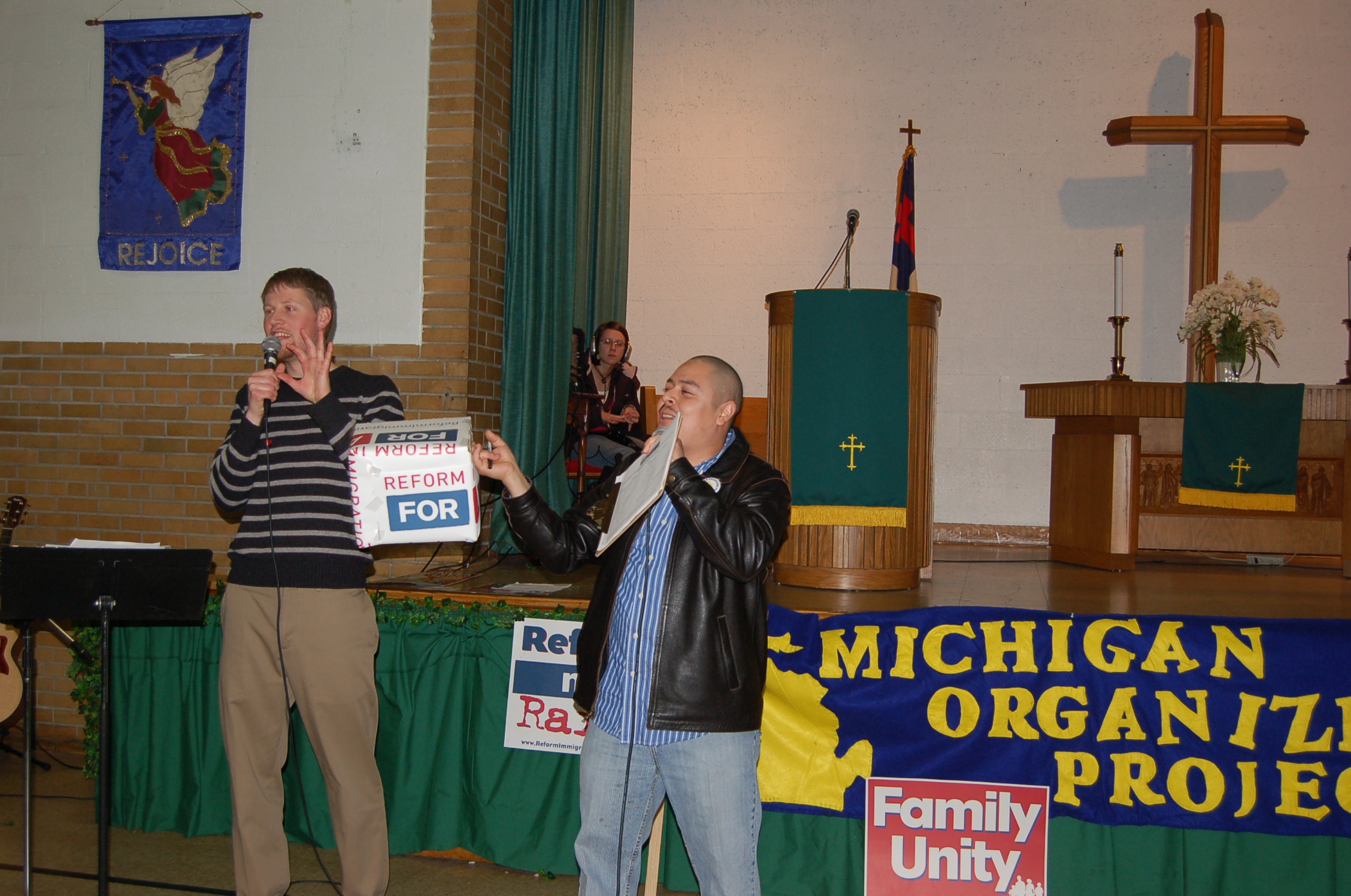
A woman named Gema then shared her story about participating in a program called democracy schools. It is an organizers training program that teaches people about US history, US laws and the rich history of civil rights organizing in this country. She said she learned that struggle for justice is never easy, never quick, but it is work that is necessary and important. She invited anyone in attendance to participate in the next round of classes that are being offered. Gema ended her comments by quoting the famous Mexican revolutionary Emiliano Zapata who said, “It is better to die on your feet than to live on your knees.”
The last speaker Rigo Rodriguez, let people know about the ongoing campaign that is being organized locally for immigration reform. There is a text message campaign, so that people can get regular updates on the campaign. He also said there was literature that people were encouraged to take and put up around town in stores and coffee shops.
Rigo also encouraged people to make a commitment to bring three people to another rally that is being planned for this Sunday at Madison Square Christian Reformed Church. They want to fill the church and send a strong message to Congress that they want immigration reform. The event begins at 6pm and is located at 1441 Madison Ave SE in Grand Rapids.
Detroit to host US Social Forum in June
 “Another world is possible; Another United States is Necessary.” Those words describe the goals of the 2010 United States Social Forum (USSF). An expected 20,000 to 30,000 thousand individuals and groups will converge on Detroit June 22 through 26 for the USSF, with main events held in downtown Detroit at Cobo Hall and Hart Plaza. It will also host events at the Wayne County Community College District Downtown Campus and Wayne State University. What is the USSF? According to its Web site,
The US Social Forum is more than a conference, more than a networking bonanza, more than a reaction to war and repression. The USSF will provide space to build relationships, learn from each other’s experiences, share our analysis of the problems our communities face, and bring renewed insight and inspiration. It will help develop leadership and develop consciousness, vision, and strategy needed to realize another world . . . The US Social Forum is a very special kind of gathering: one that has never taken place in this country up to now. It isn’t a conference with an agenda and a program of events; it’s a gathering whose participants produce our own agenda and our own programs.
To date, 900 activists involved in planning the USSF have developed the following list of themes:
- Capitalism in crisis/economic alternatives

- Climate justice
- Indigenous sovereignty
- Displacement/(im)migration
- Democracy
- Understanding right-wing opposition
- Building left/progressive movements
- Community-based strategies
- Labor
- Media justice/communications
- Transformative justice/healing

- Anti-war/militarization/criminalization
International solidarity and responsibility - Detroit and the rust belt
The USSF is an outgrowth of the annual World Social Forum, first held in Porto Alegre, Brazil in 2001. Every year since, this forum has worked to develop just alternatives to the neoliberal policies and globalization that continue to plunge poor countries into debt and millions into poverty while feeding the war machine and destroying the environment.
Registration for USSF opens January 20. Organizations that want to take a more active role can join the National Planning Committee or People’s Movement Assembly. They can also propose workshops for the program along a range of themes (and cross-cutting threads). Individuals can join one of the USSF’s working groups, the USSF Writer’s Workshop or build regional and local committees. Watch GRIID Indy News for continuing updates.
Another world is possible!
 Grand Rapids Institute for Information Democracy