GR Press business editor gloats over Bissell CEO
The business editor for the Grand Rapids Press, Nancy Crawley, wrote what was essentially and promotional piece for business owner Mark Bissell in her weekly Sunday column.

The editorial salutes Bissell Inc.’s decision to not leave Michigan during tough economic times and the company’s creativity in creating new jobs with what Crawley calls “knowledge workers.”
In her editorial Crawley states, “Bissell Inc. shed hundreds of factory workers when its production moved offshore, but now employs 350 knowledge workers to push the innovation envelope.” It is interesting that Crawley chose to use the word shed as opposed to being more up front and say that the company fired hundreds of workers.
A few paragraphs later Crawley does acknowledge that workers were fired, but she frames it in neo-liberal terms of the company’s need to remain competitive. “The fourth-generation of his family to lead the business, Bissell faced a critical decision five years ago. To keep the price of his carpet cleaners and sweepers low enough to compete, he had to move the remainder of his U.S. manufacturing to Mexico and fire 200 loyal workers.”
Crawley then quotes Bissell CEO, Mark Bissell, who says, “For us, the question was how do we in Michigan leverage the global economy and not hide from it.” Bissell also uses neo-liberal language, which is code for how can we find cheap labor in the global economy.
However, Bissell turned right around and hired hundreds of engineers, industrial designers, market researchers and data analysts. These are the “knowledge workers” that Crawley was referring to in her column. Since Bissell has hired the “knowledge workers” the company has moved from number 2 in sales amongst vacuum cleaner companies to number 1.
Crawley goes on to say that the company has invested $9 million dollars in its new Innovation Center on Walker Avenue. The new center has almost as many workers as they did when vacuum cleaners were actually being manufactured here.
This all begs the question, if Bissell can invest $9 million in a new building and hire hundreds of “knowledge workers,” why couldn’t they just keep the hundreds of manufacturing workers who actually made the product and not just talked about it? Crawley’s column does not provide readers with any comparisons to what the former wage workers made assembling vacuum cleaners as opposed to what the knowledge workers make, but it is safe to assume that the knowledge workers make equally as much as the former workers if not more.
We also don’t know where the knowledge workers are coming from. Were they all living in Michigan before being hired by Bissell or were they recruited from out of state? The former Bissell assembly workers were certainly Michigan residents, so how does this kind of treatment of local workers fit into Crawley’s notion that the company is a “model for succeeding in Michigan.”
Lastly, Crawley’s column also doesn’t address the fact that Bissell recently fired 70 workers in Chicago at a warehouse because the workers were trying to organize a union and had filed some complaints against the company with the state. It seems that Bissell is more interested in people to think about their products than those who actually make or transport what workers in Mexico make for the company.
Lobbyists and the Obama Administration
During his campaign for President in 2008, Barack Obama promised to make it more difficult for Lobbyists to operate in Washington politics. The President also made putting restrictions on Lobbyists part of his State of the Union address last week, but what was the track record of Lobbyist in the first year of the new administration.

A few days ago the Center for Responsive Politics reported that, “More than 15,600 companies and organizations spent at least $3.2 billion on federal lobbying in 2009.”
“Additionally, CRP preliminarily found that the health- and health insurance-related companies and organizations spent more than $537.5 million on federal lobbying in 2009, an increase of about four percent above their 2008 spending — a sum that will certainly increase after the final reports are tallied.”
The data certainly shows there has been an increase of Lobbyist spending in the first year of the Obama administration and it should be noted that not all the data for 2009 on lobby spending has been reported yet.
“Pharmaceutical and health product companies look to be the largest industry spender on lobbying in 2009, spending at least $245 million. Other big spenders include the oil and gas industry, the insurance industry and electric utilities, all of which spent more than $135 million on lobbying in 2009.
The top lobbying clients were all groups that have actively opposed or tried to water down major legislative proposals pushed by President Barack Obama and the Democratic Congress: the U.S. Chamber of Commerce, with $144.46 million spent on lobbying; Exxon Mobil, with $27.43 million spent on federal lobbying and the drug industry trade group Pharmaceutical Research and Manufacturers of America (PhRMA), which spent $26.15 million.”
The US Chamber of Commerce is always near the top of lobbying efforts since they represent broad business interests, and it should not be surprising that big oil and drug companies are also at the top of the list considering that the White House and Congress proposed both Health Care and Climate legislation.
Mayor Heartwell and the State of the City Address 2010
Since 2004, Grand Rapids Mayor George Heartwell has made it a point to give a speech to the community on the State of the City. Several hundred people gathered this morning to have breakfast and to hear both what the City has accomplished in the past year and what direction the Mayor would like to see it take.

In previous State of the City addresses, the Mayor claimed some of his visions, or proposals, have been controversial. The “controversial” proposals he mentions are – greater city/public school partnership, streetcars, a shift from fossil fuels to renewable energy, tax capturing, and a community sustainability project.
“Look at the amazing things we have done together in this town,” said Heartwell. The Mayor claimed that Grand Rapids is recognized as the strongest economy in Michigan, although he did not provide a source to support such a claim. He also said that Fortune magazine acknowledges Grand Rapids as one of the best cities in the country at recovering from the current recession. Heartwell doesn’t say what criterion Fortune Magazine used to make that determination, but it is interesting that he used a corporate journal as a source to support the performance of the Grand Rapids economy.
A brief acknowledgement that not all is well
Before he addressed the greater accomplishments of 2009, the Mayor did mention that not all is well in Grand Rapids. He said there was double digit unemployment, failing state tax revenues, a high drop out rate for high school students, diminished budgets, and failing minority and female businesses in the area. However, this is where the unpleasant realities ended and the positive comments took over.
By glossing over the severe hardships that thousands of people face in Grand Rapids minimized the seriousness of their situation. The annual Kids Count Report released earlier this month acknowledges that 2 out of every 5 kids in Kent County lives in poverty. A few weeks later it was reported that a new Brookings Institute study showed that Grand Rapids had the highest increase in poverty rates. According to the study, 24%, or one quarter of the population is living in poverty. The Mayor also did not acknowledge the amount of jobs that the city has eliminated due to budget cuts, which was somewhat of a slight to those individuals and families.
Now on to the good stuff
Heartwell said that 2009 will be known as the year of Green Grand Rapids. He claimed that some 1800 people participated in the process and planning meetings and then took it one step further to form independent groups and coalitions to work on various projects like Friends of Grand Rapids Parks, the Grand Rapids Bicycle Coalition, and the Grand Rapids White Water group. We have written about the Green Grand Rapids initiative in the past with some critical assessment, which is always important considering how much positive attention the city gets for its efforts in sustainability.
Another highlight of the year according to Heartwell was the federal stimulus money for ($110 million) that came to Grand Rapids. The Mayor said the city was able to “hire more cops, use it for transit, home weatherization, K-12 education and neighborhood energy initiatives.” Interesting that he mentions that the city hired several police officers with the federal stimulus money, but failed to mention that more officers lost their jobs because of budget cuts. The Mayor also mentioned that he was in DC last week for US Mayors Conference and is convinced that the stimulus money showed that the economy is indeed on the rise. In fact, Heartwell told the audience that, “we shouldn’t let anyone convince us otherwise.”
In addition, Heartwell mentioned that the city and county have collaborated on some property in Grand Rapids that will mutually benefit the new Kent County Social Services building on Jefferson/Franklin and improve the neighborhood where the old facility was located on Franklin/Madison.
Now for the future
The Mayor had basically two main proposals for the next year. First, he talked about how the children are the future of Grand Rapids and to demonstrate that he announced a new initiative called The Mayor’s 50. The initiative is designed to have 50 local companies partner with the City of Grand Rapids to provide meaningful employment for 50 youth.
This is another example of private/public partnership, but it begs the question why the city feels it has to play a role in helping businesses find employees? Doesn’t this fly in the face of free market principals, which doesn’t want the government to interfere with business? However, the Mayor does not shy away from these kinds of partnerships and even prominently acknowledged the corporate donations that made the breakfast at today’s event possible – AT&T, Amway, Amway Plaza Hotel, Consumers energy, DeVos Place, Huntington Bank, 5/3 Bank, Mercantile Bank, RDV Corporation, Rockford Construction.
However, the issue that Mayor Heartwell addressed most was him emphasis on intergovernmental cooperation. Heartwell said that greater consolidation of local government bodies will be the dominant theme of the near future. Heartwell said that the present budget crisis is forcing governments to find new ways to do things, but he also acknowledged that this has already been happening in Kent County.
According to a report from the Citizens Research Council, Grand Rapids and the surrounding communities are already engaged in at least 150 cooperative ventures. However, Heartwell said that these collaborations between governments must increase. In fact, the Mayor went one step further and proposed that all instead of having six cities, why not just have one?

Heartwell said countywide consolidation would make the area the 23rd largest city in the country. It would give the new government political clout, attract corporations, and gain greater access to federal monies. Heartwell said, “The greatest gift we could leave for our grandchildren would be a consolidated government.” For a moment I thought I was listening to a speech from former US President Ronald Reagan. Heartwell did not talk about the details of what a consolidated government would look like, but if one were to look at this through an international lens you could easily say that what the Mayor is proposing is very similar to the Structural Adjustment Programs that the IMF/World Bank imposes on poor countries.
The Mayor concluded with upbeat rhetoric and was given a standing ovation at the end. As I sat there I couldn’t help but think about what all of this will mean. But it seemed to me that the call for consolidation in government not only gives greater control to the private sector, but it takes away the autonomy of communities.
Heartwell implored citizens to take a more active role in the democracy, but how does one do that when governments consolidate and the private sector enters into the equation on a larger scale? These are important questions that must be asked and all of us who live in this area must take it upon ourselves to make sure that with these kinds of questions there is greater transparency and accountability with the local government.
What We Are Reading
Below is a list of books that we have read in the past month. The comments are not a review of the books, instead sort of an endorsement of ideas and investigations that can provide solid analysis and even inspiration in the struggle for change. All these books are available at The Bloom Collective, so check them out and stimulate your mind.

The Death and Life of American Journalism: The Media Revolution That Will Begin the World Again – This is the most recent book that journalist John Nichols and media scholar Robert McChesney have written together. The Death and Life of American Journalism looks both at the history of news media in the US and the current “crisis” facing news media.
The authors argue that there has always been state intervention in media, like subsidies for mailing newspapers, and that some state intervention is still necessary if we are to have a viable news media in the US. In addition, Nichols and McChesney provide some interesting analysis of the current crisis in news media as well as some well thought out ideas about how to make journalism sustainable and not market driven.

The Value of Nothing: How to Reshape Market Society and Redefine Democracy – This is Raj Patel’s second book, and like the first one, he has given us a thought provoking work. In The Value of Nothing, Patel revisits all the standard economic argument for capitalism and concludes that such a system is inherently flawed. The book doesn’t read like a classical Marxist critique, but is part of a growing body of anti-capitalism literature, which challenges the current economic models. Patel also provides concrete examples of movements globally that are forging new economic models, models based on cooperation. The Value of Nothing is both challenging and inspiring.

Ending the US War in Afghanistan: A Primer – This is the fourth in a series of political primers that Phyllis Bennis has put together in recent years. In Ending the US War in Afghanistan, Bennis provides readers with a framework in which to understand the complex history of US relations with Afghanistan and great analysis of the more than eight year US occupation of Afghanistan. Highly recommended if you want to both understand what is happening in Afghanistan and have a solid intellectual foundation in which to organize against the US war in that country.

The Food Wars – Walden Bello is the founding director of Focus on the Global South, which works on challenging corporate globalization from the perspective of people in countries being exploited. The Food Wars is an excellent investigation into how the capitalist driven economic model imposed on the poorer countries of the world has devastated food production and created an unsustainable food system. Bello provides case studies like Mexico, the Philippines, China and several African nations. An important contribution to our understanding of what the consequences are of putting profit over people.

The Tyranny of Oil: The World’s Most Powerful Industry – and What We Must Do to Stop It – Antonia Juhasz, author of The Bush Agenda, has given us one of the best books ever written about the oil industry. In the tradition of Ida Tarbell, The Tyranny of Oil exposes the insidious inner workings of the global oil cartel. Juhasz begins with an overview of Big Oil’s origins and how they have evolved into what they are today. The author looks at how Big Oil buys politicians, causes major health problems and devastates eco-systems around the world. The Tyranny of Oil is an important contribution for anyone interested in a world that respects people and the planet.
As could be expected the was coverage in today’s Grand Rapids Press responding to the President’s State of the Union address last night. On page 2 the Press ran a story by reporter Ted Roelofs, which featured local reactions to the Obama’s speech.
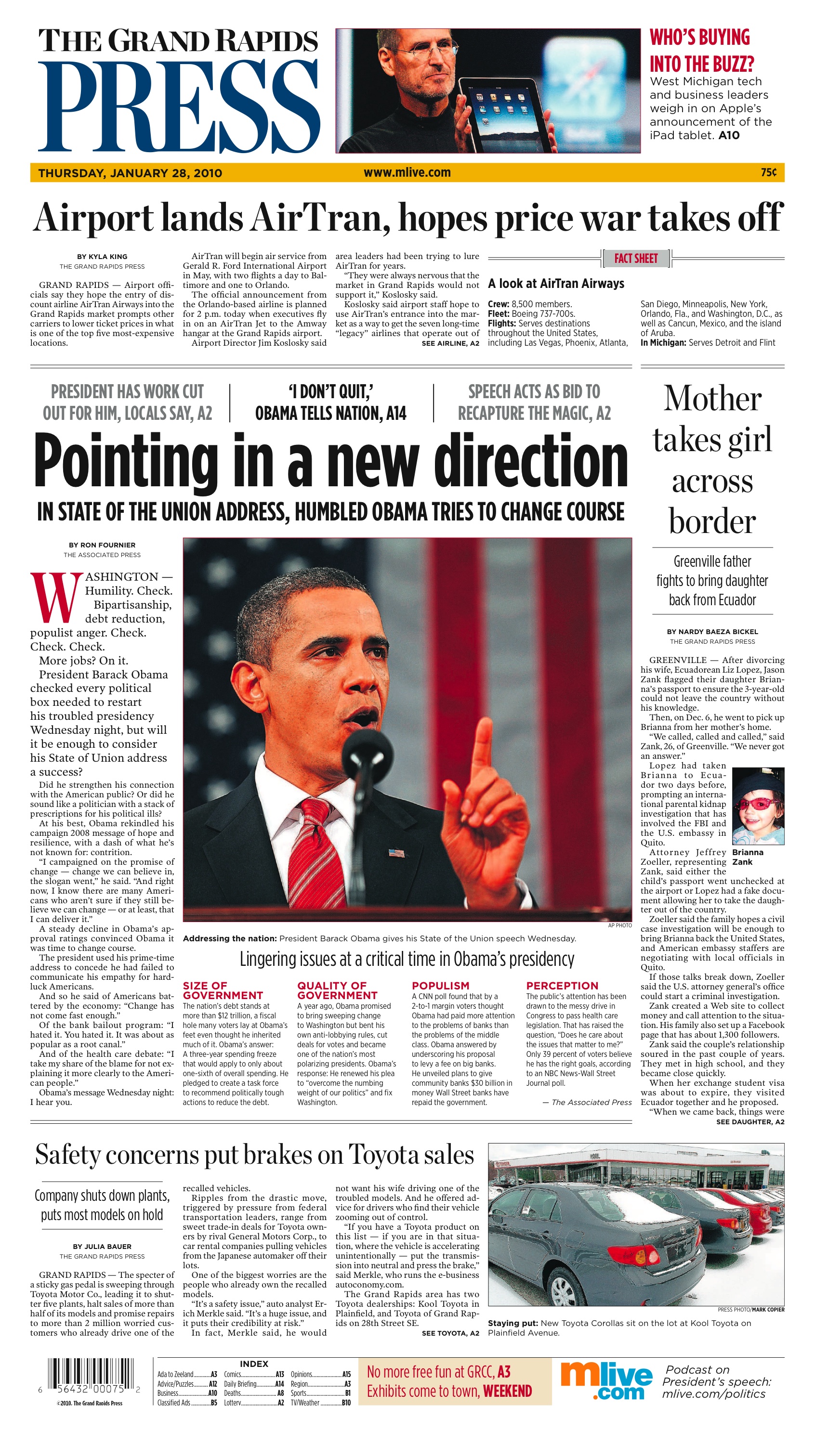
The article included six reactions from people throughout West Michigan. There were reactions from both Congressmen Pete Hoekstra and Vern Ehlers, both of which had critical assessments of the President, but nothing concrete. There were also two additional GOP reactions, one from a business consultant and the other a Grand Rapids businessman.
The other two reactions included one from a woman described as a “veteran Democratic activist,” with the remaining response coming from the “assistant director of Grand Valley State University’s Lesbian, Gay, Bisexual Transgender Resource Center.”
Most of the responses focused on partisanship or style and not on substance. Only the GVSU representative and the GR businessman addressed specific issues, namely jobs, taxes and the US military policy for gay/lesbian soldiers, often referred to as “don’t ask, don’t tell.”
What is unfortunate is that there were no working class perspectives provided and only one that seemed to be not representing either a Republican or Democratic Party perspective. Too often it seems the Press cannot see past the Red/Blue dichotomy, as if there are no other independent points of view.
What might a story like this look like if it included those who were suffering from unemployment, lack of health care or an immigrant concerned about immigration policy?
Style not Analysis
The Press also featured a front-page story from the Associated Press entitled “Pointing in a new direction.” The story that appeared in the Press was shorten version of the original AP article and was primarily about whether or not the President connected with the American people. In this shortened version there is no analysis or verification of the claims that the President made during his 75 minutes speech.
Providing citizens with this some kind of analysis or fact check is essential if we are to have an informed democracy. ABC reporter Huma Khan does exactly this kind of analysis in an online piece that fact checks the President’s comments on health care, jobs, taxes, lobbyists and campaign financing.
World Social Forum’s true colors dimmed by Press report
Jeff Smith contributed to this post.

The Grand Rapids Press ran an Associated Press story about rallies in the streets of Porto Alegre Brazil, where the 10 Years World Social Forum Seminar takes place, January 25 to 29. From the get-go, the story uses charged language to paint the obligatory picture of crazed communists and socialists ranting against capitalism and corporate greed. The story begins, “Thousands of leftists massed Monday to kick off five days of railing against unfettered capitalism.”
By framing the story with this language, the AP reporter makes it easier for readers to quickly dismiss the actions and desires of thousands of people from around the world who are striving to make the world more livable. A more honest introduction might have stated that thousands of regular people representing hundreds of NGOs and grass roots social justice groups were in the streets proclaiming that another world is possible–an alternative to the broken world that those in power are shoving down the throats of the hungry, homeless, unemployed, disenfranchised and environmentally poisoned. “Unfettered capitalism?” That’s newspeak for the neoliberal capitalist economic agenda that views human beings as nothing more than a resource or a market.
The Press account continues, “Accompanied by thundering drumbeats and samba blaring from sound trucks, a crowd of exuberant activists estimated by police to number 25,000 marched through Porto Alegre waving communist flags and shouting socialist slogans. They assailed corporate greed as the main reason the world plunged into an economic slump.”
Looking past the intentionally repetitive reference to communism and socialism, doesn’t this sound like a blast? Imagine 25,000 exuberant Grand Rapids area residents taking to the streets—not to dress like zombies or wait in line for souvlaki—but to celebrate a plan for ending poverty, discrimination, war and environmental destruction.
The article also fails to mention that the city government of Porte Alegre is on board with the World Social Forum, and that the World Social Forum was first held in Brazil with many Brazilians now engaging in participatory economic policies, called participatory budgeting. Participatory budgeting is where citizens take an active role in determining the government budget for the towns and cities they live in. These citizen groups are responding to the consequences of economic policies that are most often driven by “corporate greed.”
However, the term “corporate greed” is yet another whitewashed word. Again, it is the neoliberal policies that unleashed this greed that have led the economy to where it is today. Policies like NAFTA and CAFTA, have, for example, put Americans out of work by relocating manufacturing in Mexico, while dumping cheap corn there and destroying the livelihood of more than one million Mexican farmers.
In another interestingly twisted sentence, the story reports, “Participants said the forum is especially important this year now that governments from the United States to Europe are moving to play bigger roles in managing the global economy.”
In actuality, it is not sovereign governments who are in control. The engines that propel neoliberal policies, the IMF, WTO and World Bank are autonomous institutions that set policy that overrides any government control. These power brokers have nothing to do with democracy. In fact, they weaken democracy and mute the voice of the people. Their international standards trump our own nation’s laws.
The Press chose to shorten the AP story’s closing quote. Gustavo de Biase, a 22-year-old Brazilian, said, “We want to distribute the riches to people. We’re fighting for a more equal society and we’re saying ‘Down with hunger’ and ‘Down with war.‘” By shortening this WSF participant’s statement, readers lose a clearer sense of what people really are organizing for.

The Press fails to mention that a gathering similar to the World Social Forum takes place in Detroit this June, the US Social Forum. GRIID plans on being there to report on what happens at that gathering and how people will be organizing to address issues like war, poverty, racism and global warming.
Howard Zinn (1922 – 2010)

It is with a heavy heart that I write these words. Howard Zinn, the great radical historian died from a heart attack at the age of 87. Zinn, a WWII fighter pilot, radically influenced millions of lives with his groundbreaking investigation into American history with his book A People’s History of the United States.
Zinn wrote over 20 books in his lifetime and was inspiration for a whole series of other books that follow the same model of looking at history with books entitled A People’s History of the American Revolution, A People’s History of the Civil War, A People’s History of the Vietnam War, as well as a recent volume by Zinn and Anthony Arnove entitled, Voices of a People’s History of the United States.
I first read Zinn in 1983 and felt like I was learning US history for the first time. I remember feeling both amazement and anger. I was angry because I felt like I had been lied to all throughout my education about what had actually happened in this country’s history and I felt amazed by all the stories of people, organizations and movements that have achieved amazing things.
GRIID has been using A People’s History of the United States as a primary text for a class called “A History of US Social Movements.” In this exploration we look at a rich history of social movements that have been the only real force for radical change in this country’s history. As Zinn would say, social change has always happened from social movements and never from elections.
It is important for all of us to critically come to terms with this country’s history in order to honestly deal with the present policies. Howard Zinn taught us that the US government has not been a positive force for change in the world, but American social movements have been.
In honor of what Howard Zinn has given to those who seek justice, we leave you with one of the many powerful lectures he gave. This lecture focuses on the banality of the so-called US War on Terror.
 The Michigan State University Undergraduate Alliance (UGA) is staging its “State of the People” rally and march to the state capitol on Wednesday Feb. 3. The rally will begin at 4 p.m. at the MSU Administration Building, 150 Hannah in East Lansing, and with the march slated to arrive at the capitol, where they will join other groups taking action during Governor Granholm’s State of the State address.
“At MSU, tuition is rising rapidly–10% in two years,” reports Sam Inglot, an MSU student from Grand Rapids. “Programs are being eliminated. Graduate and non-tenure positions are being lost. Fewer sections are planned, meaning larger class sizes. Increased reliance on iClickers will essentially replace TA instruction. You will be paying more for less. The administration is squeezing the funds of every student while decimating or destroying the programs that many of us came here for.”
UGA believes that only a united effort involving both students and faculty can effect a change in these devastating tactics. As MSU is a public institution, the public at large should also raise its voice for quality education and reasonable tuition costs.
“At the State level, politicians are quickly dismantling education,” Inglot relates. “Funding for K-12 is being slashed. The Promise Scholarship, a vital financing source for undergrads, is being stripped. Politicians on the Left and Right are denying education its place and voice.”
UGA has issued the following call to action:
- Let’s ensure that Governor Granholm and those responsible for helping produce the dire state of education in Michigan hear our cries that education matters and cannot be a line-item budget cut.
- Let’s ensure that education assumes its proper place in the State of Michigan.
- Let’s demand that politicians keep their “Promise.”
Media Bites – BP
This week’s Media Bites takes a look at a recent commercial from oil giant BP. The spot is an animated piece that appears to be targeting children by having them drive a car and stop at a gas station just like adults. Viewers are also directed to a web link at the end of the spot where kids can play online games. This commercial is part of BP’s decade long attempt to re-brand themselves as an eco-friendly company which began with their name change from British Petroleum to Beyond Petroleum.
Some US Representatives Call for Relief for Palestinians
Last week, 54 members of Congress sent a letter to President Barack Obama asking him to pressure Israel to allow relief supplies to get to the thousands of Palestinians in Gaza.

The letter, which was initiated by Rep. Jim McDermott and Rep. Keith Ellison, say in part:
“The people of Gaza have suffered enormously since the blockade imposed by Israel and Egypt following Hamas’ coup, and particularly following Operation Cast Lead. We also sympathize deeply with the people of southern Israel who have suffered abhorrent rocket and mortar attacks. We recognize that the Israeli government has imposed restrictions on Gaza out of a legitimate and keenly felt fear of continued terrorist action by Hamas and other terrorist groups. This concern must be addressed without the resulting de facto collective punishment of the Palestinian residents of the Gaza Strip. Truly, fulfilling the needs of civilians in Israel and Gaza are mutually reinforcing goals.”
Only two Michigan Congressmen, Representatives Conyers and Dingle signed the letter to President Obama.
The Washington-based End the Occupation Campaign is calling on people to contact Representatives to either thank them for signing on to the letter or to confront them for not signing on. For those like West Michigan Representatives Ehlers and Hoekstra, the End the Occupation Campaign has an online message prepared for you to send to them.
However, it is worth noting the language of the letter, which states that Hamas came to power through a coup, when in fact they were democratically elected. Second, the Congressional letter implies that Israel has imposed the brutal blockade on Gaza because of “of a legitimate and keenly felt fear of continued terrorist action by Hamas and other terrorist groups.” In fact, Israel has claimed all along that there attack on Gaza was because Hamas violated the ceasefire agreement, when in fact the opposite is true.
Author and activist Stephen Shalom responds to Israel’s claim that Hamas violated the ceasefire agreement by saying, “No, Israel broke it, on November 4, 2008. Israel and the United States claimed that Hamas refused to renew the ceasefire when it expired in mid-December. No, Hamas was prepared to extend the ceasefire if the murderous blockade of Gaza were lifted, as was supposed to happen during the ceasefire and as ought to have happened on moral grounds in any event.”
Despite some of the misplaced language of the letter sent to President Obama, it is a far cry from the near unanimous vote from Congress last year to support Israel’s attack on Gaza.
 Grand Rapids Institute for Information Democracy

