Amway eliminates more West Michigan jobs
Yesterday it was reported in the Grand Rapids Press that Amway will be eliminating 100 jobs from one of its Ada-based warehouse facilities. The announcement was made via a Media Release, which stated that this decision was necessary for the company to remain competitive and that the jobs would be moved to Asia because that is where more of their product is sold.
The Press story does mention the 100 jobs to be eliminated locally, but fails to mention that 150 jobs are also being cut from an Amway facility in California. The Press cites Amway spokesperson Zeiger who states that the job elimination is “part of a project we’re calling strategic operating model.” Interesting business speak for job elimination.
However, the most interesting comment from Zeiger was, “The moves we’re making are designed to support our being a competitive West Michigan-based employer for the longest time imaginable.” Unfortunately for Press readers, the reporter never bothers to ask how eliminating 100 jobs makes Amway a competitive West Michigan-based employer. If one of the main functions of an employer that touts itself as based in West Michigan is to provide employment, how does eliminating jobs benefit this community?
The Press does acknowledge that the company also recently sent 93 West Michigan jobs to Costa Rica, but then follows this acknowledgement with more comments from Zeiger about how the new job elimination is a strategic move. Zeiger tries to compare the difference to what Amway is doing and what GM has done, but the statement is somewhat convoluted. Unfortunately, the Press reporter fails to question these comments, instead they print them as fact.
The Amway Media Release says that the company made $8.4 billion dollars in 2009. The Press reporter could have at least inquired as to how with such large profits the company is unable to keep jobs in West Michigan.
Questioning the Triple Bottom Line: Observations of the Local First Sustainable Business Conference
(Christy Mello contributed to this article)

Local First hosted an all day conference at Aquinas College this past Wednesday, and those able to pay the registration cost of $75 were welcome to attend. The majority of people in attendance were mostly people in business attire and there on behalf of their businesses. Vendors aligned the parameter of the main conference room and the majority of the booths showcased their services to aid businesses. These services included payroll accounting, wealth management, data backup, printer supplies, and banking, just to name a few.
Local First is a non-profit group who creates a network of businesses who pay membership dues to receive the Local First logo and become part of this network. This is a powerful marketing strategy for businesses in order to aid in promoting their services or products.
At this conference, people learned effective business practices, which appeal to people’s need to make humanitarian purchasing choices when they believe a business’s products are “local,” “sustainable,” or helping the “environment.” The morning keynote speakers as well as workshops through out the day utilized these terms that convey positive imagery.
Nevertheless, people asked questions indicating their confusion over what is meant by the “local” in Local First. According to one of the keynote speakers, it turns out that they define local as any business located in Kent County including businesses owned by stakeholders outside of Kent County. This was a transparent admission by Local First, and the conference was evidently devoted to economic development strategies. For example, Local First has done a study indicating that if one out of ten dollars are spent locally, this would create 1600 new jobs. Although, which non-local groups invest money in to these efforts and how much money still leaves the area? One should also ask what type of jobs would be created and available to whom.

It is important to ask critical questions around whether or not these often misleading discursive terms are being put into practice and to what degree. Businesses tap into people’s concerns over these issues with the use of this ideological language that diverts one’s attention from the fact that they may have or support destructive environmental practices. Many examples were apparent at this conference.
For example, the first keynote speaker was with the local software company known as Atomic Object. Some of the clients that Atomic Object works with are Priority One Health, Whirlpool, Amway and even the World Bank. One would have to ask how these companies practices sustainability, particularly in regards to environmental practices and how they treat their employees.
How is it that a company like Amway, which is based on a pyramid system can be considered sustainable? Amway has also been eliminating local jobs and sending them to China and Costa Rica in recent years, something which seems to conflict with part of the triple bottom line – how we treat people part. The Whirlpool Corporations has also been sending jobs abroad for years and the World Bank has funded projects that have displaced millions of people over the years.
When talking about the increased interest in local food it was interesting that Meijer was cited as a local food business. Meijer did start in West Michigan, but it is hard to see how a company which sells a majority of products not from the area, can still be considered local. One could argue that most of the food items that Meijer sells is not healthy for human consumption nor environmental sustainability.
However, there were examples such as a bakery in Ann Arbor that composts, buys and butchers grass fed cows, buys their food locally, and etc. Examples such as these, presumably, makes one feel that Local First’s primary objective is to choose businesses whose triple bottom line focuses more on the social and environmental rather that the economic component.
However, one should question the percentage that businesses utilize these components or if they do to a minimal degree as an advertisement for their products or services. Furthermore, Local First’s study revealed that a denser square footage of businesses increases profits. These businesses are flourishing in the Wealthy Street Business District, for example with several new restaurants in the past 12 months. Although maybe not intentionally, these development and revitalization efforts have been pushing out small business owners and further gentrifying this area of the city.
In one breakout session we attended on social capital, the presenter gave an example of a business in Michigan, which purchased hand-sewn goods from Nicaragua. The products were made by a worker run, women’s cooperative, which allowed the Michigan business to buy these products at a fairly low price and then sell them as Fair Trade items. What seemed to make this a “success” story was the fact that there was a worker run women’s cooperative, an economic model that was not discussed or encouraged by any of the presenters throughout the day.
In fact, this made us think about why with all the emphasis on food these days there were no formal food cooperatives in Grand Rapids like there were in the past. Grand Rapids used to have two food co-ops, one is Eastown and one on the Westside. Is it because traditional food co-ops are not privately held businesses?
At the end of the day we were left with more questions than answers about how Local First promotes sustainability with the businesses that are members of the non-profit organization. There was limited discussion about concrete and measureable practices that promoted the human and environmental aspects of the triple bottom line, with most of the focus being on how to make a profit if your business is “green” and getting people to buy “green” products.
Pete Hoekstra on Arizona’s anti-immigration law
We recently posted a story about whether or not what Arizona has recently done regarding its immigration policy could happen in Michigan. At the time, none of the Michigan gubernatorial candidates had responded to the Arizona law, but now we have a video comment from Pete Hoekstra, which was posted on MLive.com.
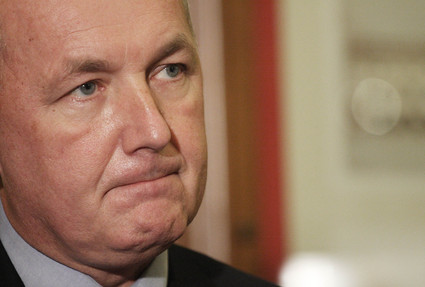
Here is a transcription of the response from Hoekstra:
Question: What about Arizona’s immigration law, can you see something like that in Michigan as states rights?
Hoekstra: Well, I think what you are seeing in Arizona, and as you talk about these issues, this is the great thing about when you stand up for the 10th Amendment and state’s rights. Arizona has a very very different problem and very different circumstances than what Michigan has. To say that we are going to take the Arizona law and put it in place in Michigan may or may not work. It probably won’t work because our issue and our problems are very different from Arizona’s.
Question: The thing about the Arizona law is that it is state’s right trumping individual rights, right of search and seizure.
Hoekstra: Well, again, let’s see exactly how this law is going to be implemented in Arizona. There is a lot of rhetoric flying around on both sides of the issue. Again, it’s the beauty of state’s rights. Let’s see if it works in Arizona or there are problems. We will have the opportunity to see that over the coming months. There will be constitutional challenges. Let’s see if they work. And after Arizona moves forward other states can learn from it and hopefully improve or deal with it. Hopefully with this issue, the federal government will do what it is supposed to do – secure the borders. That is the responsibility of the federal government. They haven’t done it.
ACLU to Obama: ‘Entire World is Not a War Zone’
(This article is re-posted from Common Dreams.)
The American Civil Liberties Union has sent a strongly-worded letter to President Barack Obama, asking him to end an alleged program that allows ‘targeted killings’ of terror suspects outside of war zones.

In the letter (PDF), the civil liberties group argues that the alleged program — which, according to news reports, is now targeting at least one US citizen — is unlawful and unconstitutional, and could set a dangerous precedent leading to foreign governments killing people on US soil.
“The program that you have reportedly authorized appears to envision the use of lethal force not just on the battlefield in Iraq, Afghanistan, or even the Pakistani border regions, but anywhere in the world, including against individuals who may not constitute lawful targets,” ACLU Executive Director Anthony Romero stated in the letter.
“The entire world is not a war zone, and wartime tactics that may be permitted on the battlefields in Afghanistan and Iraq cannot be deployed anywhere in the world where a terrorism suspect happens to be located.”
Romero’s letter came the same day as a House foreign affairs subcommittee convened to probe the legal issues surrounding the use of targeted killings. It also comes in the wake of a series of news reports suggesting the US’s use of targeted killings has expanded significantly in recent months.
In February, Director of National Intelligence Dennis Blair announced that the United States may target its own citizens abroad for death if it believes they are associated with terrorist groups.
“We take direct action against terrorists in the intelligence community,” Blair told the House Intelligence Committee. He said US counter-terrorism officials may try to kill American citizens embroiled in extremist groups overseas with “specific permission” from higher up.
If “we think that direct action will involve killing an American, we get specific permission to do that,” Blair said.
Earlier this month, news reports indicated that Muslim cleric Anwar al-Awlaki, an American citizen, was added to the CIA’s list of alleged terrorists the US has targeted to kill.
Al-Awlaki was born in New Mexico and served for years as an imam in the United States. He has not been charged with a crime, but was linked by US officials to Maj. Nidal Malik Hasan, the psychiatrist alleged to have killed 13 at an Army base in Fort Hood, as well as Nigerian Umar Farouk Abdulmutallab, the so-called “Christmas day” bomber who attempted to detonate a jetliner en route to Detroit.
“Such a program of long-premeditated and bureaucratized killing is plainly not limited to targeting genuinely imminent threats,” Romero wrote in his letter. “Any such program is far more sweeping than the law allows and raises grave constitutional and human rights concerns.”
Romero argued that the alleged program could set a dangerous precedent for other nations, which could result in foreign governments killing US citizens on home soil.
The program you have reportedly endorsed is not simply illegal but also unwise, because how our country responds to the threat of terrorism will in large measure determine the rules that govern every nation’s conduct in similar contexts. If the United States claims the authority to use lethal force against suspected enemies of the U.S. anywhere in the world – using unmanned drones or other means – then other countries will regard that conduct as justified. The prospect of foreign governments hunting and killing their enemies within our borders or those of our allies is abhorrent.
The ACLU is not alone in attacking the program as unlawful. Constitutional law professor Jonathan Turley said in February that the program raises serious questions.
“This is something that President Bush developed,” Turley explained. “We actually saw the Bush administration kill an American citizen named Kamal Derwish in 2002 with a Predator strike. … The Obama administration, once again, seems to be morphing into the Bush administration.”
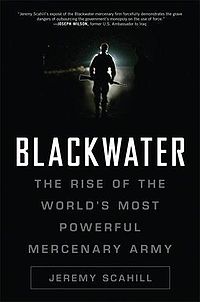
After hearing that the Tulip Time Festival in Holland had invited Blackwater founder Erik Prince to speak at the annual event, local organizers in Holland decided they needed to do something to counter the message of the Holland native.
Prince is speaking during the day, so organizers will host a public event with Jeremy Scahill, author of the book Blackwater: The Rise of the World’s Most Powerful Mercenary Army. Scahill will be speaking at the Holland 7 theater, located at 500 Waverly Road in Holland. The event is May 5th, begins at 7:30pm and is free and open to the public.
(This article is re-posted from CounterPunch.)
Tuesday’s hearings of the Permanent Subcommittee on Investigations laid the groundwork for future criminal prosecutions of Goldman Sachs Chief Executive Lloyd Blankfein and his chief lieutenants whose reckless and self-serving actions helped to precipitate the financial crisis. Committee chairman Senator Carl Levin (a former prosecutor) adroitly managed the proceedings in a way that narrowed their scope and focused on four main areas of concern. Through persistent questioning, which bordered on hectoring, Levin was able to prove his central thesis:

1. That Goldman puts its own interests before those of its clients.
2. That Goldman knowingly misled it clients and sold them “crap” that it was betting against.
3. That Goldman made billions trading securities that pumped up the housing bubble.
4. That Goldman made money trading securities that triggered a market crash and led to the deepest recession in 80 years.
The hearings lasted for 8 hours and included interviews with seven Goldman executives. Every senator had the opportunity to make a statement and question the Goldman employees. But the day belonged to Carl Levin. Levin was well-prepared, articulate and relentless. He had a game-plan and he stuck to it. He peppered Goldman’s Blankfein with question after question like a prosecuting attorney cross-examining a witness. He never let up and never veered off topic. He knew what he wanted to achieve and he succeeded. Here’s a clip from his opening statement:
“The evidence shows that Goldman repeatedly put its own interests and profits ahead of the interests of its clients and our communities…..It profited by taking advantage of its clients’ reasonable expectation that it would not sell products that it didn’t want to succeed….
Goldman’s actions demonstrate that it often saw its clients not as valuable customers, but as objects for its own profit….Goldman documents make clear that in 2007 it was betting heavily against the housing market while it was selling investments in that market to its clients. It sold those clients high-risk mortgage-backed securities and CDOs that it wanted to get off its books in transactions that created a conflict of interest between Goldman’s bottom line and its clients’ interests.” (Senator Carl Levin’s opening statement for the Permanent Subcommittee on Investigations)
Levin’s entire statement is worth reading, but these two paragraphs distill his plan for exposing Goldman. He was determined to “go small” and repeat the same points over and over again. And it worked. From a purely strategic point of view, Levin’s battleplan was flawless. The Goldman execs never knew what hit them. They swaggered into the chamber thinking they’d breeze through the hearings and have a few laughs over cocktails afterwards, and left with their heads in their hands. They were outmatched and outmaneuvered.
Senator Carl Levin:
“These findings are deeply troubling. They show a Wall Street culture that, while it may once have focused on serving clients and promoting commerce, is now all too often simply self-serving. The ultimate harm here is not just to clients poorly served by their investment bank. It’s to all of us. The toxic mortgages and related instruments that these firms injected into our financial system have done incalculable harm to people who had never heard of a mortgage-backed security or a CDO, and who have no defenses against the harm such exotic Wall Street creations can cause….
These facts end the pretense that Goldman’s actions were part of its efforts to operate as a mere “market-maker,” bringing buyers and sellers together. These short positions didn’t represent customer service or necessary hedges against risks that Goldman incurred as it made a market for customers. They represented major bets that the mortgage securities market – a market Goldman helped create – was in for a major decline. Goldman continues to deny that it shorted the mortgage market for profit, despite the evidence…
The firm cannot successfully continue to portray itself as working on behalf of its clients if it was selling mortgage related products to those clients while it was betting its own money against those same products or the mortgage market as a whole. The scope of this conflict is reflected in an internal company email sent on May 17, 2007, discussing the collapse of two mortgage-related instruments, tied to WaMu-issued mortgages, that Goldman helped assemble and sell. The “bad news,” a Goldman employee says, is that the firm lost $2.5 million on the collapse. But the “good news,” he reports, is that the company had bet that the securities would collapse, and made $5 million on that bet. They lost money on the mortgage related products they still held, and of course the clients they sold these products to lost big time. But Goldman Sachs also made out big time in its bet against its own products and its own clients.” (Sen. Carl Levin)
Levin had all the facts at his fingertips and put them to good use. Goldman’s execs were on their heels from the start and never really regained their footing. Even worse, the hearings showed that Goldman cannot be trusted. Their reputation is in ruins. Levin proved that if Goldman has junk in its portfolio, it won’t hesitate to dump it on its clients and then pass around high-fives at the prop-desk. Here’s a typical exchange between Levin and the former head of Goldman’s mortgage department, Dan Sparks:
SEN. CARL LEVIN: June 22 is the date of this e-mail. “Boy, that Timberwolf was one shitty deal.” How much of that “shitty deal” did you sell to your clients after June 22, 2007?
DAN SPARKS: Mr. Chairman, I don’t know the answer to that. But the price would have reflected levels that they wanted to invest…
SEN. CARL LEVIN: Oh, of course.
DAN SPARKS: … at that time.
SEN. CARL LEVIN: But you didn’t tell them you thought it was a shitty deal.
DAN SPARKS: Well, I didn’t say that.
SEN. CARL LEVIN: Who did? Your people, internally. You knew it was a shitty deal, and that’s what your…
DAN SPARKS: I think the context, the message that I took from the e-mail from Mr. Montag, was that my performance on that deal wasn’t good.
SEN. CARL LEVIN: How about the fact that you sold hundreds of millions of that deal after your people knew it was a shitty deal? Does that bother you at all; you sold the customers something?
DAN SPARKS: I don’t recall selling hundreds of millions of that deal after that.
Levin was just as tough on Blankfein, reiterating the same question over and over again: “Is there not a conflict when you sell something to somebody, and then you bet against that same security, and you don’t disclose that to the person you’re selling it to? Do you see a problem?”
At first, Blankfein acted like he’d never considered the question before, as if “putting himself in his client’s shoes” was something that never even entered his mind. His look of utter bewilderment was revealing. Then he launched into the excuses, the evasions, and the elaborate, long-winded ruminations that one expects from schoolboys and hucksters. But Levin never gave and inch. He kept pushing until Blankfein finally gave up and responded.
“No,” he stammered, “In the context of market-making that’s not a conflict.”
Blankfein’s answer was a triumph for Levin, and he knew it. To the millions of people watching the sequence on TV, Blankfein’s denial was as good as an admission of guilt. It showed that Wall Street kingpins don’t share the same morals as everyone else. In fact, Blankfein seemed genuinely confused that morality would even be an issue. After all, it wasn’t for him. Levin covered some old ground, pointing to Goldman’s dealings with Washington Mutual’s Long Beach unit which was a “conveyor belt” for garbage subprimes which frequently blew up just months after they were issued. It’s clear that Goldman knew the mortgages were junk that were “polluting the financial system”, but that made no difference. Goldman feels that it’s responsible to its shareholders alone, not the people who bailed it out.
All in all, it was a bad day for the holding company that’s come to embody everything that’s wrong with Wall Street. Goldman entered the hearings as the most successful financial institution in the country, and left with its reputation in tatters and its future uncertain. Its CEO came across as shifty and jesuitical while his executives seemed arrogant and uncooperative. At no point during the hearings did any of the Goldman throng look at ease with themselves or their answers. They remained rigid and sullen throughout. On top of that, they were unable to defend themselves against the main charge, that they don’t mind sticking it to their clients if it means a bigger slice of the pie for themselves.
The truth is, the Golden boys were handled quite capably by an elderly statesman who took them to the woodshed and gave them a good hiding. Levin’s stunning performance is likely to draw attention to the upcoming SEC proceedings and, hopefully, build momentum for more subpoenas, indictments, arrests, and long prison sentences.
Could Arizona Come to Michigan?
Last week, Governor Jan Brewer of Arizona signed legislation into law that effectively makes racial profiling legal in her state. The Arizona Senate Bill 1070 will allow police to stop anyone if they have a “reasonable suspicion” that the person is not in this country legally. The intent of the law is to spread a wide net to identify and arrest undocumented immigrants. It goes into effect this summer.

If one person in a car doesn’t have the correct documents, everyone in the car can be arrested. People can be arrested for “harboring” an undocumented worker, even if that worker is a member of their own family. The parents of an undocumented immigrant can be hauled off to jail for visiting in the home of their son or daughter.
And workers who do have the correct ID can be arrested for simply not carrying their papers at all times. Any Latino/a living in Arizona will have zero margin for error about forgetting their papers when taking a walk around the neighborhood.
Recently GRIID cross-posted an article that includes information about groups attempting to ensure this law will not stand—as it should not. But now that the governor has signed it into law, it may take months, if not years, to challenge it. In the meantime, the law will stand.
And with the Michigan Tea Party loudly demanding “militarized borders” and various gubernatorial candidates here in Michigan pandering to this audience, it begs the question—could something like SB 1070 happen here?
First, remember that we also have what could be represented as an “unsecured” or permeable border. Traffic moves between the U.S. and Canada with relative ease. Car traffic is monitored; private boat traffic operates mainly on a trust system. It’s the perfect alarmist vehicle to make the case for harsher immigration laws.
Next, as an example, take a look at the most likely Republican candidate for the run for governor: Pete Hoekstra. As a U.S. Representative, Hoekstra has a well-documented voting record. It’s clear what kind of stance on immigrants he would bring to the governor’s office through these examples:
•He voted on legislation requiring hospitals to turn in undocumented immigrants who came in for emergency treatment. The law would have also arranged for transportation of immigrants without papers back to their native countries for treatment—in effect, a new deportation law packaged into the bill.
•He voted for building a $7 billion fence along the U.S.-Mexican border. He also voted for more security personnel and surveillance.
•He voted to allow vigilante Minutemen to operate in secrecy, without informing the Mexican government about the placement of armed volunteers along the U.S.-Mexican border.
•He’s attempted twice to get legislation through Congress making English the sole official language of the U.S. Both times, he co-sponsored the bills.
Pete Hoekstra has been endorsed by the USBC, a group that says its work is “to seal our borders against drugs, disease, illegal migration and terrorism and…to preserve our nation’s language, culture and heritage for the next generations.”
Hoekstra has also been given a 100% approval rating from the Federation for American Immigration Reform (FAIR). FAIR has been identified as a hate group by the Southern Poverty Law Center.
You won’t find a word of any of this on Hoekstra’s official campaign site. Other candidates are equally silent on immigration. The pistol-packing Mike Bouchard doesn’t even list it as an issue on his site, where taxes and crime fighting are emphasized. Andy Dillon speaks mainly to education and jobs. Virgil Bernero’s focus seems to be, as it has been for some time, on strengthening unions and protecting workers’ rights. Rick Snyder’s issues section only outlines his 10-point plan for restoring Michigan’s economy. Mike Cox is spending both his Tea Party time and website promotion on his effort to overturn the new federal health care reform in his role as Attorney General.
Each of these candidates is going to present himself in a filtered light that will attract the maximum number of voters. Their own PR is not going to offer hard-line statements that can be used against them in the media.
Clearly, we’re not going to get the depth of information we need from the Press or other local news sources in West Michigan for this election. So it’s up to each individual voter to get educated on every issue that these candidates will address as governor. That includes, at this crucial point in our history, a solid understanding of their views on immigration. We don’t want to end up with a Jan Brewer wannabe in the Governor’s Mansion and racist Arizona-style legislation in Michigan.
Media Bites – Pepsi: One Tribe
This week’s Media Bites takes a look at a new marketing campaign by Pepsi called the Refresh Project. Pepsi is attempting to position themselves as a company that breaks down barriers and brings people together. The commercial uses a new song by the Black Eyed Peas, One Tribe, to try to make us feel that the company cares about people and the Planet. In the end, the commercial is just another ploy to get us to buy their product and to not think about what harm the company does around the world.
A New Climate Movement in Bolivia
(This article by Naomi Klein is re-posted from ZNet.)
It was 11 am and Evo Morales had turned a football stadium into a giant classroom, marshaling an array of props: paper plates, plastic cups, disposable raincoats, handcrafted gourds, wooden plates and multicolored ponchos. All came into play to make his main point: to fight climate change, “we need to recover the values of the indigenous people.”

Yet wealthy countries have little interest in learning these lessons and are instead pushing through a plan that at its best would raise average global temperatures 2 degrees Celsius. “That would mean the melting of the Andean and Himalayan glaciers,” Morales told the thousands gathered in the stadium, part of the World People’s Conference on Climate Change and the Rights of Mother Earth. What he didn’t have to say is that the Bolivian people, no matter how sustainably they choose to live, have no power to save their glaciers. Bolivia’s climate summit has had moments of joy, levity and absurdity. Yet underneath it all, you can feel the emotion that provoked this gathering: rage against helplessness.
It’s little wonder. Bolivia is in the midst of a dramatic political transformation, one that has nationalized key industries and elevated the voices of indigenous peoples as never before. But when it comes to Bolivia’s most pressing, existential crisis—the fact that its glaciers are melting at an alarming rate, threatening the water supply in two major cities—Bolivians are powerless to do anything to change their fate on their own.
That’s because the actions causing the melting are taking place not in Bolivia but on the highways and in the industrial zones of heavily industrialized countries. In Copenhagen, leaders of endangered nations like Bolivia and Tuvalu argued passionately for the kind of deep emissions cuts that could avert catastrophe. They were politely told that the political will in the North just wasn’t there. More than that, the United States made clear that it didn’t need small countries like Bolivia to be part of a climate solution. It would negotiate a deal with other heavy emitters behind closed doors, and the rest of the world would be informed of the results and invited to sign on, which is precisely what happened with the Copenhagen Accord. When Bolivia and Ecuador refused to rubber-stamp the accord, the US government cut their climate aid by $3 million and $2.5 million, respectively. “It’s not a free-rider process,” explained US climate negotiator Jonathan Pershing. (Anyone wondering why activists from the global South reject the idea of “climate aid” and are instead demanding repayment of “climate debts” has their answer here.) Pershing’s message was chilling: if you are poor, you don’t have the right to prioritize your own survival.
When Morales invited “social movements and Mother Earth’s defenders…scientists, academics, lawyers and governments” to come to Cochabamba for a new kind of climate summit, it was a revolt against this experience of helplessness, an attempt to build a base of power behind the right to survive.
The Bolivian government got the ball rolling by proposing four big ideas: that nature should be granted rights that protect ecosystems from annihilation (a “Universal Declaration of Mother Earth Rights”); that those who violate those rights and other international environmental agreements should face legal consequences (a “Climate Justice Tribunal”); that poor countries should receive various forms of compensation for a crisis they are facing but had little role in creating (“Climate Debt”); and that there should be a mechanism for people around the world to express their views on these topics (“World People’s Referendum on Climate Change”).
The next stage was to invite global civil society to hash out the details. Seventeen working groups were struck, and after weeks of online discussion, they met for a week in Cochabamba with the goal of presenting their final recommendations at the summit’s end. The process is fascinating but far from perfect (for instance, as Jim Shultz of the Democracy Center pointed out, the working group on the referendum apparently spent more time arguing about adding a question on abolishing capitalism than on discussing how in the world you run a global referendum). Yet Bolivia’s enthusiastic commitment to participatory democracy may well prove the summit’s most important contribution.
That’s because, after the Copenhagen debacle, an exceedingly dangerous talking point went viral: the real culprit of the breakdown was democracy itself. The UN process, giving equal votes to 192 countries, was simply too unwieldy—better to find the solutions in small groups. Even trusted environmental voices like James Lovelock fell prey: “I have a feeling that climate change may be an issue as severe as a war,” he told the Guardian recently. “It may be necessary to put democracy on hold for a while.” But in reality, it is such small groupings—like the invitation-only club that rammed through the Copenhagen Accord—that have caused us to lose ground, weakening already inadequate existing agreements. By contrast, the climate change policy brought to Copenhagen by Bolivia was drafted by social movements through a participatory process, and the end result was the most transformative and radical vision so far.
With the Cochabamba summit, Bolivia is trying to take what it has accomplished at the national level and globalize it, inviting the world to participate in drafting a joint climate agenda ahead of the next UN climate gathering, in Cancún. In the words of Bolivia’s ambassador to the UN, Pablo Solón, “The only thing that can save mankind from a tragedy is the exercise of global democracy.” If he is right, the Bolivian process might save not just our warming planet but our failing democracies as well. Not a bad deal at all.

Last night, an estimated 500 people showed up at Ottawa Hills High School to listen and to be heard on a variety of proposals being put forth by the Grand Rapids Public School Board and Superintendent Taylor.
As we have reported before, students and parents are upset with proposals to have more online classes, which would eliminate some teaching positions and budget cuts which would result in art & music programs being reduced.
Upon arriving to Ottawa Hills High School people were greeted by people passing out informational flyers, stickers and students holding signs and playing instruments to draw attention to the proposed cuts to art & music.
When the board meeting finally got under way, the board President right away began defending the direction that the current administration was going in and even referred to the GR Public Schools as a role model for how schools can transition in the current economic climate.
The Agenda
After four area students were recognized for scholarship awards they had won the board dealt with the agenda at hand. First, was the proposal to extend a contract with Dean Transportation, which provides busing services ever since the school board eliminated the busing provided by the school itself. There were two comments on this matter, one in favor and one against. Superintendent Taylor encouraged the board members to vote for the contract extension, but offered up no convincing evidence for why the board should support the contract extension. The measure passed with only one no vote.

Another items on the agenda had to do with grant money that was being offered by the Kellogg Foundation, but was tied to the online learning proposal that was also put forth in recent weeks. Again Taylor encouraged board members to support the Kellogg Foundation grant money, in part, because it could lead to more money from Kelloggs and maybe even the DeVos Foundation.
Taylor then invited 6 of the districts principals to speak to the benefits of the online learning, which was referred to all night as a blended educational system. The school principals all endorsed the proposal and communicated that students, once given proper information were also behind the model.
School Board member Dr. Baker asked how the students were feeling about this blended system and how the principals were able to assess student input. One principal did admit that some of the students do miss the interaction with other students, but they felt that the overall assessment was positive. The board ended up voting 6 – 3 in favor of the Kellogg Foundation grant.
Public Comment
When it came time for public comment, the board first instructed those in attendance that they should be respectful and refrain from having any reaction to comments that were made. This statement was greeted by lots of jeers from the crowd. The school board also reduced public comment from 3 minutes to 2 minutes because there were so many people who had signed up to speak.
In all, 27 people got up to address the school board. Many parents expressed concerns about proposed cuts to music and art programs. On person said that art fosters imagination and that imagination was an important part of education. Another part talked about how music not only increases the capacity for students to learn, “music can make us better people.”
The issue that most people addressed was the online education proposal. Parents, teachers and students all agreed that this was a bad idea. People spoke to the importance of having education being a relational experience, where teachers and students can engage each other. Teachers can identify the needs of each individual student and find ways to reach each student, a quality that no computer can provide. Some parents spoke to how children’s lives are already so technology focused that they did not want online classes to add to the hyper-digital pressures that students already face in a media saturated world.
However, some of the strongest statements and the ones that got the loudest applause came from several students. The students spoke eloquently and passionately about the desire to have teachers in the classroom and to have the opportunity to take art and music classes. One high school student even said that the online classes are not very challenging and are set up in such a way that it makes it easy for students to cheat.
By the end of the night over two dozen people addressed the school board, but it was clear from the applause throughout the night that those in attendance did not support the proposals being put forth by Superintendent Taylor. The overwhelming critical comments from the community seemed to resonate with board members Baker and Hinkle, both of which expressed deep concerns over the online class proposal and the urgent need for the school administration to truly listen to the concerns of the public.
Here is some additional comments by students we spoke with before the School Board meeting.

