The Press on Campaign Finance rules for Michigan
Today, the Grand Rapids Press ran as a front-page story about what the new Election Campaign Finance rules will mean in Michigan. The article begins by talking about the history of attacks ads that we have all come to know during the election season.

The Press mentions the Supreme Court decision in October of 2009, which will provide private entities greater opportunities to inject money into the political process. However, the Press does not include any of the details of that Supreme Court decision and what the potential harm it will do to the democratic process.
The article cites several sources, including the Michigan Chamber of Commerce and the state chapter of the AFL-CIO, both of which will no doubt use the opportunity to increase funding for political ads and other campaign financing tactics. Both the Michigan Chamber and unions that are part of the AFL-CIO have been amongst the top donors to Michigan campaigns, as is noted in the 2008 report put out by the Michigan Campaign Finance Network (MCFN).
The Press does cite Rich Robinson with the MCFN, but also Craig Ruff with the Lansing-based Public Sector Consultants. Both Robinson and Ruff express concerns about what Michigan Secretary of State Terry Land will do in regards to how Michigan will adopt the new Campaign Finance ruling, although Ruff seems more optimistic that Land will “will err on the side of disclosure.”
The Press article also does not discuss Land’s history as chairperson for previous election campaign committees, nor the potential conflict of interest as a running mate with gubernatorial candidate Mike Bouchard. Since there are fewer campaign finance restrictions placed on private donors, does Land’s position as a candidate put her in conflict with decisions she has to make about how the State will deal with campaign finance rules? The Press article states that Land will announce her decision within the next week.
Anti-Reform Front Group Wears a Populist Mask
(This article is re-posted from the Center for Media & Democracy.)

A corporate front group with the populist-sounding name “Stop Too Big To Fail” (STBTF) is running a $1.6 million TV advertising campaign designed to appeal to liberal/progressives and get them to advocate against financial reform legislation currently under consideration in Congress.
The ads target Senate Democrats in three states and ask viewers to tell their senators to “vote against this ‘phony financial reform’ ” and “support real reform, stop ‘too big to fail.’ ” STBTF has also put out a blitz of opinion columns on left-leaning Web sites. TPMMuckraker, which researched STBTF, says it has every indication of being an “astroturf operation funded by corporate interests to give the appearance of grassroots opposition to reform.” The group’s president is Robert K. Johnson, a serial astroturf group operator who also heads the corporate front Consumers for Competitive Choice (C4CC).
C4CC was formerly known as “Consumers for Cable Choice,” a front group funded by big telecom companies like Verizon and SBC, which fought to deregulate the cable industry. STBTF also has links to the DCI Group, a well-known Washington, D.C. Republican lobbying and astroturfing business. STBTF sought the support a prominent former chief economist for the International Monetary Fund (IMF), Simon Johnson (no relation to Robert K. Johnson), who now advocates breaking up big banks.
At first Simon Johnson agreed, and STBTF posted a picture of him on their Web site, but when Johnson realized the group was really pushing an anti-reform message, he demanded they stop using his name and likeness, and STBTF was forced to pull all references to S. Johnson from its Web site.
Here is one of the bogus ads the group was using:
Arizona’s Law May Spark Pro-Immigrant Movement
(This article by Valeria Fernández is re-posted from Common Dreams.)
After a week of ongoing protests and acts of civil disobedience, Governor Jan Brewer signed SB 1070 making Arizona the first state in the nation to consider it a crime for a person to be an undocumented immigrant.
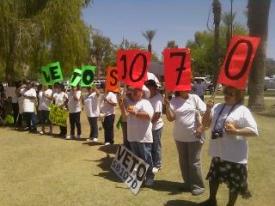
The new law would go into effect 90 days after the end of the legislative session, which is expected to adjourn in the coming weeks.
“I’m disappointed, but not surprised. I believe she’s taken this action for political purposes because she is running for election. It is a poor reason to sign unconstitutional legislation,” said Rep. Kirsten Sinema, D-Phoenix. “The silver lining is that we are going to sue and we are going to win.”
Several legal challenges to keep the legislation from taking effect are in the works by the Mexican American Legal and Educational Fund (MALDEF), the American Civil Liberties Union (ACLU) and the National Day Laborer Organizing Network (NDLON).
“Arizona would have the same place in history as South Africa,” said Salvador Reza, organizer for the PUENTE movement, which advocates for human rights, comparing the new law to apartheid.
But the passage of the Arizona law may also have ignited the pro-immigration reform movement. Rep. Luis Gutiérrez, D-Illinois, is expected to hold a rally in Arizona on Sunday.
“We hope President Obama can join us at the rally to announce swift action the federal government will take to protect the civil rights of its residents,” said Pablo Alvarado, the executive director of NDLON.
President Obama criticized the Arizona bill earlier today, saying it threatens to “undermine basic notions of fairness that we cherish as Americans, as well as the trust between police and our communities that is so crucial to keeping us safe.” He called on Congress to enact immigration reform, saying that without a federal overhaul of immigration laws, “we will continue to see misguided efforts opening up around the country.”

Opponents of the bill are holding ongoing protests and planning economic boycotts of the state convention center.
Since early Friday, thousands of people have gathered outside the state capitol, peacefully protesting the bill with signs reading “Veto SB 1070” and “We are human.” A great majority of them are students between the ages of 14 and 17 who walked out spontaneously from school after news of the protest spread through text-messaging.
Supports of the bill numbered about a dozen.
There has been a strong police presence and some activists are concerned that the governor’s signing of the bill could lead to acts of violence.
Before a crowd of peaceful protesters at the capitol, Phoenix Mayor Phil Gordon spoke passionately against SB 1070 and announced that he would seek approval from the council to seek to stop the bill’s implementation through a lawsuit.
SB 1070, also known as the “Support Our Law Enforcement and Safe Neighborhood Act,” would allow police officers to arrest a person based on “reasonable suspicion ” that he or she is an undocumented immigrant. Police departments could face lawsuits by individuals who believe they are not enforcing the law.
“This bill criminalizes people who appear to be Latino and puts them at risk for racial profiling and prosecution and harassment in the state,” said Sinema.
“There’s no protection in this bill for people who are witnesses or victims of crimes,” she added. “They’ll be less likely to work with police to keep the community safe.”
SB 1070 would also impose penalties for transporting or harboring an undocumented immigrant, which could include family members.
“This is going to break our families apart,” said Estela, an undocumented immigrant who has two children born in the United States. “My older son will want to stay, but we may have to leave.”
The law would have a devastating impact on undocumented students who were brought to the United States when they were very young, said Carmen Cornejo, executive director of CADENA, a group that advocates for passage of the DREAM Act, which would provide a path to citizenship for high school graduates who attend college or serve in the military.
“Even though this is going on, we can’t stop going to school, we can’t stop going to work, we still have a life,” said Dulce, a 25-year-old undocumented immigrant who has an engineering degree. “And we shall not fear.”
Dulce says it has been a difficult week for her family as they waited to hear whether the governor would sign the bill.
“It’s going to be another obstacle,” said the student. “We’ll have to be like we always are, extra careful. They’re not supposed to stop you if you don’t do anything wrong,” said the student. “As an Arizonan and as an undocumented immigrant, I’ll take precautions.”
Dulce planned to attend a protest all day Friday against the bill’s passage.
For immigrant communities, SB 1070 might be the tipping point for action and mobilization after state voters and conservative legislators have passed a series of laws aimed at hardening social conditions in the state to encourage immigrants to leave.
“We’re not going to give up,” said Estela. “We hope that something will be done in the next 90 days.”
Some of the Arizona laws have resulted in U.S.-citizen children going without health care benefits and a number of raids conducted by Maricopa County Sheriff’s deputies that have terrorized immigrant communities.
A coalition of businesses and religious leaders has warned that the impact of the new measure could severely damage the Arizona economy.
“SB 1070 is tearing our state into two. It humiliates us into the eyes of America and threatens our economic recovery,” said Phoenix Mayor Phil Gordon during a speech on Thursday when he urged the governor to veto SB 1070.
Sen. Russell Pearce, R-Mesa, the author of the bill, said the legislation would have the opposite effect. He believes the new legislation will lead immigrants to leave Arizona, causing the state to save money in services it currently provides to the children of undocumented immigrants at schools and hospitals. He has said that states have to take the matter into their own hands in absence of federal enforcement.
The recent death of a rancher on the border connected to violence in the area gave momentum to SB 1070.
Pearce said the legislation would take the handcuffs off law enforcement but allowing them to inquire about a person’s immigration status and would result in a number of immigrants choosing to leave the state.
Ilario and his wife, both undocumented immigrants from Guerrero, Mexico who have lived in the United States for the last 12 years, joined 30 of their neighbors to walk the streets in protest, showing that they refused to remain in the shadows. Ilario knows proponents of the bill want he and his family to leave Arizona, but he is not ready to do that.
“There’s too much at stake for us,” said Ilario in Spanish. “Aquí estamos y no nos vamos.”
US Military tries to cover up civilian deaths in Afghanistan

The anti-war group Rethink Afghanistan has just posted a new video and a petition to expose the deception of the US military in Afghanistan.
“U.S. and allied special forces in Afghanistan killed 2 civilian men, 2 pregnant women and a teenage girl in Gardez, and they then tried to hide their crime. We can’t let them get away with a cover-up.
In this night raid on Feb. 12, special-forces mistakenly attacked a baby shower. Instead of getting immediate medical treatment for the wounded, special forces personnel focused on destroying evidence, digging the bullets out of the bodies.
Gen. McChrystal’s P.R. team fought for weeks to obscure the truth. They lied about finding the women dead when they arrived. They smeared journalists who questioned their story. On April 4, they admitted to killing all of the innocent victims, including the women.
After this outrageous behavior, McChrystal says we should trust his forces to investigate themselves. If you think it is ludicrous for the military to investigate themselves, then please sign on to this petition, invite others to do the same and watch this important video.
Energy companies aren’t green, they give green
A day after celebrating the 40th anniversary of Earth Day it is important to take a look at the efforts by big energy companies and so-called alternative energy companies to influence candidates through campaign donations and lobbying.
The Center for Responsive Politics provides us with good data on both counts. Since 1990, energy companies have contributed half a billion dollars to candidates, with Republicans receiving about twice as much as Democrats. Over $77 million was given to candidates in the 2008 elections and just over $27 million has already reached candidates in the 2010 election cycle.
Here is a list of the top 20 energy companies and their campaign contributions.
| Rank | Organization | Amount |  Dems Dems |
 Repubs Repubs |
Source Indivs Indivs PACs PACs Soft $ Soft $ |
|---|---|---|---|---|---|
| 1 | National Rural Electric Cooperative Assn | $770,650 | 53% | 47% | |
| 2 | Exelon Corp | $566,448 | 66% | 34% | |
| 3 | Koch Industries | $539,900 | 19% | 81% | |
| 4 | Southern Co | $532,169 | 46% | 54% | |
| 5 | American Electric Power | $477,085 | 58% | 42% | |
| 6 | Duke Energy | $468,160 | 52% | 48% | |
| 7 | Exxon Mobil | $436,294 | 14% | 85% | |
| 8 | Dominion Resources | $431,886 | 62% | 37% | |
| 9 | Chevron Corp | $402,159 | 17% | 83% | |
| 10 | EnergySolutions Inc | $361,800 | 29% | 71% | |
| 11 | Energy Future Holdings Corp | $359,866 | 50% | 50% | |
| 12 | FPL Group | $358,096 | 47% | 53% | |
| 13 | Edison International | $356,800 | 64% | 36% | |
| 14 | Valero Energy | $338,800 | 19% | 81% | |
| 15 | Edison Electric Institute | $325,373 | 63% | 37% | |
| 16 | Marathon Oil | $318,670 | 23% | 77% | |
| 17 | Progress Energy | $304,770 | 53% | 47% | |
| 18 | Entergy Corp | $287,365 | 67% | 33% | |
| 19 | Occidental Petroleum | $266,250 | 23% | 77% | |
| 20 | DTE Energy | $250,376 | 65% | 35% |
Some of the major recipients in Congress of the energy companies campaign contributions in 2010 have been Senators Murkowski, Lincoln, Dorgan, and Reid. In the House of Representatives the list includes Boucher, Barton, Edwards, Cantor and Stover.
Michigan Senator Debbie Stabenow has received $71,096 from energy companies so far in 2010 and there is no data for Senator Levin. Congressman Ehlers has received a total of $9,300 this year.

On the lobbying front, big oil leads all energy sectors followed by electric utilities. You can see from the chart the gradual increase in lobby spending by this sector, with figures over $400 million in 2009.
The number of lobbyist for 2009 in the energy sector was 2,302 and has remained over 2,000 since 2002.
Before and After Bagua
(This article is by Paris Conwell – GVSU student)

This past January, I spent a month in the San Martin region of the Peruvian High Amazon as part of a study abroad program through Living Routes. The title of the course was “Community, Ecology, and Indigenous Spirituality in the High Amazon”. While intended to be an anthropology course, what us students found ourselves faced with demanded much more than the passive observation I had usually associated with the field of anthropology.
Within the San Martin department of Peru is the province of Lamas, which is home to the Kichwa-Lamistas, an indigenous society of about 22,500 people. During the program we had the opportunity to meet, interact, and live with some of the members of the Kichwa-Lamistas while we resided in Lamas, and it was during this time that we learned about the Bagua massacres.
On June 5th, 2009, approximately 5,800 Peruvians, mostly natives, were gathered just outside of Bagua, a town only 6 hours car ride from Lamas. They were gathered there for a strike that had begun April 9th, 2009. The strike included a roadblock and the taking of two nearby pumping stations and intended to protest the Free Trade Agreements (FTA) signed between the U.S under the Bush Administration and the government of Alan Garcia in Peru on December 4th 2007. These agreements, and the promulgation of hundreds of legislative decrees by Garcia, have opened indigenous territories to multinational companies without the consent of the indigenous people, and at the expense of their physical, mental, and spiritual well-being. The protests provoked a violent repression on behalf of Garcia’s government, now referred to as the “Bagua massacres” on June 5th this past year. The police attacked at 5:30 am releasing tear gas and firing machine guns at the natives who were armed with lances, stones, and bows and arrows to defend themselves. In the official death toll it was released that 24 police officers and 10 civilians were killed. However, according to various native and social movement communities, there are an estimated 200 to 500 persons involved in the strike who were “disappeared” by being thrown into rivers from the police helicopters and their corpses being burnt.
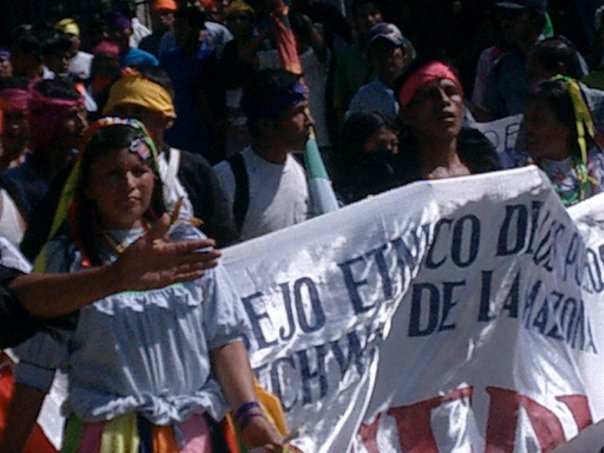
The burning of corpses, in addition to disposing of the bodies by throwing them into the rivers and dumping them from the helicopters, was an effort to greatly decrease the official death toll of native Peruvians and to hide the government’s brutality.
The press was also heavily censored: the government presented a biased account of the events that day and was the sole provider of information for the international media. In a New York Times article written by Simon Romero covering the events that unfolded at the Bagua massacre it reads:
“Initial accounts of the clashes varied. Indigenous leaders here said the killings unfolded early on Friday after the police fired from helicopters on hundreds of protesters who had blocked the highway in the northern Bagua Province, with at least 22 civilians killed. The Chachapoyas Medical Association, in the region where the killings took place, put the number of dead Indians at 25”.
The New York Times article demonstrates the bias and unsound “facts” surrounding the Bagua massacre that is characteristic of the Peruvian government under Garcia as well as the country’s media. It is unfortunate that a major news such as the Times promulgates the racist viewpoints of the Peruvian media and government in their publishing of this article, and that this reflects the tone of the majority if the international coverage of the Bagua massacre. Here is a link to the full article: http://www.nytimes.com/2009/06/06/world/americas/06peru.html?_r=1&scp=1&sq=bagua&st=cse
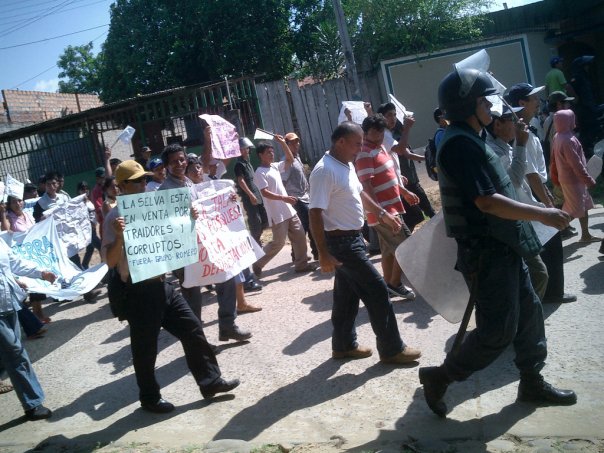
The tone of the reportage on the day of the massacre was biased and racist. Alan Garcia and members of his cabinet as well as the reporters themselves frequently used racist language to describe the native peoples, citing the natives’ efforts to protect their lands as greedy attempts to keep the resources and wealth for themselves because they do not want the land to be privatized or given in concession to transnational companies. Garcia himself called the indigenous people primitive, ignorant savages who stand in the way of progress for all Peruvians.
In the months that preceded Bagua, indigenous leaders sought ways to address the destruction being wrought on behalf of the Free Trade Agreement and Garcia’s marginalizing legislative decrees. In April 2009, leaders of indigenous groups went to Lima to discuss the issue. The leaders returned and discussed the situation with their communities, and it was decided that a strike would be best once it became clear that the Peruvian government was only willing to listen to a few select, elitist and corrupt representatives of indigenous groups who do not properly amplify the voices of the indigenous communities.
The signing of the FTA between the US and Peru has wrought a destructive force comparable to the 16th century conquest of the region, all in the name of “progress” and “development”. It is estimated that 75% of the Peruvian Amazonian territories have either been sold, given in concession, or promised to private enterprise.
Deforestation for a monoculture is a crime. The opening and selling of indigenous territories has led to well documented deforestation, mining, and oil extraction and consequently, environmental disaster and the displacement of people.
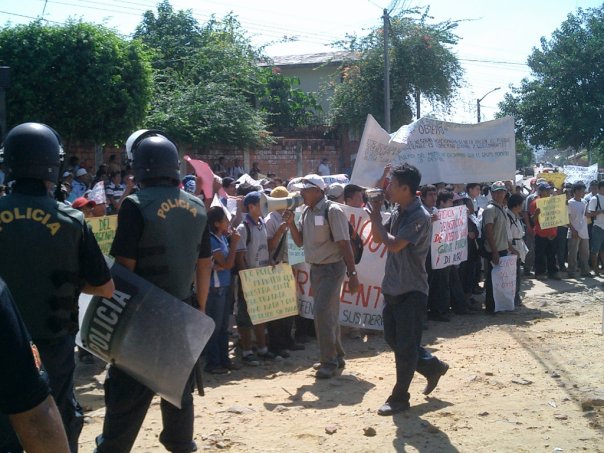
The FTA was ratified in Peru June 2006 and went into affect February 2009. The government of Alan Garcia created a package of 99 reforms to implement the FTA. More than half of these forms have been found to be unconstitutional and directly infringe upon the rights of the indigenous peoples. CEPKA, and indigenous organization representing many of the Kichwa communities, has cited seven specific laws that infringe upon their territorial rights, specifically.
In 1993, Peru ratified the International Labor Organization’s Convention on Indigenous and Tribal Peoples. This convention provides a legal basis for the indigenous people’s struggle against the FTA and the contracting of their land to private companies, particularly part II, Land, articles 13 and 14 in which the government pledges specifically to recognize and respect the lands the indigenous people occupy or otherwise use or traditionally have access to.
In addition to this, on September 13, 2007 the General Assembly of the United Nations adopted the Declaration on Rights of Indigenous Peoples, of which Peru is member. Only 4 nations voted against the declaration— New Zealand, Canada, Australia, and the United States.
As a member of the UN and a signatory of the ILO Convention, Peru is legally obligated to grant certain rights to its native peoples.
Since Bagua, Garcia has apologized and two of the most grievous laws have been amended, however many of the exploitive decrees still remain.
Native communities are devastated by the massacres at Bagua, and now refer to the magnitude of the hardships they face as being “before and after Bagua” as the event marks the pinnacle of violence on behalf of the Peruvian government in regards to the Free Trade Agreements.
The indigenous people of Peru are not against progress. They want to be able to make decisions regarding their territories and to be granted the rights promised to them through the ILO and UN. The forests are their markets, they are a source of subsistence that sustains their livelihood and their cultural identity. Indigenous communities hold a wealth of knowledge about their land. In destroying their lands, the communities are also destroyed and deprived of their wealth. Despite the legal status of these issues, there exists a moral obligation to protect the rights of peoples whose worldview challenges that of the modern west. If we are to ever discuss issues of sustainability, and the physical, mental, and spiritual health of our planet and its inhabitants, we must learn to dialogue with the voices that are often left unheard in their never ceasing challenges to our paradigm of thought.
Towards the end of the study abroad program, all of us students felt the obligation to share what we learned with a western audience. We realized the role our own country plays in the destruction and suffering of the peoples and places we encountered while in the High Amazon, but more importantly, we realized the self-destruction inherent within such practices that ultimately will lead to our planet’s demise, and are responsible for the spiritual deficit we are faced with in the west. Addressing these issues is not a matter of helping “others”; our well-being is bound with those who first feel the damage done. It is just that we are not yet directly and blatantly faced with the affects of our own undoing.
GOP gubernatorial debate coverage
Yesterday, the five Republican candidates running for the Michigan Governor’s seat participated in a debate at MSU, a debate that was organized by the GOP Party.

The debate itself was only 1 hour long, which is hardly enough time to do more than provide introductions and engage in sound bite responses to very complex issues. The major West Michigan news agencies all ran stories about the debate, but none of them went beyond reporting some of what was said by each of the candidates.
All of the news agencies spent some time pointing out how the candidates “took a swipe at each other,” but not once did the reporters bother to verify any of the claims made by the candidates. Four of the five GOP candidates are serving in positions of elected office, which would allow reporters to look at their voting records which could shed light on what kind of track record each of them has. This is particularly the case for Hoekstra and George, since they have a voting record as a member of Congress and State Senator.
Another clear omission from the news coverage was the complete absence of any information about candidate platforms. Sure, there were sound bite responses on issues like jobs and taxes, but the reporters could have bothered to take the time and look at details of key platform issues from the candidate’s respective websites.
Instead, TV stations like WZZM 13 decided it was more valuable to have the head of the Michigan Republican Party and the director of Inside Michigan Politics comment on how the debate went. The WXMI 17 story also treated the debate like a sporting event and even included shorter stories with post debate comments from the candidates that provide no value to voters whatsoever. For example, channel 17 has this comment from Mike Bouchard; “I’m in a business where people shoot at ya, so if people want to throw words, that’s fine with me. I’m going to stay focused on jobs because that’s what people at home want to hear about.”
The Grand Rapids Press article was also short on substance, with reporter Peter Luke providing a summary of the sound bites that candidates gave. The article identified issues like taxes, jobs, education and pro-life stances, but no investigation was done by the reporter who thought it was more useful to point out what called the “intramural sniping” the five candidates engaged in.
WOOD TV 8 did pretty much the same kind of coverage as the other news agencies, but they framed the debate in more entertaining ways by using words like fireworks, blows and sniping.
40 Years of Earth Days
(This article by Brian Tokar is re-posted from ZNet.)

The 40th anniversary of the original Earth Day is upon us, and many seasoned environmentalists are nostalgic for the heady days of the 1970s, when 20 million people hit in the streets and eventually got Richard Nixon to sign a series of ambitious environmental laws. Those laws managed to clean up waterways that were turning into sewers, saved the bald eagle from the ravages of DDT, and began to clear the air, which in the early 1960s was so polluted that people were passing out all over our cities.
While environmental awareness has clearly seeped into mainstream consciousness in the US, today’s environmental movement is floundering, even though the stakes are higher than ever. While grassroots campaigners continue to fight for endangered forests, challenge polluting companies in their communities, and confront the coal industry’s assaults on the mountains of southern Appalachia, the best known national organizations can point to precious few substantive victories of late. Most appallingly, they have utterly failed to demonstrate meaningful leadership around what climatologist James Hansen calls the “predominant moral issue of this century,” the struggle to prevent the catastrophic and irreversible warming of the planet.
As British journalist Johann Hari reported in The Nation back in March, this is partly the result of a legacy of collaboration between increasingly corporate-styled environmental NGOs and the world’s most polluting corporations.
In response to the climate crisis, we are seeing unprecedented collaboration between large environmental organizations and corporations seeking to profit from new environmental legislation. The notorious Climate Action Partnership (known as USCAP) has brought Alcoa, DuPont, General Electric and General Motors together with the Natural Resources Defense Council, the Environmental Defense Fund and the Nature Conservancy to push for the “market-based” approach to climate legislation known as “cap-and-trade.” This would create a vast, highly speculative market in carbon credits and offsets, with gigantic perks for corporations and little benefit for the planet. The push for cap-and-trade legislation has receded for now under pressure from both right wing anti-tax fanatics and market-skeptical environmentalists, but Washington observers anticipate that an even worse climate bill will be announced later this month by Senators Kerry, Lieberman and Graham, and laden with far more blatant giveaways to the fossil fuel and nuclear industries.
Where has the environmental movement gone wrong? To better understand this, it’s helpful to take a brief journey back to the time of the original Earth Day. Where did Earth Day come from, and how did all those 1970s environmental laws actually come to be enacted?
The First Earth Day
It turns out that the original Earth Day on April 22, 1970, was initially a staged event. Politicians like Sen. Gaylord Nelson of Wisconsin and Rep. Pete McCloskey (Republican of California) took the lead in crafting the first Earth Day celebration that unexpectedly brought millions of people out into communities around the country. The events were supported by establishment institutions such as the Conservation Foundation, a corporate think-tank founded by Laurance Rockefeller in 1948. Nixon even began the year with a presidential proclamation saying that the 1970s would be the “environmental decade.”
Many anti-Vietnam war activists came to view Earth Day (originally the Environmental Teach-In) as a devious attempt to divert national attention away from the war, from the antiwar movement’s planned Spring Offensive, and from efforts to raise awareness of the common causes of war, poverty and environmental destruction. An editorial in Ramparts, the most prominent dissident magazine of the period, described Earth Day as, “the first step in a con game that will do little more than abuse the environment even further.”
The April 1970 Ramparts featured a striking exposé on “The Eco-Establishment,” which focused on the corporate think-tanks that were helping to shape the era’s emerging environmental legislation. “[T]oday’s big business conservation,” Ramparts editorialized, “is not interested in preserving the earth; it is rationally reorganizing for a more efficient rape of resources … and the production of an ever grosser national product.” They continued:
“The seeming contradictions are mind-boggling: industry is combating waste so it can afford to waste more; it is planning to produce more (smog-controlled) private autos to crowd more highways, which means even more advertising to create more “needs” to be met by planned obsolescence. Socially, the result is disastrous. Ecologically, it could be the end.”
Journalist I.F. Stone wrote in his famous investigative weekly, “[J]ust as the Caesers once used bread and circuses so ours were at last learning to use rock-and-roll idealism and non-inflammatory social issues to turn the youth off from more urgent concerns which might really threaten the power structure. … [W]e may wake up one morning and find there is nothing left on Earth to pollute.”
To everyone’s surprise, Earth Day turned out to be the largest outpouring of public sentiment on any political issue to date. It drew public attention to environmentalism as a social movement in its own right, perhaps for the first time. And it set the stage to pressure Congress to pass 15 major national environmental laws over a 10-year period, including the Clean Air and Clean Water Acts, the Safe Drinking Water Act, the Endangered Species Act, Toxic Substances Control Act and the establishment of the U.S. Environmental Protection Agency (EPA).
Environmental Regulation: The Back-story
The origin of those 1970s environmental laws also has an underappreciated back-story. Throughout the 1960s, people were responding with horror to the increasingly visible effects of smog, oil spills, pesticide contamination and other environmental assaults. Cities and states responded by implementing their own, sometimes far-reaching programs of environmental monitoring and enforcement. Creative environmental lawsuits established important and unanticipated precedents, extending the right of citizens to sue to protect ecological values and furthering judicial review of the actions of government agencies.
This proved costly for business, and corporate interests came to view federal intervention as a possible solution. “[T]he elite of business leadership,” reported Fortune magazine on the eve of Earth Day in 1970, “strongly desire the federal government to step in, set the standards, regulate all activities pertaining to the environment, and help finance the job with tax incentives.”
Far from an interference with business prerogatives, environmental regulation by the federal government became a way to allay public concerns while offering corporate America a menu of uniform and predictable environmental rules. The laws passed in the aftermath of Earth Day helped fund essential public works projects, such as the construction of sewage treatment plants, and offered protections for public health and biodiversity, but also routinized and standardized the permitting of most industrial facilities. Most important, federal rules often pre-empted states and localities from enforcing regulations more stringent than those advanced at the national level; this core principle of federal pre-emption has again reared its head in today’s Congressional debate over climate legislation.
Just a decade later, Ronald Reagan packed the new regulatory agencies’ staffs with corporate hacks who were openly hostile to their agencies’ missions. (George W. Bush replicated this strategy with a vengeance in the early 2000s.) Reagan’s first EPA administrator resigned after two years in office, facing charges of contempt of Congress, after replacing the agency’s senior staff with officials from companies like General Motors and Exxon, and mercilessly slashing the budget. Reagan’s cartoonish Secretary of the Interior, James Watt, spoke publicly of Armageddon and the need to exploit as much land as possible before its coming. Watt’s policies, according to former New York Times reporter Philip Shabecoff, “introduced policies aimed at transferring control of public lands and resources to private entrepreneurs at a rate that had not been seen since the great giveaways of the nineteenth century.”
The Environmental Status-quo
Meanwhile, throughout the 1970s and eighties, representatives of the largest national environmental groups became an increasingly visible and entrenched part of the Washington political scene. As the appearance of success within the system grew, organizations from the National Wildlife Federation to the Natural Resources Defense Council restructured and changed personnel so as to more effectively play the insider game. The environmental movement became a stepping stone in the careers of a new generation of Washington lawyers and lobbyists, and official environmentalism came to accept the role long established for other regulatory advocates: that of helping to sustain the smooth functioning of the system. Environmentalism had been redefined, in the words of author and historian Robert Gottlieb as “a kind of interest group politics tied to the maintenance of the environmental policy system.”
This shift in the character of the most nationally visible environmental groups spelled the end of bold new policy initiatives on behalf of the environment. An environmental mainstream adapted to “insider” politics proved incapable of sustaining even a moderate Congressional consensus in favor of environmental protection, and ultimately helped prepare the stage for the anti-environmental backlash of the 1980s and beyond. The largest environmental groups launched direct mail appeals that brought in vast new funds, reflecting people’s outrage against the Reagan administration’s anti-environmentalism. Ironically, the success of these appeals pushed many groups further toward a conspicuously top-down, corporate-style structure. Those advocating a more corporate style invariably won internal battles within the Sierra Club, Friends of the Earth and even Greenpeace. They increasingly avoided issues and tactics that might prove alienating to wealthy donors.
The Sierra Club grew from 80,000 to 630,000 members during the 1980s, and the conservative National Wildlife Federation reported membership gains of up to 8,000 a month, totaling nearly a million.The World Wildlife Fund, later notorious for its efforts to establish national parks on the U.S. model in Africa and LatinAmerica, grew almost tenfold. The total budget of the ten largest environmental groups grew from less than $10 million in 1965, to $218 million in 1985 and $514 million in 1990. By the early 1990s, even the thoroughly mainstream former editor of Audubon magazine would lament that “naturalists have been replaced by ecocrats who are more comfortable on Capitol Hill than in the woods, fields, meadows, mountains and swamps.”
Environmental groups also began their flirtation with corporate sponsorships, so aptly summarized by Johann Hari in The Nation. In the lead-up to the twentieth anniversary of Earth Day in 1990, activists (including this author) began closely investigating those ties, and revealed links between groups such as the National Wildlife Federation, Sierra Club, and the Wilderness Society, and a rogue’s gallery of major oil, chemical, utility, and banking corporations. The Multinational Monitor explored links between environmental organizations’ directorships and corporate boards, university researchers scrutinized the big environmental groups’ stock portfolios, and others explored the even more nefarious ties that tainted the world of “progressive” foundations.
From Corporate Environmentalism to Green Consumerism
By 1990, everyone seemed to want to be an environmentalist. President George Bush, Sr. proclaimed himself a defender of the environment, and briefly aimed to distance himself from the anti-environmental excesses of the Reagan years by adopting the first national cap-and-trade system to address the problem of acid rain. Senator Al Gore, the 1988 presidential primary campaign’s leading Democratic war hawk, began speaking out about global warming and other environmental threats. Britain’s reactionary Prime Minister Margaret Thatcher called herself a “green.” Even the president of the World Bank won praise from environmental publications for voicing concerns about the Bank’s role in environmental destruction. The Environmental Defense Fund led the way in pushing for a more aggressively “market-oriented” approach to environmental policy.
So it was not a huge surprise when the celebrations of the twentieth anniversary of Earth Day in 1990 became the coming-out party for a more overtly corporate brand of environmentalism. Earth Day celebrations became a virtual extravaganza of corporate hype, and “green consumerism” was the order of the day. The official overriding message was simply, “change your lifestyle,” by recycling, driving less, and buying green products. And while the national Earth Day organization turned down some $4 million in corporate donations that didn’t even meet their rather flexible criteria, celebrations in several major U.S. cities were supported by notorious polluters such as Monsanto, Peabody Coal and Georgia Power. Everyone from the nuclear power industry to the Chemical Manufacturer’s Association purchased full-page advertisements in newspapers and magazines proclaiming that, for them, “Every day is Earth Day.” The now-familiar greenwashing of Earth Day had begun.
Some activists responded by organizing more politically challenging local Earth Day anniversaries of their own, focusing on local environmental struggles, urban issues, the nature of corporate power and a host of other problems that were systematically excluded from most official Earth Day events. Left Greens and Youth Greens in the Northeast initiated a call to shut down Wall Street the Monday following Earth Day, and were joined by environmental justice activists, Earth First! organizers, ecofeminists, New York City squatters and many others. In the early morning of April 23, just after millions had participated in polite, feel-good Earth Day commemorations all across the country, hundreds converged on the New York Stock Exchange, with the goal of obstructing the opening of trading on that day.
Juan Gonzalez, in his New York Daily News column, decried the weekend’s “embalming and fire sale of Earth Day,” and told his 1.2 million readers, “Certainly, those who sought to co-opt Earth Day into a media and marketing extravaganza, to make the public feel good while obscuring the corporate root of the Earth’s pollution almost succeeded. It took angry Americans from places like Maine and Vermont to come to Wall Street on a workday and point the blame where it belongs.”
The 1990 Earth Day Wall Street Action reflected the flowering of grassroots environmental activity that had emerged throughout the 1980s, partly in response to the compromises of the big environmental groups. The popular response to toxic chemical pollution — launched by the mothers of sick children living near the severely polluted Love Canal in upstate New York — grew into a nationwide environmental justice movement that exposed the disproportionate exposure of communities of color to toxic hazards. Earth First! grew as a decentralized network of grassroots forest defenders, using theatrical direct action, combined with acts of industrial sabotage, to stem the tide of forest destruction. Others joined in solidarity with indigenous peoples’ movements around the world that had arisen in defense of traditional lands, responding to the new onslaught of neoliberal development policies. During the lead-up to Earth Day 1990, a hundred environmental justice activists signed a letter to the eight largest national environmental organizations challenging the dearth of people of color on those groups’ staffs and boards, along with their increasing reliance on corporate funding.
The Clinton-Gore administration of the 1990s perfected the art of channeling environmental rhetoric while simultaneously encouraging increased resource extraction — prefiguring Barack Obama’s recent overtures to the nuclear, oil and coal industries.
As the decade ended, environmental activists made a strong showing in Seattle, as a key part of the broader coalition of social justice, labor and green groups that successfully challenged the World Trade Organization. But the Bush years that followed were a time of increasingly frustrating defensive battles. While many of the grassroots initiatives of the 1980s and nineties continued (see Douglas Bevington’s new book, The Rebirth of Environmentalism), others felt dismayed by the ineffectiveness of large environmental groups. This led to the continued evolution of Earth First! and other radical formations. By the late 1990s, groups like the Earth Liberation Front shifted toward more secretive and aggressive types of property destruction and sabotage in defense of nature. In 2006, the FBI declared “environmental terrorists” to be the top domestic security threat, even though no one had been harmed in any of their actions. The so-called “green scare” of the Bush years eventually landed at least 16 eco-militants and animal rights activists in federal prison, replete with “terrorism enhancements” to their sentences, as a consequence of the notorious “Patriot Act.” Also in the early 2000s, renewed grassroots campaigns aimed to reclaim urban spaces and challenge the genetic engineering of food, among many other new issues.
Over the last few years, it appeared that the climate crisis might be ushering in a renewed wave of grassroots environmental action in the United States. A 2009 student environmental conference attracted some 3000 participants to Washington, D.C., and the event was followed by a symbolic blockade of the city’s large coal-fired power plant. On the tenth anniversary of the WTO protests in Seattle on November 30, 2009, climate justice actions across the US included the lock-down of an intersection outside the Chicago Climate Exchange (home of the corporate-driven “voluntary” carbon market), a blockade of a major component for a new coal-fired power plant in South Carolina, protests of large banks that finance the coal industry and other mega-polluters, and a rally outside the Natural Resources Defense Council’s offices to protest their aggressive advocacy for carbon markets. People in West Virginia and across southern Appalachia have stepped up resistance to the ravages of mountaintop removal coal mining, while others across the country — from Vermont to the Navajo Reservation — have redoubled their efforts against Obama’s planned expansion of the nuclear industry.
Most of 2009’s climate actions, however, were aimed at trying to press national governments to reach a comprehensive agreement at the December UN climate conference in Copenhagen. The failure of diplomacy in Copenhagen deflated the energy of many activists, and the post-Copenhagen resurgence of climate actions has yet to materialize. Meanwhile, although Earth Day has become an annual ritual in some communities, as well as on many college campuses, the fortieth anniversary has brought a notable scarcity of attention.
One event this year, though, highlights how quickly corporate environmentalism has evolved from tragedy to farce. This gala event, held on April 21st in Washington, DC, was hosted by a group called the Carbon War Room, a rather exclusive alliance of elite environmentalists and financiers, headed by the notorious multibillionaire Richard Branson of the Virgin Group. Branson is most celebrated these days for his experimental biofueled airplanes, along with a venture to promote outer space tourism and public advocacy for geoengineering the climate. For only $450 (a third less for nonprofits), participants could have dinner with Branson, EPA Administrator Lisa Jackson, and founding Earth Day organizer Denis Hayes at the new Ronald Reagan International Trade Center, just around the corner from the White House.
Meanwhile, the green marketing of products is alive and well, from clothing, to Priuses, to luxury ecotourism. The UK’s Guardian newspaper reported from a “green business” conference in London last year that “as much as 70 percent of future advertising would have an environmental focus.” They quoted a leading British supermarket executive questioning environmental limitations on consumer desires, arguing that such an approach simply “fails to see the enormous potential of consumers.” Another Guardian story reported on a Dutch study of consumer behavior, suggesting that ethical consumer choices are made chiefly for the added social status they confer. “Researchers found consumers are willing to sacrifice luxury and performance,” for example by buying a Prius instead of a Hummer, “to benefit from the perceived social status that comes from buying a product with a reduced environmental impact,” they reported.
Today, right-wing pundits depict environmentalism as an elite hobby that threatens jobs, while many progressive environmentalists cite the potential for “green jobs” to help reignite economic growth. Both views are sorely missing a central element of what has made environmentalism such a compelling counter-hegemonic worldview ever since the 1970s: the promise that reorienting societies toward a renewed harmony with nature can help spur a revolutionary transformation of our world.
This outlook has helped inspire anti-nuclear activists to sit in at power plant construction sites, forest activists to sustain long-term tree-sits, and environmental justice activists to stand firm in defense of their communities. People around the world are acting in solidarity with indigenous peoples fighting resource extraction on their lands. With climate chaos looming on the horizon, such a transformation is no longer optional. Our very survival now depends on our ability to renounce the status-quo and create a more humane and ecologically balanced way of life.
Bolivian President Blames Capitalism for Global Warming
(This article is re-posted from Common Dreams.)
Bolivian President Evo Morales said capitalism is to blame for global warming and the accelerated deterioration of the planetary ecosystem in a speech today opening an international conference on climate change and the “rights of Mother Earth.”
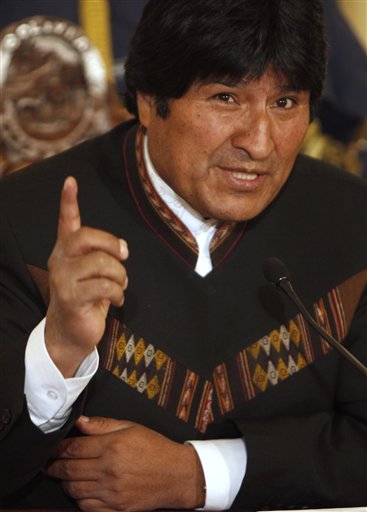
More than 20,000 indigenous, environmental and civil society delegates from 129 countries were in attendance as President Morales welcomed them to the conference at a soccer stadium in the village of Tiquipaya on the outskirts of the city of Cochabamba.
“The main cause of the destruction of the planet Earth is capitalism and in the towns where we have lived, where we respected this Mother Earth, we all have the ethics and the moral right to say here that the central enemy of Mother Earth is capitalism,” said Morales, who is Bolivia’s first fully indigenous head of state in the 470 years since the Spanish invasion.
Morales is the leader of a political party called Movimiento al Socialismo, the Movement for Socialism, which aims to give more power to the country’s indigenous and poor communities by means of land reforms and redistribution of wealth from natural resources such as gas.
“The capitalist system looks to obtain the maximum possible gain, promoting unlimited growth on a finite planet,” said Morales. “Capitalism is the source of asymmetries and imbalance in the world.”
The Bolivian president called this conference in the wake of what he considered to be failed United Nations climate negotiations in Copenhagen in December.
Those talks produced a weak political agreement, the Copenhagen Accord, instead of a strong, legally-binding set of limits on greenhouse gas emissions to take effect at the end of 2012, as Bolivia and many other countries had hoped.
Named “World Hero of Mother Earth” by the United Nations General Assembly last October, today, President Morales warned of dire consequences if a strong legally-binding agreement to limit greenhouse gas emissions is not reached.
A new agreement is needed to govern greenhouse gas emissions after the first commitment period of the Kyoto Protocol expires at the end of 2012. This year’s round of international negotiations towards an agreement began earlier this month in Bonn, Germany, and the next annual United Nations climate conference is scheduled for Cancun, Mexico from November 29.
“Global food production will be reduced by approximately 40 percent and that will increase the number of hungry people in the world, which already exceeds a billion people,” Morales warned. “Between 20 and 30 percent of all animal and plant species could disappear.”
Global warming will cause the melting of the polar ice caps and the glaciers of the Andes and the Himalayas, and several islands will disappear under the ocean,” he warned.
The convocation this morning included a multi-cultural blessing ceremony by indigenous peoples from across the Americas. Speeches by representatives of social movements from five continents focused on the urgency of the climate crisis and the need for bold action that protects both human rights and the environment.
The delegates are meeting in working group sessions this week to develop strategies and make policy proposals on issues such as forests, water, climate debt, and finance.
President Morales has pledged to bring these strategies and proposals to the UN climate conference in Cancun.

“We have traveled to Bolivia because President Morales has committed to bring our voices to the global stage at the next round of talks in Cancun,” said Jihan Gearon of the Navajo Nation in Arizona, who is a native energy organizer with the Indigenous Environmental Network.
“Indigenous rights and knowledge are crucial to addressing climate change, but the United States and Canada have not signed on to the UN Declaration on the Rights of Indigenous Peoples, and are pushing corporate climate policy agendas that threaten our homelands and livelihoods,” Gearon said.
“President Morales has asked our recommendations on issues such as REDDs [Reducing Emissions from Deforestation and Degradation],” said Alberto Saldamando, legal counsel for the International Indian Treaty Council.
“REDD is branded as a friendly forest conservation program, yet it is backed by big polluters,” Saldamando said. “REDD is a dangerous distraction from the root issue of fossil fuel pollution, and could mean disaster for forest-dependent indigenous peoples the world over.”
“We are here from the far north to stand in solidarity with our brothers and sisters of the South,” said Faith Gemmill, executive director of Resisting Environmental Destruction on Indigenous Lands (REDOIL), who spoke from the stage at the invitation of President Morales. “We have a choice as human kind – a path of life, or a path of destruction. The people who can change the world are here!”
Memo to America: Stop Murdering My People
(This article is re-posted from ZNet.)
Amid increasing civilian deaths and resurgent warlordism, Afghan women’s leader Malalai Joya writes that Hamid Karzai and the U.S. are losing credibility in Afghanistan day by day.

Almost every day, the NATO occupation of our country continues to kill innocent people. Each time, it seems, military officials try to claim that only insurgents are killed, or they completely deny and cover up their crimes. The work of a few courageous journalists is the only thing that brings some of these atrocities to light.
For instance, it was only after the reporting of Jerome Starkey of the Times of London that officials admitted to the brutal Feb. 12 murder of two pregnant women, a teenage girl, and several young men in a night raid at a home where a family was celebrating the birth of a child.
Night raids, air raid “mistakes,” firing on civilian buses and cars at checkpoints—the occupation finds many ways of killing the people of Afghanistan. The excuses and lies for these deaths are like salt in our wounds, and it is no wonder that protests against the U.S. military are growing. The Afghan people have had enough.
In recent weeks, there has been much talk about Hamid Karzai’s threats to join the Taliban and about his supposed differences with the American government. But for Afghans, Karzai long ago lost all credibility. The joke among our people is that Karzai doesn’t do or say anything without consulting the White House first. No amount of nationalistic rhetoric or demagoguery on his part will change this perception.
Everyone in Afghanistan knows that Karzai was placed into power with the backing of the United States and its allies, and to this day he relies on their support. His regime would not last a day without it. And Afghans know too well the reality of his corrupt government: It has delivered nothing to the country’s poor other than sorrow and destitution, while filling the pockets of drug traffickers, warlords, and its own corrupt officials.
Afghanistan has had puppet leaders before, rulers who served only the interests of foreign occupiers, whether British or Soviet. But Karzai may be the most hated puppet in our history; he has empowered some of the most brutal internal enemies of ordinary Afghans, warlords of the Northern Alliance like Sayyaf, Dr. Abdullah, Rabbani, Mohaqiq, Ismael Kahn, Dostum and many others. Even his two vice presidents, Fahim Qasim and Karim Khalili, are notorious fundamentalist warlords. The president’s brother in Kandahar, Ahmed Wali Karzai, is another thug in power whose links to the drug trade and the CIA have been widely reported.
Karzai made headlines by threatening to “join the Taliban,” but the reality is that for more than eight years he has had no problem working with fundamentalists who are the ideological brothers of the anti-women Taliban. In fact, Karzai himself used to support the Taliban when he was a minor tribal leader in Kandahar in the 1990s, and for years he has been negotiating to bring Taliban leaders into his puppet regime. Some of them are already serving in his regime, and the U.S. government has been encouraging these negotiations by creating the false categories of “moderate” and “extremist” Taliban.
He has also been reaching out to that most brutal warlord and criminal, Gulbuddin Hekmatyar, a mujahideen leader known for killing civilians and currently designated a terrorist by the U.S. government. Karzai recently appointed Abdul Hadi Arghandewal, an infamous leader of Hekmatyar’s party, as his minister in charge of the economy. These negotiations and flexible alliances by Karzai and the U.S. government are nothing new. For three decades, the U.S. has backed these criminals: Hekmatyar, al Qaeda and other fundamentalists in the 1980s, the Taliban in the 1990s, and now Karzai and his warlord allies.

Progressive-minded Afghans want to break out of this circle of warlordism once and for all. It is ironic that Karzai talks about the possibility that a “national resistance” could develop in Afghanistan. He should know that the prime target of such a movement will be his own regime and its foreign supporters.
Our people are deeply fed up. They have organized many anti-U.S. protests in the past months and if the occupation continues, the resistance will only grow. More than eight years of occupation have made life bleak, and we are tired of being pawns in the U.S. and NATO’s game for control of Central Asia.
We can no longer bear the killing of our pregnant mothers, the killing of our teenagers and young children, the killing of so many Afghan men and women. We can no longer bear these “accidents” and these “apologies” for the deaths of the innocent.
We salute the anti-war movements in the NATO countries. Here, we will struggle to our last breath to stop this war that is tearing apart our beloved Afghanistan.
Malalai Joya, now 31, was the youngest member of the Afghan parliament, elected in 2005. In 2007 she was suspended from parliament because of her consistent criticism of the warlords and other human-rights abusers in the Karzai regime. Joya has survived five assassination attempts to date, and has written her life story in the book A Woman Among Warlords (with Derrick O’Keefe, Scribner, 2009). She writes from Kabul, Afghanistan.

