Will the Climate Bill Nuke Earth Day?
(This article by Harvey Wasserman is re-posted from Commondreams.org)
The Climate Bill is due on Earth Day. By all accounts it will be a nuclear bomb.
It will be the ultimate challenge of the global grassroots green movement to transform it into something that can actually save the planet.

For the atomic power industry, the bill will cap a decade-long $640-million-plus virtual cleansing of its radioactive image.
It will have the Obama Administration and Senators John Kerry (D-MA), Joe Lieberman (I-CT) and Lindsay Graham (R-SC) embracing very substantial taxpayer subsidies for building new nuclear plants.
Ditto new offshore drilling and “clean coal.” The markers have been laid for a greenwashed business-as-usual approach toward pretending to deal with global climate change and the life-threatening pollution in which our corporate power structure is drowning us. All without actually threatening certain corporate profits.
From “An Inconvenient Truth” to Obama’s impending Earth Day address, the official emphasis is on each of us, as individuals. To be sure, we ALL must consume smarter, use less and recycle more. Since the first Earth Day, all these great green ideas have had an undeniable impact.
Some corporations have also learned that pollution is by definition a form of waste, and that to actually go green is to become more profitable.
But some technologies and fuel sources have proved simply unworkable on a survivable planet. Topping the list is atomic power.
Once sold as “too cheap to meter,” atomic reactors are too expensive to matter—except for massive taxpayer subsidies.
The first commercial reactor opened at Shippingport, Pennsylvania, in 1957. Since then, the industry has failed to solve its radioactive waste problem, failed to find meaningful private liability insurance and failed to find unsubsidized private financing for new reactors.
The handouts in the Climate Bill are sorry testimony to all that. But there’s more.
All reactors are indefensible targets for terror and error. As at Fermi, Chernobyl and Three Mile Island, the potential for disaster is apocalyptic.
All reactors kill nearby living things—human and otherwise—from “normal” radiation releases.
All reactors also emit substantial toxic chemicals and greenhouse gases in mining, milling, enrichment, fuel fabrication, transportation, waste storage and other related operations.
Reactors in France, Alabama and elsewhere which have been forced shut because they super-heat rivers and lakes—all in the name of “fighting global warming.”
Selling the falsehoods that atomic energy is “carbon free,” successful in France and can “fight climate change” has been dirty and expensive.
Along the way, the industry has hired a bevy of flacks with marginal green credentials.
But on Earth Day we may see its crowning achievement.
Already the Administration has pledged $8.33 billion in loan guarantees to fund a double-reactor project in Georgia. The designs have not yet been certified, the price tag is soaring, there’s bitter debate over where the cash will come from and what fees should be attached, and the state’s ratepayers are on the hook even if the plant never generates electricity.

But the Administration wants more than $50 billion in loan guarantees to repeat the process elsewhere. Kerry-Lieberman-Graham have toyed with even bigger subsidies, in various forms, ranging to $100 billion and more.
Offshore drilling and “clean coal” also seem poised for new handouts.
It’s not clear what the Earth gets in exchange. Cap and trade, once the centerpiece of the whole deal, is gone. A carbon tax does not seem to be on the table. There will certainly be subsidies for various Solartopian technologies, and a headline-grabbing “surprise” or two.
But exactly what the barons of fossil/nuke will offer to justify their massive cash infusions is not yet clear.
All that’s certain is that this Earth Day, the Climate Bill will jack the debate to a whole new level.
Given soaring global carbon levels and a wasteful, obsolete economic infrastructure in serious decline, we are clearly at the precipice.
The Administration, the Congress and the country will have to decide: will we continue to subsidize failed atomic technologies and catastrophic fossil mining and drilling whose corporate backers have apparently unlimited funds for lobbying and PR?
Or do we finally turn to the truly green technologies and ways of living that can save both our planet and our economy?
The final battle starts Thursday. The outcome is up to us.
Immigrants Under Fire: The Tea Party’s Newest Target
What’s bugging the Tea Party these days? Lately, there’s been a lot of talk about the English language.
For example, at a Tea Party event in August of last year, Ada Fisher said: “You cannot be one nation under God when everyone’s speaking something different.”

That might come as a surprise to, say, Switzerland, which has four official languages, or South Africa, which has 10. And in fact it’s also surprising in the United States. We are a nation founded on immigration, and many Americans were raised in multi-lingual homes. Even so, the U.S. Census Bureau found in 2000 that 96 percent of all residents speak English “well” or “very well.”
As linguist Geoffrey Pullum said in a 2004 essay, “making English the official language of the United States of America is about as urgently called for as making hot dogs the official food at baseball games.”
But according to the Institute for Southern Studies, “An Official Language of the United States” made a big showing in voting for the Contract From America, an online document created to list the Tea Party planks. It didn’t make the final cut, but English-only got more votes than issues like interstate health insurance and cutting lifetime pay for members of Congress.
So what’s with the Tea Party and this sudden obsession over English? It’s not about the language; it’s about the immigrants.
The Tea Party seems to be run on rage—White rage, a sustainable resource since 88 percent of members are White, according to a Quinnipiac poll. Along with anger over President Obama, health care legislation, and taxes, this rage is somehow suddenly being channeled against immigrants and in favor of “taking America back.”
Former Representative Tom Tancredo said in his Tea Party convention speech on March 4 that America did not need “a cult of multiculturalism.” He added, “…something really odd happened, mostly because we do not have a civics literacy test before people can vote in this country. People who could not spell the word ‘vote’ or say it in English put a committed socialist ideologue in the White House – his name is Barack Hussein Obama.”
Setting aside Tancredo’s apparent desire to re-institute laws that led to lynchings and mob violence, his speech showed one thing: Immigration, once a back-burner issue for the Tea Party, has suddenly become a burning topic.
Tancredo got a standing ovation with his concluding remarks: “[Our culture] is based on Judeo-Christian principles, whether people like it or they don’t. That’s who we are. That is who we are. And if you don’t like it, don’t come here. And if you’re here and you don’t like it, go home! Go someplace else!”
Alien, go home. It’s become a favorite theme. Last November, there was a rash of Tea Party anti-immigrant rallies held across the country, including one in Phoenix where people held up signs that said, “America Not Amexico.” The rage/hate level was so high at the Phoenix event that NeoNazi observers, some carrying signs nearly identical to the ones that the Tea Partiers had, attempted to join in.
Speakers at the Tea Party convention in Nashville this February drove home these talking points: “President Obama wants to turn the country into a Third World country.” “Make English America’s official language.” “Immigrants are taking over the United States. They must be sent back to where they came from.” “This is our nation and we must take it back.”
William Gheen, president of Americans for Legal Immigration, is one of the leaders of a new wave of Tea Party anti-immigrant rallies being held this month. Gheen explained, “We are encouraging Americans coast to coast to stand up and speak out against Obama’s push for amnesty for illegal aliens and the President’s refusal to send the National Guard to the border to defend American jobs, wages, property, health and lives,”
The fear of the foreign is nothing new in the Tea Party, as shown in their widespread claims that Barack Obama is Muslim, not Christian; African, not American. At a Tea Party event on April 9 in Escanaba, a man named Ken Schwalbach said, “Obama, to me, is a socialist. He’s a Muslim and all he wants to do is bankrupt us and run us into the ground.”
Now our need for fairer immigration laws or even tolerance for a society that speaks more than one language is enraging the Tea Party. What are these people so afraid of?
A few clues: On one Tea Party blog, a member wrote: “An overflow of poor, uneducated humanity, looking for free health care will start pouring into our nation. Around the world rumors are already flying that if you slip across the sieve of a border, you can get work as low income and get all your taxes back by lying on the tax form.”
And on this site, in response to a GRIID article, a self-identified Tea Partier wrote about not being able to find English labels on store items and hearing other languages spoken in the street. He commented that to be upset about such things “is not being racist or a bigot, it is American. We live in America, they live in America, why do the majority have to cower to the minority?”
In my opinion, you don’t really see a lot of White cowering in America, but you wouldn’t know that to listen to Tea Party speakers. They also seem unaware that laws made even more Draconian over the past decade make it nearly impossible now for undocumented immigrants who have been living here for years to find their way through the system to obtain legal status and citizenship.
But there could be something larger going on here: the manipulation and control of votes.
A standard feature of Tea Party events has become the moment, as in Riverside Park on April 10, when someone earnestly explains why he or she is not a bigot. And that rang a bell with me, as it would with most students of U.S. history. Who was famous for saying, “I am not a bigot” even when he followed it up with statements such as, “Segregation today…segregation tomorrow…segregation forever”?
George Wallace. Wallace’s clever manipulation of Alabamans over the sea change of the Civil Rights movement was nothing short of brilliant. His overt racism was essentially theater, done with political deliberation. When he was asked why he started using hate speech, Wallace admitted, “I tried to talk about good roads and good schools and all these things that have been part of my career, and nobody listened. And then I began talking about niggers, and they stomped the floor.”
The majority of Tea Party members say there is no need for more than two political parties. So their votes will inevitably go to the existing party they see as more conservative. Add to the equation that the right wing is desperate to get back into power to save tax cuts for the rich, unlimited war profiteering, and the continued deregulation of Wall Street.
Now factor in a new CBS poll that found 63% of Tea Party members get their information exclusively from Fox News.
To manipulate the Tea Party, steering them toward politicians whose voting records prove that Tea Party issues have never been their priorities, would simply be playing out a tried-and-true method…one that’s been used before, particularly when fueling it with the myth of White oppression, the threat of the erosion of White privilege. Immigration issues provide the perfect trigger for that.
Is the Tea Party being played? If they are, it won’t matter how much rage is generated. This tactic is always abandoned after the votes are cast and the patsies have successfully been used for their purpose.
In Wallace’s case, his claims he could put a stop to the essential addition of civil rights laws were lies that got him into power. Civil Rights legislation prevailed anyway.
In the case of immigration reform, there is a great need for changes to make laws fair, to see that people who desire citizenship can achieve it, and to give everyone an equal place and an equal voice. These are changes that can be stalled, but will not be stopped.
Memo to the Tea Party: You all have immigrant roots. There is no “us” and “them.” Es hora de dejar ir.

Enola Aird listens to audience members discuss points brought up in her presentation in Grand Rapids April 17.
Enola G. Aird , director of Mothers for a Human Future, spoke yesterday about the connection between the commercialization of childhood and the commodification of children. In other words, how advertising that is raising today’s kids into self-indulgent, materialistic consumers is paving the way for a time when children will be genetically modified products with traits preselected by their consumer parents.
Born in the Republic of Panama, Aird is a Phi Beta Kappa graduate of Barnard College and received her J.D. from Yale Law School. She is a member of the steering committee of the Campaign for a Commercial Free Childhood and has worked for the Children’s Defense Fund as well as a variety of media organizations, including the predecessor entities of Time Warner and Viacom. She was hosted by the local grassroots coalition, Stop Targeting Our Kids (STOK).
Aird started her talk by relating a conversation she had with a Mexican exchange student who was surprised by American children’s lifestyles. He said, “In Mexico children are raised to be respectful of their elders, to take care of the younger children and to be family oriented.” Aird went home that evening and asked her then teenage daughter what American kids were raised to be. Her daughter answered, “To get good grades, a good job, to make lots of money and to buy lots of things.” Though joking, her daughter’s response was a correct analysis.
“The US is about material success. The purpose of life is getting lots of things, having material success,” Aird said. “What if we discover our way of life is inconsistent with being human?”
The commercialization of childhood
“Advertising and marketing are a crucial piece of the deadly puzzle we’ve created for ourselves,” Aird continues. “For the past 40 years, they have trained children to be lifelong consumers. Young people want nothing but things—and that is good for our economy.”
In 1980, Congress removed the FTC’s control over regulating advertising targeted to children. Around that same time, James McNeal, who is known as “the godfather of kids’ marketing” explained why kids are the best market to have. They buy things. They influence what their parents buy. And, they will be buying the rest of their lives. (McNeal’s book credits include Kids as Customers: Handbook of Marketing to Children and Advertising to Children in China .)
Since that time, marketing aimed at kids has had less regulation than marketing to adults. Today’s childhood maladies—obesity, violence, hypersexuality and other behavior issues can be directly linked to  this free-market, profits-over-people mentality that has no concern with children’s well being. As an example, Aird mentioned the child-targeted marketing of the new R-rated movie, Kick Ass, which she described as a “Kill Bill for kids starring an 11-year-old girl.”
“The marketers not only sell product, they sell values. ‘Gotta have it. Just do it. Obey your thirst.’ That ‘gotta have it, gimme’ attitude sells the values of self indulgence, materialism and instant gratification. These are antithetical to the values needed to live in community and in relationship.”
The commodification of children
Aird then gave the example of how consumerism has already begun directing us down the post-human road. Leading scientists, such as Lee Silver, professor of genetics at Princeton, biotech entrepreneur, Greg Stock, and futurist Ray Kurzweil are already cashing in. As is the medical industry. The Fertility Institutes, with clinics in California, New York and Mexico already offer prospective parents guaranteed gender selection.
The technology will soon be here to offer parents the opportunity

The Fertility Institutes' poster child
to shop for the type of child they want: hair color, skin tone, eye color, and enhanced aptitudes. Many college newspapers feature ads for egg donors, with an emphasis on blondes of the right weight and height with high SAT scores.
“The real danger is that we are walking blithely into the commodification of human beings. Professors at University of Chicago and Princeton think it would be a good idea to make bigger, better humans,” Aird said. “When we talk about taking back childhood from corporate marketers, we’re trying to preserve our humanity. Technology and capitalism are very hard to stop … We have to stop it if we are going to preserve humanity.”
How do we stop it? While working through the legal system, staging boycotts and lobbying government all have their place, Aird believes the real hope lies with mothers. Since the dawn of humanity, mothers have carried on the particular way in which human life is brought to the world. Appealing to the “mother trust” held by women in every country of the world could be the best hope for humanity.
“The time is now . . . and it’s at the grass roots, with conversations like these” Aird said. “We have the patenting of life forms. Everything is for sale—kids, body parts, water. Is nothing to be set aside for the common good? . . . I have two children who may bring me grandchildren and I want them to be human.”
Area folks gearing up for the US Social Forum
 A small group of people met at The Bloom Collective today to talk about the upcoming US Social Forum, which takes place June 2 – 26 in Detroit. Representatives from The Bloom, GRIID and Our Kitchen Table (OKT) who plan on attending the USSF with their organizations and others who plan on attending on an individual basis all shared excitement about the potential impact the USSF could have Grand Rapids and the globe.
Some present hope people coming back to Grand Rapids after the USSF would be able to do education about the negative impacts of globalization measures being brought forth by the World Bank, World Trade Organization and the International Monetary Fund. Others want to learn how to better build a radical community here in Grand Rapids.
The discussion group will meet again Friday April 23 at 1 p.m. at The Bloom Collectives’ former space, 1134 Wealthy St. SE. Please join us… it’s about you.
GR IWW bottom-lines
MayDay2010 10 a.m. – 8 p.m. May 1
- Live music, speakers and kids’ activities
- 11 a.m. – 1 community potluck
- 2 – 4 p.m. Really Really Free Market
Martin Luther King Park
Fuller & Franklin SE, Grand Rapids
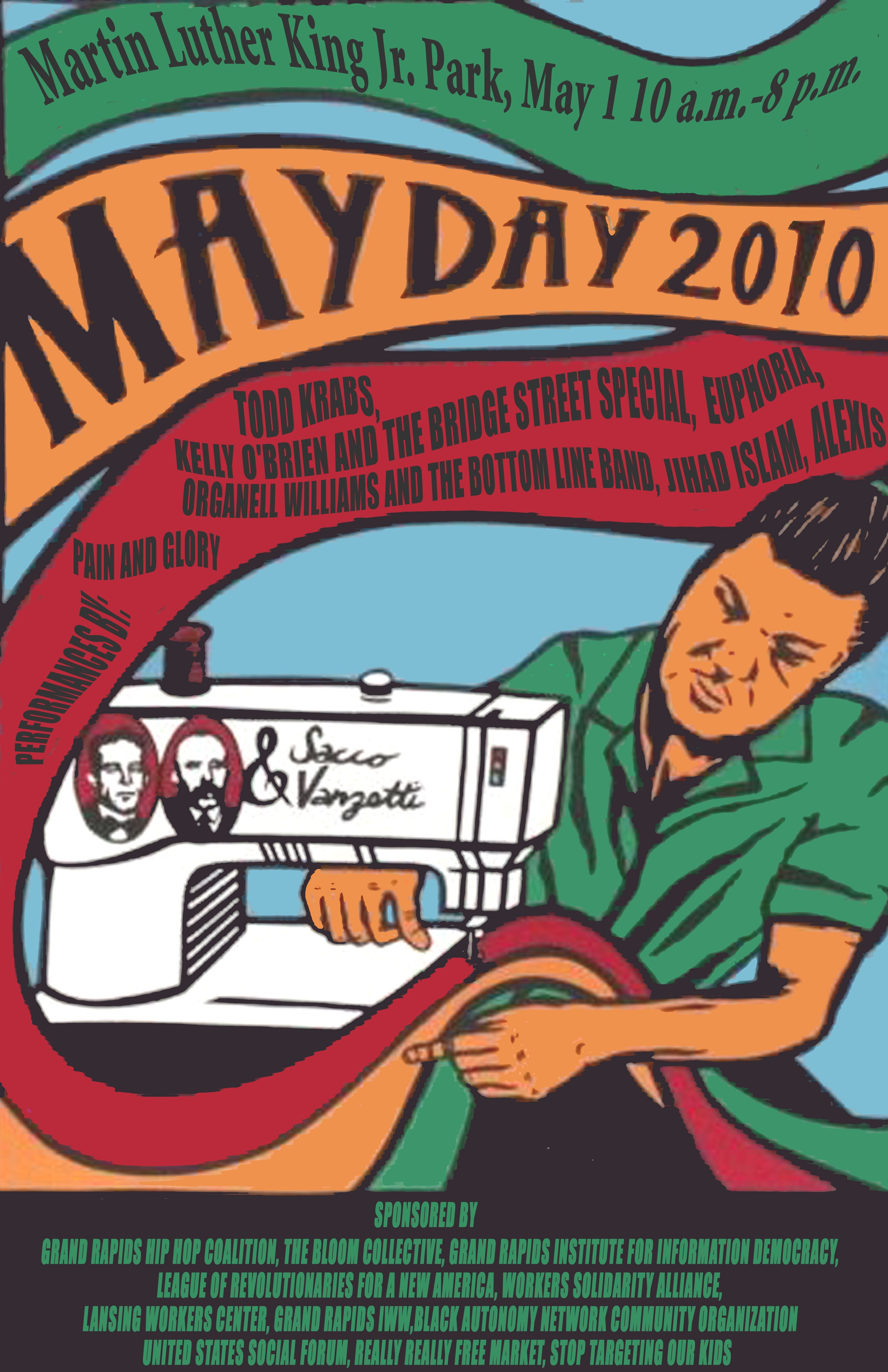
Local community organizations, labor groups and performers are coming together for MayDay 2010, a huge community event in the spirit of solidarity on Saturday May 1, 2010―the 124th anniversary of International Workers Day.
International Workers’ Day originated in 1886, when hundreds of thousands of workers across the United States went on strike. In Grand Rapids, 7,000 furniture workers of the Knights of Labor left their workplaces for an impromptu march. Workers demanded that their 10- and 12-hour work days be shortened to an 8-hour day with no reduction in pay. Over the next few years, thousands of workers won the 8-hour  workday that many take for granted today.
“In these times of layoffs and bank bail-outs working people need to regroup and realize the force for change lies among us,” said Cole Dorsey, IWW Organizer and an organizer for the event. “We want people to leave the May Day event informed and energized to take action that will benefit everyone in the working class.”
The Industrial Workers of the World (IWW) is a rank-and-file labor union open to all workers. During MayDay 2010, Grand Rapids IWW will announce plans for future organizing efforts and a local economic justice campaign.
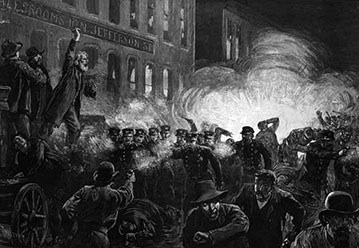 MayDay 2010 also celebrates the memory of the Haymarket Martyrs, eight labor activists framed for an explosion in Haymarket Square, Chicago, where striking workers were assembling. After a trial riddled with lies and contradictions, all eight were found guilty of the bombing. The Haymarket trial is still regarded today as one of the most grossly unjust trials in US history.
The celebration begins at 10 a.m. at Martin Luther King Jr. Park in Grand Rapids. Events include a community potluck from 11a.m. to 1 p.m. and a Really, Really Free Market, where people give and take items at no cost, from 2 to 4 p.m. Live music performances will include many genres including solo, rock, hip-hop and electronic.
The local group Stop Targeting Our Kids (STOK) will offer fun kids’ activities such as face painting, puppets, coloring and a quiet puzzle place. Speakers and resources will be available on issues such as home foreclosures, immigrant rights, workplace organizing and more.
Co-sponsors of MayDay 2010 include Grand Rapids Hip Hop Coalition, The Bloom Collective, League of Revolutionaries for a New America, STOK, Workers Solidarity Alliance, Grand Rapids Institute for Information Democracy (GRIID), Lansing Workers Center, Black Autonomy Network Community Organization (BANCO), United States Social Forum (USSF), and the Grand Rapids IWW.
Activist Enola Aird to speak in GR Saturday
Stop Targeting Our Kids (STOK) welcomes
Activist Enola Aird
of Mothers for a Human Future
Fighting the Commercialization and
Commodification of Children
5-6:30 pm, Saturday April 17, 2010
Institute for Global Education,
1118 Wealthy SE GR
(next to the Wealthy Theater)

Stop Targeting Our Kids (STOK) will host activist mother Enola G. Aird for a presentation at IGE this Saturday, April 17 from 5 to 6:30 p.m. Aird is the founder and director of Mothers for a Human Future, a new initiative focused on fighting the forces promoting the commercialization of childhood and the commodification of children.
Mothers for a Human Future is the successor to the Motherhood Project, a mothers’ campaign that convened a national symposium of mothers who worked to stem the media-generated “mommy wars” and conducted a national motherhood study that pointed to key elements of a mothers’ agenda for social change. Aird currently works to help bring mothers’ voices into the public conversation about new technologies that could fundamentally alter the genetic make-up of future human beings.
STOK member Mindy Holohan arranged for Aird’s visit “I recently returned from attending the Campaign for a Commercial Free Childhood summit in Boston,” she said. “One exciting development that grew from the trip was the opportunity to connect with activist Enola Aird who just so happened to be headed to Grand Rapids this coming weekend.”
Born in the Republic of Panama, Aird is a Phi Beta Kappa graduate of Barnard College and received her J.D.from Yale Law School. She is a member of the Steering Committee of the Campaign for a Commercial-Free Childhood and has worked for the Children’s Defense Fund as well as a variety of media organizations, including the predecessor entities of Time Warner and Viacom. She and her husband, Stephen L. Carter, are the parents of two adult children.
For information, email stokaction@gmail.com
How Your Tax Dollars Are Being Used

Every year many Americans fret over filing tax forms with the hope of getting something back. However, too often there is little information and limited discussion about how our tax dollars are being spent. Here are a few examples from various national sources for your consideration.
The War Resister’s League (WRL) every year provides a useful breakdown on how much of our tax dollars go for war and the military. “Over $1 trillion spent so far on the invasions and occupations of Iraq and Afghanistan since October 2001, with nearly half of each tax dollar going to the Pentagon and military contractors. Cities and states are closing schools, cutting services, furloughing staff. Thousands of civilians and soldiers killed with no evidence that the world is safer.”
The WRL advocates all kinds of actions around tax resistance, from education and awareness building on the matter to information on how to be a tax resister. They even provide an online “how to guide” for those wanting to challenge paying war taxes.
The group Jobs with Justice also has a Tax Day message, which is focused on the amount of your tax dollars that have gone to bailout Wall Street Banks.
“For 30 years, corporate CEOs and Wall Street speculators have put the squeeze on workers with globalization, privatization and union-busting.

They used their rising profits to buy Congress, convincing them to hand out tax breaks to the rich and gut banking regulations and consumer protections. Then they invented unscrupulous mortgage and investing practices, turning our financial system into a casino. When their speculation didn’t pay off, they got Congress to bail them out to the tune of $15,000 for every household in America.
A tax on the speculators of the Wall Street casino could put 3 million people to work fixing our infrastructure, teaching our children, making our factories more sustainable and improving our public services.”
One additional group that is organizing around tax day and tax issues is Reform Immigration For America. They are advocating that if the US reformed its immigration policy the US could be generating more tax dollars for important social services.
“A report from the Immigration Policy Center and the Center for American Progress found that legalization of undocumented immigrants would generate between $4.5 billion and $5.4 billion in tax revenues over three years.”
That’s $1,650,000,000 every year
It’s $4,517,453.80 every day
It’s $188,227 every hour
It’s $52.29 every second, that we could be generating in tax income. That money could fund infrastructure and public services – but until Congress acts, we’ll be leaving money on the table that could help our communities.
One action they are encouraging people to take is to send a blank tax form to Congress to show what kind of impact immigrants could have on the economy.
At noon today, Dr. Joia Mukherjee, medical director of Partners in Health (PIH), spoke to staff at Spectrum Health on their work in Haiti. Dr. Joia said that in all of her years of doing this work, nothing has taught her more about social justice than her work in Haiti.

Before she talks about what has happened since the earthquake she felt it was important to talk about Haiti’s history. Dr. Joia felt it was important to provide a context for the current situation in Haiti, unlike how most news agencies have reported since the January 12 earthquake.
Dr. Mukherjee said that 1 in 10 people affected by the catastrophe died immediately after the cataclysm. Then the punch line was, “from the slave trade.” To illustrate the importance of Haitian history, Dr. Joia that “Haiti would not be what it is without the trans-Atlantic slave trade. Haiti is a country really born out of slavery, the first country to end slavery and the only country to be founded out of a slave rebellion.”
The response to the Haitian revolution from the US was an embargo by the Jefferson administration. “Why is this relevant?” asks Dr. Joia. “If we look at what happened in Chile, where the earthquake was bigger, fewer people died. So we have to ask ourselves why more Haitians died?” The doctor stated it is because of the history of exploitation of Haiti by various imperial powers, which has created more systemic poverty and a failing infrastructure.
Haiti has become increasingly an urbanized country, in part because US grains have flooded the country making it difficult for Haitian farmers to make a living off the sale of their crops. More people crowded into urban centers increased the chances of people dying during the earthquake. According to Dr. Joia, the number of dead was 250,000 and an additional 300,000 injured. Again this is due to the failed infrastructure in Haiti, particularly with inadequate housing and government buildings.
PIH relies a great deal on using and training local health care workers. Their approach to health care is a systems approach and everyone of their staff in Haiti are Haitians. When the earthquake hit they PIH staff immediately went to the communities to determine what they would do. But the hard question facing them was “how does a human rights and health organization respond to the needs of disaster relief?”
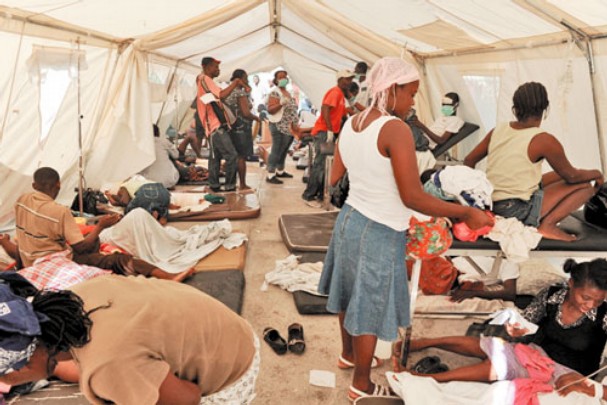
PIH has historically focused a great deal of attention around doing work and seeking funding to support HIV treatment and prevention. When they first started clinics around HIV/AIDS work they were successful because they eliminated any fees at the clinic, but the other thing they did was to pay the staff. For PIH health care is a right. The third thing they did was to provide free medicines and the fourth thing was to send health care workers into the community who couldn’t come to the clinic. “The key here,” according to Dr. Joia, “was that this whole approach was not about a building, rather it was about the people.”
During the relief work they always insisted on a fully integrated medical team with Haitians and outside volunteers, instead of just allowing foreign volunteers to work separately. “We believe that this will have lasting impact because of these kinds of partnerships so that Haitians can build their capacity for responding to these kinds of problems in the future.”
Dr. Joia sees the possibilities of increased funding for Haiti as an opportunity to focus on long-term infrastructure improvement instead of funding as a response to the disaster work where money gets channeled to NGOs who are generally not engaged in the Haitian communities. In contrast, PIH hired hundreds of Haitians to go into the communities to find the sick and wounded, do some assessments and then bring them to the health care facilities they operate. At present they see about 1,000 people per day in the clinics.
A few other areas of interest that PIH focuses on are rehabilitation and mental health care. These are issues that generally get ignored in the top-down approach to medical care, especially since the earthquake.
The last thing they do is to do promotional work to stop a brain drain of Haitian doctors, so PIH promotes the amazing work done by Haitians to show that Haitians are really the ones doing the important work.
The ongoing challenges of the earthquake will be the resettlement of 2 – 3 million refugees, needs for all kinds of shelter/housing and ongoing medical support as the immediacy of the earthquake is less in the news now.
In her critique of many of the mainstream and US-based NGOs Dr. Joia said that many of the groups that have raised a ton of money “because they have sophisticated media machines. They don’t care if people spoke Creole or not.” She even says that there is graffiti in some parts of the country that says “down with NGO thieves.” NGOs have lots of vehicles, lots of bosses and less staff on the group. Dr. Joia said that 46% of the US money went to the US military and the bulk of the rest went to US NGOs, which have a large overhead.
We asked her about Naomi Klein’s critique that the earthquake is another example of the Shock Doctrine, where more of Haiti’s basic services are being privatized. She agreed with Klein’s analysis and said that PIH wants to do the work to empower the local communities and the government in order to prevent or minimize the push to privatize Haitian services.
Dr. Joia’s presentation was passionate and impressive. It’s too bad that the local news media was not present to share this analysis with the broader West Michigan community.
Last night a small group of people gathered in the Wayland High School auditorium to hear Megan Quinn Bachman speak. Bachman, who is with Community Solutions, was invited to town by the Michigan-based organization Local Future.

The speaker begins by talking about the fact that we are at a critical crossroads in human history, which we have been before. She gives the example of Easter Island, where massive deforestation occurred, which anthropologists believe led to the destruction of the people on that island. The only thing different now Bachman said, is that the Island is our whole planet.
People too often think that there is a technological fix, but more and more we are realizing that technology cannot save us from the ecological crises that we face. Bachman shows a slide called the Energy Curve of History, where in the US we went from use of wood to coal to petroleum. This energy curve also demonstrated that humans have only experienced major energy consumption in the past 150 years or so, ever since the beginning of the industrial revolution.
What the energy curve also shows is that humans could do more with fossil fuels than with human labor or human energy. For example one gallon of gas is equal to six weeks of human labor. Bachman also had the statistic which stated that US daily oil use is equal to 20,000,000 years of human labor.
She provided a few more statistics, like 93% of the energy we use now will be in decline in the next 25 years. Megan argues that peak oil is now, where demand has exceeded new oil discovery and production. In fact, 64 of the 98 oil-producing Nations are in decline.
So where are we going?
Bachman laid out some scenarios about what will happen in the future as a result of the energy crisis and the massive ecological destruction. These scenarios were an immediate crash, which would be the result of no fundamental change to what we are doing now. Another scenario is what she called the techno fantasy scenario, where we all believe that technology will save us.
A third scenario she identified is called the green tech stability scenario. In this scenario we rely heavily on bio-fuels and other green technology, but don’t make many fundamental changes to our levels of consumption. This third scenario is sort of what the Green Capitalists would like us to embrace, where we can just buy “green” products. The last scenario Bachman offered up is what she called creative descent, where we make significant changes to our consumption patterns, rely mostly on renewable energy and focus on building sustainable, localized communities.

Bachman said this last scenario, creative decent, is the direction that her organization advocates. It’s what Community Solutions calls Plan C. Plan C calls for conservation & curtailment of resource use, along with cultural and lifestyle changes. Bachman said that in a Plan C model, people don’t relying on government and the business community to make the change that is necessary.
One model that fits with Plan C was what Cuba did after the collapse of the Soviet Union, which meant a major loss of oil. She said the government provided some assistance, but urban communities started localized food systems. What was impressive about the Cuban model was their ability to maintain a good standard of living. About 90% of Havana’s vegetables come from the City and 80% of the production is organic. The Cuban model impressed Bachman so much that she and others from Community Solutions produced a documentary called The Power of Community: How Cuba Survived Peak Oil.
What do we need to do?
Bachman said change starts with us and that we all need to take steps to a sustainable life. These steps include a reduction in our purchases, purchasing more local, conservation measures, gardening, organic purchasing, walking/biking, reducing debt, diet change, preventative health, more efficient car, store emergency supplies, learn survival skills, use bartering, get a CSA membership, use mass transit, share a car or get rid of your car, and retrofit our homes to be energy efficient.
Bachman said that in her research there has also been more career/job shifts, where new farmers is the fasting growing sector, followed by activism, teaching and small micro-businesses. She also said that there are barriers to change. Her research showed that people have a hard time driving less, changing their diet and that habits & family practices are hard to overcome. However, Bachman said we can live a better life, which is why many people are motivated to make a change. People have expressed to her that learning new skills, having better relationships, and cooperating with people are motivating factors to change.
Bachman also said we need community level strategies, particularly around food and energy. She said in order to be sustainable we need to be producing what we consume. This is important because it requires us to move from an abstract to a real economy, where we are able to see what is actually happening. Real wealth, Bachman said, is the community, when we rely on each other. Monetary reform is one tactic to use, where we can create our own wealth systems and take our money out of commercial banks. There are state banks that are being proposed around the country and one that is operating in North Dakota.
Bachman ended her presentation with a quote from Buckminster Fuller, which said – “don’t fight the existing reality, build a new model.” While it is extremely important to build new models for living, it seems that we can’t ignore the systems of power that are perpetuating the massive ecological destruction around the world. It seems that resisting this destruction is necessary at the same time that we build new models of living.
Media Bites – Monsanto’s Roundup
In this week’s Media Bites we take a look at a new commercial for Monsanto’s weed killer Roundup. The seasonal commercial uses an old theme in ads where nature must be conquered. However, the biggest problem in the commercial is what they don’t tell you, which is the ecological and human health consequences of the use of this herbicide.
 Grand Rapids Institute for Information Democracy