40 Years of Earth Days
(This article by Brian Tokar is re-posted from ZNet.)

The 40th anniversary of the original Earth Day is upon us, and many seasoned environmentalists are nostalgic for the heady days of the 1970s, when 20 million people hit in the streets and eventually got Richard Nixon to sign a series of ambitious environmental laws. Those laws managed to clean up waterways that were turning into sewers, saved the bald eagle from the ravages of DDT, and began to clear the air, which in the early 1960s was so polluted that people were passing out all over our cities.
While environmental awareness has clearly seeped into mainstream consciousness in the US, today’s environmental movement is floundering, even though the stakes are higher than ever. While grassroots campaigners continue to fight for endangered forests, challenge polluting companies in their communities, and confront the coal industry’s assaults on the mountains of southern Appalachia, the best known national organizations can point to precious few substantive victories of late. Most appallingly, they have utterly failed to demonstrate meaningful leadership around what climatologist James Hansen calls the “predominant moral issue of this century,” the struggle to prevent the catastrophic and irreversible warming of the planet.
As British journalist Johann Hari reported in The Nation back in March, this is partly the result of a legacy of collaboration between increasingly corporate-styled environmental NGOs and the world’s most polluting corporations.
In response to the climate crisis, we are seeing unprecedented collaboration between large environmental organizations and corporations seeking to profit from new environmental legislation. The notorious Climate Action Partnership (known as USCAP) has brought Alcoa, DuPont, General Electric and General Motors together with the Natural Resources Defense Council, the Environmental Defense Fund and the Nature Conservancy to push for the “market-based” approach to climate legislation known as “cap-and-trade.” This would create a vast, highly speculative market in carbon credits and offsets, with gigantic perks for corporations and little benefit for the planet. The push for cap-and-trade legislation has receded for now under pressure from both right wing anti-tax fanatics and market-skeptical environmentalists, but Washington observers anticipate that an even worse climate bill will be announced later this month by Senators Kerry, Lieberman and Graham, and laden with far more blatant giveaways to the fossil fuel and nuclear industries.
Where has the environmental movement gone wrong? To better understand this, it’s helpful to take a brief journey back to the time of the original Earth Day. Where did Earth Day come from, and how did all those 1970s environmental laws actually come to be enacted?
The First Earth Day
It turns out that the original Earth Day on April 22, 1970, was initially a staged event. Politicians like Sen. Gaylord Nelson of Wisconsin and Rep. Pete McCloskey (Republican of California) took the lead in crafting the first Earth Day celebration that unexpectedly brought millions of people out into communities around the country. The events were supported by establishment institutions such as the Conservation Foundation, a corporate think-tank founded by Laurance Rockefeller in 1948. Nixon even began the year with a presidential proclamation saying that the 1970s would be the “environmental decade.”
Many anti-Vietnam war activists came to view Earth Day (originally the Environmental Teach-In) as a devious attempt to divert national attention away from the war, from the antiwar movement’s planned Spring Offensive, and from efforts to raise awareness of the common causes of war, poverty and environmental destruction. An editorial in Ramparts, the most prominent dissident magazine of the period, described Earth Day as, “the first step in a con game that will do little more than abuse the environment even further.”
The April 1970 Ramparts featured a striking exposé on “The Eco-Establishment,” which focused on the corporate think-tanks that were helping to shape the era’s emerging environmental legislation. “[T]oday’s big business conservation,” Ramparts editorialized, “is not interested in preserving the earth; it is rationally reorganizing for a more efficient rape of resources … and the production of an ever grosser national product.” They continued:
“The seeming contradictions are mind-boggling: industry is combating waste so it can afford to waste more; it is planning to produce more (smog-controlled) private autos to crowd more highways, which means even more advertising to create more “needs” to be met by planned obsolescence. Socially, the result is disastrous. Ecologically, it could be the end.”
Journalist I.F. Stone wrote in his famous investigative weekly, “[J]ust as the Caesers once used bread and circuses so ours were at last learning to use rock-and-roll idealism and non-inflammatory social issues to turn the youth off from more urgent concerns which might really threaten the power structure. … [W]e may wake up one morning and find there is nothing left on Earth to pollute.”
To everyone’s surprise, Earth Day turned out to be the largest outpouring of public sentiment on any political issue to date. It drew public attention to environmentalism as a social movement in its own right, perhaps for the first time. And it set the stage to pressure Congress to pass 15 major national environmental laws over a 10-year period, including the Clean Air and Clean Water Acts, the Safe Drinking Water Act, the Endangered Species Act, Toxic Substances Control Act and the establishment of the U.S. Environmental Protection Agency (EPA).
Environmental Regulation: The Back-story
The origin of those 1970s environmental laws also has an underappreciated back-story. Throughout the 1960s, people were responding with horror to the increasingly visible effects of smog, oil spills, pesticide contamination and other environmental assaults. Cities and states responded by implementing their own, sometimes far-reaching programs of environmental monitoring and enforcement. Creative environmental lawsuits established important and unanticipated precedents, extending the right of citizens to sue to protect ecological values and furthering judicial review of the actions of government agencies.
This proved costly for business, and corporate interests came to view federal intervention as a possible solution. “[T]he elite of business leadership,” reported Fortune magazine on the eve of Earth Day in 1970, “strongly desire the federal government to step in, set the standards, regulate all activities pertaining to the environment, and help finance the job with tax incentives.”
Far from an interference with business prerogatives, environmental regulation by the federal government became a way to allay public concerns while offering corporate America a menu of uniform and predictable environmental rules. The laws passed in the aftermath of Earth Day helped fund essential public works projects, such as the construction of sewage treatment plants, and offered protections for public health and biodiversity, but also routinized and standardized the permitting of most industrial facilities. Most important, federal rules often pre-empted states and localities from enforcing regulations more stringent than those advanced at the national level; this core principle of federal pre-emption has again reared its head in today’s Congressional debate over climate legislation.
Just a decade later, Ronald Reagan packed the new regulatory agencies’ staffs with corporate hacks who were openly hostile to their agencies’ missions. (George W. Bush replicated this strategy with a vengeance in the early 2000s.) Reagan’s first EPA administrator resigned after two years in office, facing charges of contempt of Congress, after replacing the agency’s senior staff with officials from companies like General Motors and Exxon, and mercilessly slashing the budget. Reagan’s cartoonish Secretary of the Interior, James Watt, spoke publicly of Armageddon and the need to exploit as much land as possible before its coming. Watt’s policies, according to former New York Times reporter Philip Shabecoff, “introduced policies aimed at transferring control of public lands and resources to private entrepreneurs at a rate that had not been seen since the great giveaways of the nineteenth century.”
The Environmental Status-quo
Meanwhile, throughout the 1970s and eighties, representatives of the largest national environmental groups became an increasingly visible and entrenched part of the Washington political scene. As the appearance of success within the system grew, organizations from the National Wildlife Federation to the Natural Resources Defense Council restructured and changed personnel so as to more effectively play the insider game. The environmental movement became a stepping stone in the careers of a new generation of Washington lawyers and lobbyists, and official environmentalism came to accept the role long established for other regulatory advocates: that of helping to sustain the smooth functioning of the system. Environmentalism had been redefined, in the words of author and historian Robert Gottlieb as “a kind of interest group politics tied to the maintenance of the environmental policy system.”
This shift in the character of the most nationally visible environmental groups spelled the end of bold new policy initiatives on behalf of the environment. An environmental mainstream adapted to “insider” politics proved incapable of sustaining even a moderate Congressional consensus in favor of environmental protection, and ultimately helped prepare the stage for the anti-environmental backlash of the 1980s and beyond. The largest environmental groups launched direct mail appeals that brought in vast new funds, reflecting people’s outrage against the Reagan administration’s anti-environmentalism. Ironically, the success of these appeals pushed many groups further toward a conspicuously top-down, corporate-style structure. Those advocating a more corporate style invariably won internal battles within the Sierra Club, Friends of the Earth and even Greenpeace. They increasingly avoided issues and tactics that might prove alienating to wealthy donors.
The Sierra Club grew from 80,000 to 630,000 members during the 1980s, and the conservative National Wildlife Federation reported membership gains of up to 8,000 a month, totaling nearly a million.The World Wildlife Fund, later notorious for its efforts to establish national parks on the U.S. model in Africa and LatinAmerica, grew almost tenfold. The total budget of the ten largest environmental groups grew from less than $10 million in 1965, to $218 million in 1985 and $514 million in 1990. By the early 1990s, even the thoroughly mainstream former editor of Audubon magazine would lament that “naturalists have been replaced by ecocrats who are more comfortable on Capitol Hill than in the woods, fields, meadows, mountains and swamps.”
Environmental groups also began their flirtation with corporate sponsorships, so aptly summarized by Johann Hari in The Nation. In the lead-up to the twentieth anniversary of Earth Day in 1990, activists (including this author) began closely investigating those ties, and revealed links between groups such as the National Wildlife Federation, Sierra Club, and the Wilderness Society, and a rogue’s gallery of major oil, chemical, utility, and banking corporations. The Multinational Monitor explored links between environmental organizations’ directorships and corporate boards, university researchers scrutinized the big environmental groups’ stock portfolios, and others explored the even more nefarious ties that tainted the world of “progressive” foundations.
From Corporate Environmentalism to Green Consumerism
By 1990, everyone seemed to want to be an environmentalist. President George Bush, Sr. proclaimed himself a defender of the environment, and briefly aimed to distance himself from the anti-environmental excesses of the Reagan years by adopting the first national cap-and-trade system to address the problem of acid rain. Senator Al Gore, the 1988 presidential primary campaign’s leading Democratic war hawk, began speaking out about global warming and other environmental threats. Britain’s reactionary Prime Minister Margaret Thatcher called herself a “green.” Even the president of the World Bank won praise from environmental publications for voicing concerns about the Bank’s role in environmental destruction. The Environmental Defense Fund led the way in pushing for a more aggressively “market-oriented” approach to environmental policy.
So it was not a huge surprise when the celebrations of the twentieth anniversary of Earth Day in 1990 became the coming-out party for a more overtly corporate brand of environmentalism. Earth Day celebrations became a virtual extravaganza of corporate hype, and “green consumerism” was the order of the day. The official overriding message was simply, “change your lifestyle,” by recycling, driving less, and buying green products. And while the national Earth Day organization turned down some $4 million in corporate donations that didn’t even meet their rather flexible criteria, celebrations in several major U.S. cities were supported by notorious polluters such as Monsanto, Peabody Coal and Georgia Power. Everyone from the nuclear power industry to the Chemical Manufacturer’s Association purchased full-page advertisements in newspapers and magazines proclaiming that, for them, “Every day is Earth Day.” The now-familiar greenwashing of Earth Day had begun.
Some activists responded by organizing more politically challenging local Earth Day anniversaries of their own, focusing on local environmental struggles, urban issues, the nature of corporate power and a host of other problems that were systematically excluded from most official Earth Day events. Left Greens and Youth Greens in the Northeast initiated a call to shut down Wall Street the Monday following Earth Day, and were joined by environmental justice activists, Earth First! organizers, ecofeminists, New York City squatters and many others. In the early morning of April 23, just after millions had participated in polite, feel-good Earth Day commemorations all across the country, hundreds converged on the New York Stock Exchange, with the goal of obstructing the opening of trading on that day.
Juan Gonzalez, in his New York Daily News column, decried the weekend’s “embalming and fire sale of Earth Day,” and told his 1.2 million readers, “Certainly, those who sought to co-opt Earth Day into a media and marketing extravaganza, to make the public feel good while obscuring the corporate root of the Earth’s pollution almost succeeded. It took angry Americans from places like Maine and Vermont to come to Wall Street on a workday and point the blame where it belongs.”
The 1990 Earth Day Wall Street Action reflected the flowering of grassroots environmental activity that had emerged throughout the 1980s, partly in response to the compromises of the big environmental groups. The popular response to toxic chemical pollution — launched by the mothers of sick children living near the severely polluted Love Canal in upstate New York — grew into a nationwide environmental justice movement that exposed the disproportionate exposure of communities of color to toxic hazards. Earth First! grew as a decentralized network of grassroots forest defenders, using theatrical direct action, combined with acts of industrial sabotage, to stem the tide of forest destruction. Others joined in solidarity with indigenous peoples’ movements around the world that had arisen in defense of traditional lands, responding to the new onslaught of neoliberal development policies. During the lead-up to Earth Day 1990, a hundred environmental justice activists signed a letter to the eight largest national environmental organizations challenging the dearth of people of color on those groups’ staffs and boards, along with their increasing reliance on corporate funding.
The Clinton-Gore administration of the 1990s perfected the art of channeling environmental rhetoric while simultaneously encouraging increased resource extraction — prefiguring Barack Obama’s recent overtures to the nuclear, oil and coal industries.
As the decade ended, environmental activists made a strong showing in Seattle, as a key part of the broader coalition of social justice, labor and green groups that successfully challenged the World Trade Organization. But the Bush years that followed were a time of increasingly frustrating defensive battles. While many of the grassroots initiatives of the 1980s and nineties continued (see Douglas Bevington’s new book, The Rebirth of Environmentalism), others felt dismayed by the ineffectiveness of large environmental groups. This led to the continued evolution of Earth First! and other radical formations. By the late 1990s, groups like the Earth Liberation Front shifted toward more secretive and aggressive types of property destruction and sabotage in defense of nature. In 2006, the FBI declared “environmental terrorists” to be the top domestic security threat, even though no one had been harmed in any of their actions. The so-called “green scare” of the Bush years eventually landed at least 16 eco-militants and animal rights activists in federal prison, replete with “terrorism enhancements” to their sentences, as a consequence of the notorious “Patriot Act.” Also in the early 2000s, renewed grassroots campaigns aimed to reclaim urban spaces and challenge the genetic engineering of food, among many other new issues.
Over the last few years, it appeared that the climate crisis might be ushering in a renewed wave of grassroots environmental action in the United States. A 2009 student environmental conference attracted some 3000 participants to Washington, D.C., and the event was followed by a symbolic blockade of the city’s large coal-fired power plant. On the tenth anniversary of the WTO protests in Seattle on November 30, 2009, climate justice actions across the US included the lock-down of an intersection outside the Chicago Climate Exchange (home of the corporate-driven “voluntary” carbon market), a blockade of a major component for a new coal-fired power plant in South Carolina, protests of large banks that finance the coal industry and other mega-polluters, and a rally outside the Natural Resources Defense Council’s offices to protest their aggressive advocacy for carbon markets. People in West Virginia and across southern Appalachia have stepped up resistance to the ravages of mountaintop removal coal mining, while others across the country — from Vermont to the Navajo Reservation — have redoubled their efforts against Obama’s planned expansion of the nuclear industry.
Most of 2009’s climate actions, however, were aimed at trying to press national governments to reach a comprehensive agreement at the December UN climate conference in Copenhagen. The failure of diplomacy in Copenhagen deflated the energy of many activists, and the post-Copenhagen resurgence of climate actions has yet to materialize. Meanwhile, although Earth Day has become an annual ritual in some communities, as well as on many college campuses, the fortieth anniversary has brought a notable scarcity of attention.
One event this year, though, highlights how quickly corporate environmentalism has evolved from tragedy to farce. This gala event, held on April 21st in Washington, DC, was hosted by a group called the Carbon War Room, a rather exclusive alliance of elite environmentalists and financiers, headed by the notorious multibillionaire Richard Branson of the Virgin Group. Branson is most celebrated these days for his experimental biofueled airplanes, along with a venture to promote outer space tourism and public advocacy for geoengineering the climate. For only $450 (a third less for nonprofits), participants could have dinner with Branson, EPA Administrator Lisa Jackson, and founding Earth Day organizer Denis Hayes at the new Ronald Reagan International Trade Center, just around the corner from the White House.
Meanwhile, the green marketing of products is alive and well, from clothing, to Priuses, to luxury ecotourism. The UK’s Guardian newspaper reported from a “green business” conference in London last year that “as much as 70 percent of future advertising would have an environmental focus.” They quoted a leading British supermarket executive questioning environmental limitations on consumer desires, arguing that such an approach simply “fails to see the enormous potential of consumers.” Another Guardian story reported on a Dutch study of consumer behavior, suggesting that ethical consumer choices are made chiefly for the added social status they confer. “Researchers found consumers are willing to sacrifice luxury and performance,” for example by buying a Prius instead of a Hummer, “to benefit from the perceived social status that comes from buying a product with a reduced environmental impact,” they reported.
Today, right-wing pundits depict environmentalism as an elite hobby that threatens jobs, while many progressive environmentalists cite the potential for “green jobs” to help reignite economic growth. Both views are sorely missing a central element of what has made environmentalism such a compelling counter-hegemonic worldview ever since the 1970s: the promise that reorienting societies toward a renewed harmony with nature can help spur a revolutionary transformation of our world.
This outlook has helped inspire anti-nuclear activists to sit in at power plant construction sites, forest activists to sustain long-term tree-sits, and environmental justice activists to stand firm in defense of their communities. People around the world are acting in solidarity with indigenous peoples fighting resource extraction on their lands. With climate chaos looming on the horizon, such a transformation is no longer optional. Our very survival now depends on our ability to renounce the status-quo and create a more humane and ecologically balanced way of life.
Bolivian President Blames Capitalism for Global Warming
(This article is re-posted from Common Dreams.)
Bolivian President Evo Morales said capitalism is to blame for global warming and the accelerated deterioration of the planetary ecosystem in a speech today opening an international conference on climate change and the “rights of Mother Earth.”
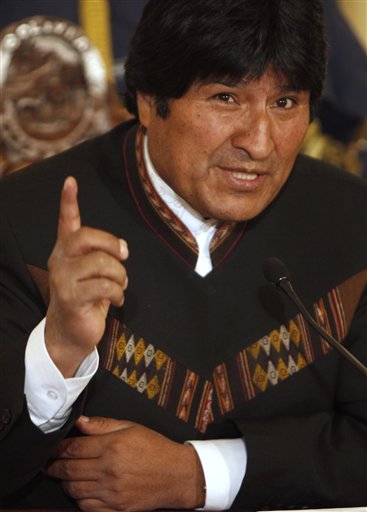
More than 20,000 indigenous, environmental and civil society delegates from 129 countries were in attendance as President Morales welcomed them to the conference at a soccer stadium in the village of Tiquipaya on the outskirts of the city of Cochabamba.
“The main cause of the destruction of the planet Earth is capitalism and in the towns where we have lived, where we respected this Mother Earth, we all have the ethics and the moral right to say here that the central enemy of Mother Earth is capitalism,” said Morales, who is Bolivia’s first fully indigenous head of state in the 470 years since the Spanish invasion.
Morales is the leader of a political party called Movimiento al Socialismo, the Movement for Socialism, which aims to give more power to the country’s indigenous and poor communities by means of land reforms and redistribution of wealth from natural resources such as gas.
“The capitalist system looks to obtain the maximum possible gain, promoting unlimited growth on a finite planet,” said Morales. “Capitalism is the source of asymmetries and imbalance in the world.”
The Bolivian president called this conference in the wake of what he considered to be failed United Nations climate negotiations in Copenhagen in December.
Those talks produced a weak political agreement, the Copenhagen Accord, instead of a strong, legally-binding set of limits on greenhouse gas emissions to take effect at the end of 2012, as Bolivia and many other countries had hoped.
Named “World Hero of Mother Earth” by the United Nations General Assembly last October, today, President Morales warned of dire consequences if a strong legally-binding agreement to limit greenhouse gas emissions is not reached.
A new agreement is needed to govern greenhouse gas emissions after the first commitment period of the Kyoto Protocol expires at the end of 2012. This year’s round of international negotiations towards an agreement began earlier this month in Bonn, Germany, and the next annual United Nations climate conference is scheduled for Cancun, Mexico from November 29.
“Global food production will be reduced by approximately 40 percent and that will increase the number of hungry people in the world, which already exceeds a billion people,” Morales warned. “Between 20 and 30 percent of all animal and plant species could disappear.”
Global warming will cause the melting of the polar ice caps and the glaciers of the Andes and the Himalayas, and several islands will disappear under the ocean,” he warned.
The convocation this morning included a multi-cultural blessing ceremony by indigenous peoples from across the Americas. Speeches by representatives of social movements from five continents focused on the urgency of the climate crisis and the need for bold action that protects both human rights and the environment.
The delegates are meeting in working group sessions this week to develop strategies and make policy proposals on issues such as forests, water, climate debt, and finance.
President Morales has pledged to bring these strategies and proposals to the UN climate conference in Cancun.

“We have traveled to Bolivia because President Morales has committed to bring our voices to the global stage at the next round of talks in Cancun,” said Jihan Gearon of the Navajo Nation in Arizona, who is a native energy organizer with the Indigenous Environmental Network.
“Indigenous rights and knowledge are crucial to addressing climate change, but the United States and Canada have not signed on to the UN Declaration on the Rights of Indigenous Peoples, and are pushing corporate climate policy agendas that threaten our homelands and livelihoods,” Gearon said.
“President Morales has asked our recommendations on issues such as REDDs [Reducing Emissions from Deforestation and Degradation],” said Alberto Saldamando, legal counsel for the International Indian Treaty Council.
“REDD is branded as a friendly forest conservation program, yet it is backed by big polluters,” Saldamando said. “REDD is a dangerous distraction from the root issue of fossil fuel pollution, and could mean disaster for forest-dependent indigenous peoples the world over.”
“We are here from the far north to stand in solidarity with our brothers and sisters of the South,” said Faith Gemmill, executive director of Resisting Environmental Destruction on Indigenous Lands (REDOIL), who spoke from the stage at the invitation of President Morales. “We have a choice as human kind – a path of life, or a path of destruction. The people who can change the world are here!”
Memo to America: Stop Murdering My People
(This article is re-posted from ZNet.)
Amid increasing civilian deaths and resurgent warlordism, Afghan women’s leader Malalai Joya writes that Hamid Karzai and the U.S. are losing credibility in Afghanistan day by day.

Almost every day, the NATO occupation of our country continues to kill innocent people. Each time, it seems, military officials try to claim that only insurgents are killed, or they completely deny and cover up their crimes. The work of a few courageous journalists is the only thing that brings some of these atrocities to light.
For instance, it was only after the reporting of Jerome Starkey of the Times of London that officials admitted to the brutal Feb. 12 murder of two pregnant women, a teenage girl, and several young men in a night raid at a home where a family was celebrating the birth of a child.
Night raids, air raid “mistakes,” firing on civilian buses and cars at checkpoints—the occupation finds many ways of killing the people of Afghanistan. The excuses and lies for these deaths are like salt in our wounds, and it is no wonder that protests against the U.S. military are growing. The Afghan people have had enough.
In recent weeks, there has been much talk about Hamid Karzai’s threats to join the Taliban and about his supposed differences with the American government. But for Afghans, Karzai long ago lost all credibility. The joke among our people is that Karzai doesn’t do or say anything without consulting the White House first. No amount of nationalistic rhetoric or demagoguery on his part will change this perception.
Everyone in Afghanistan knows that Karzai was placed into power with the backing of the United States and its allies, and to this day he relies on their support. His regime would not last a day without it. And Afghans know too well the reality of his corrupt government: It has delivered nothing to the country’s poor other than sorrow and destitution, while filling the pockets of drug traffickers, warlords, and its own corrupt officials.
Afghanistan has had puppet leaders before, rulers who served only the interests of foreign occupiers, whether British or Soviet. But Karzai may be the most hated puppet in our history; he has empowered some of the most brutal internal enemies of ordinary Afghans, warlords of the Northern Alliance like Sayyaf, Dr. Abdullah, Rabbani, Mohaqiq, Ismael Kahn, Dostum and many others. Even his two vice presidents, Fahim Qasim and Karim Khalili, are notorious fundamentalist warlords. The president’s brother in Kandahar, Ahmed Wali Karzai, is another thug in power whose links to the drug trade and the CIA have been widely reported.
Karzai made headlines by threatening to “join the Taliban,” but the reality is that for more than eight years he has had no problem working with fundamentalists who are the ideological brothers of the anti-women Taliban. In fact, Karzai himself used to support the Taliban when he was a minor tribal leader in Kandahar in the 1990s, and for years he has been negotiating to bring Taliban leaders into his puppet regime. Some of them are already serving in his regime, and the U.S. government has been encouraging these negotiations by creating the false categories of “moderate” and “extremist” Taliban.
He has also been reaching out to that most brutal warlord and criminal, Gulbuddin Hekmatyar, a mujahideen leader known for killing civilians and currently designated a terrorist by the U.S. government. Karzai recently appointed Abdul Hadi Arghandewal, an infamous leader of Hekmatyar’s party, as his minister in charge of the economy. These negotiations and flexible alliances by Karzai and the U.S. government are nothing new. For three decades, the U.S. has backed these criminals: Hekmatyar, al Qaeda and other fundamentalists in the 1980s, the Taliban in the 1990s, and now Karzai and his warlord allies.

Progressive-minded Afghans want to break out of this circle of warlordism once and for all. It is ironic that Karzai talks about the possibility that a “national resistance” could develop in Afghanistan. He should know that the prime target of such a movement will be his own regime and its foreign supporters.
Our people are deeply fed up. They have organized many anti-U.S. protests in the past months and if the occupation continues, the resistance will only grow. More than eight years of occupation have made life bleak, and we are tired of being pawns in the U.S. and NATO’s game for control of Central Asia.
We can no longer bear the killing of our pregnant mothers, the killing of our teenagers and young children, the killing of so many Afghan men and women. We can no longer bear these “accidents” and these “apologies” for the deaths of the innocent.
We salute the anti-war movements in the NATO countries. Here, we will struggle to our last breath to stop this war that is tearing apart our beloved Afghanistan.
Malalai Joya, now 31, was the youngest member of the Afghan parliament, elected in 2005. In 2007 she was suspended from parliament because of her consistent criticism of the warlords and other human-rights abusers in the Karzai regime. Joya has survived five assassination attempts to date, and has written her life story in the book A Woman Among Warlords (with Derrick O’Keefe, Scribner, 2009). She writes from Kabul, Afghanistan.
Revitalization vs Gentrification in the Heartside area
Yesterday I attended a forum to discuss the issue of whether or not the revitalization of the Heartside district of downtown Grand Rapids has led to any gentrification.
The forum was hosted by the Grand Rapids Community Foundation and was attended by a variety of people in the community, including business owners, downtown property owners, politicians, political candidates, non-profit directors, representatives from the faith community and a few residents from the downtown area.
The event was promoted as Knotty Cocktails, which was meant to reflect the tension that such a topic might lend itself to. However, there were also cocktails, so people had the opportunity to have a drink and enjoy some of the finger foods provided.
Laurie Craft, with the Grand Rapids Community Foundation (GRCF), moderated the discussion. However, the GRCF decided upfront to have two people from Dwelling Place provide some background and analysis of the evolution of Heartside before any dialogue could take place. Jen Schaub, a staff member of Dwelling Place and a resident of Heartside, joined Denny Sturtevant, the CEO of Dwelling Place.
Both Schaub and Sturtevant addressed some of the history of the area, tensions between new development and long-term residents, and how land is used in the Heartside area. In fact, Dwelling Place was founded 30 years ago with the intent of trying to provide basic housing services to people who were poor, homeless or recently de-institutionalized.
Eventually a few questions were asked around issues of defining a healthy neighborhood, diversity, affordable housing and why there wasn’t a viable grocery store in the Heartside area. Sturtevant said that Dwelling Place did open and operate a grocery store in the 1990s, but was not able to make it work due to limited income diversity and the easy access to large grocery chains like Meijer, at least for those who own a car.
The issue of crime and loitering at the new Heartside Park on the corner of Division and Cherry St. was also brought up, especially since it was recently in the news. This became an issue as the weather warmed up and people in large numbers were congregating in the area. Representatives from Heartside Ministries and Degage said after the form that the GRPD was upset with their agencies for not doing more to monitor this activity.
Someone also asked the question about whether or not homelessness will ever stabilize or decrease over time. A representative of the Coalition to End Homelessness said that this was a goal, but considering the current economic trend and high levels of unemployment homelessness and access to affordable housing will continue to a major concern.
Near the end of the forum Rev. Charlotte with Heartside Ministries asked if there was a tipping point, where with all the new development people might be forced out of the neighborhood. Sturtevant responded by saying that he didn’t think that would happen and that he is not aware of anyone ever being forced out of the Heartside area due to new business or housing developments.
This writer stated that the problem with the conversation was that it was framed as reinvestment vs gentrification, when in fact both can happen. Gentrification can take forms, such as people feeling threatened, intimidated and marginalized and people need to recognize that these are real outcomes of “economic development.”
I also said that I was not directly invited, but was told about the forum by someone who was. I was grateful to be included in the discussion, but it seemed that most of those in attendance did not live in the Heartside area and that many of the long-term residents are often excluded from these kinds of discussions. I asked what criteria the foundation used to determine whom they would invite, but the question was never really addressed.
This last point is an important one, especially as new development projects are in process, as well as proposed projects like the “farmers market” are likely to happen. People who live in areas like Heartside need to be included in these kinds of conversations, especially when public funds are used, otherwise we should expect there to be ongoing tensions between developers and residents.
Will the Real Tea Party Movement Please Stand Up?
(This article is re-posted from the Center for Media & Democracy.)

Have you wondered how the Tea Party, portrayed as a “grassroots” movement, could possibly raise enough money in one year to procure a professionally-painted, luxury motor coach and send it on two highly-publicized national tours? Or how the Tea Party so quickly developed the expertise to plan, organize and execute the tours, and consistently draw major media attention to them?
The answer is that the Tea Party Express is not a “grassroots” effort. The Web site Politico.com obtained and posted a proposal (pdf) showing that long-time Republican party operatives are, in fact, directing the “Tea Party Express” portion of the movement. The “group” and its activities are the result of efforts by a Republican-affiliated political consulting and public relations firm, Russo Marsh & Rogers, based in Sacramento, California. PR executive Sal Russo of Russo, Marsh & Rogers is also the chief strategist for the Our Country Deserves Better, political action committee (PAC) formed in 2008 to oppose then-candidate Barack Obama.
A Visible “Brand”
The “Tea Party Express” is one of the more visible “brands” of the overall tea party movement. It is the faction that organized the highly publicized desert rally in Searchlight, Nevada last March to oppose Senator Harry Reid (D-Nevada), an event that cost around $1 million to pull off — a pretty big chunk of change for a real “grassroots” gathering.
Since forming in 2008, the Our Country Deserves Better PAC has taken in more than $4.5 million in donations, including major contributions from corporate executives and other wealthy supporters of conservative candidates, like the actor Chuck Norris. The PAC does not have to disclose who its big-name funders are.
“Tea Party Express” PR Proposal
The PR proposal obtained by Politico was written by Joe Wierzbicki, a principal at Russo Marsh & Rogers. In it, Wierzbicki suggests essentially taking over the Tea Party movement by rushing in with campaign-style event planning and advance work. He suggests obtaining a “proper luxury coach wrapped in ‘tea party’-themed graphical design,” and sending it out to “cross the nation, stopping in cities to conduct ‘tea parties.’ ” Wierzbicki suggests inviting local Tea Party leaders, talk radio hosts and fiscally-conservative political candidates to speak at each stop. Wierzbicki says a major fundraising effort would be needed “to ‘do this ‘right’ (have an awesome looking tour bus, getting the word out, having slick/persuasive/compelling advertising, paying for permits/insurance hotels, food, etc… ). He suggests that, to raise the money, “the bus tour rallies focus not on asking for funds to support the tour, but on the ” ‘Defeat Harry Reid’ or ‘Defeat Chris Dodd’ or ‘Defeat Arlen Specter’ political components to this effort.” In other words, Wierzbicki suggests exploiting the real Tea Partiers’ emotions to raise money, and take the focus off the PR project itself. He also suggests renting email lists from conservative news outlets like Newsmax, Human Events, WorldNetDaily, etc. to begin direct fundraising — again, not a cheap endeavor.
All of Wierzbicki’s ideas are professional-style campaign moves proposed by a GOP-affiliated, political PR firm. In fact, they bear a suspicious similarity to the strategy we saw in another big-funded, right-wing endeavor by Americans for Prosperity: the “Hands Off My Health Care Bus” and its tours around the nation. Clearly, none of this is the work of the kitchen-table set.
“Outsider” Sensitivity, “Buttressing Authenticity”
Wierzbicki expresses sensitivity to the issue of outsiders coming in and “working” the tea party theme. He says,
“We have to be very very careful about discussing amongst ourselves anyone we include ‘outside of the family’ because quite frankly, we are not only NOT part of the political establishment or conservative establishment, but we are also sadly not currently a part of the ‘tea party’ establishment …”
Wierzbicki acknowledges the difference between their big PR effort and “real” grassroots activists:
“We can probably pull off a phenomenally successful tour without these big-ego establishment types, provided that we do a good job in getting the word out to local tea party leaders and grass roots conservatives who operate in their local communities independently as is…”
He discusses “buttressing our authenticity” by featuring local supporters and donors in TV ads that target Harry Reid.
True Grassroots Buried
Most everything Wierzbicki put in his proposal has come to fruition. The Tea Party Express is successfully raking in money and garnering tons of media attention while the real grassroots faction of the movement, the Tea Party Patriots, struggles to raise money and get attention. The Patriots have said they do not want to support political parties or PACs, and have accused the “Tea Party Express” of being a “sham organization” and an “astroturf” outfit. They point out that Republican strategists are co-opting a true conservative movement to raise money to support the party’s agenda. The Patriots have even charged that Tea Party Express organizers dragoon real grassroots Tea Party activists into doing the grunt work for the professional campaign, like getting them to help set up stages and clean up rally sites after the bus leaves.

Even More Dubious Tea Party Factions
Other Tea Party factions are equally dubious: Tea Party Nation (the entity that organized the first official Tea Party convention last February in Nashville, Tennessee) is purely a for-profit business entity. Its official name, “Tea Party Nation Corporation,” is even registered with the Tennessee Department of Agriculture and Commerce, Division of Business Services. Its business is selling “tea party” merchandise, like bejeweled tea bag pins ($89.99 apiece), regular and decaffeinated “Freedom” coffee beans, trucker hats, coolers and other items at a Web site called Tea PartyEmporium.com. Tea Party Nation’s organizer, an attorney named Judson Phillips, was even alleged to have linked a PayPal account for Tea Party Nation merchandise to his wife’s bank account.
Corporate Backing
Reports indicate that the Tea Party movement benefits from millions of dollars in funding funneled to it from conservative foundations supported by mega-wealthy U.S. families and their business interests.
Money to organize and implement Tea Party activities flows primarily through two conservative groups: Americans for Prosperity and FreedomWorks. In an April 9, 2009 article posted on ”ThinkProgress.org”, Lee Fang reported that the principal Tea Party movement organizers are Americans for Prosperity and Freedom Works, two “lobbyist-run think tanks” that are “well funded” and provide the logistics and organizing for the Tea Party movement from coast to coast. ”Media Matters” reported that FreedomWorks receives substantial funding from David Koch of Koch Industries, the largest privately-held energy company in the country, and the conservative Koch Family Foundations, which make substantial annual donations to conservative organizations (including FreedomWorks and other conservative think tanks advocacy groups). Media Matters reports that the Koch family has given more than $12 million to FreedomWorks and its predecessor, Citizens for a Sound Economy, between 1985 and 2002.

“Fox News Tea Parties”?
The Tea Party also gets substantial support in the form of promotion from the Fox News Channel and its talk show hosts, including Glenn Beck. Media Matters noted that “While discussing the April 15 protests on his April 6 program, Beck suggested that viewers could “[c]elebrate with Fox News” by either attending a protest or watching it on Fox News. Beck stated that in addition to himself, hosts Neil Cavuto, Greta Van Susteren, and Sean Hannity would be “live” at different protests. While Beck spoke, on-screen text labeled those protests as “FNC Tax Day Tea Parties.”
The Real “Takeover” is by Corporate Interests
While tea partiers load their rifles and worry about a supposed “government takeover,” their nascent movement itself has, in fact, been taken over by GOP-affiliated PACs, professional PR operatives, wealthy corporate interests seeking a “grassroots” face and by individuals seeking to profit off of citizens’ honest concern about the country’s political direction. Like a human hand zooming in and animating an otherwise limp hand puppet, these entities have zoomed in and co-opted the tea party movement from the inside out, and have started using it to advance their own agendas.
The bright side is that this episode is instructive to people on both sides of the political spectrum about how entrenched corporate, media and political interests work together to co-opt real public sentiment, and harness it to advance their own goals. A “big government” takeover may seem like less of a threat when viewed through the prism of how all these big, professional political and corporate-level interests have siezed the tea party movement and started using it for their own gain.
GRPS Student opposition grows
Last night the Grand Rapids School Board cancelled their Monday meeting because too many people showed up at the Franklin Street Campus. The Grand Rapids Press reported that parents, students and teachers came to voice their opposition to the proposed educational changes.

The front-page story came with a headline that read, “Meeting cancelled; debate simmers,” with a subheading that said, “School Board refuses to discuss course changes with large, angry crowd.” The online version of the story says that the “meeting turned ugly.”
The Press story did point out the exchange between parents, teachers and some school board members. When it was announced that the meeting would be cancelled because of “overcapacity,” some people voiced their opposition. GRPS Board Chair Catherine Mueller “reminded the crowd that they are examples to children.” Such a comment did not endear Mrs. Mueller to the crowd, which began a chant of “Vote The Out.”
While the Press coverage did reflect an engaged community, they chose to frame the story around conflict instead of highlight the passion and organizing that went in to turning out 250 people for a school board meeting.
The GRPS Student Union can take a great deal of credit for this organizing, which you would not know from the Press article. The only student cited in the story was from City High and her comments do not give any indication that she represented an organized opposition to school administration policies.
A subsequent Press article does state that the meeting is rescheduled for next Monday at 6:30pm at Ottawa Hills High School, but there is no sense of what the organized opposition is protesting. The follow up Press article just states, “Staff, parents and students were hoping to engage the board on proposed changes in instruction.”
We received a message from the GRPS Student Union stating that they are in the process of “making plans to host a district-wide Walk Out, where students would walk out of their fourth hour and join their parents in a Sit-In in front of the school at every high school in the district. This idea is still in the planning stage but we are confident that it will happen during next month May.”
It seems clear that the students and parents are organized and will challenge the proposed changes of the school administration. Unfortunately, the local commercial news agencies are not reporting this important aspect of the story.
Last week the Grand Rapids Press announced that the founder of the private mercenary group Blackwater, Erik Prince, would be this year’s Tulip Time Festival keynote speaker (May 5).

The Press Release sent out by the festival planning committee states, “Prince will offer an engaging and motivational presentation sharing insights into his life experiences and how the value-based lessons of his childhood in Holland helped launch his life’s journey. His presentation will also touch on his family’s guiding principles of free enterprise and local philanthropy.”
I think a lot of people would like to know how his “value-based lessons of childhood in Holland” led him to starts one of the world’s largest private mercenary armies that has murdered innocent civilians, stole US weapons, and assisted US imperialism abroad. Maybe the lessons he learned from his father Edgar Prince, a supporter of far-right groups, taught him that the real value of the free enterprise system is to get millions in government contracts, which is just a fancy way of saying that the public has subsidized his wealth.
The Press Release continues by stating, “We are pleased that Erik is willing to join us for the Luncheon and provide us with his personal life stories,” says Tamra Bouman, Executive Director of Tulip Time Festival, Inc. “We sought out a speaker who has strong personal ties to our community. Erik has been on the world’s stage, and we’re very interested to hear how Holland’s educational, cultural and social environment influenced his life.”
Again, wouldn’t we all like to know the answer to these questions. I’m sure the people of Iraq, Afghanistan and New Orleans would like to know as well.
The Tulip Time Festival Press Release goes out of its way to avoid any controversial content, mentioning that Prince is the founder of Blackwater, “a state of the art tactical training facility in North Carolina.” It will be interesting to see if any media covers this event and how they present Prince in light of everything we know about Blackwater.
Just this week, Jeremy Scahill, who has done more investigative work on Blackwater than anyone else, reveals that the Justice Department has brought new charges against Blackwater officials. According to Scahill:
“The Justice Department announced that a federal grand jury had returned a fifteen-count indictment against five current and former Blackwater officials, charging them with conspiracy to violate a series of federal gun laws, obstruction of justice and making false statements to the Bureau of Alcohol, Tobacco and Firearms. Among those indicted were Blackwater owner Erik Prince’s longtime right-hand man, former company president Gary Jackson, Blackwater’s former legal counsel Andrew Howell and two former company vice presidents. Given Blackwater’s track record and the severity of other allegations against the company–including killing unarmed civilians–if the charges in this case stick, it would be somewhat akin to Al Capone going down for tax evasion. The one major difference being, the number-one man at Blackwater, Erik Prince, is evading prosecution and jail. Prince, who remains the Blackwater empire’s sole owner, was not indicted.”
Blake Krueger, President & CEO of Wolverine World Wide, was the keynote speaker at today’s Econ Club luncheon in downtown Grand Rapids. His presentation was a brief summary of a new “design initiative” involving Wolverine, Meijer, Steelcase and Amway.

The project is called GRiD70 and was presented as a way to have local corporations “collaborate, provide more economic growth opportunities for downtown Grand Rapids and attract and retain young professional talent.”
The Grand Rapids Press was so impressed with this idea that they ran a front-page top story on the corporate plan this past Saturday. The online pro-growth, pro-business blog Rapid Growth Media also ran a favorable piece as well.
Wolverine CEO Blake Krueger kept saying that Grand Rapids needed to attract the “creative class,” which seemed to be a euphemism for young professionals. Krueger stated that this young talent would be attracted by a vibrant urban environment with entertainment venues that are walkable.
At this point Krueger showed the audience a short video consisting of two parts. This first part was a brief interview with Carol Coletta, President of CEOs for Cities. Coletta was in Grand Rapids a year and a half ago to address the Business Policy Summit, which was advocating for a better tax climate for Michigan businesses and a right to work state policy.
The head of CEOs for Cities said in the video that she was impressed with the urban initiatives that Grand Rapids has already begun and cited the success of last year’s ArtPrize and the newly proposed “urban farmers market.” It was interesting that she mentioned the market idea, since this was a produced video and the market idea was only announced a few weeks ago.
In addition to the hype around this corporate collaboration there will be a Masters degree program offered through the Illinois Institute of Technology. This business program is called a Master of Design Methods program to help students not just design products but to better understand how consumers use these products.
The project begins next week and staff from the four companies mentioned earlier will be renting space in a Rockford Construction owned property in downtown Grand Rapids.
None of the media coverage we have seen so far has asked any serious questions about what kind of economic development this “design initiative” would look like and who would be the beneficiaries. There has also been no discussion about the contrast of wanting to bring young professionals to the area, when there are thousands of unemployed workers. Does this mean that these companies are only interested in the “creative class” and not the working class?
Earth Day is coming – let’s look to corporations for help?
Today the Grand Rapids Press features a, “Guide to helping save the planet,” in preparation for the 40th Anniversary this week. The “guide” not only emphasizes personal behavior, which has been the growing trend, it also advocates personal behavior that will not threatened the current business as usual destruction of the planet’s eco-systems.

The Press article begins by asking readers if they kept lights on this morning, were recycling or drinking water out of plastic bottles. The article then goes on to say that Earth Day is coming, “it’s time to take saving the planet a little more seriously.” Ok, so what does the Press mean by getting “serious?”
Getting serious about the planet for the Press is participating in a park clean up in Kent County or attend some educational events that look at invasive species. The next suggestion is for readers to buy an Uncle Goose toy, because this toy manufacturer makes toys out of wood and doesn’t use lead paint. The Press even provides a link to local retailers who sell this line of products.
The Press also encourages readers to shop for the planet and buy educational toys or go to a screening of the Disney film Oceans. Everyone known’s what a commitment the Disney corporation has to the environment, with all the plastic products they sell, which are made in China. Disney also demonstrates their commitment to sustainability with their expensive, hyper-consumer theme parks. Oh, and lets not forget the commitment that the Disney-owned network ABC has to environmental protection.

The Press Earth Day Guide also has a section called Eat Green, which sounds like we might be getting serious about saving the planet. Maybe you are thinking that there is information from local farmers who participate in Community Sponsored Agriculture (CSA) or maybe there would be a tutorial on how to grow your own food. Instead, this section has a few “tips” on eating green from the international home products retailer IKEA. Yes, you read that correctly. The Grand Rapids Press Guide for saving the planet offers green eating tips from a multinational corporation that has nothing to do with sustainable agriculture and everything to do with convincing us to buy stuff we don’t need.
If you respond to such weak reformist tips with some sense of disgust, then you have not bought into the Green Capitalist mantra that buying the right products will save us. However, at some point we have to ask ourselves why does the GR Press promote these kinds of eco-friendly actions?
It is important to recognize that the Press is owned by Advance Publications, a large corporation whose primary purpose is to make money. A significant percentage of the money they make is from advertisers, most of which are part of an economic system, which by its very nature exploits the planet. This would explain why the Press’s Earth Day Guide does not include campaigns to stop new coal powered plants from being built in Michigan, information about efforts to stop the diversion of water from the Great Lakes for private profits or any other efforts to seriously reduce carbon emissions that will be necessary to avoid a global catastrophe due to global warming. These sorts of tips might not make us feel as good as buying “green” toys for our kids.
OKT hosts a “How to Plant a Garden” workshop
(This article was submitted by Christy Mello, who is a member of OKT.)
Twenty people stood in near 40-degree weather for almost two hours on Saturday morning in order to learn “How to Plant a Food Garden.” This workshop was hosted by Our Kitchen Table (OKT) and took place at the Barefoot Victory Garden located at 1350 Wealthy Street.

A group of nearby residents have built twenty nine raised beds for this community garden, which is open for anyone who wants to plant, tend to it, hang out, join in on the soon to be scheduled activities, and—best of all—feast on the harvest regardless if you worked in the garden. Unlike other community gardens, it is not segregated into individual plots but is open to all including those who cannot afford fresh produce. Both of these groups collaborated on this event due to their expressed desire to create a community/social network of people to share and grow local food. This workshop is one of a series of OKT’s Food Diversity Project’ (FDP) activities.
OKT is a grassroots advocacy group determined to achieve food, social, and environmental justice for low-income earners, especially women with children, in Grand Rapids, MI. Food justice is the fundamental principle guiding the FDP in which OKT challenges the systemic causes of food insecurity: a lack of access to fresh and affordable food. As Lisa Oliver King, the founding organizer of OKT, announced this past Saturday morning, “food is a right for everyone!” The FDP is an alternative to charitable food donations, and encourages neighborhood residents to produce and share their own bio-diversely grown food either from their backyard or community garden.

The “How to Plant a Food Garden” workshop addressed many components of gardening while speaking to environmental and food justice. The attendees included novice and experienced gardeners who traded gardening tips. Everyone had the opportunity to ask a series of questions that predominantly were about composting, what to plant where, and where to find—at no cost—resources for their gardens such as expertise, compost, and seeds.
Clinton Boyd, a biochemist of the Sustainable Research Group, has worked closely with OKT over the last few years around issues of lead poisoning and asthma. He discussed how gardening is related to environmental health issues. For instance, he reported that second to Detroit, Grand Rapids has the highest rates of lead poisoning in the state. Residents living in the more impoverished areas of Southeast Grand Rapids, especially children, suffer from disparate rates of lead poisoning compared to the rest of Kent County. Thus, one does not want to exasperate this problem by growing food in soil with high levels of lead. For this reason, OKT provides resources, such as Clinton, to encourage gardeners to get their soil tested for lead as well as educate people around facts including which plants are less susceptible to lead contamination.
Raised beds are a method for avoiding high levels of lead. Commonly people use compost in their beds though as Clinton pointed out, you have to know what is in it since there is hardly any state or federal laws regulating companies to test their compost for toxins. For instance, he described how much compost in Michigan comes from cow and chicken feces. However, the Food and Drug Administration allows a certain level of arsenic to be used in chicken feed. Therefore, when it comes time to process chickens, their feathers easily fall out due to arsenic poisoning. This is more convenient and less expensive for farmers who are often owned by and mass-produce—with destructive environmental and health practices—for a particular company. As a result, your compost may have high levels of arsenic. As you may know, arsenic is a major component of rat poison.
At the heart of industrial agriculture is this type of quick and convenient production of our food that results in larger profit margins at the expense of our health, the humane treatment of animals, and the environment. For this reason, OKT provides education and resources around less costly and sustainable practices in order for food insecure (and secure) community members to not depend on agribusinesses and the charitable efforts of those who provide the unhealthy food directly linked to high rates of diabetes and obesity.
Last year’s and soon to be this year’s activities educate about as well as address these issues. These events include food garden tours, seed saving, food canning, communal cooking, and educational workshops like the one at Barefoot Victory Garden on “How to grow your own food.”
 Grand Rapids Institute for Information Democracy