Transparency in campaigns? State just says, “No.”
(This article is a re-posting from the Michigan Campaign Finance Network.)
The Michigan Department of State issued a draft response on April 30th to a request from the Michigan Chamber of Commerce for a Declaratory Ruling on disclosure requirements for corporate expenditures in State campaigns in view of the U.S. Supreme Court’s decision earlier this year in the case of Citizens United v. Federal Election Commission. In its essence, the Chamber’s request asked whether it would have to reveal the identities of contributors whose funds it aggregates for campaign expenditures, or will it be sufficient to say that the aggregated funds are from the Chamber’s general treasury?
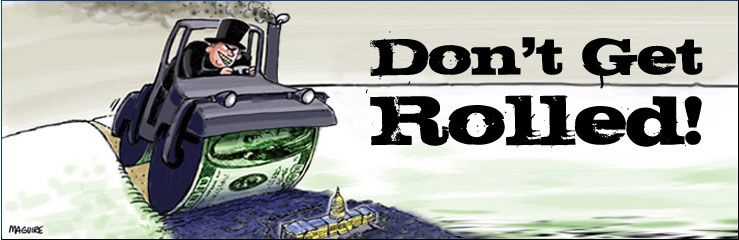
The Department of State’s draft response says that the Chamber can simply report its corporate campaign expenditures are funded by its general treasury.
The Michigan Campaign Finance Network views the Department’s draft to be a fundamentally flawed interpretation of the Michigan Campaign Finance Act (MCFA), P.A. 388 of 1976, as amended, and relevant U.S. Supreme Court campaign finance jurisprudence.
First, the Department of State’s draft response addresses itself to ‘express advocacy,’ a term not found in language or concept in the MCFA, rather than the broader definition of ‘expenditure’ found in the Act, and the full body of relevant Supreme Court jurisprudence on campaign expenditures.
Secondly, the Department of State agrees to place the Chamber’s electioneering ‘committee’ outside the Chamber’s corporate accounting, in order to accommodate the notion of just one contributor – the general treasury, rather than inside the Chamber’s corporate accounting with multiple contributors, as suggested by the Chamber’s own tax returns.
Thirdly, the Department of State appears to ignore section (42)(3) of the MCFA, which says that any recipient of a contribution that is not from a committee that has its own accounting and reporting, must include in its record keeping and reporting the name, address and amount given by each person who has contributed to the total amount of the contribution. That should mean that the Chamber’s general treasury must tell its Chamber PAC III who put money in the general treasury to give to Chamber PAC III, and Chamber PAC III must report those contributors’ identities and the amounts they gave.
“The Department of State’s draft response is surely cause for celebration among the special interests who gain anonymity for their campaign spending by channeling money through nonprofit aggregators,” said Rich Robinson of the Michigan Campaign Finance Network. “Secrecy makes government actors more accountable to special interests than voters. If this flawed interpretation is not corrected, more campaign spending than ever will be off-the-books, and that is a deadly prospect for democracy.”
MCFN comment on MI Dept. of State draft Declaratory Ruling
MI Department of State draft Declaratory Ruling
MCFN comment on MI Chamber request for a Declaratory Ruling
MI Chamber of Commerce request for a Declaratory Ruling
The Michigan Campaign Finance Network (MCFN) is a nonprofit, nonpartisan organization that conducts research and public education on money in Michigan politics.

In Monday’s edition of the Grand Rapids Press, there was an article about a Calvin Professor scheduled to give a talk on the BP oil disaster in the Gulf of Mexico. The headline of the story on page 3 read, “As oil spills, hope emerges.”
The story states that Gerry Van Kooten (Calvin Professor) is somewhat optimistic about the long-term outcome of the growing oil disaster caused by BP drilling for oil in the Gulf of Mexico. Van Kooten worked on the Exxon Valdez oil spill in 1989 and because of that experience believes that nature is very “resilient.” “Mother Nature is remarkably resilient in the end, but it may take decades to get there,” said Van Kooten.
An interesting observation, especially since this could end up being the worst oil spill ever recorded. Van Kooten goes on to say that it is key that the engineers keep the oil spill from reaching the shoreline, which he says will put more wildlife at risk.
The Press reporter does not question any of the assertions from Van Kooten, but they do cite the Sierra Club’s Executive Director Michael Brune who says, “We will be dealing with the impacts of BP’s drilling rig for decades to come.”
Van Kooten then tells the Press reporter that it would be “unrealistic to permanently halt offshore drilling.” That comment is followed up by a statement from the CEO of Grand Rapids-based Wolverine Gas & Oil Corp Sid Jansma. The oil & gas executive thinks “the people of the US will be the losers” if there is a ban on off shore drilling.

It seems quite amazing that the Press can pass this story off as journalism. First, even though they cite a Sierra Club spokesperson, there is no balance in this story, since the comment from the Sierra Club is not used to counter the comments made by Van Kooten or the oil industry executive. Second, the Press reporter does not provide any information to suggest that he verified any of the claims made by either Van Kooten or Sid Jansma.
Third, the Press did not provide full disclosure on Van Kooten. The Calvin Professor does teach geology, but he also worked as a petroleum geologist and oil and gas consultant in Alaska for two decades.
Fourth, the article provides no real context about the extent of the damage done so far from the BP oil spill. Such investigation was demonstrated in an interview conducted by Democracy Now with Riki Ott, a woman who has written two books on the Exxon Valdez oil spill. Ott talked about how the oil industry was not held accountable on regulations, how the spill will devastate eco-systems, potentially destroy the commercial fishing industry and have long-term economic ramifications. This kind of assessment differs greatly from the “optimism” of the Calvin Professor who spoke with the Press before giving a public lecture today.

Yesterday the Grand Rapids Press ran an AP article on page A19 entitled, “Immigration bill old hat for Sheriff Joe.”
The article presents a fairly favorable look at Sheriff Joe Arpaio, the sheriff of Maricopa County, Arizona who has been known for using repressive tactics in dealing with immigration.
The Associated Press story talks about the 15 “crime and immigration sweeps” Arpaio has conducted since April of 2008 and that he has arrested over “2,000 illegal immigrants since 2006.”
In the Grand Rapids Press version of the AP story only Sheriff Arpaio is cited, but in the original version they also cited an Arizona State Senator and marketing professor, both of which do not provide any criticism of Arpaio.
The article does say at one point that “Critics say his deputies pull people over for minor traffic infractions because of the color of their skin so they can ask them for proof of citizenship.” Unfortunately, none of these critics are named in the article, even though there are numerous sources that the AP reporter could have cited.

For instance, the FBI and the Attorney General’s office in Arizona have begun a Grand Jury investigation into claims that Sheriff Arpaio has abused his power and even begun investigations of local politicians who have been critical of him.
There are also citizen groups that have been critical of Arapio, one which calls for the overthrow of the sheriff. Another group, America’s Voice, which advocates for sensible immigration reform, has documented numerous charges against Arapio. Among these charges are – the sheriff gives priority to immigration sweeps over felonies, racial profiling of Latinos and the use of forced labor in his “tent city” prison camp.
If the Grand Rapids Press is going to run wire stories about an important issue, such as immigration policy, they need to make sure that these stories have more balance so as to provide readers with multiple perspectives on the critical issues of the day.
Another Look at the Proposed Urban Market – Part II
Last month we posted a story that took a critical look at the downtown “urban market” that has been proposed by Grand Action. Since then there has been additional news coverage of the Grand Action plan and some community discussion.
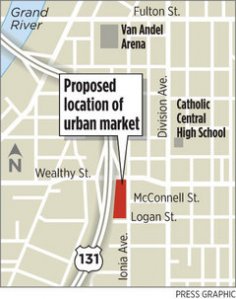
In this article we will look at a recent community meeting on the topic, additional news coverage and some power analysis by looking more closely at whom Grand Action is comprised of.
Public Dialogue
Because this project has raised some red flags for people who do justice work, a meeting was hosted by Kent County Commissioner Jim Talen with the intent of trying to provide some answers to questions people in the community have about the project.
Members of Our Kitchen Table, community organizers and a few residents from the near Southeast part of Grand Rapids came together to ask questions. Commissioner Talen was upfront with those in attendance by saying that Grand Action was a group of “rich white guys” who have vested economic interests. The commissioner also said that even though Grand Action has been working on this proposal for two years there are things that they would not talk about in public. For instance, Grand Action will not provide a list of the people who have been consulted from the community, nor will they share much of the financial details at this point.
Commissioner Talen did say that Grand Action does have a larger agenda, which is to re-develop the area south of Wealthy Street, one of the concerns that people expressed at the meeting. The project proposal states that 1,200 jobs would be created, but nowhere does it state what kind of jobs will be created and whether or not they would pay a living wage. When asked if the proposal has any commitment to hiring residents near to the proposed site, Commisioner Talen responded that he was unaware of any such commitment.
Other issues that were raised at the meeting was the consequences of increased traffic congestion, increased air pollution because of more traffic and traffic jams, whether or not public dollars would be used in the process, why no transparency in the process and why such a high price tag for such a proposal?
Many of these questions could not be answered by the commissioner, but he did reveal to those in attendance that on top of the $27 million price tag, there was an additional $600,000 – 900,000 needed to move forward just for pre-construction purposes. In addition, since our first story on the proposed project the Grand Rapids Downtown Development Authority (DDA) has approved $100,000 towards the project, which means that public dollars are now involved.
Additional News Coverage
Since the initial stories about the proposed “Urban Market,” there have been a few new stories. First, there was a critical article in the May issue of new month publication, Positive Voices. Writer Peter Carlberg asks some important questions and makes sound observations. The current issue in not yet online, but should be by the end of the month if you can’t get hold of a print copy.
The other article that recently appeared was from the business journal MiBiz, which ran a story headlined, “Urban market sprouts collaboration, education.”
The article only cites the guy whom Grand Action hired to do an initial study for the project and someone from the Michigan Department of Agriculture. The story states that the planned market would generate “$775 million in regional economic activity in a decade.” One question to be asked based on that statement is who will be the primary beneficiaries of that $775 million?
The article also states that the project could train “entrepreneurs in good agricultural practices, leveraging technology to help agribusiness become more efficient to meet the needs of retailers and consumers.” Why do we need to help agribusiness become more efficient? Shouldn’t the real goal of truly sustainable project promote agriculture that involves more people and provides healthy food because it is everyone’s right?
However, the driving force behind such a project seemed to be captured in a comment by the representative from the Michigan Department of Agriculture who said he expected the “urban market to be a catalyst for adjacent redevelopment projects, spurring residual economic benefit and job growth.”
This statement should cause us all to question the larger motive behind such a project and whom it will benefit.
Interlocking Systems of Power
As we stated in the previous article about this issue, the primary beneficiaries of such a project will no doubt be those who are the major proponents of such a project – members of Grand Action.
Dick DeVos, David Frey and John Canepa are the “General Chairs” of Grand Action. Most of our readers know what economic interests Dick DeVos has (Amway & The Windquest Group). David Frey is recently retired Bank One Chase executive and is the current Chairman of the Frey Foundation. John Canepa is a former Old Kent Bank executive and now works as a financial consultant for the Crowe Horwath.
The Executive Committee for Grand Action is a who’s who of the areas economic powerbrokers. The list includes Marty Allen (businessman), David Haynes (Lobbyist), Richard Haslinger (West Michigan Chase Bank President), Steve Heacock (Van Andel Institute), Bob Hooker (Doctor), Mike Jandernoa (former CEO of Perrigo, Bridge St. Capital Management & head of Janderoa Entrepreneurial Mentoring), Kurt Kimbal (former Grand Rapids City Manager), Birgit Klohs (Executive Director of The Right Place), Jim Leach (President Leach Food Equipment), Donald Maine (Chancellor Emeritus of Davenport), Mary Ellen Rodgers (Deloitte LLC), Steve Van Andel (Chairman of Alticor), Carol Van Andel (Van Andel Foundation), Michelle VanDyke (CEO Fifth Third Bank of West Michigan) and Casey Wondergem (former Amway executive and now with the Van Andel Foundation).
Clearly these people represent a small sector of elites in West Michigan. However, in addition to their professions they solidify their economic and political influence by being part of inter-locking systems of power locally.
For instance, Richard Haslinger and Michelle VanDyke are both board members of The Right Place, which has tremendous influence on economic development locally. Kurt Kimball and Richard Haslinger are both members of the Economics Club of Grand Rapids.
John Canepa is a member of the Grand Rapids DDA and Mary Ellen Rodgers is on the Siedman School Advisory Board. Birgit Klohs is a member of the Grand Rapids Chamber of Commerce and the Michigan Economic Development Corporation. Jon Nunn, the Executive Director of Grand Action sits on the board of the Grand Rapids/Kent County Convention Center and Visitors Bureau. Mike Jandernoa is on the board of the Van Andel Instiute, Carol Van Andel is on the GVSU Foundation board and Steve Van Andel is the with the Center for Private Enterprise.
These interlocking systems of power should certainly tell us something about what might be motivating the downtown urban market proposal and who is likely to be the primary beneficiaries of such a project.
Indian author & activist Arundhati Roy interview
(This article/video is a re-post from Common Dreams.)

In 1997, Arundhati Roy’s first novel The God of Small Things made her the first Indian woman to win the prestigious Booker Prize. More than six million copies of the book were sold worldwide.
Since then, she has turned her pen to politics. During the Bush years, she was a fierce critic, calling the invasion of Afghanistan “an act of terror on the people of the world”.
In India, she has campaigned against mega dams projects, denounced the rise of Hindu nationalism, and has been imprisoned by the Supreme Court of India for “corrupting public morality”.
Her latest essay describes her trip into the heart of India’s Maoist insurgency, the movement, India’s government has launched a major military campaign to crush.
Fault Lines caught up with Arundhati Roy during a rare US appearance.
She talks to Avi Lewis about fighting on the ground, battles over corporate control of Indian land, India and the US after the Cold War, ‘Islamophobia’ and terrorism, tribal resistance in India and Afghanistan, and the issues behind the so-called Maoist insurgency.
The Origins of Mother’s Day
As we are all carpet-bombed with ads admonishing us to buy something for our mothers, it is important that we look back at the origin of Mother’s Day in the US.

Mother’s Day came about as an extension of the efforts of women who were involved in abolition and suffragist struggles. Most radical historians say that Mother’s Day can be traced to the person of Julia Ward Howe.
This courageous woman is best known for writing the Battle Hymn of the Republic, which she wrote in response to visiting wounded men in the camps during the Civil War. It was in this context that Julia Ward Howe began to think about both the human and economic toll of war.
When war broke out at the international level in 1870, with the Franco-Prussian War, Howe called for women all around the world to rise up against war. She wanted women to come together across national lines, to recognize what we hold in common above what divides us, and commit to finding peaceful resolutions to conflicts.
She also issued a declaration which spoke out against war by saying things like, “Our husbands will not come to us, reeking with carnage,” and “Our sons shall not be taken from us to unlearn all that we have been able to teach them of charity, mercy and patience. We, the women of one country, will be too tender of those of another country to allow our sons to be trained to injure theirs.”
Her attempts to have a formal Mother’s Day for Peace was not successful, but another woman named Anna Jarvis took up where Julia left off. Jarvis organized to have a Memorial Day for Women who lost husbands or sons due to war.
The first time it was celebrated in any official capacity was in 1907 in West Virginian church, where Anna Jarvis’s mom had taught Sunday school. The custom spread and eventually was adopted by 45 states. In 1914, President Woodrow Wilson declared Mother’s Day to be a national holiday.
It would do us all well to honor the origin of this holiday and to stand with mothers around the world and call for the end of war.
NYT Has No Space to Tell You It’s an Oil Industry Group Saying That Spills Aren’t So Bad
(This article is re-posted from Fairness & Accuracy in Reporting.)
The formula for “contrarian” journalism was aptly summed up by Wonkette (1/6/09):
Take a widely accepted belief (e.g., “Dogs make good pets”) and write a cool 600 words arguing why its opposite is SECRETLY truer (“Why all dogs should die”).
Of course, it helps if the upside-down world you’re proposing turns out to be one that is surprisingly cozy to powerful corporate interests. Thus the piece that appeared on the front page of the New York Times today (4/4/10) arguing that maybe we’re all a little too worried about that oil spill in the Gulf.
To back up this counterintuitive notion, reporters John Broder and Tom Zeller turn to an “expert”:
“The sky is not falling,” said Quenton R. Dokken, a marine biologist and the executive director of the Gulf of Mexico Foundation, a conservation group in Corpus Christi, Texas. “We’ve certainly stepped in a hole and we’re going to have to work ourselves out of it, but it isn’t the end of the Gulf of Mexico.”
Who is this “conservation group” minimizing the impact of a massive oil spill on the area it specializes in conserving? That’s what Marian Wang of ProPublica (5/4/10) wondered, too. Turns out it’s not really a conservation group at all:
At least half of the 19 members of the group’s board of directors have direct ties to the offshore drilling industry. One of them is currently an executive at Transocean, the company that owns the Deepwater Horizon rig that exploded last month, causing millions of gallons of oil to spill into the Gulf of Mexico.
Seven other board members are currently employed at oil companies, or at companies that provide products and services “primarily” to the offshore oil and gas industry. Those companies include Shell, Conoco Phillips, LLOG Exploration Company, Devon Energy, Anadarko Petroleum Company and Oceaneering International.
The Gulf of Mexico Foundation’s president is a retired senior vice president of Rowan Companies Inc., an offshore drilling contractor.
Meanwhile, Transocean hosted the group’s winter board meeting in January and sponsored a dinner for the board of directors. Past board meetings have been hosted in full or in part by Anadarko Petroleum Company, Shell Exploration and Production, Valero Refinery and Marathon Oil Corporation.
So it’s not exactly surprising that the executive director of such a group would have a nonchalant view of the impact of oil spills on the Gulf. What is maybe a little surprising is that the New York Times would present a coalition of offshore drilling interests as neutral experts on the environment.
And it’s not like the Times reporters didn’t know who they were quoting. In an addendum to her ProPublica piece, Wang quotes an email response from Zeller:
We were aware of GMF’s industry partnerships–and for what it’s worth, I believe they also have members from the agriculture and fishing industries, among others. As you’ll note from Dr. Dokken’s bio, the group also includes marine scientists.
You could certainly mount the argument that such co-mingling might influence his assessment of the oil slick and how bad it might get, but as I understand it, the bulk of GMF’s operating budget comes from federal and state grants, so that wasn’t my sense.
So because the group gets government grants, the Times reporters thought it wasn’t worth mentioning that half the group’s board represents the very industry whose damage to the Gulf is being minimized?
“Of course, it’s probably always better to err on the side of full disclosure,” Zeller tells ProPublica–as if revealing that you’re quoting an industry group speaking in its own defense would be bending over backwards–“but we operate within space constraints as well–and I believe we did link out to the various websites, so enterprising readers could peruse their boards and sponsors.”
Here’s a tip for the Times: Next time you are running into “space constraints,” maybe you can free up some room by killing the piece that revolves around an industry spokesperson telling readers not to worry about the damage the industry that employs him has done to the environment.
UPDATE: The New York Times published an Editor’s Note on May 5 saying that the article “should have included more information about” the Gulf of Mexico Foundation: “While the group says the majority of its funding comes from federal and state grants, it also receives some money from the oil industry and other business interests in the gulf, and includes industry executives on its board.” While few readers–“enterprising” or not–would realize from that additional info that offshore drilling interests represent half the group’s board, we suppose it’s better than Tom Zeller’s response.
It has been just two weeks since Arizona pass a controversial law that gives law enforcement agents the power to question anyone they suspect of not having documentation. The new law is doing what some commentators thought it might do……give strength to the immigrant rights movement.

Some organizations like the National Council of La Raza (NCLR) have called for a boycott of Arizona. Their Press Release from yesterday states, “When a law so contrary to our values is passed, we must act decisively. We are calling for a boycott because this law will blow open the door to increased racial profiling, wrongful arrests, and other discrimination.”
The boycott is calling on people to not do any business in Arizona or visit Arizona as a tourist. The NCLR has created a pledge that they are asking individuals and organizations to sign on to, a pledge that details the parameters of the boycott.
The call for a formal boycott has already resulted in at least 23 major meetings/conferences in Arizona that will cost the state $6 million dollars. In addition, some truckers are refusing to make deliveries into Arizona, an action they are organizing over their CB radios.
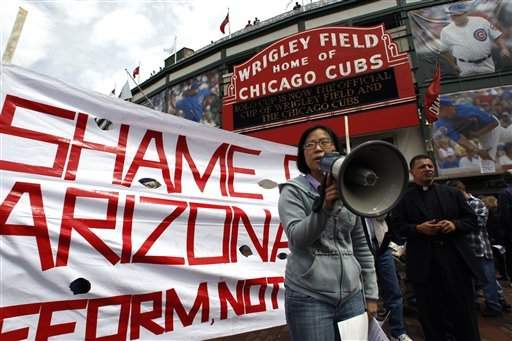
One of the more interesting arenas of resistance is in the world of professional sports. The professional baseball team from Arizona, the Diamondbacks, are being greeted with protests whenever they play on the road. Last week when they were playing in Chicago they were greeted with an organized protest of immigrant rights groups, holding a large banner that said “Shame on Arizona.”
The players union of professional baseball also has come out against the anti-immigrant law in Arizona. In a May 4 media release they state, “The Major League Baseball Players Association opposes this law as written. We hope that the law is repealed or modified promptly. If the current law goes into effect, the MLBPA will consider additional steps necessary to protect the rights and interests of our members.”
According to Left sports writer Dave Zirin, the pressure against the Arizona baseball team has forced the owner, Ken Kendrick (a long time supporter of anti-immigrant laws), to publicly state that he now is against the Arizona law. Zirin believes that the pressure needs to increase and that fans should call for a boycott of the Major League All Star Game, which is scheduled to be played in Phoenix this July.

But baseball is not the only sport that his making headlines in opposition to the racist Arizona law. The NBA team based in Arizona, the Phoenix Suns, in a statement of solidarity wore jerseys that said “Los Suns” on May 5th, Cinco de Mayo, to support immigrant rights and to challenge the Arizona law. Team owner Robert Sarver, released a statement on May 5 that read in part: “The frustration with the federal government’s failure to deal with the issue of illegal immigration resulted in passage of a flawed state law. However intended, the result of passing this law is that our basic principles of equal rights and protection under the law are being called into question, and Arizona’s already struggling economy will suffer even further setbacks at a time when the state can ill-afford them.”
One player on the Phoenix Suns, Steve Nash, stated recently on a sports talk program that the law is bad for civil liberties and will create a climate of racial profiling. Taking these kinds of positions is not new for Nash, he was the first professional athlete to speak out against the US invasion of Iraq in 2003.
We are encouraged by these actions and will continue to report any new developments in this struggle for immigrant and racial justice in the coming weeks and months.
US to Expand Pakistan Drone Strikes
(This article is re-posted from Common Dreams.)
The Central Intelligence Agency (CIA) has been granted approval by the US government to expand drone strikes in Pakistan’s tribal regions in a move to step up military operations against Taliban and al-Qaeda fighters, officials have said.

Federal lawyers backed the measures on grounds of self-defence to counter threats the fighters pose to US troops in neighbouring Afghanistan and the United States as a whole, according to authorities.
The US announced on Wednesday that targets will now include low-level combatants, even if their identities are not known.
Barack Obama, the US president, had previously said drone strikes were necessary to “take out high-level terrorist targets”.
Conflicting figures
“Targets are chosen with extreme care, factoring in concepts like necessity, proportionality, and an absolute obligation to minimise loss of innocent life and property damage,” a US counterterrorism official said.
But the numbers show that more than 90 per cent of the 500 people killed by drones since mid-2008 are lower-level fighters, raising questions about how much the CIA knows about the targets, experts said.
Only 14 of those killed are considered by experts to have been high ranking members of al-Qaeda, the Taliban or other groups.
“Just because they are not big names it does not mean they do not kill. They do,” the counterterrorism official said.
The US tally of combatant and non-combatant casualties is sharply lower than some Pakistani press accounts, which have estimated civilian deaths alone at more than 600.
Analysts have said that accurately estimating the number of civilian deaths was difficult, if not impossible.
“It is unclear how you define who is a militant and who is a militant leader,” Daniel Byman, a counterterrorism expert at the Brookings Institution’s Saban Center for Middle East Policy, said.
Jonathan Manes, a legal fellow at the American Civil Liberties Union, said: “It is impossible to assess the accuracy of government figures, unattributed to a named official, without information about what kind of information they are based on, how the government defines ‘militants’ and how it distinguishes them from civilians.”
US message
Former intelligence officials acknowledged that in many, if not most cases, the CIA had little information about those killed in the strikes.
Jeffrey Addicott, director of the Center for Terrorism Law at St Mary’s University, said the CIA’s goal in targeting was to “demoralise the rank and file”.
“The message is: ‘If you go to these camps, you’re going to be killed,'” he added.
Critics say the expanded US strikes raise legal as well as security concerns amid signs that Faisal Shahzad, the suspect behind the attempted car bombing in New York’s Times Square on Saturday, had ties to the Pakistani Taliban movement, known as Tehrik-e-Taliban Pakistan.
CIA-operated drones have frequently targeted the group over the past year in Pakistan, and its members have vowed to avenge strikes that have killed several of their leaders and commanders.
Shah Mehmood Qureshi, Pakistan’s foreign minister, told CBS television channel that the US should not be surprised if anti-government fighters try to carry out more attacks.
“They’re not going to sort of sit and welcome you [to] sort of eliminate them. They’re going to fight back,” Qureshi said.
(This article is re-posted from the Center for Responsive Politics.)

On Thursday, oil giant BP asked for U.S. government assistance in cleaning up massive amounts of crude oil ominously approaching the coast of Louisiana — the messy results of a recent oil rig explosion 40 miles off-shore.
In response, the Obama administration promised support in both clean up and containment of the environmental crisis. The president also sent clear signals indicating a potential federal investigation to determine cause and responsibility for the accident.
If BP faces heavy federal scrutiny, it’s well-positioned to fight back: The London-based company has consistently spent top dollar to influence legislative and regulatory activity in Washington, D.C., the Center for Responsive Politics finds.
During the 2008 election cycle, individuals and political action committees associated with BP — a Center for Responsive Politics’ “heavy hitter” — contributed half a million dollars to federal candidates. About 40 percent of these donations went to Democrats. The top recipient of BP-related donations during the 2008 cycle was President Barack Obama himself, who collected $71,000. BP regularly lobbies on Capitol Hill, as well. In 2009, the company spent a massive $16 million to influence legislation. During the first quarter of 2010, it spent $3.53 million on federal lobbying efforts, ranking it second (behind ConocoPhillips) among all oil and gas industry interests.
Its registered lobbyists include a number of former federal government and high-ranking political campaign officials, including longtime political operative Tony Podesta, former congressional chief of staff Bob Brooks, former congressional legislative director David Pore and vice presidential aide Michael S. Berman, the Center’s research shows.
The oil and gas industry, of which BP is a member, reported $169 million in 2009 lobbying expenditures.
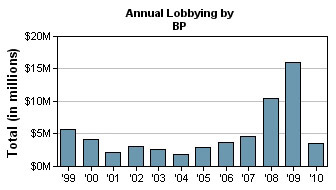
Comparatively, the entire environmental movement spent $22 million on lobbying in 2009 – not much more than BP alone spent for the year. The most active member of the environmental industry, the Nature Conservancy, reported $2.2 million in 2009 expenditures. Last year, BP was active lobbying on the American Clean Energy Leadership Act of 2009, which allows increased oil and gas leasing in the Gulf of Mexico, in areas closer to shore than current law allows.
The bill also calls for additional research and inventory of oil and gas reserves in the U.S. Outer Continental Shelf. The bill is sponsored by Sen. Jeff Bingaman (D-N.M.), who has received $14,000 in campaign donations during the past two decades from those associated with BP, the Center finds. In 2009, BP also lobbied on the Oil Spill Prevention Act of 2009 and the Clean Water Restoration Act. The oil spill, which has yet to be remedied, was caused by an explosion on a BP-leased oil rig on April 20.
A state of emergency has since been enacted in Louisiana, and the White House has designated it an event of “national significance.” The oil well is reportedly leaking between 1,000 and 5,000 barrels a day, and rescue crews are trying to eliminate the oil by setting it on fire, breaking it up with chemicals and skimming it off the surface of the ocean. Already, questions are being asked about cause and responsibility. Upon hearing the cry for help in the Gulf of Mexico, Rep. Henry A. Waxman (D-Cal.), chairman of the House Energy and Commerce Committee, called for a “full blown investigation.”
In 2009, individuals and political action committees associated with BP donated $16,000 to members of the House Energy and Commerce Committee. In addition, five of the all-time top 10 recipients of BP money in the House of Representatives sit on the House Energy Committee: John D. Dingell (D-Mich.) Joe Barton (R-Tex.), Ralph M. Hall (R-Tex.), Roy Blunt (R-Mo.) and Fred Upton, (R-Mich.). All have received upward of $13,000 from BP-related individuals and political action committees during the past two decades. Dingell, the second most favored recipient of BP money in the House, has received $31,000.
 Grand Rapids Institute for Information Democracy