Climate Strategies for Sustainable Communities – GreenTown
(This article is part of a series based on our reporting at the GreenTown conference in Grand Rapids on September 10.)
The afternoon portion of the conference was divided into four separate tracks with 3 sessions in each track. This writer attended the Climate Strategies for Sustainable Communities track.

The first part of this track was entitled “Future of Greenhouse Gar Emission and Management Strategies,” consisting of a panel of four.
The first speaker was Norm Christopher with the GVSU center for sustainability. Christopher says that there are three main ways to move toward climate change actions: doing nothing/denial, a regulatory approach or what he called a voluntary approach.
The GVSU representative said that before any action can take place you have to determine where you are and what your current levels of carbon emissions are. Once you have determined where your organization/community is you need to devise a strategy on how to reduce these emissions.
Christopher says that the state of Michigan has signed on to a commitment to reduce carbon emissions 80% by 2050. GVSU, according to the speaker, will be carbon neutral by 2036, even though how that is defined and how it will be achieved were never stated.
The next speaker was Michael Davidson, the Mid-West regional Director of ICLEI. Davidson said his presentation would be how local governments can manage carbon emissions.
Davidson spent too much time describing the mission of ICLEI with a powerpoint presentation with information that anyone with access to the web could obtain. Focusing so much time on what ICLEI does and other data did not allow for enough time to address concrete strategies for climate action.
Following Davidson was another ICLEI staff member, BritaPagels. Like, Christopher, this presenter felt it was important for local governments to be able to measure carbon emissions. ICLEI has developed a protocol for this kind of measuring with their Clean Air & Climate Protection Software. This software tracks fuel usage, solid waste, electricity use and other indicators.
Brita then presented software to develop a climate & air pollution planning strategy, a software that currently contains 120 different strategies that are being used around the country.
Brita also presented yet another tool she called the Municipal Clean Energy toolkit. Again, the speaker emphasized what others on the panel addressed was that “you can’t manage what you can’t measure.” It was painfully clear that this was the point that the panel wanted to drive home, but it was essentially overkill and avoided the opportunity for looking at best-practices and concrete strategies that communities could implement.
The last presenter, from the Michigan Municipal League, addressed what is called the Michigan Green Communities Challenge. So far there are 70 communities throughout the state.
The Challenge involves providing communities with tools to incorporate energy efficiency and sustainable strategies.
There are 6 steps in this Challenge:
- Obtain organizational support
- Assign responsibility
- Collect energy data
- Assess situation and identify gaps
- Develop goals and activities
- Measure performance and quantify results
Ultimately, the message that the last presenter wanted to communicate was that Green saves money, it is smart economic development and it makes businesses and people want to live and raise their families in such a community.
Again, because of “time constraints” there was only enough time allotted to field two questions, thus minimizing the amount of feedback and engagement from those in attendance.
9/11 and the Afghan war

This October it will be nine years that the US & NATO troops have been occupying the country of Afghanistan. And like any war of occupation, governments need the support of their citizens in order to do what militaries do during a war of occupation – namely brutalize the local populace and secure access to resources.
The US government has its own propaganda mechanisms to promote its mission in Afghanistan. However, the US government could not be as effective in its prosecution of the war of occupation in Afghanistan without the help of the major news sources around the country.
There is growing domestic opposition to this brutal and costly US occupation and that is despite the fact that the major media have pretty much accepted the Bush/Obama administration’s justification for such a war. Lets look at some of the major arguments that both the US government and US corporate media have presented since the initial bombing/invasion of Afghanistan in October of 2001.
It should be noted that even though we are approaching 9 years of the current US occupation in Afghanistan, Afghanis have been suffering under war and occupation for the past 30 years. The US news media has a short memory and doesn’t remind us often enough of the fact that during the 1980s the Soviet Union occupied Afghanistan, while the US provided billions of dollars in weapons and training to an armed resistance that gave rise to the Taliban and al Qaeda.
The Bush administration, along with the support of the Democrats argued that since the Taliban would not turn over al Qaeda operatives in the fall of 2001 that was grounds for an invasion of a country that did not attack the US. Since the removal of the Taliban from power the argue has been that there are still al Qaeda operatives within Afghanistan’s borders and allowing the Taliban to retake control of the country would give more opportunities for the “terrorists” to attack us.
First, the al Qaeda operatives who attacked the US on 9/11, 2001 did not plan it from Afghanistan. Second, most credible sources, including US military officers acknowledge that there is fundamentally no al Qaeda presence in Afghanistan at this time. Third, the Taliban is primarily an indigenous resistance movement that is organized around expelling foreign occupiers, not a rigid ideology.
Another argument put forth by the government and echoed in the major news media is that the US is in Afghanistan to bring democracy. This is probably the longest standing argument by the US government over the past 100 years and is generally unquestioned by the commercial news media. However, since the US has occupied Afghanistan, the two elections that have been held have both resulted in Karzai as President. Both elections were mired in fraud and Karzai’s administration is rife with corruption.

There are more minor arguments used to justify the US occupation of Afghanistan, such as the need to liberate women. This was a strong argument used by the Bush administration, but according to the Afghan Women’s Mission and RAWA (Revolutionary Women of Afghanistan) women are worse off now than they were under the Taliban. Anti-women laws have been entrenched under Karzai and US bombing and military raids have made life for women even more terrifying. The need for US military presence in Afghanistan to protect women was manifested most recently in a cover story in Time magazine, even though the article did not provide the perspective of any organized women’s organization operating inside the country.
Beyond the major policy articles that deal with military strategy, any coverage of US troops in Afghanistan or just returning perpetuate the belief that what the US is doing there is good. Other comments often cited in this context is that the US has to stay and finish the “job,” even though “job” is rarely defined.
During the Bush years there was always at least some token coverage of US opposition to the occupation of Iraq, but this has not happened during the Obama administration. Liberals now are defending the US presence in Afghanistan as necessary, even though there are plenty of progressives and anti-imperialists organizing against the 9-year occupation across the country.
In Grand Rapids, there will be several events to draw attention to the US occupation of Afghanistan. On Sept 30 there will be a benefit concert, followed by a speaker at Calvin on October 8 and an anti-war march on October 9. Don’t let the media complicity in the war fool you. There is a growing opposition to the US war of occupation in Afghanistan.
“Decision-makers” kick-off Greentown conference
 (This article is part of a series of postings based upon our attendance of the GreenTown Conference in Grand Rapids.)
Considering how climate change is already impacting our lives and devastating the lives of millions of people living in less powerful countries, the presence of such a conference at Grand Valley State University (GVSU) Eberhard Center is a local step in the right direction. As the stream of opening speakers took the podium, each acknowledged the imminent reality of climate change and the need to address it now–not at some nebulous point in the future.
Gary Cuneen, executive director of Seven Generations Ahead, a 501C3 non-profit with the mission of promoting “the development of ecologically sustainable and healthy communities” led off. Greentown is a program of Seven Generations Ahead that has the goal of discussing “actionable ways to make communities greener, healthier and more prosperous.” Greentown conferences have been staged in the greater Chicago area since 2007. Grand Rapids came on board in 2009. Cuneen sees Greentown as a forum for “the municipal sector, the private sector and community leaders–the decision makers.” This mix of the powerful is underscored by a walk through the lobby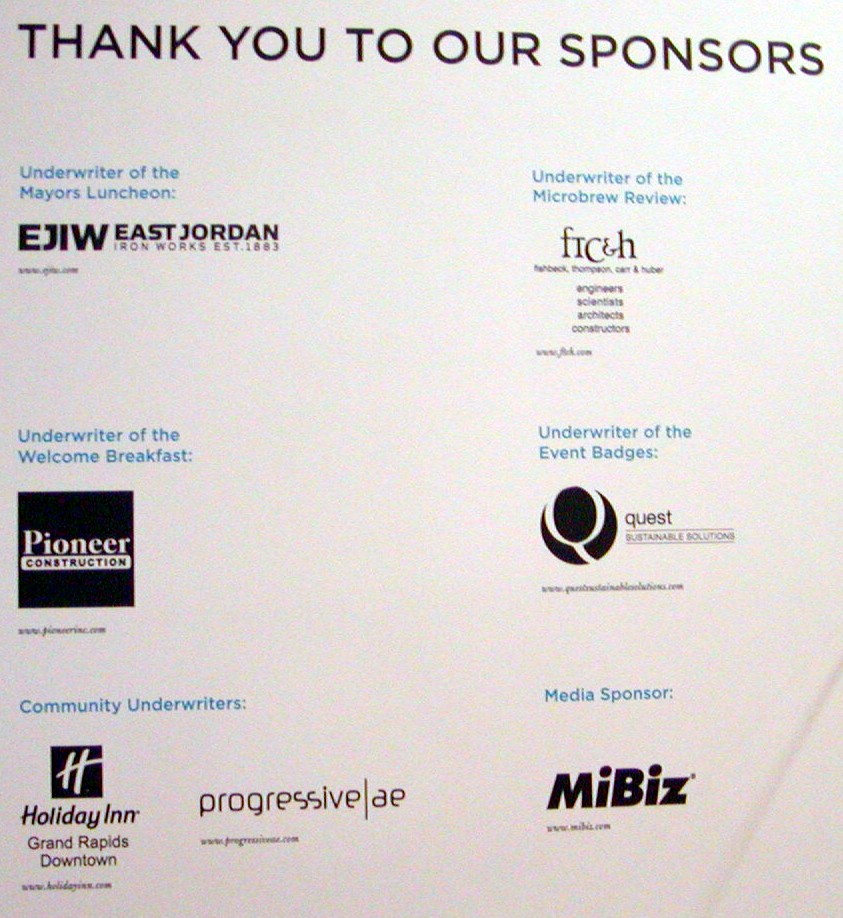 outside the conference rooms where the event’s sponsors were highly visible: GVSU and Aquinas College (both offering majors in sustainable business), Pioneer Construction, Rockford Construction, East Jordan Iron Works, Consumer’s Energy, Pizzo Ecological Restoration and MiBiz. Other underwriters included the Kellogg Foundation, Holiday Inn and the architectural and engineering firm, Fishbeck Thompson Carr and Huber. Oddly, no local, state or national environmental organizations were among those represented.
John Harris, principal of A5 Group, an advertising and PR agency with locations in Chicago, St. Louis and Grand Rapids.He graciously acknowldegd all of the above sponsors and hyped the debut of two books for sale in the lobby: one by Grand Rapids’ business leader, Peter Wege, and the other a picture book (its main character is a former Navy Seal who puts his expertise to work saving the Great Lakes from invasive species.) The cover of the GVSU hand-out promoting its Applied Sustainability program has this Native American proverb on its cover, “We do not inherit the earth from our ancestors, we borrow it from our children” When Tom Haas, GVSU president, took the podium, he echoed that sentiment with an anecdote about his granddaughters’ fishing adventure at the family cottage on a quiet Michigan lake.
George Heartwell responded by saying, “We live in extraordinary times. We have never experienced an economy like the economy today. It’s like standing on the edge of a precipice looking down into a bottomless void. We are coming to grips with the fact that climate change is a reality. We are experiencing changes, fundamental changes in climate in the country that will last for generations to come. (We have) considered the word adaptation a dirty word. The fact of the matter is we are already being forced to adapt to climate change. We have record rainfalls, heat waves that are claiming lives and changes in the rural areas of crop cycles. We simply need to address the whole question of adaption and identifying vulnerabilities.” al approach. cities go about saving the world.
This quiet question also came to the writer’s mind: when affluent America goes about creating a better world for its children, will other children, in its less affluent neighborhoods and in developing countries, continue to pay the price? When Mayor Heartwell and Jim Sygo, Deputy Director Environmental Protection, Michigan Department of Natural Resources and Environment (DNRE, formerly DEQ) laid their messages out, that question gained more volume. Sygo started off with a powerfully relevant report on the impending impact of climate change on Michigan’s people and wildlife:
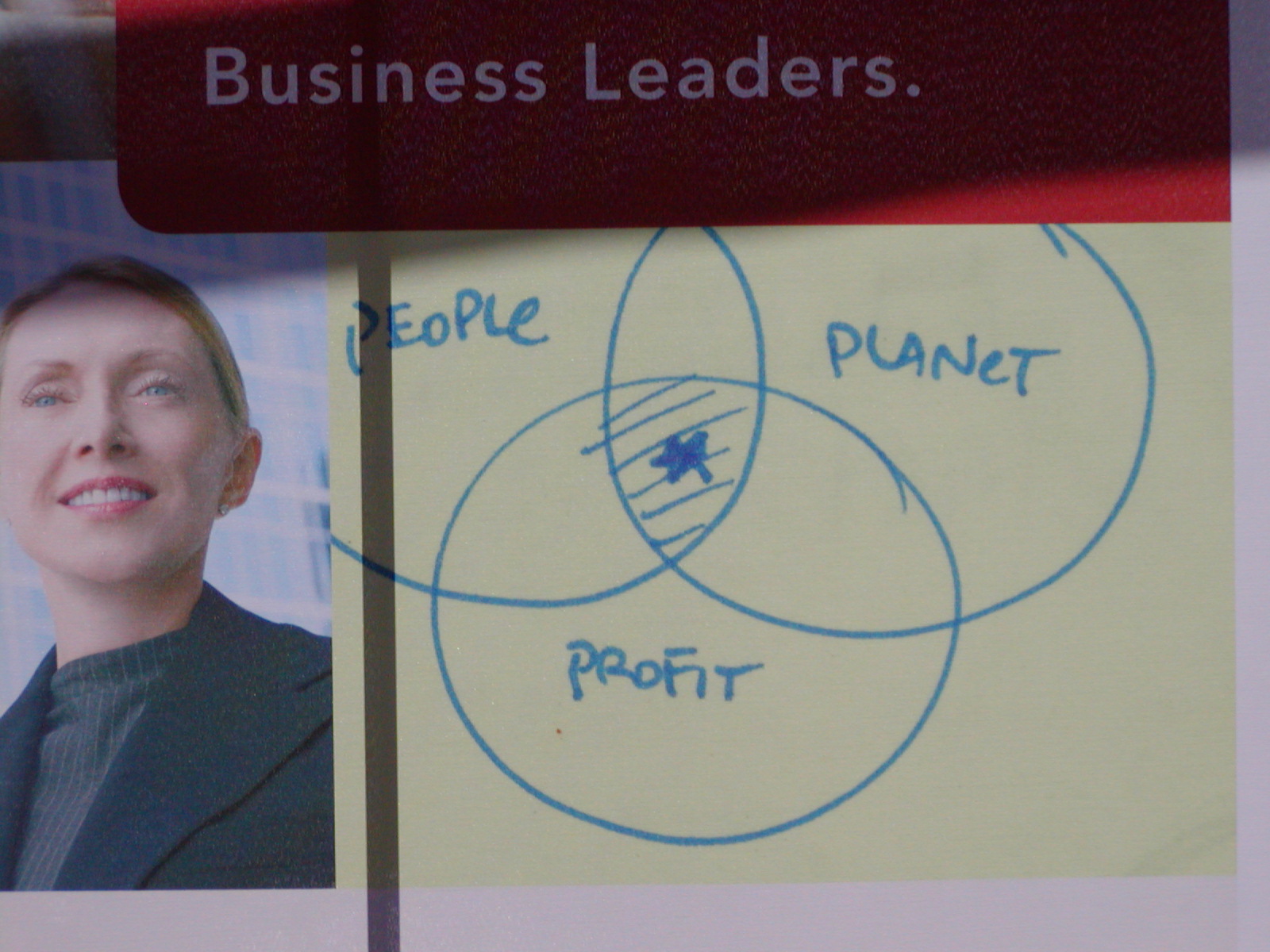 1. A five to ten degree increase in winter temperatures.
2. A seven to thirteen degree increase in summer temperatures,.
3. More frequent flooding and more heavy weather events.
4. Eight to ten weeks extension of the growing season.
5. Significant decline in ice cover on the Great Lakes and inland lakes.
6. Impacts to wildlife because of shrinking spruce and fir forests and increasing aspen and birch forests, more birds to compete with migratory songbirds; a greater moose range and more forest pests and wildlife diseases.
7. Shifts in aquatic species, oxygen depleted waters, lower productivity in the aquatic food chain and spread of aquatic invasive species.
He then provided a summary of the weak responses the state has made so far: creation of climate action plans; collecting greenhouse gas emissions data; the State employee ecodriver program; a green chemistry initiative; and adoption of building codes that meet national standards for overall energy improvements for new buildings. These responses seem weak considering the urgency and magnitude of the task before us. He finished his talk with an appeal to the profit motive. “Michigan’s natural resources are a $20 billion dollar a year industry. $12 billion in forest industries and $8 billion recreational.”
Like Mayor Heartwell before him, Sygo made frequent mention of adaptation.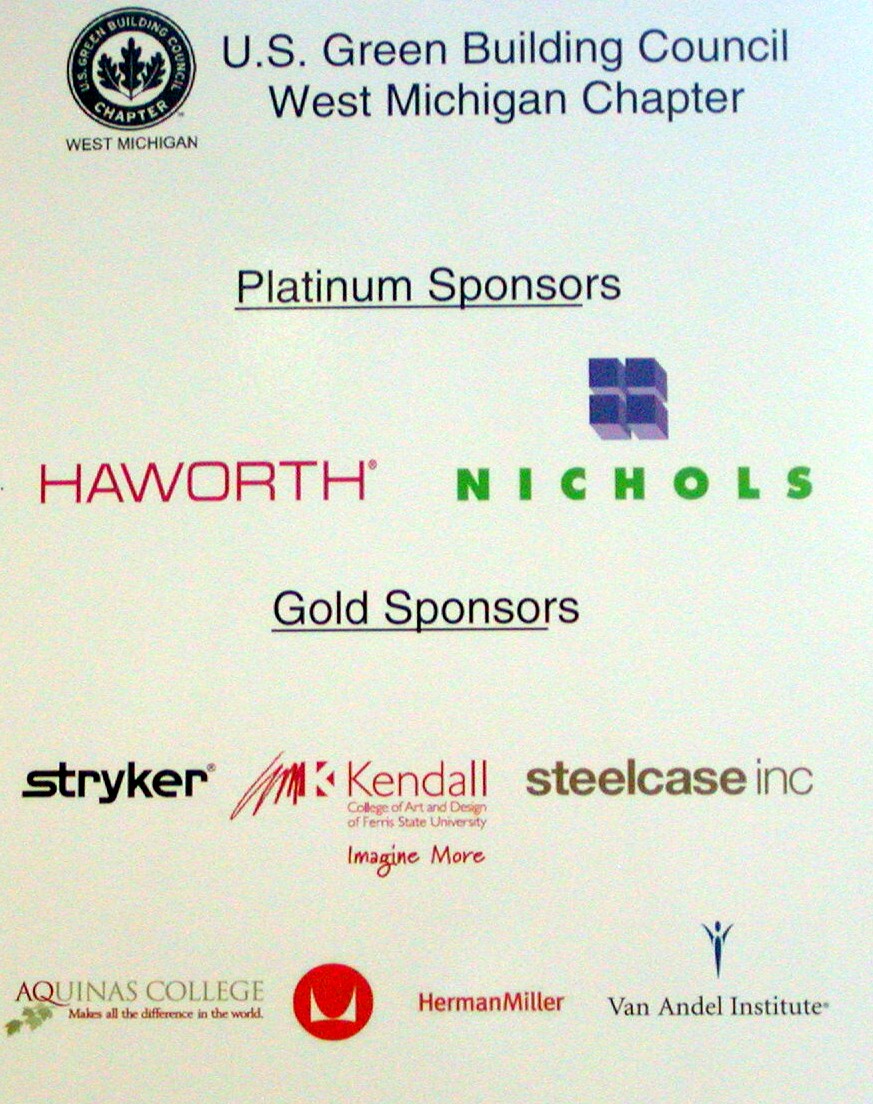 The writer finds this troubling as it seems our efforts should be on reversing climate change through radical systemic change rather than figuring out how to adapt to a ruined world–and making a profit while doing so.
He then enumerated the State’s responses so far: creation of climate action plans; collecting greenhouse gas emissions data; the State employee ecodriver program; a green chemistry initiative; and adoption of building codes that meet national standards for overall energy improvements for new buildings. These responses seem weak considering the urgency and magnitude of the task before us. He finished his talk with an appeal to the profit motive. “Michigan’s natural resources are a $20 billion dollar a year industry. $12 billion in forest industries and $8 billion recreational.”
Wrapping up the introductory session, Martin Chavez, three term mayor of Albuquerque New Mexico and “The Nation’s Greenest Mayor” stated, “There is no comprehensive energy policy in the US. The local and state governments, that’s where it’s getting done. It’s in the private sector, that’s what’s getting it done. If you want to make money, it’s in clean technology. That’s the future. The financial bottom line. We have to balance budgets.”
Chavez is balancing his “budget ” as he now works for ICLEI – Local Governments for Sustainability, a global-reaching nonprofit organization that emphasizes private sector partnerships–not regulation– as the answer to environmental challenges.
GreenTown: The Promise of LEED and neighborhood development
(This article is part of a series of postings based upon our attendance of the GreenTown Conference in Grand Rapids.)
The last morning session featured Doug Farr, founder of Farr Associates Architecture and Urban Design, Inc. Farr has written a book on sustainable urban planning entitled Sustainable Urbanism: Urban Design with Nature.

Farr acknowledges that efficiency is not enough, since research shows that the more efficient we make things in the US, the more people will consume, which in essence cancels out any gains made in efficiency.
Farr also acknowledges that LEED buildings in a one building at a time approach is also not very effective and ultimately not sustainable. LEED construction needs to be more strategic and part of a larger system of sustainability.
One example Farr gave is when one community built a new school 3 miles outside of town. The new school was a LEED building, but it was no longer in a neighborhood and forced more people to drive their kids to school.
Another example was that of a fitness center that had an escalator outside for people to get to the building from the parking lot. LEED planners might ask if the escalator could be more efficient instead of asking whether or not it was needed.
Farr looked at other examples in various communities around the country. What Farr ultimately suggested was needed is to have LEED being discussed as part of municipal master plans, where LEED construction is part of a larger view of planning an design, which incorporates transit, water diversion and other sustainable components.
One example that Farr provided was a community where instead of a traffic round about where no people could be, they fought to get the round about to be a place that people could enjoy – sit and recreate.
Farr then discussed a model for a residential area in South London (discussed in detail in his book) that incorporated energy, housing and land use. What was interesting was that the project not only utilized good technology, but it changed people’s attitudes and behavior, something that the presenter said is always difficult to measure, but an important component for future sustainability.
LEED-ND incorporates the 10 principles of Smart Growth and the outcome of what he referred to as the “New Urbanism.” He showed the audience a map of the US and Canada that were involved in a LEED-ND project, but unfortunately no Michigan communities were included.
Farr then discussed more of the how to’s with implementing what he called LEED-ND pre-requisites, such as walkable streets, smart locations and green infrastructure and buildings. Farr says that residential density is important, accessibility, local food production and neighborhood schools should also all be part of LEED certification. Farr even said that they received significant support and endorsement from health professionals with the CDC.
The last example he showed the audience was in Victoria, Canada. This project was a LEED-ND, where all 26 buildings were platinum certified and the investor was making money off the project even more than he thought because they were taking household waste and making energy pellets to sell to the local municipality. Farr then said that here is a great example of how capitalism can work and in fact the presenter said he believes in capitalism and that it will work if we all think better about how to make this happen.
While the presenter provided some interesting data and some good examples, he did not address how LEED-ND could be a strategy that benefits everyone, particularly the growing number of those living in poverty. Farr did not address the concerns that many critics have that LEED and LEED-ND primarily serves the interests of those with more disposable income and the new urban professional class.
This concern is not a marginal one and unfortunately because of time constraints was not part of the dialogue during the Q&A, since the session was already running overtime and did not afford more audience participation with the presenter.
GreenTown: Future of Energy and Economy Session
(This article is part of a series of postings based on our attendance of the Greentown Conference in Grand Rapids.)
 Grand Rapids Mayor George Heartwell was the moderator for this session that featured two panelists from the government sector and two from the private sector.
Fred Keller, Chairman and CEO of Cascade Engineering was the first panelist to speak. Keller spent a few minutes talking about the evolution of his company from a focus of auto manufacturing to some renewal energy development. Keller didn’t address anything concrete other than his company’s shift from spending thousands of dollars on waste removal and is fast approaching zero waste.
Greg White with the Michigan Public Service Commission spoke next and addressed the struggles with trying to develop renewal energy systems at the state level. White acknowledged that the state has struggled until recently when they have developed a new platform for renewal energy. Their goal is to have 10% of the state’s energy generation be renewable by 2015.
The next panelist was Jon Allan, the Executive Director of Environmental Policy & Intergovernmental Affairs with Consumers Energy. He began his comments by addressing the importance of a regulatory industry that he believes will be beneficial for the private energy sector.
Allan then cited some data on what Consumers Energy has done in recent years to implement energy efficiency for residential consumers. He said that Exelon just bought John Deer and will now be a major energy player in Michigan. What he didn’t say was that Exelon is a major coal powered energy company and a leading nuclear power entity that has been contributing over a million dollars to political campaigns since 2002. Allan also did not mention their role in pushing for an increase in coal-burning power plants throughout the state nor the public campaign to confront Consumers Energy on their role in perpetuating ecologically disastrous energy sources.
Consumers Energy is developing wind farms in a few counties in the state and they believe that they are moving in the right direction in regards to renewable energy. He emphasized the entrepreneurial opportunities with energy, particularly lighting. However, Allan spoke primarily in terms of what they do and how it relates to “customers” instead of citizens.
The last panelist was John Hieftje, who is the Mayor of the City of Ann Arbor. Hieftje talked a bit about their mass transit improvements and the incentives they offer to promote more bicycle commuting for residents. Ann Arbor is also working on improving their recycling processes and has increased their use of solar energy systems in the city.
The mayor of Ann Arbor did acknowledge that just across the border in Canada they are doing so much more with renewable energy production with wind and solar. Hieftje asks the question about why Michigan is not doing more of that and do we have the capacity to make these kinds of things happen. He also said that he has put out an invitation to any energy company that they would sign a long-term contract for renewal energy for the City of Ann Arbor, but not one company has stepped forward to offer such a service. This certainly says something about what the energy profiteers are not doing.
The first question asked of the panel addressed accessing data on energy use and if that information was more public would that be useful in terms of determining what actions to take. The Consumers Energy representative argues that the data is private and that the “responsibility” of energy use is on those individual entities – residents, business and municipalities. This response avoided the importance of what it would mean to have more public transparency of energy use in order to develop better strategies and hold each other accountable.
A second question addressed street lighting and energy efficiency, which was responded to by the Michigan Public Service Commissioner. However, the answer was somewhat muddled and did not address the concern about efficiency that the questioner posed.
The last question was addressed to Consumers Energy and addressed the need to improve and expedite the possibility of getting more customers to participate in their energy efficiency program. The Consumer’s rep said that they wanted to move in that direction, but also placed some of the burden on the current regulatory laws in Michigan.
Overall the panel spoke mostly in generalities and did not address many specific solutions or strategies around energy and the economy. It was clear that no one on the panel addressed the possibilities of energy being held in the public sector or as part of “the commons,” where everyone would have a say in how energy is produced and used. An energy commons would also take out the profit motive and operate as a public service in the same way that libraries or municipal recycling systems do.
Reporting Live from Afghanistan – Journalist Anand Gopal to speak in Grand Rapids

As part of a series of events for the 9th anniversary of the US invasion/occupation of Afghanistan a local group called Grand Rapids for Justice & Peace in Afghanistan will host an event with journalist Anand Gopal.
Gopal has been reporting from Afghanistan for years and will provide a first hand account of what the US occupation means to Afghanis. Anand has reported for the Christian Science Monitor, the Wall Street Journal and numerous other news outlets.
Friday, October 8
7pm
Calvin College
Commons Lecture Hall
This is a free event, but we will accept donations to cover the travel & lodging costs. For more information on other planned activities go to http://www.facebook.com/group.php?gid=10150114773985291.
The video below is an interview that was done with Anand Gopal 7 months ago where he discussed torture and other US military actions in Afghanistan.
Today on front-page of the Region section of the Grand Rapids Press, reporter Myron Kukla wrote a short article about members of the DeVos family speaking at an event in Holland that is part of the Edgar Prince “Lessons in Leadership Series.”
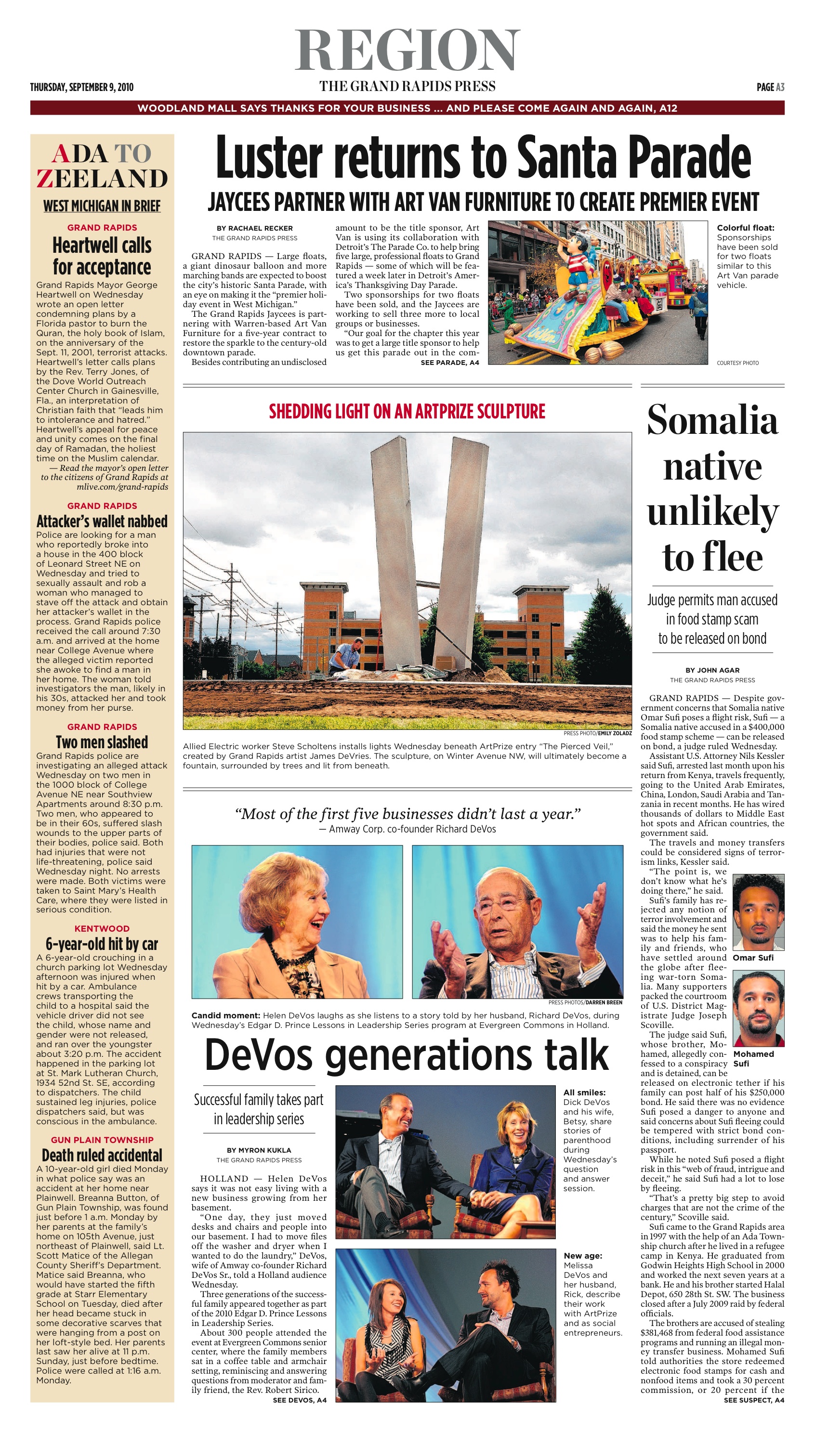
The article shares comments from Helen DeVos, Richard DeVos and Dick DeVos Jr., who shared the stage with Betsy DeVos, Rick DeVos and his wife. The Press reporter shared comments from each of the family members that were presented in such a way that made you feel like we were all just sitting in some typical family living room and drinking tea.
The article does mention the Amway business, the creation of Windquest Group, their ownership of the Orlando Magic basketball team, Kids Hope USA and Rick DeVos’ involvement with ArtPrize.
There was no historical context and no discussion about how the family has used their wealth over the years. Even if those aspects were not discussed at last nights event it would not be unreasonable for a journalist to explore those angles, especially considering the DeVos family arguably has more economic and political influence on West Michigan than any other family.
People need to know about the Richard DeVos Sr.’s long time funding of far-right causes around the world. In fact, Helen, Dick, and Betsy DeVos have also contributed to far-right causes such as using public tax money for private education, English only campaigns, anti-gay legislation, pro-corporate policies and counter-insurgency campaigns around the world.
For a reporter to not ask questions or raise questions about such influence is unacceptable. The public deserves more from journalists, especially if they want people to participate at any level of the democratic process. Maybe the Press reporter knows that if you challenge or even question the power that the DeVos family wields there will be consequences, such as what happen to sports journalist Dave Zirin who exposed Richard DeVos’ support of far-right activities in a recent book.
The Press reporter did mention who the moderator of the event was, Rev. Robert Sirico, who was referred to as a “family friend.” Sirico is the founder and president of the far-right think tank The Acton Institute based in Grand Rapids that weds capitalism and Christianity and has a history of supporting anti-environmental and other reactionary policies. Sirico is also a “family friend” and spiritual advisor to Erik Prince, the war profiteer who has fled the country in order to avoid any consequences for the growing scandal surrounding the activities of Blackwater.
Any competent journalist would have a least frame the event with the DeVos clan with some acknowledgement that there are serious criticisms of their influence, but not much can be expected from the Grand Rapids Press, which the day before made the new home of Dick and Betsy DeVos their front-page story. Instead, the Press reporter merely acted as a stenographer of power.
Wall Street Aggressively Filling Republican Coffers After Many Months Supporting Democrats
(This article is re-posted from the Center for Responsive Politics.)
Wall Street-related political donations are bolstering Republicans’ political fortunes this summer as financial interests have suddenly — and dramatically — shifted their contributions away from Democrats, who they largely favored last year.

In both the first and second quarters of this year, the broad finance, insurance and real estate sector has favored Republican candidates and committees in its political giving, a Center for Responsive Politics analysis finds. The same holds true for both the more narrow commercial banking and securities and investment industries.
This trend is a notable departure from last year, when the finance, insurance and real estate sector sent more money to federal-level Democrats than Republicans during each quarter, the Center finds. People and political action committees associated with the securities and investment industry favored Democrats as recently as 2009’s 4th quarter, while the commercial banking industry favored Democrats as recently as 2009’s 1st quarter.
The findings by the Center, which underscore a preliminary analysis from August, indicate an increased frustration with congressional Democrats by Wall Street interests, many of which are still smarting from passage of federal financial reforms they consider onerous. (Download a full quarter-by-quarter breakdown of Wall Street contribution amounts here: financequarterly.xlsx )
People and political action committees associated with the finance, insurance and real estate sector significantly favored Democratic candidates during the early months of 2009.
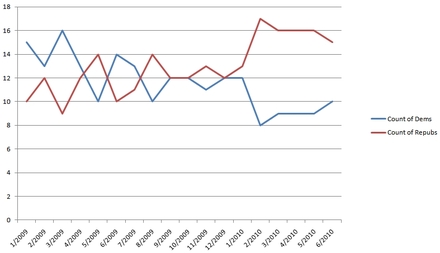
But in February, a dramatic shift occurred — to Republicans’ advantage, the Center finds.
That month, Republicans represented 17 of the top 25 federal-level recipients of finance, insurance and real estate-related money. It’s a shift that’s persisted, too: In each month since June, at least two-thirds of the sector’s 25 favorite candidates have been Republicans.
It’s with little irony that this change in donation patterns coincided with congressional Democrats’ aggressively pushing financial reform legislation — legislation highly unpopular with many banks and financial houses.
Follow the shift in how many candidates among the finance, insurance and real estate sector’s top targets were in each month Democrats and Republicans:
And click here to download a month-by-month list of the top 25 recipients of finance, insurance and real estate sector political contributions from January 2009 to June 2010: FIREcontribs.xlsx
Consider the case of Senate Majority Leader Harry Reid (D-Nev.), traditionally a prime Wall Street target.
In each month between January 2009 and August 2009, Reid ranked among the top five federal-level recipients of finance, insurance and real estate-related donations but for one month — March 2009 — when he ranked No. 7.
But between September 2009 and June, Reid failed to crack the top five even once.
His best showing, in May, placed him 6th among congressional candidates — one of only three times since September 2009 that he’s even managed to finish a month in the top 10.
By June, only two of the top 10 recipients of finance, insurance and real estate-related political cash were Democrats: Sens. Charles Schumer ($237,700) and Kirsten Gillibrand ($259,471), both of whom count Wall Street as a constituent.
Among the Republicans within June’s top 10 list: Senate candidates Carly Fiorina of California, Marco Rubio of Florida, Rob Portman of Ohio and Pat Toomey of Pennsylvania.
Overall, the finance, insurance and real estate sector has funneled about $194.4 million into federal politics through June 30, with Democrats for the entire cycle maintaining a narrow edge in overall contributions — 51 percent to 48 percent.
Such a figure puts the finance, insurance and real estate sector on pace to easily exceed its federal-level political contribution total from the 2006 midterm cycle — $262.9 million.
During this year’s second quarter, the finance, insurance and real estate sector pumped $28.54 million in federal-level contributions into the political system, with $16.29 million going to Republican candidates and interests, while about $12.1 million went to Democrats.
Compare that to the first quarter of 2009, when the sector sent $15.32 million the way of Democrats, compared to $10.1 million to Republicans.
Through June 30, political action committees alone from the finance, insurance and real estate sector had contributed $49.4 million to federal political candidates and committees. That already exceeds what PACs from this sector spent for the entire 2002 election cycle — $47 million.
What We Are Reading
Below is a list of books that we have read in recent weeks. The comments are not a review of the books, instead sort of an endorsement of ideas and investigations that can provide solid analysis and even inspiration in the struggle for change. All these books are available at The Bloom Collective, so check them out and stimulate your mind.
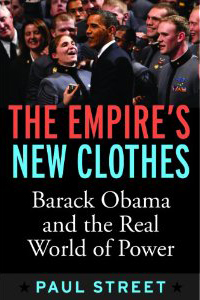
The Empire’s New Clothes: Barack Obama in the Real World of Politics, by Paul Street – Street has been one of the most consistent writers in terms of analyzing the Obama administration since the day he took office. In this sequel to the book that Street wrote just before the last presidential election, Street provides clear analysis of the “progressive agenda” that the President was elected on and whether or not it has translated into real policy reform. The author looks at the Obama administration’s economic policy, health care legislation, foreign policy and the claim of whether or not we are in a post-racial America. Street’s main conclusion is that the current administration is just as imperialist as the last administration and just as beholden to private capital.
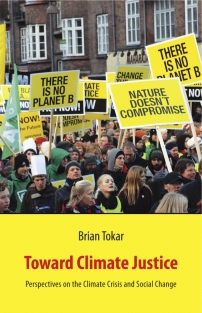
Toward Climate Justice: Perspectives on the Climate Crisis and Social Change, by Brian Tokar – In this short book author/activist Brian Tokar presents an important perspective on both the status of the global climate justice movement and where it needs to go. Tokar believes that those of us living in rich societies must always begin our discussion/analysis of climate justice by coming to terms with the fact that it is poor people in Third World countries around the world who are most impacted by climate change. Rooting our actions in this fact would drastically alter our actions and strategies and lead to a more honest a radical movement.

Signal:01 – This new book by PM Press is a treasure for anyone interested in the intersection between art and politics. Signal 01 is a collection of interviews and examples of the art from numerous insurgent artists and art collectives around the world. The book talks to print makers, graffiti artists, cartoonists, photographers and graphic designers. What makes this book so important, besides the beautiful pictures of art, is that it frames the question of the work of cultural production outside of the typical privileged narrative. “The question we need to ask is whether our cultural production is used to uphold the massive levels of inequality that exists across the globe, or to challenge capitalism, statecraft, patriarchy, and all the systems used to produce and reproduce that disparity.”

Thriving Beyond Sustainability: Pathways to a Resilient Society, by Andres Edwards – In this new book from New Society Publishers, Andres Edwards attempts to push the envelope on how we should not only view the issue of sustainability, but think about our relationship with the natural world. The author begins his analysis by looking at examples of how indigenous cultures around the world have developed a vision/ethic about how to live with nature instead of trying to control it. However, when it came to concrete strategies I felt that the author was too limited and tended to mimic much of the current liberal writing on sustainability.
Free canning workshop at The Bloom Collective
Canning How-To
1 – 5 p.m.
Sunday Sept. 19 & Oct. 24
The Bloom Collective
Steepletown Center
671 Davis NW
(Corner of 5th & Davis)

As the food industry separates us farther from the sources of our foods—and the nutrients real food provides—people seeking more sustainable and healthier mealtimes are taking up the nearly lost art of home canning. Some of us remember the jars of peaches, pickles and tomatoes lining our grandmother’s pantry shelves. Sadly, others have been brought up on foods jarred, canned, boxed or frozen in factories—and know nothing else.
As the industry’s mouthpiece, corporate media has Americans convinced that it’s difficult to cook from scratch and dangerous to can your own foods. But guess what? It’s easy and it’s safe. You don’t have to worry about those six-syllable food additives poisoning your family. And, canning your own can save you bundles of money. (That can mean less time working to live and more time working at life.)
You can learn the basics of canning at two upcoming free workshops sponsored by The Bloom Collective. On Sunday Sept. 19 from 1 to 5 p.m., experienced home canners from The Bloom, Our Kitchen Table and the GR Free School will show folks how to can salsa. On Sunday Oct. 24 from 1 to 5 p.m., the topic will be applesauce. Bring your own produce, jars, lids, a cutting board and knife.
For information, visit www.thebloomcollective.org or email bloomcollective@gmail.com.

