Corporate Media Discover Private Spies
(This article by Jeremy Scahill is re-posted from Common Dreams.)

Stop the presses and call the government spokespeople back from Martha’s Vineyard. The corporate media have discovered that the United States is radically outsourcing national security and sensitive intelligence operations. Cable news channels breathlessly report on the “groundbreaking,” “exclusive” Washington Post series, Top Secret America, a two-year investigation by Dana Priest and William Arkin. No doubt there is some important stuff in this series. Both Arkin and Priest have done outstanding work for many years on sensitive, life-or-death subjects. And that is one of the main reasons why this series has, thus far, been incredibly disappointing. Its greatest accomplishment is forcing a discussion onto corporate TV years after it would have had an actual impact.
The misplaced hype surrounding the Post series speaks volumes to the ahistorical nature of US media culture. Next week, if the New York Times published a story on how there were no WMDs in Iraq, there would no doubt be cable news shows that would act like it was an earth-moving revelation delivered by Moses on the stone tablet of exclusive, groundbreaking journalism.
The Post does a fine job of exploring the scope of the privatization and providing some new or updated statistics. It also produces a few zingers from senior officials like Defense Secretary Robert Gates. “This is a terrible confession,” Gates said in Tuesday’s installment. “I can’t get a number on how many contractors work for the Office of the Secretary of Defense.” It was also hilarious to read CIA director Leon Panetta-who just gave Blackwater a brand new $100 million global CIA contract-act like he is anything other than a contractor addict. “For too long, we’ve depended on contractors to do the operational work that ought to be done” by CIA employees, Panetta told the Post. But replacing them “doesn’t happen overnight. When you’ve been dependent on contractors for so long, you have to build that expertise over time.” Panetta told the Post he was concerned about contracting with corporations, whose responsibility “is to their shareholders, and that does present an inherent conflict.” I wonder if the Blackwater guys working for Panetta can contain their laughter reading those statements. I imagine them taping a post-it note that says “Kick me” on Panetta’s back and then chuckling about it with the Lockheed contractors.
The Post is “doing their best to obfuscate what contractors really do for US intelligence. They’re eight years behind and still haven’t caught up…. there’s virtually nothing in their series about the broader picture-like what it means to have private for-profit companies operating at the highest levels of our national security.”
What is perhaps most telling about the Post series is how little detail is provided on the most sensitive operations performed by contractors: assassinations, torture, rendition and operational planning.
In reality, there is little in the Post series that, in one way or another, has not already been documented by independent journalist Tim Shorrock, author of the (actually) groundbreaking book, Spies for Hire: The Secret World of Intelligence Outsourcing. With the exception of some details and a lot of color, much of what I have read in the Post‘s series thus far I had already read in Shorrock’s book and his previous reporting for Salon, Mother Jones and The Nation. Shorrock was the reporter who first revealed the extent of the radical privatization of intel operations. In 2007, Shorrock obtained and published a document from the Office of the Director of National Intelligence showing that 70 percent of the US intelligence budget was spent on private contractors. Shorrock was way out in front of this story and, frankly, corporate media ignored it. When I was working on my book on Blackwater, which first came out in 2007, Shorrock provided me with some crucial insights into the world of privatized intelligence. Shorrock remains a valued colleague and source and the Post is just wrong to not credit him for the work he has done on this story. Everyone should read Shorrock’s latest story which includes an exclusive photo tour through the private intelligence community.

The Post and its reporters, Shorrock told me, “are doing their best to obfuscate what contractors really do for US intelligence. They’re eight years behind and still haven’t caught up. Basically their stories are throwing big numbers at readers-such as the fact that of 854,000 people with top security clearances, 265,000 are contractors. But that’s work that can be done by interns; there’s virtually nothing in their series about the broader picture-like what it means to have private for-profit companies operating at the highest levels of our national security.”
Much of the series reads like a description of the mundane work of analysts and IT people with the types of stats Shorrock mentioned thrown in. Of course, it is meant to feel insider-ish to read the description of the General Dynamics contractor tracking a white pick-up truck in Afghanistan suspected of being “part of a network making roadside bombs” and with a few clicks of the mouse revealing the history of the vehicle, the address and identity of the driver and a list of visitors to his house. But what about the ultra-sensitive work contractors do for the NSA or the highly secretive National Reconnaissance Office? “It’s very significant that, in their database, [the Post] eliminated information about what key contractors do for the agencies such as NSA,” says Shorrock. “There’s tons of data about these companies in their database, but not what they actually do.” (People wanting more information on contractors doing this work, such as Booz-Allen, SAIC, Northrop Grumman and others should check out the contractor database Shorrock developed with CorpWatch last year.)
Also, what about the contractors who have tortured prisoners, flown rendition flights and participated in lethal “direct actions” ie assassination operations?
According to the July 20 article in the Post‘s series: “Private contractors working for the CIA have recruited spies in Iraq, paid bribes for information in Afghanistan and protected CIA directors visiting world capitals. Contractors have helped snatch a suspected extremist off the streets of Italy, interrogated detainees once held at secret prisons abroad and watched over defectors holed up in the Washington suburbs. At Langley headquarters, they analyze terrorist networks. At the agency’s training facility in Virginia, they are helping mold a new generation of American spies…. Contractors kill enemy fighters. They spy on foreign governments and eavesdrop on terrorist networks. They help craft war plans. They gather information on local factions in war zones.”
Wow, an engaged reader might think after reading that, this will be fascinating. Now we are getting somewhere. But instead of revealing new details on these types of operations and naming names and employers and specific incidents, none of that is to be found. The discussion of torture and extrajudicial killings committed by private contractors is relegated to a whitewashing by the Post. “Contractor misdeeds in Iraq and Afghanistan have hurt U.S. credibility in those countries as well as in the Middle East,” Priest and Arkin write. “Abuse of prisoners at Abu Ghraib, some of it done by contractors, helped ignite a call for vengeance against the United States that continues today. Security guards working for Blackwater added fuel to the five-year violent chaos in Iraq and became the symbol of an America run amok.” [Emphases added.]
I’m sorry, Blackwater “added fuel” to “chaos?” “America run amok?” These are very strange descriptions of the take-away message from the massacre of seventeen innocent Iraqi civilians, the alleged murder of a bodyguard to the Iraqi vice president and night-hunting Iraqis as “payback” for 9/11. Not to mention the allegations of young prostitutes performing oral sex for a dollar, guns smuggled on private planes in dog food bags, hiding weapons from ATF agents and on and on. But more important, where in the Post series is the examination of the CIA assassination program that relied on Blackwater and other private contractors? Where is the investigation of Erik Prince’s hit teams that operated in Germany and elsewhere? What about the ongoing work of contractors in the drone bombing program? What about Blackwater contractors calling in air-strikes in Afghanistan or operating covertly in Pakistan?
Also, since when is torturing prisoners a “misdeed?” According to the Post, torture at Abu Ghraib “helped to ignite a call for vengeance against the United States.” This type of vapid description of the consequences of heinous crimes committed by America and its proxies has become like daily bread in corporate media outlets. The Post‘s focus on the calls for vengeance rather than the incredible uphill quest for justice in the US courts by the victims of this torture is telling. As is the total omission of the other torture facilities employed by the United States-some of which were revealed first by Dana Priest and the Washington Post.
Marcy Wheeler–another unfamous journalist who rarely gets credit from the corporate all-stars when she scoops them-described this aspect of the Post story on her EmptyWheel blog: “Abuse of prisoners happened. But apparently, only at Abu Ghraib, not at Bagram, not at Gitmo, not at firebases where detainees died. And the names of those contractors? Their role in the abuse? The WaPo stops short of telling you, for example, that a CACI interrogator was the one instructing the grunts at Abu Ghraib to abuse detainees. The WaPo also doesn’t tell you the CACI contractors never paid any price for doing so. The WaPo doesn’t mention that DOD believed they had no way of holding contractors accountable for such things (though the case of David Passaro, in which a detainee died, of course proved that contractors could be prosecuted).”
Perhaps the Post plans to publish a story called “Top Top Super Duper Triple-Decker Secret America” where the paper actually delves deep into the outsourcing of assassinations, torture, rendition, interrogation and “find fix and finish” operations. That would truly be ground-breaking. Until then, buy Tim Shorrock’s book and read Marcy Wheeler.
3rd Congressional Candidates on Immigration
There are some issues that will quickly get people talking and even turn into a heated debate. One of those issues, immigration, has been the source of much controversy, especially after Arizona’s decision to adopt a policy that allows law enforcement the right to stop anyone they suspect as being undocumented.

Since, Arizona adopted such a law other states have begun to follow suit, but recently the US Justice Department has sued the state of Arizona calling the law unconstitutional. This move by the Obama administration may suggest that they are pro-immigration, but others argue that the administration hasn’t done enough and even supports policies that are repressive.
During this election year immigration has become a major issue is some parts of the country and according to a study done by the Pew Research Center in early May found that a majority of those surveyed support what Arizona is doing. With that in mind we thought it important enough to take a look at what the 3rd Congressional Candidates have to say about immigration.
MLive has recently posted a Voter Guide, which includes a list of questions they posed to the candidates, one of which was on immigration. The question that the Grand Rapids Press asked was:
Should there be a path to citizenship for illegal immigrants currently in the country, or should the nation’s policy be to secure borders only and to rigorously enforce current immigration laws?
Justin Amash’s response to this question was:
The federal government must focus first on securing our borders. Unchecked immigration is a threat to national safety and security. The United States has always welcomed individuals who legally seek to enter our country to work or become citizens, but Congress and the president must make every effort to stop at the border those immigrants who attempt to break our laws.
Immigrants who are found to be here illegally should not be banned from legal citizenship, but they should get in line behind those who have already begun the citizenship process.
This statement by Amash is a slightly revised version of what he has posted on his website.
Bill Hardiman’s response was:
We must have respect for our laws, and a policy which seems to reward illegal actions is unacceptable. I believe this is primarily an enforcement issue. We must get serious about securing our borders.
There are things we can do pro-actively as well. We must look at an improved temporary guest worker program, which could be very beneficial. The H-2 temporary guest worker visa could be streamlined and increased to meet our agricultural employer needs. I believe most Americans are prepared to welcome people who play by the rules, and who demonstrate good faith in living as law-abiding citizens.
Many of our investment immigration visas go unused every year due to red tape and other logistical challenges. We should look at streamlining this process as well, which will allow for a greater influx of investment capital, and also create an environment where following the rules is rewarded.
Hardiman has no position on immigration at his webpage.
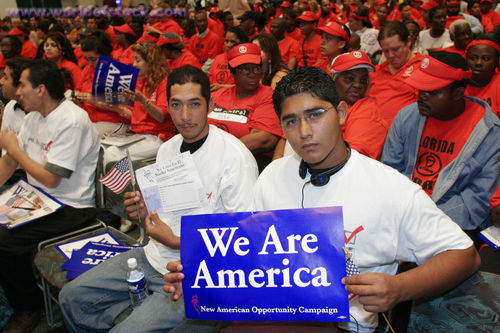
Steve Heacock’s response was a shorter version of what he has on his website, which is the longest of any of the candidates running for the 3rd Congressional District. Heacock says:
Immigration has a significant impact on national security, state and federal budgets, job creation, agriculture and our basic sense of who we are as a country. We have been and continue to be a symbol of hope for those from around the world who are looking for a better life. But our first obligation is to the safety and well being of our people.
- First, we must secure the border and stop the culture of unlawfulness at the border.
- Amnesty is not the answer and, as it has in the past, would likely only encourage further illegal immigration.
- We must enforce existing workplace and immigration laws.
- Temporary work permits should be used, on a test basis, for jobs that otherwise go unfilled. The family status issue would need to be addressed and we would need assurance that workers would return to their home country after expiration of permits.
- We also need to reform visa, immigration and citizenship services to recognize that we need knowledge workers that often can only be recruited from outside of our country. We harm only ourselves by sending people away just as they are creating intellectual property that can be commercialized.
Louise Johnson did not respond to the Press questionnaire, but she does have a position on immigration via her webpage. In fact, of all the candidates Johnson takes the strongest anti-immigration position and even uses the phrase “Illegal Aliens” as the heading for her position on this issue.
There is a process for becoming a citizen in this country. And it is a process worthy of the cause and the supreme benefits of being an American citizen. First apply for citizenship. Then allow the process to work. Meanwhile, we should provide government officials at every level the tools to enforce our immigration laws. However, local county governments should not have to house illegal aliens indefinitely in their local jails until the federal government decides to act and do it job. This is taxing our already overburdened local governments. The fact is, the federal government is not acting or doing its job. Especially in Arizona and the other border states. Still, a two- or three-week jail period until the federal government arrives on the scene appears reasonable. But our federal government must commit to following its own immigration laws and support states that have passed laws that TOTALLY obey and follow such federal laws, such as Arizona has. And before Arizona, Rhode Island!
Bob Overbeek’s response to the Press questionnaire is longer than what his website statement reads on the matter of immigration.
We need immigration reform in our country and we need a continued flow of immigrants to our country. Unless one is “native American,” one is an immigrant. This is one of the great strengths of our nation. I am fifth generation Dutch myself. We need federal policy that welcomes immigrants, and I believe that by harnessing immigrants we can smartly grow our workforce and our economy at the same time. We must ensure those who immigrate become part of our system and pay their fair share of taxes if they are to reap the benefits of our society. I don’t support amnesty; however, I want to make sure immigration reform proposals do three things: 1. Ensure there is a clear path to citizenship. 2. Make sure that path clearly states that immigrants must abide by the rule of law. 3. If they are employed that they are paying their fair share of taxes, because there is a cost to our freedom and supporting the system they benefit from.
Democratic candidate Patrick Miles Jr. has no position on this issue at his webpage, but his response to the Press questionnaire in no way can be considered liberal or progressive.
Federal immigration policy and enforcement have been a failure for a generation. But we must take the emotion and rhetoric out of the discussion and focus on the best solutions to this problem.
We are a nation of immigrants and of laws. No one should be rewarded for breaking the law. In the post-9/11 world, we must secure our borders and enforce immigration laws.
If illegal immigrants come forward, have clean records, pay back taxes or a fine, and learn English I am willing to consider giving them legalized status, but they must go to the end of the line in terms of gaining full citizenship behind those who are here legally.
The other Democratic candidate Paul Mayhue also has no information about immigration on his webpage. He did respond to the Press questionnaire and has a slightly more humane view on the matter than the rest of the candidates.
There should be a path to citizenship for people that are legally in the country. We as a country need to sort out the illegal immigrant issues and separate criminal activity from legal activity and respond accordingly to creating paths to citizenship. The borders should be secured for security reasons and threats to our national security. We should be careful about how rigorously we enforce the laws, the concept of arresting a person on reasonable suspicion goes against the grain of our US Constitution, probable cause and due process is how we need to treat this issue. We don’t need to arrest our way out of this issue, employers that hire illegal immigrants create problem in the American workforce.
First, it should be pointed out that all of the candidates use language, which suggests that their view of immigration translates into “illegal’s” (read Mexicans) who are crossing the southern border of the US. This is a very limited and reactionary view of immigration, since people from all around the world immigrate to the US every year.
Second, there is a double standard the US government applies for people applying for immigrant status. For example, for years if you showed up in the US with no documentation and were from Cuba, the US would almost always grant immigration status, but the same has response has not been applied to people coming from Mexico or Central America. This clearly indicates that politics rules immigration policy, not equal humane treatment.
Third, none of the responses that candidates gave reflect the harsh realities of people who come to the US and are undocumented. The risks that people take are tremendous and numerous people end up being sold into a form of wage slavery or are left to die in the desert. Once undocumented immigrants are detained they are often abused by US law enforcement personnel.
Fourth, the question that the Press asks about immigration frames it in such a way as to decontextualize it, thus make it more likely that candidates would respond to themes such as border security and legal issues as opposed to the rights that immigrants have and the positive contributions they have always made to this country.
What We Are Reading
Below is a list of books that we have read in recent weeks. The comments are not a review of the books, instead sort of an endorsement of ideas and investigations that can provide solid analysis and even inspiration in the struggle for change. All these books are available at The Bloom Collective, so check them out and stimulate your mind.

Ecology and Socialism: Solutions to Capitalist Ecological Crisis, by Chris Williams – This book provides an excellent analysis of the current ecological crisis we are faced with throughout the world, with an emphasis on global warming and the factors that contribute to this issue. However, unlike many books on the topic, Ecology and Socialism put at the root of the problem the economic system of Capitalism. And although the book did not provide enough “solutions” it does provide a good road map of possibilities for a future that cannot survive as long as Capitalism is the dominant economic model.
 Hopes and Prospects, by Noam Chomsky – This is Chomsky’s first full book of the Obama era and he does not disappoint. Chomsky provides us with sharp analysis of the US policy under “brand Obama” and demonstrates that there has been little difference in foreign policy besides rhetoric. Hopes and Prospects takes a close look at Israel/Palestine, Iraq, Afghanistan, the War on Terror, and Latin America. Chomsky’s keen sense of history always helps to frame the current policy with the trajectory of the American Empire.

Pornland: How Porn has Hijacked Our Sexuality, by Gail Dines – This new book provides a fresh analysis of the pornography industry that is beyond the tired debates about free speech and eroticism. Dines sees pornography as both a Capitalist enterprise with its constant need for new markets and as a source for tremendous harm. The harm that the author presents is both the harm caused to those used in the production of pornography and those who consume it. Dines makes a strong case that pornography has negatively impacted our ability to have healthy sexual relationships, because porn has moved from a marginal product to a mainstream commercial want.

The Floodgates of Anarchy, by Stuart Christie and Albert Meltzer – Reprinted from the late 1960’s, this book provides a lively collection of essays that presents the importance of political anarchism as a real and lasting solution for a liberated humanity. Christie and Meltzer bring years of experience to bare on the importance of class struggle and movement building as co-founders of the revitalized Anarchist Black Cross.
The Most Dangerous Man in America: Daniel Ellsberg and the Pentagon Papers – A powerful new documentary that looks at the individual courage of one man and the risk he took to challenge the US government. Daniel Ellsberg not only exposed the genocidal policies of the US government in South East Asia, he helped galvanize the anti-war movement of his day.
Media Bites – Jim Beam and Male Fantasy
This week’s Media Bites takes a look at a new commercial from the Jim Beam Company. In this ad a guy gets caught cheating on his girlfriend, but the girlfriend responds by suggesting a threesome. Jim Beam is not only normalizing a popular male fantasy, but going one step further by having a woman initiate the idea of having a threesome.
(This article is re-posted from OpenSecrets.org.)
After Democrats crafted 2,300 pages of legislation to tackle financial regulatory issues in the aftermath of the economic collapse that brought behemoths like AIG and Lehman Brothers to their knees, they were met with resistance from one of their own.

Sen. Russ Feingold (D-Wis.) spoke out against the bill championed by President Barack Obama because he thought it wasn’t strong enough to prevent another economic meltdown. And on Thursday, Feingold became the lone Democrat to vote against it. Feingold was in a position to stand up to Wall Street like few other senators.
Contributions from the finance, insurance and real estate sector account for just 3.75 percent of Feingold’s overall contributions over his career, according to research by the Center for Responsive Politics. Just two other senators elected to their seats have relied less on money from the financial sector: a wealthy self-funder and the Senate’s only self-identified socialist.
“Campaign contributions are very effective at slowing down reforms that need to be done from a public-interest perspective,” Lawrence Baxter, a law professor at Duke University, told OpenSecrets Blog as part of our “Crossing Wall Street” series last year.
Wall Street interests lobbied ferociously to limit the legislation’s effect on them, and they have invested in powerful members of both parties over the years. Long-standing relationships build rapport among these interests and legislators — legislators who may therefore be inclined to lend a sympathetic ear.
Contributions from the financial sector account for roughly 30 percent of all money collected by the campaign committee and leadership PAC of Senate Banking Committee Chairman Chris Dodd (D-Conn.), the bill’s chief sponsor in the Senate, the Center found — the most among all senators. Dodd’s home state of Connecticut is also home to many financial industry companies and workers.
On average, 12 percent of all campaign contributions and donations to leadership PACs since 1989 have come from the finance, insurance and real estate sector for senators who supported the Wall Street reform legislation, the Center found.
Contributions from these interests accounted for 14 percent, on average, of all contributions since 1989 to senators who opposed the bill.
While this gap is narrow for the broad finance, insurance and real estate sector, certain finance-related industries within the sector have given much more money to senators who resisted the bill.
According to the Center’s research, the political action committees and employees of commercial banks have, since 1989, given an average of 68 percent more to the committees of senators who opposed the Wall Street reform plan.
Insurance interests, meanwhile, have given 37 percent more to the bill’s opponents over the years. Special interests tied to finance and credit companies gave 25 percent more to senators who voted against the bill. And people and PACs associated with the real estate industry have contributed 12 percent more to the committees of senators who opposed the bill since 1989.
Only the securities and investment industry has given more to senators who favored the legislation. Since 1989, these interests, on average, have contributed 19 percent more to the committees of senators who voted to pass the legislation.
Here is a table summarizing the contributions since 1989 to senators’ leadership PACs and campaign committees from the finance, insurance and real estate sector — as well as various industries within that sector — broken out by the average “Yes” vote and average “No” vote:
| Average
No Vote |
Average
Yes Vote |
% Difference | |
| Money Since 1989 | $32,258,180 | $28,629,173 | +13% NO |
| Finance Money Since 1989 | $3,657,077 | $3,151,778 | +16% NO |
| Percent Finance Sector | 14% | 12% | +2% NO |
| Commercial Banks | $454,874 | $271,251 | +68% NO |
| Finance/Credit Companies | $110,182 | $88,259 | +25% NO |
| Securities/Investment | $883,983 | $1,049,342 | +19% YES |
| Insurance | $599,493 | $438,911 | +37% NO |
| Real Estate | $881,129 | $784,143 | +12% NO |
To pass the bill, three New England Republicans joined 57 members of the Senate Democratic caucus.
Since the Senate first passed a version of the bill in May, Democrats lost the vote of Sen. Chuck Grassley (R-Iowa) but won over the support of Sen. Maria Cantwell (D-Wash.). Republican Sens. Scott Brown (R-Mass.), Susan Collins (R-Maine) and Olympia Snowe (R-Maine) all voted for the original version of the legislation as well as the conference committee report.
The final version of the legislation accomplishes many things.
It establishes new regulations and disclosure requirements for the investment products known as derivatives — which have been almost completely unregulated and played a substantial role in causing the nation’s economic crisis. It also creates new rules for credit rating agencies, including penalties for inaccurate ratings. Inflated evaluations of troubled investments also contributed to the nation’s economic meltdown.
The legislation seeks to end the notion of “too big to fail” by requires financial institutions to maintain plans for their dissolution, should they need to be dismantled. It will also prevent banks from making risky investments with federally insured dollars. And it will further require hedge fund and private equity fund advisers to register with the Securities Exchange Commission.
One of the most sweeping changes in the bill is the creation of a new federal watchdog for consumer financial protection within the Federal Reserve. This Consumer Financial Protection Bureau will have the power to prohibit financial products it deems unfair or predatory, and it will implement changes such as simplified mortgage loan and credit card disclosure documents.
The legislation additionally gives the Government Accountability Office the ability to perform a one-time audit of the Federal Reserve relating to all loans and financial assistance provided since Dec. 1, 2007, in response to the economic meltdown. It also ends the government’s Troubled Asset Relief Program (TARP), which was used to provide assistance to faltering financial institutions.
Moreover, at the end of 2012, it will put toward deficit reduction any unused money from the American Recovery and Reinvestment Act (Obama’s stimulus plan). The plan also gives shareholders a nonbinding “say on pay” vote on executive compensation and “golden parachute” retirement plans.
The House adopted the conference committee report in late June. According to the Center’s research, giving by finance-related industries to House members over the years has been similar to their giving to senators.
As with the Senate, the average percentage of donations from Wall Street interests out of all contributions received by House members was just two percentage points less for congressmen who voted in favor of the legislation compared to those who voted against it.
On average, 13 percent of all campaign contributions and donations to leadership PACs since 1989 have come from the finance, insurance and real estate sector for House members who opposed the Wall Street reform legislation, the Center found.
Contributions from these interests accounted for 11 percent, on average, of all contributions since 1989 to House members who supported the bill.
And contributions from people and PACs associated with commercial banks, insurers, the real estate industry and finance and credit companies have all favored congressmen who opposed the reform legislation. As in the upper chamber, only PACs and employees of the securities and investment firms favored supporters of the legislation since 1989.
The giving from these industries since 1989 are outlined in the following chart:
| Average
No Vote |
Average
Yes Vote |
% Difference | |
| Money Since 1989 | $6,952,611 | $6,853,451 | +1.4% NO |
| Finance Money Since 1989 | $951,593 | $790,306 | +20% NO |
| Percent Finance Sector | 13% | 11% | +2% NO |
| Commercial Banks | $144,378 | $87,269 | +65% NO |
| Finance/Credit Companies | $43,341 | $32,325 | +34% NO |
| Securities/Investment | $150,763 | $166,253 | +10% YES |
| Insurance | $185,323 | $143,038 | +30% NO |
| Real Estate | $228,279 | $214,588 | +6% NO |
Many Republicans have argued that the legislation will kill jobs and that less regulation is needed, not more. Obama plans to sign the measure into law on Wednesday.
3rd Congressional Candidates on Iraq & Afghanistan

The August 3rd Primary is two weeks away, so we thought it would be useful to take a look at where the 3rd Congressional District candidates stand on major issues of the day.
One of the most pressing issues of the past decade has been the US wars/occupations in both Iraq and Afghanistan. Since 2001, nearly 1200 US troops have died in Afghanistan, while over 4400 have died in Iraq and tens of thousands more wounded in both wars. The death toll has been greater to the people of both those countries, with more than 1.3 million civilians dead in Iraq and thousands dead in Afghanistan.
The monetary cost of these two wars has also been astronomical. According to the National Priorities Project the US has spent over 1 Trillion dollars since 2001 just on these two military occupations. This amount translates into over $27 billion dollars leaving the state of Michigan and $533 million leaving Grand Rapids alone. Any candidate who was serious about government waste or local spending cuts, it is hard to ignore these numbers.
The so-called withdraw of US troops in Iraq is now under question and the Obama administration has escalated the US war in Afghanistan, which now includes Pakistan. Considering the human and monetary costs of these wars and the “no end in sight” realities, one might think that candidates running for Congress would have clear positions on these issues. Lets look at the five Republican candidates first.
Justin Amash, the darling of the DeVos clan says nothing about Iraq or Afghanistan on his website in the issues section and only makes vague comments about the role of US troops and National Security.

Steve Heacock, doesn’t mention Iraq, but he does have a position on Afghanistan. “I believe in President Bush’s freedom agenda and hope that the surge strategies will secure Afghanistan against the Taliban and ensure success for the budding democracies in both countries. But our patience as a country is understandably ebbing. Our willingness and ability to risk resources and lives for others’ freedom is not unlimited. We must quickly see that the long-term goal of having each nation supporting its own democracy is realistic and achievable.”
Bill Hardiman, a Vietnam War veteran says nothing about either war on his webpage in the issues section.
Bob Overbeek, who has pledged to not take more than $1 dollar in campaign contributions from any one person, is the only 3rd Congressional candidate to at least take a position on both Iraq and Afghanistan. “I support victory in Afghanistan and Iraq; however, we must wage these long-term wars with covert action and the limited use of Special Forces troops and air power. I do not support continued action in Afghanistan with the deployment of US ground troops en masse.”
Louise Johnson does not take a position on either of these US wars and does not mention them in the Defense section of her issues page.
There are only two Democratic candidates running for the seat being vacated by Vern Ehlers. Unfortunately, both Pat Miles Jr. and Paul Mayhue have nothing to say about the US wars in both Iraq and Afghanistan.
It seems pretty clear from a review of the congressional candidates who will be on the August 3 Primary ballot that none of them are taking an anti-war position, at least not publicly.
(This article is re-posted from FIST.)
 Glenn Beck, an extreme right-wing pundit of television and radio, has shown his outrageous racism and anti-working-class sentiments once again when he told us that Barack Obama “has a deep-seated hatred for white people” and that a massive “invasion” by undocumented workers “threatens our America.”
Beck’s anti-communism is not new, either. But he made clear his dedication to the capitalist system and racism on June 4 in a pseudo-historical lecture on his radio show. Proclaiming that the author “was doing the same things that we are doing now,” Beck promoted “The Red Network,” a book written in 1934 by virulent anti-communist Elizabeth Dilling.
The book is a tract of conspiracy theories attempting to link high government officials in the Roosevelt administration with the U.S. Communist Party and the Soviet Union. It is full of confused logic, giant leaps and baseless presumptions.
Dilling would have you believe that the very government that had just sent the National Guard to mow down communist-led strikers in Minneapolis and San Francisco was itself controlled by the Kremlin. Dilling’s text stands out, however, for its unapologetic racism and support for the newly installed regime of Adolph Hitler in Germany.
It apologizes for the massive repression and arrests of Jews by the Nazi regime, saying that most of the victims were only “Russian Jews” bent on “Red terrorist revolution” and that “German nationalist Jews” would remain untouched. Dilling portrayed the Black liberation movement as communists manipulating oppressed people to inflame them against whites.
Later in life, Dilling wrote another book called “The Jewish Religion: Its Influence Today.” Originally entitled “The Plot Against Christianity,” it blamed Jewish people for all the world’s problems. Dilling toured the U.S. in 1940 as part of the “America First Committee,” a group of fascist sympathizers who opposed war with Germany. Dilling herself was very supportive and most likely a member of the German-American Bund, a U.S. Nazi group that used the swastika as its official symbol and marched in full brown-shirt regalia.
Was Glenn Beck correct in stating that Elizabeth Dilling was “doing the same thing” he is doing? Absolutely.
In the 1930s the global capitalist economy had collapsed, and millions were cast into poverty and misery. However, a strong and powerful movement of the working class finally erupted.
Unemployed workers staged mass hunger marches and even burst into the Capitol building, challenging members of Congress to provide them with jobs or an income. Southern textile workers, organizing their workplaces with the help of the interracial, communist-led Trade Union Unity League, armed in self-defense against gun-toting company goons.
In Harlem, Black artists and writers like Langston Hughes raised the demands of racial equality and self-determination for the Black community. Mass women’s organizations demanded a constitutional declaration of gender equality, which already existed in the Soviet Union.
The capitalists could not smash these heroic uprisings with their usual bag of tricks. Many began throwing money and other support behind the fascist movement. They attacked the administration of Franklin Roosevelt as “soft on communism,” even though Roosevelt’s reforms were in fact aimed at saving capitalism.
Many describe fascism as “capitalism in decay.” The fascists were ideologically trained racists and defenders of the capitalist class. However, their propaganda pretended to be “revolutionary” and, in some cases, “anti-capitalist.”
Fascists recruited alienated individuals by channeling their rage into attacks on oppressed people and the revolutionary movement. For example, while pretending to be “revolutionary,” the fascist Citizens’ Alliance and Black Legions attacked striking autoworkers in Flint, Mich., who were demanding that the millionaire bosses recognize their right to unionize.
The Dillings of our day
Today, at a time when long-term unemployment is at its highest level since the Depression and millions are losing their homes, the movement directed by the Glenn Becks and the “Tea Party” is calling for “liberty” and an end to “big government.” Instead of attacking the capitalist class and the banks that have impoverished the workers, its target are social programs and the millions who receive very minor assistance in place of a job or livable income.
After first coming out — with much support from the medical corporations — to oppose even the meager health care reform introduced by the Obama administration, these right-wingers soon switched their focus to anti-immigrant racism. These “champions of liberty” defend the racist Arizona law that allows police to search “suspected” undocumented workers and demand proof of legal status at any time. They also try to block women’s right to reproductive choice.
While White House journalist Helen Thomas was accused of anti-Semitism and forced to resign for defending the Palestinian people, Glenn Beck can openly champion the writings of a Nazi and continue to earn millions. What better exposes the two-faced capitalist ruling class and media?
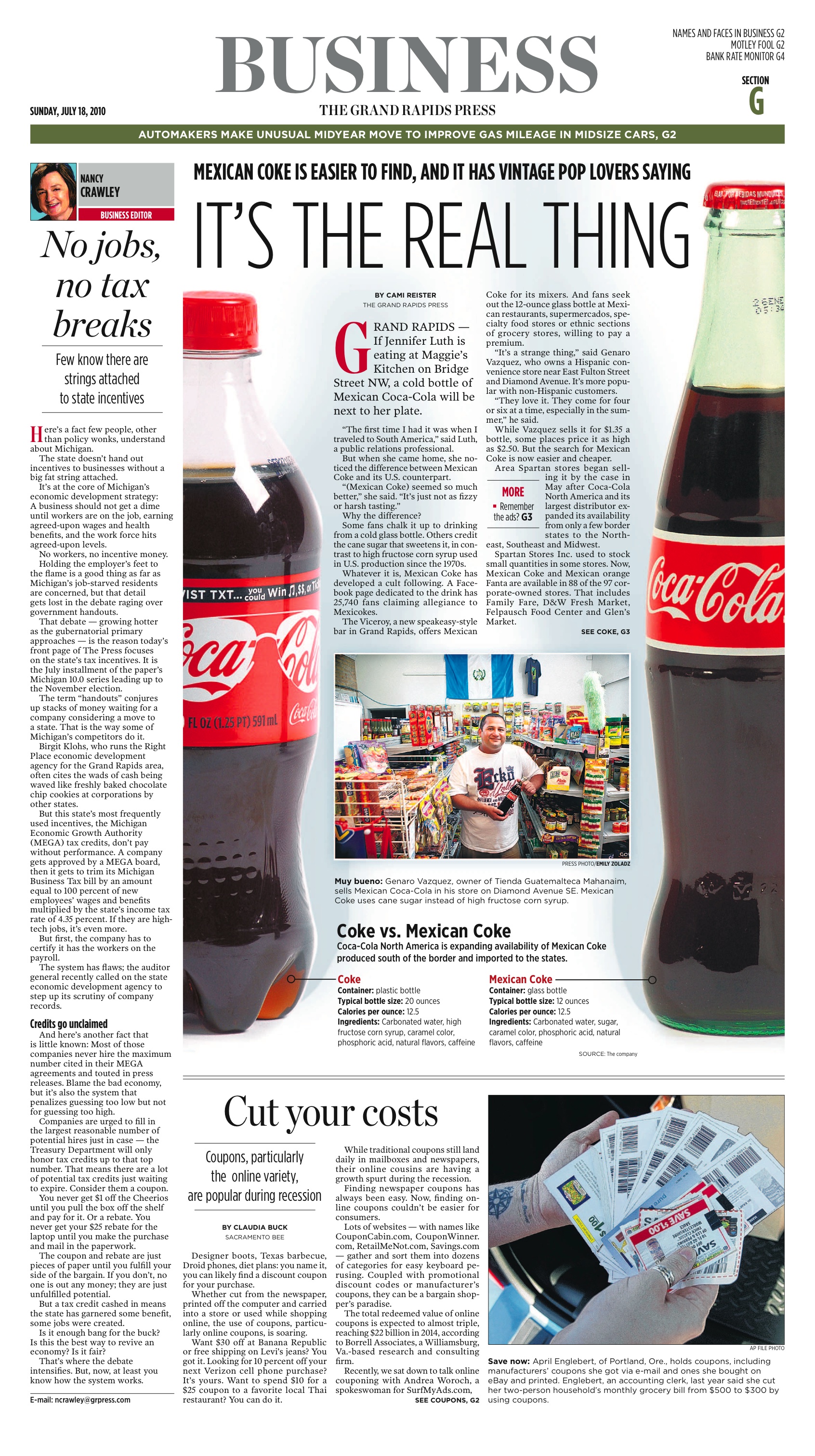
For the past month or so the Grand Rapids Press has been endorsing political candidates for County Commissioner all the way up to Governor. These are obvious endorsements, but it would be more accurate to say that news media endorses all kinds of economic and social realities on a daily basis, in part because of their own internal biases.
One other factor that determines what news organizations endorse is the fact that they sell advertising space or time. This may be painfully obvious to people, but it is worth repeating lest we forget what drives commercial news agencies – the profit motive.
However, beyond the obvious internal bias associated with commercial advertising in news media there is another kind of endorsement that in some ways is even more insidious than the apparent commercial intent of ads. More and more we see news stories that are fundamentally product endorsements. We know that PR firms often create news copy and distribute stories about products that are nothing more than veiled ads in what are called Video News Releases (VNRs), but increasingly reporters engage in the same behavior.
A great example of advertising in the form of journalism was the front-page story of the Business section of Sunday’s GR Press (7/18). Headlined in the print version of the article as “It’s the Real Thing,” the nearly 2-page story was framed to look as a consumer interest story about whether people prefer US-produced Coke (made with fructose corn syrup) or Mexican produced Coke (make with cane sugar).
The story not only is a promotional piece for Coca Cola, but for numerous local grocery stores, since the article tells readers about the numerous locations that one can buy the Mexican produced Coke from, including hyper-links to the stores.

The only journalistic component in the story was a passing comment about public concerns related to high fructose corn syrup and negative health effects, but this comment is lost amidst all the “happy” text attributed to being able to purchase Mexican-produced Coke in the area.
But maybe all is not lost. This article could be the beginning of a series of stories that the Press is planning on the soft drink giant in the coming weeks. We might see an article about Coca Cola’s theft of public water resources globally, followed by the company’s role in the murder of union organizers in Colombia.
However, the likely outcome is that the Press is not even thinking along those lines, because that kind of journalism doesn’t create what media critic Neil Postman calls “a positive consumer environment” for the public. It could be worse though. The Press could write a story about appropriate office attire with tips from local managers.
Advertisers hijack the meaning of Back to School

It’s mid-July and most of the parents I know are thinking about what they can do to make the summer enjoyable and safe for their children. People are looking for activities around the house, in the back yard, the local park and if they are lucky, short trips to the lake or campsite.
Many parents are wondering if they will have a job or if the job they have will provide enough money to pay the bills. They worry about their children’s nutrition and whether or not they have enough time to prepare healthy meals. Most parents wonder every day whether or not they are doing all they can to ensure their child’s safety. This is what parents do and this is what parents spend their time thinking about.
Now consider what advertisers spend their time thinking about as it relates to parents and their children. Remember, it is mid-summer, which means that advertisers are implementing their Back-to-School campaigns, where billions of dollars will be spent to convince parents and their children to spend billions more to ensure that students will be in fashion for the coming year.
Back-to School campaigns have become some of the most sophisticated of all ad campaigns in recent years, utilizing some of the most creative minds. AOL Advertising is using an array for techniques to reach consumers, such as their Tech campaign, which brings together some of the best electronics brands to provide a back-to-school electronics buying guide; the Spinner program, which popular soundtracks for selling products to teens and pre-teens; and PopEater, which connects celebrity fashion with youth interest.

Then there are marketing groups like School Family Media, which provide consulting services to companies to better target parents, especially moms – “moms with school-age kids – at a time and place where they are most interested in and receptive to your brand message – at school or while involved in school-related interests or activities.”

There are also the big retailers like WalMart, which goes as far as to even provide a check list for parents on what to buy for their children’s back-to-school needs, from kindergarten on up. The retail giant is also a big supporter of Box Tops for Education, a campaign designed to get families to buy branded products as an incentive for raising money for schools.
However, the company that best exemplifies the back-to-school marketing hype is JC Penny. JC Penny all the current social media sites and techniques that are way ahead of the rest of the back-to-school marketing world. Their 2010 campaign is called “New Look. New Year. Who Knew,” and features a “school picture day” video campaign, where teens take over this decades long school function to promote the newest JC Penny Teen fashions.

In addition, the JC Penny back-to-school campaign features a partnership with Supergirl by Nastia, and another skater event the Dew Tour, which will feature as a major sponsor exclusive clothing brands through JC Penny. JC Penny will also be targeting youthful ethnic minorities in their back-to-school campaigns by sponsoring the largest Hispanic music awards, Premios Joventud and the Secret International Agents concert, which showcases the talents of the best of young Asian and Asian Americans.
JC Penny continues to be a leader in the mobile space, bringing its products directly to teens’ fingertips with a special Back-to-School WAP site (jcpteen.mobi). This mobile hub includes JCPenney’s Back-to-School TV spot and an opportunity to opt-in and receive weekly texts on the latest Back-to-School looks; view Back-to-School styles and even upload their own look, which can be voted on and shared with friends.

Of course, one of the most popular tools that JC Penny has used to tap into the teen and pre-teen market is their Facebook page, JCP Teen. At the site, one can view all the back-to-school media – still ads, video, games and the full product line. Members are invited to share ideas and vote for their favorite items, as the company uses this information to sharpen its marketing campaigns in the future.
So, while parents are busy trying to make ends meet and minimize the negative influences the world can sometimes have on children, Corporate America is hard at work in order to manipulate you and your children into associating back-to-school with fashion and product consumption.
We may all desire that our children get a good education, have the best learning environment and even develop good critical thinking skills, but if we do not come to terms with what back-to-school marketers are doing then we will fail our children. We must understand that the fundamental economic principle of capitalism is growth and that translates into a constant need to get us to buy more clothing and other items in order for our children to have a proper “educational experience.”
The Grand Rapids-based group, Stop Targeting Our Kids (STOK) understands the importance of this issue and has resources available to help parents and anyone in the community who think it is unconscionable to manipulate the children of our community. You can find them on Facebook and join in on their local efforts to defend children and to counter-act the effects of commercialism in our lives.
Afghanistan Violence Soars

(This report is re-posted from Al Jazeera.)
More than a thousand civilians have been killed in the war in Afghanistan this year alone, an Afghan rights group has reported.
The Afghanistan Rights Monitor said recent statistics show more than 1,000 civilians were killed in the first six months of 2010, with over half of them dying in suicide attacks and roadside bombings.
Among those killed and injured were children.
As Al Jazeera’s Zeina Khodr reports, the war’s escalation has taken a huge toll on the Afghan people and its children in particular.
 Grand Rapids Institute for Information Democracy