A Celebration of Killing
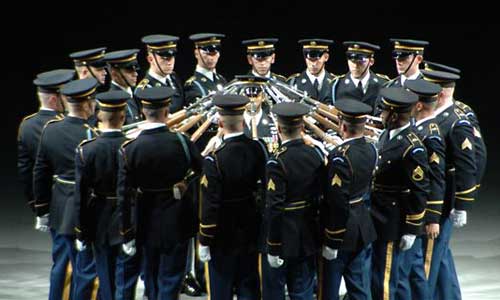
Recently GRIID has been in correspondence with Amanda Stuart, a local parent who made contact with Stop Targeting Our Kids (STOK) after going with her child’s school to see The US Army’s Spirit of America performance at the Van Andel arena. GRIID had a chance to interview her about that experience.
Amanda, can you tell us about how the event you took your child to see was promoted? What did you expect it to be?
I volunteered to drive for the class field trip. It was promoted to the teacher as an educational event on U.S. history. I don’t think she realized it was U.S. Army sponsored. I didn’t know who the event sponsor was until we arrived. The only thing I saw ahead of time was a glimpse of a poster with the photo of someone in a revolutionary war uniform. It made me wonder if this would be a history of the U.S. through the history of war. Another parent and I spoke with the teacher about it ahead of time.
Describe some of the content of the event/show?
I was presented as a pep rally for the U.S. Army and its war history, complete with loud music, lights show, machine gun fire and soldiers in fatigues throwing free t-shirts to pump up the crowd.
What disturbed you most about the messages that the US military was sending, particularly to children?

I thought they might try to glorify the army and war and skim over the killing and dying. They did not skim over the killing and dying. They included the killing and dying and tried to glorify those aspects as well. There was a whole musical number about the U.S. flag being something worth killing and dying for. The narration said war is a way the nation reaches its goals without mentioning any of the peaceful ways goals are met. Soldiers playing WWII soldiers talked about planning to kill as many Germans as they could without bothering to examine the reasons. That specifically was probably the most disturbing because I was sitting beside a child whose mother was born in Germany and part of my own family comes from Germany. The crowd was in a cheering frenzy throughout much of the performance. It was nauseating.
Would you say that the event you attended was a form of propaganda? and do you feel like you were misled about what you were going to see?
This was definitely U.S. Army propaganda. In fact, one of the questions that I wrote down during the show as I was noting critical thinking questions for the class was: “What does the word propaganda mean and were there any aspects of propaganda in the show?” As the show began, the announcer read the names of the schools in attendance. I’m sure Army recruiters were scheduled for visits to those schools to follow-up on the excitement of the performance. If I were to describe the performance without assigning a place, someone might mistake it for a spectacle put on by a military dictatorship.
As a parent what lessons did you learn from this experience and what would you want other parents to think about when presented with this kind of information?
We teach children to solve their own problems with their words, not by hurting others. Peace begins there. War is not a backdrop for happiness. We have to expect the same peaceful resolution of conflict from adults that we try to teach to our children. Another parent in attendance told me that she thinks normal people should know the difference between military and civilian killing. I don’t see a difference. Killing is killing. Even if I were someone who says military murder is not really murder, too many civilians end up dying in the crossfire for any of it to be justified.
IWW screens “Plunder: The Crime of Our Time”
 Grand Rapids IWW Free Movie Night
PLUNDER: The Crime of Our Time
7 p.m. Thurs. Oct. 21
Trinity United Methodist Church
1100 Lake Dr. SE Grand Rapids
“When plunder becomes a way of life for a group of men,they create for themselves, in the course of time,a legal system that authorizes it,and a moral code that glorifies it.”– Political economist Frederic Bastiat, The Law [1850]
“I used to think of Wall Street as a financial center.I now think of it as a crime scene.”– Filmmaker Danny Schecter, Plunder (2009)
According to its promotional Web site, Plunder: The Crime of Our Time explores how the financial crisis was built on a foundation of criminal activity, showings how Wallstreet scammers recklessly put trillions of dollars and the world economy at risk.
This pyramid of fraud led to the massive foreclosures affecting 10 million homeowners, rising unemployment, economic collapse and increasing hardships worldwide. It connects the dots identifying who the victims and beneficiaries are in what “may well turn out to be the greatest nonviolent crime against humanity in history,” As Graydon Carter, editor, Vanity Fair states, ” . . . never before have so few done so much to so many.”
The film reveals the complicity of the major media outlets, which failed to sound the alarm or investigate wrong doers. It’s also a call to action: if action is not taken real lessons will not be learned or applied and another crisis may be looming as the underlying problems are still there.
“This is a story that must be told if economic justice is to have any meaning,” says Schechter, “Plunder demands a full investigation into who is responsible for the crisis and an appropriate punishment . . . This crisis is not about the unintentional mistakes of a greedy few but a crime that effects us all.”
View the trailer:
How “Breast Cancer Awareness” Campaigns Hurt
 (This article is re-posted from PR Watch.org)
October is Breast Cancer Awareness month. Pink ribbons abound at department stores, grocery stores, gas stations, shopping malls and many other places. But the big “awareness” push may be misplaced. After all, lung cancerkills twice as many women each year as breast cancer — more women every year in the U.S. die from lung cancer than from breast, uterine, and ovarian cancers combined. In 2009 alone, 31,000 more women died of lung cancer than breast cancer. But there aren’t any ribbons, theme-colored products, corporate promotions, colored car magnets, festivals or fundraisers to make people aware of lung cancer’s devastating toll, or to support lung cancer victims or raise money for a cure.
Why not?
Sex Sells
Because female breasts are sexy, and sex sells. Lungs and other organs — and theircancers — just don’t have the same zing. Lung cancer may be the country’s number one cancer killer, but people are unlikely to flock to buy weird and inappropriate “lung cancer awareness” products like a colored “lung cancer awareness” hand gun, a “colon-cancer awareness” floating beer pong table or a bile-colored “pancreatic awareness” toaster. Lungs, pancreases, colons, prostates and other hard-working internal organs are just plain unattractive marketing tools — they don’t sell stuff. They are asexual, and hidden, and we like them that way. Not so with breasts. Female breasts conjure up buying power like few other organs, and the “breast cancer awareness” theme gives corporate America a legitimate “in” to link female breasts to sales of just about anything — a winning combination for marketing purposes.
People also tend to blame lung cancer victims for their own disease, since smoking causes lung cancer. Never mind that cigarette companies engaged in 50 years of fraud and deception in advertising their products, or that they magnify the addictiveness of cigarettes by free-basing nicotine and performing other hidden chemical hanky-panky with tobacco. It’s all the smoker’s fault for getting cancer.
And What About Men?
Virtually all breast cancer awareness campaigns are silent about the fact that breast cancer also affects men. Men are at a diagnostic disadvantage for the disease because they are not urged to conduct self-exams or get screening mammograms the way women are. Ignorance about male breast cancer leads to long delays in diagnosis, reducing men’s survival rate. Since the public is repeatedly told that breast cancer is a woman’s disease, men have difficulty accepting the diagnosis when they are affected, even to the point of keeping their diagnoses secret. Male breast cancer victims also face a terrible stigma from society. One public health clinic refused to give a man a mammogram because he was a man. A neighbor of mine whose whose husband died of breast cancer (and who enlightened me about the toll the disease takes in men) told me that after his diagnosis, her husband’s own friends jokingly derided him for having a “woman’s disease.”
When it comes to men, “breast cancer awareness” promotions as they are currently conducted, with their over-the-top emphasis on women’s breasts, do more harm than good.
So It’s All About Women’s You-Know-Whats (Snicker!)
 These days, many breast cancer promotions have cringeworthy, degrading overtones that convey all the respect of drunken sailors at a strip club. A southern California company called “Save the Ta Tas” (phone 1-877-MY-TATAS), sells T-shirts with embarrassing slogans like “Caught you lookin’ at my Ta Tas” and “I love my big Ta Tas.” The company donates a small portion of sales from these items for research. A television commercial shows a woman wearing a skimpy bikini walking next to a swimming pool. Men gawk at her chest. The camera zooms in to focus on her jiggling breasts and a message fills the screen, “You know you like them. Now it’s time to save the boobs.” The ad invites viewers to attend an event called “The Boobyball Party.” Hard Rock Hotels are advertising “Get into Bed for a Cure.” There’s even a horrifyingly-named “Beat the Hell Out of Breast Cancer” festival in Bryan, Texas, which offers promotional bracelets that say, “I Love Boobies.” Flanigan’s Boathouse in Malvern, Pennsylvania offers a happy hour called “Tips for Tits.”
Ugh.
Alcohol Un-Awareness
Alcohol manufacturers have started offending breast cancer survivors by using femalebreast cancer to sell liquor. California’s Marin Brewing Company sponsors “BreastFest.”The Russian River Brewing Company in Santa Rosa, California has “All Hopped Up for the Cure,” and Sweetwater Brewery in Atlanta minces no words with its ““Beer for Boobs”festival, promoted with the snickering tag line, “It’s all about the boobs!” Delta Airlines’ October in-flight magazine asks airline customers to “join Delta in the fight against breast cancer” by purchasing a pink martini made with Skyy Vodka and Minute Maid Pink Lemonade for $7. The Chambord liquor company urges people to “pink your drink”, saying that “by adding a splash of Chambord to any cocktail, you’re supporting breast cancer awareness year-round.”
Liquor companies persist in linking their products to breast cancer awareness even though the National Cancer Institute warns that “even moderate drinking has been shown to increase the risk of breast cancer,” and theAmerican Cancer Society says “The use of alcohol is clearly linked to an increased risk of developing breast cancer.”
Barbara Brenner, Executive Director of Breast Cancer Action, sums it up by saying, “Anybody trying to sell alcohol to promote breast cancer awareness should be ashamed of themselves.”
Time for Self-Examination
Come October we are inundated with often mindless, embarrassing, even harmful and degrading pink cause marketing promotions. October, then, is a good time to urge consumers to look critically at marketing campaigns that persuade us to buy products by leveraging the emotions generated by a deadly disease, or employing sexual overtones to sell products. At the very first sign of pink, consumers need to start asking critical questions like “Is the product being sold actually good for us?” “Is the promotion appropriate?,” “How would a breast cancer victim — male or female feel toward this promotion? Would they consider it offensive?” and “Could I do more good if I donated money directly to a reputable disease research organization instead of spending it on this product?”
Chances are the answers to those questions will help consumers see that they’ve been taken for a ride on an often inappropriate and sometimes offensive rising tide of corporate pink.
The Press takes a “clean up” tour with Enbridge

What happens when a major energy company, which was responsible for one of numerous environmental catastrophes, invites the media to a “clean up” tour? Answer: the news media takes them at their word.
This is a conclusion that any sane person would come to after reading yesterday’s Grand Rapids Press article entitled, “Enbridge gives tour to show most of the oil from Kalamazoo River spill has now been cleaned up.”
Reporter Chris Killian begins the article by describing what he believes is a recovering eco-system along Talmadge Creek. He states at one point, “Life is slowly returning to normal at ground zero of one of the worst oil spills in Midwest history.” Now, I don’t know what kind of environmental knowledge this reporter has, but I’m not sure that just looking at an eco-system is enough evidence to make the kind of value judgment that the reporter does.
Beyond the reporter’s own observations the only other source he relied on for this story was someone from Enbridge’s management team. Not surprising since the occasion for the Press reporter’s visit to the Talmadge Creek was to take a “tour” of the area affected by the oil spill.
Sure the article mentions EPA requirements for the clean up, but no one from the EPA was interviewed for the story in terms of how the clean up is going. The Press writer did not speak to any of the local residents, local biologists or environmental groups as to their assessment of the short-term impact of the Enbridge caused oil spill. Instead they just took the word of the company that caused the disaster in the first place.

We have noted this kind of coverage in the Press in recent months, such as a story in August based on an interview with the CEO of Enbridge. In this most recent article they even used clean up data that was also provided by Enbridge, again without any verifications of whether or not the data is accurate or independent data from a different source.
This type of reporting is completely unacceptable, especially considering that Enbridge has been responsible for at least 610 documented spills, according to a report put out by Tar Sands Watch. At a minimum, the reporter should have been painfully clear up front that his story was based on a tour hosted by the company and for the media. Maybe a disclaimer at the beginning of the article would have been in order.
Direct Action for Social Change Potluck/Discussion
 Direct Action for Social Change
Potluck Discussion
2 -4 p.m. Sat. Oct. 16
The Bloom Collective
671 Davis NW (corner of 5th & Davis)
Free! Bring a dish to pass. The Bloom will provide vegan options.
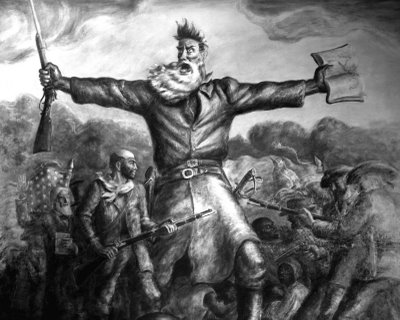
On October 16, 1859, abolitionist John Brown and several followers seized the United States Armory and Arsenal at Harpers Ferry. Their intention was to arm slaves and start a slave revolution that would end slavery in the United States. The raid on Harper’s Ferry failed and Brown was executed for treason. However, the actions of Brown’s men brought national attention to slavery.
Brown had grown tired of pacifist abolitionists. He proclaimed, “These men are all talk. What we need is action—action!” He has been lauded as “one of the most perceptive human beings of his generation,” the man who “killed slavery, sparked the civil war, and seeded civil rights” and “an American who gave his life that millions of other Americans might be free.”
In honor of John Brown, The Bloom Collective will host a potluck discussion Saturday about the role direct action has played in bringing about change throughout history and how direct action is still relevant today.
In this 2009 Democracy Now! video clip from “The People’s History of the United States,” Howard Zinn and actors Harris Yulin and James Earl Jones share John Brown’s legacy:
(This video is re-posted from The Nation.)
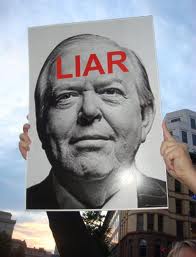
There’s no doubt that the reported $6 million a year Dobbs raked in while bashing undocumented immigrants at CNN has helped him amass real estate, and boosted his family’s profile in the elite world of horse shows. But without undocumented immigrants, just who would look after Dobbs’s properties?
Levin releases report on private security contractors in Afghanistan
On Friday, the Senate Armed Services Committee released a report on the role of private security contractors operating in Afghanistan.
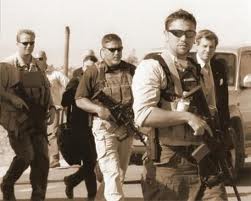 Michigan Senator Carl Levin is the chair of this committee and he released a statement on Friday to announce the release of the report. In his statement Levin says:
“The committee’s investigation uncovered a significant amount of evidence that a number of security contractors working under Department of Defense contracts and subcontracts funneled U.S. taxpayer dollars to Afghan warlords and strongmen linked to murder, kidnapping, and bribery, as well as to Taliban and anti-Coalition activities. It also revealed wasted resources, dangerous performance failures, and wide gaps in government oversight that allowed such failures to persist.”
The 89 – page report (some of which is blacked out – like most declassified US government documents) also has 12 conclusions, 3 of which are highlighted in Levin’s statement. Those three conclusions are:
- Conclusion 1: “The proliferation of private security personnel in Afghanistan is inconsistent with the counterinsurgency strategy.”
- Conclusion 2: “Afghan warlords and strongmen operating as force providers to private security contractors have acted against U.S. and Afghan government interests.”
- Conclusion 4: “Failures to adequately vet, train and supervise armed security personnel have been widespread among Department of Defense private security contractors, posing grave risks to U.S. and coalition troops as well as to Afghan civilians.”
At the end of his released statement, Senator Levin says, “We need to shut off the spigot of U.S. dollars flowing into the pockets of warlords and powerbrokers who act contrary to our interests and contribute to the corruption that weakens the support of the Afghan people for their government. Our commanders have taken first steps toward identifying abuses and I am hopeful that they will act aggressively to fix the problem.”
What Senator Levin fails to acknowledge is that the warlords he is referring to were some of the same men who the US trained and funded during the counter-Soviet occupation of Afghanistan in the 1980’s. Many of these same men are close to or make up part of the Karzai administration, which the US has backed over the past 8 years.
In addition, Levin and the Senate Armed Services Committee do not take ownership for the lack of oversight of how US tax dollars are being used by private security contractors in Afghanistan, especially since most of those Senate members voted for said funds.
Lastly, it should be pointed out that Levin never clarifies what “our interests” are in US occupation of Afghanistan, now in its 10th year. Maybe the liberal Senator should ask himself if Afghan civilians who are being killed, tortured, detained and terrorized by US soldiers and private security contractor care about US interests in their country.
Looking at Columbus Day through Native Eyes
Yesterday, students, faculty and the community members were invited to an event held on the GVSU campus called Rethinking Columbus. The event was organized by people from the local Native American community and was designed to get the audience to rethink their views on Columbus Day.
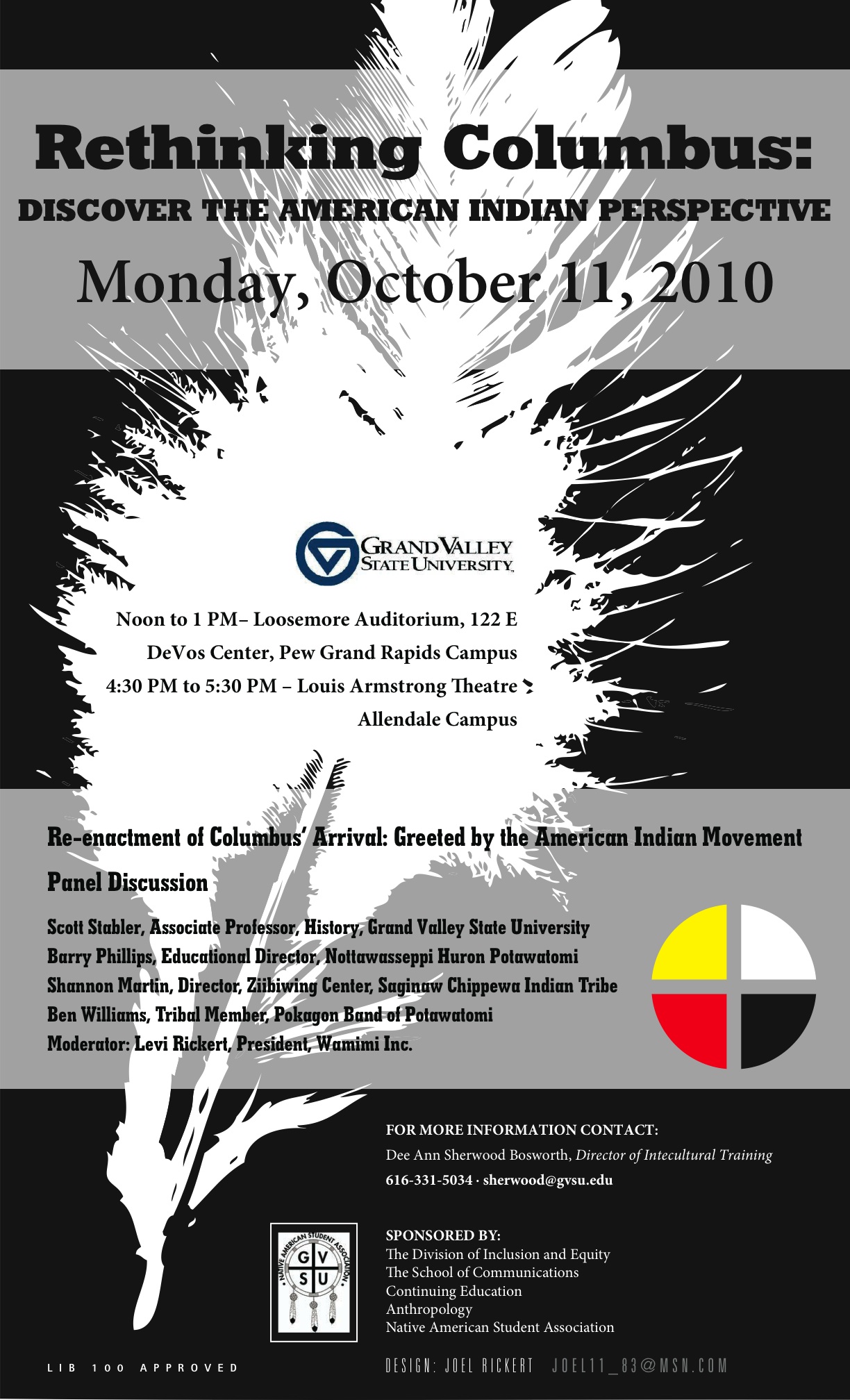
The event began with a short play written by Dee Ann Sherwood Bosworth who is the Director of Intercultural Training at GVSU. The was a re-interpretation of Columbus’s “arrival in the New World,” where he was greeted by members of the American Indian Movement (AIM).
In the play Columbus is asked for his passport and green card. Upon hearing that Columbus believes he is in India, the Native people tell him that he is lost and should just get back on his boat and leave. The play wove in aspects of the historical record of the genocide that was perpetrated against Indigenous people with the European conquest and how Native people have survived that history, most recently through the formation and work of the American Indian Movement.
After the play there was a panel discussion, consisting of Shannon Martin with the Saginaw Chippewa Indian Tribe, Barry Phillips a Nottawasseppi Huron Potawatomi, Ben Williams with the Pokagon Band of Potawatomi and Scott Stable, a history professor at GVSU. The panel discussion was moderated by Levi Rickert.
Levi began by asking panelists what the “celebration” of Columbus Day means for Native people. Shannon Martin told the audience that the perpetuation of that history needs to be seriously reconsidered. “As Native people we need to have our own show and tell for how Native people have been treated throughout US history. One problem is that the burden of truth telling falls to the Native communities, since it is not honestly represented through the current education system.”
Barry Phillips responded to that question by saying there are a growing number of educators that want to teach history from a Native perspective, but they don’t know where to get information, so “we need to get that information to those who are teaching our children.”
Ben Williams said we need to seriously investigate the history of conquest and the meaning of Columbus Day. “It is appalling that Columbus is still being celebrated by groups like the Knights of Columbus.”
Levi asked Scott Stabler how Columbus Day even came about in the US It was a way to gain votes amongst the Italian community in some communities but did not become an official holiday until FDR made October 12 a national holiday in 1937. In 1971 the US Congress made Columbus Day the 2nd Monday of October in order to have a 3 day weekend.
The next question asked of the panelists was what are some of the alternatives to celebrating Columbus Day. Barry Phillips said, “Many of us believe it shouldn’t be celebrated at all.” Shannon Martin stated, “we need to establish Indigenous People’s Day in Grand Rapids, we have to change the focus of the day, to really celebrate Indigenous heritage and history.” She also stated that many countries in Latin America have renamed the day and call it Indigenous People’s Day. Ben Williams thinks these changes are necessary but said it will be a slow process, “since it will not be a priority for politicians to want to change the holiday.” Scott Stabler mentioned that at some campuses Indigenous People’s Day is already celebrated, but as long as it is a federal and state holiday there will continue to be a huge gap.
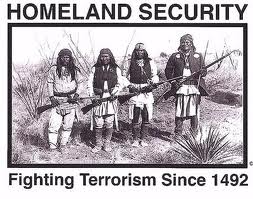
The next question posed to the panelists was how this ugly history impacts the present? Barry Phillips believes there has been a generational impact, from theft of land to boarding schools. “We are still feeling the effects of genocide today.” Ben Williams thinks that there are parallels to today. “Columbus was a terrorist and that is the language we need to use.” For Shannon Martin the genocide is still continuing, “not with the search for gold and spices, but with oil. And it will keep continuing until truth telling is part of the education system.”
After the panel discussion, the audience was invited to ask questions or make comments. A local Native American activist Roger Williams stated, “Until America changes nothing will happen in this country…….whether it is media or sports mascots, these things all impact us. Until we demand change, nothing will happen. Respecting our spirituality is key, so when you all go back to your churches, be advocates for us so that your people respect our beliefs.
Another Native woman told the crowd that their prophecies say that “progress” and “over consumption” will happen and be the fall of this world, but it also says that people can unite, especially when other people come to them for understanding and knowledge.
Both the play to the panel discussion provided valuable information about the genocidal history of the US, but they also provided powerful messages about the resiliency of Native culture and the respect for all living beings.
Holding Media Accountable on Sexual Assault Reporting
Over the past 10 years GRIID has worked with the Kent County Sexual Assault Prevention Action Team. Part of that work has consisted of documenting how local news media reports on sexual assault.

After conducting numerous studies on this issue the Action Team came up with a list of recommendations (see GRIID Media Activist Toolkit page 12) on how the news media can report on this issue in the future. In addition, GRIID participated in helping to create a reporting guide for journalists with the Michigan Coalition Against Domestic and Sexual Violence.
These resources provide reporters with information and ideas on how best to report on this critical issue in our community. Despite these resources being available, some reporters still continue to engage in reporting that reflects a lack of understanding on these issues.
This was the case with a recent story that appeared in the Muskegon Chronicle and on MLive.com. The article includes a comment from a resident who lived near the bus stop, where a child was abducted and assaulted by a man. The comment was putting blame on the mother of the victim, which may be that person’s opinion, but is not relevant to the story and it promotes victim-blaming attitudes.
Members of the Kent County Sexual Assault Prevention Action Team make it a point to contact reporters when they see this kind of coverage as a way of encouraging reporters to think about these issues and to hold them accountable for the potential influence they have on public opinion. Here is the letter that one of the Action Team members sent to the reporter.
Dear Ms. Peters,
I am the coordinator of the Kent County Sexual Assault Prevention Action Team and would like to encourage you to stop promoting victim-blaming attitudes in news coverage of violence.
“Who would have a baby out there alone?” Jones said. “You don’t send a baby out there without her mom.”
This comment from your article regarding the child that was abducted and assaulted from a Muskegon bus stop is not at all relevant to the story, hurtful to the victim and her family, and supports the attitude of blaming the victim, or in this case the victim’s mother, rather than the man that assaulted the child. I do not believe that is was the intention of this article, however, that is the point that was made.
It will take our entire community to change victim blaming attitudes and as a journalist you could have a very powerful role to bring about this change. I have attached a resource that offers some suggestions for journalists that may be helpful to you.
Thank you for your consideration.
Best Regards,
Amy Endres Bercher
Journalist Anand Gopal speaks at Calvin College
(This article first appeared on the Rapidian.)

Renowned free-lance journalist Anand Gopal gave a startling talk Friday night to a crowd of around fifty people at Calvin College. Gopal, who has reported from Afghanistan for the last three years was full of current information, having just left the war stricken country four days ago.
Gopal’s reporting has been from not only the perspective of the U.S. military, but Afghan civilians, as well as embedding with Taliban insurgents.
The reporter began his talk by sharing a story in which he traveled into the mountains to meet with a Taliban leader. Upon meeting him, Gopal said the leader asked him a number of questions, including why United States citizens voted for Barack Obama if he was only going to send more troops to fight in Afghanistan, and why we allow our women to walk around without any restrictions? Gopal said he told the Taliban leader that both of those questions were far too complex for one person to answer.
One of the highlights of Gopal’s talk was the historical context he was able to provide. He went into great detail about how in 2001, after the US invaded, most of the Taliban surrendered within a month or two. Many of them fled into Pakistan he said. After a short time many wanted to come back to their lives, and vowed to abstain from participating in any kind of politics within Afghanistan. Gopal said that US policy makers refused that request. “If that happened today we would jump on it,” he added.
Gopal said that 2010 has been a record setting year in Afghanistan in terms of violence. “2009 was before that, 2008 before…each year sets a new record”.
Gopal shared a number of stories from Afghan civilians and Taliban insurgents to underline his point about how detrimental US policy has been in the country. One such story was about a man who was a Taliban commander at the time of the United States invasion. The commander and his 43 troops surrendered to Afghan militia forces almost immediately in the hopes of getting amnesty and vowing to abstain from political life. Gopal said that despite the fact that this man had already surrendered all his weapons, the militia believed he had more. Gopal said they hung him upside down by his ankles for eighteen days and whipped him. Eventually his family went and bought weapons from the black market to hand over to the militia to have him freed. This man was arrested two more times, and tortured by US forces as well as Afghan militia. Each time in order to have him freed, Gopal said the family had to pay money or give weapons to Afghan forces.
“These men who tortured him were allies of US Special Forces,” Gopal said. “The Taliban came back to get rid of these militia forces.”
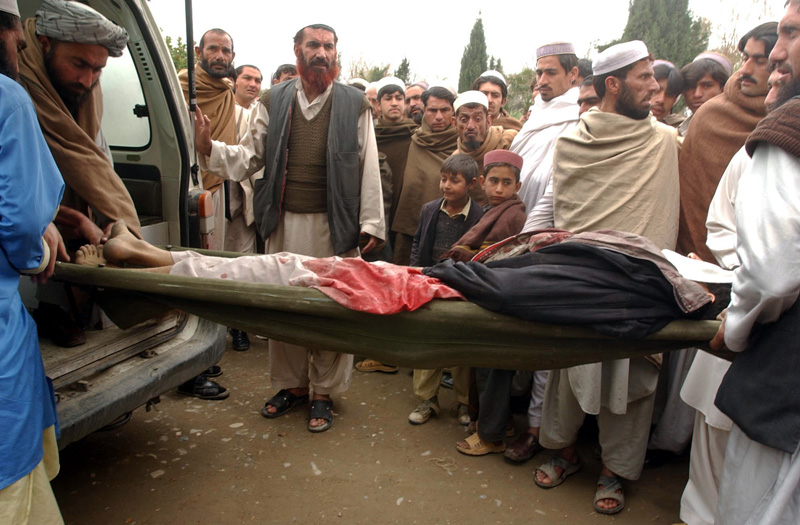
Another story Gopal shared was about a 13 year old boy whose parents were killed in a US air strike. Gopal said that the boy found the severed head of his mother in the rubble of the destroyed building. The boy was so traumatized he carried the head around with him and would not let go of it. Eventually a tribal elder came to the boy and suggested that the honorable thing to do would be to bury his mother’s head and then take revenge. The boy was trained as a suicide bomber and given the mission of assassinating an Afghan government official. Gopal said the boy went into the building where the official worked and was spotted just before detonating. He is now 17 years old and in an Afghan prison.
As far as current policy, Gopal said he does not see any chance that the Obama Administration’s plan for a July 2011 withdrawal will happen. “The Afghan security forces will not be ready”. Gopal added that he recently visited an Afghan military outpost and what he saw left him with very little hope. “There were only 17 soldiers there…most of them were too stoned to fire their guns.
An important point that Gopal made was in regards to the United States fighting the Taliban as part of the global War on Terror. He made it clear that the Taliban’s interests are strictly on a local level. “I have never met a Taliban member who has talked about attacking America.” He also said that while he views the Taliban as a despicable regime, many of America’s allies, such as Saudi Arabia, do not have better human rights records.
Gopal said it is not only his belief, but the hope of many Afghan civilians that the best outcome at this point would be a negotiated settlement between all the interested parties, which include the US, the Taliban insurgents, members of Afghan president Karzai’s government, and members of the Pakistani government.
“A negotiated settlement and withdrawal [of US troops] could give Afghanistan a chance of peace for the first time in 30 years.”
Disclosure: I was a part of the group that contacted Anand Gopal about speaking in Grand Rapids

