Deals with the Devil
There’s a joke that’s been circulating in Canada for a few years now. A Canadian student is asked during a geography lesson if he’d like to live in the US. The child says no. Asked why, the child replies, “Because I’d be shot sitting on my front porch, and I wouldn’t be able to afford to go to the hospital.”
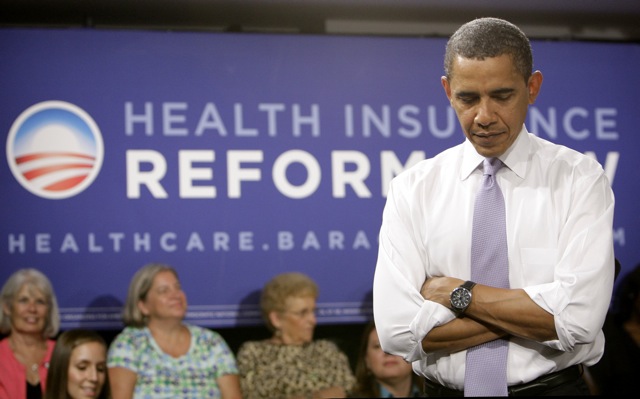
Maybe the Canadians find this joke hilarious because the United States health care “system” has made us a laughingstock in the global community. A recent report from BBC news recapped the fact that our “unregulated fee-for-service,” for-profit health care has increased in cost at twice the rate of health care in other countries, and at the same time is causing our lowered life expectancies.
When President Obama was campaigning for office, he claimed he was going to break the backs of the big insurance companies and create universal coverage in the United States. After a year-long political theater production, health care “reform” turned out to be this: Every American would be compelled by law to buy health care—apparently whether it was affordable or not. Abracadabra, universal coverage!
We can’t be surprised that Obama’s final twist was to offer massive concessions to the capitalists; after all, many of them fueled his campaign. And now, empowered by their behind-closed-doors bailout, everyone is working to find ways around the few tattered regulations that have gone into place. For example, 30 large employers were just given waivers from the law that required them, because of their size, to provide employee insurance. One of the exempted companies is McDonald’s.
So we can’t be surprised by the news published in the Grand Rapids Press on October 19: A number of Michigan hospitals allegedly made deals with Blue Cross Blue Shield in a price-fixing scam to eliminate competitors.
The Press article chose to give the story that local spin that Editor Paul Keep seems to feel is so vital. This made the text almost incomprehensible by burying the real lead to promote the Grand Rapids story angle. I had to access the Detroit Free Press in order read an article that clearly laid out the specifics of the deal.

“Millions of Michigan consumers have paid higher health insurance premiums over the last three years because Blue Cross Blue Shield of Michigan forced at least 70 hospitals statewide to charge its competitors more, according to a lawsuit filed Monday…” the Free Press stated.
Veteran reporter Patricia Anstett went on to explain that BCBS appeared to be crushing its competition with a price-fixing scheme. The Blues even offered to temporarily pay more for services if a hospital agreed to charge other insurance companies even higher rates. Even so, everything worked out for the Blues. One hospital in Royal Oak charged Blue Cross’s competitors about 25 percent more than it charged BCBS.
BCBS continually claims that since it’s the only insurer in the state that must accept all applicants—something that is supposed to change under the new Obama regulations—it is compelled to level the playing field in order to make ends meet. But the investigation showed that the company has raked in huge benefits.
Did the Blues then pass on its newfound wealth to patients? Of course not. The company added to its “reserve fund,” now standing at $3 billion. It contributed to political campaigns. It gave big raises to its top executives. Because that’s how the capitalists roll.
Meanwhile, the Free Press reported that one customer in Southfield, Michigan, has endured 25 percent worth of increases over the past five years for what he calls a “bare bones policy” that doesn’t really cover his needs.
As other industrialized countries in the world provide their citizens with health care that far exceeds ours and costs a great deal less, it looks like we’ll be enduring this continuing road show of corruption and greed for some time to come.
When even the President of the United States bows down to the Goliath health care industry, it’s clear the only hope is for working people to unite and break the death grip that the capitalist regime has on this country. Nothing less will allow us to enjoy the same care that other citizens of the world have as their right, not as a privilege of the rich. And Canadian humor aside, that’s no joke.
BP Campaign Cash: Still Toxic Six Months After Oil Spill
(This article is re-posted from OpenSecrets.org)
 Money from the political action committee of beleaguered oil company BP largely remains a toxic asset in Washington following the massive Deepwater Horizon oil spill in the Gulf of Mexico, which started six months ago.
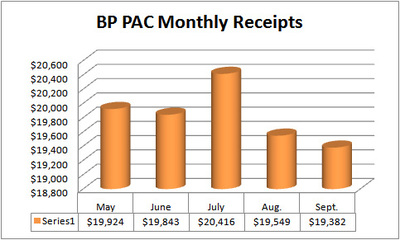
BP’s PAC did not write a single check to federal lawmakers in September, according to a Center for Responsive Politics review of campaign finance documents filed today. In fact, the PAC has not donated a dime to any federal lawmakers since May.
In May, BP’s political action committee wrote a $1,000 check to Rep. Charles Gonzalez (D-Texas), a member of the House Energy Committee, but Gonzalez never pocketed that contribution, as OpenSecrets Blog previously reported.
Instead, the PAC has focused its attention during the past several months on state-level candidates. Even then, some legislators and state-level politician seem to prefer Gonzalez’s approach of distancing themselves from the company.
Last month, the PAC wrote off contributions totaling $14,100 from 38 lawmakers in Indiana, according to OpenSecrets Blog’s review of campaign finance documents.
BP’s PAC had sent these politicians checks in June, as OpenSecrets Blog previously reported, but the candidates never cashed them. The PAC this month also reported writing off an August contribution of $750 to California Democratic state assemblywoman Norma Torres.
Nevertheless, during September, BP’s PAC donated $19,300 to three dozen state-level candidates, with 80 percent of that sum benefiting Republicans, according to the Center’s tally.
Transactions include $2,000 to Wyoming Republican gubernatorial candidate Matt Mead, $1,000 to Ohio Republican House Minority Leader Bill Batchelder, $1,000 a piece to five New Mexico politicians and a variety of other, smaller contributions to candidates and lawmakers in Indiana, Ohio, Washington and Wyoming.
In September, more than 200 BP employees contributed to their employer’s PAC, mostly in small amounts, according to the Center’s analysis.
Overall, BP’s PAC raised about $19,400 in September and ended the month with about $311,200 cash on hand. This sum is about $200 less than the amounted it raised in August, and it represents the smallest amount the PAC has taken in since the oil spill last April.
Since January 2009, BP’s PAC has contributed $80,000 to federal politicians and committees, with 56 percent of that amount benefiting Republicans. The PAC’s top beneficiaries at the federal level this cycle have been the National Republican Senatorial Committee and Sen. Lisa Murkowski (R-Alaska), who lost an August primary to the Tea Party-fueled Joe Miller, but who continues to wage a competitive write-in campaign as in independent. Both have received $5,000 from BP’s PAC.
BP’s actions became a national political issue after hundreds of millions of gallons of oil seeped into the ocean waters during the spill. In July, the well was capped, and last month, work on a relief well was completed and cement was pumped in to permanently plug it.
You can read more about the oil industry’s influence in federal politics in the 12-part OpenSecrets Blog series “Fueling Washington.”
Yesterday’s front page of the Grand Rapids Press had an interesting article that raises some interesting questions.
The article was about new research being done at the Van Andel Institute for a new chemical spray that has “potential to boost agricultural production.” The article goes on to say that the “researchers have discovered a way to activate the hormone with a biodegradable spray that not only could ease global food shortages but maybe keep your grass greener in the summer, too.”
First, since the article states that this new research could help ease global food shortages it is worth asking the question if indeed there are food shortages around the world. According to organizations like Food First, the issue is not so much a lack of food, but who has access to food. The global food crisis that began in 2008 had more to do with food policy and food prices than it did with food shortages.
The Food First reports do acknowledge that drought in some parts of the world has limited to global food reserves, but is spraying chemicals (organic or not) on a plant to make it more drought resistant is a questionable solution. Wouldn’t the more appropriate response be to find out what is causing drought in the first place?

According to many recent scientific reports the number one cause of drought worldwide is global warming. If global warming is the main cause of drought, which leads to potential food shortages, should entities like the Van Andel Institute be looking into ways to reduce carbon emissions?
Second, as was already mentioned one outcome of this kind of research might be to “keep your grass greener in the summer.” This kind of application of such research certainly raises all kinds of questions about the waste of funds and which companies might benefit economically from a chemical which makes your grass greener. Historically, this has been the case with the use of lab-tested chemicals or genetically modified plants, where most applications are driven by profits and not improving access to food for people around the world. The profit motive certainly is what motivated the so-called “Green Revolution” of the 1960s.
Third, what has worked in terms of high yields in food production and sustainable farming practices is not modern technology and genetic research, but traditional and localized methods. The world is full of examples of local farming practices that are not dependent on genetic research such as the Navdanya food project in India and the millions of small farmers who are part of Via Campesina. These farmers and organizations not only practice sustainable agricultural methods they work to influence food policies that take the power away from multinational corporations which control much of the world’s food supplies.
Lastly, one thing that is missing from the Press story on the Van Andel Institute research is an alternative perspective. With such a critical issue as global food shortages, genetic modification and chemicals used on food plants the Press should have sought out other voices for their opinion on this matter instead of publishing an article that presents the research as fact and in an extremely positive light.
(This article is re-posted from Fairness & Accuracy in Reporting.)

A multi-part FAIR exposé of PBS‘s most prominent news and public affairs programs demonstrates that public television is failing to live up to its mission to provide an alternative to commercial television, to give voice to those “who would otherwise go unheard” and help viewers to “see America whole, in all its diversity,” in the words of public TV’s founding document.
In a special November issue of studies and analyses of PBS‘s major public affairs shows, FAIR’s magazine Extra! shows that “public television” features guestlists strongly dominated by white, male and elite sources, who are far more likely to represent corporations and war makers than environmentalists or peace advocates. And both funding and ownership of these shows is increasingly corporate, further eroding the distinction between “public” and corporate television. There is precious little “public” left in “public television.”
FAIR undertook the examination following news last fall that PBS was canceling Now and that Bill Moyers was retiring from Bill Moyers Journal. PBS announced that it was replacing the two shows, which exemplified the public broadcasting mission, with Need to Know, a news magazine launched in May and anchored by two journalists from the corporate media world.
FAIR’s findings reveal: * Need to Know. FAIR’s study of the first three months of Need to Know‘s guestlist and segments finds that its “record so far provides little encouragement that it will ever serve as an adequate replacement for Now and the Bill Moyers Journal.”
The program’s heavily white (78 percent) and male (70 percent) guestlist failed to “break out of the narrow corporate media box.” Corporate representatives outnumbered activists 20 to 12. And black people appeared overwhelmingly on stories on drugs and prisons. * PBS NewsHour. If PBS‘s signature news show is any indication, the system is doing little to help us “see America whole, in all its diversity.”
— The NewsHour‘s guestlist was 80 percent male and 82 percent white, with a pronounced tilt toward elites who rarely “go unheard,” like current and former government and military officials, corporate representatives and journalists (74 percent). Since 2006, appearances by women of color actually decreased by a third, to only 4 percent of U.S. sources. – Women and people of color were far more likely to appear as “people on the street” providing brief, often reactive soundbites, than in more authoritative roles in live interviews. – Viewers were five times as likely to see guests representing corporations (10 percent vs. 2 percent) than representatives of public interest groups who might counterweigh such moneyed interests–labor, consumer and environmental organizations. – While Democratic guests outnumbered Republican guests nearly 2-to-1 in overall sources, Republicans dominated by more than 3-to-2 in the program’s longer format, live segments. (FAIR’s 2006 NewsHour study, which examined a period when Republicans controlled the White House and Congress, showed Republican guests outnumbering Democrats in both categories: 2-to-1 among all sources, 3-to-2 in the longer live interviews.) – On segments about the BP Gulf of Mexico oil spill, the most frequent story of the study period, viewers were four times as likely to see representatives hailing from the oil industry (13 percent of guests) as representatives of environmental concerns (3 percent). – On segments focusing on the Afghan War, though polls show consistent majorities of Americans have opposed the war for more than a year, not a single NewsHour guest represented an antiwar group or expressed antiwar views. Similarly, no representative of a human rights or humanitarian organization appeared on the NewsHour during the study period.
** The NewsHour, “public TV’s nightly newscast,” is actually privately owned. For-profit conglomerate Liberty Media has held a controlling stake in the NewsHour since 1994. The company is run by industry bigfoot John Malone, who has declared that “nobody wants to go out and invent something and invest hundreds of millions of dollars of risk capital for the public interest.” Public dollars still support the NewsHour, and former PBS president Ervin Duggan declared the show “ours and ours alone,” but Liberty CEO Greg Maffei refers to the program as “not our largest holding,” but “one we’re very proud of.”
And it’s not just the NewsHour. The Nightly Business Report was sold earlier this year by public station WPBT to a private company. The details of the deal–which shifts the most-watched daily business show on television into private hands–are mostly unknown.
** The Charlie Rose Show–a show produced outside the PBS system but widely carried on public television stations–boasts a remarkably narrow guestlist. FAIR found the most common guests (37 percent) were reporters from major media outlets, and corporate guests, well-known academics and government officials also made frequent appearances. Of the 132 guest appearances, just two represented the public interest voices that public television is supposed to highlight (equaling the number of celebrity chefs who appeared). Eighty-five percent of guests were male, and U.S. guests were 92 percent white.
** Washington Week, the longest-running public affairs show on public television, suffers from similar problems–which would seem to be by design, given the show’s inside-the-Beltway focus. In four months of programs (5-8/10), Washington Week presented 29 reporter guests; only one did not represent a corporate-owned outlet. Only four of 64 appearances by guests were by non-white panelists (6 percent), and the guestlist was 61 percent male.
For the full NewsHour and Need to Know reports, click on the links above. For all other content, please subscribe to Extra! today and receive the special PBS issue instantly.
Massive Chevron Ad Campaign Derailed, Media Slapstick Follows
(This article is re-posted from the Yes Men)
A day-long comedy of errors began Monday morning when the Yes Men, supported by Rainforest Action Network and Amazon Watch, pre-empted Chevron’s enormous new “We Agree” ad campaign with a satirical version of their own. The activists’ version highlights Chevron’s environmental and social abuses – the same abuses they say Chevron is attempting to “greenwash.”
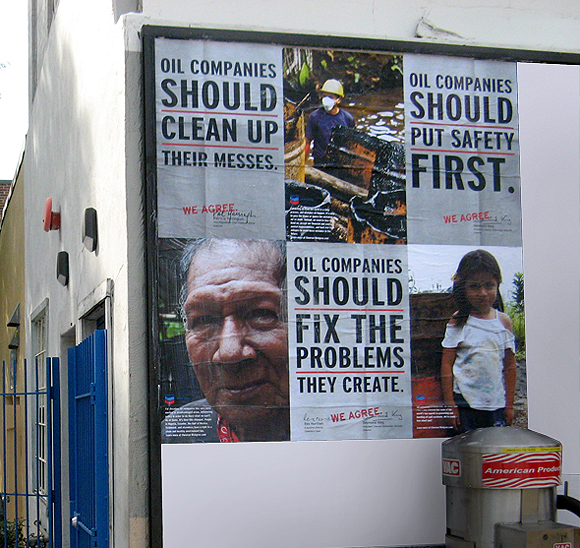
“Chevron’s super-expensive fake street art is a cynical attempt to gloss over the human rights abuses and environmental degradation that is the legacy of Chevron’s operations in Ecuador, Nigeria, Burma and throughout the world,” said Ginger Cassady, a campaigner at Rainforest Action Network. “They must think we’re stupid.”
“They say we’re ‘interrupting the dialogue,’” said Andy Bichlbaum of the Yes Men, referring to Chevron’s terse condemnation. “What dialogue? Chevron’s ad campaign is an insulting, confusing monologue – with many tens of millions of dollars behind it.”
The activists’ pre-emptive campaign began early Monday with a press release from a spoof Chevron domain, which launched the fake “We Agree” campaign hours before the real Chevron could launch its ads. The fake “We Agree” site featured four “improved” advertisements, complete with downloadable PDF files to be used in on-the-street postering.
Nine hours later, after producing its own “We Agree” press release, the real Chevron decried the hoax in a predictably curt and humorless manner. Mere moments later, the counter-campaign issued a much better denial on Chevron’s behalf, laying out Chevron’s principal arguments in its Ecuador case. “We have binding agreements with the Ecuadorian Government exempting us from any liabilities whatsoever, granted in exchange for a $40 million cleanup of some wells by Texaco in the 1990s,” the spoof press release crowed, absurdly yet accurately.
Throughout the day, a sort of slow vaudeville unfolded on the web, as a number of outlets, from industry mouthpieces to the AFP and even a watchdog group, produced accidental mash-ups of “real” and fake information.
First, Fast Company fell for the hoax (archived article here), then related their duping with humor. An outlet called “Environmental Leader,” quoted indiscriminately from both real and fake press releases, before quietly removing the fake parts a few hours later (original article archived here).
Shortly after that, Energy Digital, an online source providing “news and information for Energy Executives” (capitalization theirs), quoted extensively (archive here) from the fake release to describe Chevron’s campaign, then mentioned that the campaign had “already been spoofed.” They didn’t realize they’d just fallen for that very same spoof.
Even the AFP found itself duped (original article archived here), and described with glee the hoax “that appeared to have fooled some news outlets,” before going on to quote “the real firm” at length. (The “real firm” wasn’t.)
Nor were industry watchdog groups immune. “Oil Watchdog” dissected the hoax minutely and accurately, before citing Advertising Age as one of the outlets duped. That whole article, however, was a fake.
“If you really want to snooker the media, it’s pretty hard for them to resist,” said Mike Bonanno of the Yes Men. “We cobbled together some fake releases with string and thumbtacks and chewing gum, and we fooled the most respectable outlets.”
“Chevron is doing what we did, a million times over, with a ginormous budget – and it never reveals its subterfuge,” said Bichlbaum. “No wonder the media’s full of lies.”
“Yesterday’s spoof was a comedy of errors, but what’s happening in Ecuador is no joke,” said Mitch Anderson, a campaigner at Amazon Watch. “While Chevron spends tens of millions every year to greenwash their image and fool the media, Ecuadorians continue to die from their toxic legacy.”
Yesterday’s hoax is just the beginning for the activists. “Stay tuned,” said RAN’s Cassady. “There’s a lot more to come in the days ahead. We’re going to keep Chevron scrambling.”
On Sunday, the Grand Rapids Press ran a story on the current campaign finance data for the 2nd and 3rd Congressional Districts. The 3rd Congressional District was the focus of the article, which included the headline, “Amash keeps financing edge over Miles.”

In many ways this article is similar to one the Press ran on campaign contributions in this race back in late August, a story which we critiqued for its limited information on who was giving how much to which candidates. The same criticism could be applied to the October 17 story.
The Press reporter provides readers with totals for each of the candidates – total raised during the last quarter, amounts from political action committees (PACs), cash on hand and total raised for the entire election cycle. This is all data you can find about the 3rd Congressional race at the Center for Responsive Politics.
At one point the Press reporter states, “Nine members of the DeVos family contributed $40,000 to the Amash campaign and Alticor’s PAC gave $5,000.” While this statement is true it could easily be misinterpreted, since there are numerous other large donations from area business owners and families. (Entire contributions list for Amash) For instance, there are numerous Arab American business owners who have donated large sums of money to Justin Amash, which the Press does not highlight. However, to make such a statement would carry some baggage in the same way that stating there is a sizeable amount of money coming from the DeVos family does.
In addition, since the Press reporter decided to highlight the DeVos family contributions why not also then ask the question(s) about their relationship to Amash and whether or not such large sums of money will provide the DeVos’ will political access in the event that Amash is elected?

The Press reporter then includes some names of big donors to the Miles campaign and states that, “most of his individual donations were under $2,000.” While this may be true, many of those donations to Miles that were under $2,000 are $500 to $1,000 with some donors giving that amount more than once, which makes their donation total $2,000 or more. (Entire contributions list to Miles)
Besides limited information on individual donations to the Mile campaign the Press reporter also included one sentence about PAC money the Democratic candidate has received. “He got $20,000 from UAW-V-CAP out of Detroit and $5,000 each from the Kent County Democratic Party and Third Democratic Congressional District.”
The reporter doesn’t pursue any further investigation as to why a union from the eastside of the state would give $20,000, although that seems to be a fairly basic question that should be asked. In addition we should ask why the Press reporter includes no information on which PAC entities donated to the Amash campaign since they are larger in number ($58,518) than the PAC money Miles has received ($36,325) to date.
The last few paragraphs of the article provide limited campaign finance information for the 2nd Congressional race between Democrat Fred Johnson and Bill Huizenga. Again, since the Press provides little information on how much money these candidates received from which individuals and PAC entities voters are left in the dark about how money influences these races and which sectors are more likely to have political access after the election.
What We Are Reading
Below is a list of books that we have read in recent weeks. The comments are not a review of the books, instead sort of an endorsement of ideas and investigations that can provide solid analysis and even inspiration in the struggle for change. All these books are available at The Bloom Collective, so check them out and stimulate your mind.
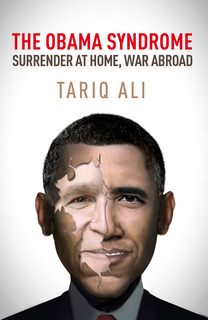
The Obama Syndrome: Surrender at Home, War Abroad, by Tariq Ali – In this short volume prolific writer and activist Tariq Ali makes a strong case that the Obama administration has done just what the title of his book suggests – surrendering to the economic and social power structures in the US (Wall Street, health insurance companies) and continuing the same basic foreign policy objectives as previous administrations with imperialist policies abroad. Ali doesn’t believe that Obama and the people around him every had any intention of pursuing any of the changes that were put forth in the 2008 campaign rhetoric, instead the author believes that Obama was the right choice for those who benefit from both US domestic and foreign policies. An important contribution for those who want to honestly assess US policy under the current administration.
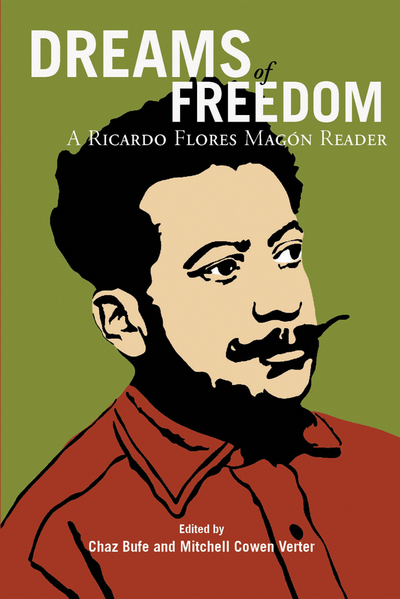
Dreams of Freedom: A Ricardo Flores Magon Reader, edited by Chaz Bufe and Mitchell Cowen Verter – For those who are not familiar with the life and work of the great Mexican anarchist Ricardo Flores Magon, this book is essential reading. This collection of Magon’s writings covers his writings on a variety of topics: racism, war, feminism, class war, the Mexican Revolution and of course anarchism. Magon was a prolific writer, an organizer, a dissident and a newspaper editor. Magon was arrested and died in a US prison in 1922, but this collect of his writings has the capacity to keep his memory alive and inspire new generations to work for revolutionary change.
The Anti-American Manifesto, by Ted Rall – Writer and political cartoonist Ted Rall has written a very interesting book that will unfortunately no get much attention outside of the left/independent media. The Anti-American Manifesto provides readers with plenty to think about in terms of what is not work in this country. Rall makes his case that democracy here is a joke and that engaging in reformist politics is a waste of time. Using good analysis and biting humor the author forces us to think about how change should come about in the US and why it is vital for those who want social justice to change their tactics.
Skin Trade – A documentary film by ARME Production – This is one of the documentaries that is both inspiring and disturbing. Skin Trade takes a look at the fur industry, their deceptive marketing campaigns and the harsh reality of how animals are brutalized for profit.
Beyond Talking About Racism in Grand Rapids
A few weeks ago people in West Michigan had a wonderful opportunity to have a conversation about racism. The play Lines: The Lived Experience of Race, written and directed by Stephanie Sandberg was preformed at Actors Theater in late September/early October.

Lines was based on interviews that Sandberg did with roughly 160 people in the community about their experience of racism. The play was divided into themes, like discrimination, education, gentrification on Wealthy St. and police profiling.
The way Lines was constructed not only highlighted individual experiences of racism, it exposed the larger problem of institutional or structural racism. The commentary was powerful and indicting. It was powerful because of the way it challenged the audience to confront the still deeply entrenched reality of racism in West Michigan and it was indicting because it forced us White folks who like to think care about communities of color that whatever we are doing now just isn’t working.
As a matter of transparency, I was one of the individual’s highlighted in the play and I participated in a talk back session after one of the performances. I can only speak about the content of the discussions after the show I attended. In some ways I thought that it was good, but primarily the comments made by White people afterwards still communicated a tremendous amount of privilege.
For example, one person said that the play dealt with heavy stuff and that “we can’t always be carrying that heaviness around. We need to take a vacation from the issue and sometimes just enjoy ourselves.” In one sense I understand the intent of the statement, but it fails to acknowledge that people of color don’t have the luxury of “going on vacation” from racism.
This for me underscored how deeply entrenched White privilege is in this society, since even people who came to a play about racism still didn’t get it. One aspect of White privilege is our unwillingness to confront the harsh realities of what communities of color face every second of every day.

The ugliness of racism and White privilege certainly needs to be discussed and Lines certainly gave us an excellent opportunity to have those discussions. However, talk must eventually be translated into action and that action must be geared to transforming society from one of White privilege and institutional racism to one of racial justice. Therefore, I want to make a few observations/proposals about how we could move in that direction.
1. All institutions must make racial justice and integral part of their work and mission. By this I don’t mean tokenism or just having people of color on your board of directors, I mean seriously coming to terms with how these institutions can challenge the deeply entrenched forms of institutional racism in this community. For example, communities of color disproportionately living in poverty, which means have higher rates of unemployment, underemployment and are facing housing foreclosures. If the work of religious institutions, government and the plethora of non-profits that inhabit Grand Rapids does not change this really then how can they say they are committed to racial equality?
We cannot be content by sending people to the Institutes for the Healing of Racism and think that somehow absolves us of having to actually do something to challenge institutional racism. We can’t just hang out with people of color and think makes of champions of racial justice.
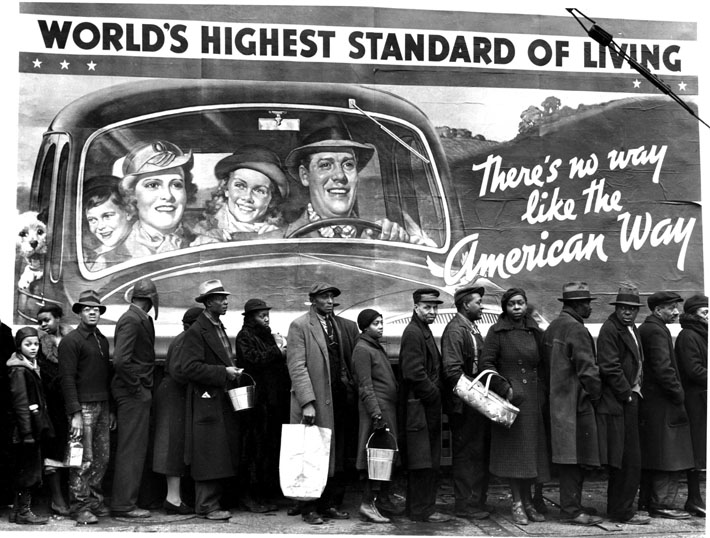
2. We all must challenge institutions that by their very nature perpetuate institutional racism. Here is where I am sure to make enemies, but such is life. One example of an institution that perpetuates institutional racism is the Chamber of Commerce. This is an association of area businesses that promotes economic policy and practices that disproportionately benefit White people. Can people of color be members of the local Chamber of Commerce……absolutely! Heck, they even offer their own version of the Institutes for the Healing of Racism. However, the power that the Chamber of Commerce can leverage on economic issues mostly benefits White people.
3. We all must think about racism as more than a White/Black issue. Other communities of color are equally affected by institutional racism. For example, Latino communities are disproportionately made up of people who work for substandard wages picking our food, serving our food and cleaning up after us in the service industry. On top of the economic hardships they must endure we have the audacity to claim “they take jobs from us” or are nothing more than “illegal aliens.”
Lastly, since we must give in to the temptation to take a vacation from racism, we need to think about how racism works in the less obvious ways. For example, look at the hundreds of thousands of people who participated in the event we all know as ArtPrize. Lots of people came to downtown Grand Rapids to look at art and to enjoy the commercial district. However, we have to ask ourselves who were the primary beneficiaries of this seemingly benign cultural event? Which businesses made money and how were race relations negotiated during that three-week spectacle? What if next year ArtPrize were to use the intersection of Franklin and Eastern as its focal point? Would that mean a massive amount of financial investment in that part of the city? Would it benefit many of the current residents who live in that area? The answers to these questions should tell us something about how entrenched institutional racism is in this city.
The Bloom Hosts Canning How-To Sunday

Canning How-To
1 – 5 p.m. Sunday Oct. 24
The Bloom Collective
Steepletown Center
671 Davis NW (Corner of 5th & Davis)
You don’t have to stay for the entire four hours to participate. Come, can and go!
Are you mad as hell that America’s food and agriculture industries (1) grow GMO foods that can make you sick, (2) use processing methods that delete nutrients and insert harmful additives, (3) are a major cause of climate change, soil death and water pollution, and (4) target kids and adults with foods that cause obesity, diabetes and heart disease?
Here’s your chance to take some direct action. Learn how to can your own food. Canning is easy and safe. You don’t have to worry about those six-syllable food additives poisoning your family. And, canning your own takes you one more step away from the capitalist economic system.
You can learn the basics of canning at this Sunday’s free workshop sponsored by The Bloom Collective. From 1 to 5 p.m., experienced home canners from The Bloom, Our Kitchen Table and the GR Free School will show folks how to can applesauce. Bring your own produce, jars, lids, a cutting board and knife.
For information, visit www.thebloomcollective.org or email bloomcollective@gmail.com.
If you can’t make it to the workshop, check out this free online Guide to Preserving Food safely provided by the MSU Extension.
Statewide efforts in sexual assault prevention
Yesterday, people from all over the state came together in Lansing for a statewide sexual violence prevention grantee meeting. This meeting consisted of health professionals across the state to talk about the sexual assault prevention projects they all have recently been funded to implement in their communities.

The funding for these projects comes from the Center for Disease Control and is funneled through the Michigan Dept of Community Health Violence and Injury Prevention Section. It is important for the public to know about these efforts for two reasons. First, while there have been in the past a great deal of focus on providing funding for programs for victims of sexual assault there is a growing emphasis being put on prevention. Secondly, anytime programs are being funded with tax dollars it is important for the public to know how those funds are being spent and whether or not they are accomplishing the goals & objectives of the grants allocated. This is what the radical women of color organization INCITE! would refer to as community accountability.
The first presenter was from the Houghton area with a project called Dial Help. This project has recently seen an increase in awareness and volunteers, with roughly 30 people offering their time and talent for the projects. Some of the community partners with Dial Help are the local campus, Health Department, students groups, and local law enforcement. One of the new aspects of the project is a requirement for anyone involved in organized sports to participate in an informational session on sexual assault prevention. They also have used media to promote their efforts, particularly a poster campaign.
The second presenter was also from the Upper Peninsula from the Diane Peppler Resource Center. This project partners heavily with local tribal communities but also is now working with Mackinac Island. The reason for doing work with Mackinac Island is because the island is in the top 10 of locations in the country for reported sexual assault, assaults targeted at workers who come to the Island during the tourist season. The other aspect of their grant-funded project is to do peer-focused educational projects for teens.
The next presenter was from the Kent County Health Department, which has been a recipient of these sexual assault prevention grant funds for the past 10 years. The presenter listed the numerous community partners they have been able to develop over the last decade, with not only help in geting the word out about the projects, but also providing greater access to county wide data on sexual assault and sexual assault prevention.
Their projects have included working with students, mostly through the Yo Puedo Program. This has included youth produced media campaigns on healthy relationships and sexual assault prevention. Here is one example of a youth produced video on sexual assault.
They have also been working on using sports based programs to target athletes and coaches on the importance of sexual assault prevention. The newest component of the project is a workplace project, which will include a toolkit for businesses created by the Health Department modeled on the Corporate Alliance to End Partner Violence.
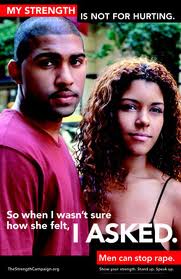
The fourth presenters were from Calhoun County’s Sexual Assault Services. This group also has numerous community partners, but is confronted with a large geographic area that poses some problems. Beyond the community partners this project is really focused on working in the school systems. This includes providing resources to administrators, teachers, students and parents. They also conduct trainings with students and provide services. Another challenge they face, which is incorporated into the project, is cultural competence, especially since they work with four different school districts with lots of cultural diversity.
The fifth presenters were from the St. Clair County Child Abuse/Neglect Council. Their project is called Working Together Works, which involved both the educational system and the broader community. They spoke about their extensive community partners, with law enforcement, the courts and a neighborhood-based crime prevention project. The main goal of this campaign is to reduce the numbers of first time sexual offenders, thus the focus is with young males. Engaging young males takes place with juvenile offender programs, youth groups and in the school system through presentations and the use of theater.
The community education aspect of the project involves a Women’s Expo at a local shopping mall, a community advocate recognition event and an event called the Roof Sit. This involves a local radio DJ sitting on a roof top for 1 week and presenting lots of information about sexual assault prevention and community resources.
Following a break there were presenters were from Haven in Oakland County. They are also focusing on primary prevention in the community through a variety of avenues, like parents. They feel that the more they can do with parents early on they can prevent young boys from becoming perpetrators of sexual assault. They have recently had to hired new staff and they have been developing relationship and collaborative partners. Student participation is also a component and they have found that working with the sports team and athletes.
The sixth presenters were with a group called The Underground Railroad Inc., based in Saginaw. This project has identified all the programs and services that already existed so as to avoid duplicating existing services. They do a great deal of work in the schools and recently have made inroads into some of the parochial schools. They have also created a toolkit used by service providers and educators. The use of the toolkit led to numerous projects with students, such as a media campaign and a student pledge to prevent violence campaign.
The next presenter was from Women’s Aid Service based in Alma, Michigan. They have also developed numerous community partners and work within the educational systems, including Alma College. This project has also done a great deal of work with the faith community by attending the Ministerial Alliance.
The next to last presenter was from the Women’s Resource Center of Northern Michigan. The presenter stated that this new grant has really revitalized people, because so much of the work and energy was for services for victims and now they can do more work around prevention. They really believe that a primary goal should be to eliminate the services they provide for victims and do whatever they can to prevent sexual assault. One of the focuses of this project is to work on developing the role of bystanders, so that people become engaged in intervening to prevent violence in their community. The Women’s Resource Center also works in the education system and has done numerous projects with students.
The last presenter was a new grantee from the YWCA West Central MI. This project has also developed strong community partners such as the Hispanic Center and the Kent County Sexual Assault Prevention Action Team. The focus of their project will be to expand the amount of groups in the community to work on violence prevention, with an emphasis on prevention and services for young women of color. This emphasis will also include education around sexism and racism within the work of violence prevention. One component of the project with youth will be to meet with Federal Legislators as a way to impact policy.
After lunch staff members of MPHI discussed their role in assisting these statewide funded projects. They also presented some information on ways to use photo-voice as a way of collecting information, data and perspectives on sexual assault prevention from the community.
Hearing all the work being done around the state on the issue of sexual assault prevention not only providing those in attendance with a better understanding of the scope of the work being done on this critical issue, but it also provided an opportunity for people to share best practices and ideas for implementing crucial programs in the community.

