DINNER & A MOVIE: Rethink Afghanistan
 BLOOM DINNER & A MOVIE:
Rethink Afghanistan
6:30 pm Thursday Oct. 14
The Bloom Collective
671 Davis NW (Corner of 5th & Davis)
$3-$5 suggested donation
This coming Thursday evening, The Bloom Collective kicks off its Dinner and a Movie series with the widely acclaimed film, Rethink Afghanistan. October 2010 marks the 9th Anniversary of the US Occupation of Afghanistan.
While mainstream media has lulled Americans into ignoring the brutality and violence that this occupation brings to the Afghani people on a daily basis, this film intelligently lays out the facts and figures that prove the only rational solution is a negotiated peace. For example, did you know the US spends more than $1 million per soldier per year to fund this war?
As the film’s website states, “This ground-breaking, full-length documentary focuses on the key issues surrounding the War in Afghanistan, raising critical questions that Congress and the American people need to address.” The documentary can also be viewed free online in parts.
The Bloom Collective will serve a light supper (with vegan options) before the film begins. Afterwards, folks will discuss ways to take action for peace in Afghanistan.
The Tea Party Does Not Exist
(This article by Paul Street and Anthony DiMaggio is re-posted from ZNet.)

Recent developments demonstrate that the Tea Party is not the powerful national force that it’s been made out to be. The organization’s meager levels of participation (documented in my and Paul Street’s past research) has finally come back to haunt the Tea Party in the run-up to the midterm elections, as it has been unable to organize outside of scattered local electioneering, largely in favor of Republican interests. In short, the Tea Party does not exist – at least not in the form depicted in the mass media and in political commentary.
Perhaps most indicative of the failure of local chapters to organize are two factors: the collapse of the pre-election National Tea Party conventions and the failure of Tea Partiers to organize and win primaries outside of smaller states. The fall 2010 National Tea Party convention in Las Vegas, although originally planned for July, was postponed, allegedly due to the unforgiving summer heat. Organizers promised the convention would take place in mid-October immediately prior to the midterms, although reporting in September concluded that the entire event had been cancelled. This was not the first time that the Tea Party suffered from a lack of participation at the cross-national level. The first national Tea Party rally in Nashville in February 2010 was generally poorly attended, with just 600 representatives from across the entire country. Some may claim that the low turnout was due to exorbitant costs ($549 to attend, plus travel, food, and lodging expenses), but this defense fails to explain why the Tea Party organized LibertyXPO was an abject failure, despite advertising free attendance. LibertyXPO, a national organization seeking to galvanize Tea Partiers, saw the collapse of its planned September 10th 2010 D.C. convention, which was consciously timed to coincide with the equally lackluster 2010 9-12 D.C. rally. LibertyXPO suffered from incredibly low attendance, and failed to raise even the $40,000 it originally sought to cover conference expenses, despite having spent almost an entire year networking with local Tea Party leaders and groups. Similarly, the 2010 9-12 D.C. rally planned for two days after the LibertyXPO meeting saw a turnout of just a few thousand protestors. In contrast, critics on the political left were framing the anti-war movement as essentially dead in late 2007, when just twenty to thirty thousand demonstrators rallied in Washington D.C. The Tea Party’s far weaker D.C. turnout in the run-up to the midterms – just 10 to 15 percent the size of the 2007 D.C. anti-war protest – should be evaluated just as critically by those on the right as the anti-war movement was assessed by those on the left. At a time when massive attendance and activism at national conventions and rallies was most needed, Tea Partiers were refusing to engage in the sort of action that would bring about a genuine mass movement.
As a national federation, the Tea Party has largely been ineffective. The Tea Party’s failure to organize likely relates to its low level of resources and weak organizing at the local level – documented throughout this chapter – but also demonstrated in the 2010 primary results. The Tea Party was much more likely to succeed in electing primary candidates in small states characterized by small populations and far smaller voter turnouts. The “movement” was largely unsuccessful on the national level, however, as a 2010 Wall Street Journal article titled “Big States Dilute Tea Party Strength” suggested. As the paper reported during the primary season, the Tea Party benefitted from “little of either” in terms of monetary resources and wide-reading political organization.

The poor performance of Tea Party candidates in large states, in addition to the failure of the group to organize local chapters into a national force, stands in dramatic contrast to the massive support for mediated rallies and events that claim the Tea Party banner, but are manufactured from the top-down. A stark example is the August 2010 Glenn Beck-Sarah Palin “Restoring Honor” rally, which coincided with the anniversary of Martin Luther King’s “I Have a Dream” speech. Reports suggested turnout at this Washington D.C. rally of 100,000 or more – the only Tea Party rally in 2010 that even came close to the hundreds of thousands of anti-war protestors who regularly appeared in Washington between 2003 and 2005. Of course, the massive attendance of Beck’s rally suggests that the Tea Party phenomenon itself is largely a media creation, considering that Tea Partiers could not be bothered to show up in large numbers for their own convention and other national rallies when they failed to headline prominent national figures such as Beck and Palin. The Las Vegas Tea Party convention and LibertyXPO rally required sustained and mass based local activism (coordinated at the national level) to draw a mass large turnout, whereas Beck and Palin merely needed to employ their megaphone at Fox News to attract demonstrators. The failures of the LibertyXPO and Las Vegas convention is strong evidence that, contrary to the common media narrative, Tea Party supporters are not participating in local chapters on a substantial level.
Our analysis is reinforced by another study done by Fairness and Accuracy in Reporting, which found the marginalization of left social gatherings during the media’s preoccupation with the Tea Party. Julie Hollar found in her analysis that the fall 2009 march on Washington D.C. with tens of thousands of gay, lesbian, bisexual, and transgender activists received significantly less coverage than the Tea Party marches in April. Similarly, the February 2010 Nashville Tea Party Convention received far more attention than the U.S. Social Forum, (a convention leftist and socialist activists) which drew 15,000 to 20,000 attendees (compared to the 600 at the Tea Party convention), but received just 1.5 percent of the coverage of the Tea Party convention in a sample of ten national news outlets.
The national media has played an important role not only in exaggerating the power of the Tea Party in relation to other social movements. Reporters have also masked the Tea Party’s failures when they raise serious questions about the group’s power as a movement. The collapse of the Tea Party’s LibertyXPO convention in Washington D.C. in the fall of 2010, for example, was largely ignored in national reporting. A Lexis-Nexis search finds that neither the New York Times nor the Washington Post bothered to run a single story on the meeting’s collapse in September 2010, while directing strong attention to the earlier, although comparatively lightly attended Nashville conference earlier in the year. Additionally, coverage of the collapsed October 2010 Tea Party convention in Las Vegas was almost completely ignored at a time when reporters preferred the narrative of an ascendant and insurgent Tea Party – rising up from the grassroots against establishment politics. The failed Las Vegas convention was covered in just one story in the New York Times, and one story in the Washington Post in the last two weeks of September, when the story was originally reported by alternative media.
By downplaying the failure of the Tea Party to organize as a coherent national movement, the U.S. establishment press further reinforced the already-prominent view that the Tea Party is a vigorous, broad-based national phenomenon. The fact that Republicans will be picking up a large number of seats this fall is more the product of public anger at a two party system that has been unable or unwilling to ease public suffering in the worst economic crisis since the depression. It is to be expected, then, that Americans will come out to punish the party in power in light of its half-hearted attempts to stimulate a sagging economy and protect a workforce increasingly under assault from budget cuts and downsizing. We shouldn’t let the Tea Partiers false image as an “insurgent,” “grassroots” “movement” obscure this basic reality.
March to Count the Cost of 9 years of war in Afghanistan takes places in Grand Rapids
Yesterday, about 20 people participated in an event for the 9th anniversary of the US occupation of Afghanistan.

Organized by people calling themselves Grand Rapids for Justice & Peace in Afghanistan, the anti-war march began at the now closed Central High School. Organizer Mike Saunders stated the location was picked in part because it was a reflection of the spending priorities, where money was leaving the Grand Rapids community while funding for public education is dwindling.
Before the march began John Kroondyk talked about how military recruiters target students through JROTC programs in schools and the disproportionate focus on students from communities of color. Kroondyk said that even though there isn’t a military draft, many working class students end up going into the military in what amounts to an “economic draft.”
Once the group left Central High they marched through neighborhoods going door to door the leave informational flyers on the cost of the 9-year US occupation of Afghanistan for Grand Rapids taxpayers.

The march moved east and made a stop at the cemetery on the corner of Fulton and Eastern. At the cemetery people read the names of Afghan civilians who have been killed since 2001 and US soldiers who have died during combat in Afghanistan. After each name was read a gong was struck to dramatize the loss of human life.
In addition to the list those who have died, people heard some comments from a Vietnam veteran who counsels soldiers who are suffering from Post Traumatic Stress Disorders (PTSDs). PTSD is such a serious problem for those who have served in Afghanistan that it often ends in suicide. In fact, the rate of suicides for US veterans who have served in Afghanistan and Iraq has equaled or surpassed the number killed in combat in those two countries.
As the group moved south through Grand Rapids people could see the housing stock in worse condition and many houses were boarded up. Despite the poverty many people showed support for those marching and willingly took flyers. The group distributed 400 informational flyers along the march route.
When the group arrived at the Baxter Community Center again the comments that were shared focused on the monetary costs to Grand Rapids of the 9-year US occupation of Afghanistan. According to the National Priorities Project since 2001 $185 million dollars has left this community to fund the war in Afghanistan. Had that money stayed in Grand Rapids it could have provided funding for low-income health care to 25,617 people.

The march ended up at Martin Luther King Jr. Park and as the people arrived they were greeted by an audio recording from one of Dr. King’s speeches where he condemned militarism. “A country that continues to spend year after year more money on war than on programs of social uplift is approaching spiritual death.”
At the park Cole Dorsey from the local chapter of the IWW told people that this US government, both Republicans and Democrats, doesn’t care about Afghanis. He also said that this war was a war of imperialism to protect the interests of capital. Cole then told people about numerous opportunities to learn more about what US policy in Afghanistan and actions they could take to resist such policies.
People wrote on a large roll of paper with ideas about how they would like to see the millions of dollars be used right here instead of leaving Grand Rapids to fund the war in Afghanistan. The group intends to take this information to the Grand Rapids City commission. People can get that information and information about other efforts by going to the Facebook page for the group Grand Rapids for Justice and Peace in Afghanistan.
Interview with Anand Gopal on Afghanistan

We had a chance today to sit down with Anand Gopal and talk about what he has seen in Afghanistan during the past three years he has lived there working as a reporter and writer.
Anand is in Grand Rapids today for a lecture he is giving at Calvin College. (7pm tonight) In this interview we discussed the history of US involvement, the current US occupation, the reality of Afghan women, opium production and the Karzai government.
Muslim Scholar addresses Interfaith audience in Grand Rapids

Yesterday, I attended the keynote talk at a conference organized by the Kaufman Interfaith Institute on the campus of Calvin College. The keynote speaker was Dr. Omid Safi, a professor, author and Muslim scholar.
During the introductory remarks it was mentioned that Dr. Safi was the first Muslim to be a keynote speaker, despite the fact that this interfaith event has been held since 1991, although not on an annual basis.
The title of Dr. Safi’s talk was Islam Beyond the Headlines. He began his remarks by saying that we are living in difficult days. “Americans are struggling in many ways, economically and without health care.” In North Carolina, where Dr. Safi lives, roughly 10% of the population that is actively looking for work cannot find work.
Dr. Safi then put the difficult days in context by saying, “We are seeing the crumbling of an American Empire. The US is the most heavily militarized society in the world, even while our roads crumble and basic social services are limited.” He went on to say that the country’s excessive spending on militarism while people’s basic needs are not being met is what will drive the end of the American Empire, a sentiment shared by Dr. King who said, “a nation that continues year after year to spend more money on military defense than on programs of social uplift is approaching spiritual death.”
Dr. Safi then spoke about how the US public’s perception of Islam has been constructed in recent months, with much of the headlines in August and September focusing on the opposition to the Mosque that was being built at “ground zero” and the Christian pastor who wanted to have a public burning of the Koran.
He said that when talking with the US news media he asked them why even bothered to report on the pastor? They told him it was because their editors wanted them to make it news because it would get people’s attention. Dr. Safi asks why are the news media not focusing on the good actions of Muslims, Jews and Christians around the country? “This is not to overlook ugliness,” he said, “but as people of faith we are called to have faith in the things that are unseen……the good deeds that we do every day.”

Dr. Safi then tells the audience how his kids come home and ask him, “why do people say that your daddy is a terrorist?” His son, who looks like his mother (blonde hair and blue eyes), is Muslim and every day in school he gets to hear what his classmates think about Muslims. The kind of stereotyping that exists for Muslims has on become worse since 9/11. Dr. Safi said, “If the actions of the 19 Arab/Muslim men who committed acts of terror on 9/11 makes all Arabs & Muslims terrorists, that equates to collective punishment.”
The speaker went on to say that much of what motivates action against the US is global poverty, which is not a new things, but the gap between the haves and have nots is larger than at any other time in the modern world. “Poverty is an unacceptable reality for people of faith, since the Creator has provided enough of what is necessary for all of us to go without.”
Dr. Safi said, “people of faith have a responsibility to do more than just quarantine the evil in the world, we have to do whatever we can to eliminate it.” One of the best examples of a person of faith that does this for Dr. Safi is Martin Luther King Jr. However, when he speaks about King to students, they say act bored by what the perceive Dr. King represents. “This is due to King being made into an icon, which has allowed us to not hear the critical words of King. King was a prophet and the prophetic tradition challenges us about the fundamentals of our faith.”
“We can either idolize Dr. King one day a year or we can manifest King’s message by standing against war and militarism today.” Dr. Safi mentions King’s triplets of evil – racism, militarism and capitalism. “We cannot keep spending the amount of money of weapons while people starve and have not health care.”
When addressing how people of faith ought to think about militarism, Dr. Safi stated, “When people are killed by bombs or bullets it is the same as killing the living, breathing scriptures. Our faith tradition treats the written scriptures with great reference, often wrapping the book in clothe and this is how we need to treat human beings, with the same reverence.”
He began hi concluding remarks by speaking about the importance of love in the religious traditions and said that love is necessary for justice to occur. “Unless our spiritual quest is directly linked to social justice, neither of them will do well.” Dr. Safi said that Islam teaches that we have to come to the aide of the oppressed and oppressor. “You come to the aide of the oppressor by stopping him from continuing oppressive behaviors and policies.”
He ended his presentation with a re-telling of Dr. King’s interpretation of the Good Samaritan story. Dr. King said the question shouldn’t just be “should I stop to help someone victimized, the question should be what do we do about the system that victimizes people.”
In some ways the speaker made some important points that challenged our stereotypes about Islam, questioned US militarism and called people of faith to act with justice and compassion. However, nothing that Dr. Safi said could be considered terribly radical. He framed his comments within a very conciliatory fashion and even used humor to disarm the crowd.
Despite his talk being very moderate, the first could of questions that were posed to him were from people who clearly felt threatened by Islam and its practitioners. The first person asked if Dr. Safi could have given this same talk in Iran. Dr. Safi, who is Iranian, stated that he could give this talk but would probably be arrested. Having said that he made the point that just because other countries may not respect freedom of speech the same way it is respected in the US doesn’t mean that people here shouldn’t speak out about injustice.
Other people asked why Muslims don’t speak out again Islamic terrorism? Dr. Safi said that they did, that he does on a regular basis, but that the media doesn’t report on it. These questions and other comments made by some of those in attendance clearly reflected the unwillingness to hear Muslim voices or to examine US exceptionalism.
US Soldiers Speak Out Against the Occupation of Afghanistan

On the 9th anniversary of the US invasion/occupation of Afghanistan the group Rethink Afghanistan has produced a new short video with a perspective we rarely see in the commercial media.
The video is with US military veterans who are speaking out against the US occupation in Afghanistan, all of which who have been deployed to fight in this brutal war of occupation.
Our Muslim neighbors live in “Fear and Trembling”
 Wednesday night, about 160 folks from Christian, Jewish and Muslim faith communities met for dialogue at St. Andrew’s Cathedral via the Catholic Information Center’s program, Fear and Trembling: An Interfaith Conversation about Anti-Muslim Sentiment in Western Michigan.
The purpose of the dialogue was to raise awareness about the true practices of Islam and the misunderstanding and persecution that local Muslims face. Fr John Geaney CSP opened the dialogue by asking, “Is the United States Islamaphobic? I read the Time Magazine article and thought ‘It kinda looks like that to me.’ We have the situation developing in New York with the Muslims building a community center two blocks away from Ground Zero, the media hypes it, and the country goes upside down. A Christian decides to burn a Qur’an in Florida, the media hypes it, and America goes upside down. We are trying to get a better grip on what is going on in our country. What is the situation that Muslims face each day in their lives?”
In between segments of the PBS documentary, Muhammad: Legacy of a Prophet, people of different faiths at each table asked questions and shared information about what they knew about Islam. Many were surprised by Islam’s reverence for life, call to peace and demand for charity to those in need. The video excerpts started with Kevin James, a New York City Muslim and September 11 responder who became a firefighter because his Islamic faith deems saving one life as important as saving humanity.
Other clips included a Muslim government official who works hard at his job because his Islamic faith requires him to take action for justice; an Imam who operates a soup kitchen serving mainly non-Muslims because his Islamic faith requires him to care for those in need; and a Muslim nurse practicing in Dearborn, Michigan. These and other clips can be viewed online at www.groundzerodialogues.org.
People also discovered the similarities between Islam and Christianity. Both share the same Old Testament. And while Muslims do not believe that Jesus is God, they do hold him in high esteem as one of their prophets.
The video also answered another point of contention raised by those who fear our Muslim neighbors, “If Islam isn’t about terrorism, why aren’t any Muslims standing up against it?” The answer is that they are. The problem is that the media does not give them a platform. While everyone in West Michigan knows about the Qur’an burner and the supposed “Ground Zero Mosque,” few will hear about last night’s event. One reporter from the Grand Rapids Press was in attendance (though it is not known if she was on assignment) but no other media bothered to show up. That in spite of the fact that news releases were sent out well in advance of the event.
Perhaps that’s because good Muslims don’t make for sensational headlines. Or perhaps the motivations run deeper. After all, if we all decide we’re part of one human family where all deserve life, liberty and happiness, who will be left to fight the wars and pile up the profits for those in power?
For those reasons, providing spaces for face-to-face dialogue between Christians, Jews and Muslims to dialogue is a very admirable goal. Only as “we the people” understand the issues and take action to learn about each other will we be motivated to demand an end the madness in the Middle East and beyond.
Local organizations sponsoring the event included the Catholic Information Center, Bosnian Cultural Center, ICC Behar, Grand Rapids Area Center for Ecumenism (GRACE), Interfaith Dialogue Association, Islamic Center and Mosque of Grand Rapids and the Islamic Mosque and Religious Institute.
Dollar Stores: Top Link in the Sweatshop Chain
(This article is re-posted from CorpWatch.)

Abel Lopez was a busy man. The El Paso resident’s job with Family Dollar, Inc. averaged 60-80 hours a week. A former graphic designer and ad man from neighboring Ciudad Juarez, Mexico, Lopez spent his days unloading trucks, processing freight, scouring toilets, running cash registers, cleaning, shelving, changing prices, doing inventory, and covering for other employees. As a bonus, he was even held up by armed robbers.
Like others at Family Dollar who wind up spending most of their time doing grunt work, Lopez bore the title of manager. He contends that the company routinely classifies regular workers as managers in order to categorize them as exempt employees and in doing so ensure they are not subject to the overtime provisions of the 1938 Fair Labor Standards Act (FLSA). (See box.)
Family Dollar is one of a growing group of chain-store corporations that cater to America’s poor by selling cheap goods, many imported from sweatshops in low-wage countries including China and Mexico.
Critics of the two largest dollar store chains, Family Dollar and Dollar General, contend that the companies extract super-profits from the uncompensated labor of overworked store “managers” and other employees.
“It’s corporate theft,” asserted Alabama attorney Lance Gould, whose firm represents some of [Dollar General’s] managers. “All these dollar stores, their company structure is the same. Their largest controllable expense is their labor budget.”
Last April, after more than seven years on the job, Abel Lopez was fired. Family Dollar blamed him – unjustly, the worker says — for bad upkeep of the store. Recently, he and a small group of supporters conducted roving pickets at different Family Dollar stores in El Paso. One day he stood outside a store wearing a t-shirt that read: “Family Dollar: Exploited Manager,” while an El Paso police officer warned the group not to leaflet on company premises.
“We’re being misclassified as store managers to avoid paying overtime,” Lopez charged. “I think the profit is made out of the hours they don’t pay the managers. …They give you a payroll, and actually most of the time the payroll doesn’t cover you,” Lopez said, adding that managers were forced to do the jobs of workers they could not afford to staff. Stout and straight-talking, Lopez resumed picketing as the mid-day traffic picked up and the hot sun blazed the pavement of the border city.

Pennies on the Dollar
Pay for Family Dollar managers like Lopez starts off around $550 per week but the long hours required result in some employees barely earning above minimum wage, Lopez says. At the opposite end of the company’s income spectrum, Family Dollar CEO Howard Levine enjoyed an annual compensation package of $5.38 million in 2010–part of a five-year bundle valued at $14 million, according to Forbes. Based in North Carolina, Family Dollar began in 1959 with one store in Charlotte. More than 40 years later, the chain has more than 6,700 stores in 44 states with 45,000 employees. Earning nearly $7.9 billion in revenues for fiscal year 2010, Family Dollar recorded nine consecutive quarters of double-digit earnings per share growth through the summer of this year. The chain “significantly expanded operating margins and improved inventory productivity” while continuing to return “excess cash” to its shareholders, according to a company statement.
For the first three quarters of fiscal year 2010, Family Dollar paid out approximately $58 million in dividends. While Family Dollar raked in profits, Lopez scrambled to make ends meet. With mortgage payments, as well as a wife and three young daughters to support, he did what so many other workers are forced to do by the Great Recession: dip into his 401(K)3.
As the months dragged on, Lopez waged a battle on two fronts: out on the streets and inside state unemployment offices, there he eventually prevailed against Family Dollar’s initial rejection of his claim, he said. Abel Lopez is not the first company manager to challenge the Tennessee-based retailer. In 2006, more than 1,400 former and current company managers won an Alabama lawsuit alleging FLSA overtime violations and seeking compensation. Agreeing with the plaintiffs, a federal jury ordered the company to pay $35.6 million. Family Dollar appealed.
Family Dollar chairman and CEO Howard Levine praised the hard work of his employees but insisted they were exempt from laws requiring overtime pay. “We believe we are correct in classifying our store managers as salaried managers, and we intend to continue to fight for what we believe is right,” Levine said in a statement.
In 2008, the 11th Circuit Court of Appeals disagreed and upheld the judgment against Family Dollar. The Fortune 500 company did not respond to several requests for comment on the current complaints against the company.
The Inflation of Dollar Stores
Rising from the U.S. Bible Belt, the dollar store trend began back in the 1950s. Today, three Fortune 500 companies compete for the title of Old King Buck–Dollar General, Family Dollar, and Dollar Tree. The corporate chains appeal to legions of economically-stressed shoppers, with Dollar General even sponsoring an advice-column blog authored by “Ms. Cheap.”
Unlike many retailers, the dollar store industry is thriving in these hard economic times. At the top of the heap is Dollar General. Beginning as a family business in Springfield, Kentucky, it expanded into a huge company that was eventually taken over in 2007 by affiliates of corporate raiders KKR and Goldman Sachs.
Publicly traded since 2009, Dollar General counts more than 9,000 stores, 72,000 employees and sales in the neighborhood of $11.8 billion. Like some Family Dollar stores, Dollar General accepts food stamps and goes beyond the buck-an-item model by also featuring grocery aisles. While checking the weekly coupon stand, customers can browse tabloids with headlines like “Michael Jackson Seen Alive.”
Dollar General faces the same overtime issues as Family Dollar. The “majority of [mangers’] work is the same as hourly employees,” said Gould, an attorney for Beasley-Allen, the Alabama-based law firm that since 2004 has handled thousands of employee complaints against Dollar General. Unlike actual executives, Gould charged, Dollar General’s managers must defer to district bosses for significant decisions. The approximately 750 cases pending in various U.S. courts make overtime lawsuits filed by managers of retail outlets “one of the fastest-growing areas of litigation,” said Gould.
A spokesperson for Dollar General said the company does not comment on litigation. True to its name, Dollar Tree does indeed offer mostly very cheap goods. As the night of witches and goblins approached, El Paso shoppers were greeted with a gaudy “Halloween Headquarters” stocked with $1 candy bags, “boneyard” skulls, black crows and other apparitions of faux terror.
For a mere buck, borderland children can play at killing with toy assault rifles and grenades, the make-believe images of real-life weapons used every day just across the river in violence-torn Ciudad Juarez, Mexico. They can also pretend to ply the tools of the trade of returning Iraq and Afghanistan war veterans stationed at El Paso’s Fort Bliss in ever increasing numbers. Boasting more than 3,900 stores in 48 states, Dollar Tree traces its evolution to the Ben Franklin variety store in Virginia. Changing into a publicly-traded company decades later, Dollar Tree has recently busied itself buying up similar retailers in different states. During the second quarter of 2010, Dollar Tree opened 56 stores and closed only five.
Between Wal-Mart and a Garage Sale
“Dollars may not grow on trees but outlets of Dollar Tree’s stores seem to,” noted Hoover’s. “Customers are responding in record numbers to our outstanding values and fun shopping experience,” said president and CEO Bob Sasser, who presumably also finds fun in a four-year compensation package Forbes estimated at $9.42 million.
Filled with the products of the world’s low-wage manufacturing centers, the dollar store industry occupies an economic niche somewhere below Wal-Mart and K-Mart, and somewhat above the weekend garage sale. They fill store fronts in moribund cities and strip malls around the country, as in economically depressed Barre, VT, where a Family Dollar displaying cheap items in bright colors nestles next to a nail emporium, a Chinese restaurant, a basic Radio Shack, and a long-empty storefront.
Dollar stores are also fixtures of immigrant communities. In New Mexico, west Texas and elsewhere it is common to find them near indoor flea markets, pay-day lenders and other manifestations of what Eric Murillo of the El Paso-based Retail Workers Rights Committee (RWRC) called the brave new world of the “predatory economy”.
Organizing for Fair Treatment
Organized this year to support Abel Lopez and other workers, the Retail Workers Rights Committee is laying the groundwork for a fresh burst of labor activism in an industry that is notoriously anti-union. The new group demands a halt to the misclassification of store managers, an end to threats and intimidation of employees, and an increase in workplace security and no-retaliation pledges.
Founder of El Paso’s Border Workers Association, Guillermo Glenn, noted that the Family Dollar battle has special resonance in a city where retail jobs are one of the few options left. After NAFTA and other free trade pacts were implemented, nearly 40,000 manufacturing jobs were demolished in what Glenn termed a Katrina-like economic storm. Unpaid overtime is a major problem in the retail and fast food industries of his city, Glenn maintained. Worse yet, he said, is weak Texas labor law that gives employers the power to fire even “if they don’t like your shoes.”
Ironically, in El Paso’s shops now, gadgets and gizmos made in China and other low-wage havens compete with cheaply produced Mexican goods. If workers’ grievances are as severe as they appear to be, it poses the question of whether retail stores are the sweatshops at the top of the sweatshop chain. Added Glenn: “I see the movement of the retail workers as very important because there is [so much] sub-employment in this area-part-timers and people that don’t work sufficient hours.”
Backed by allies from different social movements, the RWRC is planning an October 16th national day of action against Family Dollar in cities such as El Paso and San Antonio. Organizer Eric Murillo said Family Dollar employees across the country were in the same boat. “We feel if we keep this pressure up, we’ll get other Family Dollar workers and perhaps other retail workers involved in this struggle as well,” Murillo said.

For anyone following the news—what little of it there is to be had in the local mainstream media—it should come as no surprise that Grand Rapids is in a serious budget crisis. The City has so many problems in meeting its obligations, particularly where employee salaries, benefits, and pensions are concerned, that it is looking for any possible way to cut costs. Last week, Mayor George Heartwell announced that one of the options that the City was exploring was the privatization of the water/sewer system. GRIID covered this story and wrote about the disastrous effects that this type of decision has had on other cities that have tried it.
This week, GRIID was in touch with Commissioner Rosalynn Bliss for additional information. We wanted to know how extensive discussions have been about removing the water/sewage service from City management with its Commission oversight, and putting it in the hands of private contractors. Bliss described the water/sewer system discussion as “incredibly preliminary.” She stated that no decision “would be made without ample research, information, cost-benefit analysis, and community input.”
That being said, Bliss reported that at the last Commission meeting, Mayor Heartwell “asked the commission to share their ideas on what services could potentially be contracted out and one of the services is some of the operations of the sanitary sewer and water system (not selling the assets, but contracting out for some of the services).”
Bliss went on to say that the Commission had originally had a discussion about this in 2009 “when the water department requested another increase in water and sewer rates and the commission started asking about the details to the rate increase request.” At that time, Bliss said, the question arose about the possibility of keeping rates down if some services were contracted out of City hands.
What’s the problem with the current City system and why are the rates increasing? According to Manager Joellen Thompson of the City Water/Sewer Department, a large part of the problem is usage. She states that Grand Rapids has lost several major water users from the commercial/industrial sector. Fewer people using less water means that everyone pays more. This, by the way, is not good news for people who are attempting to act responsibly by conserving water use.

Another problem is increased costs. This, according to Thompson, includes higher electricity and chemical treatment costs. But Grand Rapids’ water system is also aging, and infrastructure costs are rising faster than they were in the past as a result.
The Water Department laid off 13 percent of its workforce in 2009. There were other City employee layoffs as well. But none of this could offset the tidal wave of costs that the City faces, with its largest financial obligation being its salaries, benefits, and pensions. Health care benefits for employees continue through retirement with the same plans intact, and the average retired City worker gets a pension of $1,900 a month. Police officers receive an average pension amount of $2,415 a month.
Most of the City of Grand Rapids employees are represented by unions, but not all. The “non-rep” employees—which, according to one report by WMMT are mainly “appointed officials, non-represented executive class and district court management employees,” have already received a 10 percent cut in compensation, primarily from increasing health care premiums and reducing pension contributions and the so-called “life allowance.” For details about these cuts, click here.
But if City services are to be preserved and the water system remain safely out of the hands of privateers, it’s crucial that all human resources costs be reduced this year. Bliss acknowledged that to GRIID, saying, “We are currently in negotiations with all of the City’s 13 unions and are seeking concessions.”
Whether or not the unions will make any concessions is another matter. As an example, the Grand Rapids Police Officers Association seems aggrieved about “dramatic concessions” it has already accepted and feels the public is not giving them credit for what they do. The union states the Police Department has already conceded to a $119.56 per month employee contribution payment for health insurance, and a “100 percent increase” in co-pays for office visits. The police union also notes that no one on the police force received a pay increase from 2006 through 2008.
It’s possible that the public doesn’t give the police credit for its sacrifices in this area because they don’t seem like sacrifices to most working people in Grand Rapids. Many folks in Grand Rapids have not had a pay raise for five years or longer. Those who are lucky enough to still have health care insurance pay an average of 21 percent of their salary for employee contributions, according to a recent Kaiser Foundation report. The Grand Rapids police officers pay less than half that—10 percent. In addition, the police department’s out-of-pocket deductible is an unheard-of $50. By comparison, a current policy from one area furniture manufacturer has set its out-of-pocket deductible at $1,500 per employee.
As for co-pays, the police’s previous co-pays for doctors’ visits were $10, and are now $20. This would still seem like a bargain to most people with insurance who pay between $30 to $50 for a doctor’s visit, depending on the type of doctor (primary care or specialist) seen.
In addition, under their current contract, the Police Department personnel receive a minimum of two weeks’ paid vacation, an additional minimum of 12 sick days per year, 12 paid holidays a year, and “longevity pay” bonuses starting at their 5th year of employment. Plainclothes police officers receive almost $1,000 a year as a clothing allowance to pay for new wardrobe items. It would be difficult to find Grand Rapids citizens, a quarter of whom are now living below the poverty line, who would see minor changes to these benefits as “dramatic concessions.” Most citizens of Grand Rapids can only dream of such extensive benefits and health insurance this affordable.
If the police union is any benchmark, meaningful cuts to the City’s largest financial obligation seem to be tentative at best. While it’s crucial to have strong union representation and to safeguard employee pay and hours, in the case of City employees this has to be balanced against the need to allocate taxes for services to the community at large.
According to Rosalynn Bliss, currently everything is on the table, to be explored and researched, while the City waits to conclude its 13 different union negotiations. She told GRIID, “I can assure you that I would never support any recommendation that would negatively impact our water service or add additional cost/further increase residents’ water and sewer rates.”
While Bliss has a solid record of supporting citizens’ concerns and interests, the question remains if the Mayor, City Manager, and other Commissioners might still be tempted by the idea of making the water/sewer system a profit center. Certainly budget cutting at the City is more complex than this writer ever anticipated. But it’s frightening to think that an easy way out of the budget shortfall might end up putting Grand Rapids citizens at risk of higher and higher payments to a utility being run as a profit center by a private company.
Enbridge Investors Told Pipelines Feed Fossil Fuel Addictions
(This article is re-posted from Common Dreams and deals with the people confronting the energy company Enbridge, which was responsible for a major oil disaster in Michigan earlier this year.)
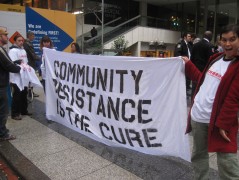
As Enbridge holds its investors meeting in Toronto’s financial district, Environmental Justice Toronto sent them a message about their dirty investments in fossil fuels. Grassroots organizers sent up a banner attached to helium balloons that read “Enbridge Invests in Oil Addiction.” The banner was visible through the glass front of the building, outside of which activists held up another banner that read, “Community Resistance is the Cure.”
A message held up with helium balloons, tells investors that their money is funding more than pipelines.
“When it comes to the tar sands, Enbridge is Canada’s pusher, pumping dirty oil through unreliable pipelines which are bound to spill,” said Taylor Flook, an organizer with Environmental Justice Toronto. “Averaging at 61 leaks per year for the past 10 years, Enbridge is celebrating over 600 leaks and breaks-and its investors need to know that. Enbridge pipelines are too risky.”
Enbridge is asking investors to support the expansion of tar sands oil pipelines across North America. Recent accidents and breaks, including one of the largest spills in US history when a pipeline leaked into the Kalamazoo River in Michigan this July, are showing that it is not a matter of “if” there is a spill, but “when” there is a spill.
Enbridge wants to expand its pipelines to send tar sands oil across the continent through projects like the Northern Gateway Pipeline. The pipeline stretches from the Tar Sands in Northern Alberta to Kitimat, B.C., polluting water and food sources and causing cancers and disease in local communities. The pipeline has been rejected by communities all along its route, including the Carriere Sekani Tribal Council and now the B.C. Union of Municipalities who voted to oppose the project last week.
Resistance to the expansion of the Enbridge and other tar sands pipelines is being lead by many First Nations communities along with climate justice activists. “Tar sands projects are one of the largest environmental injustices on earth and is Canada’s largest source of global warming pollution,” says Flook. “If Canada wants to uphold human rights and be a leader at the international stage, projects such as Enbridge pipelines cannot go through.”
Hundreds of people are mobilizing across Canada to stop the Gateway and other pipeline projects with demonstrations in Vancouver, Whistler, Kitimat, and Sarnia taking place over the past two weeks.

