The Realities for US Veteran’s on Veteran’s Day

It is Veteran’s Day and that usually means parades and ceremonies to honor men and women who have served in the US military. It means the President will give a speech about the commitment to freedom that the US military demonstrates and Veteran’s Day usually means news stories about soldiers on leave.
This was the case with a story in the Grand Rapids Press, which features the return of a US soldier from Afghanistan. The brief article tells us about a US soldier from Hudsonville, who was greeted at the airport by family and friends. The story quotes the soldier’s mom who says she expected her son to come back different.
Coming back different is an understatement, particularly for soldiers who have been involved in combat. The statistics are staggering, whether we are talking about soldiers who have been physically wounded, are struggling with Post Traumatic Stress Disorder (PTSD), substance abuse and broken relationships.
While the news media and society in general might celebrate the sacrifices that US soldiers make, the concern for soldiers returning from war changes dramatically after the parade ends.
There has been some news coverage of US troop deaths in Iraq and Afghanistan, but that is usually limited to numerical milestones. What we don’t hear much about are US troops who have committed suicide as a result of their involvement in war. In fact, for every death, at least five members of the armed forces were hospitalized for attempting to take their life. According to the Navy Times, 2 percent of Army; 2.3 percent of Marines and 3 percent of Navy respondents to the military’s own survey of 28,536 members from all branches reported they had attempted suicide at some point.
US soldier suicides have now claimed more lives than soldiers killed in combat in Afghanistan. You can see from this graph how US soldier suicides have risen steadily since the US War in Iraq began and the recent escalation of US troops in Afghanistan.

In addition to high suicide rates, US soldiers have to try to cope with living in a civilian life, which means finding work and attempting to maintain relationships. Ann Jones reports that many US soldiers fall victim to substance abuse after combat. Substance abuse can add stress to relationships, which sometimes results in physical abuse by veterans against spouses, girlfriends and children. Sometimes this abuse results in rape and murder of intimate partners.

These are the ugly realities of the consequences of putting very young men in circumstances that no one should have to endure. Unfortunately, these are realities that we do not want to talk about or come to terms with since to do so is often seen as unpatriotic. This kneejerk response is ridiculous on many levels but particularly when we realize that the strongest voices on the realities of war veterans are veterans themselves.
Just a few days ago Jeff Hanks, a US soldier who has served in Afghanistan, refused deployment because of his struggle with PTSD. Hanks sought help from military doctors when returning from Afghanistan, but his treatment was cut short when he received orders for re-deployment. Iraq Veterans Against the War have organized a campaign to support Jeff Hanks and they are seeking solidarity from the public.
So on Veteran’s Day 2010, let’s not blindly honor veterans as heroes, rather let us see them as victims of a policy they had little to do with. Let us listen to US veterans of war who are resisting the ongoing US wars in Iraq and Afghanistan. Here is a short video by Brave New Foundation, where US veterans speak out on the US war in Afghanistan.
GR Press Announces End of Recession….Again
Last Monday, November 8, the Grand Rapids Press ran an article which explained that Michigan was finally “climbing out of the recession.”
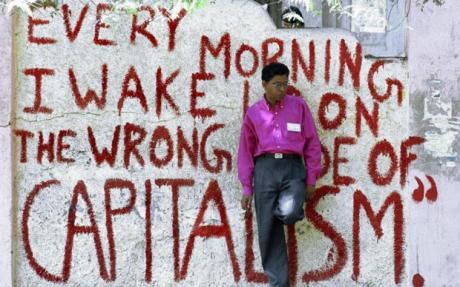
But let’s not get excited. The Press has run a number of articles saying the same thing over the past few years. Back in 2008, we had “Fifth Third Exec Predicts End to Credit Crisis,” in which we were told that we hadn’t even had a recession yet: “Stapley sees an end that could come soon enough [thanks to the Wall Street bailout] to avert a true recession—or at least make any national recession short-lived.” Then in 2009, we had “Is Recession Really Over?” with a Fifth Third bank official explaining how things were going to improve and the stock market was about to rally. More stories were scattered throughout 2010: “Economic Panel Says Recession Ended in June 2009”; “There’s No Shortage of Money, There’s a Shortage of Confidence”; “Stocks Post Meager Gains Despite Strong Jobs News”; and one of my personal favorites, “Do Extended Unemployment Benefits Discourage Job Searches?” Right…it’s those lazy workers’ fault that they don’t have new jobs yet! How could I not have seen that?
So you can’t blame reporter Jackie Headapohl for being just a bit tentative this time around. Her Monday article was headlined with a question (“Is Michigan Finally Climbing Out of the Recession?”) and is not based on any investigative work of her own. Instead, it recaps a recent article in Crain’s Detroit which predicts “mild economic growth” for the state in 2011. But, Crain’s adds, “…it will be quite a while before [Michigan’s] unemployment rate gets to the national level—at least a year.”
Or never.
First let’s recap a few facts that GRIID has featured in recent articles on this site:

•Grand Rapids’ poverty rate now stands at 25 percent.
•Its current “official” unemployment rate is 10.5 percent.
•In September 2010, foreclosures jumped 30 percent over August’s numbers.
Add to those statistics a new study that shows that across the country, 77 percent of Americans are now living paycheck to paycheck.
Every time the Grand Rapids Press has run an article announcing the end of the recession, or reminding people that the recession ended in June of 2009, readers write in protest, saying, “Not as far as I’m concerned!” So what’s going on? Why do the capitalists keep insisting that everything’s back to normal?
As Bill Moyers would say, “Welcome to the plutocracy.”
Moyers gave a speech in October as part of this year’s Howard Zinn Lecture Series. He chose a topic that he feels is vital to our understanding of our current situation: we have been robbed. We now live in a society where the wealth distribution is equivalent to, or worse than, it is in banana republics such as Nicaragua, Venezuela, and Guyana. A concerted effort began in 1980 to demolish the middle class and shift wealth into the hands of the richest Americans. The government, the media, and the financial industry have conspired together to hide that fact from us. So Moyers decided to lay out the entire scam in his lecture:
•The richest 1 percent of Americans take home 24 percent of the country’s income. That’s almost 10 percent more than the wealth gap during the Gilded Age, where the richest 1 percent had corned 15 percent of the nation’s wealth.
•CEOs now make an average of 531 times as much as the average worker.
•American CEOs have cut, in the past decade, one in three manufacturing jobs in the U.S.
•Under the Bush tax cuts, which will now probably be re-instated, the richest 0.1 percent of Americans will receive about $370,000 in tax cuts…and it will not “trickle down” because studies show this class invests tax-return money, not spends it.
•From 1950 to 1980, an even distribution of wealth across the classes created an average income which rose from $17,719 to $30,941, or about $661 a year.
•But from 1980, when Reagan took office and the official plundering of national wealth began, to 2008, the average worker’s income has gone from $30,914 to $31,244. That means over the past 20 years, our average income has only risen $303. That’s $15.15 a year.

It’s called what Moyers calls “wage repression.” It’s created two different Americas. And that’s clearly class warfare.
Moyers states: That’s how financial capitalism works today: Conserving cash rather than bolstering hiring and production; investing in their own shares to prop up their share prices and make their stock more attractive to Wall Street. To hell with everyone else…If this were a functioning democracy, our financial institutions would be helping everyday Americans and businesses get the mortgages and loans – the capital – they need to keep going; they’re not, even as the financiers are reaping robust awards…The super-rich earn their fortunes with overseas labor, selling to overseas consumers and managing financial transactions that have little to do with the rest of America, while relying entirely or almost entirely on immigrant servants at one of several homes around the country.
Moyer’s entire speech can be read here. It’s well worth the time.
And it explains a lot. The capitalists are telling us the recession is over because for them, it is. In fact, between the bailout dollars on Wall Street, the constant squeezing of wages and the invented “jobs deficit,” good times have never been better for them. But the other 90 percent of us are trapped in the gray world of a recession—a recession that those in power have a vested interest in continuing, if possible, forever.
Mainstream newspapers like the Grand Rapids Press help corporations maintain the smoke-and-mirrors illusion that things are just not as bad as we think they are. That’s the purpose of those jolting, occasional articles about the end of the recession. It’s a weapon of mass confusion, and an effective one, considering how much has been stolen from us and how little we still understand about the criminals who robbed us.

Tonight (Wednesday, November 10th), as part of American Indian Heritage Month, there will be a screening of the documentary film Reel InJuns: On the Trail of Hollywood Indians.
Hollywood has made over 4000 films about Native people; over 100 years of movies defining how Indians are seen by the world.
Reel Injun takes an entertaining and insightful look at the Hollywood Indian, exploring the portrayal of North American Natives through the history of cinema.
Travelling through the heartland of America, Cree filmmaker Neil Diamond looks at how the myth of “the Injun” has influenced the world’s understanding – and misunderstanding – of Natives.
With candid interviews with directors, writers, actors and activists, including Clint Eastwood, Jim Jarmusch, Robbie Robertson, Sacheen Littlefeather, John Trudell and Russell Means, clips from hundreds of classic and recent films, including Stagecoach, Little Big Man, The Outlaw Josey Wales, One Flew Over the Cuckoo’s Nest, and Atanarjuat the Fast Runner, Reel Injun traces the evolution of cinema’s depiction of Native people from the silent film era to today.
The film will be show on the GVSU downtown campus and followed by a discussion. The film is free and open to the public.
Reel Injuns
6pm
Loosemore Auditorium – 122E DeVos
401 W. Fulton St.
Grand Rapids, MI
WOOD Radio drops local show, adds racist Glenn Beck to their far right programming
Friday it was reported that WOOD AM Radio discontinued one of the few locally produced programs in order to make room for the syndicated show of Glenn Beck.

The show Mouth 2 Mouth aired 9am til noon on Monday through Friday every week in the West Michigan media market. The largest radio conglomerate in the country Clear Channel owns WOOD Radio, which has seven stations in this area.
It was reported yesterday in the Grand Rapids Press that the Glenn Beck show began airing on WOOD Radio on Monday and that has fans of the Mouth 2 Mouth show upset. The Press reported that people have started a Facebook group, called Mad at WOOD. The Facebook page says, “Are you angry at Wood Radio 1300 for “letting go” Scott Winters and Michelle McCormick, our beloved hosts of Mouth to Mouth? Show it by joining!” There isn’t any concrete call to action, although some of the comments on this page are suggesting that people flood station manager Tim Feagan with E-mails demanding that the local show be reinstated.
People on the Facebook page are arguing that Mouth 2 Mouth was one of the few information/news-based shows that was locally produced, where the public could call in to add their comments to the topics of the day. It is true that there is limited local program in the West Michigan market this is overwhelmingly the case for WOOD Radio.
Station manager Tim Feagan said that the decision had nothing to do with the content of Mouth 2 Mouth, rather it was purely a “business decision.” The decision was no doubt good for business since advertisers will want to tap into Beck’s popularity. However, adding Glen Beck to their line up has other implications for WOOD Radion.

A quick look at WOOD Radio’s weekday program should tell us something about the kind of programming content they have decided upon. Not only are all the shows (except 5am – 9am) nationally syndicated shows, many of them are notorious for making false claims and engaging is racist hate speech, as has been well documented by Rory O’Connor in the book Shock Jocks: Hate Speech and Talk Radio.
09:00am – 12:00pm – The Glenn Beck Program – LIVE
12:00pm – 03:00pm – The Rush Limbaugh Show – LIVE
03:00pm – 06:00pm – The Sean Hannity Show – LIVE
06:00pm – 09:00pm – The Dave Ramsey Show
09:00pm – 12:00pm – The Michael Savage Show
12:00am – 05:00am – Coast To Coast AM with George Noory – LIVE
Fairness and Accuracy in Reporting has been documenting fallacious comments by Limbaugh for years, including racists comments. Michael Savage has an even worse track record of on air racist comments, which has led to efforts to get him off the air in various markets through a campaign called No Savage. Savage has advocated for an outright ban on Muslim immigration to the US and the construction of Mosques.
Glenn Beck has also engaged in demonizing Muslims and immigrants on his talk show, but the comment that resulted in a campaign against him was when he called President Obama a racist in 2009.
This comment resulted in the group Color of Change organizing a campaign to pressure Fox News to pull Beck from their programming. The campaign has not been able to get Beck off the air, but it has resulted in numerous national advertisers pulling their ads from the network.
In addition to these kinds of campaigns, some organizations have petitioned the Federal Communications Commission to investigate the link between on air hate speech and hate crimes in the US. So far the FCC has not made any decisions on this matter, but it does show that people are organized to challenge the kind of racist and xenophobic language that is part of radio programming across the country and on WOOD Radio.
Wiping the War Paint Off the Lens
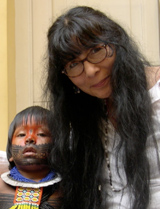
Beverly Singer PhD, Santa Clara Pueblo, Tewa/Dine’
We had good lives. We fed ourselves. We built our homes. We had worship. And, we celebrated family and community. What have you brought us?
Beverly Singer PhD
When Beverly Singer was 11 years old, she looked on as a Hollywood film crew set to work on the Indian reservation she called home. That experience inspired her to become a filmmaker; her film work has explored the lives of native women, native children and health issues facing Native Americans. Also an author, her book Wiping the War Paint Off the Lens: Native American Film and Video, was the backdrop for her Nov. 8 presentation as part of the Grand Valley State University American Indian Heritage Month series.
Singer began by talking about the importance of community, of belonging to each other and how 21st century technology impacts the experience of community. “We are now moving towards a different idea of ourselves as human beings as a result of what technology brings.”
In illustration, she recalled the Disney promotion of its animated feature Pocahontas in New York’s Central Park. She was living in New York City at the time. Singer was struck that the Disney film repeated the same fixated themes propagated by media about Native Americans throughout American history: 1) the romanticized, free spirited people of the land who have a special connection with some energy force that allows them to adapt to anything that comes along; 2) the embattled savages who are just waiting to be enlightened and changed; and 3) the revolutionary activists who spend all their time figuring out how to counter-balance all the changed that have been forced on our indigenous peoples.
“The bias of the narrative is that we’re constantly at juxtaposition; we don’t really belong. We lost the war. We are angry. We need to make a stand,” Singer said. “Yes, we are very revolutionary but not in the ways you would think. We have held on and not forgotten where we come from. We have connection to community.”
By making their own films, Singer and other Native American filmmakers have been able to step outside those conventional representations—and outside of the boundaries set for native arts by a White America that sees native peoples as mysterious, decorative and nostalgic.
 “In the market place, you see the totem pole, the Navajo woman figure, the mythological figure. Somehow native people cannot be understood because we are still mysterious, still hiding something. This (representation) turns back in on ourselves. Much of this art is non-political and non-creative—safe and decorative. What does that do to a people? We are not allowed to move, to change, to feel and experiment.”
As TV has become for native children “their parent, grandparent, teacher, babysitter and best friend,” children grow up with this twisted idea of what it means to be native. They are hounded with images that reiterate the notion that Native Americans can’t fit into society and are potentially volatile.
Following Singer’s talk, five panelists were asked to respond. Glenn Zaring, Tribal Public Affairs Director, Little River Band of Ottawa Indians, Manistee, MI, said, “We are tired of being referred to as the Indian problem. Too often, we’re viewed as an anomaly that now happens to have a casino and money. The Native Americans offers solutions. Apply our principles to . . . to the issues we are all having to face. We are not the problem. We are the Solution. We would like to offer that assistance.”
Lisa LaPlante, News Reporter, FOX-17, Grand Rapids, responded, “There is a corporation. What I do makes money. The (editors) are gonna cut, gonna cut, gonna cut. On a national news level, people take shortcuts and regurgitate whatever was fed to them. On a local level were getting better.”
Matthew Wesaw, Tribal Chair, Pokagon Band of Potawatomi, Dowagiac, said, “For too many years, we have let other people talk about who we are, what we need and what we want. That’s why we are still a mystery. Now is the time for us to tell our story . . . Without us telling, it will never be told properly . . . Warriors like the doctor (Singer) get the message out.”
David Murray, Reporter, The Grand Rapids Press, responded, “American Indians today are still considered mysterious or hiding something? It wasn’t mysterious to me and it wasn’t hidden. … In my community (growing up) there were people who spoke native languages. They were regular folks like you and me.” Murray also denied the existence of institutional racism having an effect on media based on his practice of not using race as a basis for choosing interview subjects on his assignments.
Jeff Smith, Grand Rapids Institute for Information Democracy, presented figures from GRIID studies analyzing representations of Native Americans in local news. The studies exemplify how news agencies do indeed engage in systemic racism. “Native Americans are racially profiled, meaning they only appear in stories that are race specific—like Pow Wows or casinos. When there are news stories about the economy, public health issues, the environmental or politics, Native voices are virtually non-existent,” he said. “In the 50 popular films we studied this past year, only one has a native character—Twilight. In that context, the native is seen as savage, succumbing to emotions and economically depressed. The white vampires are cool, calm, economically privileged and don’t give into their emotions. How do we think about this stuff that all of us are consuming and how do we relate to that?”
As corporate media isn’t going to set the record straight anytime soon, Singer’s is the most logical response: she and other Native American filmmakers are making their own media. As she said when concluding her talk, “l create media that connects American Indian people with each other, to reduce the noise, to get back to inherent values and practices that keep people belonging to a community, locally and globally, as full partners in what is the creative economy at this moment in history.”
(This article is re-posted from PR Watch.)

In response to growing public pressure about promoting unhealthy food to kids and contributing to the obesity epidemic, the fast food industry did what every industry that produces a harmful product does: it pledged to voluntarily end the harmful practices that started drawing scrutiny to the industry. Accordingly, in 2006 the Council of Better Business Bureaus launched its Children’s Food and Beverage Advertising Initiative (CFBAI), a voluntary code under which fast food purveyors pledged to promote healthier food choices in their advertising, and use messages hat encourage good nutrition in ads aimed at kids.
As with other voluntary corporate codes, the CFBAI has proven more effective at staving off regulation of the fast food industry than protecting kids from predatory advertising and marketing practices. Since signing onto the Initiative, the fast food industry has found many ways to evade it, and promote unhealthy foods to kids more than ever.
On November 8, 2010 Yale University’s Rudd Center for Food Policy and Obesity released a study that shows fast food companies have ramped up advertising aimed at kids in recent years, and often employ tricky, point-of-sale marketing practices that undermine good nutrition for kids. Researchers looked at the marketing practices of 12 national fast food chains and nutritional data, like sugar, saturated fat and total calories, for over 3,000 children’s meal combos and 2,781 total menu items. Out of 3,039 possible meal combinations, only 12 met the nutritional standards set by the Institute of Medicine for preschoolers, and only 15 met the criteria for older children.
Targeting Kids More Than Ever

Children as young as two years old are seeing more fast food ads than ever before. Researchers found that in 2009, preschoolers saw 56 percent more ads for Subway, 21 percent more ads for McDonalds and 9 percent more ads for Burger King than they did in 2007. Older kids saw even more fast food ads, and African-American youth were exposed to at least 50 percent more fast food ads than white youth. Fast food companies have also moved beyond television ads in their advertising practices, and now use social media to reach kids. For example, McDonalds has 13 Web sites that get 365,000 unique child visitors between the ages of 2 and 11, and 294,000 unique visits from teens ages 12 to 18 every month. McDonalds starts targeting kids as young as age two with websites like Ronald.com. McDonalds and Burger King have even created sophisticated “advergames” and online “virtual worlds” that engage children, like HappyMeal.com, McWorld.com and ClubBK.com.
Youth Marketing is Effective
Fast food ads work well at getting kids into the restaurants. According to online surveys, 40 percent of kids between the ages of 2 and 11 beg their parents to take them to McDonalds at least once a week. 84 percent of parents report that they give in to their kids’ request at least once a week. While some argue that it is the parent’s job to refuse kids’ pleas for fast food, researchers concluded that it is a poor practice to promote unhealthy products directly to children, and constantly put parents in the position of having to say “no” to their kids. Ideally, restaurants would support parental efforts to encourage kids to eat healthy foods, not undermine those efforts by marketing directly to children.
Tricky Point of Sale Practices
Even though companies like Burger King and McDonalds signed onto the BBB’s voluntary pledge to limit advertising to kids, these companies engage in tricky point-of-sale practices that undermine healthy nutritional practices. For example, even though most fast food restaurants list at least one healthful side dish and beverage on their menus, and even though their ads show healthful food options as side dishes, restaurants’ default practice is to serve French fries as a side dish 86 percent of the time, and sugary drinks at least 55 percent of the time. And instead of eliminating their biggest side dishes and drinks, companies merely rename them. Burger King’s former 42-ounce “King” sized drink is now called a “Large,” their former 32-ounce “Large” size is now called a “medium,” and their former 21-ounce medium-sized drink is now called “small.”
The Yale study confirms, yet again, that when an industry imposes a voluntary code of conduct on itself, it is time for real and effective regulation of harmful corporate behavior. Voluntary codes are smokescreens. They are not designed to protect the public from harmful corporate behavior. They are devised for one reason only: to protect an embattled industry from truly effective regulation of known harmful practices.
Bloom Collective to host Zine making workshop this Saturday
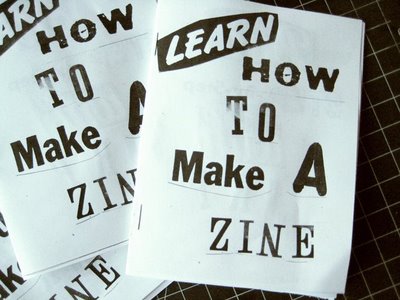
Zines have been around since the 1970s, as an effective way to protest the idea that information can be “owned” or copyrighted.
In the 1980s and 90s zine making became popular within the DIY and punk scene as a way of self-expression and a form of resistance against commercial culture and even official left magazines, which tend to rely on a small sector of experts who can tell us all what to think.
In order to promote more independent media and highlight their zine collection, the Bloom Collective is hosting a “How to” zine making workshop.
Saturday, November 13
Zine making workshop
2 – 4pm
671 Davis NW – in the Steepletown Center building
The Bloom Collective will have supplies needed for the workshop, but if you have markers, scissors, glue and old magazines that you can bring it would be welcomed.
There are lots of good online resources on how to make a zine, such as the Pony Boy Press Blog and this E-how site. Here is a nice video How To by a woman who makes zines and edits other Indy Media.
Conference of the Americas: Climate Justice
On Saturday, John Kroondyk and Jeff Smith presented a session entitled Climate Justice as part of the 11th Annual Conference on the Americas sponsored by Grand Valley State University. While terms like global warming, 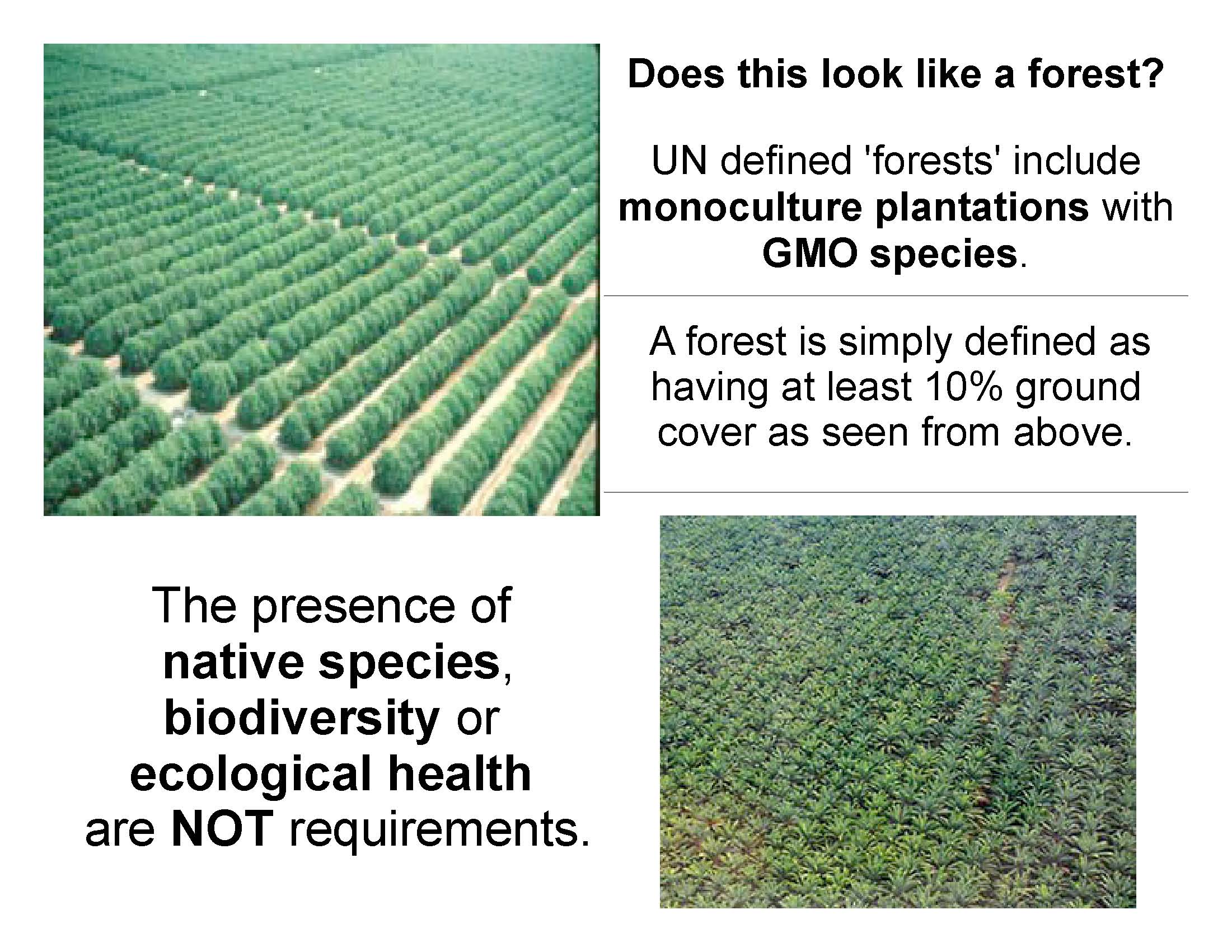 climate change and climate crisis are familiar to most, the concept of climate justice rarely makes it into the mainstream. However, in Latin America the issues of climate crisis and social justice collide with very real, drastic and horrific results for the continent’s indigenous peoples. “We’re not here to talk about the science of climate change. We agree it is a real, human-caused climate crisis,” Kroondyk said. “We won’t be talking about how many degrees warmer the earth is but about the broader social, political and cultural factors.”
Raining death on the rain forest
Kroondyk went on to address some of the major contributors to the climate crisis in Latin America. Deforestation of the Amazon River Basin is commonly recognized as one of these. Conservative estimates state that 150 acres of Amazon rainforest are destroyed per minute to accommodate the goals of corporate agri-businesses, cattle ranching (think McDonalds) and dam projects—which produce power and landscapes to meet the needs of capitalist business ventures, not to feed or provide electricity for the people living there. While these dam projects tout themselves as “green” projects, they submerge vast forests under water, where they rot and outgas huge amounts of methane and carbon dioxide. Dam projects also drive indigenous people from their ancestral homes, farms and livelihoods while generating food crops for export, soy for bio-fuels and electricity used to operate industries, such as mining, which further degrade the environment. “The sad part for me is that indigenous communities, poor folks, and farmers, are driven into the forest and given no choice but to slash and burn in order to grow crops for their families,” Kroondyk said. “Then, they are judged as the bad guys.”
The UN-REDD Program, which portends to remedy deforestation, is a false solution that exacerbates climate crisis. By defining “forest” as any land with 10% ground cover, REDD allows corporate profiteers to destroy forests and replace them with mono-culture tree plantations and non-native cash crops. 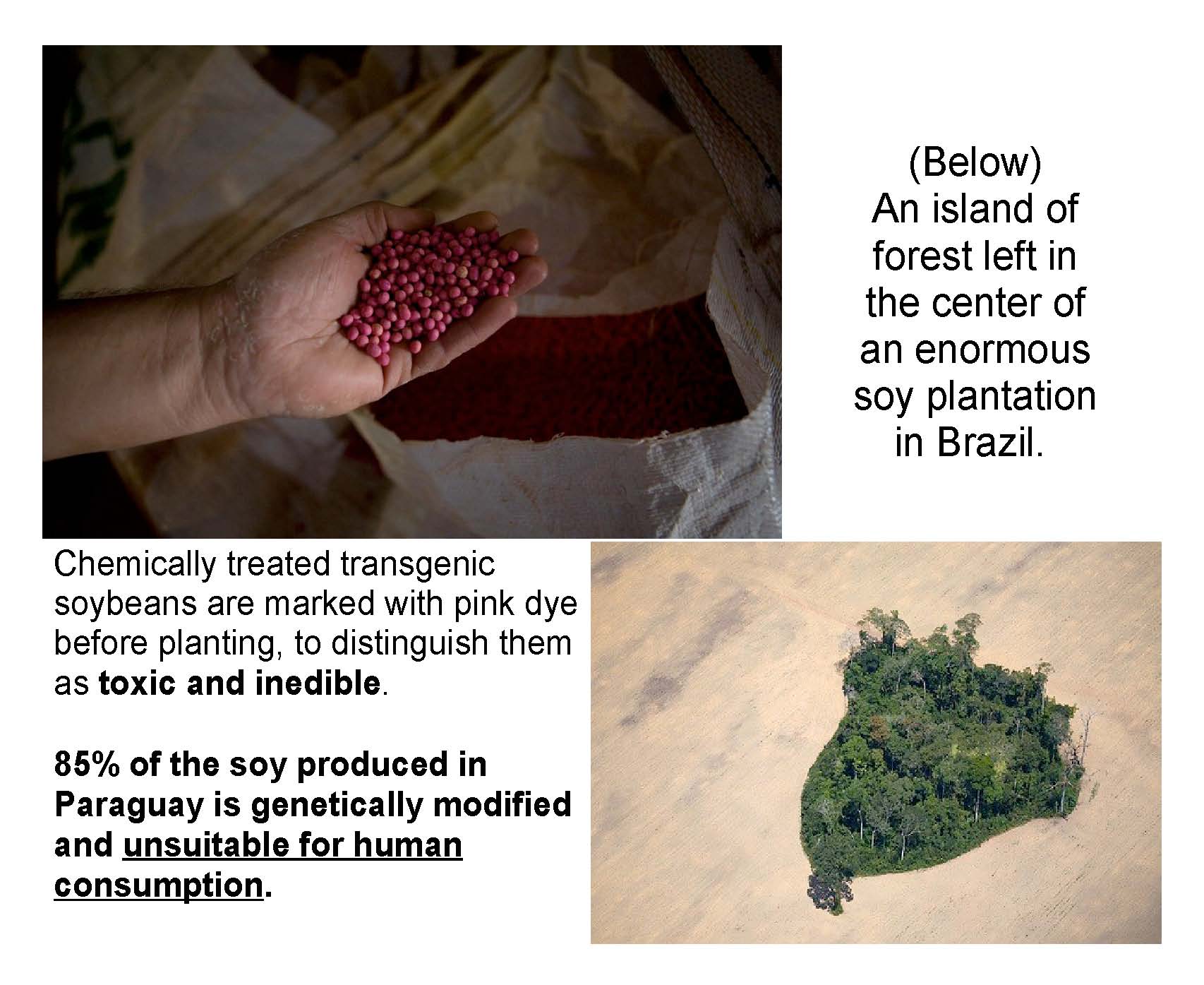 “It’s really disgusting what their definition of a forest is,” Kroondyk said. “The presence of native species, biodiversity or ecological health are not requirements.”
As mentioned, agri-business is one of the main beneficiaries of deforestation. The market demand for agri-fuels has motivated companies like BP, Shell, DuPont, Cargill and Monsanto to grab Latin American lands away from indigenous peoples in order to grow toxic soy for bio-fuels. One example of the scope of this industry, 85% of the soy grown in Paraguay is for bio-fuel—and is toxic, unsuitable for human consumption. This land grab for bio-fuel production led to the 2008 global food crisis and threatens another 60 million people with hunger and starvation.”Agri-fuels emit just as much CO2 as diesel or petroleum,” Kroondyk pointed out. “They also use water and chemicals for growing. Thinking of bio-fuels as a solution to the climate crisis is ludicrous.”
The carbon boot-print of war
Another cause of global climate crisis as well as climate injustice in Latin America, militarization is rarely cited by environmentalists. Barry Sanders, 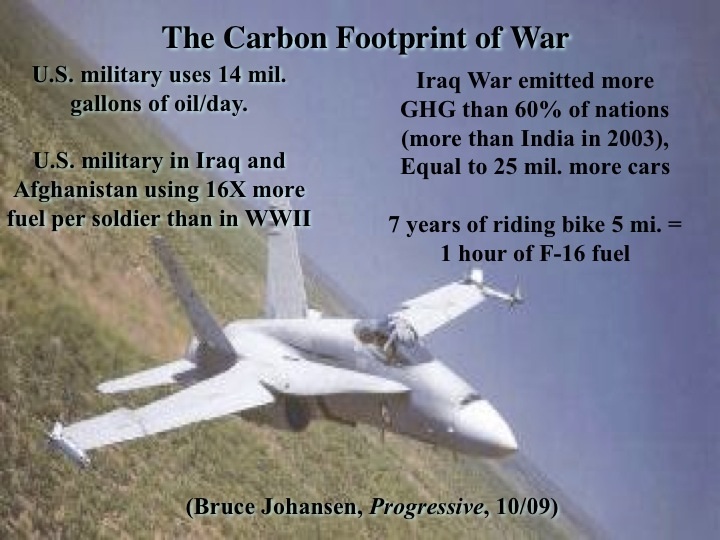 in his book, The Green Zone, shares that the US Military alone consumes 14 million gallons of oil a day—that’s more than is consumed by 85% of the countries of the world.
US military aid to Latin America fuels even more massive military consumption of oil. In addition, specific programs, such as the War on Drugs, cause drastic environmental damage as aerial chemical and manual deforestation is used to destroy coca production. “These efforts haven’t made a dent in coca production but they have contributed to human deaths, impacted human health, destroyed water and killed other trees and plants that produce oxygen,” Jeff Smith said. “The US has spent $1.5 billion on aerial spraying in Columbia alone.”
The US is also in the process of building many new military bases. These not only expand militarization but also displace people and create social instability within communities.
Resource extraction
While America cheered its ingenuity in rescuing the Chilean coal miners, the media wasn’t telling us about the ongoing horrors caused by resource extraction throughout Latin American by US and multinational firms. Oil, coal, gold and other mineral extraction projects continue to devastate ecosystems, displace people and contaminate soil and water. “These projects also result in significant state repression. Not one country in Latin America is untouched by those dynamics,” Kroondyk said. “And, the actual mining of resources also provides fuel for other industrial production that further contributes to the climate crisis.”
One example, a giant wind farm in Colombia has been described as a “green” project. However, the indigenous people living there were kicked off their land and the power generated is being used to power an open pit coal mine. People living in the area are not receiving any of the electricity.
“There is a great deal we can learn from their movements.”
Unlike their counterparts in the US, the people of Latin America have consistently challenged deforestation, militarization and resource extraction causing crisis in their lands. Last summer, 20, 000 people from 70 countries and UN agencies as well as indigenous peoples gathered for the World Peoples’ Conference on Climate Change in Cochabamba, Bolivia. In response to the failures of the 2009 Copenhagen UN Conference on Climate Change, Cochabamba came up with proposals calling for 50% reduction of CO2 emissions by 2017; indentifying the rights of mother earth; respecting indigenous people and climate migrants; lifting the barriers of intellectual property; prohibiting the commodification of forests; forming an international climate justice tribune; and more.
- In 2000, the people of Bolivia took to the streets, demanding that their water rights be returned to them. Bechtel Corporation had bought the rights from Bolivia’s government. They raised prices on water, making it unaffordable—and even preventing people from gathering rain water. Though their peaceful protests were met with military violence and murder, they kept protesting until they won their water rights back.
- In Brazil, one million members of the Landless People’s Movement (MST) have reclaimed lands for homes, schools and health clinics. Since 1985, they have won land titles for 350,000 families; 180,000 more families are awaiting titles.
- The Bolivarian Alternative for Latin America (ALBA) is challenging US trade policy, including FTAA, CAFTA and NAFTA. This is encouraging localized trade and agriculture, i.e. growing food for local consumption and reducing emissions tremendously. Bolivia has also refused US requests to renew a new military base there.”Ecuador did the same thing,” Smith said. “They told the US ‘you can but only if we can put an Ecuadorian base in Miami.”
- Ecuador has taken steps to prevent extraction of oil under Yasuni National Park UNESCO Biosphere.
- In Peru, people are challenging oil extraction with blockades, dismantling pipelines and a variety of tactics.
- In Columbia, the U’wa indigenous peoples fought against Occidental Petroleum through legal action, non-violent direct action such as blockades and dismantling pipelines. FARQ also blew up pipelines. After 17 years, Occidental left.
- Via Campesina a worldwide peasant movement, fights for peasant and family-based farm production, food sovereignty and local food production. This combats climate crisis, emissions from agricultural production and transportation.
- The Zapatistas (EZLN) have specific struggles in Chiapas, an area historically exploited by Mexico’s elite… Currently, they are fighting against a huge agri-business bio-fuel onslaught.
“The Zapatista political ideology goes hand in hand with the climate justice movement. They say no to false solutions, market control and market logic that recreates the same mess we are already in. They say yes to a pluralistic view, respect for biodiversity, indigenous cultures, negotiation of environmental space and social equity between the global north and south,” Smith said. “We need to be looking at ways we can change US policy and asking ourselves what kind of solidarity can we engage in to support the people in these countries. We can be agents of creative change in this process. And, there is a great deal we can learn from their movements.”
Kroondyk ended the presentation with this clip of Bolivian hip-hop artists challenging the system for climate justice.
[S1]LINK?
GVSU conference features speaker from Argentina: Women’s Movements and Democratization in Argentina
The 11th Annual Conference of the Americas wrapped up on Saturday with numerous session, workshops and documentary screenings all that dealt with the theme of “Creative Agents of Change.”
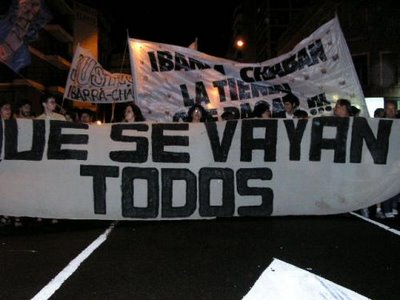
People had the change to hear from local educators and organizers who presented on topics such as immigration, cultural autonomy, youth based media, resource extraction and Latin America literature. There were also Latin Americans who presented on subjects such as the realities of being an immigrant in the US, reclaiming literary history and current popular movements throughout the continent.
The keynote speaker for Saturday was Graciela Di Marco, a professor at the university of San Martin in Argentina and long time participant in popular movements in her country. Professor Di Marco talked about the role that the women’s movement has had on all other popular movements in Argentina.
Prof. Di Marco talked about the evolution of popular movements in Argentina, where there has been a broadening of the scope of citizenship, the promotion of women’s rights, the cultural impact of feminism and joint articulation of these changes amongst academics and activists.
The speaker said, “Radical democracy is the construction of counter hegemonies resulting from the articulation of popular struggles.” She went on to say that this processes is grounded in the “denaturalization and criticism of inequality.” For Di Marco, the democratization process should put its emphasis on the equalization of relations and relationships.
During the military junta years, when 30,000 Argentines were disappeared, the human rights movement created the conditions for “elaborating a critique of all discretionary forms of the exercise of political authority.” This critique was not just of the military dictatorship, but a critique of power relations in the home and in popular movements themselves.
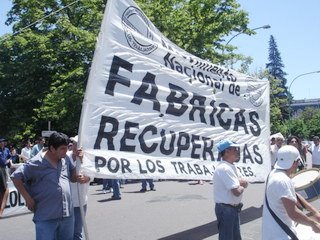
It was in this context that women started to see themselves in significantly different ways. Professor Di Marco said that women continued to see themselves as mothers, but they began to articulate the idea of “social motherhood,” which involves the demands of political power.
The advent of popular feminism at this time was made up of women in unemployed workers movements. Women’s participation in marches for instance, often ended up being festivals for the women who participate, since many of them rarely had the chance to visit the capital or enjoy the interaction with women from all over the country. Popular movement marches provided a forum for women to have those kinds of experiences.
Professor Di Marco then spoke about the picket movement, which has been the strongest movement over the last decade. Roughly 70% of the picket movement is made up of women, who in addition to marching, management community projects and occupy public spaces.
After the economic crash of December 2001 (a topic which is explored in the documentary The Take) the picket movement grew and began to express itself in different ways. Worker occupations and collectives led to greater cooperation between men and women and women were often in leadership positions in the worker co-ops and collectives.
These co-operative groups began creating new cultural models, such as transforming old warehouse spaces into a space for those wanting to learn how to be trapeze artists, day care centers and arts collectives.
Professor Di Marco said that women’s participation showed women that they did not need to be isolated and that tactics such as roadblocks and factory occupations gave them the idea that rights can be obtained through struggle.
However, while it is clear that this movement in Argentina is anti-capitalist, the movement still needs to work on anti-patriarchal dynamics that exist. Women were happy with the push for dignity in work and better education for their children, but they still struggled with domestic abuse and the inherent machismo that permeates institutes.
Professor Di Marco said that patriarchy was manifest in many of the social institutions because of the historical influence of the Catholic Church. She said that one could see this in the government, hospitals, the courts and other social institutions. The speaker also said that Catholic fundamentalism is a key player in the counter attack on women’s rights and the popular movements.
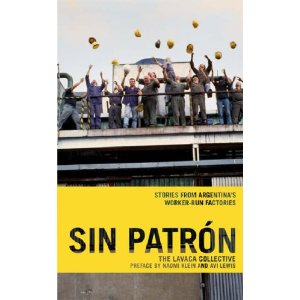
For more information on the worker occupations, worker-run factories, co-ops and collectives that number in the thousands in Argentina, good sources are the book, Sin Patron: Stories from Argentina’s worker-run factories, and Indy Media in Argentina.
MiBiz spreads myth about toilet paper company’s “green” practices

The regional business publication MiBiz recently sent out their sustainability E-newsletter, which is always worth critiquing. Like most business entities they love to highlight so-called “green” corporate practices as a way of taping into the growing green consumer market.
The article in the MiBiz newsletter that caught my attention was a blurb about the toilet paper giant Kimberly-Clark, which has announced they will be putting on the market tubeless toilet paper.
The MiBiz blurb was based on a USA Today article that acts essentially as a PR piece for the Kimberly-Clark. Not only does the article cited a company spokesperson who makes eco-friendly claims, the story also cites someone with the Natural Resources Defense Council who claims this is a positive example of what corporations can do to promote conservation. However, such a business-friendly article from the McJournalism of newspapers (USA Today) should not confuse us with what is fundamentally wrong with equating Kimberley-Clark’s new marketing strategy with concern for eco-systems.
First, citing a spokesperson from the Natural Resources Defense Council makes complete sense once you know that this so-called environmental group is part of what some call the Big Green groups or Gang Green. Big Green groups are those who have abandoned any real grassroots environmental work and have shifted to lobbying in Washington and partnering with Corporate America.

Second, calling Kimberly-Clark’s tubeless toilet paper rolls green is a perfect example of green-washing. The company is the second largest toilet paper company in the world and has contributed to deforestation and soil erosion on a massive scale. Kimberly-Clark owns or controlled hundreds of thousands of acres of land in the US, Spain, Thailand, Mexico, China and 20 other countries.
In addition to the amount of land the company owns it is important to understand that most toilet paper is currently made from trees, which means the industry does not use much in the way of recycled paper. In fact, in the US today, tissue from 100% recycled fibers make up less than 2% of sales for at home use. This is an astounding number and it means that companies like Kimberly-Clark need to cut down more forests for their products.

Third, since Kimberly-Clark is committed to increasing its profits they will do whatever is necessary to make that happen. For instance, the company spent hundreds of thousands of dollars annually lobbying the US Congress. Another tactic the company uses is having representative from other large corporations sit on their board of directors, which gives them greater influence on policy and greater access to natural resources. Some of the board members of Kimberly-Clark also sit on the boards of General Electric, Home Depot and Waste Management.
Lastly, the biggest flaw with corporations claiming to be green is that they don’t have a limit to their growth. Kimberly-Clark, like any other business, wants to expand and develop more markets for their products. Just because they make a minor adjustment to how they manufacture their product doesn’t mean they will end up cutting down fewer trees.
Therefore, just because news agencies like USA Today and MiBiz are fooled by this kind of corporate green-washing, doesn’t mean we have to be.


