The Press’ selective eulogy of Peter Cook

Today, MLive.com posted a story about the death of local businessman and former Chairman of Mazda Great Lakes, Peter Cook.
The article frames Cook as person born who “rose from near poverty to become a visionary businessman and generous philanthropist.” The Press reporter recounts the “influential encounter” Cook had that made him a successful businessman, his relationship with his wife and a short listing of some of the recipient’s of his philanthropy.
The story ends with a comment from Mary Angelo with the Roosevelt Park Neighborhood Association who speaks highly of Cook’s donations to non-profit institutions along the Grandville Avenue corridor, where Cook grew up.
While it is clear that Cook donated to entities which have benefited working class communities (arts center, library and Hispanic Center) in the Grandville Avenue corridor, Cook has also donated significant amounts of money to the Republican Party and to some far right entities around the state and around the country. This information is unfortunately not included in the Press eulogy of Cook.
According to OpenSecrets.org Cook donated in just the 2009/2010 Election cycle thousands of dollars to the Michigan Republican Party and to individual GOP candidates in West Michigan. This information is relevant, particularly as it relates to where candidates and the GOP stands on issues like education, health care and the public funding of these basic human rights. One could argue that Cook has financed politicians who have a history of advocating for less public funding of basic social programs.
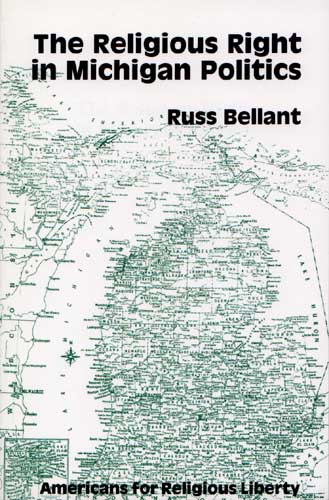
The other area of funding, which is worth looking at, are the donations he has made to groups like Campus Crusade for Christ, Michigan Family Forum, the Mackinac Center, the Acton Institute, Teach Michigan and Gospel Films in Muskegon. In addition, Cook served as a member on the board of the Council for National Policy, which serves as a mechanism for religious right and conservative individuals across the country. (see Russ Bellant’s The Religious Right in Michigan Politics)
MLive’s exclusion of Cook’s funding of far right groups and his involvement with organizations with overt political agendas is not only misleading, it does a disservice to the public by not providing comprehensive disclosure on someone who had tremendous influence on many levels locally and nationally.
IWW to host 2-day organizing training in Grand Rapids

The local chapter of the IWW (Industrial Workers of the World) is hosting a 2-day organizer training for anyone who is part of the working class.
Fire Your Boss! is the name of the training, where people will learn what their rights are on the job, US Labor laws and how to organize where you work. People from all over the Midwest will be participating in this training and the public is invited.
December 4 & 5
9:30am – 5:00pm
671 Davis NW
Steepletown Neighborhood Center
The IWW is asking for a $5 – $10 donation for the training, which will include coffee, bagels and lunch for both days. You can register by sending an E-mail to griww@iww.org or by calling 616-881-5263.
Justin Amash, Israel and AIPAC

Yesterday, the Grand Rapids Press ran a short blurb mentioning that the Arab American Institute (AAI) considers Justin Amash’s election to Congress as a victory, since Amash himself is an Arab American.
The Press coverage of the 3rd Congressional race did not make the ethnicity of Amash an issue during the election campaign and did not mention that some of his largest donors were Arab American business owners such as the owner of Martha’s Vineyard in Grand Rapids.
The AAI considers the election of Amash as a victory since it increases the number of Arab Americans in Congress. One can certainly argue that increasing the racial diversity of Congress is an improvement, but racial diversity alone does not mean that there will be an improvement with major policy decisions.
For instance, the AAI also supports a more progressive or liberal position when it comes to US foreign policy with countries such as Iraq, Lebanon and with Palestine. Amash himself did not have a well-developed position on Israel/Palestine on his website during the campaign, but what content he did have, was not terribly consistent with what the AAI advocates. More important was a position paper that Amash wrote concerning US/Israeli relations.
The position paper is written with language that emphasizes the need for Israel to have security and it condemns the use of violence and terrorism to achieve political gains for Palestinians. The position paper goes on to criticize Iran’s desire to develop any nuclear capability, but fails to mention that Israel already possesses nuclear weapons.
In many ways the position paper by Amash reads like it was written by the American Israeli Public Affairs Committee (AIPAC). In fact, AIPAC may have played a role in writing the position paper by Justin Amash, since it is mentioned as part of an announcement about an AIPAC event in Grand Rapids that will include comments from Rep. Amash.
The announcement appears on Facebook and states “Representative-elect Amash worked closely with AIPAC throughout his campaign.” The announcement also states, “In addition to regularly speaking with AIPAC’s leaders in West Michigan and meeting with AIPAC’s professional staff, Representative-elect Amash traveled to Detroit to attend both the annual AIPAC Michigan Community Event in May and the AIPAC Michigan Annual Brunch in October. We value Representative-elect Amash’s friendship and look forward to continuing to work closely with him.”
The AIPAC meeting with Rep. Justin Amash will be held at Temple Emanuel in Grand Rapids and is open to the public at 7pm on December 13. GRIID plans on being there to report on what happens during the AIPAC-sponsored public forum, but it already seems clear that despite his Arab heritage, Amash is clearly in the pro-Israeli camp.
Re-Teaching Gender and Sexuality
Reteaching Gender & Sexuality is a message about queer youth action and resilience. The video was generated to contribute additional queer/trans youth voices to the national conversations about queer/trans youth lives. Reteaching Gender & Sexuality intends to steer the conversation beyond the symptom of bullying, to consider systemic issues and deeper beliefs about gender and sexuality that impact queer youth. We invite you to share the video with your friends, family and networks; we invite you to share with us what THIS issue means to you!
Help kickstart our tour: kck.st/?dJtJqi
For more info go to putthisonthemap.org.
On the World Stage, U.S. Falls Flat on Women’s Equality
(This article by Michelle Chen is re-posted from In The Times.)
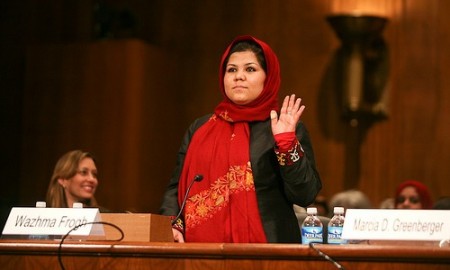
The United States speaks boldly about women’s rights in Afghanistan, about liberating Arab women in the Middle East, and about Mama Grizzlies and Supermoms on the home front. But when it comes down to codifying our commitment to women’s equality in the law… we’ll get back to you.
As the Senate bailed on the Paycheck Fairness Act, which would have strengthened critical anti-discrimination protections, lawmakers again locked horns on gender equity at the international level, in a debate on the Convention on the Elimination of All Forms of Discrimination against Women (CEDAW).
Along with Sudan, Iran and Somalia, the U.S. has yet to formally ratify the United Nations’ CEDAW since it was launched over three decades ago. (It hasn’t even been a century since the 19th Amendment, so conservatives understandably need a little more time to adjust.) The CEDAW is associated with campaigns against gross human rights violations like human trafficking or systematic violence against women. But the Convention is also a versatile framework for measuring equality in many arenas, including the global economy and the workplace.
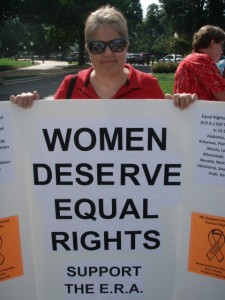
Article 3 provides for equality in the “full development and advancement of women,” especially in the “political, social, economic and cultural fields.” Such words may prompt the same red flags that conservatives waved when fighting the Equal Rights Amendment (“by ‘equality,’ they mean mass abortions and the demise of the American family!”). But the text articulates a vision of gender justice that draws upon decades of feminist discourse.
Article 11 not only sets a standard of gender non-discrimination in employment, but also bars bias on the basis of marital or maternity status, which in theory decouples a woman’s freedom to earn a living from her ties to a spouse or family planning decisions.
Article 10 ensures equal educational opportunity for women, including job training, which may undercut structural barriers that exclude women from certain sectors or higher-skill positions.
Other provisions guarantee equal access to financial resources and credit, give rural women a voice in community development planning, ensure equality before the law in terms of contracts and property holding. The Convention also enshrines equality before the law without regard to gender.
You could argue that an “advanced” society like the U.S. needn’t bother with CEDAW, a treaty that seems geared toward countries like Morrocco and Kuwait, which struggle with severe restrictions on women’s political and economic activities.
But understanding how gender equity plays out in America requires reading between the lines. For example, the Senate would have a lot to answer for if it were really bound to certain provisions of Article 11:
(d) The right to equal remuneration, including benefits, and to equal treatment in respect of work of equal value, as well as equality of treatment in the evaluation of the quality of work;
(e) The right to social security, particularly in cases of retirement, unemployment, sickness, invalidity and old age and other incapacity to work, as well as the right to paid leave
Sadly, the Senate’s failure on Paycheck Fairness appears to be entirely consistent with our global outlook. In terms of the overall safety net, core concepts like social security, unemployment benefits, and paid medical leave, have all been stifled or threatened by deficit hawks in recent months.
Research indicates that the lack of such benefits hurts workers overall, but disproportionately punishes lower-income mothers and families. But, as we’ve reported before on this blog, initiatives on the federal, state and local level to provide paid sick leave-a benefit that millions of workers lack despite widespread public support-have confronted militant resistance from the right.
Many of the controversial family-friendly policies are of course taken for granted in Western Europe, where the welfare state is not (yet) politically taboo. But even so, the European Union continues to reflect CEDAW’s guiding principles in ongoing efforts to close the gender wage gap and expand political participation.
The Convention has enjoyed only a brief flash in the Washington spotlight at a Senate hearing last week. As the Iowa Independent reports, the CEDAW has languished on the Senate’s backburner for years despite the broad support from current and previous administrations, together with a slew of other national and international human rights, legal advocacy and community organizations.
Melanne Verveer, Ambassador-at-Large with the State Department’s Office of Global Women’s Issues, testified before the Senate Judiciary Subcommittee on Human Rights and Law:
In my time at the State Department, I have visited scores of countries and met with women from all walks of life, from human rights activists in Russia, to microcredit recipients and small-business entrepreneurs in rural South Asia, to survivors of rape and conflict in the Democratic Republic of the Congo. In my travels, the number-one question I am asked time and time again is, “Why hasn’t the United States ratified CEDAW?” …
Some governments use the fact that the U.S. has not ratified the treaty as a pretext for not living up to their own obligations under it. Our failure to ratify also deprives us of a powerful tool to combat discrimination against women around the world, because as a non-party, it makes it more difficult for us to press other parties to live up to their commitments under the treaty.
While U.S. hypocrisy is exposed when addressing the most blatant human rights crises on a global scale, the everyday injustice that women face in the American workplace displays a subtler paradox: hegemony is not leadership. In fact, it might just mean you never have to explain why you lag so far behind.
Dennis Banks: “Take your truth and leave the room.”

GRIID file photo
“When we as human beings start destroying the very mother that provides for us, then we are not only destroying ourselves but the future of human beings. It’s going to be that way if change doesn’t start now. Not a political change, but some kind of uprising, some sort of anger. Something’s going to happen. I hope I see it in my lifetime because I want to hobble over there and be part of that change.” Dennis Banks, 11-22-2010
Despite his graying beard and slower pace, Dennis Banks commanded the respect of the audience assembled to hear the wisdom of this contemporary Native warrior and elder. He came to Grand Rapids Nov. 22 to speak as part of Grand Valley State University’s Intercultural Training for Native American Heritage Month.
A Native American activist and one of the founders of the American Indian Movement, AIM, Banks took part in the famous 1973 occupation of Wounded Knee, South Dakota and many other courageous actions for Native rights.
Banks, whose given name is Nowa Comig, began with an anecdote about the car accident that broke his back last year. The doctor came into his hospital room to break the bad news, “There’s going to be a problem with you walking. That’s the truth.”
Banks told him, “Take your truth and leave the room.”
On Feb. 14, 2011, Banks will lead “The Longest Walk,” a 5,000+mile walk across the United States to raise awareness about diabetes prevention among native peoples.
Bury the dead
Banks then shared how he recently joined the Ojibwa people near Mount Pleasant, Michigan for very special ceremony. Central Michigan University had returned the human remains of 130 native people so they could be laid to rest in the way that their sacred belief requires. “Ironically other universities said that this was a dangerous precedent,” Banks said.
The University of Michigan is one institution holding the remains of thousands of native people. In California, Berkley has 25,000. In all, the remains of some half a million native people are under glass or storage boxes in universities and museums. “The American Indian Movement (AIM) is going to issue a statement about policies mandated by the federal government to return those bones to the native people. Some universities are going to resist.”
He then encouraged young people to tell universities holding these remains that they would not enroll there. “This should be a major concern to the conscience of America. What are we doing storing human beings? It’s time to give these things back. Our religious belief is that those bones have to be returned to the earth so the person can continue their journey.”
Support the troops
As a Viet Nam era war veteran, Banks lived the results of US Foreign Policy first-hand. “This latest war is the longest one the US has been involved in except the longest undeclared war–against native people. It’s still going on. There is absolutely no need morally for them (US troops) to be there (Afghanistan). Bring them home and get them out of harm’s way.”
“Why would people hate us in other countries? . . . Our foreign policy is getting us in trouble the last 30, 40, 50 years. Those who stay at home never see the damage. To try to make this entire world a Christian world—it’s not going to happen. Ask the question, ‘Why do they hate us?’ When native people go overseas, we are loved. They welcome American Indians. But if you’re white, there’s warnings . . . Terrorists? If we start defining terrorists that definition is going to come pretty close to home.”
Religious freedom
During the recent national brouhaha over the so-called Ground Zero mosque, Banks stood with Muslim Americans. He shared an MSNBC/Rachel Maddowclip about a handful of fanatical right wing pundits turning the New York City mosque issue into a campaign to outlaw the practice of Islam in the United States.
“I supported Muslims so that history is not overlooked. In the late 1700s there were many burnings of sweat lodges, longhouses, holy sites. Those who did the burning were US soldiers and militia. When I first started hearing about people protesting the mosque, I began to think ‘Why are these people protesting against Americans?’ The 1890 Massacre at Wounded Knee . . . Sand Creek, Colorado, the death marches of the Cheyenne people, chapter after chapter of American history . . . America should have a memory. Why does it have to rely on Native American memory? What is sacred? The whole land is sacred . . .
We have closed up some churches on our reservations. Since then, no suicides. (It’s not that the churches caused the suicides, it’s) the conflict of who we are as native people. We are native people. Our DNA is we are native. Yes we’ve joined the different faiths but we are still native people. That’s the conflict going on inside of us.”
Love your mother
Banks then turned the talk to environmental issues. He shared how one of his enterprises on the reservation where he lives is tapping five kinds of trees for syrup, including maple syrup. Ten years ago, the tapping season lasted four weeks. The past few years, it has only lasted ten or twelve days. Power lines on the reservation prevent eagles and hawks from nesting and scare away the bears.
Army Corps of Engineers water control has killed off the reservations supply of medicinal herb and reduced the wild rice harvest. (The water is being used to irrigate urban golf courses.) “We try to stop them but they are coming with their bulldozers. Soon young people are going to rise up and say this is it. The very first lesson we should learn is ‘What is our relationship to this earth?’ It’s a breathing relationship but pretty soon there will be no more trees. When we as human beings start destroying the very mother that provides for us, then we are not only destroying ourselves but the future of human beings. It’s going to be that way if change doesn’t start now. Not a political change, but some kind of uprising, some sort of anger. Something’s going to happen. I hope I see it in my lifetime because I want to hobble over there and be part of that change.
This is our Mother Earth. She has been feeding us. What are we doing? We are killing our Mother. That’s a great, great sin. It will never be excused. Who knows? Mother Earth will destroy us all. She will have to do that to cleanse herself and get rid of us. We are shoveling our own graves. We can turn it around.”
“Take your truth and leave the room.”
How can we turn it around? We must identify the so-called truths propelling humanity towards certain destruction as lies. Sustainable capitalism. The “free” market. Corporate benevolence. Materialistic happiness. Fighting for freedom.
It’s time that people tell the powers that be to take their truth and leave the room.
###
View the trailer of A Good Day to Die, a new documentary about Dennis Banks.
Wal-Mart doesn’t give a shit about people going hungry in America
Yesterday, MLive.com posted a brief article on the new campaign by Wal-Mart, which claims it wants to fight hunger in America.

The MLive article tells people about an online campaign that Wal-Mart is promoting, where by just clicking on the site you can determine which community across the country will receive $1 million dollars to fight hunger. As of today, Grand Rapids had more hits than any other city.
The Wal-Mart campaign has identified the food hardship rate for the 100 largest communities in America, according to the Food Research and Action Center. Being identified as one of the 100 largest communities for food hardship in the country should be cause for major concern and would have been a more relevant story for the Press reporter to take. Instead, we are just told that Grand Rapids is in the lead and doesn’t that just sound more positive?
Stealing a lot from the poor and giving a little back
The whole notion that Wal-Mart wants to fight hunger in America would make any reasonable person burst out in laughter. Thinking that the largest company in the world wants to actually fight hunger in America tells us something about how well propaganda works in this country. Here are several reasons why Wal-Mart is not committed to fighting hunger in the US.
- Wal-Mart is the wealthiest company in the world with over $14 billion in profits last year alone. The company makes that kind of an annual profit because it has destroyed many local businesses and pays its workers poverty level wages. In 2008, Wal-Mart CEO H. Lee Scott Jr. made a $29,682,000 salary, which according to United for a Fair Economy is 1,314 times more than the salary of an average full-time Wal-Mart worker.
- If Wal-Mart paid its workers a livable wage they could seriously reduce the number of people needing food assistance in the United States. Wal-Mart also constantly violates worker pay agreements and is currently facing about 80 individual lawsuits from workers and 4 class action lawsuits for worker violations.
- Wal-Mart gets millions in tax breaks every year from communities across the country when they broker deals to build new stores. In addition, Wal-Mart use state and federal tax loopholes to pay less in taxes and get all kinds of subsidies. For example, Wal-Mart has been taking advantage of a tax loophole that the federal government closed years ago, paying rent to itself then deducting it from state taxes in about twenty-five states. Data from filings with the Securities and Exchange Commission show that on average Wal-Mart has paid only about half the statutory state rates over the past decade.” (2008 Wal-Mart Watch Report)
- Wal-Mart is a company, like any other company, that is committed to maximizing their profits. You cannot simultaneously end hunger and make a profit. Besides not paying workers in the US a livable wage, Wal-Mart profits off the misery of millions globally by selling products made in sweatshop conditions. Thus, Wal-Mart is also contributing to hunger around the world by benefiting off a neoliberal global economic system.
- Wal-Mart’s board of directors is made up of a group of economic elites who are also committed to maximizing profits and maintaining inter-corporate relations, which allows them to be a united front against government and public scrutiny. Look at who sits on Wal-Mart’s Board of Directors and ask yourself if these people are committed to fighting hunger.
There are many more reasons to discredit the claim that Wal-Mart wants to fight hunger in America, but we think you get the point. Wal-Mart recognizes they are despised by millions of people throughout the country, so this new campaign is really a PR effort to paint themselves as a “responsible” corporation.

This tactic of “funding community projects” is not a new one employed by corporations. Robber Barons like Carnegie and Rockefeller did the same thing 100 years ago as a means to prevent working class rebellion against their obscene wealth in the face of widespread poverty.
Currently, companies like Chase Bank, Pepsi and Wal-Mart are also trying to con the public into thinking they care about our communities by offering funds for local projects. We need to see these efforts for what they are, elaborate public relations ploys to divert our attention from how they continue to amass incredible amounts of wealth while more and more people fall into poverty.
Several Lawmakers Invested in L-3 Communications, Maker of Airport Body-Scanning Machines
(This article is re-posted from OpenSecrets.org. L-S Communications is also a major military contractor and has a facility in Muskegon, MI.)
 A handful of federal lawmakers are invested in one of the companies behind the controversial full-body scanning machines now in more than 60 U.S. airports. The individual investments are worth thousands, and in some cases tens or hundreds of thousands, of dollars.
According to a Center for Responsive Politics review of the most recent personal financial disclosure filings, eight members of Congress — three Democrats and five Republicans — owned at least $2,000 worth of stock in L-3 Communications, which is one of the two main contractors involved in the full-body scanning machines.
Sen. John Kerry (D-Mass.) disclosed possessing the most stock in L-3 Communications — with a minimum investment of at least $500,000 and a maximum value of $1 million. The L-3 Communications stock is fully owned by his wife, Teresa Heinz, according to federal financial disclosure reports.
Members of Congress file annual personal financial disclosures detailing their assets and liabilities, as well as those of their spouses and dependent children. These forms also allow lawmakers to describe the value of their holdings and debts in broad ranges, so it’s impossible to know exactly how much the holdings of Kerry’s family, or any other lawmaker’s household, are worth.
Republican Reps. Michael Castle (R-Del.) and Michael McCaul (R-Texas) both disclosed possessing between $16,002 and $65,000 worth of L-3 Communications stock in 2009.
And Rep. Judy Biggert (R-Ill.) was the member of Congress with the next most valuable holdings in L-3 Communications, worth between $15,001 and $50,000.
Here is a table of all eight lawmakers whose 2009 personal financial disclosure forms, which were filed in May, noted holdings in L-3 Communications, along with the minimum and maximum value of these holdings, according to the Center’s research.
| Name | Value |
| Sen. John Kerry (D-Mass.) | $500,001 to $1,000,000 |
| Rep. Michael Castle (R-Del) | $16,002 to $65,000 |
| Rep. Michael McCaul (R-Texas) | $16,002 to $65,000 |
| Rep. Judy Biggert (R-Ill.) | $15,001 to $50,000 |
| Rep. Ron Klein (D-Fla.) | $1,001 to $15,000 |
| Rep. Robert Scott (D-Va.) | $1,001 to $15,000 |
| Sen. Jon Kyl (R-Ariz.) | $2,173 |
| Rep. Kenny Marchant (R-Texas) | $2,086 |
The government’s investment in full-body scanners has broadened since the “underwear bomber’s” failed terrorism attempt last Christmas. Days later, L-3 Communications was awarded a $165 million contract for the machines, and another company, RapiScan, was also awarded a $173 million contract.

Both companies have seen significant jumps in their federal lobbying expenses since just a few years ago, and both are employing officials with well-heeled government connections, as OpenSecrets Blog previously reported.
For instance, RapiScan utilizes the services of Michael Chertoff, the secretary of Homeland Security under Republican President George W. Bush. And former Republican Sen. Alfonse D’Amato (R-N.Y.) and Linda Daschle, the wife of former Senate Majority Leader Tom Daschle (D-S.D.), are both actively lobbying for L-3 Communications.
Shell’s Arctic Drilling Will Destroy Our Homeland and Culture
(This article by Rosemary Ahtuangaruak is re-posted from Climate Story Tellers.)
This week families across the country will be celebrating Thanksgiving—sharing food and telling stories. Here is my story about our food and culture that would be destroyed if Shell Oil gets the permit to drill for oil in our homeland—the Beaufort and Chukchi Seas.

Since 1986 I lived in Nuiqsut, an Inupiat community on the Beaufort Sea coast of Arctic Alaska. In 1991 I graduated from the University of Washington Medex Northwest Physician Assistant program and was employed as a health aide in Nuiqsut for 14 years. Nearly 8 years ago I helped to found REDOIL (Resisting Environmental Destruction on Indigenous Lands) to represent my interests.
I have raised my family in Nuiqsut. I have one daughter, four sons, two granddaughters, and four grandsons. I live a very traditional lifestyle—hunting, fishing, whaling, gathering, and teaching our family and community members the traditional and cultural activities as my elders taught me. We hunt and eat various birds, including ptarmigan, ducks and geese; fish, including char, salmon, whitefish, dolly varden, grayling, pike, trout, and cisco; land mammals, including caribou, moose and muskox; and marine mammals, including bearded seals, walrus, beluga and bowhead whales. We harvest berries, plants roots and herbs. We work together in harvesting plants and animals.
We have extensive sharing traditions that unite our families and communities. Other communities share their harvest with my family and we share our harvest with others. These sharing patterns have given us much of the variety of foods that we eat. We also share our harvest with those in need. My mother taught me the land hunting skills that she learned from her parents and family. Other family members taught me how to hunt whales and other marine mammals. I have family ties that bind me to Nuiqsut and other communities in the Arctic, and exposure to hunting and gathering is an important part of these ties.
Whales Give Us Food and Bind Our Communities
Inupiat communities across the Arctic coast of Alaska primarily depend on Bowhead whales for subsistence food and our culture is tied intimately with the whales and the sea. Nuiqsut whalers hunt for bowhead whales in the Beaufort Sea during the fall. We await the migration of the whales from Camden Bay for this hunt. The crews go to Cross Island in August. My sons help the crews with their preparation. My ex–husband has gone whaling from Cross Island with his uncle a few times.

There is a feast in the village after a successful whale hunt. Everyone is invited to the captain’s home to eat whale meat and other food, tea and coffee. I have participated in several of these feasts in Nuiqsut. These feasts are a time of celebration, when stories are told about the hunt.
We have a unique sharing system to divide the harvested whale among the crew striking the whale and the crews helping to land and butcher the whale. The whalers also set aside a portion of the whale meat to share with those in need. Part of the catch is saved for feasting. We share the feast three times during a year, at the blanket toss—a traditional celebration during the summer, Thanksgiving and Christmas. Sharing of the whale binds our communities. Whale meat feeds families throughout the long, dark winter, and provides nourishment, warmth and fuel for our daily activities during the Arctic winter.
The foods we eat are important to our lives and health. We have activities associated with our harvesting throughout the year, such as skin sewing, sinew preparation, and craft making. The teaching of the activities and stories continues throughout the year with each generation sharing family hunting stories.
Shell’s Drilling Plan Will Affect Wildlife That We Depend On For Survival

Shell’s proposals to drill for oil and gas in the Chukchi and Beaufort Sea are detrimental to the traditional and cultural activities of our family and village. We depend on traditional foods that migrate through both Beaufort and Chukchi Seas. Any harm from Shell’s activities to our resources, including bowhead whales, seals, fish and caribou, threatens our food and our health.
I am concerned that Shell’s exploration drilling, icebreaking, aircraft and helicopter flights, and other noisy activities in the Beaufort and Chukchi Seas will keep whales from their feeding areas or otherwise harm them. Any changes in the whale populations could affect our hunting. We educate our families that a whale hunt must be respectful and quiet. If the noise from Shell’s drilling and icebreaking causes whales to be farther offshore, I am concerned that this would place more wear on our equipment and put the whalers at greater risk. We have been taught not to put things in the water that may cause the whales to turn away from the hunting grounds. I fear that water discharges from drillships or the presence of drilling muds in the water where Shell conducts its activities could cause whales to avoid our hunting grounds.
If the whale hunts are less successful, I fear that the community will suffer, as it has in the past during times of shortage. To give an example, in the early 1990s there was seismic activities and exploration drilling in Camden Bay that severely affected our whaling. The following winter, I heard of an unusually high rate of domestic violence in Nuiqsut and increases in suicide attempts and in suicides. I heard of and witnessed increases in drug and alcohol use as well. As a community health aid, I listened to people’s stories of how difficult it was to hunt without success. That winter was the worst I spent as a community health aide and the experience prompted me to speak out at meetings about oil development.
We also depend on caribou for our subsistence food. I am concerned that helicopters and aircraft associated with Shell’s offshore drilling will affect caribou along the coast, and make the caribou avoid hunting areas, including traditional migratory routes and areas used for insect relief.
Due to ongoing oil development on land caribous are already affected. We have a hunting cabin 8 miles from Nuiqsut. This cabin is across the river from the Alpine oilfield, and the activity levels around the cabin are so high that we travel up fish creek and other tributaries, away from the cabin, in order to hunt geese and caribou. I feel that the overflights have caused the caribou to avoid the area near our hunting cabin. My second youngest son was brought to the same area where his dad hunted his first caribou. My son shot a caribou there, but the wounded animal fled from a helicopter that was flying overhead, and moved into a water filled gravel pit, created for development of the Alpine oilfield, and drowned where we could not get to it. The loss of that caribou eliminated my son’s desire to attempt to hunt for the rest of the summer.
Oil and Gas Activities Threaten Our Traditional Way Of Life
I embrace the traditional and cultural activities that I learned from my elders and extended family members. Sharing and passing these traditions onto my children, grandchildren and families is very important to me. I fear that industrial oil and gas activities, including those put forward in Shell’s drilling plans, are changing our natural environment and thereby affecting my ability to live, share, and pass on our traditional way of life. Increased contact with unnatural activities causes a cascade of reactions. Taking the next generation hunting and fishing in areas that now feature signs and sounds of industrial activity—gravel placement, flight activity, personnel activity—is not the same.
I have seen first hand how the Alpine oilfield affected our cultural camp at Nigliq and on the Colville River. There is a growing need to work in cultural camps that teach the next generation our hunting traditions. But teaching the young harvesters our traditions is getting harder because of oil and gas development that drives animals away from our camp. For example, the caribou herds are kept miles away by traffic, including freighter flights, helicopters, and airboats. When industrial activities that conflict with traditional and cultural activities are permitted to dominate our landscape, traditional usage of the areas that has persisted for generations loses out to expanding oil and gas infrastructure.
The disconnect between our concerns and continual government permitting of oil and gas activities in our region is stark. Generations of our people have discussed and put together comments, mitigation measures, restrictions, and prevention attempts. Yet the government has not prevented the loss of traditional and cultural activities, impacts that the Council on Environmental Quality for the Bush administration told us were illegal. State and Federal Governments push the permitting process without looking at the losses created for us. We pushed for deferral and permanent restrictions of industrial activities during our whaling at Cross Island and we were kept out of meetings that changed these discussions. That also was illegal, yet the Obama administration has only allowed industrial activities to continue. National Marine Fisheries Service has stated that oil and gas activities should be postponed until baseline data could be obtained. Yet no new information exists to guide decisions. We fought for restrictions that were not honored.
Words on papers create real loss to our stomachs and the rest of the process of sharing, teaching, celebrating, and learning. Hotdogs offered by industry in their meetings cannot replace the loss of our traditional and cultural foods and activities.
When Will The Government Honor Our Concerns?
http://www.youtube.com/watch?v=zRsjTuNMHY8&feature=player_embedded
Earlier this month there were federal government hearings in several Inupiat communities including Barrow, Kotzebue, Point Hope, Point Lay and Wainwright to hear our concerns about Shell’s Arctic drilling. I attended the hearing in Barrow, where I’ve been living since May of this year. We had about 60 people attend the Barrow hearing and overwhelmingly the statements were in opposition to Shell’s drilling plan. The hearing showed the continued concerns of the lack of ability to respond to a spill, lack of taking the concerns of the people into meaningful consultation, the lack of willingness to protect our traditional and cultural activities, and the continued stress and strain this is causing to our people. The risks of the process stay with us and the benefits are taken elsewhere. None of it is worth the risk to harvesting, sharing, celebrating, consuming, teaching, constructing crafts, preparing foods, planning, feasting, dancing, and singing.
Oil companies have a long tradition of making promises and then breaking them by cutting costs to increase profits. Recently I read about a detailed study reported in The New York Times that concluded, “Arctic is not ready for such deep–sea drilling operations.” This is very worrisome for me. But I don’t need to know this from The New York Times—I live here in the Arctic and I know how dangerous it would be to drill for oil in the frozen Arctic Seas.
We want to be Inupiat into the future not just residents in an industrialized area destroyed by Shell’s offshore oil drilling. Our animals, land and seas in the Arctic are already severely stressed by climate change. We don’t want Shell’s dangerous offshore drilling to add to our difficulties. I urge President Obama to hear our concerns and deny Shell the permit to drill for oil in the Beaufort and Chukchi Seas.
What Michigan Kids Learn About Thanksgiving
Every year about this time, Michigan children trail home with construction-paper turkeys and coloring pages of the “first Thanksgiving.” Their heads have been stuffed with stories about Pilgrims putting on a big party for their Indian friends.

But in the Michigan Department of Education (MDE) curriculum standards, only Grade 5 students might have Thanksgiving as a required lesson. Fifth grade is the year that Michigan students learn about American Indian life across the continent, and then abruptly switch over to White history when they reach 1620. You might think that they’d kick off with the feast at Plymouth Rock. But the curriculum notes state, “study relations with American Indians: King Phillip’s War,” starting out, as it were, with a bang.
So why is Thanksgiving a universal feature of November class work? Because teachers find that holiday lessons provide one way to handle student excitement over an upcoming vacation. In other words, it’s a behavior-modifier. A child tracing his hand to make a picture of a turkey isn’t going to be dancing around in anticipation of freedom from school.
Teachers seek out their own lessons and activities for this type of teaching…and the overall quality of canned, downloadable Thanksgiving materials is awful. Many of the Thanksgiving “stories” available on teachers’ resource sites are overtly racist. Most of them provide no true American Indian perspective of the holiday. And the accompanying materials—such as coloring pages—are wildly inaccurate, like the one shown here of a young Indian girl at the first Thanksgiving feast.
Is a White perspective justified? Some teachers might tell you that it is. After all, the primary documents for this event come from two White men: Governor Bradford and Edward Winslow.
But here’s something interesting: when you actually read the accounts, you’ll find that Bradford makes no mention of a feast at all. He just notes that the harvest was successful and that the colony has enough provisions to winter over. Winslow describes how the men went on a hunting trip for turkeys so that “we might after a more special manner rejoice together.” He tells how they “exercised” their arms in target shooting, and “many of the Indians coming amongst us, and among the rest their greatest King Massasoyt, with some nintie men, whom for three dayes we entertained and feasted, and they went out and killed five Deere, which they brought to the Plantation and bestowed upon our Governour…”
And that’s the entire first-hand story. No planned joint celebration; no intention of including Indians as guests; no mention of a religious intent for the feast. Today, almost all of the Thanksgiving stories for elementary school children offer about a chronology that’s much embroidered and expanded from the real account. The Pilgrims landed. The first winter was hard, although they did find ten large baskets of corn and other items to sustain them as they built their houses. Illness swept through the colony, along with hunger. The next spring, Samoset suddenly appeared. Along with Squanto, he befriended the Pilgrims, taught them some farming tricks and gave them other advice that helped them have a good harvest. The Pilgrims decided to hold a big feast to celebrate. They invited their Indian friends to share in their bounty.
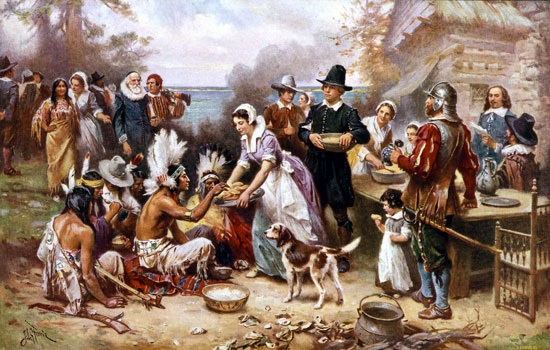
Here’s an excerpt from one story that teachers can download and ask students to read. It’s written with an old-fashioned style, to make it sound like a first-hand account:
So they had the first Thanksgiving party, and a grand one it was! Four men went out shooting one whole day, and brought back so many wild ducks and geese and great wild turkeys that there was enough for almost a week. There was deer meat also, of course, for there were plenty of fine deer in the forest. Then the Pilgrim mothers made the corn and wheat into bread and cakes, and they had fish and clams from the sea besides.
The friendly Indians all came with their chief Massasoit. Every one came that was invited, and more, I dare say, for there were ninety of them altogether. Kind as the Indians were, you would have been very much frightened if you had seen them.
They were dressed in deerskins…They had their faces painted in all kinds of strange ways, some with black stripes as broad as your finger all up and down them. But whatever they wore, it was their very best, and they had put it on for the Thanksgiving party. Each meal, before they ate anything, the Pilgrims and the Indians thanked God together for all his goodness
Here’s another story from a Thanksgiving teaching unit, complete with dialogue but using the same general information:
“Let us gather the fruits of our first harvest and rejoice together,” said Governor Bradford.
“Yes,” said Elder Brewster, “let us take a day upon which we may thank God for all our blessings and invite to it our Indian friends who have been so kind to us.”
The Pilgrims said that one day was not enough; so they planned to have a celebration for a whole week. The great Indian chief, Massasoit, came with ninety of his bravest warriors, all gaily dressed in deerskins, feathers, and fox tails, with their faces smeared with red, white, and yellow paint. As a sign of rank, Massasoit wore a string of bones and a bag of tobacco around his neck. In his belt he carried a long knife. His face was painted red, and his hair was daubed with oil.
There were only eleven buildings in the whole of Plymouth village, four log storehouses, and seven little log dwelling-houses, so the Indian guests ate and slept out of doors. This did not matter for it was one of those warm weeks in the season that we call Indian summer.
To supply meat for the occasion four men had already been sent out to hunt wild turkeys. They killed enough in one day to last the company almost a week. Massasoit helped the feast along by sending some of his best hunters into the woods. They brought back five deer which they gave to their pale face friends, that all might have enough to eat. Under the trees were built long, rude tables on which were piled baked clams, broiled fish, roasted turkey, and venison. The young Pilgrim women helped serve the food to the hungry redskins.
The first things you probably notice in reading these two stories are the incredibly racist descriptions of the Indians: they are frightening in appearance; they wear scary clothing and are armed; they are referred to as “redskins” in one of the accounts.
But in fact, these are actually the less offensive details of the accounts. The underlying White subtext is a much more effective tool in demeaning the Indians and advancing a sense of White superiority. It’s the Puritans who plan the feast and do the bulk of the work in these accounts. They have cooked an entire range of delicacies, from turkey to geese to fish clams to bread and cakes. The Indians show up as guests, bringing a token gift of five deer, and it’s implied that they bring the deer mainly so that they themselves will have enough to eat. The Indians give thanks to the White men’s god along with the Puritans, as if they obviously recognize the superiority of the White man’s religion. The Indians had made a big effort to dress in their finest clothing because it was such an honor to eat with the Puritans. It was not a problem for the Indians to sleep outdoors because the weather was warm—no breach of hospitality was intended. One story also introduces the racist term “Indian summer.”
Many Michigan teachers might object that they would never use one of these reading selections in their classrooms. But these two stories are posted on one of the most popular teaching-unit sites. Some teachers might insist that they do present an Indian perspective by teaching more about the Wampanoag culture and offering an explanation that the good will between the Puritans and the Indians was short-lived. (That brings us to the Pequot Massacre and then King Phillip’s War, which occurred only a generation later).
In one of these more “Indian-centric” teaching units, the story does explain more about the Wampanoag culture and credits the Indians with the colonists’ survival. But the Thanksgiving story feels oddly similar:
“Captain Miles Standish, the leader of the Pilgrims, invited Squanto, Samoset, Massasoot (the leader of the Wampanoags), and their immediate families to join them for a celebration, but they had no idea how big Indian families could be. As the Thanksgiving feast began, the Pilgrims were overwhelmed at the large turnout of ninety relatives that Squanto and Samoset brought with them. The Pilgrims were not prepared to feed a gathering of people that large for three days. Seeing this, Massasoit gave orders to his men within the first hour of his arrival to go home and get more food. Thus it happened that the Indians supplied more food, some of which we still eat today: Five deer, wild turkey, fish, beans, squash soup and berries. Captain Standish sat at one end of the long table and the Clan Chief Massosoit sat at the other end. For the first time the Wampanoag were sitting at a table to eat instead of on mats or furs spread on the ground.”
Here again is the invitation initiated by the White colonists…the feeling of White superiority (the Indians get to eat at a table for the first time!)…and as for the large group of Indians, the explanation was that they were overly enthusiastic and brought too many relatives and friends with them.
But to understand how twisted our White perspective is, it’s necessary to get a true Indian explanation of the event. One excellent example can be found at Oyate, a site dedicated to offering an Indian perspective so “that our lives and histories are portrayed honestly, and so that all people will know our stories belong to us.” In an article titled “Deconstructing the Myths of ‘The First Thanksgiving’,” authors Judy Dow and Beverly Slapin give an account drawn on their knowledge from their own nations. Dow, an Abenaki, offers a unique perspective because a direct account of Samoset’s exists in the oral traditions of this people.
Here are just a few of the points the authors address:
• The term “Pilgrim” was not in use until the American Revolution, in a first-wave effort to infuse this entire story with a sense of Christian morality.
• The corn that the Puritan hunting party brought back to their settlement was seed corn belonging to the Wampanoag. It was stolen, not “found.” The scouting party also stole items from homes, according to their own account. Worst of all, they robbed graves, taking beads and important spiritual objects that had been buried with a child.
• Samoset didn’t appear out of nowhere. The Abenaki often played a diplomatic role among the Eastern woodland tribes, and Samoset, an Abenaki chief, had been asked by Massasoit to discover the intentions of the colonists at Plymouth. Squanto (real name: Tisquantum), who had been enslaved by an English crew and later escaped, offered to live with the colonists so he could send reports back to Massasoit.
• And as for that “invitation” to a great feast, Winslow’s account turns out to be exactly accurate, although it’s not complete without the Indian side of the story. The colonists’ gunshots indicated to the nearby Wampanoag that the White men were forming a war party. Massasoit assembled a party of 90 men—dressed in war gear (not party clothes) and with no women and children with them—to approach the settlement. When the chief saw a celebration was underway, he ordered some of his hunters to bring deer, turkeys, and other food as gifts. It was the Indians who provided the bulk of the food for the harvest feast, not the Puritans.
It’s well worth reading the entire article, found here. It’s too bad that more Michigan teachers don’t use this material. The instruction of the “Thanksgiving story” in Michigan as well as across the United States, despite some pasted-over attempts to update the information, remains a perfect expression of White supremacy and is infused with an expression of American imperialism. That’s not a lesson that any child should learn.

