30th Anniversary of the Murder of 4 US Church Workers in El Salvador

It was 30 years ago today that the bodies of four US church workers – Ita Ford, Maura Clarke, Dorothy Kazel and Jean Donovan – were exhumed from where the spot they were clandestinely buried the day they were murdered.
Ita, Maura and Dorothy were nuns in the Catholic Church and had been working on Central America for some time before they were killed. Jean Donovan was a successful accountant with Arthur Andersen, but in 1977 she decided to leave all that behind and work for justice through the lay religious order of Maryknoll.
The four women had been invited to work with internal refugees in El Salvador by the Archbishop Oscar Romero in 1979. They women became good friends of the bishop up until his assassination in March of 1980. The women were present at the funeral for Romero where Salvadoran soldiers opened fire on the crowd of mourners, killing roughly 30 people.
Jean Donovan wrote that things became more dangerous by the day and that friends of hers were being killed on a regular basis. When asked why she didn’t leave, Donovan said, “I almost could, except for the children, the poor, bruised victims of this insanity. Who would care for them? Whose heart could be so staunch as to favor the reasonable thing in a sea of their tears and loneliness? Not mine, dear friend, not mine.”

On December 2nd, Jean and Dorothy drove to the Salvadoran airport to pick up Ita and Maura. After they left the airport they were pulled over by Salvadoran Security forces. The four women were murdered, the bodies taken to a clandestine location and buried. After the bodies were exhumed it was determined that the four women were raped before they were murdered.
This injustice took place at the end of the Carter administration, which did nothing to hold the Salvadoran government accountable. The incoming Reagan administration was quite friendly with the Salvadoran government and even suggested that the four women were responsible for their own deaths.
However, family members of the four women and former US Ambassador to El Salvador Robert White fought hard for an investigation and in 1984 five Salvadoran National Guardsmen were sentence to 30 years each for the murders. The Truth Commission findings in 1992 determined that the murders were planned and that the soldiers were following them from the airport.
As a young man I was inspired by the dedication and courage that these four women demonstrated in the face of repression. Their deaths and the murder of Archbishop Romero months earlier both played a major role in my decision to become involved in solidarity work in Central America in the 1980s.
The self-less love that the 4 women demonstrated is what led several of us to start the Koinonia House in Grand Rapids in 1984, on the 4th anniversary of their death and then to declare ourselves a sanctuary for Central American refugees in 1986. Two years later I went to Guatemala to work with Peace Brigades International (PBI) and follow the tradition of the four women in doing solidarity work with people who were being terrorized by US funded death squads.
The courage of Ita, Dorothy, Maura and Jean were part of what influenced my own work and the work and lives of countless other people. It is because of this that we honor their memory today.
Dorothy Kazel, Ita Ford, Maura Clarke and Jean Donovan…….Presente!
Open letter from Afghan Youth to our World Leaders
(This letter is re-posted from ZNet.)
Dear Mr Obama, Mrs Clinton, Mr Petraeus, Mr Rasmussen, and all our world leaders,

We are Afghans and we ask the world to listen.
Like yourselves, we couldn’t live without the love of our family and friends.
We were hurt by your criticism of Mr Karzai for voicing the people’s anguished pleas, “Stop your night raids.”
Please, stop your night raids.
If you could listen, you would have heard 29 NGOs in Afghanistan describe how we now have “Nowhere to Turn”.
If you could listen, you would also have heard Mr Karzai and the 29 NGOs express concern over your Afghan Local Police plan; the world will henceforth watch our militia killing the people, your people and our people, with your weapons and your money.
If you could listen, you would have heard the sound of your drones crystallizing the nights of hatred among the Afghan, Pakistani and global masses.
Instead, we hear your determination to ‘awe, shock and firepower’ us with Abrams tanks. We hear distant excitement over your new smart XM25 toy, a weapon you proudly proclaim will leave us with ‘nowhere to hide’.
Nowhere to turn and nowhere to hide.
Your actions have unfortunately dimmed our hopes that we the people could turn to you. Along with our Afghan war-makers, you are making the people cry.
Yet, we understand. You are in the same trap we’re in, in a corrupt, militarized mania.
Love is how we’re asking for peace, a love that listens, and reconciles.
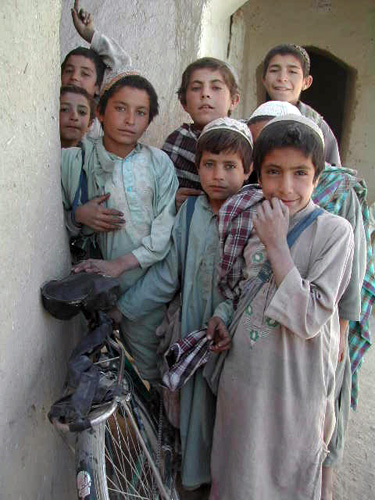
And so, we invite you to listen to the people of Afghanistan and to world public opinion on the Global Day of Listening to Afghans, to be internet-broadcast from Kabul this December.
It is time to listen broadly and deeply to both local and overseas Afghan civil groups and the numerous alternative solutions they have proposed for building a better socio-political, economic and religious/ideological future for Afghanistan.
We have shared the pain of our American friends who lost loved ones on September 11, by speaking with and listening to them.
Though, if the world could listen like these American friends did, the world would know that few Afghans have even heard about September 11 and that no Afghans were among the 19 hijackers. The world would have heard our yearnings as we were punished over the past 9 years.
If the world could listen, they would know how much we detest the violence of the Taliban, our warlords, any warlord, or any bullet-digging finger-trophy troops.
And now, for at least another four more years, we will grieve over souls who you are unwilling to ‘count’ and we are unwilling to lose.
It is extra painful to us and to your troops because clearly, there are non-violent and just alternatives.
We understand the pain of financial hardships but try telling an Afghan mother about to lose her child or a soldier about to take his life that the only way their illiterate and angry voices can ruffle the posh feathers of our world leaders is when it disturbs not their human or truth deficit, but their trillion dollar economic deficits. How do we explain that without denuding ourselves of human love and dignity?
What more can we say?
How else can we and our loved ones survive?
How can we survive with hearts panicking in disappointment while perpetually fleeing and facing a ’total’ global war, a war that wouldn’t be questioned even in the crude face of a thousand leaks?
We would survive in poverty, we may survive in hunger, but how can we survive without the hope that Man is capable of something better?
We sincerely wish you the best in your lives.
We are Afghans and we ask the world to listen.
Salamat bAsheen!
Be at peace!
Meekly with respect,
The Afghan Youth Peace Volunteers
Global Day of Listening to Afghans
19th December 2010
Why not listen?
Why not love?
To share the pain of Afghans and people in conflict all over the world, please join us in Afghanistan by taking a few minutes on the 18th & 19th of December 2010 to Skype call us or call us directly, from wherever you are
Email youthpeacevolunteers@gmail.com
1. To arrange a call on the 18th & 19th of December 2010 OR
2. To support our Open letter from Afghan Youth to our World Leaders, by emailing “YES, Why not listen?”
Please call us…tell us when your heart has pain
MiBiz, Whirlpool and Newsweek’s Green Rankings
In their weekly electronic Michigan Manufacturing newsletter, MiBiz announced that the Michigan-based Whirlpool Corporation was included in Newsweek’s top 500 Green Ranking on companies in the US.
The blurb in MiBiz, was based on a Press Release by Whirlpool itself, without any real verification of whether or not the company does engage in sustainable practices. The press release cites Whirlpool’s commitment to the environment by setting up an office of environmental control and having all its appliances “capable of receiving and responding to signals from smart grids.”
There is no evidence to suggest that Whirlpool actually cares about the environment. In fact, the opposite is true, since the company makes products that require intense amounts of mining to acquire resource in the manufacturing of their products, immense amounts of energy to produce them and unnecessary amounts of energy to power their appliances. Add to that the company’s treatment of workers and support for racist policies and it seems quite laughable to give Whirlpool and kind of award for responsible behavior.
However, rational thinking does not apply in Newsweek’s Green Rankings process. According to the website’s methodology, “The goal was to assess each company’s actual environmental footprint and management of that footprint (including policies and strategies), along with its reputation among environmental experts.”
An investigation into the Methodology shows that the “standards” are pretty weak and conducted by a London-based group called Trucost, which has a strong history with the corporate and financial world. The group’s publications tend to focus on carbon trading and environmental costs within a market framework.
Whirlpool is 116th on a list of the top 500 companies in the US on Newsweek’s Green Rankings. If one looks at the list of companies that precede Whirlpool, you can get a sense of how ridiculous this green ranking system is.

Companies such as McDonalds (79th), the GAP (71st), the pharmaceutical company Merck (68th), Coca Cola (54th), Wal-Mart (51st), JPMorgan Chase (45th), Starbucks (33rd), Pfizer (21st), Nike (10th) and Dell (1st) are all on the Newsweek Green Rankings list. Anyone who knows much of anything about the practices (both ecologically and socially) of these corporations knows that they are involved in serious environmental degradation, labor abuses, corruption and political manipulation.
Honestly, how could anyone say with a straight face that McDonalds does anything that promotes environmental sustainability? The very nature of McDonalds – drive through food, factory farm meet, forest destruction, unhealthy food, deceptive marketing campaigns targeting kids, and low wages – is unsustainable. (See the film McLibel and the website http://www.mcspotlight.org/).
For MiBiz to promote this hoax that companies like Whirlpool are environmental stewards is irresponsible and unethical. And while is may seem quite apparent to reasonable people we have to exposed this deception for what it is as nothing more than a form of greenwashing.
Media Bites – Chevy’s Greenwashing Campaign
In this week’s Media Bites we take a look at a new ad campaign by Chevrolet, called Chevy Runs Deep. The ad campaign presents the car company as making an environmental commitment to carbon emissions reduction. However, this is based on how many cars they sell, not on any serious effort to reduce greenhouse gases.
What We Are Reading
Below is a list of books that we have read in recent weeks. The comments are not a review of the books, instead sort of an endorsement of ideas and investigations that can provide solid analysis and even inspiration in the struggle for change. All these books are available at The Bloom Collective, so check them out and stimulate your mind.

The Ecological Rift: Capitalism’s War on the Earth, by John Bellamy Foster, Brett Clark and Richard York – Humanity in the twenty-first century is facing what might be described as its ultimate environmental catastrophe: the destruction of the climate that has nurtured human civilization and with it the basis of life on earth as we know it. All ecosystems on the planet are now in decline. Enormous rifts have been driven through the delicate fabric of the biosphere. The economy and the earth are headed for a fateful collision—if we don’t alter course. In The Ecological Rift: Capitalism’s War on the Earth, environmental sociologists John Bellamy Foster, Brett Clark, and Richard York offer a radical assessment of how capitalism is inherently destructive to the environment. The authors also look at the arguments that free market apologists offer for what is now called Green Capitalism.

Pakistan: Democracy, terrorism, and the Building of a Nation, by Iftikhar Malik – As the fall-out of the US-led “war on terror” continues to destabilize the countries of the Indian subcontinent, Pakistan and its fate are never out of the headlines. How did this predominantly Muslim country of 175 million reach this critical state? And what does the future hold in the face of such political and social upheaval? This clear, comprehensive book synthesizes the complex issues facing Pakistan today while remaining cautiously optimistic about the future of a pluralistic nation caught between civic and military imperatives. Professor Malik examines: the country’s strategic geopolitical position; the main characters who have shaped the nation; the legacy of Partition and the role of civil society as a force for change; the vexing problems of good governance; and the parts played by Political Islam and Jihadi extremism, and by the West in its use of Pakistan as a buffer state. This is an excellent book for those wanting to have a better understanding of the US Af-Pak war.

Dispossessing the Wilderness: Indian Removal and the Making of the National Parks, by Mark David Spence – A landmark historical reconstruction of a forgotten story–the eviction of American Indians from a troika of our nation’s major parks: Yosemite, Yellowstone, and Glacier. Spence documents the separate but symbiotic developments of the Indian reservation and recreational park systems, the former to corral Indians, the latter to sequester nature. Spence underpins his three compelling narratives with a clear exposition of the evolving ‘wilderness’ and ‘preservationist’ ideologies, which spelled exclusion for Indian residents of these natural wonders. His riveting chronicle concludes with current tensions, as Indians are attempting to reclaim special rights to these sacrosanct areas and parks are struggling to correct a century of native dispossessions and misrepresentations of the cultural/historical record.

U.S. Savage Imperialism: Noam Chomsky on the U.S. Empire, the Mideast, and the World – In a talk at Z Media Institute 2010, Noam Chomsky begins by comparing the similarity between the U.S. founding mission to be an empire of the chosen, with Israel’s mission. He cites the U.S. self-proclaimed “humanitarian mission” to help the native population by exterminating or removing it. He then talks of the manifest destiny, its preference for settler colonialism, which he calls the most savage kind of imperialism, and the importance of the Mideast in establishing U.S. world dominance. DVD includes talk (65 minutes) and Q&A on the environment, activism, and other topics (56 minutes).
Eco-Alert: Citizen involvement in future accountability in the Gulf after BP disaster
(This alert is re-posted from Public Citizen.)
 The Oil Spill Commission will begin deliberations this week on its final report and recommendations, due to be released on January 11.
Please join Public Citizen in advocating for strong citizen participation in overseeing oil and gas activities in the Gulf.
After the Exxon Valdez spill, Congress set up Regional Citizens’ Advisory Councils for Prince William Sound and Cook Inlet in the State of Alaska. These Councils resulted in improved environmental safeguards and substantially safer and more reliable transportation and spill response capabilities in Alaska.
The citizens of the Gulf Coast deserve the same structure to monitor and provide recommendations for exploration, development, production, coastal refining and transportation of oil and gas in the Gulf of Mexico and for prevention, response and restoration measures related to the social, economic, health and environmental impacts of an incident that could result in a significant oil or gas release into the Gulf.
Lax government oversight contributed to the BP oil spill disaster, but increased government regulation alone cannot prevent future accidents. A council of Gulf Coast citizens—including representatives of commercial and charter fishing, the tourism industry, indigenous and socially vulnerable populations, conservationists and municipal governments—with knowledge of their communities and a direct interest in promoting safer oil and gas operations is needed.
Thank you for your continued support on this issue. The oil has stopped flowing from the well, but there is still much that needs to be done to make the Gulf and its communities whole again. The establishment of Regional Citizens’ Advisory Councils will be a significant step toward that end.
US Military Spending in 2010 the largest since WWII
(This article is re-posted from Open Secrets.)

Did you know that the United States is spending more on its military this year than any other year since World War II? In an article in The New Republic, Gregg Easterbrook outlines how the $700 billion the United States is spending on defense this year is roughly equivalent to military spending in all other countries combined — and how when adjusted for inflation, it’s more than was spent during the Korean War, the Vietnam War or during the Reagan military buildup.
Since 2001, Easterbrook writes, “military and security expenditures have soared by 119 percent” and “even if the costs of the conflicts in Iraq and Afghanistan are subtracted, the defense budget has swelled by 68 percent since 2001.”
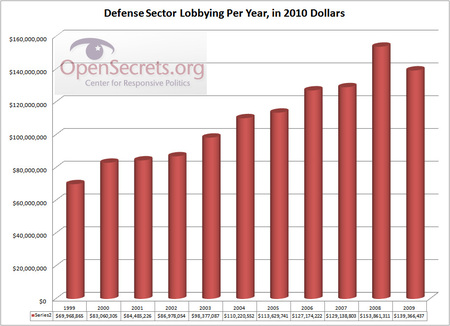
During this time, lobbying by defense contractors and other defense-related interests has also surged. According to the Center for Responsive Politics‘ analysis, in the 10-year period between 1999 and 2008, when adjusted for inflation, defense sector lobbying increased by 120 percent — going from $70 million in 1999 to $154 million in 2008 (in 2010 dollars). Calendar year 2008 represented the peak of defense lobbying in the past decade. (See graph below.)
Nevertheless, during the first three quarters of 2010, defense sector interests still invested $102 million in lobbying. These 318 clients hired nearly 1,000 lobbyists — of whom two-thirds have passed through Washington’s “revolving door” of influence between the private and public sectors, according to the Center’s research.
Don’t Let Comcast Kill the Internet
(This article by Tim Karr is re-posted from SavetheInternet.com)
In the past 24 hours Comcast has been exposed committing blatant abuses of its power over all things media.
 The New York Times reported last night that the cable giant has threatened to block access to the popular online movie service Netflix unless the company that streams its films pays new and extortionate tolls. Earlier in the day, Comcast was caught red-handed trying to smother the marketplace for competitive Internet modems designed for use on its network — a violation of fundamental Net Neutrality principles that allow you to choose what devices you want to use.
These are just the latest in a history of abuse by a company determined to become the 21st century’s media gatekeeper. If Comcast gets away with these violations, it will be the beginning of the end of the experiment in information democracy called the Internet. What more reason does the Federal Communications Commission need to step up — for once — and protect the openness that is central to a better, more participatory and diverse media.
Taken as a whole, these abuses show us what a media monopoly looks like in the Internet age — one company, consolidating its media power to squash competitors, to stifle innovation and free speech, and to gouge consumers.
Here are seven reasons we must stop an out-of-control Comcast:
1. Killing Off Competition: NetFlix
Comcast is the largest nation’s largest broadband provider and pay-TV company. It has leveraged that access to our homes to become the third-largest telephone company in the country with the tentacles of its communications networks reaching across more than a third of the country.
In most these regions, Comcast’s market power reigns uncontested, with few to no other companies vying to compete with the cable giant for this package of services. Comcast wants it to stay that way. So much so that it’s now moving to kill off competitors. On Monday, Level 3, the service that streams Netflix movies to consumers revealed that Comcast had threatened to cut off the pipe to its customers unless Level 3 pays a steep new toll for transit. The toll was non-negotiable — no payment, no access — meaning no Netflix (or any other independent content that Level3 transmits) for the 17 million broadband customers who connect via Comcast.
Not by coincidence, Comcast happens to offer its own movie streaming service: Xfinity. By erecting a tollbooth at the edge of its network, the company can price competitors out of the market and ensure that its one online video offering remains the only choice for consumers.
2. Stifling Innovation: Zoom Modems
Just hours before the Netflix story broke, Comcast was accused of violating another basic tenant of the open Internet and the free market. In a complaint filed Monday with the FCC, modem manufacturer Zoom Telephonics presented evidence that exposed Comcast restricting consumer access to modems produced by independent manufacturers. Comcast was doing this by placing unreasonable conditions on cable modems Zoom wants to sell to Comcast customers.
Comcast would prefer users rent their modems from Comcast — at a monthly fee that over time far exceeds the cost of modems bought on the open marketplace. By blocking the manufacture of independently produced modems, Comcast can lock in these exorbitant rental rates in a marketplace where it already controls about 40 percent of the national cable connections.
If Zoom’s complaint is accurate, these practices violate both the letter and the spirit of the Communications Act and the FCC’s open Internet principles. It’s the same pattern of anti-competitive behavior that the company showed when it throttled BitTorrent (see below). By erecting anti-competitive barricades and stifling innovations in the modem marketplace, Comcast is violating the open Internet principle it repeatedly promised the FCC it would respect.
3. Consolidating Media Power: NBC Takeover
Some may have thought that the Internet age marked the end of the era of a few huge companies controlling all media. But Comcast, which is hell-bent to take over NBC Universal, has given us an unwelcome glimpse at the new face of media consolidation.
For consumers, the NBC merger would give Comcast unprecedented control over what you can watch and how you can watch it. They’ll leverage this power to suffocate online TV — like Netflix, Miro and iTunes — in favor of their limited offerings. Comcast already raises its rates to the tune of 10 percent a year. With less competition, they’ll jack up prices even more. Even if you don’t have Comcast at home, you could end up paying more to get NBC shows. Comcast will also have an incentive to promote NBC shows over local or independent programming, making it even harder to find alternative voices on the cable menu.
And this will just be the first in a wave of media mega-mergers. “As the economy recovers, we will see more proposed media industry combinations,” explains FCC Commissioner Michael Copps. “While I look at each proposed transaction on its individual merits, my long-standing skepticism about the harms imposed by so few controlling so much persists.”
4. Censoring Free Speech: Vinh Pham
Comcast customer Vinh Pham got caught in the black hole that is Comcast customer service. All he wanted was to get his Internet and cable working without opting for Comcast’s “Triple Play,” which included phone services as well.
“I do not want your freaking Triple Play,” Pham says. “Who the hell still uses landlines, let alone buy landlines through their cable company? Stop trying to sell me [something] I don’t want.”
Every time he tried to make the change his account crashed. So Pham took matters into his own hands, fixing his modem so that he actually received the services he was being charged for on his monthly bill. But after Pham shared his experience via his personal blog, Comcast decided to lower the hammer.
Comcast contacted the company that hosts Pham’s blog and demanded the entire blog be censored. (This is nothing new. They had a similar reaction when one of their on-air hosts decided to protest a distinguished service award for Fox News Channel’s Bill O’Reilly.)
Reporting on the affair, blogger-activist Phil Dampier wrote: “When cable giants like Comcast trample all over free speech (and their paying customers), it’s teaches a valuable lesson why giving them a chance to grow even larger through a merger with NBC-Universal is a dangerous mistake.”
5. Lobbyists, Lawyers and Lies: Cohen’s Kumbaya
Earlier this month, Comcast’s top lobbyist, David Cohen, declared Net Neutrality an issue over which Washington needn’t concern itself any longer. “It’s time to put this [Net Neutrality] debate behind us,” he said to the strains of Kumbaya. “Check the box and move on.”
Now, don’t think this means Comcast has changed its tune on the importance of the open Internet. It’s still trying to kill Net Neutrality. It’s just making a softer sell to convince Washington to trust Comcast to protect the rights of Internet users. “Real self-regulation” by the industry itself is the answer, Cohen told a room of nodding lobbyists and lawyers.
But the only thing you can trust about Comcast is that it will seek to boost its bottom line and serve shareholders by any means possible. That’s the nature of corporations. And naturally, the public shouldn’t expect corporations like Comcast to look out for its best interests. Public policy is designed for that role. Are you listening FCC?
6. Blocking Internet Access: BitTorrent
Comcast gave us a taste of a world without Net Neutrality when an Associated Press investigation in 2007 caught the cable giant red-handed, jamming use of popular file-sharing applications.
Despite mounting evidence of Internet blocking, the company refused to come clean and disclose its “network management” practices. A coalition of Net Neutrality supporters and legal scholars filed a complaint with the FCC.
In response to the public outcry and a mountain of evidence, FCC Chair Kevin Martin sanctioned Comcast for violating Net Neutrality. Martin ruled that Comcast had “arbitrarily” blocked Internet access and failed to disclose to consumers what it was doing. But the ink was barely dry on the FCC order before Comcast sued the FCC in federal court, challenging not only the agency’s ruling but its entire authority to protect Internet users.
7. Blocking Public Access: Harvard
In 2008, The FCC called a public hearing at Harvard University to weigh whether Comcast was blocking public access to the Internet (see above). In characteristic fashion, Comcast responded by blocking public access to the hearing itself. The company deployed paid seat-fillers to bar others from entering an official FCC event.
While Comcast seat-warmers snoozed, a collection of Harvard and MIT scholars, Internet advocates, industry leaders, engineers and policymakers nearly all agreed that Internet blocking has serious consequences for each and every one of us.
That the Boston hearing was marred by Comcast’s efforts to stack the crowd in its favor — leaving concerned citizens out in the cold — demonstrates again why we can’t trust a media monopoly with an Internet that is vital to our democracy.
Those who should ultimately decide the Internet’s future are people like you and me — everyone who uses the Internet every day and in every way. That’s why every citizen needs to get involved right now.
Comcast’s most recent abuses come just days before FCC Chairman Julius Genachowski is to announce a vote on new Net Neutrality rules.
If the FCC stays on the sidelines, Comcast will turn the Internet into cable TV. Its runaway abuse of media power will impact pretty much everything we do online.
This is a moment of truth for Julius Genachowski. The FCC chairman can no longer weigh whether to take action. He must move now to restore the agency’s authority to protect consumers against a new generation of monopolists.
Cancun Climate Summit and the False Solutions of Green Capitalism

One could certainly argue that the most pressing issue of the 21st century in global warming. The International Panel of Climate Change has for years made it clear that we need to reduce the current amount of carbon emissions 80% by 2050 if we are to have a safe and stable global temperature.
However, there is not much progress being made in the attempts to reduce carbon emission by both states and private businesses as is evidenced by a new report from the National Climatic Data Center, which states that 2010 is one of the warmest years recorded in human history.
Much of the problem stems from countries like the US which are unwilling to make a commitment to reducing greenhouse gas emissions in any substantial way. This was the case over a decade ago at the Kyoto Summit and last year at the international climate summit in Copenhagen.
Cancun Summit
Yesterday, the latest round of international talks on global warming kicked off in Cancun, Mexico. Unlike Copenhagen, the Cancun Summit has received scant attention in the for profit news media. This is in part due to the Obama administration’s general lack of interest on the matter and a continued unwillingness to make any serious commitment to reduce carbon emissions.

Latin American specialist Laura Carlsen writes, “The results of the Cancun climate change talks are a foregone conclusion. Following in the footsteps of the Copenhagen non-agreement, experts, activists, and the negotiators themselves have announced that they expect no binding agreements on emissions controls to come out of the conference.”
In addition to the probability that no binding agreements will come out of the conference, Carlsen believes that the US and other powerful nations will continue to promote false solutions. Some of the major false solutions are Clean Development Mechanisms, carbon trading and geo-engineering.
However, one of the worst solutions that is being promoted is the UN REDD program (Reducing Emissions from Deforestation and Forest Degradation). The REDD program is not only a false solution, but it directly and negatively impacts indigenous communities around the world. According to the Indigenous Environmental Network (IEN), the REDD program is nothing more than a form of colonialism. The IEN provide excellent analysis of this topic and other false climate solutions in their Indigenous People’s Guide.
Independent and Autonomous actions for Climate Justice
Many groups like the Indigenous Environmental Network and Via Campesina are organizing separate assemblies during the Cancun Summit as well as protests and other actions to confront the delegates. Most of these independent and autonomous groups are anti-capitalist and believe that real climate justice is rooted in localized economies that are based upon cooperation and ecological integrity.

In addition to confronting capitalism, many groups are advocating for a more comprehensive analysis of the roots of global warming, which also means we must confront global poverty and war. This is the message that Nobel Peace Prize winner Wangari Maathai is communicating with a recent article entitled, Cancun Must Be About More than Just Climate Change.
While we shouldn’t expect that nations will make any meaningful progress at the Climate Summit in Cancun, it is important to pay attention to what civil society groups are doing to both confront the green capitalists and promote real climate justice.
For those wanting to get news and analysis from a grassroots perspective on the Climate Summit check out the Indigenous Environmental Network’s blog RedRoad Cancun and Via Campesina. For those of you who read Spanish, an excellent news resource is Mexico Indy Media.
New Report confirms fears about the possibility of Grand Rapids privatizing its water system
In late September we reported that Grand Rapids Mayor George Heartwell was considering the idea of privatizing the City’s water and sewage system because of the budget deficit that Grand Rapids is faced with.

We noted in a report by the group Food and Water Watch entitled “Money Down the Drain,” the key findings state that:
- Private utilities charge higher rates than municipalities
- Privatization does not increase the efficiency of water and sewage systems
- Privatization has many hidden expenses
- Water corporations drive up costs and shoot down service quality
- The public can do it better and cheaper, and
- Public funding for water must go to only public utilities
Food and Water Watch has just published a new report that is particularly relevant to the budget deficit issue that faces the City of Grand Rapids. Their new report, Trends in Water Privatization, released yesterday takes a close look at the dramatic increase in municipal water privatization.
The major findings of a report “reviewed 200 prospective and completed sales and concessions over the last two decades and uncovered five aspects of this new trend in water privatization:
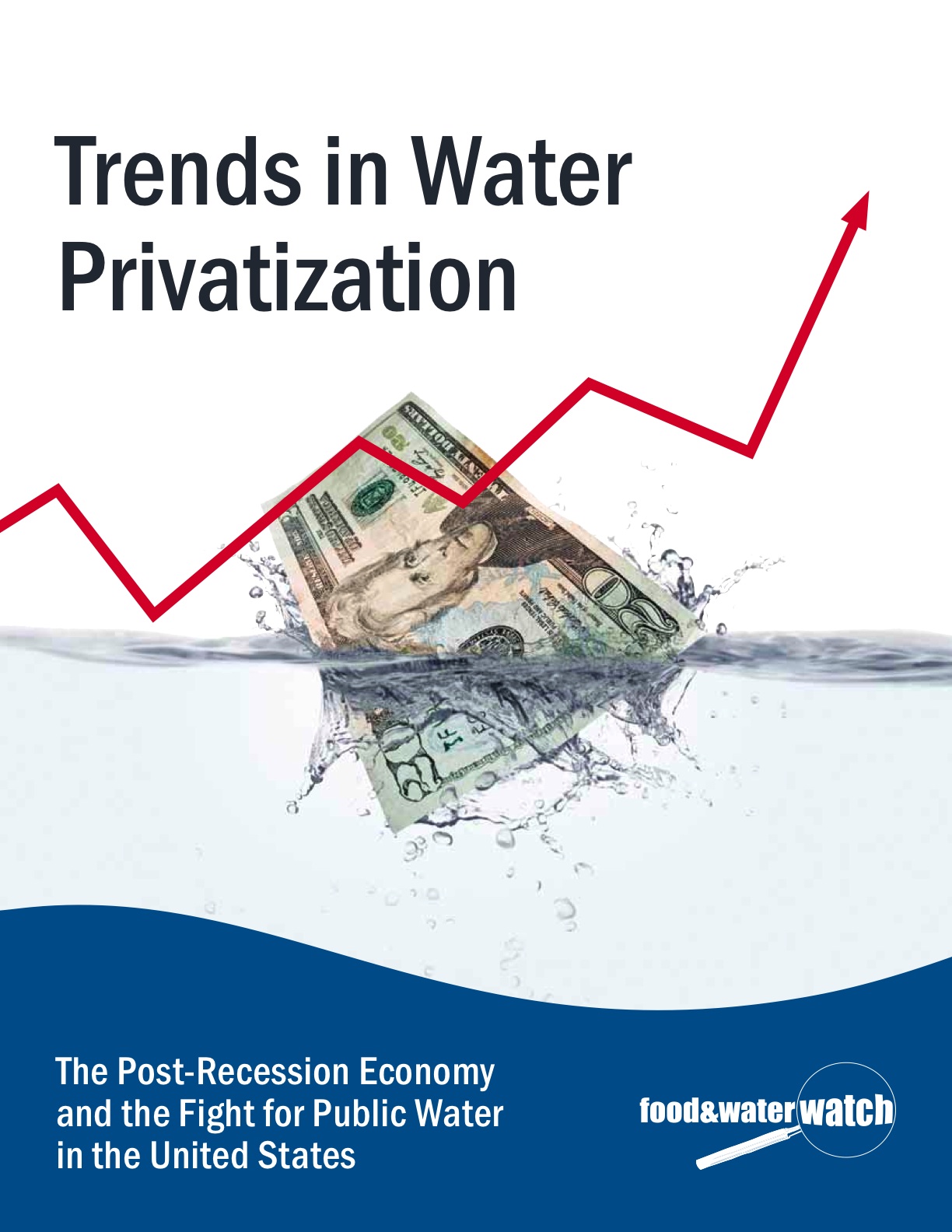
- Many cities and towns explored sales and long-term concessions of their water and sewer systems since 2008. There were five times as many prospective deals in 2010 as there were completed transactions in a typical year over the previous two decades.
- Prospective privatizations, if actualized, would affect an unprecedented number of people. The typical water system put forward for privatization in 2010 served around 45 times more people than the average system sold over the last two decades.
- Budget constraints drove the surge in potential privatization deals. Previously, the need for expensive improvements to water infrastructure was the main factor in a municipality’s decision to sell or lease its water system. Since 2008, several cities have considered privatizing well-maintained water systems to shore up weak budgets.
- Possible sales and concessions were clustered around the Rust Belt. Although the surge in interest was a nationwide phenomenon, prospective deals were concentrated in the Rust Belt, where cities were hit particularly hard by the recession.
- Strong public opposition hindered privatization. Public resistance thwarted at least 17 possible sales and concessions from 2008 to 2010 and seemed likely to block many more prospective deals. In fact, despite new attention on the idea, the number of sales and concessions completed each year remained small.
The report notes that the budget crisis that many municipalities across the country face will likely continue for a few more years and that means that for profit water companies will be seeking to cash in on this economic reality.
Food and Water Watch states in Trends in Water Privatization that, In May 2010, Don Correll, then-CEO of American Water, the nation’s largest water company, told investors that the fiscal crisis coupled with the need for expensive water system improvements created golden opportunities for privatization. “So the idea of monetizing some assets,” he said, “something that was almost heresy some time ago is something that we’re seeing far more receptivity to today and we are busy with that as well.”
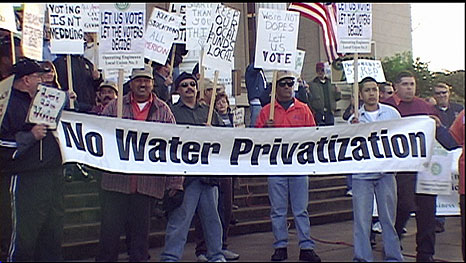
Another company, Aqua America, has stated that they were talking with at least 40 municipalities about water privatization in 2010 alone and are expected to close the deal on 20 of those communities by the end of the year. Clearly, these private corporations are aggressively seeking opportunities to buy water systems from municipalities that are struggling financially.
The report does not mention Grand Rapids, but that doesn’t mean that private entities haven’t already approached the city. However, one of the few encouraging facts presented in the Food and Water Watch report is that when citizens are alerted to the possibility of municipal water being privatized they were able to block the sale of these city services in at least 17 communities in the past 2 years.
Grand Rapids needs to not just be aware of this possibility, we need to be organized and demand that the water and sewage system we currently have stays within the democratic control of the city and not fall into the hands of private profiteers.

