The “Benefits” of ArtPrize
“Our long-term goal is really to import capital – intellectual capital, and ultimately real capital. And this (ArtPrize) is certainly an extraordinary tool.” Sam Cummings – downtown GR business/property owner

We are a little over a week away from ArtPrize 2010 and there has been plenty of buzz around the 2nd year of Rick DeVos’ creation. Like last year, GRIID will be tracking local media coverage of this event and making some comparisons to how the upcoming elections will be covered.
Last year ArtPrize was overwhelmingly reported on when comparing it to elections in Kent County. There were a total of 10 articles on elections in the Grand Rapids Press 30 days prior to the election compared to 35 on ArtPrize and that was just the last week of ArtPrize and it still merited more coverage than elections.
Our decision to focus on ArtPrize coverage is to provide some analysis that is outside of the artistic aspect of the event. We recognize that there may be benefits to individual artists and the art community as a whole, but we also believe that much of what motivates Rick DeVos and the other core members of ArtPrize is how the event benefits the elite sectors of Grand Rapids, particularly the downtown business and developers.
It was reported a few months back that last year ArtPrize was the force behind bringing in an additional $5 – $.7.6 million dollars to Kent County, based on a study done by GVSU students. This economic impact is not lost on downtown businesses, some of which have made the 2nd annual event part of the business plan.
According to a September 7 edition of the Grand Rapids Business Journal, “The 16-day art competition that begins on Sept. 22 also is a major event for downtown businesses.” Greg Gilmore, owner of the BOB and other area restaurants said he has already had 8 meetings with his staff about ArtPrize in order to be better prepared to take advantage of the business opportunities during the 16-day event.
The question to ask is not so much does ArtPrize benefit Grand Rapids, rather who does it benefit in Grand Rapids.
State and Local responses to Global Warming – GreenTown session
The second part of the afternoon track (Climate Strategies for Sustainable Communities) was entitled the Future of Energy Efficiency and GHG Inventory – Case Study: City of Grand Rapids. There were two presenters for this portion of Track 1 – Amy Butler and John Eberly.

John Eberly (Senior Electrical Engineer – Fishbeck, Thompson, Carr & Huber Inc.) spoke first. Eberly says that Grand Rapids was the recipient of $1.9 million from the federal government’s Energy Efficiency & Conservation Block Grant. Eberly’s company was part of the development and implementation of that grant-funded project.
The first thing this plan looked at were ways to reduced energy use in the 275 city run buildings, the city street lights and the city-owned vehicles – police, fire, etc. The data collection showed the bulk of Green House Gases (GHG) in energy use for the building and fuel consumed by city-owned vehicles.
The City is attempting to measure these GHG generators and develop strategies to reduce them through what are called Energy Conservation Measures (ECM). The EMCs identified would cost nearly $10 million to implement, so they decided to begin with low cost/no cost projects and used ICLEI software.
What they identified in the research was that the main contributor to green house gases (GHGs) was transportation usage, followed by what they called commercial use, which was GHGs produced by businesses. Unfortunately Eberly provided no concrete information on what the City of Grand Rapids will do to reduce green house gases from the thousands of vehicles that move about in the area daily or the GHGs produced by commercial businesses.
Amy Butler, the Director of the Bureau of Energy Systems – MI Department of Energy, spoke next. Butler showed that Michigan has a huge energy challenge. Michigan currently imports 100% of its coal, 99 % of its oil and 70% of the natural gas it consumes.
What that means for the average Michigan household is they are spending $4,600 a year on energy. Butler said this means there is a lot less money that doesn’t benefit the state, since that money leaves the state and goes into the hands of private corporations. What she doesn’t identify is who is benefiting from this energy consumption, specifically private energy companies like Enbridge, DTE and Consumers Energy.
To respond to this energy import challenge the state has implemented some weatherization programs, appliance rebates, energy efficiency funding, a decrease in electrical use in government run buildings and improvement in building codes, which seem like pretty modest responses considering the data that was provided.
The State is also providing loans for energy efficiency programs for both local municipalities and for private companies, which means that taxpayers are subsidizing for-profit entities.
Butler also addressed how the federal stimulus money factored into the state energy efficiency programs, which included lighting audits, efficiency upgrades, recycling, bike & pedestrian pathways and some renewable energy pilot projects.
During the Q&A we asked a question based on the data provided on energy sources that are being imported currently. “Since the bulk of energy resources are currently being imported, what kind of reaction do you anticipate from the corporations that are currently profiting from energy exports to Michigan if the state reduces energy use and transitions to renewable resources?”
Butler responded that this change will not happen over night, but the goal is to move towards using energy produced within the state. Butler never addressed how the corporations might react and what kind of resistance they are likely to engage in since they would stand to lose a great deal in profits if the State did move in the direction of energy self-sufficiency.
Writing 9/11 History

Everyone in Grand Rapids who was old enough on September 11, 2001 could write their own version of the history of that day. The Grand Rapids Press capitalized on that fact by running a lengthy story today of reminiscences of local folks about the day. I myself was at work when a co-worker flagged me frantically into her department. It was quarter after 9 in the morning, and she was watching a film clip on one of the design computers. “A plane just flew into the World Trade Towers!” she cried out. Stunned, I said I couldn’t understand how an air traffic controller could have let that happen. “No, no!” she said. “You don’t understand! It was the second plane to fly into the Towers.” Oh, God, I thought.
I ran back to my office to pull up a news site and finally got the Washington Post. which showed the headline, “Plane crashes into Pentagon.” I told myself, “There’s so much chaos in the newsroom that they were posting some headline about the Pentagon and left the word in by mistake—it should say ‘World Trade Towers.’” The enormity of the whole story makes rest of the day dissolves into a few details in my memory—watching early news film of people throwing themselves off the burning buildings (an aspect quickly squelched by the media); staff members at work connecting with relatives in New York and hearing detailed information that was not being reported on the news; and my mounting feeling that the media’s version of the story, more and more obviously orchestrated as the day ground on, represented more editorializing than truth.
This weekend I saw a History Channel special called “9/11 Conspiracies: Fact or Fiction.” The special dealt with troubling aspects of 9/11 that have been discussed but are rarely addressed in mainstream media. How much did the government know prior to the event? Did Cheney, rather than Bush, issue the order to shoot down United Flight 93? Was Building 7 at the World Trade Center deliberately destroyed because it contained closely held CIA and other government documents that might have shed light on the attack and our inability to respond to it? Were the events of 9/11 used by the Bush Administration as a flimsy excuse to invade Iraq?
Each “conspiracy theory,” of course, is roundly rejected in this History Channel presentation. “The Bush Administration is the ultimate target of the 9/11 conspiracy movement,” the narration declares solemnly. This is followed by the director of the documentary “Loose Change” reminding viewers many times did Bush attempted to link 9/11 to Iraq, declaring that America had to “go get the terrorists wherever they are,” using 9/11 as the justification of the Iraq and Afghanistan occupations. Then “experts” appear on the screen to explain that anyone questioning the official line displays the “messianic aspect” that apparently exists in all conspiracy theories, because in fact our government responded effectively to a crisis that they knew nothing of beforehand and did not benefit from it afterward; there is nothing to suggest otherwise.

But even in this carefully executed TV show, small cracks appear in the official story. For example, Condaleeza Rice once reported that Bush debated with she and Cheney at length about shooting down Flight 93; but the Commission report states that the phone call lasted less than two minutes. And at the 9/11 Commission testimony, Secretary of Transporation Mineta said that the shoot-down order was for American Flight 77, the plane that hit the Pentagon, not for United Flight 93. He later refused to recant this statement even though Rice and Cheney both said it was false.
I couldn’t help but notice other details, such as the words of a NYC fire chief named Albert Turi, one of many witnesses who reported hearing secondary explosions inside the World Trade buildings. But despite the fact that he was on the scene, he is labeled a “conspiracy theorist” in this show and his statements are dismissed as “chaotic reporting of the moment” that had no basis in fact.
Every theory that even hints that the military/industrial complex might have ultimately profited from the events of the day is soundly labeled utter nonsense by the History Channel. “Demonizing a powerful group of leaders has historically been one method to explain away a huge traumatic event,” the narration explains glibly.
Setting conspiracy theories completely aside, I am fascinated in the way that American history is shaped, edited, and controlled after the fact. The parallel to the reporting about the JFK assassination is an obvious one. PBS once aired all the mainstream TV reporting of that day in 1963 and you could not help but notice the formation and refining of an official story line. Some early eyewitness testimony was simply tossed out the window—and later some of those dismissed statements were in fact verified by the Zapruder film. The official version was then reshaped to include the film’s images into a new explanation, later known as the Warren Commission Report.
The History Channel, co-owned by the Hearst Corporation and Disney, stands clearly in the government camp, “debunking” even eyewitness testimony at 9/11 events as nonsense if it doesn’t fit the official military/industrial line. And while I watched the show’s neat, pro-government packaging of the day’s events, I couldn’t help but think of the great Howard Zinn, who said, “If those in charge of our society—politicians, corporate executives, and owners of press and television—can dominate our ideas, they will be secure in their power. They will not need soldiers patrolling the streets. We will control ourselves.”
Greentown:How healthy, local food factors into development (or not)
 (This article is part of a series based on our reporting at the GreenTown conference in Grand Rapids on September 10.)
Greentown’s first afternoon session in the “Healthy Food, Little Waste” track was titled, “Fields, Forks & Futures: How Healthy, Local Food Factors into Development.” The speakers presented solid ideas for increasing the use of more sustainable, locally grown foods .
The three speakers were: Kathryn Colasanti, Academic Specialist, C.S. Mott Group for Sustainable Food Systems at Michigan State University; Denis Jennisch, produce category manager, SYSCO Food Service of Grand Rapids; and Jerry Adams, president, West Michigan Cooperative.
Adams started off with a recap of the Grand Rapids area food co-op that sees itself as an online farmer’s market. The all-volunter organization posts the month’s offerings on its website; members place orders and then pick up their food a week or so later. West Michigan Cooperative works with 40 producers who bring foods like free range eggs, locally grown produce and grass fed beef–items that are not readily available in area supermarkets.
“The co-op provides easy access for the kind of foods my wife was looking for for my kids,” Adams said.
The co-op has also developed software that eases operations and shares if for free with other co-ops around the country who want to do something similar. Adams is currently looking into the option of making the site and ordering items available by hand-held device, including cell phones, with the intention of making access to healthy whole foods available to a wider range of people.
Jennisch described in detail how local SYSCO Food Service of Grand Rapids is leading a nationwide company program, Success for Family Farms, in distributing locally grown foods to the institutions it serves. Its definition of  local is anything grown or produced within the state. SYSCO began the initiative because of customer demand. Jennisch noted that it was working out well because he takes a relationship approach not a profits-here-and-now approach when dealing with local producers. While SYSCO is to be commended for this philosophy, it does not necessarily follow that other large food distributors would be willing to follow suit. In the current system, profit is the motive of choice.
Jennisch also pointed out that local and sustainably produced foods were listed among six of the top ten food trends identified by a recent National Restaurant Association poll. So, another question remains. When local food is no longer trendy, will local farmers be cast to the side?
Last, and certainly most on top of the real issues, Kathryn Colasanti made a compelling case for the Michigan Good Food Charter. You can view or download the 36-page .pdf document online. Colasanti explained that charter expands on the premise that good food is 1) Healthy – It provides nourishment and enables people to thrive; 2) Green – It was produced in a manner that is environmentally sustainable; 3) Fair – No one along the 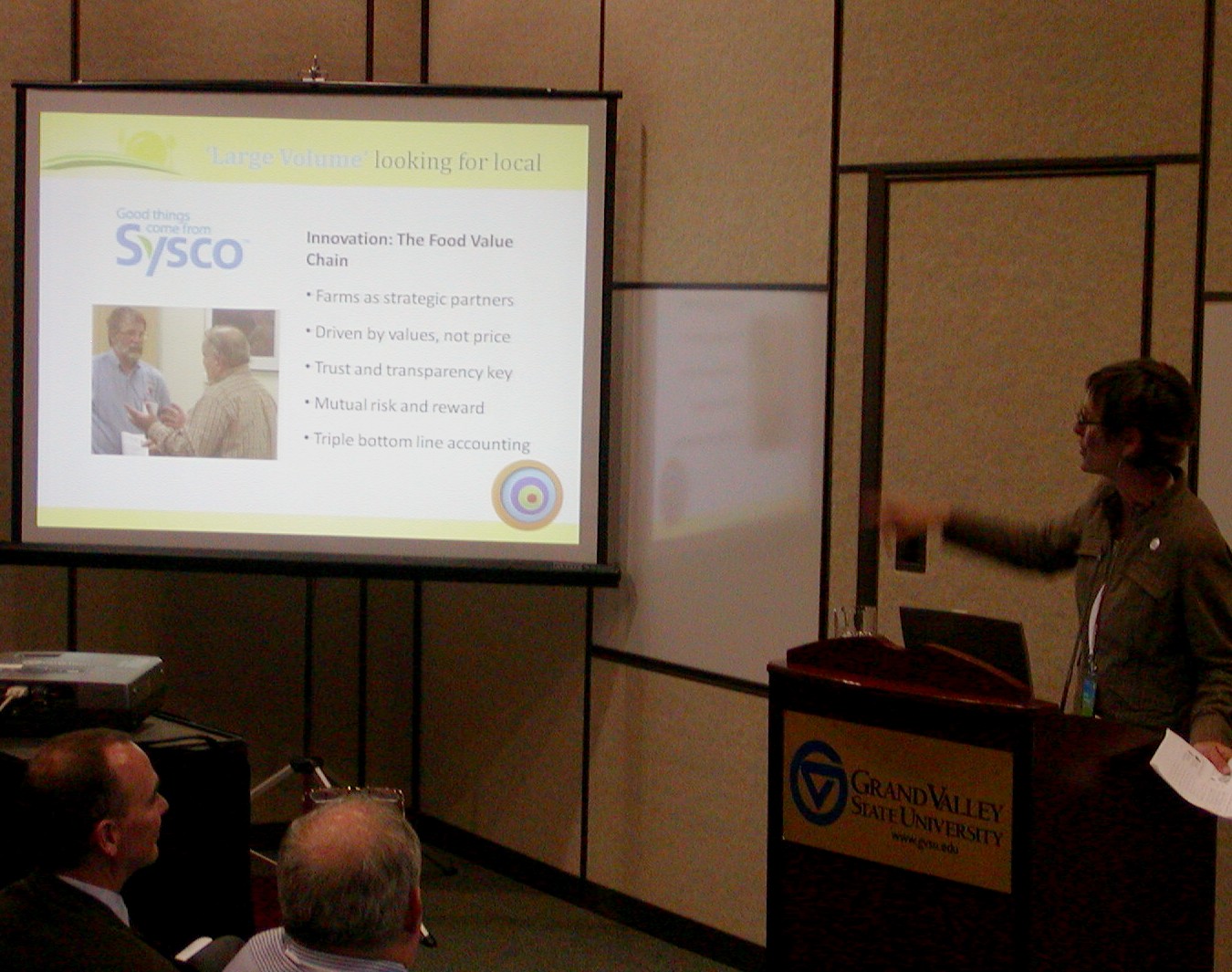 production line was exploited for its creation; and 4) Affordable – All people have access to it. “If we could move forward to these goals with our food system, Michigan would be the place to be,” she said.
To bring the ideals of the charter into effect within the current economic system, Colasanti said that Michigan would need to establish food business districts where buyers, sellers and processors can collaborate in one location. She mentioned that some locations could function as urban agri-tourism destinations. Second, she said the state should provide institutions such as prisons, schools and hospitals with incentives for purchasing locally produced foods. Third, she said the state needs to actively pursue the preservation of farmlands and provide current and new farmers incentives to keep vulnerable tracts as farms rather than developments.
“Access to healthy food should be available to everyone,” she said. “Cities take on issues like housing and transportation. They should take food on, too. They should allow and facilitate urban agriculture and use local food groups as a resource.”
Colasanti then invited the audience to visit the Michigan Good Food Charter web site to sign on as a supporter of the charter. Sad to say, chances that state government will adopt the charter are slim. She encouraged people to contact their legislators in support of the charter. “We might see adoption of policy issue by issue, ” she said. “But we don’t want to alienate wide-scale agriculture. There are concerns that we’re against big agriculture. The charter is a good educational piece, a guide for policy.”
And there lay the crux of the matter. Equitable access to good, sustainable food that’s produced without exploitation of workers will not happen as long as legislators represent the big-money food industry lobbyists who continue to control Michigan’s and US food policy.
Climate Strategies for Sustainable Communities – GreenTown
(This article is part of a series based on our reporting at the GreenTown conference in Grand Rapids on September 10.)
The afternoon portion of the conference was divided into four separate tracks with 3 sessions in each track. This writer attended the Climate Strategies for Sustainable Communities track.

The first part of this track was entitled “Future of Greenhouse Gar Emission and Management Strategies,” consisting of a panel of four.
The first speaker was Norm Christopher with the GVSU center for sustainability. Christopher says that there are three main ways to move toward climate change actions: doing nothing/denial, a regulatory approach or what he called a voluntary approach.
The GVSU representative said that before any action can take place you have to determine where you are and what your current levels of carbon emissions are. Once you have determined where your organization/community is you need to devise a strategy on how to reduce these emissions.
Christopher says that the state of Michigan has signed on to a commitment to reduce carbon emissions 80% by 2050. GVSU, according to the speaker, will be carbon neutral by 2036, even though how that is defined and how it will be achieved were never stated.
The next speaker was Michael Davidson, the Mid-West regional Director of ICLEI. Davidson said his presentation would be how local governments can manage carbon emissions.
Davidson spent too much time describing the mission of ICLEI with a powerpoint presentation with information that anyone with access to the web could obtain. Focusing so much time on what ICLEI does and other data did not allow for enough time to address concrete strategies for climate action.
Following Davidson was another ICLEI staff member, BritaPagels. Like, Christopher, this presenter felt it was important for local governments to be able to measure carbon emissions. ICLEI has developed a protocol for this kind of measuring with their Clean Air & Climate Protection Software. This software tracks fuel usage, solid waste, electricity use and other indicators.
Brita then presented software to develop a climate & air pollution planning strategy, a software that currently contains 120 different strategies that are being used around the country.
Brita also presented yet another tool she called the Municipal Clean Energy toolkit. Again, the speaker emphasized what others on the panel addressed was that “you can’t manage what you can’t measure.” It was painfully clear that this was the point that the panel wanted to drive home, but it was essentially overkill and avoided the opportunity for looking at best-practices and concrete strategies that communities could implement.
The last presenter, from the Michigan Municipal League, addressed what is called the Michigan Green Communities Challenge. So far there are 70 communities throughout the state.
The Challenge involves providing communities with tools to incorporate energy efficiency and sustainable strategies.
There are 6 steps in this Challenge:
- Obtain organizational support
- Assign responsibility
- Collect energy data
- Assess situation and identify gaps
- Develop goals and activities
- Measure performance and quantify results
Ultimately, the message that the last presenter wanted to communicate was that Green saves money, it is smart economic development and it makes businesses and people want to live and raise their families in such a community.
Again, because of “time constraints” there was only enough time allotted to field two questions, thus minimizing the amount of feedback and engagement from those in attendance.
9/11 and the Afghan war

This October it will be nine years that the US & NATO troops have been occupying the country of Afghanistan. And like any war of occupation, governments need the support of their citizens in order to do what militaries do during a war of occupation – namely brutalize the local populace and secure access to resources.
The US government has its own propaganda mechanisms to promote its mission in Afghanistan. However, the US government could not be as effective in its prosecution of the war of occupation in Afghanistan without the help of the major news sources around the country.
There is growing domestic opposition to this brutal and costly US occupation and that is despite the fact that the major media have pretty much accepted the Bush/Obama administration’s justification for such a war. Lets look at some of the major arguments that both the US government and US corporate media have presented since the initial bombing/invasion of Afghanistan in October of 2001.
It should be noted that even though we are approaching 9 years of the current US occupation in Afghanistan, Afghanis have been suffering under war and occupation for the past 30 years. The US news media has a short memory and doesn’t remind us often enough of the fact that during the 1980s the Soviet Union occupied Afghanistan, while the US provided billions of dollars in weapons and training to an armed resistance that gave rise to the Taliban and al Qaeda.
The Bush administration, along with the support of the Democrats argued that since the Taliban would not turn over al Qaeda operatives in the fall of 2001 that was grounds for an invasion of a country that did not attack the US. Since the removal of the Taliban from power the argue has been that there are still al Qaeda operatives within Afghanistan’s borders and allowing the Taliban to retake control of the country would give more opportunities for the “terrorists” to attack us.
First, the al Qaeda operatives who attacked the US on 9/11, 2001 did not plan it from Afghanistan. Second, most credible sources, including US military officers acknowledge that there is fundamentally no al Qaeda presence in Afghanistan at this time. Third, the Taliban is primarily an indigenous resistance movement that is organized around expelling foreign occupiers, not a rigid ideology.
Another argument put forth by the government and echoed in the major news media is that the US is in Afghanistan to bring democracy. This is probably the longest standing argument by the US government over the past 100 years and is generally unquestioned by the commercial news media. However, since the US has occupied Afghanistan, the two elections that have been held have both resulted in Karzai as President. Both elections were mired in fraud and Karzai’s administration is rife with corruption.

There are more minor arguments used to justify the US occupation of Afghanistan, such as the need to liberate women. This was a strong argument used by the Bush administration, but according to the Afghan Women’s Mission and RAWA (Revolutionary Women of Afghanistan) women are worse off now than they were under the Taliban. Anti-women laws have been entrenched under Karzai and US bombing and military raids have made life for women even more terrifying. The need for US military presence in Afghanistan to protect women was manifested most recently in a cover story in Time magazine, even though the article did not provide the perspective of any organized women’s organization operating inside the country.
Beyond the major policy articles that deal with military strategy, any coverage of US troops in Afghanistan or just returning perpetuate the belief that what the US is doing there is good. Other comments often cited in this context is that the US has to stay and finish the “job,” even though “job” is rarely defined.
During the Bush years there was always at least some token coverage of US opposition to the occupation of Iraq, but this has not happened during the Obama administration. Liberals now are defending the US presence in Afghanistan as necessary, even though there are plenty of progressives and anti-imperialists organizing against the 9-year occupation across the country.
In Grand Rapids, there will be several events to draw attention to the US occupation of Afghanistan. On Sept 30 there will be a benefit concert, followed by a speaker at Calvin on October 8 and an anti-war march on October 9. Don’t let the media complicity in the war fool you. There is a growing opposition to the US war of occupation in Afghanistan.
“Decision-makers” kick-off Greentown conference
 (This article is part of a series of postings based upon our attendance of the GreenTown Conference in Grand Rapids.)
Considering how climate change is already impacting our lives and devastating the lives of millions of people living in less powerful countries, the presence of such a conference at Grand Valley State University (GVSU) Eberhard Center is a local step in the right direction. As the stream of opening speakers took the podium, each acknowledged the imminent reality of climate change and the need to address it now–not at some nebulous point in the future.
Gary Cuneen, executive director of Seven Generations Ahead, a 501C3 non-profit with the mission of promoting “the development of ecologically sustainable and healthy communities” led off. Greentown is a program of Seven Generations Ahead that has the goal of discussing “actionable ways to make communities greener, healthier and more prosperous.” Greentown conferences have been staged in the greater Chicago area since 2007. Grand Rapids came on board in 2009. Cuneen sees Greentown as a forum for “the municipal sector, the private sector and community leaders–the decision makers.” This mix of the powerful is underscored by a walk through the lobby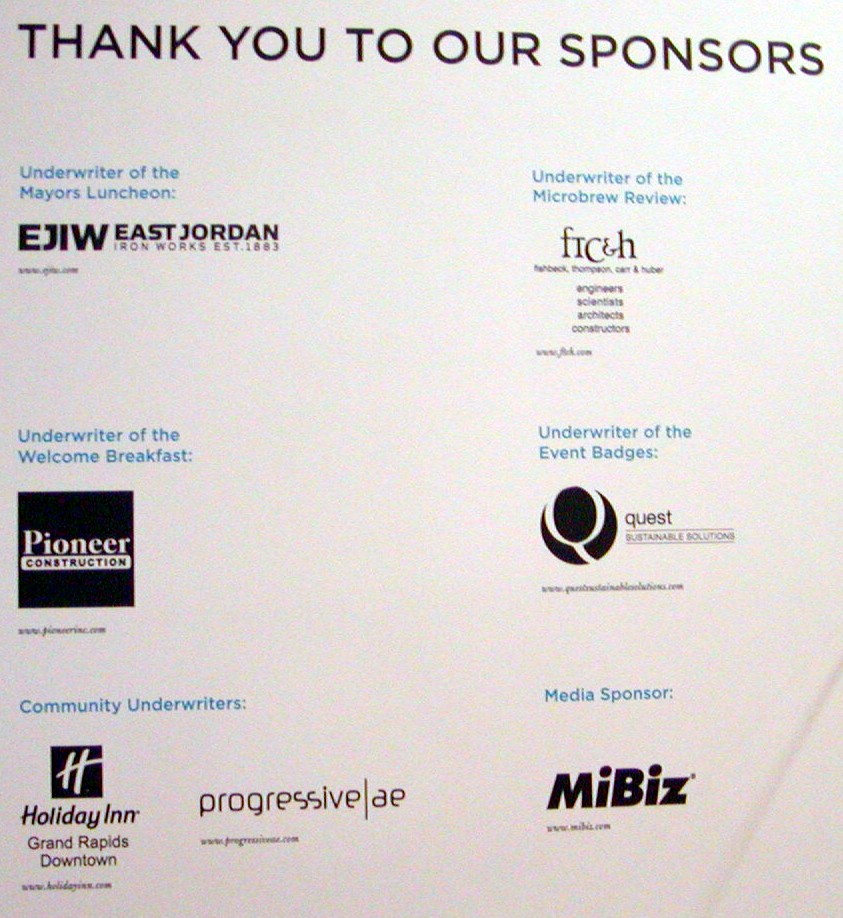 outside the conference rooms where the event’s sponsors were highly visible: GVSU and Aquinas College (both offering majors in sustainable business), Pioneer Construction, Rockford Construction, East Jordan Iron Works, Consumer’s Energy, Pizzo Ecological Restoration and MiBiz. Other underwriters included the Kellogg Foundation, Holiday Inn and the architectural and engineering firm, Fishbeck Thompson Carr and Huber. Oddly, no local, state or national environmental organizations were among those represented.
John Harris, principal of A5 Group, an advertising and PR agency with locations in Chicago, St. Louis and Grand Rapids.He graciously acknowldegd all of the above sponsors and hyped the debut of two books for sale in the lobby: one by Grand Rapids’ business leader, Peter Wege, and the other a picture book (its main character is a former Navy Seal who puts his expertise to work saving the Great Lakes from invasive species.) The cover of the GVSU hand-out promoting its Applied Sustainability program has this Native American proverb on its cover, “We do not inherit the earth from our ancestors, we borrow it from our children” When Tom Haas, GVSU president, took the podium, he echoed that sentiment with an anecdote about his granddaughters’ fishing adventure at the family cottage on a quiet Michigan lake.
George Heartwell responded by saying, “We live in extraordinary times. We have never experienced an economy like the economy today. It’s like standing on the edge of a precipice looking down into a bottomless void. We are coming to grips with the fact that climate change is a reality. We are experiencing changes, fundamental changes in climate in the country that will last for generations to come. (We have) considered the word adaptation a dirty word. The fact of the matter is we are already being forced to adapt to climate change. We have record rainfalls, heat waves that are claiming lives and changes in the rural areas of crop cycles. We simply need to address the whole question of adaption and identifying vulnerabilities.” al approach. cities go about saving the world.
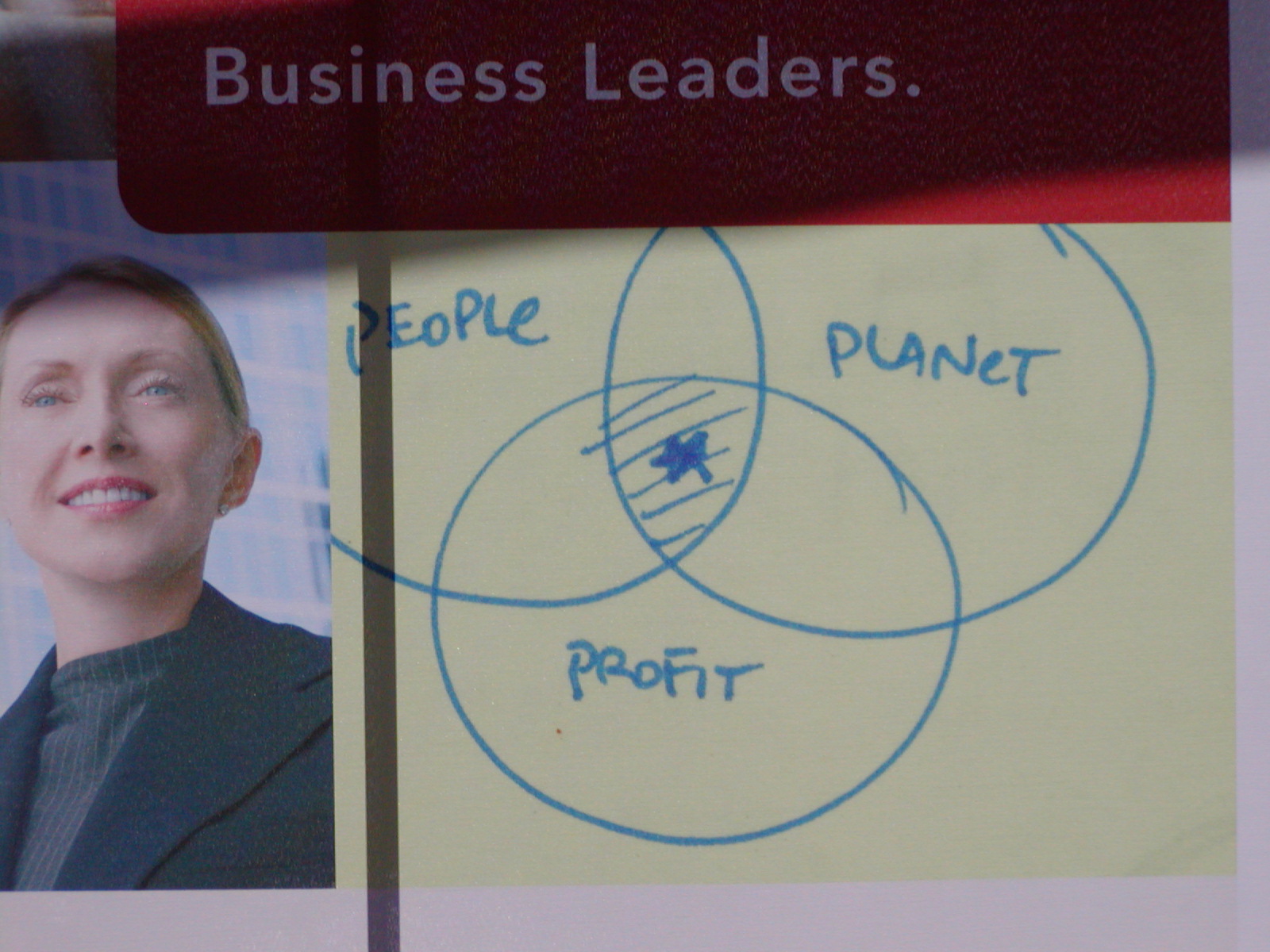
This quiet question also came to the writer’s mind: when affluent America goes about creating a better world for its children, will other children, in its less affluent neighborhoods and in developing countries, continue to pay the price? When Mayor Heartwell and Jim Sygo, Deputy Director Environmental Protection, Michigan Department of Natural Resources and Environment (DNRE, formerly DEQ) laid their messages out, that question gained more volume. Sygo started off with a powerfully relevant report on the impending impact of climate change on Michigan’s people and wildlife:
 1. A five to ten degree increase in winter temperatures.
2. A seven to thirteen degree increase in summer temperatures,.
3. More frequent flooding and more heavy weather events.
4. Eight to ten weeks extension of the growing season.
5. Significant decline in ice cover on the Great Lakes and inland lakes.
6. Impacts to wildlife because of shrinking spruce and fir forests and increasing aspen and birch forests, more birds to compete with migratory songbirds; a greater moose range and more forest pests and wildlife diseases.
7. Shifts in aquatic species, oxygen depleted waters, lower productivity in the aquatic food chain and spread of aquatic invasive species.
He then provided a summary of the weak responses the state has made so far: creation of climate action plans; collecting greenhouse gas emissions data; the State employee ecodriver program; a green chemistry initiative; and adoption of building codes that meet national standards for overall energy improvements for new buildings. These responses seem weak considering the urgency and magnitude of the task before us. He finished his talk with an appeal to the profit motive. “Michigan’s natural resources are a $20 billion dollar a year industry. $12 billion in forest industries and $8 billion recreational.”
Like Mayor Heartwell before him, Sygo made frequent mention of adaptation.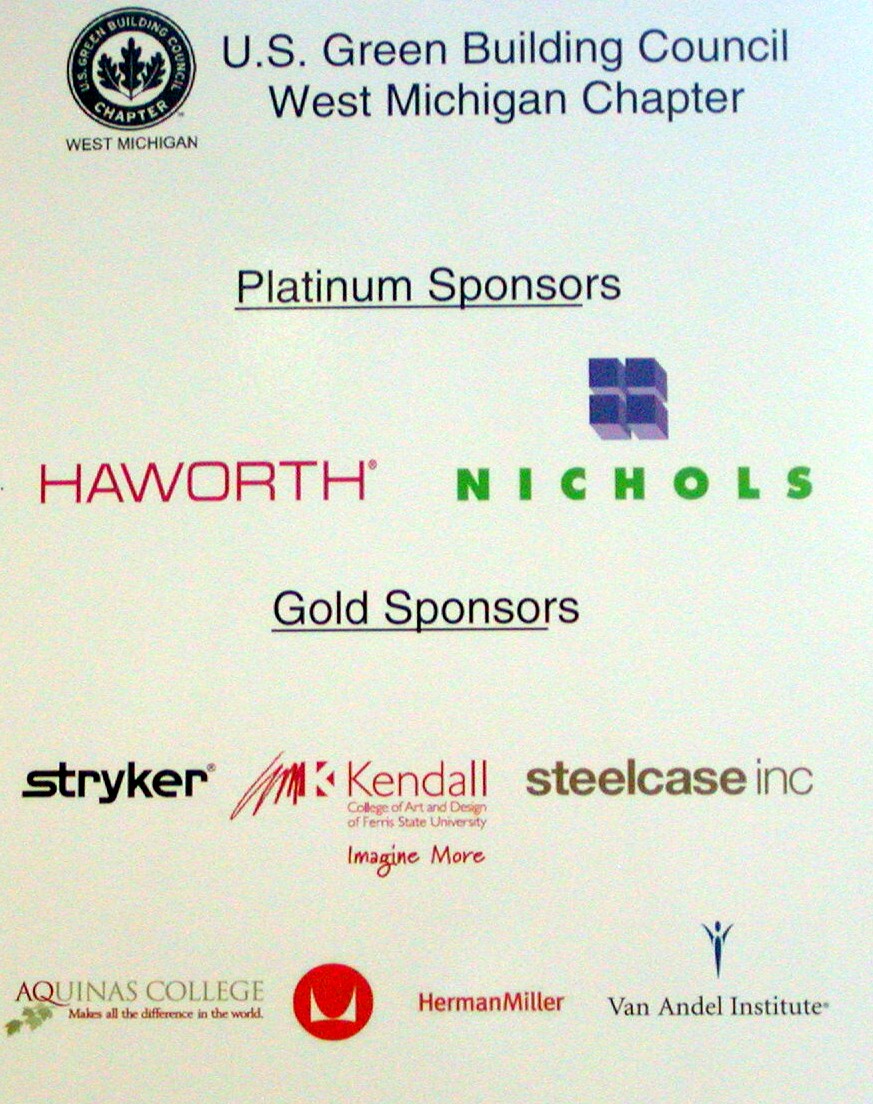 The writer finds this troubling as it seems our efforts should be on reversing climate change through radical systemic change rather than figuring out how to adapt to a ruined world–and making a profit while doing so.
He then enumerated the State’s responses so far: creation of climate action plans; collecting greenhouse gas emissions data; the State employee ecodriver program; a green chemistry initiative; and adoption of building codes that meet national standards for overall energy improvements for new buildings. These responses seem weak considering the urgency and magnitude of the task before us. He finished his talk with an appeal to the profit motive. “Michigan’s natural resources are a $20 billion dollar a year industry. $12 billion in forest industries and $8 billion recreational.”
Wrapping up the introductory session, Martin Chavez, three term mayor of Albuquerque New Mexico and “The Nation’s Greenest Mayor” stated, “There is no comprehensive energy policy in the US. The local and state governments, that’s where it’s getting done. It’s in the private sector, that’s what’s getting it done. If you want to make money, it’s in clean technology. That’s the future. The financial bottom line. We have to balance budgets.”
Chavez is balancing his “budget ” as he now works for ICLEI – Local Governments for Sustainability, a global-reaching nonprofit organization that emphasizes private sector partnerships–not regulation– as the answer to environmental challenges.
GreenTown: The Promise of LEED and neighborhood development
(This article is part of a series of postings based upon our attendance of the GreenTown Conference in Grand Rapids.)
The last morning session featured Doug Farr, founder of Farr Associates Architecture and Urban Design, Inc. Farr has written a book on sustainable urban planning entitled Sustainable Urbanism: Urban Design with Nature.

Farr acknowledges that efficiency is not enough, since research shows that the more efficient we make things in the US, the more people will consume, which in essence cancels out any gains made in efficiency.
Farr also acknowledges that LEED buildings in a one building at a time approach is also not very effective and ultimately not sustainable. LEED construction needs to be more strategic and part of a larger system of sustainability.
One example Farr gave is when one community built a new school 3 miles outside of town. The new school was a LEED building, but it was no longer in a neighborhood and forced more people to drive their kids to school.
Another example was that of a fitness center that had an escalator outside for people to get to the building from the parking lot. LEED planners might ask if the escalator could be more efficient instead of asking whether or not it was needed.
Farr looked at other examples in various communities around the country. What Farr ultimately suggested was needed is to have LEED being discussed as part of municipal master plans, where LEED construction is part of a larger view of planning an design, which incorporates transit, water diversion and other sustainable components.
One example that Farr provided was a community where instead of a traffic round about where no people could be, they fought to get the round about to be a place that people could enjoy – sit and recreate.
Farr then discussed a model for a residential area in South London (discussed in detail in his book) that incorporated energy, housing and land use. What was interesting was that the project not only utilized good technology, but it changed people’s attitudes and behavior, something that the presenter said is always difficult to measure, but an important component for future sustainability.
LEED-ND incorporates the 10 principles of Smart Growth and the outcome of what he referred to as the “New Urbanism.” He showed the audience a map of the US and Canada that were involved in a LEED-ND project, but unfortunately no Michigan communities were included.
Farr then discussed more of the how to’s with implementing what he called LEED-ND pre-requisites, such as walkable streets, smart locations and green infrastructure and buildings. Farr says that residential density is important, accessibility, local food production and neighborhood schools should also all be part of LEED certification. Farr even said that they received significant support and endorsement from health professionals with the CDC.
The last example he showed the audience was in Victoria, Canada. This project was a LEED-ND, where all 26 buildings were platinum certified and the investor was making money off the project even more than he thought because they were taking household waste and making energy pellets to sell to the local municipality. Farr then said that here is a great example of how capitalism can work and in fact the presenter said he believes in capitalism and that it will work if we all think better about how to make this happen.
While the presenter provided some interesting data and some good examples, he did not address how LEED-ND could be a strategy that benefits everyone, particularly the growing number of those living in poverty. Farr did not address the concerns that many critics have that LEED and LEED-ND primarily serves the interests of those with more disposable income and the new urban professional class.
This concern is not a marginal one and unfortunately because of time constraints was not part of the dialogue during the Q&A, since the session was already running overtime and did not afford more audience participation with the presenter.
GreenTown: Future of Energy and Economy Session
(This article is part of a series of postings based on our attendance of the Greentown Conference in Grand Rapids.)
 Grand Rapids Mayor George Heartwell was the moderator for this session that featured two panelists from the government sector and two from the private sector.
Fred Keller, Chairman and CEO of Cascade Engineering was the first panelist to speak. Keller spent a few minutes talking about the evolution of his company from a focus of auto manufacturing to some renewal energy development. Keller didn’t address anything concrete other than his company’s shift from spending thousands of dollars on waste removal and is fast approaching zero waste.
Greg White with the Michigan Public Service Commission spoke next and addressed the struggles with trying to develop renewal energy systems at the state level. White acknowledged that the state has struggled until recently when they have developed a new platform for renewal energy. Their goal is to have 10% of the state’s energy generation be renewable by 2015.
The next panelist was Jon Allan, the Executive Director of Environmental Policy & Intergovernmental Affairs with Consumers Energy. He began his comments by addressing the importance of a regulatory industry that he believes will be beneficial for the private energy sector.
Allan then cited some data on what Consumers Energy has done in recent years to implement energy efficiency for residential consumers. He said that Exelon just bought John Deer and will now be a major energy player in Michigan. What he didn’t say was that Exelon is a major coal powered energy company and a leading nuclear power entity that has been contributing over a million dollars to political campaigns since 2002. Allan also did not mention their role in pushing for an increase in coal-burning power plants throughout the state nor the public campaign to confront Consumers Energy on their role in perpetuating ecologically disastrous energy sources.
Consumers Energy is developing wind farms in a few counties in the state and they believe that they are moving in the right direction in regards to renewable energy. He emphasized the entrepreneurial opportunities with energy, particularly lighting. However, Allan spoke primarily in terms of what they do and how it relates to “customers” instead of citizens.
The last panelist was John Hieftje, who is the Mayor of the City of Ann Arbor. Hieftje talked a bit about their mass transit improvements and the incentives they offer to promote more bicycle commuting for residents. Ann Arbor is also working on improving their recycling processes and has increased their use of solar energy systems in the city.
The mayor of Ann Arbor did acknowledge that just across the border in Canada they are doing so much more with renewable energy production with wind and solar. Hieftje asks the question about why Michigan is not doing more of that and do we have the capacity to make these kinds of things happen. He also said that he has put out an invitation to any energy company that they would sign a long-term contract for renewal energy for the City of Ann Arbor, but not one company has stepped forward to offer such a service. This certainly says something about what the energy profiteers are not doing.
The first question asked of the panel addressed accessing data on energy use and if that information was more public would that be useful in terms of determining what actions to take. The Consumers Energy representative argues that the data is private and that the “responsibility” of energy use is on those individual entities – residents, business and municipalities. This response avoided the importance of what it would mean to have more public transparency of energy use in order to develop better strategies and hold each other accountable.
A second question addressed street lighting and energy efficiency, which was responded to by the Michigan Public Service Commissioner. However, the answer was somewhat muddled and did not address the concern about efficiency that the questioner posed.
The last question was addressed to Consumers Energy and addressed the need to improve and expedite the possibility of getting more customers to participate in their energy efficiency program. The Consumer’s rep said that they wanted to move in that direction, but also placed some of the burden on the current regulatory laws in Michigan.
Overall the panel spoke mostly in generalities and did not address many specific solutions or strategies around energy and the economy. It was clear that no one on the panel addressed the possibilities of energy being held in the public sector or as part of “the commons,” where everyone would have a say in how energy is produced and used. An energy commons would also take out the profit motive and operate as a public service in the same way that libraries or municipal recycling systems do.
Reporting Live from Afghanistan – Journalist Anand Gopal to speak in Grand Rapids

As part of a series of events for the 9th anniversary of the US invasion/occupation of Afghanistan a local group called Grand Rapids for Justice & Peace in Afghanistan will host an event with journalist Anand Gopal.
Gopal has been reporting from Afghanistan for years and will provide a first hand account of what the US occupation means to Afghanis. Anand has reported for the Christian Science Monitor, the Wall Street Journal and numerous other news outlets.
Friday, October 8
7pm
Calvin College
Commons Lecture Hall
This is a free event, but we will accept donations to cover the travel & lodging costs. For more information on other planned activities go to http://www.facebook.com/group.php?gid=10150114773985291.
The video below is an interview that was done with Anand Gopal 7 months ago where he discussed torture and other US military actions in Afghanistan.
 Grand Rapids Institute for Information Democracy