Today on front-page of the Region section of the Grand Rapids Press, reporter Myron Kukla wrote a short article about members of the DeVos family speaking at an event in Holland that is part of the Edgar Prince “Lessons in Leadership Series.”
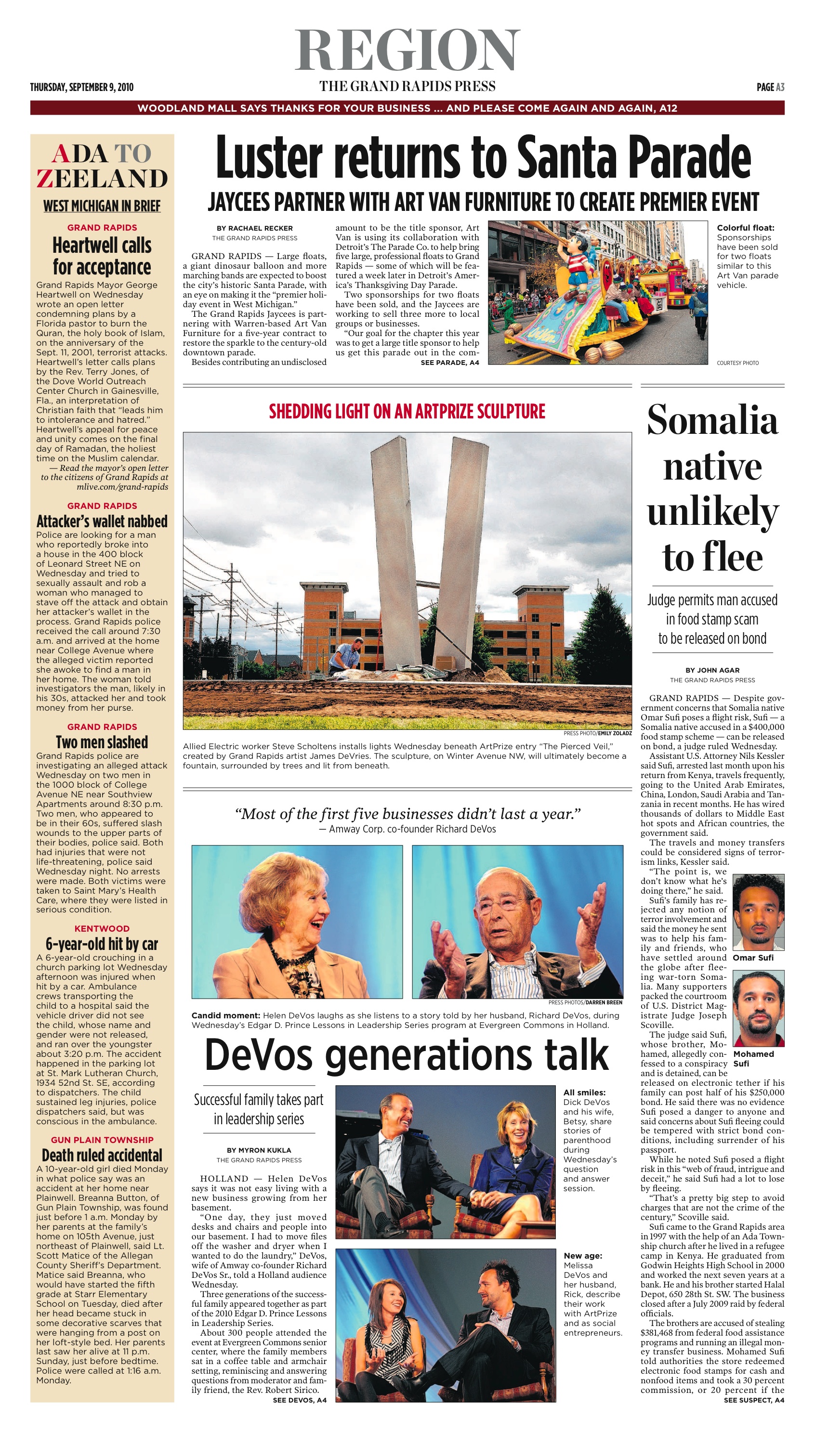
The article shares comments from Helen DeVos, Richard DeVos and Dick DeVos Jr., who shared the stage with Betsy DeVos, Rick DeVos and his wife. The Press reporter shared comments from each of the family members that were presented in such a way that made you feel like we were all just sitting in some typical family living room and drinking tea.
The article does mention the Amway business, the creation of Windquest Group, their ownership of the Orlando Magic basketball team, Kids Hope USA and Rick DeVos’ involvement with ArtPrize.
There was no historical context and no discussion about how the family has used their wealth over the years. Even if those aspects were not discussed at last nights event it would not be unreasonable for a journalist to explore those angles, especially considering the DeVos family arguably has more economic and political influence on West Michigan than any other family.
People need to know about the Richard DeVos Sr.’s long time funding of far-right causes around the world. In fact, Helen, Dick, and Betsy DeVos have also contributed to far-right causes such as using public tax money for private education, English only campaigns, anti-gay legislation, pro-corporate policies and counter-insurgency campaigns around the world.
For a reporter to not ask questions or raise questions about such influence is unacceptable. The public deserves more from journalists, especially if they want people to participate at any level of the democratic process. Maybe the Press reporter knows that if you challenge or even question the power that the DeVos family wields there will be consequences, such as what happen to sports journalist Dave Zirin who exposed Richard DeVos’ support of far-right activities in a recent book.
The Press reporter did mention who the moderator of the event was, Rev. Robert Sirico, who was referred to as a “family friend.” Sirico is the founder and president of the far-right think tank The Acton Institute based in Grand Rapids that weds capitalism and Christianity and has a history of supporting anti-environmental and other reactionary policies. Sirico is also a “family friend” and spiritual advisor to Erik Prince, the war profiteer who has fled the country in order to avoid any consequences for the growing scandal surrounding the activities of Blackwater.
Any competent journalist would have a least frame the event with the DeVos clan with some acknowledgement that there are serious criticisms of their influence, but not much can be expected from the Grand Rapids Press, which the day before made the new home of Dick and Betsy DeVos their front-page story. Instead, the Press reporter merely acted as a stenographer of power.
Wall Street Aggressively Filling Republican Coffers After Many Months Supporting Democrats
(This article is re-posted from the Center for Responsive Politics.)
Wall Street-related political donations are bolstering Republicans’ political fortunes this summer as financial interests have suddenly — and dramatically — shifted their contributions away from Democrats, who they largely favored last year.
In both the first and second quarters of this year, the broad finance, insurance and real estate sector has favored Republican candidates and committees in its political giving, a Center for Responsive Politics analysis finds. The same holds true for both the more narrow commercial banking and securities and investment industries.
This trend is a notable departure from last year, when the finance, insurance and real estate sector sent more money to federal-level Democrats than Republicans during each quarter, the Center finds. People and political action committees associated with the securities and investment industry favored Democrats as recently as 2009’s 4th quarter, while the commercial banking industry favored Democrats as recently as 2009’s 1st quarter.
The findings by the Center, which underscore a preliminary analysis from August, indicate an increased frustration with congressional Democrats by Wall Street interests, many of which are still smarting from passage of federal financial reforms they consider onerous. (Download a full quarter-by-quarter breakdown of Wall Street contribution amounts here: financequarterly.xlsx )
People and political action committees associated with the finance, insurance and real estate sector significantly favored Democratic candidates during the early months of 2009.
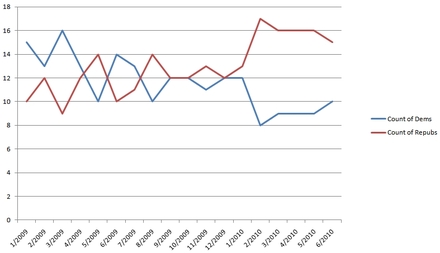
But in February, a dramatic shift occurred — to Republicans’ advantage, the Center finds.
That month, Republicans represented 17 of the top 25 federal-level recipients of finance, insurance and real estate-related money. It’s a shift that’s persisted, too: In each month since June, at least two-thirds of the sector’s 25 favorite candidates have been Republicans.
It’s with little irony that this change in donation patterns coincided with congressional Democrats’ aggressively pushing financial reform legislation — legislation highly unpopular with many banks and financial houses.
Follow the shift in how many candidates among the finance, insurance and real estate sector’s top targets were in each month Democrats and Republicans:
And click here to download a month-by-month list of the top 25 recipients of finance, insurance and real estate sector political contributions from January 2009 to June 2010: FIREcontribs.xlsx
Consider the case of Senate Majority Leader Harry Reid (D-Nev.), traditionally a prime Wall Street target.
In each month between January 2009 and August 2009, Reid ranked among the top five federal-level recipients of finance, insurance and real estate-related donations but for one month — March 2009 — when he ranked No. 7.
But between September 2009 and June, Reid failed to crack the top five even once.
His best showing, in May, placed him 6th among congressional candidates — one of only three times since September 2009 that he’s even managed to finish a month in the top 10.
By June, only two of the top 10 recipients of finance, insurance and real estate-related political cash were Democrats: Sens. Charles Schumer ($237,700) and Kirsten Gillibrand ($259,471), both of whom count Wall Street as a constituent.
Among the Republicans within June’s top 10 list: Senate candidates Carly Fiorina of California, Marco Rubio of Florida, Rob Portman of Ohio and Pat Toomey of Pennsylvania.
Overall, the finance, insurance and real estate sector has funneled about $194.4 million into federal politics through June 30, with Democrats for the entire cycle maintaining a narrow edge in overall contributions — 51 percent to 48 percent.
Such a figure puts the finance, insurance and real estate sector on pace to easily exceed its federal-level political contribution total from the 2006 midterm cycle — $262.9 million.
During this year’s second quarter, the finance, insurance and real estate sector pumped $28.54 million in federal-level contributions into the political system, with $16.29 million going to Republican candidates and interests, while about $12.1 million went to Democrats.
Compare that to the first quarter of 2009, when the sector sent $15.32 million the way of Democrats, compared to $10.1 million to Republicans.
Through June 30, political action committees alone from the finance, insurance and real estate sector had contributed $49.4 million to federal political candidates and committees. That already exceeds what PACs from this sector spent for the entire 2002 election cycle — $47 million.
What We Are Reading
Below is a list of books that we have read in recent weeks. The comments are not a review of the books, instead sort of an endorsement of ideas and investigations that can provide solid analysis and even inspiration in the struggle for change. All these books are available at The Bloom Collective, so check them out and stimulate your mind.
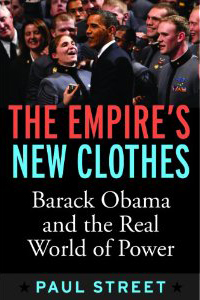
The Empire’s New Clothes: Barack Obama in the Real World of Politics, by Paul Street – Street has been one of the most consistent writers in terms of analyzing the Obama administration since the day he took office. In this sequel to the book that Street wrote just before the last presidential election, Street provides clear analysis of the “progressive agenda” that the President was elected on and whether or not it has translated into real policy reform. The author looks at the Obama administration’s economic policy, health care legislation, foreign policy and the claim of whether or not we are in a post-racial America. Street’s main conclusion is that the current administration is just as imperialist as the last administration and just as beholden to private capital.

Toward Climate Justice: Perspectives on the Climate Crisis and Social Change, by Brian Tokar – In this short book author/activist Brian Tokar presents an important perspective on both the status of the global climate justice movement and where it needs to go. Tokar believes that those of us living in rich societies must always begin our discussion/analysis of climate justice by coming to terms with the fact that it is poor people in Third World countries around the world who are most impacted by climate change. Rooting our actions in this fact would drastically alter our actions and strategies and lead to a more honest a radical movement.

Signal:01 – This new book by PM Press is a treasure for anyone interested in the intersection between art and politics. Signal 01 is a collection of interviews and examples of the art from numerous insurgent artists and art collectives around the world. The book talks to print makers, graffiti artists, cartoonists, photographers and graphic designers. What makes this book so important, besides the beautiful pictures of art, is that it frames the question of the work of cultural production outside of the typical privileged narrative. “The question we need to ask is whether our cultural production is used to uphold the massive levels of inequality that exists across the globe, or to challenge capitalism, statecraft, patriarchy, and all the systems used to produce and reproduce that disparity.”
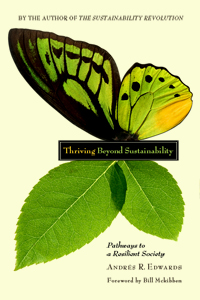
Thriving Beyond Sustainability: Pathways to a Resilient Society, by Andres Edwards – In this new book from New Society Publishers, Andres Edwards attempts to push the envelope on how we should not only view the issue of sustainability, but think about our relationship with the natural world. The author begins his analysis by looking at examples of how indigenous cultures around the world have developed a vision/ethic about how to live with nature instead of trying to control it. However, when it came to concrete strategies I felt that the author was too limited and tended to mimic much of the current liberal writing on sustainability.
Free canning workshop at The Bloom Collective
Canning How-To
1 – 5 p.m.
Sunday Sept. 19 & Oct. 24
The Bloom Collective
Steepletown Center
671 Davis NW
(Corner of 5th & Davis)

As the food industry separates us farther from the sources of our foods—and the nutrients real food provides—people seeking more sustainable and healthier mealtimes are taking up the nearly lost art of home canning. Some of us remember the jars of peaches, pickles and tomatoes lining our grandmother’s pantry shelves. Sadly, others have been brought up on foods jarred, canned, boxed or frozen in factories—and know nothing else.
As the industry’s mouthpiece, corporate media has Americans convinced that it’s difficult to cook from scratch and dangerous to can your own foods. But guess what? It’s easy and it’s safe. You don’t have to worry about those six-syllable food additives poisoning your family. And, canning your own can save you bundles of money. (That can mean less time working to live and more time working at life.)
You can learn the basics of canning at two upcoming free workshops sponsored by The Bloom Collective. On Sunday Sept. 19 from 1 to 5 p.m., experienced home canners from The Bloom, Our Kitchen Table and the GR Free School will show folks how to can salsa. On Sunday Oct. 24 from 1 to 5 p.m., the topic will be applesauce. Bring your own produce, jars, lids, a cutting board and knife.
For information, visit www.thebloomcollective.org or email bloomcollective@gmail.com.
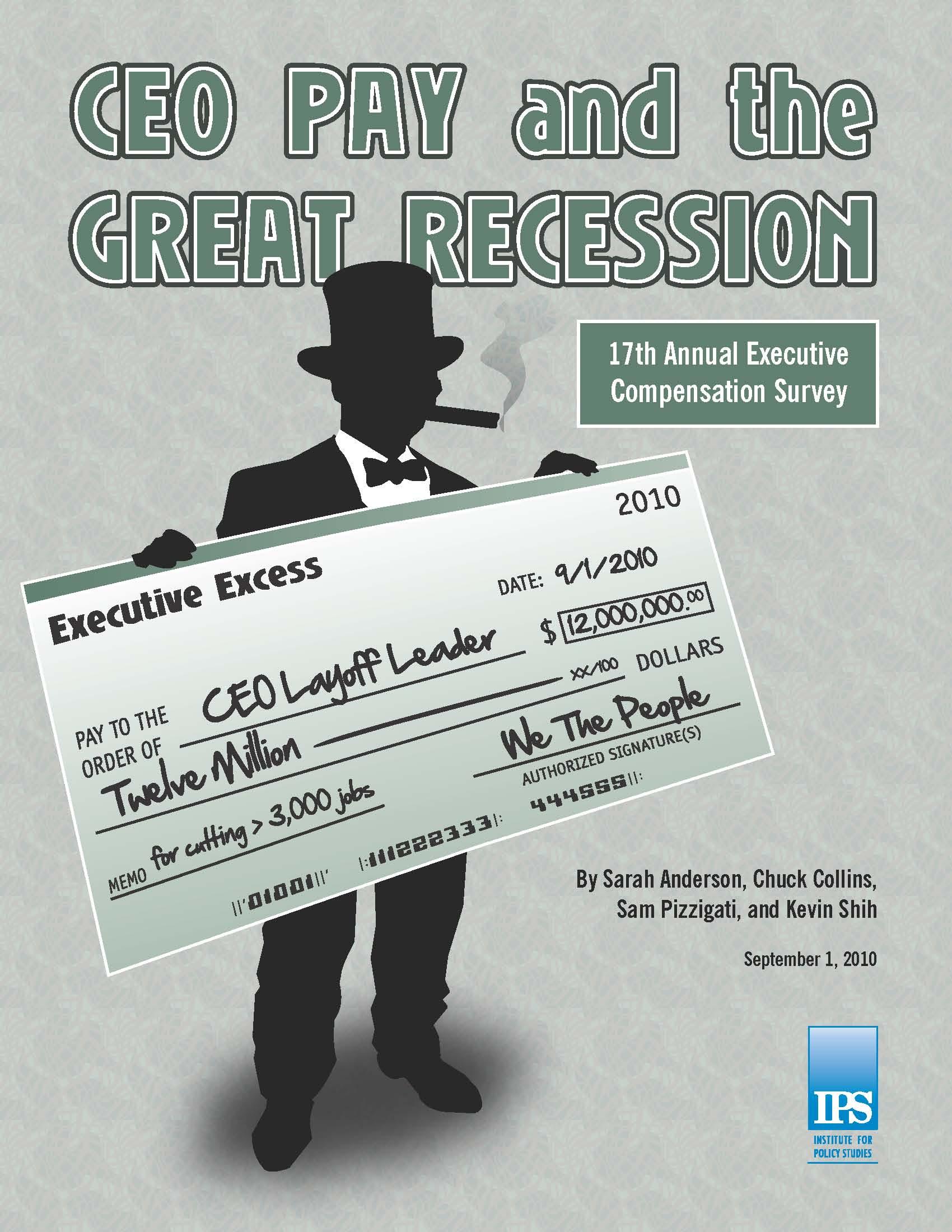
CEO Pay and the Great Recession
(The article is re-posting from ZNet.)
CEOs of the 50 firms that have laid off the most workers since the onset of the economic crisis took home 42 percent more pay in 2009 than their peers at S&P 500 firms, according to CEO Pay and the Great Recession, the 17th in a series of annual Executive Excess reports from the Institute for Policy Studies.
“Our findings illustrate the great unfairness of the Great Recession,” says Sarah Anderson, lead author on the Institute study. “CEOs are squeezing workers to boost short-term profits and fatten their own paychecks.”
PSAs Challenge Bigotry, Church’s Quran-Burning Event
(This article is re-posted from PRWatch. GRIID equally condemns hate crimes of any kind directed at the Muslim community abroad and here in West Michigan.)
The Council on American-Islamic Relations (CAIR) in Los Angeles is responding to a wave of anti-Muslim bigotry sweeping the U.S. by running public service announcements aimed at helping defuse the growing hatred.
Two of the three spots remind the public that many of the first responders at the World Trade Center site on 9-11 were, in fact, Muslims. These two spots conclude with the line, “9/11 happened to all of us.”
The third PSA features Christian, Jewish and Muslim leaders describing the “Golden Rule” as their faiths define it, and ends by saying “We have more in common than we think.” The third PSA is designed to demonstrate the commonalities between faiths and challenge people who seek to divide Americans along religious lines, like the member of the church in Florida who plan to burn Qurans on September 11. The PSAs will be disseminated to TV stations and through social media sites.
Media Bites – Nike and Mountain Top Mining

In this week’s Media Bites we take a look at a recent ad campaign by Nike in conjunction with the University of West Virginia football team. Nike has contracts with numerous college sports programs and often will do ad campaigns to accompany those contracts.
In this ad Nike attempts to honor miners killed this past April, but the ad really ends up normalizing mountain top coal mining. We point out that not only is the ad misleading, but coal mining is also a burden on working people and taxpayers in general because of the deaths and environmental impact.
We also note that because of public pressure the ad was changed just prior to the opening of the college football season, which was last weekend.
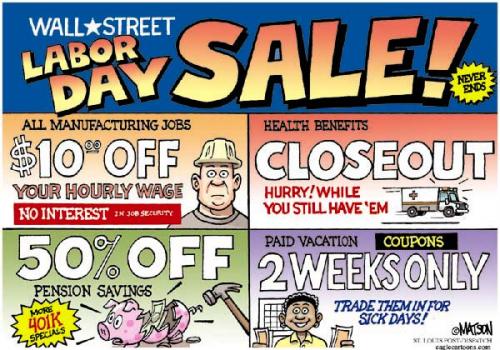
Wall Street Labor Day Sale
Farmworkers launch JPMorgan Chase Divestment Campaign
We reported at the US Social Forum in June about a campaign that was being organized by the Farm Labor Organizing Committee (FLOC) that was targeting the JP Morgan/Chase bank. Below is a Media Release we received today from FLOC.

JP Morgan Chase is one of the lead banks in a consortium of lenders that provides $498 million dollars in credit to Reynolds American, one of the largest tobacco companies in the US. While Reynolds American and JP Morgan Chase make billions, tobacco farmworkers continue to suffer serious human rights abuses in the fields. Although Reynolds does not directly employ these farmworkers, they determine the terms for contract growers which directly affects the living and working conditions of farmworkers.
Reynolds American and JP Morgan Chase have the ultimate responsibility and financial resources to ensure safe and humane working conditions for tobacco farmworkers.
As a major lender to Reynolds, Chase has the stature and resources to convince Reynolds to improve conditions for tobacco farmworkers. Since May 12, 2010 FLOC has been asking Chase to use their influence to push Reynolds to address farmworker exploitation. To date Chase has refused to take any action.
Beginning on September 7, 2010, FLOC will launch a national divestment campaign of Chase bank and call on consumers to close their Chase accounts and cancel Chase credit cards until Reynolds agrees to work with FLOC to find a solution to these abuses or until Chase severs financial ties with Reynolds.
Even if you don’t currently have a Chase bank account or Chase credit card, you can support the divestment campaign by pledging not to bank with Chase or apply for a Chase credit card.
Beginning Monday, September 13, FLOC supporters will be organizing actions nationwide in front of Chase branches to increase awareness about the abuses in the fields of NC and to keep building on the Chase divestment campaign. We will continue to organize events at Chase Bank branches throughout the campaign until Chase agrees to help find a solution or it severs financial ties with Reynolds American. Click here for more info and to download the Chase Organizing Toolkit.
IWW holds Solidarity picket in Grand Rapids for Jimmy John’s workers

Today, 10 members of the local chapter of the IWW and a few supporters stood in the rain outside of the Jimmy John’s restaurant in Eastown today to show support for a new national effort to unionize fast food restaurant chain in the US.
IWW members received primarily positive responses from people walking and driving by the Jimmy John’s location on Wealthy Street near the intersection of Lake Dr and Wealthy.
Despite sending out a Media Release to dozens of local news agencies, the only coverage of the solidarity picket came from Indy media sources, GRIID and a citizen journalist with the Rapidian. WZZM 13 did run a story about the planned picket yesterday, but no commercial news agencies showed up today, despite the obvious tie in to Labor Day.
We had a chance to interview IWW member Cole Dorsey after the solidarity picket and asked him about the campaign to support Jimmy John’s workers and related matters.
 Grand Rapids Institute for Information Democracy