Media Bites – National Happy Hour
In this week’s Media Bites we take a look at a new commercial from Budweiser, which is promoting its National Happy Hour Day.
This ad is essentially trying to get viewers to associate all things American – baseball, cookouts, and concerts with their product. Thus montage of scenes and build up of the music underscore this message.
However, the commercial also uses images of a woman that seeks to present her as nothing more than a sexual being woven throughout the spot.
Local concert to benefit groups doing solidarity work in Afghanistan

This Thursday there is a Beatles Tribute show at Billy’s Lounge in Eastown. The show will benefit two organizations doing solidarity work in Afghanistan.
One of those organizations is RAWA – the Revolutionary Association of Women in Afghanistan. RAWA has been fighting for the rights of women and against foreign occupation of their country ever since the 1979 occupation begun under the former Soviet Union.
RAWA has consistently opposed military occupation, whether under the Russians or the current US/NATO occupation, which is now 9 years and counting. RAWA has also been a strong critic of the Islamic fundamentalists that make part of the Karzai government, the Warlords and the Taliban.
RAWA does amazing work both inside and outside of Afghanistan to not only bring attention to the plight of women, but to provide resources and training for women to be leaders in their communities. RAWA focuses primarily on education and health care work.

The other organization which will benefit from funds raised at the show is the Grand Rapids-based group Healing Children of Conflict (HCC). HCC was formed a year ago around the idea of providing medical treatment to children who have been seriously wounded by US military attacks in Iraq or Afghanistan and Palestinian children wounded by Israeli attacks, which are funded by the US.
HCC also does work to educate people in the West Michigan area about US policy in each of those countries in order to prevent children from being killed or wounded in the future.
The show this Thursday, September 30th is at Billy’s Lounge in Eastown, 1437 Wealthy. $5 will get you in the door and music starts at 8:30pm.
The concert is just one of several events around the 9th anniversary of the US occupation of Afghanistan. For more information on other activities, go to Grand Rapids for Justice and Peace in Afghanistan.
On Saturday, 21 area folks, many from the arts community, gathered at The Bloom Collective for a potluck/discussion, ArtPrize: Open Competition? Or 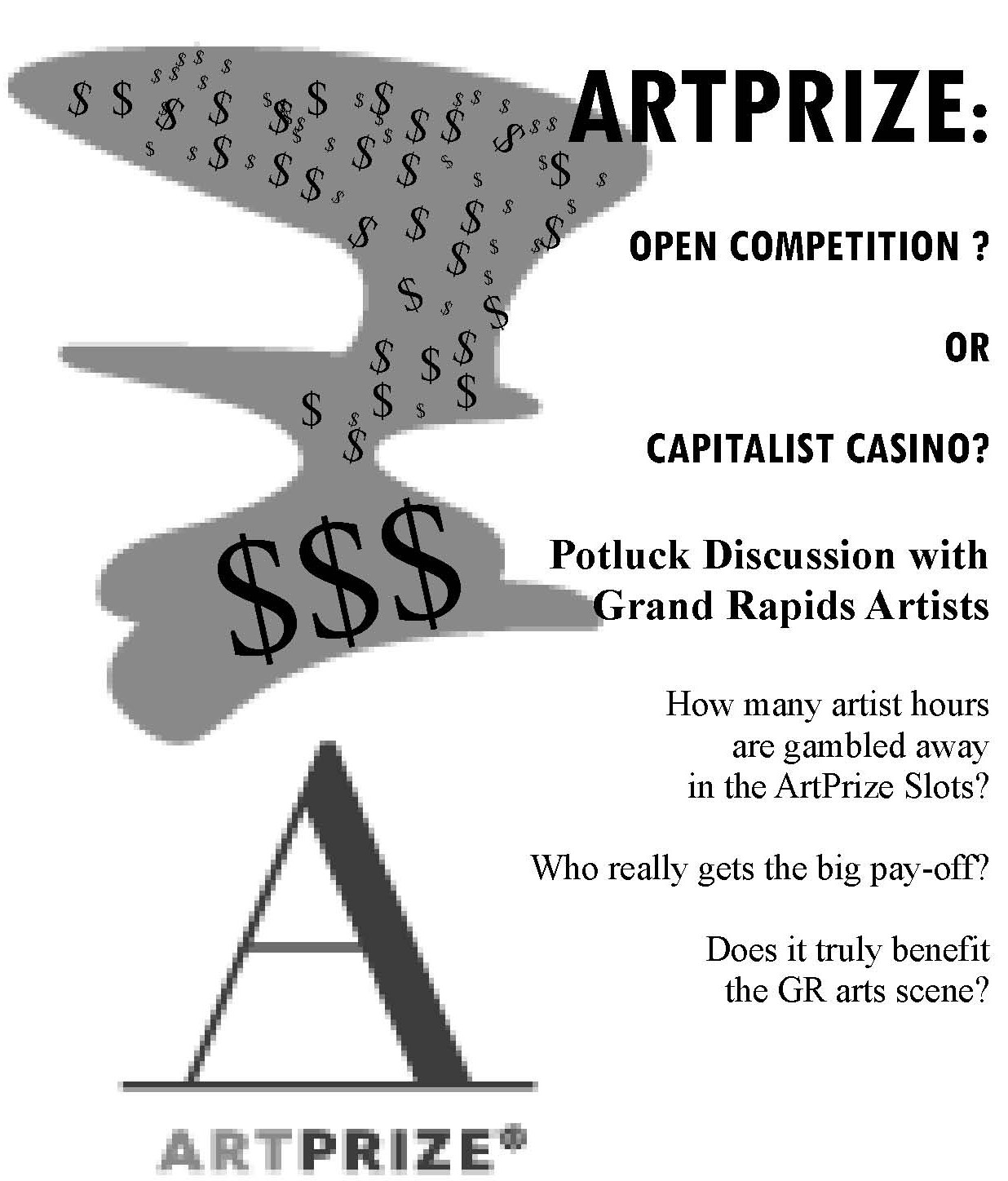 Capitalist Casino?
Of the many discussions The Bloom has hosted, this was the first where participants voiced fears over remaining anonymous. Because of these concerns, the discussion was not recorded and some comments reported are not sourced.
The discussion opened with this quote from Signal: 01, A Journal of International Political Graphics & Culture: “The production of art and culture does not happen in a vacuum. It is not a neutral process. We don’t ask the question of whether culture should be instrumentalized towards political goals, the economic and social conditions we exist under marshal all material cultural towards the maintenance of things the way they are. The question that we need to ask is whether our cultural production is used to uphold the massive levels of inequality that exist across the globe, or to challenge capitalism, statecraft, patriarchy, and all the systems used to produce and reproduce that disparity.”
ArtPrize as Empire
ArtPrize is not simply a cultural production. Its parameters are created and controlled by a self-selected elite. One artist described ArtPrize as colonizing Grand Rapids artists, venues and neighborhoods. In response, another said that ArtPrize reminded them of an old cartoon where the characters lived inside of a video game. When someone turned the game on, a giant cone descended and any characters caught within were forced to take part in the game. “The top-down aspect is the biggest problem,” he said.
 Two people shared examples from 2009’s ArtPrize. Representatives from the event visited their venues some months prior to the event. They were told not to schedule anything during the dates that ArtPrize was going to happen—but not given any details about what ArtPrize was.
Heartside’s street people and homeless persons are assigned a different role. Police stopped by agencies serving this population to tell them to warn their clients that their presence on the streets during ArtPrize would not be tolerated. Seating in the Cherry Street pocket park was partially eliminated to discourage street people from gathering there.
“It’s about property values. ArtPrize is importing capital, getting consumers interested in moving in and developing the area in a way that marginalizes the working class people in Heartside,” another participant said. “When rich white people come into Grand Rapids they don’t want to see the black people.”
Indeed, Heartside and its neighbors to the south have been targeted for gentrification as is evidenced by Grand Action’s Urban Market project and the Wealthy Jefferson Development Initiative, two projects steaming ahead without input from the people living in the neighborhood.
The ArtPrize Color Pallet
Just how white is ArtPrize? Well, no black faces were among last year’s chosen winners; the bulk of folks attending the event seem to be of the paler persuasion; and, at least one of last year’s African American venues and entries was left off the ArtPrize map not once, but every time it was printed in the Grand Rapids Press.
“ArtPrize is for white people to come to have a lot of fun and not have to deal with black people. It is part of a conservative movement that is racially motivated,” the artist said. “I opened up my venue . . . white families that came up to my loft would take three steps into my space and run out. They literally flew back down the hallway. This happened repeatedly. Those are the dynamics in this city and I am trying to reverse them. Frederick Douglas said that until America deals with the issue of race, nothing van be fixed. Race is going to have to be a part of ArtPrize. Get some black people involved.”
Art or Entertainment?
ArtPrize does make art accessible to the general public, albeit through the non-stop hype produced for the event by local media. While some entries do tackle social issues, these are few and far between—and the subject of negative comments, according to one artist present. Why the negative reactions? Perhaps because people have been cajoled into perceiving the event as pure entertainment. Casting art in this role takes away its power to challenge political and social issues.
Printmaker Alynn Guerra grew up in Mexico where the general public sees art as more than decoration. “ArtPrize perpetuates society looking at art as something that is just beautiful, that attracts. Art is more than decoration. Art has purpose. It’s evident that most artists who support themselves with their art are starving in this society. They have to work another job,” she said. “Why isn’t our community supporting us in the same way it supports other professions? How come no one is questioning why artists can’t come up with projects like these ourselves? Why does it have to come from the government and private sector, from the top not the bottom?”
Artist Brett Colley voiced similar concerns. “Much art is not suited for ArtPrize,” he said. Two of his students working on ArtPrize entries were asked to change their work by the venue. Two others who presented challenging work received hate mail. He also cited the lack of opportunity for critical discourse during the event.
Another artist said, “ArtPrize has not managed to make art more visible. The eyes of the world were on us. What the world saw was work that didn’t deserve the attention. The really amazing artists (in Grand Rapids) were not seen. . . I don’t think it’s doing a damn thing for artists.”
Who’s working? Who’s getting paid?
Many voiced concern with ArtPrize’s use of free labor—volunteer labor during the event and the countless artist hours poured into creating the works. Gallery owners and art educators are left out of the financial equation but expected to take part. While flyers for an upcoming anti-war march were torn down from public utility poles, ArtPrize flyers were welcome. This brings up the issue of public space. “Why does ArtPrize get to usurp all this public space and then give it back to us? Their logo shows up on every corner with no license or fees paid,” Colley said. “When art is used as an economic vehicle, who does it serve?”

This zine is available at The Bloom Collective, bloomcollective@gmail.com
The scheduled two-hour discussion carried on for nearly three. A last and very relevant question posed by one participant, “What do people want to do about it?”
One artist encouraged people to get involved with ArtPrize when it achieves
non-profit status. Others suggested making a publication prior to next year’s event.
“We need to form a guerilla art collective, to step outside the system,” another artist said. “to attract people to a counter-voice on the streets rather than what is coming through ArtPrize.”
GRIID has access to a zine, Against ArtPrize, anonymously created and shared at The Bloom event, which takes a critical look at ArtPrize.
Business as Usual at the Grand Rapids Press

On September 6, The Grand Rapids Press published an article, complete with “photo album,” of Dick and Betsy DeVos’s new summer home in Holland. The facts—that the DeVos family had chosen to tear down a 12,000-square-foot, multimillion dollar home in order to build a 22,000-square-foot faux-chateau, along with a multi-bedroom guest house—proves that the current Michigan Depression is only a rumor for some people.
The photos prove something that my father used to say: “Money can’t buy good taste.”
Surprisingly, in this area of DeVos worship, particularly during the current month of Art Prize (formerly known as September), this Press article rubbed many people the wrong way. Letters to the editor all month have complained bitterly about the insensitivity of an article flaunting the DeVos’s immense pyramid-scheme fortune at a time when people in West Michigan are struggling with increased poverty, loss of jobs and health care insurance, and record numbers of foreclosures.
The Press, insists bombastic editor Paul Keep, embraces criticism, but it apparently rankled under this relative onslaught of harsh letters. So on Sunday, September 26, the job fell to Business Editor Nancy Crawley to play apologist for the Press’s decision to feature the DeVos summer house story on page 1.
In doing so, she revealed a lot about the Press’s attitude about capitalism, the still-clung-to idea of a trickle-down economy, and an open contempt for the realities of life in West Michigan for the majority of us.
Crawley stated that a “handful of readers” chose to complain. This was unbelievable, Crawley said, puzzling, “Didn’t the project employ scores of people, from architects to attorneys to carpenters?” Why, there was even a local grocer who had to add “staff” (probably an out-of-work college student) to handle all the food orders from work crews.
Of course, Crawley doesn’t note that all this fabulous employment was temporary, and now has essentially come to an end.
Other readers, Crawley says, objected to the front-page placement of the story. This, she said, was “evidence of a scary mind set emerging from this long, ugly recession—a stern, puritanical insistence that we don’t deserve good things, good times.”
Of course, an objective observer might comment that the problem was that so few of us enjoy “good things, good times,” and those who do are doing so at the expense of the majority of working-class folks in the area.
After all, we’re talking about Dick and Betsy DeVos here. Proponents of a right-to-work state in Michigan, and advocates of union-busting. Supporters of private-school vouchers that weaken bring public education for those who can’t afford private schooling. Heirs to the vast Amway wealth that was brought about by drawing people into a pyramid scheme that destroyed thousands of lives and businesses. And let’s not forget Betsy “Marie Antoinette” DeVos’s statement in 2004 that the only problem with the Michigan economy was that Michigan workers were paid too much. In a press release statement in 2004, Betsy stated, “Many, if not most, of the economic problems in Michigan are a result of high wages and a tax and regulatory structure that makes this state uncompetitive.”

But according to Crawley, our supposed Puritanical insistence that we be frugal and not lavish “hurts rather than helps our economy. What makes the economy stronger and our way of life the envy of the world is that people have the right to pursue happiness, enjoy the fruits of their labor, and, if they have gotten rich on the up-and-up, let’s hope they spend their money instead of hoarding it.”
Oh, yes—the famous Reaganomics with its trickle-down effect is omnipresent in this ludicrous column. Dick and Betsy DeVos have served the economy well by spending, spending, spending. And now, Grand Rapids, Nancy Crawley says it’s your turn. Let’s make West Michigan the envy of the free world by spending to keep our economy (that is to say, the fortunes of the ùber-capitalists like the DeVos family) strong. Even if you have to cut out a few more meals in your two-room rented apartment, or lower the thermostat again, or figure out how the same income you had 10 years ago is going to stretch to meet record increases in your health insurance, or watch your house being seized by the sheriff.
And, with the kind of sensitivity that we’ve come to expect from the Press, Crawley’s column ran right next to a feature article titled “2010 on track to set another record for foreclosures across Kent County, West Michigan.” The first line of the article was, “Andrew Zukowski lost his full-time job eight years ago and has not had a steady paycheck since.”
Let’s hope Nancy never glanced over at the next column of the Business section. It might have brought a little reality into the rosy, free-market, spendy world in which she lives, and from which she edits and reports to the rest of us long-suffering Press readers.
If Chile can, why can’t we – Net Neutrality
(This article was written by an Aquinas student, Joe Spaulding)

On July 15, 2010 mainstream national news outlets like CNN, Fox, and MSNBC were focused on reporting which candidates were leading the horse race in primaries across the U.S., as well as the implications of a somewhat grass-roots initiated Tea Party movement that had been given a surge of strength at the cost of cohesion and stability by the conservative corporate elite on the upcoming elections in November (to be fair and balanced, Foxnews.com also had articles covering the average number of sex partners iPhone owners have and the tumor that was threatening one of the world’s largest breasts). News of the ongoing and perpetually devastating oil spill in the Gulf of Mexico and the continuation of bullets flying at and from American soldiers in Iraq and Afghanistan was present, but sitting on the media’s back-burner.
On that “unnewsworthy” mid-summer day the government of the nation of Chile passed a law guaranteeing its citizens protection from the malicious techniques of control previously available to the Internet Services Providers that supply the 7,387,000 of the country’s 16,454,143 citizens that are online. A few technology blogs like Endgaget picked up on the story within a couple of weeks, mostly taking the tone of neo-cosmopolitan internet geeks congratulating their overseas brethren with a dash American envy of Chilean exceptionalism, wondering why it was so easy for Chile to pass these protections, but so difficult in the U.S.
This type of protection is referred to in online communities as “Net Neutrality.” It means having ISPs be legally prohibited from favoring any specific Internet content by changing the speeds at which the data gets delivered. The deciding factor is if the Internet is viewed as a utility like electricity, water, and telephone service, or if it is viewed as an information service like cable TV. Utility companies hook you up to their networks, and don’t tell you how to use your power, water, or gas. Cable companies control what channels they let you have access to, as well as establish tiered pricing for varied content. In the late 1980s and early 1990s, Internet access was obviously a utility because the vast majority of the few online computers used a dial-up modem to access the online world. The advent of broadband brought two technologies that fell on either side of the FCC’s authority to ensure fair content delivery: DSL (which goes through phone lines) and Cable.
Net neutrality (or the oncoming lack of it) has massive and definite implications concerning access to information for every person on the planet, especially in countries like the U.S where a great deal of media – social, entertainment, commercial, and informative- is created, distributed from, and consumed. Senator Al Franken of Minnesota has stated that, “Net Neutrality is the 1st Amendment issue of our time.” The lack of coverage in the American media is indicative of a press that is either hateful of its readership or too tied down to corporate interests to spread word of legislation that might limit the power of their parent companies, or both. The New York Times will sometimes run a piece describing the concept, but almost never delves into the implications. Like so many stories deserving more attention, most of the text concerning net neutrality advocacy is in the margins: Tech blogs and social media aggregation sites like Reddit where Internet savvy individuals gather, socialize, and pool information.
The coverage of net neutrality is so sparse that it is not uncommon to find average citizens, politicians, and political science professors that have never heard of the terms. To understand the policy that was passed in Chile, and the effects an analogous policy could have on the U.S., it is probably best to understand the regulations regarding Internet access that make up the status quo in the U.S. Because few real regulations exist, this is a disappointingly simple task. The FCC has issued guidelines urging ISPs to not restrict any flow of any data unnecessarily, but has neither the criteria to determine what constitutes necessity, nor the power to enforce penalties for arbitrary limits on net traffic. When the FCC tried to fine Comcast for choking the bandwidth of users during peak download times in 2007 the Federal Court sided with Comcast. Until legislation makes it way through congress, the courts have transformed the FCC (when attempting to regulate ISPs) into a dog with a mild bark and no bite.
ISPs, their lawyers, and lobbyists use two ideas to try to derail fair access to the Internet; that throttling and choking bandwidth is necessary to ensure the continued flow of data without network downtimes, and that net neutrality undermines the free market in favor of government control. The first is ludicrous for two reasons. Primarily, if Comcast can afford to make a bid to purchase GE, they certainly can afford to upgrade their network capacity to handle the increased traffic. Second, because there are no real restrictions making arbitrary or malicious network manipulations illegal, there is no way to make sure ISPs do not use this power to extort money from content providers and internet subscribers alike or to block sites the ISP or its business associates find politically “unagreable.”
The second idea used to defend ISPs’ power to regulate content on the Internet is exactly backwards. Tech companies and ISPs will never need to develop more adequate network infrastructure if all that is needed to keep most of the network running smoothly is to turn down the parts of the Internet they like the least.
The beauty of the Internet in regards to American democracy is that because the content providers are the consumers of that content, the Internet helps bind all of the freedoms guaranteed by the First Amendment into a more cohesive unit. The closer freedom of speech is tied to freedom of the press, the more power rests in individual people and not telecommunications corporations. It’s extremely difficult for a person to make a blockbuster action flick that rakes in millions of dollars unless they start off with millions of dollars, but right now, anyone get a video of their cat being adorable to go viral online for free. AT&T, Verizon, and Comcast stand to make a lot of money if they can change this, and if they do it will be the average American that suffers. In any real democracy, free and fair access to information is as important to its survival as the air its citizens breathe. Congratulations Chile.
http://techdailydose.nationaljournal.com/2010/09/more-hostile-environment-for-n.php
http://www.savetheinternet.com/
http://www.freepress.net/policy/internet/net_neutrality
http://www.nytimes.com/2010/04/07/technology/07net.html
http://www.engadget.com/2010/07/15/chile-becomes-first-country-to-guarantee-net-neutrality-we-star/
3rd Congressional Race: No debates, no real news
Today, the Grand Rapids Press reported that both the Republican and Democratic candidates for the 3rd Congressional seat being vacated by Vern Ehlers can not come to an agreement on public debates.
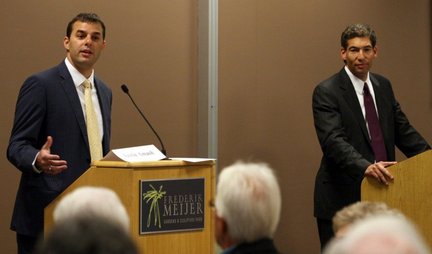
The Press articles states that there have been 2 debates since the August Primary, one being public and one being for members only (Kent County Medical Society). Press reporter Jim Harger cites both the Miles and Amash campaigns as being is disagreement about the terms of possible debates.
The article also cites several other sources, all of which have sent invitations to the candidates and all four of which say that Amash has refused or did not respond to the invitation to debate.
Clearly, debates are one way for the public to get access to information about the candidates, by hearing their responses to questions and possibly being able to ask questions themselves.
However, debates or the lack thereof, should not prevent the local news media from providing coverage of these candidates and their stance on issues. Since Labor Day, the GR Press has only run two stories on the 3rd Congressional race.
The first story was based on a debate between Amash and Miles from September 18 and the second story was about endorsements for Miles. In both cases, the Press reporters did not provide readers with any details of the candidate’s position on issues.
We are only five weeks away from the November 2nd vote and the Grand Rapids Press has an obligation to inform voters about where the 5 candidates stand on the critical issues of the day. The Press should not wait for debates in order to explore where the candidates stand on issues, they have the capacity to interview them, engage them and the public about what people want from Washington in terms of policy on economics, health care, the environment, war, spending, immigration, education, political corruption, civil rights, etc.
The Press will no doubt print a voters guide the week prior to Election Day, but as we have noted in the past, those voter guides only include responses to a few questions. The Press could at least provide the guide more than once before Election Day, which is exactly what they did with the ArtPrize Voters Guide, which was included in the Press three times – September 19th, 22nd and 23rd. As the only daily newspaper in Grand Rapids, they owe it to the public to provide the kind of information that will allow voters to make an informed decision.
True Majority and Pepsi
(This article by Russell Mokhiber is re-posted from CounterPunch.)
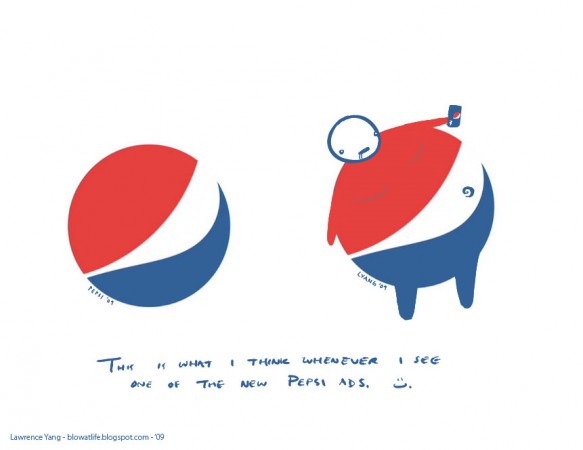
True Majority ought to change its name.
Try: The Pepsi Generation.
True Majority is the Ben & Jerry’s creation that has become a Democratic Party front group run by USAction.
And True Majority has entered a contest sponsored by the Pepsi – the liquid candy queen – the company that brought you the childhood obesity epidemic.
The contest is called: Pepsi Refresh.
Pepsi gives away $1.3 million a month to worth causes.
You enter your idea at the Pepsi Refresh website.
You pick a category.
TrueMajority and USAction entered for $250,000.
They want to use the money to explain to Americans what a good deal Obamacare is.
Wow kids, if you are 26 and under, you too can be covered by your parents health insurance!
And then every month, people vote on line for you or your competitors.
If you get the most votes, you get the money.
Right now, USAction is in fifth place.
Voting ends in eight days.

Michael Jacobson knows what Pepsi is trying to do here.
Jacobson is executive director of the Center for Science in the Public Interest, which put out a classic report a couple years ago titled Liquid Candy: How Soft Drinks Are Harming America’s Health.
“Junk-food makers, like alcohol and tobacco companies, often try to distract attention from the harm they wreak on public health by donating money to worthy charitable causes,” Jacobson said. “Giving away each month the equivalent of about what it costs to broadcast a 30-second commercial is a highly effective PR strategy.”
David Elliot of TrueMajority sent out an e-mail this week asking supporters to vote for TrueMajority’s entry.
With eight days left in the voting, USAction ranks fifth among the competitors in the $250,000 category.
We rang up Elliot and ask him if TrueMajority would take money from any corporation.
“Absolutely not,” Elliot said.
Defense contractors?
“Probably not,” Elliot said.
Were any moral qualms raised within the organization about entering a contest that inflicted such harm on the health of America’s children?
“Not at my level,” Elliot said.
Elliot defended the group’s action, saying that the money would be put to good use, to educate Americans what a great deal Obamacare is – especially for young people.
But Pepsi is actively damaging the health of young people.
And Obamacare is an insurance industry written bill that won’t control costs, won’t cover everyone, and keeps the insurance industry in control of the system.
That’s great – using Pepsi money to defend the insurance industry.
TrueMajority – Taking Democratic Party front groups to new lows.
Campaign finance update for Michigan House and Senate races
This year’s election cycle is breaking records across the country and the money raised in Michigan for state races is also on the rise.
According to the Michigan Campaign Finance Network (MCFN) “Candidates for the Michigan Legislature raised $20.9 million and spent $14.5 million through the post-primary campaign reports. That fundraising total is up by 8.3 percent compared to 2006, the last time candidates for both the House and Senate faced the electorate.”
When looking at the data MCFN has provided for the two state Senate races in West Michigan one race is financially tight, while the other one is lopsided. In the 28th District Senate race featuring Republican Mark Jansen it would appear that the Democrats are conceding that race. Jansen has raise $96,242 so far, with a total of $44,264 still in his money chest. The Democratic candidate Robin Golden has not raised a cent as of the last reporting period.
The 29th District Senate race is much closer. Republican Dave Hildenbrand has raised $269,927 so far with $134,353 left in his balance. The Democratic candidate David LaGrand has raised $141,536 so far with $30,649 left in his money chest. We can expected to see lots more money being raised and spent on ad campaigns in the remaining 5 weeks of the campaign.
In the State House races in West Michigan there are two races with candidates who are challenging incumbents and have raised no money. In the 74th District House race incumbent Dave Agema (R) has raised $38,828, while the Democratic challenger Leon Chase (D) has not raised any money to date. The same is the case in the 76th District House race where Democratic incumbent Roy Schmidt has raised $107,034, while the Republican challenger Marc Tonnemacher has raised no money.
This is not the case in the 75th District House race where there are no incumbents. Democratic candidate Brandon Dillon was not challenged in the primary and still has $37,561 in his campaign account. The Republican candidate Bing Goei barely beat out fellow Republican Jordon Bush in the Primary election, which has left Goei with only $696 left from the $60,275 he has raised.
According to MCFN the total amount of money raised so far across the state for House races is $10,151,168. In the state Senate races in Michigan a total of $10,755,281 has been raised so far. Combined that is over $20 million that has been raised. Imagine what that kind of money could do if it was spent on housing or other basic rights for people living in Michigan.
HCC to host Film series on the Middle East
The Grand Rapids-based group Healing Children of Conflict (HCC) will be hosting a film series beginning in October to raise awareness about the human cost of US policies in Iraq, Afghanistan and Palestine.
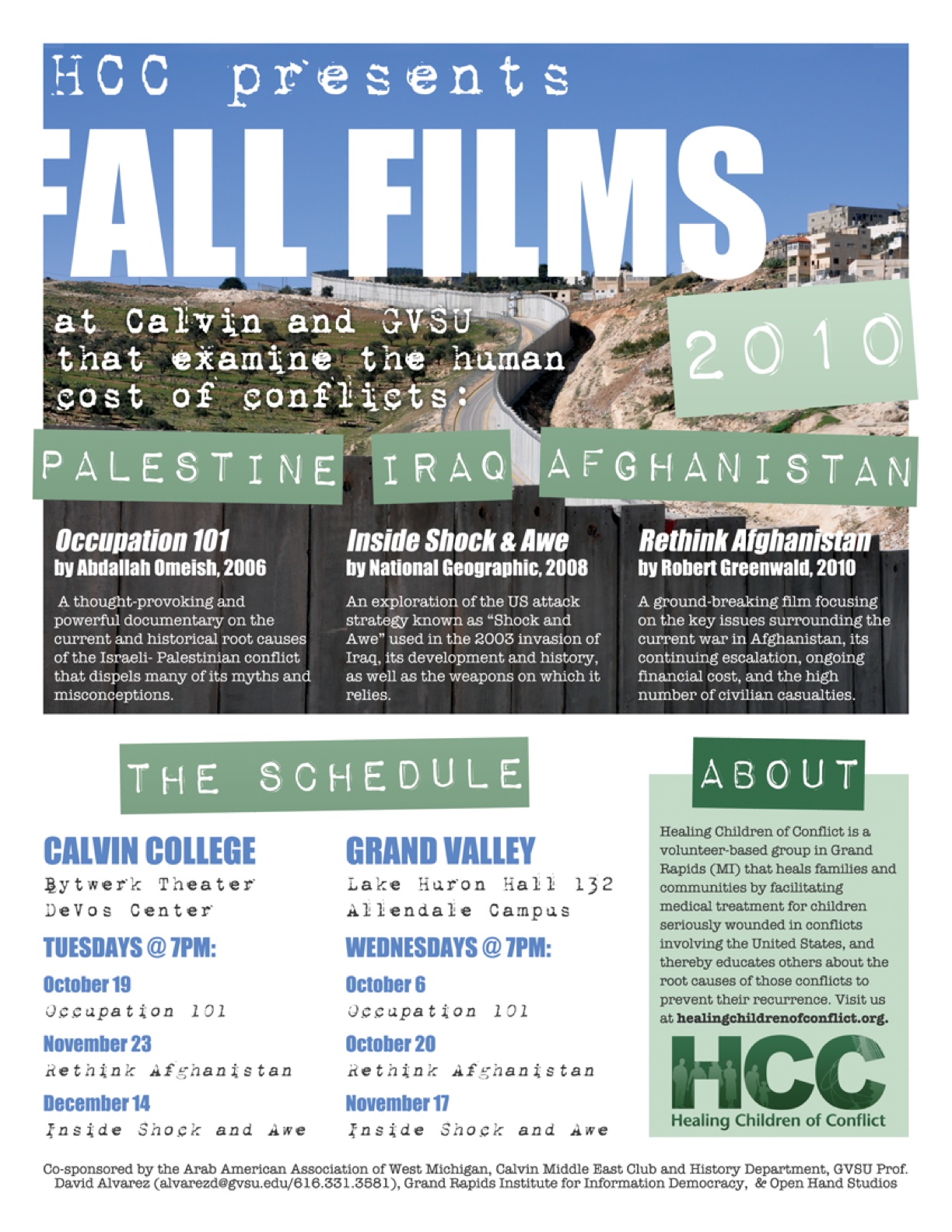
HCC works to provide medical assistance to children wounded from US military attacks in Afghanistan and Iraq, as well as US supported Israeli military attacks against Palestinians.
The film series will take place on both the Calvin College campus and the GVSU campus in Allendale.
Occupation 101 – an investigation into the historical roots of the Israeli/Palestinian conflict.
October 6, 7pm at GVSU Lake Huron Hall 132, Allendale Campus
October 19, 7pm at Calvin College Bytwerk Theater
Rethink Afghanistan – An hour-long look at the US occupation of Afghanistan, both the political and human consequences.
October 20, 7pm at GVSU Lake Huron Hall 132, Allendale Campus
November 23, 7pm at Calvin College Bytwerk Theater
Inside Shock and Awe – A People’s War Crimes Tribunal that investigates US war crimes committed against the people of Iraq since the 2003 US military invasion.
November 17, 7pm at GVSU Lake Huron Hall 132, Allendale Campus
December 14, 7pm at Calvin College Bytwerk Theater
There will be discussion following each film screening along with additional resources on each of these three topics.
Combating Global Warming through office furniture production?
Last week it was announced that the West Michigan office furniture company Steelcase was ranked #1 in the Home and Office Furniture Industry for its efforts in combating climate change.

The New Hampshire group Climate Counts, has its own scorecard system to measure individual companies and how they are reducing greenhouse gases.
Steelcase was ranked number one in their industry sector because of their investment in wind energy production and the use of new bio-degradable packing for their products.
While these action may seem like the company is making changes that will reduce greenhouse gases it doesn’t address the more systemic problems of production and consumption.
Steelcase, like any other capitalist enterprise is committed to constant growth and is continually making new products. Office furniture is their main focus of production and in order for Steelcase to continue as a corporate entity they have to figure out ways to keep selling office furniture.
The question one could ask is how much office furniture do we actually need? Their products, like so many in the industrial world, are not built to last, thus perpetuating the need to consume. Steelcase is also always coming up with “new designs” so that consumers will always feel the need to upgrade their office furniture, even if the current furniture they own is fully functional.
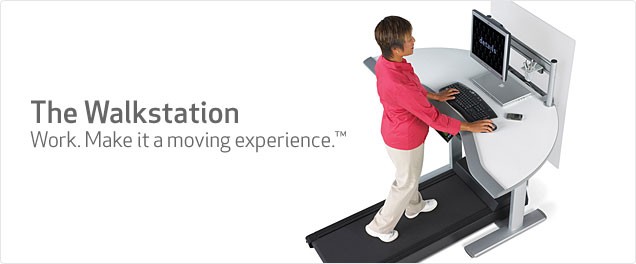
Then there is the issue of cost. In looking at their products online I was a little shocked at the cost of items as simple as an office chair. Their Leap office chair goes for $849, which is the same amount of money that many working class people will make in a month.
Then there are newer products like walk stations. Walk stations are a mix between a treadmill and a work desk, which allows people to exercise while working at their computers. These items run a mere $4,000 plus. So, on top of the lack of longevity of their products, the costs contribute to a vicious cycle of economic dependency.
One other area that is not included in the award to the West Michigan office furniture manufacturer is resource extraction. While the company might be using bio-degradable packing material there is no acknowledgement of the resources used to make their furniture – wood, metal and plastics, all which contribute to deforestation, oil and mineral extraction. And this is not one of the criteria included when groups like Climate Counts does assessments of corporate behavior.
Climate Counts is a non-profit entity that is part of a growing sector of agencies that are designed to make the public feel as if the corporate world was actually doing something significant to challenge global warming.
Climate Counts sees “business as having the power to change the world,” thus they work in conjunction companies and ultimately act as a buffer against civil society that might demand more radical change.
In fact, Climate Counts does not see people as citizens or agents of change. People are nothing more than “consumers.” On their home page, Climate Counts states that they “fight climate change by helping consumers with their choices and voices to put pressure on the world’s largest companies to take corporate climate action.” But what does this actually mean?
One example that Climate Counts gives is getting McDonald’s to reduce some of its energy use at their fast food facilities in order to reduce global warming. Again, on the surface this might seem like a positive things, but if we were really serious about reducing carbon emissions fast food would not be part of our future. Fast food by its very nature is unsustainable.
The same can be said for the office furniture maker Steelcase, which if we were serious about what role it would play in truly reducing global warming then we would have to talk about the fact that it can not be a positive force for carbon reduction until it stopped making expensive, unsustainable products.
 Grand Rapids Institute for Information Democracy