An Informed Vote My Ass
In yesterday’s Grand Rapids Press, editor Paul Keep ran is usual Sunday column. The focus for this week’s column was on the efforts that the Press has made to provide readers with information for the November 2nd Election.

The title of his column in the print version of the paper was, “Prepare yourself to cast an informed vote on Nov. 2.” As someone who monitors the Press and the information it provides to people on candidates and ballot initiatives I find it hard to take Mr. Keep’s comments seriously. The Press editor mentions three things that he believes will help voters make informed decisions – the Michigan 10.0 series, their online voter guide and Keep calls their “day to day, blow by blow news coverage.”
First, just because the Press did a series of stories they called Michigan 10.0 doesn’t mean they provided people with important information relevant to the elections. GRIID has been tracking those stories and providing some analysis. We found both significant bias in stories that dealt with both environmental issues specific to Michigan and labor issues, specifically the “right to work” question. The bias in these stories and the series as a whole overwhelmingly represented the views of business people or people in positions of authority. Rarely, did readers of the Michigan 10.0 series get the perspective or working class people or grassroots organizations.

Second, while the online voter guide does have information and candidate responses to questions posed by the Press editorial staff, it does not provide an investigative element that journalism should provide. The online voter guide provides responses from candidates, but there is no investigation into the claims they make. Having a reporter investigate those claims, do some fact checking and provide context for readers would make the online voter guide more relevant.
Also, the online voter guide is just that, online. Why doesn’t the Press provide voters with this information in print well before Election Day, so that people can easily access the information instead of having to go online? It can’t be a matter of using too much print space, since the Press has included the ArtPrize venue/voter guide 6 times between September 7th and October 3rd. The Press will run on print version of their voter guide on October 26, but it will only have “excerpts of what is online.”
Lastly, the Press editor claims they are providing “day to day and blow by blow coverage.” This simply isn’t true. The link that Paul Keep includes in his column only has eight articles in the last 30 days, which is a very low number, especially considering the amount of candidates and ballot issues that people will be deciding on. On top of that the articles are mostly about endorsements, candidate debate agreements and responses to attack ads. What voters are not getting on a day-to-day basis is information on where candidates stand on the issues or the voting records of incumbents and those who are running for a higher office.
The column by the Press editor ends with a list of upcoming election stories they plan to run, but these are not an adequate amount of stories that would provide voters with the necessary information in order to make an informed voter.

“Liberal” Michigan Senator Carl Levin continues to show his true colors in the so-called US War on Terrorism. Yesterday, Levin spoke to the elite foreign policy establishment, the Council on Foreign Relations.
CNN reported yesterday that Levin criticized the government of Pakistan for not doing more to fight terrorist and for complaining about US military Drone strikes that kill Pakistani soldiers and civilians.
Speaking about the US military Drone attacks in Pakistan Levin said, “There is a significant improvement in the accuracy. The minister, the foreign minister of Pakistan, acknowledged this yesterday to me. There are mistakes made but there is a huge improvement in the accuracy and the reduction of mistakes.”
It is so comforting to know that the “liberal” Senator Levin considers the death of innocent civilians from US Drone strike to be “mistake.” According to numerous sources in the past year, US military Drone strikes in Pakistan accounted for over 700 civilian deaths in 2009 alone.
Jane Mayer’s excellent piece in the New Yorker also examines the disastrous US military Drone campaign in Pakistan, a campaign which has increased anti-US sentiment to such levels that a recent poll done in Pakistan revealed that 59% of Pakistanis believe that the US is greatest threat to their country.
Senator Levin’s response to the criticism coming from Pakistan – “They object when we make mistakes. I mean we hit some Pakistani troops by mistake the other day and there is some strong blowback on that. This is understandable.”

These statements from Levin were responses to questions after a talk he gave to the Council on Foreign Relations. In that speech, Levin continued to support the US occupation of Afghanistan and emphasize his belief that the Obama administration will stick to its commitment of US troop withdrawal in July of 2010.
Levin also continued his belief that Afghanis being training by the US are making strides that will allow them to take over security matters in their country. This optimism is seriously called into question by independent reports on the “progress” of US training programs for Afghan security forces.
In addition, Levin acknowledges that the current levels of corruption in the Karzai administration are problematic, but the Michigan Senator does not acknowledge the degree to which the US is responsible for the corruption, particularly the US use of private contractors, which have been exposed as an integral part of the problem.
It should be crystal clear to anyone who is opposed to the US Afghanistan/Pakistan war that Senator Carl Levin is no anti-war ally. In fact, it seems clear that Levin is a proponent of continued US war crimes against civilians in both of those countries.
Fake News Persists, FCC is Mute
(This article is re-posted from PR Watch.)

Television stations are continuing to broadcast fake news, four years after the Center for Media and Democracy exposed the practice and the Federal Communications Commission (FCC) warned TV stations against using it.
Public relations firms make videotaped fake TV news segments in which hired actors pose as “reporters” who tell “stories” about a product or service they want advertised. The PR firms then send these so-called video news releases (VNRs) to cash-strapped news rooms around the country, who broadcast them as though they were real news, without revealing that they are really advertisements.
A 2006 CMD study titled Fake TV News: Widespread and Undisclosed, exposed 123 TV stations across the country that were regularly airing VNRs without informing viewers that the spots were paid ads. Four years later, FCC has yet to take a firm stand on the practice, or crack down on new tactics that are emerging.
Recently, advertisers have started hiring paid “experts” to appear on newscasts. A reporter will present a “story” about a product, and then hand the microphone to a paid spokesperson who gets a free platform to pitch the product. In some cases, stations have been paid over $10,000 for such a promotion.
In one example, a TV station ran a “news story” about how well convertible cars were selling, but the segment featured only GM cars. A recent article in the Los Angeles Times confirmed the practice and warned viewers to be suspicious of self-proclaimed “consumer advocates” who appear on local TV news programs pitching cars, electronics, travel, toys and more.
ArtPrize, criticism and the Press
As we have mentioned in a previous posting, GRIID has been tracking the Grand Rapids Press coverage of ArtPrize since the day after Labor Day.

To date we have seen 76 total stories, with 21 of them being on the front page. The articles have dealt with everything from artist profiles, to venues, to how to make your ArtPrize experience more meaningful.
What we haven’t seen much of are stories that have offer up any real critical perspective of ArtPrize, apart from some of the stories that have pointed out the electronic voting flaws due to not getting all the broadband companies on board from the get go.
The lack of any critical stories changed as of Wednesday, when the Press ran four articles that could fall under the broad tent of criticism.
The first of the four articles appeared on page A15, written by art critic Ed Riojas. Riojas calls himself an “art curmudgeon” in the opinion piece since he has issues with people submitted works of art made from what he called recycled or found material. Riojas raises some interesting points about how one defines what art is and the potential dangers of allowing people to submit virtually anything.
The other three articles (all appearing on page A17) were stories that originally appeared on the Grand Rapids-based citizen journalism site The Rapidian. One article by George Wietor, entitled “Essays and Critique,” was more of an explanation of what The Rapidian does and how ArtPrize coverage has been one of the main sources of stories generated in recent weeks. The other two stories dealt with the role of social media in ArtPrize and the other dealt with the role of the public vote in ArtPrize.
In some ways it was very refreshing to see these pieces included after two weeks of nothing but glowing accounts of ArtPrize or stories that were nothing more than shameless promotional pieces for downtown businesses. It is extremely important for sources of journalism such as the Grand Rapids Press to provide either criticism of the role of art in society or at least a forum for that dialogue to take place.
However, each of these criticism pieces all focused on very narrow aspects of the social implications of art. There was and has been little about how ArtPrize is perceived by racial and cultural minorities in this community, how ArtPrize impacts the economically & socially marginalized populations that make up part of the Heartside community, the use of public space and how ArtPrize impacts local artists and local art year round. One other aspect that has not been explored in the Press coverage are the economic impact that the event has on the community as a whole and who are the primary beneficiaries of the money being spent/invested in downtown Grand Rapids because of ArtPrize.
These are all important and valid questions that news agencies should be exploring but have yet to do so in any serious way. The four pieces in Wednesday’s paper were a positive contribution to the beginnings of that questioning, but three of those stories were from non-staff.

Using the stories from The Rapidian raises questions about why the Press has not paid its own staff to write these kinds of stories. Did they choose to run somewhat critical pieces from non-Press staff as a way of avoiding any backlash from ArtPrize supporters? Certainly it makes it easier for the Press to deflect any criticism, since they can always say that such criticism is from a source independent of the Press.
In addition, the Press’ decision to run stories from The Rapidian also raises questions about what relationship the monopoly daily newspaper has with this recent citizen journalism experiment. Will we see more of this kind of collaboration? If so, then what is the ultimate function of citizen journalism? Will it just supplement the kind of news that the Press should be doing without having to pay anyone to do this kind of work or will it provide the Press with a greater pool of free lance writers, thus making it easier to downsize its fulltime staff?
These are not minor questions, since it leads us back to the obligation of journalism in this community, particularly journalism that will fulfill the fundamental tenets of that profession. Some of the most important aspects of journalism are to be an independent source to monitor power, all kinds of power – political, economic, etc.
Another important function of journalism is its obligation to the truth and its loyalty to the public. If journalism is true to these principles, it means that it will not shy from making critical observations or investigating the implications of anything that will impact the community. The Grand Rapids Press and any other entity that claims to practice journalism has an obligation to practice these principles, otherwise they should not deserve our trust or respect.
What We Are Reading
Below is a list of books that we have read in recent weeks. The comments are not a review of the books, instead sort of an endorsement of ideas and investigations that can provide solid analysis and even inspiration in the struggle for change. All these books are available at The Bloom Collective, so check them out and stimulate your mind.

The Case for Withdrawal from Afghanistan, edited by Nick Turse – This is an important collection of essays by 22 different contributors on not only the possibility of a US/NATO withdrawal from Afghanistan, but the necessity of such a move. There are essays that provide historical context and some that provide important analysis about the real reasons for the 9-year US occupation of Afghanistan. However, the most important and most critical essays are from Afghans themselves, particularly Malalai Joya whose essay is entitled, “No Nation Can Liberate Another.” This book is a timely contribution that could be a useful resource for a growing anti-war movement in the US.

Uses of a Whirlwind: Movement, Movements, and Contemporary Radical Currents in the United States, edited by Team Colors Collective – This collection of essays and interviews is some of the best analysis we have come across in recent years. Not only does Uses of a Whirlwind provide excellent examples of radical organizing across the US, it provides inspiration and models for how to organizing better. The essays deal with work being done around urban rights, queer organizing, food justice, climate justice, worker movements and anti-authoritarian efforts. For anyone who does organizing work this book is a must. For anyone who needs evidence that there is important grassroots work being done across the country this book is for you.

Midnight on the Mavi Marmara: The Attack on the Gaza Freedom Flotilla and How it Changed the Course of the Israeli/Palestine Conflict, edited by Moustafa Bayoumi – The world saw earlier this year the raw brutality of the Israeli government when it boarded a boat filled with humanitarian supplies for the victims in Gaza. This collection of essays provides first hand accounts of that vicious Israeli action, along with its relevance within the larger struggle for justice for Palestine. The contributors exposed the hypocrisy of the Israeli government and the complicity of the US who supported these serious human rights abuses. This book is an excellent contribution for those wanting to make sense of the so-called Israeli/Palestine conflict.

We Are An Image From the Future: The Greek Revolt of December 2008, edited by A.G. Schwarz, Tasos Sagris, and Void Network – For most of us in the US, what was presented by the US media at the end of 2008 in Greece seemed like nothing more than street riots. What we learn from We Are An Image From the Future is that there was and is a highly organized anti-capitalist block in Greece that shook the very foundations of power there. This collection of essays provides not only a close look at what took place on the ground in Greece, it provides some inspiration for what could happen anywhere. As one observer said; “What the Zapatista uprising of 1994 was to the anti-globalization movement, the Greek uprising of 2008 could be to the demise of capitalism itself.”
Obama administration wants to increase government spying on US citizens
(This Action Alert is from the ACLU.)
Did you hear about this? The Obama administration is seeking to expand the government’s ability to conduct invasive surveillance online.1
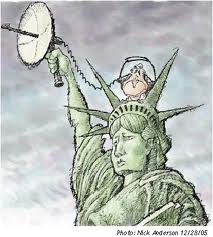
This outrageous proposal would mandate that all online communications services use technologies that would make it easier for the government to collect private communications and decode encrypted messages that Americans send. This includes communications sent using texting platforms, BlackBerries, social networking sites, and other “peer to peer” communications software such as Skype.
While the country tends to other issues, the administration and law enforcement officials are seeking greater power to invade your privacy. We must take a stand against this proposal before it even makes its way to Congress.
Sign the ACLU’s petition to Attorney General Holder: Rein in FBI surveillance power.
So, what’s wrong with this proposal?
- Instead of securing our online communications and protecting our privacy, the government wants to pave the road for more out-of-control government spying. Concern over cyber security is at an all-time high. This proposal will create even more security risks by mandating that our communications have a ‘backdoor’ for government use — making our online interactions even more vulnerable and easier to collect.
- It’s not only the government that will go through this ‘door.’ In 2004, hackers took advantage of a similar law in Greece to hack into mobile communications systems and listen to the calls of high government officials — including the Prime Minister.2
- The government has yet to make the case that encryption is actually hindering their investigations. According to the most recent Wiretap Report3, law enforcement encountered only a single encrypted call last year, and they were able to learn the contents of that call in spite of the encryption.
Take a stand against this proposal. Sign the ACLU’s petition to Attorney General Holder: Rein in FBI surveillance power.
There is no justification for this move to put our personal online communications within easy reach of the government’s prying eyes.
We must send a strong and clear message to the Obama administration today: Do not spy on me.
Heartwell Proposes Grand Rapids Privatize Water Services
It was reported today in the Grand Rapids Press that Grand Rapids Mayor George Heartwell is proposing to both consolidate and privatize some of the current services the city provides.

Press reporter Jim Harger states that there are some “low-hanging fruit” and some “big ticket” items that the Mayor is proposing for either consolidation or privatization. Among those identified for possible privatization in the story are, “city’s emergency medical services currently handled by city firefighters; merging motor fleet operations with Kent County and neighboring cities; and privatizing the city’s water and sewer systems.”
The article only sources the Mayor who said he expects resistance from within the city government since it will mean some employees will lose their jobs.
On the matter of privatizing the water and sewage services, Heartwell admitted that he has been in contact with private companies, but none have made any offers.
We should not be surprised that this is the direction that Mayor Heartwell wants to take the city, since consolidation and privatization were the main themes of his State of the City address in January. On the surface in it seems quite understandable that this is a direction the Mayor wants to go in considering the budget deficit they are facing. However, what is really happening with Grand Rapids and communities all across the country is what has been happening for decades around the world – it’s called Structural Adjustment.
Structural Adjustment (SAPs) is a policy that the IMF and the World Bank impose on countries seeking loans, a policy that the US has endorsed. These SAPs advocate for cutting government spending, privatizing public services and opening up markets to outside entities, most often corporations.
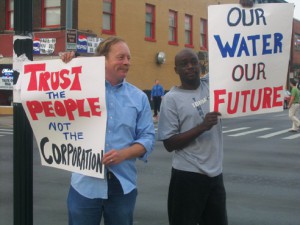
If Grand Rapids were to go the route of privatizing both the water and sewage services, what might be some possible outcomes of that decision?
The organization Food & Water Watch has been looking at this issue for years and provides us with important documentation that sheds light on what we can expect if Grand Rapids were to privatize its water and sewage services.
In one report entitled “Money Down the Drain,” the key findings state that:
- Private utilities charge higher rates than municipalities
- Privatization does not increase the efficiency of water and sewage systems
- Privatization has many hidden expenses
- Water corporations drive up costs and shoot down service quality
- The public can do it better and cheaper
- Public funding for water must go to only public utilities
Another report, “Faulty Pipes: Why Public Funding, Not Privatization – Is the Answer for US Water Systems,” provides numerous examples and case studies of when privatization has been disastrous for municipalities. One example they look at is the city of Milwaukee, which is comparable in size to Grand Rapids.
In 1998, they privatized their water services and gave the contract over to the multinational water giant Suez. Shortly after that rates went up, services diminished and polluted water was being piped into Lake Michigan. Food and Water Watch has dozens of case studies, which show that municipal water privatization does not work.
Unfortunately for readers of the Grand Rapids Press, the reporter did not explore the potential consequences of privatization and just reported that the Mayor of Grand Rapids was considering taking these steps.
We cannot let something as fundamental to our lives as access to clean water, be placed in the hands of private corporations. We all should send a message to the city that this is unacceptable and organize ourselves in order to fight this proposed privatization.
Peace Studies Conference held at GRCC
The Second Annual Peace Studies Conference is being held at Grand Rapids Community College this week and even though GRIID is not able to attend the whole conference, it will be writing about some of the presentations.
The first session we were able to attend was an afternoon session on Tuesday entitled, Dealing with the Causes and Ramifications of Violence: Peacebuilding Techniques. There were two presenters, Julie Keil from Saginaw Valley State University and Carole McKenna from Ferris State University.
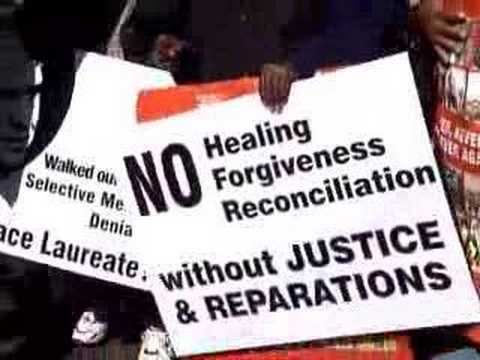
Julie Keil spoke first on the topic of Truth and Reconciliation Commissions (TRC), a process where countries that have experienced of form of civil war or serious political violence has come to terms with that dark period of their country.
Julie said she has spent time and worked on post civil war work in Sierra Leon. The question she posed to the audience and was the framework for her research is whether or not countries that went through a TRC process has lead to democracy and the growth of civil society?
She used Freedom House as a source for definition for democracy, political rights, civil liberties, civil society, although the definitions were very limited for each of these categories. It should also be noted that Freedom House while having more progressive origins, has in the past 30 years become more an arm of US policy, often reflecting State Department positions on international conflict.
Ms. Keil then gave reasons why it is important to have Truth and Reconciliation Commissions. First, a TRC can provide a record of the truth and to provide a forum to discuss the abuses that is not in a punitive nature, meaning people cannot be punished for the information disclosed. In addition, TRCs can provide some sort of justice/reparations for victims of political violence, to provide for closure, to expose the wrongdoing of previous regimes and to provide legitimacy for the new regime.
She then stated that often perpetrators are not brought to justice, There are numerous reasons why justice often does not occur, such as it is very costly to proceed through legal means. Secondly, trials to get to the truth of events, only to focus on the guilt or innocence of individuals. Another reason is that courts can provide an opportunity for acquittals. The speaker cited Nuremburg as an example where some war crimes got off.
The rest of the time she spent looking at whether or not countries that had Truth and reconciliation Commissions have an improvement in democracy. Her data showed that in 27% of the cases there was an increase of democracy, as defined by Freedom House. Countries with the biggest increases were Ghana and Panama. The same percentage of countries had increases in civil rights, with South Africa and Chile being countries with major improvements.
Her conclusions were that there is a positive outcome of Truth and Reconciliation Commissions in countries that go through that process. The greatest improvements in broad democratic terms were mostly seen in Latin America, while the worst area was sub Saharan Africa.
The Culture of US Militarism
The second speaker was Dr. Carole McKenna, who presented on what she called Canadian and American Culture of Militarism. She is also author of the book Militarism: The Power Arrangements between Soldiers, Wives, and the Military Industrial Service Complex.

Dr. McKenna wanted to look at how military families and wives coped not just with the risks that their spouses & children were taking in war, but how they negotiated the realities of war while living in America.
Dr. McKenna admitted that she had 3 sons in the US Army, but she also protested the US war in Iraq. She looked at the US military policy known as Stop Loss, which is where the military kept soldiers in active duty for longer periods of time than in previous wars.
During one interview with a woman married to a soldier she mentioned graffiti that was spray painted on cliffs near the military housing that said “Iraq made our husbands mean.”
Using the graffiti as a jumping off point, she then discussed the Thomas Theorem, which reflects the idea that people will believe whatever they want to believe in order to cope. “Military families,” she said, “had to believe in the military missions that their families were involved in. This was particularly so during military funerals where the message that was required was to stay positive.”
She then discussed the relationship between our culture of consumerism and pampering, which Dr McKenna said are both necessary in order for military wives to cope. Some of the wives would work on self-beautification through teeth whitening or physical exercise. One other technique was for people to attend church or get into therapy. Overwhelmingly, those who admitted they were depressed, while in therapy, were often prescribed drugs. So the emphasis is that instead of looking at the reality of war, military families are encouraged to remain positive and not question what is being done in our name.
She concluded her comments by discussing the need for a peace process that has an economy that serves people and protects eco-systems. Her analysis of our economic system was certainly anti-capitalist, although she never named it as such. There is a clear need to change our economic system, according to Dr. McKenna, in order to avoid perpetual war. “Not until we change our economic system can we address this country’s involvement in war.”
Historic First in Nation’s Fast Food Industry, 200 Jimmy Johns Workers to Vote in NLRB Union Election on October 22
(The Grand Rapids chapter of the IWW is working on an organizing campaign with Jimmy John’s workers locally. Anyone interested can contact the IWW. This Media Release is re-posted from ZNet.)
FOR IMMEDIATE RELEASE:

Jimmy Johns Workers Union (Industrial Workers of the World)
Contact: Mike Wilkow, 612-807-6633
September 28, 2010
MINNEAPOLIS– The National Labor Relations Board confirmed today that it will conduct a union election for 200 workers at ten Minneapolis-area Jimmy John’s on October 22, an historic first in the nation’s almost entirely non-union fast food industry. The secret ballot union election could be a turning point for labor at a time of deepening poverty for millions of Americans affected by the recession, many of whom are employed in low-wage service sector jobs.
“People who thought of themselves as middle class or upwardly-mobile two years ago are now making minimum wage at Jimmy John’s, with no real prospects for moving up. If these are the kinds of jobs that American workers will be stuck with, then we are going to make them quality jobs for working families,” said Mike Wilkow, a union member at Jimmy Johns.
If a majority of workers vote in favor of unionization, the company will be legally bound to negotiate with a bargaining team elected by its employees.
The unprecedented fast food union campaign at Jimmy John’s comes at a time of deepening economic misery for US workers. According to a recent report by the US Census Bureau, a record-breaking 43.6 million Americans– 1 in 7 people– are living in poverty. The Bureau of Labor Statistics estimates the unemployment rate at 9.6%, with 14.9 million people out of work and uncounted millions more too discouraged to look for work. Layoffs and outsourcing have decimated higher-paid jobs, particularly strongholds of unionization such as manufacturing and construction, forcing many workers to seek employment in low-wage areas of the economy once reserved for teenagers and students. For many, it feels like food service and retail are the only jobs left.
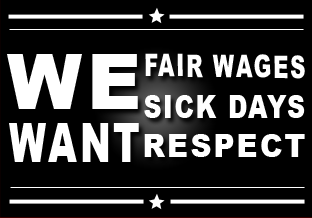
While many workers are forced to seek employment in food service, industry wages and working conditions are widely regarded as substandard; in 2009, the median wage in the fast food industry was $8.28/hr and as of July 2010, the average workweek in fast food was only 24.3 hours. The median annual income for fast food workers is $10,462, or $871 per month. This is less than half the federal poverty line of $21,954 for a family of four, and below the federal poverty line of $ 10,830 for an individual. Jimmy John’s is below industry standards, paying most workers the federal minimum wage of $7.25/hr, scheduling most workers less than 20 hours/week, and offering no benefits.
Unionization has clear allure to poverty-wage food service workers. According to figures released by the Bureau of National Affairs, union members in the food service industry earned on average $2.36 more per hour, a 32% difference, than non-union workers in the same industry in 2009.
Despite the appeal of higher wages and better benefits, union density in the fast food industry is stuck at only 1.8%, far below the national average of 12.3%. Unionization efforts have been stymied by stiff employer resistance and professional “union avoidance” firms that specialize in thwarting NLRB election campaigns. 75% of employers avail themselves of third-party anti-union consultants when their employees petition for an NLRB election, according to a recent study by noted Cornell University labor scholar Kate Bronfenbrenner. The study demonstrates that many employers embark on union-busting campaigns consisting of threats, intimidation, firings, interrogation, and even spying. Due largely to these factors, only 45% of NLRB elections conducted from 1999-2003 resulted in a union victory.
Success for the union at Jimmy John’s could be a major breakthrough for labor in an industry known for low union density and deplorable working conditions. Jimmy John’s workers say they possess the resolve to see through what they acknowledge will be a tough fight. Jaim’ee Bolte, a member of the union, says, “People say fast food is unorganizable. We say failure is not an option. Service industry jobs are the future and our future needs to have quality jobs for working families with living wages, affordable healthcare, paid time off, consistent hours, and basic respect. It’s time for change in America, we hope this will be a turning point for all workers.”
The Jimmy Johns Workers Union, open to employees at the company nationwide, is affiliated with the Industrial Workers of the World labor union. Gaining prominence in recent years for organizing Starbucks workers, the IWW is a global union founded over a century ago for all working people.
Lies in the Name of the Free Market
(This article is re-posted from PRWatch.org)
A powerful advocacy organization has made a big impact on this midterm election cycle in states across the country. Americans for Job Security (AJS) has spent millions of dollars on attack ads targeting candidates they view as anti-free market.

While this group believes in the free exchange of capital, they are vehemently opposed to the free exchange of information, at least when it comes to their sponsors. AJS has routinely denied requests for a list of donors. As a 501(c)(6), they do not have to reveal this information. But the IRS has stated that any 501(c)(6) group whose “primary purpose” is political activity, must name their donors.
The Washington Post reports that AJS spends the vast majority of its budget on television and radio ads before elections. Groups such as Public Citizen have complained to the IRS about AJS’ abuse of its tax-exempt status. But the ambiguous nature of the IRS’ “primary purpose” standard has allowed AJS to continue spewing attack ads every election cycle.
Beyond the Pale
In addition to being shadowy and secretive, AJS’ ads are often misleading, completely untrue, and even offensive. While attacking Congressman Zack Space, AJS stated that he voted for “job-killing energy taxes.” AJS is referring to Space’s vote in favor of a cap-and-trade system designed to slow global warming. While it is arguable that a cap-and-trade system will cause businesses to pass costs on to consumers, it cannot be equated to an energy tax.
AJS also accused former Colorado Lieutenant Governor and Republican Senate candidate Jane Norton of growing “the state bureaucracy by $43 million in just 3 years.” While the state budget did grow by this amount during Norton’s time in office, it was not because of her actions. Spending grew in Colorado because of an increase in federal funds, not because of any increases in taxes.
In a very disturbing case, AJS disseminated a television ad geared toward defeating Arkansas Senate candidate Bill Halter that has generated charges of racism. The TV spot depicts numerous Indians thanking Halter for outsourcing jobs to India. The ad’s detractors have argued that the ad promotes stereotypes. In addition to being racist, the ad is not true. The Securities and Exchange Commission reported that while WebMethods did open a center in India while Halter was on the board, it had no effect on the loss of jobs in America.
Americans for Job Security joins all the other front groups springing up in the wake of the U.S. Supreme Court’s ruling in Citizens United, which gave corporations the right to spend unlimited funds to influence elections. These groups allow corporations to do just that while remaining anonymous. This kind of election hanky-panky makes SourceWatch an even more important resource for voters seeking the truth about suspicious groups with “feel good” names that suddenly appear and run over-the-top attack ads against candidates.
 Grand Rapids Institute for Information Democracy