Our Muslim neighbors live in “Fear and Trembling”
 Wednesday night, about 160 folks from Christian, Jewish and Muslim faith communities met for dialogue at St. Andrew’s Cathedral via the Catholic Information Center’s program, Fear and Trembling: An Interfaith Conversation about Anti-Muslim Sentiment in Western Michigan.
The purpose of the dialogue was to raise awareness about the true practices of Islam and the misunderstanding and persecution that local Muslims face. Fr John Geaney CSP opened the dialogue by asking, “Is the United States Islamaphobic? I read the Time Magazine article and thought ‘It kinda looks like that to me.’ We have the situation developing in New York with the Muslims building a community center two blocks away from Ground Zero, the media hypes it, and the country goes upside down. A Christian decides to burn a Qur’an in Florida, the media hypes it, and America goes upside down. We are trying to get a better grip on what is going on in our country. What is the situation that Muslims face each day in their lives?”
In between segments of the PBS documentary, Muhammad: Legacy of a Prophet, people of different faiths at each table asked questions and shared information about what they knew about Islam. Many were surprised by Islam’s reverence for life, call to peace and demand for charity to those in need. The video excerpts started with Kevin James, a New York City Muslim and September 11 responder who became a firefighter because his Islamic faith deems saving one life as important as saving humanity.
Other clips included a Muslim government official who works hard at his job because his Islamic faith requires him to take action for justice; an Imam who operates a soup kitchen serving mainly non-Muslims because his Islamic faith requires him to care for those in need; and a Muslim nurse practicing in Dearborn, Michigan. These and other clips can be viewed online at www.groundzerodialogues.org.
People also discovered the similarities between Islam and Christianity. Both share the same Old Testament. And while Muslims do not believe that Jesus is God, they do hold him in high esteem as one of their prophets.
The video also answered another point of contention raised by those who fear our Muslim neighbors, “If Islam isn’t about terrorism, why aren’t any Muslims standing up against it?” The answer is that they are. The problem is that the media does not give them a platform. While everyone in West Michigan knows about the Qur’an burner and the supposed “Ground Zero Mosque,” few will hear about last night’s event. One reporter from the Grand Rapids Press was in attendance (though it is not known if she was on assignment) but no other media bothered to show up. That in spite of the fact that news releases were sent out well in advance of the event.
Perhaps that’s because good Muslims don’t make for sensational headlines. Or perhaps the motivations run deeper. After all, if we all decide we’re part of one human family where all deserve life, liberty and happiness, who will be left to fight the wars and pile up the profits for those in power?
For those reasons, providing spaces for face-to-face dialogue between Christians, Jews and Muslims to dialogue is a very admirable goal. Only as “we the people” understand the issues and take action to learn about each other will we be motivated to demand an end the madness in the Middle East and beyond.
Local organizations sponsoring the event included the Catholic Information Center, Bosnian Cultural Center, ICC Behar, Grand Rapids Area Center for Ecumenism (GRACE), Interfaith Dialogue Association, Islamic Center and Mosque of Grand Rapids and the Islamic Mosque and Religious Institute.
Dollar Stores: Top Link in the Sweatshop Chain
(This article is re-posted from CorpWatch.)

Abel Lopez was a busy man. The El Paso resident’s job with Family Dollar, Inc. averaged 60-80 hours a week. A former graphic designer and ad man from neighboring Ciudad Juarez, Mexico, Lopez spent his days unloading trucks, processing freight, scouring toilets, running cash registers, cleaning, shelving, changing prices, doing inventory, and covering for other employees. As a bonus, he was even held up by armed robbers.
Like others at Family Dollar who wind up spending most of their time doing grunt work, Lopez bore the title of manager. He contends that the company routinely classifies regular workers as managers in order to categorize them as exempt employees and in doing so ensure they are not subject to the overtime provisions of the 1938 Fair Labor Standards Act (FLSA). (See box.)
Family Dollar is one of a growing group of chain-store corporations that cater to America’s poor by selling cheap goods, many imported from sweatshops in low-wage countries including China and Mexico.
Critics of the two largest dollar store chains, Family Dollar and Dollar General, contend that the companies extract super-profits from the uncompensated labor of overworked store “managers” and other employees.
“It’s corporate theft,” asserted Alabama attorney Lance Gould, whose firm represents some of [Dollar General’s] managers. “All these dollar stores, their company structure is the same. Their largest controllable expense is their labor budget.”
Last April, after more than seven years on the job, Abel Lopez was fired. Family Dollar blamed him – unjustly, the worker says — for bad upkeep of the store. Recently, he and a small group of supporters conducted roving pickets at different Family Dollar stores in El Paso. One day he stood outside a store wearing a t-shirt that read: “Family Dollar: Exploited Manager,” while an El Paso police officer warned the group not to leaflet on company premises.
“We’re being misclassified as store managers to avoid paying overtime,” Lopez charged. “I think the profit is made out of the hours they don’t pay the managers. …They give you a payroll, and actually most of the time the payroll doesn’t cover you,” Lopez said, adding that managers were forced to do the jobs of workers they could not afford to staff. Stout and straight-talking, Lopez resumed picketing as the mid-day traffic picked up and the hot sun blazed the pavement of the border city.

Pennies on the Dollar
Pay for Family Dollar managers like Lopez starts off around $550 per week but the long hours required result in some employees barely earning above minimum wage, Lopez says. At the opposite end of the company’s income spectrum, Family Dollar CEO Howard Levine enjoyed an annual compensation package of $5.38 million in 2010–part of a five-year bundle valued at $14 million, according to Forbes. Based in North Carolina, Family Dollar began in 1959 with one store in Charlotte. More than 40 years later, the chain has more than 6,700 stores in 44 states with 45,000 employees. Earning nearly $7.9 billion in revenues for fiscal year 2010, Family Dollar recorded nine consecutive quarters of double-digit earnings per share growth through the summer of this year. The chain “significantly expanded operating margins and improved inventory productivity” while continuing to return “excess cash” to its shareholders, according to a company statement.
For the first three quarters of fiscal year 2010, Family Dollar paid out approximately $58 million in dividends. While Family Dollar raked in profits, Lopez scrambled to make ends meet. With mortgage payments, as well as a wife and three young daughters to support, he did what so many other workers are forced to do by the Great Recession: dip into his 401(K)3.
As the months dragged on, Lopez waged a battle on two fronts: out on the streets and inside state unemployment offices, there he eventually prevailed against Family Dollar’s initial rejection of his claim, he said. Abel Lopez is not the first company manager to challenge the Tennessee-based retailer. In 2006, more than 1,400 former and current company managers won an Alabama lawsuit alleging FLSA overtime violations and seeking compensation. Agreeing with the plaintiffs, a federal jury ordered the company to pay $35.6 million. Family Dollar appealed.
Family Dollar chairman and CEO Howard Levine praised the hard work of his employees but insisted they were exempt from laws requiring overtime pay. “We believe we are correct in classifying our store managers as salaried managers, and we intend to continue to fight for what we believe is right,” Levine said in a statement.
In 2008, the 11th Circuit Court of Appeals disagreed and upheld the judgment against Family Dollar. The Fortune 500 company did not respond to several requests for comment on the current complaints against the company.
The Inflation of Dollar Stores
Rising from the U.S. Bible Belt, the dollar store trend began back in the 1950s. Today, three Fortune 500 companies compete for the title of Old King Buck–Dollar General, Family Dollar, and Dollar Tree. The corporate chains appeal to legions of economically-stressed shoppers, with Dollar General even sponsoring an advice-column blog authored by “Ms. Cheap.”
Unlike many retailers, the dollar store industry is thriving in these hard economic times. At the top of the heap is Dollar General. Beginning as a family business in Springfield, Kentucky, it expanded into a huge company that was eventually taken over in 2007 by affiliates of corporate raiders KKR and Goldman Sachs.
Publicly traded since 2009, Dollar General counts more than 9,000 stores, 72,000 employees and sales in the neighborhood of $11.8 billion. Like some Family Dollar stores, Dollar General accepts food stamps and goes beyond the buck-an-item model by also featuring grocery aisles. While checking the weekly coupon stand, customers can browse tabloids with headlines like “Michael Jackson Seen Alive.”
Dollar General faces the same overtime issues as Family Dollar. The “majority of [mangers’] work is the same as hourly employees,” said Gould, an attorney for Beasley-Allen, the Alabama-based law firm that since 2004 has handled thousands of employee complaints against Dollar General. Unlike actual executives, Gould charged, Dollar General’s managers must defer to district bosses for significant decisions. The approximately 750 cases pending in various U.S. courts make overtime lawsuits filed by managers of retail outlets “one of the fastest-growing areas of litigation,” said Gould.
A spokesperson for Dollar General said the company does not comment on litigation. True to its name, Dollar Tree does indeed offer mostly very cheap goods. As the night of witches and goblins approached, El Paso shoppers were greeted with a gaudy “Halloween Headquarters” stocked with $1 candy bags, “boneyard” skulls, black crows and other apparitions of faux terror.
For a mere buck, borderland children can play at killing with toy assault rifles and grenades, the make-believe images of real-life weapons used every day just across the river in violence-torn Ciudad Juarez, Mexico. They can also pretend to ply the tools of the trade of returning Iraq and Afghanistan war veterans stationed at El Paso’s Fort Bliss in ever increasing numbers. Boasting more than 3,900 stores in 48 states, Dollar Tree traces its evolution to the Ben Franklin variety store in Virginia. Changing into a publicly-traded company decades later, Dollar Tree has recently busied itself buying up similar retailers in different states. During the second quarter of 2010, Dollar Tree opened 56 stores and closed only five.
Between Wal-Mart and a Garage Sale
“Dollars may not grow on trees but outlets of Dollar Tree’s stores seem to,” noted Hoover’s. “Customers are responding in record numbers to our outstanding values and fun shopping experience,” said president and CEO Bob Sasser, who presumably also finds fun in a four-year compensation package Forbes estimated at $9.42 million.
Filled with the products of the world’s low-wage manufacturing centers, the dollar store industry occupies an economic niche somewhere below Wal-Mart and K-Mart, and somewhat above the weekend garage sale. They fill store fronts in moribund cities and strip malls around the country, as in economically depressed Barre, VT, where a Family Dollar displaying cheap items in bright colors nestles next to a nail emporium, a Chinese restaurant, a basic Radio Shack, and a long-empty storefront.
Dollar stores are also fixtures of immigrant communities. In New Mexico, west Texas and elsewhere it is common to find them near indoor flea markets, pay-day lenders and other manifestations of what Eric Murillo of the El Paso-based Retail Workers Rights Committee (RWRC) called the brave new world of the “predatory economy”.
Organizing for Fair Treatment
Organized this year to support Abel Lopez and other workers, the Retail Workers Rights Committee is laying the groundwork for a fresh burst of labor activism in an industry that is notoriously anti-union. The new group demands a halt to the misclassification of store managers, an end to threats and intimidation of employees, and an increase in workplace security and no-retaliation pledges.
Founder of El Paso’s Border Workers Association, Guillermo Glenn, noted that the Family Dollar battle has special resonance in a city where retail jobs are one of the few options left. After NAFTA and other free trade pacts were implemented, nearly 40,000 manufacturing jobs were demolished in what Glenn termed a Katrina-like economic storm. Unpaid overtime is a major problem in the retail and fast food industries of his city, Glenn maintained. Worse yet, he said, is weak Texas labor law that gives employers the power to fire even “if they don’t like your shoes.”
Ironically, in El Paso’s shops now, gadgets and gizmos made in China and other low-wage havens compete with cheaply produced Mexican goods. If workers’ grievances are as severe as they appear to be, it poses the question of whether retail stores are the sweatshops at the top of the sweatshop chain. Added Glenn: “I see the movement of the retail workers as very important because there is [so much] sub-employment in this area-part-timers and people that don’t work sufficient hours.”
Backed by allies from different social movements, the RWRC is planning an October 16th national day of action against Family Dollar in cities such as El Paso and San Antonio. Organizer Eric Murillo said Family Dollar employees across the country were in the same boat. “We feel if we keep this pressure up, we’ll get other Family Dollar workers and perhaps other retail workers involved in this struggle as well,” Murillo said.

For anyone following the news—what little of it there is to be had in the local mainstream media—it should come as no surprise that Grand Rapids is in a serious budget crisis. The City has so many problems in meeting its obligations, particularly where employee salaries, benefits, and pensions are concerned, that it is looking for any possible way to cut costs. Last week, Mayor George Heartwell announced that one of the options that the City was exploring was the privatization of the water/sewer system. GRIID covered this story and wrote about the disastrous effects that this type of decision has had on other cities that have tried it.
This week, GRIID was in touch with Commissioner Rosalynn Bliss for additional information. We wanted to know how extensive discussions have been about removing the water/sewage service from City management with its Commission oversight, and putting it in the hands of private contractors. Bliss described the water/sewer system discussion as “incredibly preliminary.” She stated that no decision “would be made without ample research, information, cost-benefit analysis, and community input.”
That being said, Bliss reported that at the last Commission meeting, Mayor Heartwell “asked the commission to share their ideas on what services could potentially be contracted out and one of the services is some of the operations of the sanitary sewer and water system (not selling the assets, but contracting out for some of the services).”
Bliss went on to say that the Commission had originally had a discussion about this in 2009 “when the water department requested another increase in water and sewer rates and the commission started asking about the details to the rate increase request.” At that time, Bliss said, the question arose about the possibility of keeping rates down if some services were contracted out of City hands.
What’s the problem with the current City system and why are the rates increasing? According to Manager Joellen Thompson of the City Water/Sewer Department, a large part of the problem is usage. She states that Grand Rapids has lost several major water users from the commercial/industrial sector. Fewer people using less water means that everyone pays more. This, by the way, is not good news for people who are attempting to act responsibly by conserving water use.

Another problem is increased costs. This, according to Thompson, includes higher electricity and chemical treatment costs. But Grand Rapids’ water system is also aging, and infrastructure costs are rising faster than they were in the past as a result.
The Water Department laid off 13 percent of its workforce in 2009. There were other City employee layoffs as well. But none of this could offset the tidal wave of costs that the City faces, with its largest financial obligation being its salaries, benefits, and pensions. Health care benefits for employees continue through retirement with the same plans intact, and the average retired City worker gets a pension of $1,900 a month. Police officers receive an average pension amount of $2,415 a month.
Most of the City of Grand Rapids employees are represented by unions, but not all. The “non-rep” employees—which, according to one report by WMMT are mainly “appointed officials, non-represented executive class and district court management employees,” have already received a 10 percent cut in compensation, primarily from increasing health care premiums and reducing pension contributions and the so-called “life allowance.” For details about these cuts, click here.
But if City services are to be preserved and the water system remain safely out of the hands of privateers, it’s crucial that all human resources costs be reduced this year. Bliss acknowledged that to GRIID, saying, “We are currently in negotiations with all of the City’s 13 unions and are seeking concessions.”
Whether or not the unions will make any concessions is another matter. As an example, the Grand Rapids Police Officers Association seems aggrieved about “dramatic concessions” it has already accepted and feels the public is not giving them credit for what they do. The union states the Police Department has already conceded to a $119.56 per month employee contribution payment for health insurance, and a “100 percent increase” in co-pays for office visits. The police union also notes that no one on the police force received a pay increase from 2006 through 2008.
It’s possible that the public doesn’t give the police credit for its sacrifices in this area because they don’t seem like sacrifices to most working people in Grand Rapids. Many folks in Grand Rapids have not had a pay raise for five years or longer. Those who are lucky enough to still have health care insurance pay an average of 21 percent of their salary for employee contributions, according to a recent Kaiser Foundation report. The Grand Rapids police officers pay less than half that—10 percent. In addition, the police department’s out-of-pocket deductible is an unheard-of $50. By comparison, a current policy from one area furniture manufacturer has set its out-of-pocket deductible at $1,500 per employee.
As for co-pays, the police’s previous co-pays for doctors’ visits were $10, and are now $20. This would still seem like a bargain to most people with insurance who pay between $30 to $50 for a doctor’s visit, depending on the type of doctor (primary care or specialist) seen.
In addition, under their current contract, the Police Department personnel receive a minimum of two weeks’ paid vacation, an additional minimum of 12 sick days per year, 12 paid holidays a year, and “longevity pay” bonuses starting at their 5th year of employment. Plainclothes police officers receive almost $1,000 a year as a clothing allowance to pay for new wardrobe items. It would be difficult to find Grand Rapids citizens, a quarter of whom are now living below the poverty line, who would see minor changes to these benefits as “dramatic concessions.” Most citizens of Grand Rapids can only dream of such extensive benefits and health insurance this affordable.
If the police union is any benchmark, meaningful cuts to the City’s largest financial obligation seem to be tentative at best. While it’s crucial to have strong union representation and to safeguard employee pay and hours, in the case of City employees this has to be balanced against the need to allocate taxes for services to the community at large.
According to Rosalynn Bliss, currently everything is on the table, to be explored and researched, while the City waits to conclude its 13 different union negotiations. She told GRIID, “I can assure you that I would never support any recommendation that would negatively impact our water service or add additional cost/further increase residents’ water and sewer rates.”
While Bliss has a solid record of supporting citizens’ concerns and interests, the question remains if the Mayor, City Manager, and other Commissioners might still be tempted by the idea of making the water/sewer system a profit center. Certainly budget cutting at the City is more complex than this writer ever anticipated. But it’s frightening to think that an easy way out of the budget shortfall might end up putting Grand Rapids citizens at risk of higher and higher payments to a utility being run as a profit center by a private company.
Enbridge Investors Told Pipelines Feed Fossil Fuel Addictions
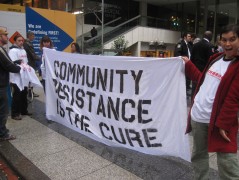
(This article is re-posted from Common Dreams and deals with the people confronting the energy company Enbridge, which was responsible for a major oil disaster in Michigan earlier this year.)
As Enbridge holds its investors meeting in Toronto’s financial district, Environmental Justice Toronto sent them a message about their dirty investments in fossil fuels. Grassroots organizers sent up a banner attached to helium balloons that read “Enbridge Invests in Oil Addiction.” The banner was visible through the glass front of the building, outside of which activists held up another banner that read, “Community Resistance is the Cure.”
A message held up with helium balloons, tells investors that their money is funding more than pipelines.
“When it comes to the tar sands, Enbridge is Canada’s pusher, pumping dirty oil through unreliable pipelines which are bound to spill,” said Taylor Flook, an organizer with Environmental Justice Toronto. “Averaging at 61 leaks per year for the past 10 years, Enbridge is celebrating over 600 leaks and breaks-and its investors need to know that. Enbridge pipelines are too risky.”

Enbridge is asking investors to support the expansion of tar sands oil pipelines across North America. Recent accidents and breaks, including one of the largest spills in US history when a pipeline leaked into the Kalamazoo River in Michigan this July, are showing that it is not a matter of “if” there is a spill, but “when” there is a spill.
Enbridge wants to expand its pipelines to send tar sands oil across the continent through projects like the Northern Gateway Pipeline. The pipeline stretches from the Tar Sands in Northern Alberta to Kitimat, B.C., polluting water and food sources and causing cancers and disease in local communities. The pipeline has been rejected by communities all along its route, including the Carriere Sekani Tribal Council and now the B.C. Union of Municipalities who voted to oppose the project last week.
Resistance to the expansion of the Enbridge and other tar sands pipelines is being lead by many First Nations communities along with climate justice activists. “Tar sands projects are one of the largest environmental injustices on earth and is Canada’s largest source of global warming pollution,” says Flook. “If Canada wants to uphold human rights and be a leader at the international stage, projects such as Enbridge pipelines cannot go through.”
Hundreds of people are mobilizing across Canada to stop the Gateway and other pipeline projects with demonstrations in Vancouver, Whistler, Kitimat, and Sarnia taking place over the past two weeks.
$5.5 million spent on TV ads in Michigan Governor’s race so far

According to new data from the Michigan Campaign Finance Network (MCFN) the Democrats and Republicans have spent a combined $5.5 million on political TV ads just in the Governor’s race.
The largest TV market in which gubernatorial ads were run was Detroit, where TV stations made $2.5 million alone from early August through October 3. The Grand Rapids TV market was the second largest recipient of campaign money for airtime with a little over $1.1 million being spent by the Democrats and Republicans.
However, MCFN also notes that the bulk of the money being spent for both Rick Snyder and Virg Bernero are coming from proxy sources and not the candidate campaigns directly.
For instance, Rick Snyder has not sent one dollar on paid TV ads since he won the August 3 Republican Primary. The $2.1 million spent on running pro-Snyder or anti-Bernero ads have come from the Republican Governor’s Association.
On the Democrat’s side the Bernero campaign has spent $995,000 on airing TV ads since August 3, but the bulk of ads supporting him have come from the Michigan Democratic State Central Committee, which has spent $2.4 million through October 3rd.

According to MCFN director Rich Robinson, the Republican sources have been less transparent in where their money is coming from and their relationship to the candidate Rick Snyder. Robinson believes that some of same video footage used by Snyder in the Primary race is being used by the Republican Governor’s Association in the current ads, but there is no evidence of this relationship in the TV station public files since the FCC doesn’t require that kind of disclosure.
Beyond the lack of transparency in how the money is being spent it raises other issue relevant to information and priorities. First, how do these amounts of money impact TV stations and their ability to do news coverage of these large political campaigns, especially when they are making thousands and in some cases, several million? As we have documented in previous gubernatorial races, local TV stations give limited coverage and what coverage they give is overwhelmingly poll driven or horse-race coverage.
Second, considering how communities across the state are faced with major budget deficits wouldn’t it be better for the political parties to just give the money to cities instead of private broadcasters? It of course will never happen, but it illustrates what the political parties are committed to. They are committed to their own parties and not the people. One could argue that political parties giving directly to cities/communities would be a way of buying votes, but at least the money would be used for basic city services and not end up in the hands of local TV station, all of which are owned by larger media conglomerates.
Birth as Power presents options and preparation for childbirth
 Birth as Power:
Options and Preparation for Organic Childbirth
9:30 – 11:30 a.m. Weds. Oct. 13 – Dec. 1
The Bloom Collective @ Steepletown Center
671 Davis NW (Corner of 5th & Davis)
Was a time when childbirth was the realm of women. Doctors didn’t deliver babies; mothers gave birth. The babies came when they were ready, working within their mothers’ bodies and the strongest muscle in the human body, male or female, the uterus.
When the industrial revolution and advances in the Western medical model collided within patriarchal society, the process—and power—of birth was taken away from women. Childbirth was moved from the home to the hospital. Science scoffed at the midwife and deified the OB-GYN. By mid-twentieth century, nearly every birth in America was in hospital, under the influence of heavy drugs and ensconced in unhealthy, disempowering rituals, i.e. interventions such as shaving of pubic hair, extreme episiotomy and forceps.
In the 70s, women revolted. They demanded natural births, the presence of partners during delivery and the absence of drugs and unnecessary interventions. But by the 90s, that movement was for the most part co-opted by pretty birthing suites, a sprinkling of female OB GYNs and certified nurse midwives and the epidural, probably the most overused and profitable drug prescribed in hospitals today.
In deference to a culture born of industrial revolution and growing into a techno-cracy, pregnant mothers are ultra-sounded, stress-tested, hooked up via electrodes and doptone. Birthing mothers struggle to understand the data, rather than listen with intuition to their soon-born child. And while no one can criticize the use of cutting edge medical science when a true emergency arises, its use as standard care for every birth diminishes not only the magic and mystery of the birthing process but also disrupts the very biochemical bonds of mother and child, leading the way to a host of potentially negative outcomes.
 Birth is power, the very power of life. Women experiencing birth on their own terms become empowered. A culture that takes away power from women giving birth disempowers all women, whether they choose motherhood or not.
The Bloom Collective is offering an eight week course, Birth as Power: Options and Preparation for Organic Childbirth beginning next Wednesday, October 13. Class participants will explore basic needs of pregnancy and birth such as nutrition, exercise, relaxation and the use of breath. They will explore common medical interventions and their results. They will envision how they would like their births to be and take steps to make their visions reality. Overall, the goal will be to empower women to take back their birth-rights, the right to give birth in strength and power while ensuring their babies have the healthiest possible transition from womb into world.
The class is open to all birthing women and their support persons as well as anyone, pregnant or not, who is interested in attending. The class is free. Donations accepted to cover the cost of materials and to help The Bloom pay its rent.
Bloom core member, Stelle, will facilitate the class. She taught Bradley Method childbirth classes for eight years, has coached several births and has five children, four birthed in hospital and one at home. If interested, contact her at stellemarie@gmail.com to let her know of your intent to participate .
Miles campaign goes after Amash on Michigan jobs issue
For the past 2 weeks now local TV stations have been running an ad paid for by the Pat Miles campaign that presents Republican candidate for Congress Justin Amash as sending jobs abroad.
Here is the commercial the Miles camp has been buying airtime for:
In some ways the Miles campaign has done it’s homework. It is true that Amash co-owns a factory in China that sells tools in the US, based on his personal financial disclosure.
The political ad also accuses Amash of voting against a bill in the Michigan legislature that “would hire Michigan workers first.” Amash did vote against SB 293 last year, but the language of the bill is a bit different than what the Miles campaign wants you to believe. A summary of the bill states:
“Under the bill, beginning July 1, 2009, when designating a renaissance zone, if all other considerations were equal, the State Administrative Board or the MSF would have to give preference to an applicant for renaissance zone status if the applicant agreed in writing to hire only Michigan residents or individuals who planned on becoming Michigan residents, or contract with businesses that agreed to hire only those people, to construct, renovate, rehabilitate, or improve a facility in the renaissance zone under the conditions described in Senate Bill 290 (S-1).”
While it certainly says that these businesses would have to “hire only Michigan residents or individuals who planned on becoming Michigan residents,” it also says that the “State Administrative Board would have to give preference” to an applicant who agreed to hire Michigan residents. Giving preference is not the same as requiring businesses to hire Michigan residents, so the claim from the Miles camp is a bit of a stretch here.

Clearly Amash is no defender of working people and keeping jobs in Michigan, but the Miles ad does not address much larger issues that have impacted jobs in Michigan.
First, to the issue of China and job loss, the US voted to include China in the WTO in 1999, under the Clinton administration. This designation really opened up the prospects of more US factories moving to China or the outsourcing of jobs.
Second, the other main factor in job loss to Michigan has been trade policies such as NAFTA and CAFTA. According to the data provided on the Public Citizen new Trade Data Center, Michigan lost 342,325 manufacturing jobs from 1993 – 2009 because of trade policies.
Unless trade policies are addressed supporting tax incentives for businesses to hire Michigan residents is not going to effectively counteract the impact that policies like NAFTA have had on Michigan.
In looking at Pat Miles campaign website he does, “Insist on fair and reciprocal trade agreements since West Michigan workers and products can compete with any in the world when there is a level playing field.” Unfortunately, this vague sentiment does not make any commitments to repealing trade policies such as NAFTA, which would take a strong stand in favor of Michigan workers.
AMID SOARING DEATHS, OBAMA AFFIRMS AFGHAN STRATEGY
(This article is re-posted from Common Dreams.)

US President Barack Obama has told lawmakers that no current changes are needed to his Afghanistan and Pakistan strategy, as US forces escalate operations against the Taliban and Al-Qaeda.
Obama delivered the verdict, which had previously been voiced by senior members of his national security staff, as he handed over his administration’s latest classified report on the conduct of the war mandated by Congress.
“We are continuing to implement the policy as described in December and do not believe further adjustments are required at this time,” Obama wrote in the assessment, delivered Monday.
“As the Congress continues its deliberations on the way ahead in Afghanistan and Pakistan, I want to continue to underscore our nation’s interests in the successful implementation of this policy.”
At the end of an exhaustive policy review in December, Obama announced plans to surge 30,000 troops into Afghanistan to seize the momentum in the long-running war but warned some soldiers would begin to withdraw by July 2011.
The president is expected to mount a fresh review of strategy on Afghanistan by the end of the year, but again, no major adjustments are expected.
The NATO-led strategy is designed to push Taliban insurgents out of major towns in the south and east while building up Afghan government security forces so that American troops can start withdrawing by July 2011.
Defense Secretary Robert Gates and top commanders say there are tentative signs of progress in Afghanistan, where nearly 150,000 US and allied troops are trying to turn the tide against a resilient Islamist insurgency.

The White House said late Monday that Obama held a 30-minute videoconference with Afghan President Hamid Karzai, discussing “a number of topics, including the strategic vision for long term U.S.-Afghan relations, the recent Afghan parliamentary elections, and regional relations.”
“The two leaders agreed that they should continue routine engagements to refine a common vision and to align our efforts to support President Karzai’s goal of completing transition to Afghan lead security responsibility by 2014,” the White House said.
Obama released his report Monday amid fresh evidence of an escalation of US activity in the lawless region between Pakistan and Afghanistan
A US drone strike on Monday killed eight militants, including German nationals in Pakistan near the Afghan border, local security officials said.
The attack came hours after Japan and Sweden joined Washington and London in issuing an alert warning of a “possible terrorist attack” by Al-Qaeda and affiliated groups against their citizens traveling in Europe.
Fresh bombings, shootings and violence meanwhile underscored the heavy toll on US and allied forces, as five NATO soldiers died Monday.
The new deaths took to 561 the number of foreign troops killed in the Afghan war so far in 2010, according to a tally by independent website icasualties.org, as the toll from the nine-year Taliban-led insurgency worsens.
This year’s toll is the highest on record since the war began in late 2001 with a US-led invasion toppling the Taliban regime after it refused to hand over Al-Qaeda leaders following the September 11 attacks.
Anti-War March this Saturday on the 9th anniversary of the US Occupation of Afghanistan

(The following information is based upon a Media Release sent out by the group Grand Rapids for Justice & Peace in Afghanistan.)
Grand Rapids for Justice and Peace in Afghanistan invites you to participate in a Count the Cost anti-war march for the 9th anniversary of the US occupation of Afghanistan.
We ask the question what has 9 year in Afghanistan meant from Grand Rapids? According to the National Priorities Project the amount of tax dollars that have left Grand Rapids to fund this war since October of 2001 is $177 million and counting. Our city has a serious budget deficit, our schools are underfunded, people’s homes are being foreclosed and we don’t have enough money to keep community pools open. At the same time we can spend billions of dollars on one of the longest wars in US history, with no end in sight.
The march will start at Noon on Saturday, October 9 in front of the now empty Central High School – 421 Fountain St. NE in Grand Rapids.
The march will focus on four main themes. First, there will be a speaker addressing how the US military recruits young people and how it disproportionately targets youth of color. Second, at the cemetery on Eastern/Fulton people will read the names of Afghan civilians and US soldiers who have been killed during this bloody occupation of Afghanistan.

Third, near the Baxter Community Center people will speak about the cost of the US war locally in terms of housing, lack of resources for basic social services and how this war affects women, children and families. The march will end up at MLK Park where people will be motivated by the words of Dr. Martin Luther King Jr and invited to be part of future actions and campaigns.
In addition, along the march route, which will take people through neighborhoods, people will be dropping off information flyers to people that addresses the issues that the march is bringing attention to.
The group organizing the event has both a Facebook page for the march itself and the group in general.
Grand Rapids for Justice & Peace in Afghanistan was instrumental in organizing the benefit concert last week for 2 organizations doing solidarity work in Afghanistan and they also organized the October 8 lecture by reporter Anand Gopal who just returned from another trip reporting on Afghanistan.
YWCA Vigil Honors Michigan Domestic Violence Victims
 Forty-seven. That’s the average number of people murdered by someone they love each year in Michigan. Experts estimate that the number is actually double. And, these numbers do not reflect the additional victims left behind—children, parents, other family members and friends.
On Friday October 1, YWCA West Central Michigan Domestic Violence Services and Safe Haven Ministries held a candlelight vigil to remember these victims of domestic violence. The event opened with a two-scene skit. Six women held signs up identifying their role: teacher, pastor, friend, employer and others. In scene one, as the woman playing the role of domestic violence victim approached them for help, each gave an excuse not to get involved and turned her back. Another woman, playing the role of abuser, then verbally attacked the victim, convincing her to come back to the relationship. In scene two, each person offered support to the victim, and encircled her. When the abuser returned, the victim was able to stand firm.
 “As a community, it’s important we surround people who are experiencing abuse and provide support so instead of feeling isolated and alone they have more safety and support,” explains Eileen McKeever, program director of YWCA Domestic Violence Crisis Services.
People often blame victims of domestic violence by asking, “Why does she (or sometime, he) stay in the relationship?” This skit aptly illustrated how victims are held in a web of abuse comprised of many strings: love, money, religion and family expectations as well as the isolation and destruction of self-esteem that their abusers impose upon on them. When families, friends, employers and spiritual advisors stand with the victim, these strings can be broken, one by one.
In conclusion, the names and brief stories of the 47 victims were read aloud. They included a senior in high school killed by her boyfriend; a 76-year-old wife with dementia; a pregnant 19 year-old; a police officer shot by her husband, also a police officer; a young mother and her four-year-old son; and three men. “The synopsis of newspaper articles giving the stories of the lives of the victims contained in this report does not convey the complicated experience of torment and violence victims experienced,” the skit’s narrator said. “These stories also cannot reveal to us all the ways victims protected their children, reached out to various systems for help, how long they were afraid, begged not to be hurt or screamed for help before their lives ended. These images help renew our determination to continue working toward a world free of domestic violence.”
The YWCA staffs a 24-Hour confidential crisis line for victims of domestic violence, 616.451.2744. They also offer free intervention, referrals and safety planning; free emergency shelter; counseling services; support groups; supervised parenting time and safe child exchange; and long-term housing and supportive services. For non-emergency information, call 616.459.4652 during business hours.
 Grand Rapids Institute for Information Democracy