Levin, Jobs and the Defense Industry

Just before the Christmas break Michigan Senator Carl Levin announced that the Senate had approved a Pentagon contract to build ships for the Navy that would create jobs in Michigan.
The statement by Senator Levin said that the contract was awarded to Marinette Marine, a company based in the eastern part of Wisconsin, along the Michigan border in the Upper Pennisula. Levin also stated, “The contract for Marinette Marine is expected to fund 500 direct jobs in Michigan, and support up to an additional 2,500 jobs in Michigan.”
Levin goes on to say that this new contract will be a boost to the economy in that part of Michigan and then ends that paragraph by saying, “It’s a win not just for our own workers, but for national security and the taxpayers.” Such claims are worth looking at.

First, no where in Levin’s announcement or the website of the company does it say what kind of wages the workers will make in these jobs, nor whether they are full time or part time jobs. However, the parent company of Marinette Marine, the Italian corporation Fincantieri, announced in a Press Release that the US government contract was worth $4 billion dollars. The Press Release also states that the contract involves the largest defense contractor in the US, Lockheed Martin and includes a quote from Lockheed’s CEO in the body of the media release.
What would be useful for taxpayers to know is how much of that $4 billion is for wages and how much will the corporation end up pocketing after expenses for the project, which involves the construction of 10 Littoral Combat Ships. It would also be a bit more transparent for the Senator to mention that the company based in Wisconsin in a subsidiary of an Italian corporation.
Second, Levin states that this contract is a win for taxpayers, but he fails to articulate how it is a benefit to taxpayers. There are numerous jobs that are paid for by taxpayers besides government jobs, but this still doesn’t explain how giving $4 billion of taxpayer’s money to a private company is a win for the taxpayers. It should also be noted that Marinette Marine also received $500,000 in state money to train current and new employees because of the contract to build the 10 naval ships, according to a Greenbay newspaper.

Lastly, Senator Levin makes the claim that these new Navy ships will be good for national security. Here Levin does provide some information when he states, “The ships are designed to operate close to the shore, with greater speed, stealth and maneuverability than vessels now in the fleet. They will have the capability to support troops ashore, to combat enemy surface vessels and submarines, and counter enemy mines.”
However, the question should be asked if the US military is currently in need of such naval capacity. Is the US military currently fighting wars that require such vessels? In the two major current US military campaigns in both Iraq and Afghanistan there is no evidence provided by the Senator that such ships would be used in the current wars. More importantly, even if the ships were to be used in such a capacity it does not explain how that is a benefit to national security. How is the US safer because of the occupations of both Iraq and Afghanistan? This burden of proof lies with the US government to provide evidence that supports such a claim.
It seems that the real winners in the contract are the companies within the defense industry, an industry that spends millions every year lobbying Congress in order to get multi-billion dollar contracts. The same industry has also contributed to Senator Levin over the years, with Lockheed Martin being in the top 20 of contributors.
New Memo Shows Fox News’ Unacceptable Level of Bias
(This news brief is re-posted from PRWatch.)

Media Matters uncovered another internal email sent out by Fox News‘ Washington, D.C. Managing Editor Bill Sammon which ordered Fox Network journalists to slant coverage of the climate change issue by “refrain[ing] from asserting that the planet has warmed (or cooled) in any given period without IMMEDIATELY pointing out such theories are based upon data that critics have called into question.”
The memo is inflammatory because the increase in global annual average temperatures over the last 50 years is a well-established fact. The National Climatic Data Center (part of the U.S. Department of Commerce) says “The warming trend that is apparent in all of the independent methods of calculating global temperature change is also confirmed by other independent observations, such as the melting of mountain glaciers on every continent, reductions in the extent of snow cover, earlier blooming of plants in spring, a shorter ice season on lakes and rivers, ocean heat content, reduced arctic sea ice, and rising sea levels.”
Media Matters also recently revealed an internal Fox News email in which Sammon ordered network journalists to stop using the phrase “public option” in favor of a term cooked up by prominent Republican pollster Frank Luntz, who was helping Republicans turn public opinion against health care reform.
Exposure of the two emails has led the Los Angeles Times to print a rare rebuke of another mainstream news organization in an editorial saying that Fox News needs to either “come clean” about the partisanship within its newsrooms, or “stop pretending to be an objective news source.”
What We Are Reading
Below is a list of books that we have read in recent weeks. The comments are not a review of the books, instead sort of an endorsement of ideas and investigations that can provide solid analysis and even inspiration in the struggle for change. All these books are available at The Bloom Collective, so check them out and stimulate your mind.

Floodlines: Community and Resistance from Katrina to the Jena Six, by Jordan Flaherty – Floodlines is a firsthand account of community, culture, and resistance in New Orleans. The book weaves together the stories of gay rappers, Mardi Gras Indians, Arab and Latino immigrants, public housing residents, and grassroots activists in the years before and after Katrina. From post-Katrina evacuee camps to torture testimony at Angola Prison to organizing with the family members of the Jena Six, Floodlines tells the stories behind the headlines from an unforgettable time and place in history. An excellent book that raises up racial justice work and community organizing.

What Matters? Economics for a Renewed Commonwealth, by Wendell Berry – Over the years, Wendell Berry has sought to understand and confront the financial structure of modern society and the impact of developing late capitalism on American culture. There is perhaps no more demanding or important critique available to contemporary citizens than Berry’s writings — just as there is no vocabulary more given to obfuscation than that of economics as practiced by professionals and academics. Berry has called upon us to return to the basics. He has traced how the clarity of our economic approach has eroded over time, as the financial asylum was overtaken by the inmates, and citizens were turned from consumers — entertained and distracted — to victims, threatened by a future of despair and disillusion. This collection of essays is an important contribution to creating a new economic model.

Agriculture and Food in Crisis: Conflict, Resistance and Renewal, by Fred Magdoff ad Brian Tokar – The failures of “free-market” capitalism are perhaps nowhere more evident than in the production and distribution of food. Although modern human societies have attained unprecedented levels of wealth, a significant amount of the world’s population continues to suffer from hunger or food insecurity on a daily basis. In Agriculture and Food in Crisis, Fred Magdoff and Brian Tokar have assembled an exceptional collection of scholars from around the world to explore this frightening long-term trend in food production. While approaching the issue from many angles, the contributors to this volume share a focus on investigating how agricultural production is shaped by a system that is oriented around the creation of profit above all else, with food as nothing but an afterthought.

The Empire Strikes Out: How Baseball Sold US Foreign Policy and Promoted the American Way Abroad, by Robert Elias – From the Civil War to George W. Bush and the Iraq War, we see baseball’s role in developing the American empire, first at home and then beyond our shores. And from Albert Spalding and baseball’s first World Tour to Bud Selig and the World Baseball Classic, we witness the globalization of America’s national pastime and baseball’s role in spreading the American dream. Besides describing baseball’s frequent and often surprising connections to America’s presence around the world, Elias assesses the effects of this relationship both on our foreign policies and on the sport itself and asks whether baseball can play a positive role or rather only reinforce America’s dominance around the globe. Like Franklin Foer in How Soccer Explains the World, Elias is driven by compelling stories, unusual events, and unique individuals. His seamless integration of original research and compelling analysis makes this a baseball book that’s about more than just sports.
Pete Hoekstra, the CIA and Torture
(This article by James Bovard is re-posted from CounterPunch.)
On December 21, the Central Intelligence Agency gave its Agency Seal Medal to Rep. Pete Hoekstra, the top Republican on the House Intelligence Committee. Hoekstra has labored almost ceaselessly to assure that the CIA can break federal laws with impunity.

CIA Director Leon Panetta announced at the ceremony for Hoekstra at CIA headquarters: “To honor your service, I want to present you with the agency Seal Medallion. You have been a strong voice for protecting the nation and we pay tribute to your service.” The official citation declared: “He worked to provide the Agency with the resources and support it needs to accomplish its mission.” Hoekstra responded: “I am honored and humbled to receive such recognition from the CIA.”
Hoekstra has been one of the most vigilant defenders of federal agencies that have ravaged Americans’ rights. As former CIA agent Ray McGovern reported, it was Hoekstra who “blocked any attempt to hold [National Security Agency chief Keith] Alexander accountable for his lie” in 2005 congressional testimony regarding the Bush administration’s massive illegal wiretaps of Americans. Hoekstra’s shining moment on the Intelligence Committee occurred when he proudly announced in 2006 that the U.S. military really did find weapons of mass destruction in Iraq. The main achievement of his press conference was to make Hoekstra a laughingstock.
When he was chairman of the House Intelligence Committee from 2004 to 2006, Hoekstra occasionally bemoaned the CIA’s misleading Congress. But when push came to shove, Hoekstra has worked to protect CIA torturers from prosecution.
In April 2009, Hoekstra warned that torture investigations could have a “chilling effect” on interrogators.
In May 2009, when House Speaker Nancy Pelosi accused the CIA of lying to Congress regarding torture, Hoekstra denounced her for becoming a “wrecking ball” for CIA morale. In August 2009, Hoekstra talked as if any consideration of Bush-era torture abuses would leave the nation vulnerable to another Al Qaeda attack: “Attorney General Holder should know that as he increases the focus on America’s past counterterrorism efforts, he is distracting from the CIA’s current counterterrorism efforts.”
In September 2009, after Holder signaled that he was going to pretend to seriously consider prosecuting CIA interrogation crimes, Hoekstra declaimed: “The political witch hunt and endless investigations against the CIA being conducted by partisan ideologues need to stop.”
This past February, Hoekstra led efforts to successfully defeat the proposed “Cruel, Inhuman, and Degrading Interrogations Prohibition Act of 2010.” The bill would have made clear that CIA employees can be prosecuted if they use beatings, electric shocks, or attack dogs to interrogate detainees. Hoekstra denounced as “shameful” the effort by some Democrats’ effort to “target those we ask to serve in harm’s way.”
On October 31, when the Republicans were poised to recapture control of the House in midterm elections, Hoekstra announced that the House Intelligence Committee would conduct “vigorous oversight” over the Justice Department’s “review of potential prosecutions of CIA folks involved in interrogation programs.” Hoekstra didn’t care what CIA agents had done. Instead, the only issue was whether the outside chance of being indicted caused the nation’s premier interrogators to lose sleep.
When WikiLeaks began releasing U.S. State Department cables last month, Hoekstra raced in front of the TV cameras to denounce the “breakdown of trust.” Hoekstra fretted that American allies would ask: “Can the United States be trusted … to keep a secret?” Apparently, as long as federal crimes are kept secret, then the U.S. government remains trustworthy. Or at least that’s what people like Hoekstra want Americans to think.
I interviewed Hoekstra in 1999 for an article I wrote on AmeriCorps. Hoekstra was good on that issue — even though he insisted that his most incisive criticisms were “off the record.” But as time went on, Hoekstra became increasingly Washingtonized. In 2002, he announced that he would scorn his term-limit pledge to voters and seek more terms in Congress. Hoekstra justified betraying voters in part because he had been “selected for more senior leadership posts in Congress, including the Intelligence Committee.” Hoekstra did not seek another term this year so that he could pursue the governorship of Michigan. (He failed to win the Republican primary this past August.)
Hoekstra is not the first Intelligence Committee member to receive the CIA Agency Seal Award. Previous recipients include Rep. Jane Harman (D-California), Sen. John Warner (R-Virginia), and Sen. Pat Roberts (R-Kansas) — all reliable stooges for the agency. The Founding Fathers would spin in their graves at the notion of federal agencies giving awards to the congressmen who were supposed to be holding the leash on the agency. This is akin to a judge bragging about receiving a Public Service Award from some mobster who he made sure was found “not guilty.”
Perhaps the official oath of office for congressmen should be revised. Instead of representatives swearing to uphold the Constitution, they should instead openly pledge fealty to the CIA and other federal agencies. Can American democracy fall any lower than congressmen sending out press releases bragging about Lap Dog awards from agencies whose crimes they helped cover up?
Wal-Mart Strikes Again
(This article is re-posted from CounterPunch and further illustrates the point we made about Wal-Mart policies in light of their PR campaign to win public opinion through its so-called anti-hunger project.)

It didn’t get much media attention, but on December 8, Wal-Mart announced that beginning January 1, 2011, it would discontinue its $1 dollar per hour bonus pay for Sunday work. Maybe the media figured there had already been enough recession-angle stories, and that compared to lay-offs, home foreclosures, and double-digit unemployment, the loss of a buck an hour wasn’t worth reporting.
But considered from a different angle, Wal-Mart’s announcement is quite sobering. Overturning the long-standing policy of paying people premium-time (even as little as $1 per hour more) for Sunday work is definitely a step backwards. After all, premium pay for Sunday work has been an American institution of sorts for more than 100 years.
Sunday was always special. It was the Sabbath, the day people attended church, the traditional day of rest in America (even many 19th century laborers, wretched as they were, worked only half a day on Sundays). For that reason, Sunday was chosen as the day on which certain holidays—Mother’s Day, Father’s Day, Easter—were observed.
Sunday was also recognized as America’s unofficial family day, a day when the kids were out of school, a day when relatives got together; and, until well after World War II, it was a day on which most retail businesses in America were shuttered. Thus to work on a Sunday was to serve above and beyond the call of duty, hence the premium pay.
So why is the most successful merchandiser in the history of the world (and the largest private employer in the United States, Canada and Mexico) squeezing its future full-time workers out of $8 pay on Sundays? Surely, it’s not a question of being unable to afford it, because Wal-Mart is rolling in dough. Actually, the answer is fairly obvious: They did it because they could.
With no labor union or government agency to stop them, with the country too distracted by its own economic worries and woes to empathize with retail clerks, and with the job market in the sorry shape it’s in, what are these Wal-Mart folks supposed to do—quit their jobs and look for work elsewhere? Taking all of this into account, Wal-Mart saw the move as eminently doable….and did it.
What makes this phenomenon—i.e., management’s boot placed firmly on labor’s neck—so spooky is that no one knows where it will ultimately lead. Many fear that the continued attack on the American worker will result in the dissolution of the middle-class and turn the U.S. into a glorified Third World nation, where we have a tiny upper class and a huge, sprawling lower class. It’s not as farfetched as it sounds.
Consider: Besides sending jobs overseas and replacing people with automated services and robots, corporations are laying off blue and white collar workers, shifting to part-time employees, eliminating pensions, rolling back holiday, vacation and sick pay, raising premiums on health care, and forcing employees to sign loyalty oaths. Workers are treated like disposable commodities. Had labor relations experts predicted such a thing in 1957, they would’ve been laughed out of the profession.
Former Secretary of Labor Robert Reich argues that the 30-year erosion of the middle-class and the onset of the Great Recession are inextricably connected. Because the success of the economy is dependent on the health (“buying power”) of the middle-class, when the middle can’t afford to purchase goods and services, the economy tanks. Simple as that. Therefore, maintaining a healthy middle isn’t a form of generosity; it’s a form of self-preservation.
The rich can’t do it by themselves. In 1970, the top 1-percent earned 9-percent of all income. By the time the 2008 recession rolled around, the top 1-percent were earning nearly 24-percent. But even though Wall Street is flourishing and the rich are getting richer, they can’t be relied upon to fuel the economy. According to Reich, the very rich simply don’t spend enough money. That’s where the American middle comes in.
Historically, the middle-class has been extraordinarily dependable shoppers. They buy everything. The middle-class buys huge amounts of regular, everyday goods and services, and because these everyday goods and services are what keep the economy lubricated, society prospers. Buying a yacht doesn’t help that much. Also, the rich tend to invest much of their money, which, while sweetening their bank accounts and propping up the stock market, does little to sustain the “real” economy.
Assaulting American labor is analogous to chopping down an apple orchard. Although cutting down the trees makes picking the apples infinitely easier (and, if you’re a fruit vendor, more profitable), it also deprives the orchard of a future. But, come to think of it, no one ever accused Wall Street of caring that much about the future.
Protest Against Gentrification Dismissed as Prank

On Christmas Day, merchants and restaurateurs in the Wealthy and Cherry Street neighborhoods received messages. They were not Yuletide greetings, but declarations of class warfare. Painted on storefront windows, a garage at an ICCF townhouse, and on bricks thrown through windows, the protest was clearly about gentrification and a group of people being pushed out of their own neighborhood by business development.
The Green Well Gastro Pub, the Richard App Gallery, The Sparrows, The Meanwhile Bar, and The Winchester Restaurant were all targets of the protesters.
According to a report filed with The Rapidian, messages on bricks and painted on windows included the Anarchist symbol (an A in a circle); “Fuck You!”; “Yuppie Scum Yer Time Has Come,” a drawing of a capitalist pig, “Get Out,” “Urban Renewal = Classist + Racist,” “Gentrify This!” and “This is Not Your Neighborhood.” One brick was decorated with dollar signs.
The Rapidian commentary produced speculation that the damage had been done by kids, echoing the fact that in the site’s article, Winchester owner Paul Lee stated flatly, “I don’t feel that this is obviously anyone that is really from the neighborhood.”

Lee amplified his statement in the second of two articles published by The Grand Rapids Press on the MLive site December 25 and in the paper on December 26. In that article, Lee is quoted as stating: “This is the mark of probably a suburban kid who had too much time and who doesn’t understand what’s really going on in this neighborhood.”
Several other business owners, such as co-owner Tami VandenBerg from The Meanwhile Bar, started reiterating Lee’s statements. VandenBerg told the Press that she thought it was “disgruntled kids” or “college kids” who had painted the graffiti and thrown the bricks.
But by December 27, Lee’s story about the culprits had changed again. Interviewed by WOOD-TV, he did not mention his “suburban kids” theory. Lee called some of the statements painted on his business (especially “This is not your neighborhood”) “ignorant” because he and his wife live above their restaurant. After the WOOD-TV reporter summarized that neighbors and business owners worked hand-in-hand and “have reclaimed this neighborhood,” the reporter quoted Lee as saying that he knew the protesters were not people from the neighborhood “because most drug dealers don’t use words like ‘gentrification.’”
None of these speculations about the motive of the protesters appeared in the first article by the Press, published on MLive on Christmas Day. That article was shorter and seemed more to the point, reporting that the attacks were “vandalism warning the businesses that were seen as intruders in their respective neighborhoods.”
Although the business owners’ feelings about vandalism to their property is understandable, it should be noted that the story is evolving to frame the event as a kind of high school prank instead of considering it as a possible response to the gentrification of the neighborhoods in question.
GRIID has reported on various aspects of gentrification, including a report about a community forum last spring to discuss the problem in the Heartside area and a story in the Press about the “revitalization” of Wealthy Street.
The Press articles and the WOOD-TV report ignored what can be considered the inevitable downside of business development:
• Longtime residents and even some business owners have been forced out of the area by higher rents.
•As property taxes in the neighborhoods go up, some residents will lose their homes.
•Minorities who have been in the neighborhood for years are feeling pressured by the predominantly White influx of new business owners and residents.
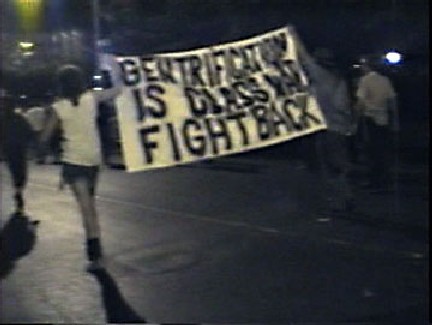
When one looks at the messages left on Christmas Day, it appears that they point to this feeling of alienation. They also speak to the idea that gentrification inevitably brings about changes that are detrimental to the poor. They present the concept that urban renewal can carry a racist element with it. They underscore that some people in these neighborhoods might feel their lives are being dismantled for the profits of a few business owners.
Paul Lee’s statements, along with some of those posted at The Rapidian, seem to be a denial that this element to the changes in the neighborhood even exists. Conferences such as the one held by the Grand Rapids Community Foundation and meetings for further development, such as the year-round “farmers’ market” complex, are not as inclusive as they could be in giving long-time residents a venue to voice their concerns and assert their rights in this changing environment,
People left out of any dialogue will find a way to make themselves heard. It’s an unsettling thought to those who are putting their money and development interests into Cherry and Wealthy Streets. But rather than dismissing it or denying it, addressing it in constructive ways could lead to a better dialogue than bricks.
The Right to the City movement based in New York City has tackled issues around urban development and gentrification for several years now. They have numerous resources on their webpage with links to other resources being used around the country that may be useful for any discussion that might take place in Grand Rapids.
Obama’s Afghanistan Review
(This article by Phyllis Bennis and Kevin Martin is re-posted from ZNet.)
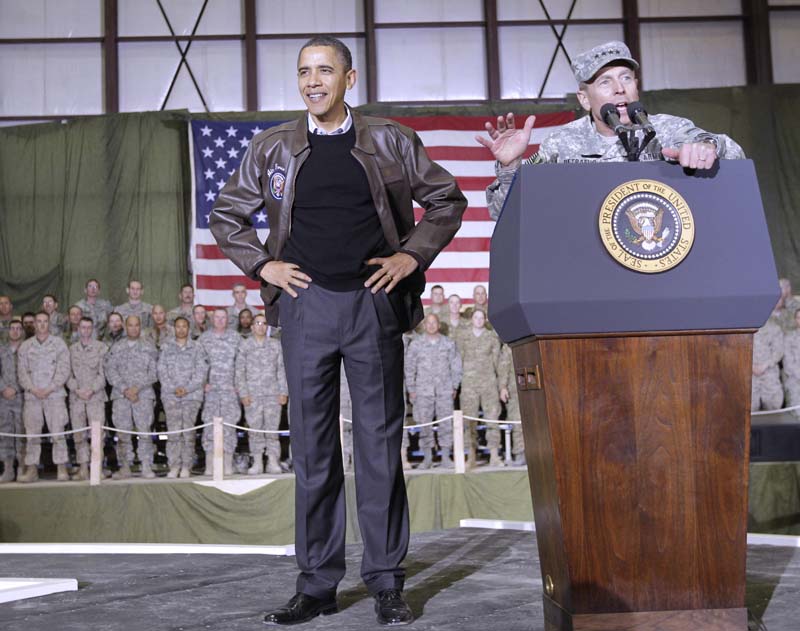
Apparently nothing can happen in the U.S. war in Afghanistan that doesn’t mean good news. If violence rises, it’s because “we’re taking the fight to the enemy.” The Pentagon must be taking a lot of fighting to whoever they’re calling the enemy – this year alone the war has killed over 2500 Afghan civilians, and almost 500 U.S. troops and more than 200 other NATO forces have died too. Of course in those isolated areas where violence may have dropped, it’s because “our strategy is winning.”
President Obama’s most recent Afghanistan review process resulted – surprise! – in the announcement that the U.S./NATO occupation will continue at least until 2014. Another four years of war, death, and devastation for the people of Afghanistan, as well as for the young U.S. soldiers drafted by poverty and lack of opportunity and sent to kill and die there in escalating numbers.
That earlier promise of July 2011 as the pull-out date? That one was always at least partially a sham – designed to pacify Obama’s powerfully anti-war base. The language even when first announced was a carefully ambiguous version that sounded like “July 2011 will start a process to determine whether conditions might allow preparation for beginning consideration of when the partial transfer of some control to Afghan forces might allow for a partial withdrawal of a few U.S. troops…”
As is recognized by the 60% of people in the U.S. who understand that the war in Afghanistan is “not worth fighting,” this is a war we cannot win and cannot afford. There is no military solution – we’ve heard that for years now, from the very leaders orchestrating the war, in the Pentagon, in Congress, in the White House. And yet, the military battle goes on, despite its inevitable failure.
And the cost continues to rise, exacting a huge price from U.S. taxpayers. The 2010 military budget plus the costs of the wars in Afghanistan and Iraq totaled over one TRILLION dollars – an amount so huge we can’t even comprehend it. Here’s one slightly smaller, that maybe we can grasp. Just the cost of President Obama’s escalation this last year, those additional 30,000 troops, was over $33 billion. That money could instead have been used to create 600,000 new green middle-class jobs here at home – and still had $3 billion left over to help with the rebuilding of post-occupation Afghanistan. Wouldn’t those 60% of Americans who think the war is not worth fighting have preferred to use the money for jobs instead of war?

President Obama told us the military is succeeding in its mission to “disrupt and dismantle, defeat and destroy” al Qaeda. And yet the CIA and other intelligence agencies acknowledge there are somewhere between 50 and 100 al Qaeda operatives even in Afghanistan. So we’ve sent 100,000 troops to wage war against the insurgents in Afghanistan who aren’t al Qaeda. Do they really believe that al Qaeda-style terrorism really requires large swathes of territory? They’re not training up battalions of soldiers who need to practice. All they really need are a few garage-sized labs and an Internet café with a fast connection.
As is true in any guerrilla war, the insurgents will fade before massed conventional forces, only to reappear when those forces move on. “Clearing” an area of the Taliban or other Afghan opposition forces is relatively easy; “holding” the area, not so much. And “building” – that’s pretty much off the agenda altogether. Why? It has a lot to do with the Afghan government, as well as the Afghan National Army and National Police. We hear a lot about how we’re making improvements in their recruitment and training, how they’re gaining skills and capacity every day. That’s probably all true. (Recruitment is fairly easy in a country with such pervasive unemployment.)
But it’s mostly irrelevant too. The problem isn’t training, it isn’t even the widespread lack of literacy. Many Taliban, Haqqani, and other fighters are largely illiterate also, and have no access to sophisticated training. It’s not about training, it’s about loyalty. And there’s no reason in the world to believe that a majority of Afghans, even those temporarily accepting pay in military or civil service, are going to develop real loyalty to a U.S.-imposed, western-style “strong central government” when there is nothing anywhere in Afghan culture that has created strong central governments or primarily national identity. That would be the case even with a legitimate, relatively honest administration in Kabul – let alone Hamid Karzai’s government that remains so thoroughly mired in fraud and corruption linked to the billions of U.S. tax dollars funneling in and out of Afghanistan.
Ironically, while President Obama’s review was all about the positive, the latest National Intelligence Estimate (NIE) on Afghanistan was leaked just the day before. And boy, did they see things differently. The NIE is important – it reflects the consensus view of all 16 U.S. intelligence agencies – the CIA, the DIA, the NSA and all the rest. And what they said was profoundly different from the rosy-eyed assessment of the White House and the Pentagon. Officials briefed on the NIE said it acknowledged that large swaths of Afghanistan are still at risk of falling to the Taliban. And that there is no chance for anything resembling success in Afghanistan without the kind of massive shift in Pakistan that would eliminate the Afghan Taliban’s current access to safe havens across the border.
And as of now, since the government in Pakistan we’re propping up with billions of dollars in military and economic aid has made quite clear that it – especially its powerful ISI intelligence agency – has no intention of ending support for the Afghan Taliban, the possibility of “success” seems to be just about zero.
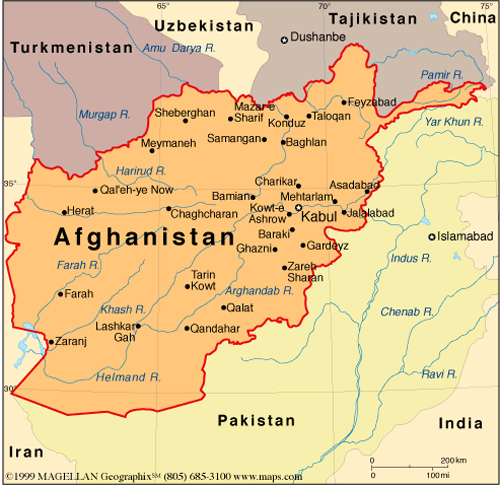
It shouldn’t be a surprise to anyone. The Pakistani government is perfectly happy to accept U.S. aid and weapons and use them to go after the Pakistani Taliban – who could indeed threaten the stability, maybe even the survival of the current government in Islamabad. But they are just as clear that the Afghan Taliban, currently taking advantage of Pakistan’s welcome and support, is pretty much the opposite of a threat to the government in Islamabad. To the contrary, the Afghan Taliban are understood to represent Pakistan’s interests in Afghanistan – especially against those of Pakistan’s arch-rival India. And, like every regional government surrounding Afghanistan, Pakistan is looking out for its own interests, making sure it has a reliable surrogate in Kabul, especially whenever the U.S. troops begin to leave.
The ultimate military goal, we are told, is to make sure the Taliban doesn’t come back to power, because supposedly that will prevent al Qaeda from launching another 9/11. Let’s just take a “worst case scenario.” The U.S. invasion, war and occupation have devastated Afghanistan, and in a post-occupation scenario the Taliban will certainly be one of the forces contending for political power. Could they win?
Maybe – they did once before, in 1996, when a huge proportion of Afghans welcomed them because the Taliban promised to end the five years of bloody inter-warlord fighting that had devastated the country and nearly destroyed Kabul.
What if they did? The Taliban leadership are no fools – they know they lost their hold on power only because of their protection (for a while) of al Qaeda and its leaders. Chances are pretty good they might not want to risk that again.
And if they did? We know that war doesn’t work against terrorism – what does work, what has worked in every example where the U.S. has managed to find and capture top al Qaeda officials or information, has not been bombing but good intelligence, good police work, good cooperation with other governments and international institutions. That hasn’t changed. That’s why we need – and shouldn’t fear – negotiations with everybody at the table. Including the Taliban.
The U.S. war and occupation has not made Afghans safer, more secure, more prosperous – they still have one of the lowest life expectancies on earth. The war has not protected women – Afghan women still die in childbirth at rates second highest in the world. And children are not better off – UNICEF reports that Afghan babies are more likely to die before their first or fifth birthdays than any other children in the world.
War isn’t working. Sixty percent of Americans know it. The U.S. intelligence agencies know it too. And we’re thinking even President Obama knows it.
The president was quoted in Bob Woodward’s recent book Obama’s Wars as saying he would not lose his political base over Afghanistan, yet he is risking exactly that. Despite some significant political victories on gay rights and disarmament in the lame duck session of Congress that have him looking much better than after the mid-term election “shellacking” just seven weeks ago, Obama and his political advisers must know his chances of re-election will be very poor if the economy is still in the doldrums and we remain mired in a seemingly endless war in Afghanistan. His base, both on the war and peace side, and the economic justice side, simply won’t hustle for him as it did in 2008 (and without said hustle he’d still be the junior senator from Illinois).
Our main concern is not for the president’s re-election prospects, it’s to end this disastrous war as soon as possible. But it’s conceivable the two could be strategically linked. The president’s anti-war base must connect the urgency of getting out of Afghanistan and making serious cuts in the military budget, with the immediate need to reinvest in the working economy, job creation, and environmental restoration. That means building powerful alliances with the key movements rising in response to the economic crisis, and fighting now for immigrant, labor, community and civil rights.
If the president and his political team are as savvy as everyone thinks they are (or at least were in the 2008 campaign), they’d do well to get in front of that wave and run on a genuine peace and green prosperity platform. Imagine if that happened, and President Obama really did start paying attention to his anti-war base, and began carrying out the dramatic shift in policy necessary to insure a real withdrawal of troops from Afghanistan, a genuine move to close Guantanamo, a final withdrawal of all remaining troops in Iraq, a serious level of pressure on Israel to end its occupation, as well as to launch a serious New New Deal to create green jobs and rebuild the economy… Then not only would the president likely coast to re-election, but the Afghan and U.S. people would be the real beneficiaries – instead of banks, war profiteers and Wall Street – and THAT election would really be one for the history books.
The Press’ Double Standard on Foreign Policy Speakers

This morning MLive posted an article announcing the 2011 foreign policy lecture series hosted by the World Affairs Council of Western Michigan. In fact, the Grand Rapids Press and MLive always publish the lecture series and write about each speaker as the series progresses.
The World Affairs Council (WAC) could be labeled as host speakers that tend to have a right of center view of the world and US foreign policy and this year’s line up is not that different.
The speakers include someone with the Council on Foreign Affairs, a retired Navy officer, a representative of the Red Cross and for a discussion about energy policy and national security WAC has someone from Marathon Oil and the American Petroleum Institute, which is essentially a front group for the oil industry.
In addition, there is a panel discussion on the global financial crisis featuring economics professors who all take a pro-capitalist position. Lastly, there is a speaker from the American Institute for Contemporary German Studies, which has a board of directors that mostly represents corporate America and includes as an honorary member James Baker III of the Reagan and Bush Sr. administrations.
However, if one were to look at speakers who have come to Grand Rapids in the past two years that have a critical view of US foreign policy the Grand Rapids Press and MLive not only don’t send a reporter to these events, they don’t announce them either. (with the exception of Kathy Kelly, where the announcement appeared in the Faith Calendar, even though it was not a religious-based event.)
In March of 2009, Institute for Policy Studies analyst Phyllis Bennis spoke on the Israeli assault on Gaza and the US wars in Iraq and Afghanistan during a two-day conference.
In June of 2009, Kathy Kelly with Voices for Creative Non-violence spoke in Grand Rapids after returning from a trip to Pakistan and Afghanistan to speak with victims of the US drone bombings.
On March 18/19 the group Healing Children of Conflict hosted Doctor Izzeldin Abuelaish, a Palestinian doctor who spoke about the 2008/2009 Israeli assault on Gaza that killed his 2 daughters.
On March 25 of 2010, radical author and activists John Ross spoke in Grand Rapids about the role of the US in the war on drugs in Mexico while he was on a book tour throughout the US.
Lastly, on October 8, journalist Anand Gopal spoke in Grand Rapids. Gopal has been living in and reporting from Afghanistan for both the Christian Science Monitor and the Wall Street Journal.
These are not all of the left of center or anti-imperialist speakers to come to Grand Rapids in the past 2 years, but it gives you an indication of the double standard that the Press practices in terms of foreign policy speakers who come to West Michigan.
(This statement from Palestinians is re-posted from Common Dreams.)

We, the Palestinians of the Besieged Gaza Strip, on this day, two years on from Israel’s genocidal attack on our families, our houses, our roads, our factories and our schools, are saying enough inaction, enough discussion, enough waiting — the time is now to hold Israel to account for its ongoing crimes against us. On the 27th of December 2008, Israel began an indiscriminate bombardment of the Gaza Strip. The assault lasted 22 days, killing 1,417 Palestinians, 352 of them children, according to mainstream human rights organizations. For a staggering 528 hours, Israeli Occupation Forces let loose their US-supplied F15s, F16s, Merkava Tanks, internationally prohibited white phosphorous, and bombed and invaded the small Palestinian coastal enclave that is home to 1.5 million, of whom 800,000 are children and over 80 percent UN registered refugees. Around 5,300 remain permanently wounded.
This devastation exceeded in savagery all previous massacres suffered in Gaza, such as the 21 children killed in Jabalia in March 2008 or the 19 civilians killed sheltering in their house in the Beit Hanoun Massacre of 2006. The carnage even exceeded the attacks in November 1956 in which Israeli troops indiscriminately rounded up and killed 275 Palestinians in the southern town of Khan Younis and 111 more in Rafah.
Since the Gaza massacre of 2009, world citizens have undertaken the responsibility to pressure Israel to comply with international law, through a proven strategy of boycott, divestment and sanctions. As in the global BDS movement that was so effective in ending the apartheid South African regime, we urge people of conscience to join the BDS call made by over 170 Palestinian organizations in 2005. As in South Africa the imbalance of power and representation in this struggle can be counterbalanced by a powerful international solidarity movement with BDS at the forefront, holding Israeli policy makers to account, something the international governing community has repeatedly failed to do. Similarly, creative civilian efforts such as the Free Gaza boats that broke the siege five times, the Gaza Freedom March, the Gaza Freedom Flotilla, and the many land convoys must never stop their siege-breaking, highlighting the inhumanity of keeping 1.5 million Gazans in an open-air prison. Two years have now passed since Israel’s gravest of genocidal acts that should have left people in no doubt of the brutal extent of Israel’s plans for the Palestinians. The murderous navy assault on international activists aboard the Gaza Freedom Flotilla in the Mediterranean Sea magnified to the world the cheapness Israel has assigned to Palestinian llife for so long. The world knows now, yet two years on nothing has changed for Palestinians. The Goldstone Report came and went: despite its listing count after count of international law contraventions, Israeli “war crimes” and “possible crimes against humanity,” the European Union, the United Nations, the Red Cross, and all major Human Rights Organizations have called for an end to the illegal, medieval siege, it carries on unabated. On 11th November 2010 UNRWA head John Ging said, “There’s been no material change for the people on the ground here in terms of their status, the aid dependency, the absence of any recovery or reconstruction, no economy…The easing, as it was described, has been nothing more than a political easing of the pressure on Israel and Egypt.” On the 2nd of December, 22 international organizations including Amnesty, Oxfam, Save the Children, Christian Aid, and Medical Aid for Palestinians produced the report ‘Dashed Hopes, Continuation of the Gaza Blockade’ calling for international action to force Israel to unconditionally lift the blockade, saying the Palestinians of Gaza under Israeli siege continue to live in the same devastating conditions. Only a week ago Human Rights Watch published a comprehensive report “Separate and Unequal” that denounced Israeli policies as Apartheid, echoing similar sentiments by South African anti-apartheid activists.

We Palestinians of Gaza want to live at liberty to meet Palestinian friends or family from Tulkarem, Jerusalem or Nazareth; we want to have the right to travel and move freely. We want to live without fear of another bombing campaign that leaves hundreds of our children dead and many more injured or with cancers from the contamination of Israel’s white phosphorous and chemical warfare. We want to live without the humiliations at Israeli checkpoints or the indignity of not providing for our families because of the unemployment brought about by the economic control and the illegal siege. We are calling for an end to the racism that underpins all this oppression.
We ask: when will the world’s countries act according to the basic premise that people should be treated equally, regardless of their origin, ethnicity or colour — is it so far-fetched that a Palestinian child deserves the same human rights as any other human being? Will you be able to look back and say you stood on the right side of history or will you have sided with the oppressor?
We, therefore, call on the international community to take up its responsibility to protect the Palestinian people from Israel’s heinous aggression, immediately ending the siege with full compensation for the destruction of life and infrastructure visited upon us by this explicit policy of collective punishment. Nothing whatsoever justifies the intentional policies of savagery, including the severing of access to the water and electricity supply to 1.5 million people. The international conspiracy of silence towards the genocidal war taking place against the more than 1.5 million civilians in Gaza indicates complicity in these war crimes.
We also call upon all Palestine solidarity groups and all international civil society organizations to demand:
– An end to the siege that has been imposed on the Palestinian people in the West Bank and Gaza Strip as a result of their exercise of democratic choice.
– The protection of civilian lives and property, as stipulated in International Humanitarian Law and International Human Rights Law such as The Fourth Geneva Convention.
– The immediate release of all political prisoners. - That Palestinian refugees in the Gaza Strip be immediately provided with financial and material support to cope with the immense hardship that they are experiencing
– An end to occupation, Apartheid and other war crimes.
– Immediate reparations and compensation for all destruction carried out by the Israeli Occupation Forces in the Gaza Strip.
Boycott, Divest and Sanction. Join the many international trade unions, universities, supermarkets and artists and writers who refuse to entertain Apartheid Israel. Speak out for Palestine, for Gaza, and crucially ACT. The time is now.
Besieged Gaza, Palestine
Dismissing race and class in Digital Divide story
MLive posted a story by a Grand Rapids Press reporter on the digital divide for students in Grand Rapids. The article claims that one third of Americans still do not have access to the Internet from home, which effects both urban and rural populations.
The digital divide is a serious problem in the US and in West Michigan, but instead of exploring what that really means the Press reporter decides to just speak with a student, a parent and two local library staff. All of those interviewed are addressing either their use of computers at public libraries or the increased amount of research students must do as part of their class work, even though the headline clearly puts the emphasis on the negative consequences of the digital divide. (Grand Rapids students caught in the digital divide as more school assignments include online aspect)
Besides some Census Bureau data, the MLive story never explores what the digital divide really means for Grand Rapids students. There is no investigation into the testing skills of students with easy access to the Internet compared to those with limited access. There is no exploration on the difference with Internet access along class and income lines or along racial lines, which seem to be obvious and important routes to take in such a story.
The first major government funded study on the digital divide was done a decade ago by the National Telecommunications and Information Administration (NTIA). The report found that there were major sectors in both urban and rural areas that have limited or no access to the Internet. Since then more Americans now have access, but the data shows that it disproportionately effects low income and minority populations.
The Pew Research Center just conducted a survey of Internet use in the US by income levels and found there was a disparity in use between households that make more than $75,000 and those that make less than $75,000. However, the household income level seems to be a bit misleading and there would no doubt be an even greater disparity if one looked at households of $25,000 or less.

Just having access does not always mean the digital divide is decreased, since the speed and quality of the broadband can also impact Internet use. A new report by the FCC says that 68% of the 133 million broadband users in the US have way too slow of a connection to even be legitimately considered broadband.
The Pew Hispanic Center published findings in July of this year about the digital divide when comparing US born to foreign-born children now living in the US. This is the most recent study that looks at the digital divide along racial lines and similar investigation could be done for Grand Rapids Public School students, considering that it is a majority Black student population and a growing Latino student population. An excellent resource for exploring the digital divide and online use for school age students is the book The Young and the Digital, by S. Craig Watkins.

