The Largest Prison Strike In American History Goes Ignored By US Media
(This article is re-posted from InfoShop.)
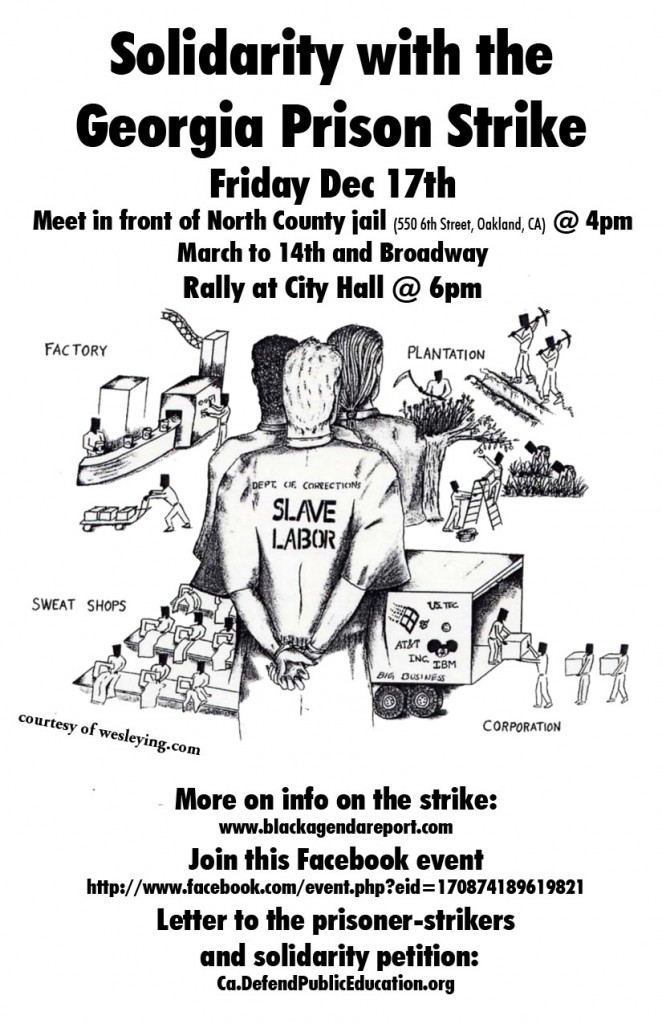
Today marks the end of a seven-day strike where tens of thousands of inmates in Georgia refused to work or leave their cells until their demands had been met. The odd thing is, that until today, no one had ever heard about this strike. Inmates in ten Georgia prisons, Baldwin, Hancock, Hays, Macon, Smith and Telfair State Prisons, to name a few, went on strike last Thursday to protest their treatment and demand their human rights.
Today marks the end of a seven-day strike where tens of thousands of inmates in Georgia refused to work or leave their cells until their demands had been met. The odd thing is, that until today, no one had ever heard about this strike.
Inmates in ten Georgia prisons, Baldwin, Hancock, Hays, Macon, Smith and Telfair State Prisons, to name a few, went on strike last Thursday to protest their treatment and demand their human rights.
According to an article by Facing South, Department of Corrections have been nervous about deteriorating conditions in Georgia’s prisons since early 2010. Wardens started triple bunking prisoners in response to budget cuts – squeezing three prisoners into cells intended for one. Prison officials have kept a watchful eye out for prisoners to meaning riot, for prisoners’ rights lawyers to litigate, or both.
Poor conditions and substandard medical care are also on the inmates’ list of demands. However, the jailed’s main gripe seems to center on landing recognition as workers entitled to fair pay.
As it goes, prisoners in Georgia are forced to work without pay for their labor – seemingly a violation of the 13th Amendment, which prohibits slavery and involuntary servitude.

For months the prisoners had apparently used cell phones to get in touch with inmates from other prisons, organizing a non-violent strike. The outcome began the morning of Dec. 9 – by Dec. 13 the GDC issued a statement that four prisons were completely on strike.
An interview with one of the strike leaders revealed that every group of inmates in the prison had been working together. “They want to break up the unity we have here,” said an anonymous strike leader in an interview with the Black Agenda Report. “We have the Crips and the Bloods, we have the Muslims, we have the head Mexicans, and we have the Aryans all with a peaceful understanding, all on common ground.”
The largest prison strike in American history seems like a topic ripe for the press, however there was no mention of it anywhere in mainstream media. Smaller outlets like Black Agenda Report and Facing South (Institute for Southern Studies) have been covering the strike since day one.
Perhaps there was a larger hand at play – one that did not want the deplorable conditions of the Georgia prison system to surface. If Wikileaks has taught us anything, it is that the revolution will be televised.
The prisoners demands:
* A LIVING WAGE FOR WORK: In violation of the 13th Amendment to the Constitution prohibiting slavery and involuntary servitude, the DOC demands prisoners work for free.
* EDUCATIONAL OPPORTUNITIES: For the great majority of prisoners, the DOC denies all opportunities for education beyond the GED, despite the benefit to both prisoners and society.
* DECENT HEALTH CARE: In violation of the 8th Amendment prohibition against cruel and unusual punishments, the DOC denies adequate medical care to prisoners, charges excessive fees for the most minimal care and is responsible for extraordinary pain and suffering.
* AN END TO CRUEL AND UNUSUAL PUNISHMENTS: In further violation of the 8th Amendment, the DOC is responsible for cruel prisoner punishments for minor infractions of rules.
* DECENT LIVING CONDITIONS: Georgia prisoners are confined in over-crowded, substandard conditions, with little heat in winter and oppressive heat in summer.
* NUTRITIONAL MEALS: Vegetables and fruit are in short supply in DOC facilities while starches and fatty foods are plentiful.
* VOCATIONAL AND SELF-IMPROVEMENT OPPORTUNITIES: The DOC has stripped its facilities of all opportunities for skills training, self-improvement and proper exercise.
* ACCESS TO FAMILIES: The DOC has disconnected thousands of prisoners from their families by imposing excessive telephone charges and innumerable barriers to visitation.
* JUST PAROLE DECISIONS: The Parole Board capriciously and regularly denies parole to the majority of prisoners despite evidence of eligibility.
Bradley Manning and GI Resistance to US War Crimes
(This interview is reposted from Dissident Voice.)

Jamail is the author of two recent books: “Beyond the Green Zone: Dispatches From An Unembedded Journalist” (2008) and “The Will To Resist: Soldiers Who Refuse To Fight in Iraq and Afghanistan” (2009). He also contributed Chapter 6, “Killing the Intellectual Class,” for the book Cultural Cleansing in Iraq: Why Museums Were Looted, Libraries Burned and Academics Murdered (2010). Learn more at http://www.dahrjamailiraq.com
Angola 3 News: On April 4, 2010, WikiLeaks.org released a classified 2007 video of a US Apache helicopter in Iraq, firing on civilians and killing 11, including Reuters’ photojournalist, Namir Noor-Eldeen, and his driver, 40 year old Saeed Chmagh. No charges have been filed against the US soldiers involved.
In sharp contrast, a 22-year-old US Army intelligence analyst named Bradley Manning has been accused of leaking the classified video. Arrested in May and facing up to 52 years in prison for a range of charges, Manning is now being held under what lawyer/journalist, Glenn Greenwald, has termed “inhumane conditions.”
Manning’s support website declares that “exposing war crimes is not a crime.” Indeed, the Nuremberg Laws, established after the horrors of WWII, declare that soldiers have a legal obligation to resist criminal wars. Let’s please take a closer look at this issue of US war crimes. What do you think are the strongest arguments that have been made for why US invasions of Iraq and Afghanistan are criminal?
Dahr Jamail: To be clear, while I’ve covered Iraq extensively, I’ve not covered Afghanistan. Thus, I’ll keep all my answers in the context of my expertise, that being Iraq.
That said, the US-led invasion and occupation of Iraq could not have more clearly violated international law. Even former Secretary General of the UN, Kofi Annan, said in September 2004 that the Iraq war was illegal and breached the UN Charter.

An illegal war is thus the mother of all war crimes, for from that stem all the rest. What I’ve seen in Iraq has been a parade of war crimes committed by the US military: rampant torture, collective punishment (Fallujah is an example), deliberate firing on medical workers, deliberate killing of civilians for “sport,” and countless others.
Then, there is the fact that both occupations are so clearly about control of dwindling resources and their transport routes, that the excuses given for them by the US government (both Bush and Obama) are both laughable and insulting to anyone capable of a modicum of critical thought.
A3N: How do you rate the corporate media’s coverage of the Bradley Manning story?
DJ: It’s been a farce. A classic case of “shoot the messenger.” When someone becomes a soldier, they swear an oath to support and defend the US constitution by following “lawful” orders. Thus, they are legally obliged by their own oath to not follow unlawful orders. What Manning did by leaking this critical information has been to uphold his oath as a soldier in the most patriotic way. Now compare that with how he has been raked over the coals by most of the so-called mainstream media.
A3N: How do they address the argument that “exposing war crimes is not a crime?”
DJ: Usually they don’t, because the corporate media, and the government for that matter, avoid the words “war crime” as though they are a plague. Thus, they avoid the issue at all cost.
A3N: In your opinion, how do the corporate media present the US occupations of Iraq and Afghanistan to the US public?

DJ: With Iraq, the occupation is presented as though it was a mistake, as though the great benevolent US Empire was mistakenly mislead into the war. But since “we” are there, it is good that at least Saddam Hussein has been removed, and now, of course, the US has only done the best it can in a tough situation.
With Afghanistan, the occupation is presented to the public as the ongoing frontline battle against “terrorism,” while, in reality, they should call Afghanistan “pipeline-istan” because it’s all about securing the access corridors for natural gas and oil pipelines from the Black Sea, through Afghanistan (the 4 main US bases there are located along the exact pipeline route) to the coast of Pakistan.
A3N: How does the corporate media narrative contrast with what you have seen first-hand in Iraq?
DJ: The difference is night and day. The whitewashing and outright lying by the corporate media is offensive to me. It is repulsive, in fact, when compared to what the reality on the ground is in Iraq. The brutality of the US military there against the civilian population would shock people. More than 1 million Iraqis have been slaughtered because of the US occupation. As you read this you can know that one in every ten Iraqis remains displaced from their homes. Can you imagine that? The US policy in Iraq has been so destructive, that one out of every ten Iraqis is currently displaced from their home, now at more than 7 years into the occupation?
A3N: Returning now to the issue of soldier resistance, what are the various reasons that anti-war soldiers give as motivation for their opposition to the occupations?
DJ: Mostly from what the soldiers see once they arrive in the occupation: the buckets of money being made by the contractors, the lack of goals for the occupation beyond generating huge amounts of profit for war contractors, and that the reasons given for the invasion/occupation were entirely false. So most seem to become anti-war when they see that they’ve been lied to, used, betrayed, and that they are putting their lives on the line so that war contractors can get richer.
A3N: What are some of the ways that anti-war soldiers in Iraq and Afghanistan have resisted?
DJ: Myriad ways. The most common, and least dramatic, is going AWOL. More than 60,000 soldiers have now taken that route since 11 September 2001. So, often, folks will go do a deployment, come back for a break, then simply not show up when it’s time for their unit to redeploy.
Some of the more interesting means of resistance I’ve found entailed doing what soldiers refer to as “search and avoid” missions. One soldier told me how they would go out to the end of their patrol route in their Humvees, find a big field, and park. They’d call in to base every hour to check in and say, “We’re fine, we’re still searching this field for weapons caches.” And they would sit there doing nothing until the time was up for their patrol, and they’d return to base. I met more and more soldiers who shared similar stories, from all over Iraq, during different times of the occupation. That’s when I realized how low morale was and how widespread different kinds of resistance had become.
Other soldiers found out how to manipulate their locator beacon on the GPS unit in the Humvees, so they’d sit and have tea with Iraqis, while someone moved their beacon around so their base thought they were patrolling.
A3N: How has US military leadership responded to this resistance?
DJ: They don’t know about much of it when it’s happening. Although there have been times when a unit has been caught doing something like the aforementioned, and they’ve broken up the unit, but that has been quite rare overall.
With AWOL troops, the military doesn’t have the manpower to send their MPs after them, so they let them go, wait for them to get a traffic ticket, for example, then the cops hand them over to the MPs who throw the AWOL soldier in the brig to await a court-martial. Then, often, the soldier is told he/she can go back to Iraq/Afghanistan, or they will be court-martialed.
A3N: In your book The Will To Resist, you document many different cases of soldiers that faced criminal charges for their opposition to US wars. We discussed Bradley Manning’s case earlier in this interview, but can you please tell us about any other recent, ongoing cases that have begun since the publication of your book in 2009? How can our readers best support these soldiers?
DJ: Most of those I followed that took place after my book was published have been completed, time served by the soldiers, and then their release into freedom from the military. Two cases of this type really stand out: Victor Agosto and Travis Bishop. Both of these men stood up and refused to be deployed, were court-martialed, served their time, and are now free.
There will be more to come as these occupations persist. A group to follow who regularly supports these resisters is Courage To Resist. They are based in Oakland and are run by Jeff Paterson, himself a resister to the first Gulf War. They do a great job of tracking resisters and what folks can do to support them. Support includes donations, but also making phone calls, writing letters, and other forms of activism.
A3N: In the months leading up to the US invasion of Iraq in 2003, the anti-war movement in the US was relatively strong, but since the invasion began, the anti-war movement seems to have lost considerable momentum and strength. On a practical level, what do you think the US anti-war movement needs in order to be re-energized and finally end these wars?
DJ: At the risk of sounding like a cynic when I feel I’m making an honest assessment, I don’t feel there will be a mass organization of an anti-war movement. We already live in a police state. What is left of the anti-war movement is completely infiltrated, and is being torn apart by sectarianism and profiteering (the peace-industrial-complex).
In addition, I feel that the main reason for the failure of the anti-war movement is that most folks involved in it still believe they can work within the system to generate change, when the system is completely corrupted already. By “system,” I mean the federal government. That apparatus is broken beyond repair, it is completely corrupted, and needs to be dissolved. Thus, any movement that seeks to work within the parameters set by the system (such as weekend permitted demonstrations, thinking you can effectively pressure your representative, etc.) is doomed before it begins, because it is still playing by the rules set out by those in power. Rules guarantee never to jeopardize the loss of power by those who hold it.
Only truly radical actions, meant to subvert the system and shut it down to a point where business as usual is impossible until demands are met, are all that is left.
Anti-Muslim hysteria takes local toll
As the secular message of Christmas continues its descent into unbridled consumerism, the hate-mongers of the religious right seem more occupied with keeping the prophet Muhammad out of America than keeping Christ in Christmas. Corporate media is rife with accounts of outrage over banned nativity scenes. And, the finger of blame is increasingly pointed at Muslims.
“The Christmas story is about a person born into a religious minority in a land occupied by oppressors who persecute,” says Mary Vaccaro, associate director for program design with Grand Rapids’ Catholic Information Center. The Center actively promotes dialogue with local Muslims. “The holy family is homeless, refugees. For us to perpetuate the true Christmas spirit is to treat all people, whatever their faith, the way we would like the holy family to be treated.”
This message is sadly lacking according to a December 20 story on Alternet .”Right-Wing Money-Fed Campaign Escalates Latent 9-11 Paranoia into Anti-Muslim Hysteria” explains how the religious right, ultra-Zionists, Tea Party propagandists and half-baked conspiracy theorists have successfully financed 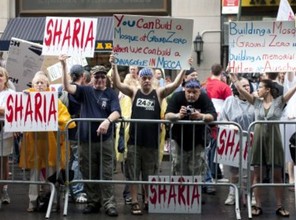 and promoted Islamaphobia as a means to their own ends. Tom Englehart writes in the article’s introduction, “In an atmosphere of swirling fears and hysteria amid declining living conditions, ‘explanations’ that at other times might have remained confined to tiny crews of conspiracy-mongers can suddenly gain a patina of plausibility and so traction. No wonder then that, as hard times hit, as the financial system seemed on the verge of collapse, as unemployment soared and a massive wave of home foreclosures swept into view, increasing numbers of Americans became prey to any wacky explanation for our troubles, none more so than the idea that Islam was somehow responsible, that mosques and Islamic centers meant for a sliver of a minority here were capable of imposing anything, no less a way of life on this country, or that Sharia law (of all things) might somehow worm its way into state legal systems, or that YouTube was a hotbed of terrorism worthy of suppression, or… well, you name it.”
Elsewhere in Indy News, Professor Juan Cole’s Dec. 21 post, “Hating Muslims in America,” states, “Rep. Peter King (R-NY), the incoming chair of the House committee on Homeland Security has announced that he will hold hearings into the ‘radicalization’ of American Muslims. This, despite the fact that the Muslim Americans are pillars of the US community–disproportionately well-educated and well integrated into the country, and even though a third of tips forestalling radical Muslim operations come from the community itself. And, despite the fact that most terrorism in the US is committed by white supremacists. King’s obscene gesture of Kristallnacht-by-hearing does not come out of the representative’s own eccentricities, but is part of an organized conspiracy to demonize and marginalize Muslim Americans and Arab Americans.”
Cole takes the government’s role in fueling anti-Islamic sentiment one very logical step further, “Since the wars are for resources in the resource-rich Muslim world, it is convenient to demonize Muslims across the board, including domestic ones.”
An August 2010 Pew Research Center poll of Americans found that the favorability rating of Muslims has dropped by 11 points since 2005. In the midst of this whipped up frenzy, arsonists are torching mosques. Christians are blocking construction of mosques in their towns and cities. And, in Oklahoma, voters overwhelmingly approved a ban on Sharia law, even though the prospect of Sharia replacing that state’s laws is laughable at best.
Has this Islamaphobia impacted our Muslim neighbors in the greater Grand Rapids area? Yes. “I know there is anti-Muslim sentiment,” Vaccaro says. “I see it in the media. And, my Muslim friends have anecdotes they have shared with me. I can’t speak for all Christians and church history sadly includes that there has been (persecution) there. We have reformed our teaching since ….and teach that it is wrong to discriminate against anyone because of their faith. To criticize another faith is not who we are.”
While preparing to write this post, the writer asked a Muslim friend, Wafa H., if she has noticed a worsening attitude towards Muslims locally. She is well educated, fluent, friendly and has a great sense of humor. She lived in the Grand Rapids area for many years before relocating to California for a year or so. She recently returned here to live and re-establish her small business.
Wafa returned my call from the urgent care waiting room. Stress has caused her physical collapse. Last summer, she moved to an apartment in Byron Center. There, every time she and her son came or left, they were called names, told to get out of the country and threatened with a rifle on several occasions. Wafa’s tires were slashed. While police responded on numerous occasions, they claimed not enough evidence existed to prosecute a hate crime.
Life in her new rental home is not much better. After living without electricity or locks on the doors for two months, Wafa withheld the rent. She shares , “My current landlord evicted me because he does not want to deal with me because I speak with a Middle Eastern accent . . . he threatened me, called me ‘bitch’ and ‘ whore’ and pushed the door on me. Now he is evicting me. Wherever you’re from (in the Middle East) if you don’t speak English (without an accent), people yell, scream and show me disrespect. Especially this year. I never had this before.”
Her son, who finally were allowed to join her in the U.S. after years of separation, is enrolled at GRCC. “He is shocked and depressed and does not know what to do. He needs a job but no one will hire him,” Wafa says. “We need to educate, educate, educate the public about Arabic culture. I was living here in peace years ago and now these people are against me. I am so tired.”
Educate, educate, educate. Though ignored by local media, people from different faiths here are working together to raise awareness of what Islam really teaches and how local Muslims really live. Despite early notification, local media failed to cover an event attended by more than 160 people last fall. Neither did they cover peaceful Muslim scholar Omid Safi when he spoke at Calvin College a few days later. Sane and peaceful Muslim voices are being raised across the country. But corporate media, goaded by right-wing fear mongers, ignores them, prefering to exploit the false idea that Islam is a faith of violence that is intent on destroying the “West.”
“It is American Muslims’ responsibility to reach out and explain their religion. The 99% need to explain how peaceful our faith is and how that 1% is misrepresenting the faith. The violent 1%, those are the ones the media grabs for the first story in the evening news,” says Dr. Mohammad Saleh, a local physician involved in organizing upcoming interfaith events about Islam. “The best thing for non-Muslim to show support is to reach out to their Muslim neighbors and co-workers . Meet with them, understand the faith, share in their traditions. We are really trying to speak up. My hope is to have more media coverage of our events so that people are aware. We would hope that people who don’t know the faith not to stereotype Muslims, to not apply what they see and hear in the news to every Muslim.”
Upcoming interfaith events about Islam
- Jan. 10 and 11, 7- 8:30 p.m. Will the Real Islam Please Stand Up? This two session course will present a basic overview of Islam and the Quran. Presenter: Ghazala Munir. Hosted by the Catholic Information Center, 2nd floor Cathedral Square Center, 360 S. Division.
- Feb 9, 7 – 9 p.m. Building Interfaith Friendships: The Dialogue Tour of the new mosque and conversation about Islam. Hosted by the Islamic Mosque and Religious Institute, 3333 East Paris SE, Grand Rapids.
FCC Adopts Corporate Internet Regulatory Rules
(This article is re-posted from OpenSecrets.)

The Federal Communications Commission on Tuesday approved new rules that will regulate Internet access for consumers. Passed by FCC Commissioner Julius Genachowski and his Democratic colleagues, the rules stipulate that Internet providers cannot block or restrict the delivery of online services. But providers may have preferred clients in which a company can pay for faster Internet access for consumers.
Indeed, the debate over net neutrality has been raging over the past two years as entities on both sides have been lobbying heavily to influence policymakers. On one end, Internet providers generally pushed for the ability to charge businesses and consumers for faster Internet speeds, creating a seemingly tiered Internet system.
Conversely, consumer advocates wanted the FCC to keep the Internet universally available to all consumers and businesses, thereby protecting and entrenching net neutrality. After analyzing lobbying disclosure reports, the Center for Responsive Politics finds that communication companies have had a much larger presence than the consumer advocates lobbying policymakers.
The chart below shows how many entities within specific industries or special interest areas specifically mentioned lobbying on “net neutrality” during the past two years:

While federal lobbying disclosure forms make it impossible to tell exactly how much money these companies spent lobbying on net neutrality alone, the significant resource advantage communication companies have over consumer advocacy groups suggest an advantage in making their voices heard over competitors.
WikiLeaks Battles for the Future of Journalism
The organization WikiLeaks continues to be attacked by the very pillars of free society it is seeking to reform, much to the detriment of good governance and free press. WikiLeaks, with its staggered release of 250,000 US diplomatic cables working in tandem with the world’s most respected newspapers, has brought to light the power abuses by the world’s governments and corporations. WikiLeaks seeks to build a more transparent and honest system of government and media by shaking the corrupt foundations of political and journalistic structure to its core.
The leaked US embassy cables continue to draw attention around the world, revealing everything from systematic torture in India, to oil giant Shell’s infiltration of the Nigerian government, to United States’ efforts to force Spain to drop a murder investigation in the case of a Spanish cameraman killed by US soldiers. The cables have turned the world inside out, enabling us all to see the gruesome innards of government and diplomacy as usual.
Because of this, Julian Assange and his large WikiLeaks organization have come under repeated attack. First have been the attacks by the US government itself, whose acts of arm twisting and political bullying, as revealed in the leaked diplomatic cables, have brought it under the judging eyes of the world. In an effort to regain credibility, politicians in Washington are currently looking into prosecuting WikiLeaks under laws they are frantically working to revise or propose, such as the SHIELD Law. This raises suspicions about the ethics of US lawmakers, as ex post facto laws are expressly prohibited by the Constitution. However, Assange can only be tried if extradited by the United States, which is proving difficult as lawmakers are unable to pin a specific charge on him. If Assange were to be tried under current law, it might follow that the New York Times, which has published the classified documents, would also be affected by the outcome of that decision. A report by the Congressional Research Service doesn’t paint this as a very likely possibility:
“Leaks of classified information to the press have only rarely been punished as crimes, and we are aware of no case in which a publisher of information obtained through unauthorized disclosure by a government employee has been prosecuted for publishing it. There may be First Amendment implications that would make such a prosecution difficult, not to mention political ramifications based on concerns about government censorship.”
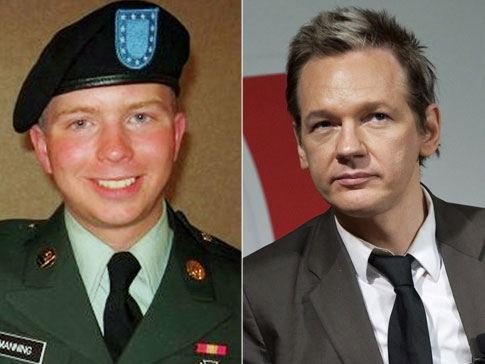
Currently, the United States government is seeking to prove Army Private Bradley Manning, who is suspected of leaking the cables, and Julian Assange worked together to gather the secret documents. If they can prove that Assange collaborated with Manning to release the information, the US may have a case against Assange as a co-conspirator. This theory has journalists and law professors in an uproar, as the relationship between reporter and confidential source lies at the heart of investigative journalism. Former Bush Justice Department official and now Harvard Law Professor Jeff Goldsmith wrote:
“But it [the prosecution theory] would not distinguish the Times and scores of other media outlets in the many cases in which reporters successfully solicit and arrange to receive classified information and documents directly from government officials. Prosecution of Assange on this theory would therefore raise awkward questions about why DOJ [Department of Justice] does not bring charges against the American media for soliciting classified information on a regular basis. It would be a fateful step for traditional press freedoms in the United States.”
Recent revelations about the conditions Manning is being held under show the seriousness of US efforts to indict Assange. Bradley Manning, a 23 year old Army Private, has never been convicted of a crime. Yet he has been held in solitary confinement in a US Marine prison in Virginia for the past 5 months, where his life is severely restricted and regimented. Here are just a few examples: Manning is unable to exercise in his cell; if he tries, he is forced to stop. Every 5 minutes during waking hours a guard asks Manning if he is ok; Manning must answer or the guards will come in and check on him. Manning is only allowed a few visitors and has been unable to speak to his family face to face. Those restrictions pale in comparison to the psychological toll that prolonged solitary confinement has been shown to have on prisoners. (This has led some countries to classify solitary confinement as a form of torture.) The journalist who exposed Manning’s prison conditions, Constitutional attorney and blogger Glenn Greenwald, provides an excellent analysis of solitary confinement. Some people believe the government hopes to so wear Manning down, that he will incriminate Assange as part of a plea bargain.
Meanwhile unlawful government censorship is continuing, despite the fact that WikiLeaks, like Manning, has not been officially charged with a crime. When WikiLeaks began its drawn out release of the diplomatic cables, their site, WikiLeaks.org, was shut down by its US based DNS provider. At the time of this writing, it is still not functioning. To keep the information accessible, WikiLeaks was picked up by other hosts around the world, but it needs to bounce around to avoid being shut down. (The most reliable mirror site so far has been http://wikileaks.ch/ .)
After the website itself was attacked, several large companies, such as Amazon, Visa, PayPal, and, most recently, Bank of America withdrew their services to WikiLeaks, saying that WikiLeaks had violated their “Terms of Service” by publishing illegally obtained documents. Though with warning comments from Senator Joseph Liebermann about aiding WikiLeaks, the motive behind the companies suddenly dropping their services seems curious at best. This blatant attack on free speech and internet freedom has prompted several cyberattacks by WikiLeaks supporters Anonymous. These attacks have not been condoned by Mr. Assange.
WikiLeaks is also being discredited by some in the media. Consider, for example, the falsehood in some media outlets that says WikiLeaks dumped all of the 250,000 cables online without any concern for journalistic ethics. This story has been repeated on NPR and TIME, among others. Again, WikiLeaks has only published cables that have first been published by the newspapers and only after they have been redacted and vetted by those journalists and by Assange’s team (Assange even sought US government assistance in this). Glenn Greenwald strongly opposes such careless reporting:
“That’s why this cannot-be-killed lie about WikiLeaks’ ‘indiscriminate’ dumping of cables has so consumed me. It’s not because it would change much if they had done or end up doing that — it wouldn’t — but because it just so powerfully proves how mindlessly subservient the American establishment media is: willing to repeat over and over completely false claims as long as it pleases the right people — the same people to whom they claim they are ‘adversarial watchdogs.’ It’s when they engage in such clear-cut, deliberate propagandizing that their true function — their real identity — is thrown into such stark relief.”
The attacks continue with calls from prominent politicians and media personalities for Mr. Assange to be taken down or even assassinated.
For instance, Democratic Party consultant and Fox Business commentator Bob Beckel:
“We’ve got special ops forces. I mean, a dead man can’t leak stuff. This guy’s a traitor, a treasonous, and he has broken every law of the United States. The guy ought to be—and I’m not for the death penalty, so if I’m not for the death penalty, there’s only one way to do it: illegally shoot the son of a [bleep].”
The logical gymnastics Beckel had to go through to come to that conclusion are astounding. Or read this gem of twisted logic from ex-governor Sarah Palin:
“He is an anti-American operative with blood on his hands. His past posting of classified documents revealed the identity of more than 100 Afghan sources to the Taliban. Why was he not pursued with the same urgency we pursue Al Qaeda and Taliban leaders?”
But the biggest attack of all is on the First Amendment’s rights of free speech and free press. The hypocrisy that the US, the world’s supposed leader in matters of democracy and rights, is displaying in relation to WikiLeaks is extremely unnerving. This also has many Europeans confused by the US government’s reaction, as reported in the New York Times:
“For many Europeans, Washington’s fierce reaction to the flood of secret diplomatic cables released by WikiLeaks displays imperial arrogance and hypocrisy, indicating a post-9/11 obsession with secrecy that contradicts American principles.”
Some criticize WikiLeaks due to the supposed security threat. But the fear that leaked documents automatically put American lives at risk may be unfounded, as a Pentagon study found no lives were put in danger with the publishing of the Afghanistan war logs. Also, the vetting process the diplomatic cables undergo, including the redaction of sensitive information, before being published by the newspapers and WikiLeaks will continue to keep this fact applicable.
What about other lives that have been negatively affected due to American foreign policy? The media and political attacks have mainly been centered on the supposed damage caused by WikiLeaks and Mr. Assange, but scant attention has been given in the mainstream media to the lives lost, environments destroyed, and the economic disasters caused by reckless and power-hungry American interests shown in the leaked embassy cables. The United States’ worries about lives in jeopardy are looking towards the wrong lives, says human rights activist and reporter Jemima Khan: ”The best justification governments can find to shut down information is that lives are at risk. In fact, lives have been at risk as a result of the silences and lies revealed in these leaks.” The embassy cable coverage itself also differs greatly, as the New York Times reportage is more optimistic as compared to the more critical London Guardian or Germany’s Der Spiegel. The public’s eyes are being diverted by the mainstream media, in particular by the politicians and military officers they continually use as their talking heads. A recent Guardian editorial addresses just that:
“In times when big business and governments attempt to monitor and control everything, there is a need as never before for an internet that remains a free and universal form of communication. WikiLeaks’ chief crime has been to speak truth to power. What is at stake is nothing less than the freedom of the internet. All the rest is a sideshow distracting attention from the real battle that is being fought. We should all keep focus on the true target.”
And what exactly is the true target? What is the point of WikiLeaks exposing governments and corporations? What drives this organization, even at great risk to itself?
The best place to start would be to look at the manifesto published by Editor-in-Chief Julian Assange and WikiLeaks back in 2006. Using computer programmer analogies, Assange points to the conspiratorial relationships (here meaning acts done in secret without public knowledge) between major world players that seek to hold onto their power at any cost. Assange’s way of disrupting this abusive power is “to address the aggregative process itself, by impeding the principle of its reproduction: rather than trying to expose and cut particular links between particular conspirators (which does little to prevent new links from forming and may not disturb the actual functioning of the system as a whole), he [Assange] wants to attack the ‘total conspiratorial power’ of the entire system by figuring out how to reduce its total ability to share and exchange information among itself, in effect, to slow down its processing power.” (More of this deep analysis of the WikiLeaks’ manifesto can be found here.) However, it is important to note from a recent TIME interview that Mr. Assange does believe that secrecy is important, yet “it shouldn’t be used to cover up abuses.”
Making the conspiratorial links ineffective is just part of WikiLeaks’ mission. Julian Assange, who rose to fame as an Australian journalist and hacker, helped start WikiLeaks to begin a new type of journalism, a “scientific journalism.” Assange wrote recently in an editorial for The Australian:
“WikiLeaks coined a new type of journalism: scientific journalism. We work with other media outlets to bring people the news, but also to prove it is true. Scientific journalism allows you to read a news story, then to click online to see the original document it is based on. That way you can judge for yourself: Is the story true? Did the journalist report it accurately?”
This statement reveals Mr. Assange’s mistrust of the media. The media has shown itself to be just as capable of being duped by the government as we are. (See: Iraq War.) Seeking to alter and address the corrupt power structures of media and government, WikiLeaks has consistently been changing the face of modern journalism. Rather than be a party to a system of corruption, of backdoor deals, and suppression of information, WikiLeaks is dismantling the status quo of reportage, leak by leak. Guardian journalist Simon Jenkins wrote:
“Disclosure is messy and tests moral and legal boundaries. It is often irresponsible and usually embarrassing. But it is all that is left when regulation does nothing, politicians are cowed, lawyers fall silent, and audit is polluted. Accountability can only default to disclosure.”
These secret disclosures of government memos are a necessary goad for change. The cozy relationship between the press and the government continues to invite more and more lies to the main discourse of the American public. Why does the press continually rely on official sources who specialize in spin? Perhaps the press should counteract official spokespeople with additional sources from outside the realm of power, in order to give an outsider’s perspective and to provide a view that does not have as its main objective the protection of power and those who profit from it. This more objective view is, in part, what the leaked documents help bring into the debate. These reports cannot and should not be ignored, for they have brought truth to light for the American people to read and understand, without the slant of a biased media and political meddling.
A sure sign the press is doing its job of not playing to those in power is, according to Julian Assange, censorship attempts:
“So, maybe where you see freedom in the press, you are actually seeing the basic power structures of society so sewn up that the press doesn’t matter much. And where you see aggressive attempts to censor things, it’s a positive symbol, because the power structures that control those attempts are revealing their fear of journalists or other people revealing that information.”
The censorship and other attacks faced by WikiLeaks reveal serious double standards that should alarm any American citizen who wants to protect free speech and a free press. Mr. Assange is being attacked for the slim possibility that he broke a yet-to-be-determined American law, whereas the documents released by WikiLeaks show evidence of war crimes in Iraq and Afghanistan, as well as outright lying by our politicians and corporations that could get them ousted by their constituencies or shareholders. Those who lie aren’t being held accountable for their actions, while those who speak truth are being torn apart. When are we going to demand justice?
Journalists and politicians are lashing out, not only because WikiLeaks is exposing their misdeeds, but also their weakness of character and morals in the gruesome face of power and money. The release of these secret documents is not about settling scores, or embarrassing American officials–nor are the leaks as damaging to the American image as WikiLeak detractors would have us believe. Rather the leaking of secret documents is about destroying the system of secrecy and revealing truths to the American people. Many of the more despicable actions of the United States are no secret to the world, yet they have long been kept from us, in whose name these actions are being perpetrated, to keep us from seeking reforming action. Finally, through WikiLeaks, we can see the cold, hard, and often embarrassing truth: This is who we really are in the world. This is how our power is won and twisted. This is why we are hated.
Perhaps America’s most famous whistleblower, Daniel Ellsberg, of Pentagon Papers fame, said it best:
“They [the American public] have not asked enough. They have not expected enough or demanded enough in the way of boldness, in the way of responsibility from their public servants. Make that known and I think our Constitution will continue to function better than it has in the past.”
WikiLeaks is tearing away the cloak of secrecy and lies that our media and politicians have shrouded US actions in for so long. WikiLeaks is not changing the power structures of media and government, it is destroying it with each and every leak released. In the place of this corrupt system, WikiLeaks hopes to bring about a new breed of journalism and a new fear of exposure instilled in power’s abusers. And for that, we should applaud Mr. Assange and WikiLeaks.
IWW supports Boycott, Divestment and Sanctions movement in support of Palestinian Rights
(This article is re-posted from the national IWW.)
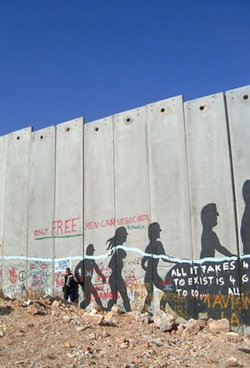
The Industrial Workers of the World (IWW or Wobblies) has officially voted to support the Boycott, Divestment and Sanctions (BDS) movement in support of Palestinian rights. The “Resolution in Support of the Workers of Palestine/Israel” was adopted in an overwhelming vote both at the IWW’s convention in Minneapolis and by the membership via referendum. This vote makes the IWW the first union in the US and the third union in Canada to officially support the Palestinian United Call for Boycott, Divestment and Sanctions.
Inspired by the struggle against apartheid in South Africa, the BDS movement calls for boycott, divestment and sanctions against Israel until such time as fundamental Palestinian rights are recognized. The BDS call is supported by a broad cross-section of Palestinian society, including Palestinian unions.
The resolution to support the BDS campaign comes out of the work of the IWW’s International Solidarity Commission and the IWW Friends of Palestinian Workers Group, a grassroots network of Wobblies supportive of the Palestinian, Israeli and international struggle against Israeli apartheid. Support for the BDS campaign was also stressed by all the Palestinian workers who met with members of the IWW on the IWW delegation to Palestine, particularly the Independent Workers Federation of Palestine, with whom the IWW shares a close bond of solidarity.
“For a union concerned with international solidarity, supporting the BDS movement is the right thing to do”, said IWW member Nathaniel Miller, who serves on the International Solidarity Commission and attended the IWW delegation to Palestine. “By officially supporting this BDS call, the IWW stands shoulder to shoulder with Palestinian workers in a global picket line against Israeli apartheid.”
“Our support of the BDS movement is in line with traditional wobbly principles of anti-racism and international solidarity”
The IWW Friends of Palestinian Workers Group resolves to continue to advance the cause of Palestinian rights inside and outside of the IWW.
Founded in 1905, the IWW is a union with a long tradition of solidarity and anti-militarism, and has been central to some of the most important struggles in US working class history. More recently, the IWW has been successful organizing at Starbucks and in the fast food industry, among workers long thought to be unorganizable. The IWW is an international union, with members across North America, Europe, Australia, and South Africa.
IWW Friends of Palestinian Workers Group
Phone – 610-209-1447
E-mail – nathaniel [at] iww.org
Web – www.iww.org/projects/isc/palestine
The Tangled Web of the Grand Rapids Press

Last week, we reported on the number of racist, homophobic, and harassing comments that readers of the Grand Rapids Press were posting on its MLive website. Several people asked if we could contact the Press directly to talk about the problem with them, see if they were aware of its extent, and find out exactly how the site was monitored.
In the meantime, Editor Paul Keep made a big, although rather vague, announcement in Sunday’s paper: that the Press was making the shift to its long-hinted-at focus on its online edition. Keep calls this “Web-first, print-important.” This seems to mean that the Press will continue to issue a printed paper, but focus on its website content first. The announcement was short on details; Keep himself noted that the change’s “dimensions are somewhat murky.” But it seems clear that the Press considers its website the lifeboat of the newspaper.
GRIID attempted to contact Paul Keep with no luck last week, but the Sunday article announced that online editor Meegan Holland was now in charge of the web edition. I called her on December 20, and she spent a significant amount of time explaining how the MLive site was monitored.
First, Holland made it clear that the Press is concerned about the vitriol and racism being posted daily about its articles. She said that in the past week, she had been engaged in “a number of intense talks” with MLive about the hate-speech posts, and added, “We’re upset about it, and our exploration of this issue has support from top to bottom here.” She added that the Press staff also had a meeting last week about the subject, stating, “Everybody felt that something must be done. We really need to be digging in and addressing this.” The new “web-first” strategy, she noted, has made the problem a priority.
Asked if having a large number of comments on each article was an editorial goal, Holland replied, “We want the website to keep rolling; our goal is to have lots of comments.” This statement agrees with a comment she made in a Press article from January 15 of this year. But Holland made it clear that no one on staff wanted that at the expense of hate speech, and that there was no encouragement by management to leave posts up just to up the number of comments per thread.

Holland verified what another Press reporter had told GRIID earlier: that each writer was encouraged to read his or her comments and attempt to monitor them; but because of the reduced size of the staff and the demands on the remaining employees, many reporters were only able give this task limited time.
One surprise was that the chief monitoring came not from the Press or MLive, but via Advance Internet. Advance hires a team of subcontracted “sweepers” to review posts and remove them. However, Holland says that the Press is also reliant on reader input. “It takes a community,” she said. Readers using the Alert button and reporting offensive messages seemed to be one of the most reliable methods the Press had currently to keep up-to-date on the removal of offensive posts. Holland said, “We really need the community’s help.”
Other problems with the monitoring of the site that Holland discussed were anonymous posting, the “Most Comments” list, and the idea of having a voting system to vote comments up or down.
Holland stated that the Press was committed to anonymous posting. She said there were legitimate reasons for this: it allowed people to avoid repercussions from employers, church members, etc. I pointed out that anonymity was also the chief feature that allowed the hate speech to thrive. No one had to accept personal responsibility for what they posted online. I also told her that there was a growing movement among some readers to change their account names to their full, real names and then demand that hate-speech authors do the same. You can find this grass-roots activity in a number of threads now.
The “Most Comments” list appears at the right side of the screen, and shows account names with the largest number of posts per week. Both Holland and I agreed that this rewarded the regulars who tended to post the most offensive comments.
Holland seemed to feel that voting individual comments up or down would be a good addition, but I told her that because this regular hate-speech gang online was so active, it seemed this would just give them the means to remove any commentary that challenged their views from the site.
While it’s encouraging to learn that the Press is addressing this problem with serious intention, one hopes that the newspaper won’t end up taking a fall-back position of giving readers the main responsibility for monitoring the site. And until the Press puts solutions in place, the hate speech continues unabated. From this week’s articles, here are a few examples:
An article about a Black woman who sued the United Way for discrimination on the job elicited many comments by people assuming that she was just attempting to “blackmail” the company and her claim was baseless, even though the EEOC found that her case had merit. The article caused one reader to make the strange and racist assumption that since most of the people who benefited from United Way programs were Black, no settlement for the discrimination suffered by the employee should be made: …$250,000 in punitive damage to a person that suffered no physical or mental harm being taken away from an organization that raises money for hundreds of local charities, many if not most, serving black clients is just plain selfish.
Other comments included:
• I think Dire Straits said it best: “You get your money for nothin and your chicks for free!” This woman sounds like she was lucky to even have a job. It is becoming way too easy to throw out the race card these days.
• I have seen this so many times, and it is alarming how often people cave in to this kind of blackmail…I’d fire her now on my first opportunity for the smallest infraction. She needs to be out of there. She will try to sue again, because she’s the type, and needs to be ousted. That’s what you get for playing your card.
• This is a perfect example of why you cannot hire a black person for any job.
Attached to a cross-posted article the GR Press featured from Muskegon about how minimum wage eliminates jobs, there was this statement that seems to argue for minimum wage, but with a disturbing, hate-speech slant:
Slaves who are starved to death don’t do much work, and letting them die and constantly having to replace them is highly inefficient, thus costly. Even fleshless machine tools require the expense of regular maintenance…In conclusion, minimum wage has the same onus today, as meeting the basic needs for slaves did in plantation days. And it must be raised periodically to adjust for the increasing costs of those needs. Very basic logic, what?
A number of posts argued that corporations should not be made to pay minimum wage because profits suffer, and included these:
• Minimum wage is a job killer. In the middle of a resesion/depression, in the midst of widespread unemployment where people can’t afford to purchase extra items, if sales are down, how can a business afford to pay more?
• Minimum wages does nothing more than increase labor costs without regard to productivity. In the early years of minimum wage it was a way for unions to keep blacks from getting their jobs.
And the vitriolic blaming of the unemployed for their own plight was on full display in comments on two stories about extending unemployment benefits. About one of the featured unemployed people in an AP wire story, one author wrote: Uh ms.smith, from the picture look’s like you haven’t miss a meal so I really don’t think you are having a bad time… So you have been collecting unemployment for 18 month’s wow! Is this the set standard for unemployment ins? Heck go on welfare after being “unable” to find work after 18 month’s. Hey kid’s can you say the word “Lazy”.
Other comments included:
• People, there are employers screaming for employees – some even offering free housing! But giving up a guaranteed $477 a week before taxes, food stamps, heating help, free this and free that, might be hard to do. In that case, unemployment is a choice.
•It is tiresome to be forced to carry the burden on our backs of all the feel-sorry-for me whiners.
• If people are losing their jobs in their 50’s and are homeless in a year then you obviously didn’t save or spend your money wisely.
• ohhhh look the free money money…Bunch of unemployed useless bums.
Let’s hope that the Press finds workable solutions to this situation soon.
21st Anniversary of the 1989 US Invasion of Panama
Twenty-one years ago the US military invaded the Central American nation of Panama under the pretext of the War on Drugs. It is worth revisiting this bit of US history since it can shed light on current US foreign policy.

President George Bush Sr. told the American public that Panamanian leader Manuel Noriega was a dictator and a thug. The US military mission in Panama was to “restore democracy” and was named Operation Just Cause.
I remember that the propaganda campaign was so well received by the American people that even many “peace” groups were not opposed to the removal of Noriega. This was the case in Grand Rapids, where few people were willing to question of challenge the invasion.
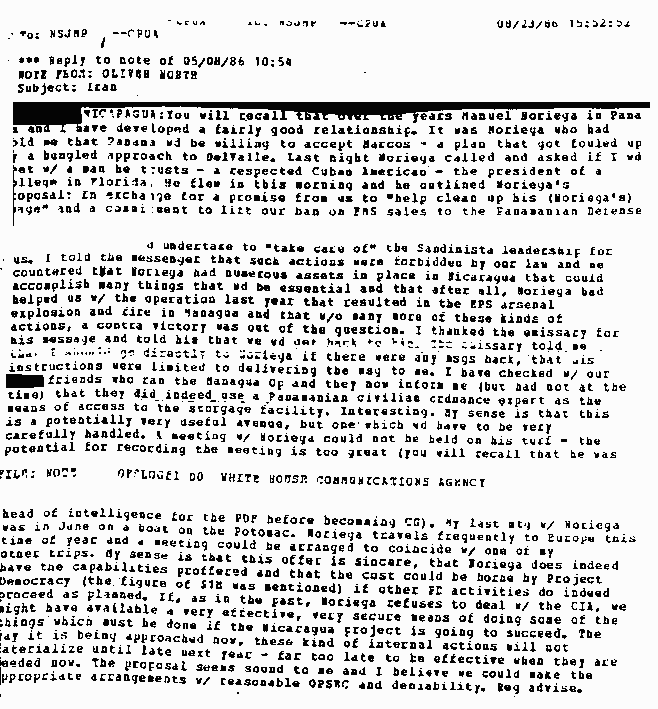
Noriega was a thug and had been involved in drug trafficking for decades. However, it is important to note that the US was aware of his drug trafficking activities, since Noriega was a CIA asset since the early 1970s. In fact, when George Bush Sr. was Director of the CIA and Vice President he and Noriega had close relations. According to Bill Blum, author of Killing Hope: US Military and CIA Interventions since WWII, Noriega was on the CIA payroll for at least two decades.
Numerous former DEA agents have noted that Noriega was involved in drug trafficking while he worked as a US government asset. Former drug trafficker Col. Oliver North acknowledged this relationship is numerous cables that are now declassified and organized by the National Security Archives. In one memo, North states, “You will recall that over the years Manuel Noriega and I have developed a fairly good relationship.”
The evidence is overwhelming that Noriega was trafficking in drugs while working directly with the US government. If that is the case, what was the real reason that Noriega was targeted in late 1989? According to Noam Chomsky, Noriega was targeted because he opposed the US Contadora Peace Process and supported the Central American initiation Esquipulas Peace Plan. The Esquipulas Peace Plan did not seek to marginalize the Sandinista government from the rest of the Central American nations and since the US had been waging a covert and economic war against Nicaragua since 1980, Noriega’s failure to support the US plan cost him dearly.

However, beyond deposing Noriega, the US also used the invasion of Panama to test new weapons systems, something that happens in almost every US intervention. One of those weapons was a stealth bomber that targeted civilians neighborhoods, particularly that of El Churro. The bombing was intense and contributed significantly to the estimated 4,000 civilian deaths at the hands of the US military, according to a United Nations report.
The level of war crimes was serious and provides a clear example of the ongoing double standard of US foreign policy. Just months after the US had killed thousands of Panamanian citizens, George Bush Sr. condemned the Iraqi invasion of Kuwait. Bush’s condemnation of Saddam Hussein would have easily been applied to the US for their invasion of Panama in 1989.
In addition to the US hypocrisy demonstrated in Panama the US media did not question the pretext of the invasion. In fact, the mainstream commercial media tended to reflect the general attitude of the White House and bought into the demonization of Noriega without providing any historical context.
The US military also used Press Pools, where they selected specific news agencies to come to Panama, but controlled their itinerary preventing them from doing any investigative reporting. This issue and many others are explored in detail in the award winning documentary, The Panama Deception. Twenty-one years later it would do us all well to think about how the 1989 US invasion of Panama is relevant today.
Democrats Push through Yet Another Anti-Palestinian Resolution
(This article by Stephen Zunes is re-posted from Common Dreams.)

Though outgoing Speaker of the House Nancy Pelosi has insisted that there just isn’t enough time for the lame duck Democratic-controlled Congress to consider much of the progressive legislation on the docket prior to the Republican takeover early next month, she and other Democratic leaders did find time last Wednesday to pass a resolution condemning efforts by Palestinian moderates to seek recognitionof a Palestinian state alongside Israel.
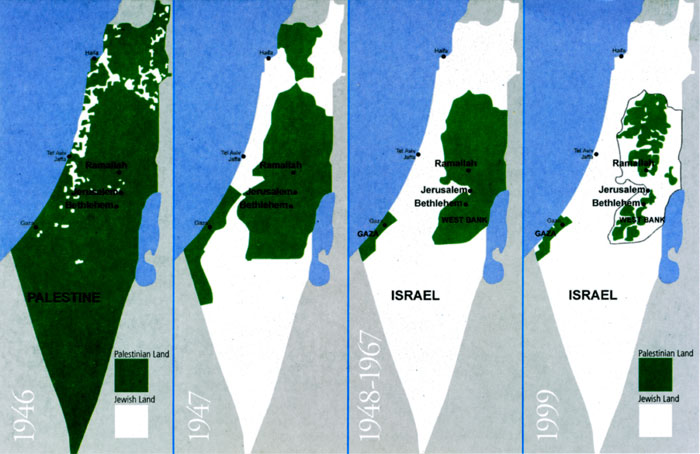
The Oslo accords were signed in 1993 with the vision of Israel’s eventual withdrawal from the occupied West Bank and Gaza Strip and the establishment of a Palestinian state alongside Israel. This was an enormous compromise on the Palestinian side, given that such a state would leave them with only 22% of their historic homeland, the rest of which became the state of Israel in 1948. Right-wing Israeli politician Benyamin Netanyahu, then in opposition, denounced the agreement and promised to derail it. As prime minister in the late 1990s and again since his coming to office again in last year’s election, he has been doing his best to accomplish this by colonizing large swathes of the West Bank with illegal settlements for Israeli Jews which he insists must be annexed into an expanded Israel. The moderate Palestinian Authority president Mahmoud Abbas, by contrast, has been working toward the implementation of the Oslo Accords, offering strict security guarantees for Israel in return for an end to the occupation.
Nevertheless, the Democratic leadership in the House of Representatives has insisted that it is the Palestinians, not the Israelis, who are responsible for the breakdown in the peace talks. Recognizing that talks are pointless while Israel’s colonization drive continues and noting the Obama administration’s ongoing refusal to exercise its extensive leverage to force Israel to stop building new settlements, the Palestinians have understandably refused to return to direct negotiations until Israel suspends its colonization drive, which has been condemned as illegal by the UN Security Council, the International Court of Justice, and virtually the entire international community. However, Rep. Gary Ackerman (D-NY), whom the Democrats put in charge of the House Foreign Affairs subcommittee on the Middle East , insisted during last Wednesday’s debate, that “Israel has shown time and again that it is ready” to make peace and that Palestinians’ objections to Israelis colonizing their land were “overwrought.”
To help put pressure on Israel and the United States to move the peace process forward, the Palestine Authority has been soliciting international recognition of an independent Palestinian state in the West Bank and Gaza Strip. During the past couple of weeks, Brazil, Uruguay, Argentina, and Norway have done just that. This is what prompted the House resolution, introduced by House Foreign Affairs committee chairman Howard Berman (D-CA), who serves as the House Democrats’ chief foreign policy spokesman.
The Democratic leadership in the House has long argued that Israel’s attacks on civilian population centers in Gaza Strip and elsewhere are legitimate self-defense and that it is the Palestinians, not the Israelis, who are making peace impossible. Pelosi, for example, insists that the conflict is about “the fundamental right of Israel to exist” and that it is “absolute nonsense” to claim it has anything do to with the Israeli occupation. One would think, then, that this Palestinian effort to achieve recognition for a state which explicitly defines the borders as exclusively those occupied by Israel in the June 1967 war and not any part of Israel itself would be welcomed. But, to the Democrats, Palestinians asking for even just 22% of Palestine is too much. Rising in support of last Wednesday’s resolution, Rep. Elliot Engel (D-NY) called it “preposterous” that a Palestinian state should be created based on the requirements of UN Security Council Resolution 242, which from Presidents Lyndon Johnson through George H.W. Bush had been recognized as the basis of Middle East peace, which called for Israeli withdrawal from the occupied territories in return for security guarantees. Similarly, Rep. Berman threatened the Palestine Authority by saying, “If they persist in pursuing a unilateralist path . . . there will be consequences.”
Congress has correctly condemned violence by extremist Palestinian extremist groups like Hamas, yet when the Palestine Authority tries to advance their freedom through nonviolent means, such as these diplomatic initiatives, the Democrats are just as quick to condemn them as well. Indeed, earlier in their careers, Berman, Ackerman, Engel, Pelosi and other Democratic leaders were on record opposing any kind of Palestinian statehood, changing their view reluctantly only years later. However, they insist that whatever kind of Palestinian “state” may emerge can only be on what the Israeli occupiers are willing to allow them to have, even if all that is left is a series of small non-contiguous cantons surrounded by annexed Israeli settlement blocs. Taking any initiative to advance their independence separate from what the rightist Israeli government can agree to, according to the Democratic leadership, is completely unacceptable.
One can only think of how Dr. Martin Luther King, Jr., in his “Letter from a Birmingham Jail,” noted that the greatest obstacle to the advance the cause of justice is one who “paternalistically believes he can set the timetable for another man’s freedom.”
Recognizing that most ordinary Democrats oppose the Israeli occupation and would likely put pressure on their representatives to vote against the resolution, Berman and Pelosi put the vote on last Wednesday’s agenda before the text was even made available to other House members. This made it impossible to have any hearings, give any time for constituents to express their opposition, or even allow the Obama administration to offer an opinion. Also fearing opposition from Democratic House members who might be concerned at rousing the anger of their liberal constituents, Berman and Pelosi refused to have roll call vote and instead brought it up under a procedure known as “suspension of the rules,” a procedure normally used for non-controversial measure like honoring a recently-deceased eminent figure. Doing it this way not only limits debate and makes it impossible to attach amendments, it allows a resolution to pass by a non-recorded voice vote and to automatically be recorded as “unanimous.” Only ten representatives were on the floor when the resolution was passed by “unanimous consent.”
This kind of cynical maneuvering by the Democratic Party leadership is unfortunately quite typical of how they have handled resolutions dealing with the Israeli-Palestinian conflict during their four years in the majority. It raises the question as to whether the Republicans can do any worse.
Unfortunately, the answer is probably yes. While a growing minority of Democratic House members are finally listening to their liberal constituents’ concerns about U.S. backing for Israeli occupation, colonization and repression, the Republicans – outside of Rep. Ron Paul (R-TX) and a few others of a more libertarian orientation – are solidly aligned with the rightist Israeli government. We can only expect more such resolutions in the coming Congress.
Community Radio Act
(This article by the Prometheus Radio Project is re-posted from ZNet.)
Today a bill to expand community radio nationwide – the Local Community Radio Act – passed the U.S. Senate, thanks to the bipartisan leadership of Senators Maria Cantwell (D-WA) and John McCain (R-AZ). This follows Friday afternoon’s passage of the bill in the House of Representatives, led by Representatives Mike Doyle (D-PA) and Lee Terry (R-NE). The bill now awaits the President’s signature.
These Congressional champions for community radio joined with the thousands of grassroots advocates and dozens of public interest groups who have fought for ten years to secure this victory for local media. In response to overwhelming grassroots pressure, Congress has given the Federal Communications Commission (FCC) a mandate to license thousands, of new community stations nationwide. This bill marks the first major legislative success for the growing movement for a more democratic media system in the U.S.
“A town without a community radio station is like a town without a library,” said Pete Tridish of the Prometheus Radio Project, the group which has led the fight to expand community radio for ten years. “Many a small town dreamer – starting with a few friends and bake sale cash – has successfully launched a low power station, and built these tiny channels into vibrant town institutions that spotlight school board elections, breathe life into the local music scene, allow people to communicate in their native languages, and give youth an outlet to speak.”
The Local Community Radio Act will expand the low power FM (LPFM) service created by the FCC in 2000 – a service the FCC created to address the shrinking diversity of voices on the radio dial. Over 800 LPFM stations, all locally owned and non-commercial, are already on the air. The stations are run by non-profit organizations, local governments, churches, schools, and emergency responders.
The bill repeals earlier legislation which had been backed by big broadcasters, including the National Association of Broadcasters. This legislation, the Radio Broadcast Preservation Act of 2000, limited LPFM radio to primarily rural areas. The broadcast lobby groups claimed that the new 100 watt stations could somehow create interference with their own stations, a claim disproven by a Congressionally-mandated study in 2003.
Congressional leaders worked for years to pass this legislation. As the clock wound down on the 111th Congress, they worked with the NAB to amend the bill to enshrine even stronger protections against interference and to ensure the prioritization of full power FM radio stations over low power stations.
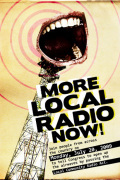
Though the amendments to the bill will require some further work at the FCC, low power advocates celebrated the first chance in a decade for groups in cities, towns, and other communities to take their voices to the FM dial.
“After ten years of effort, a $2.2 million taxpayer-funded study, and new provisions to address this hypothetical interference, we are finally on our way to seeing new community radio stations across the U.S. This marks a beginning, not an end, to our work,” said Brandy Doyle, Policy Director for the Prometheus Radio Project. “For the first time, LPFM community radio has a chance to grow, and we’re ready to seize that opportunity.”
“All of us at UCC OC Inc. and at Prometheus express our incredible gratitude to Congressmen Mike Doyle and Lee Terry and Senators Maria Cantwell and John McCain for the leadership and counsel during this process,” said Cheryl Leanza, a board member of the Prometheus Radio Project and a Policy Advisor to the United Church of Christ, Office of Communication, Inc.“Without their work and the work of their committed staff we would not have come this far. At long last the 160 million Americans who have been deprived of the opportunity to apply for a local low power radio station will get a chance to be a part of the American media.”
“I am a leadership organizer from the ranks of the poor working with other low-wage workers – fighting for human rights in Maryland,” said Veronica Dorsey of the United Workers, a human rights organization in Baltimore. “Low power FM radio would allow the United Workers to expand the message of our End Poverty Radio show, which is currently only available on the internet. End Poverty Radio develops leaders and gives workers a way to tell their stories and be heard – and a low power FM station would reach a lot of people who do not have access to the internet. LPFM is a way for those in the community who are struggling to survive to hear stories that they can relate to, and to know that they are not alone in this struggle for human dignity. We can’t wait to work to build low power FM in communities like ours, so we can accomplish these goals.”
“Civil rights groups and community organizations have wanted low power FM radio for years, and now the chance is here,” saidBetty Yu, coordinator of the Media Action Grassroots Network, a national media justice network with members in many cities and communities that lost their chance to get low power FM radio stations. “From Seattle, Oakland, and Albuquerque to Minneapolis, San Antonio, Kentucky and Philadelphia, thousands of communities know that having access to our own slice of the dial means a tool to build our movements for justice. We have won something huge in Congress, but the fight is not over. Now we need to work at the FCC to make sure as many licenses as possible can be available in rural communities, towns and suburbs, and America’s cities.”
LPFMs have saved lives in powerful storms when big broadcasts lose power or can’t serve local communities in the eye of the storm. WQRZ-LP in Bay St. Louis, MS received awards from President Bush and other organizations post Katrina in 2005, when one of the station operators swam across flood waters with fuel strapped to his back to keep his station on the air.The station proved so important that the Emergency Operations Center of Hancock County set up shop with the LPFM to serve the community after Hurricanes Katrina and Rita. Bipartisan Senators and House members have expressed support for the Local Community Radio Act as a vital way to expand emergency service media across our nation.
“I’m Frank Bluestein from Germantown, Tennessee, one of the several large suburban cities located just outside of Memphis. We have been fighting for the past 10 years to persuade Congress to give communities like ours the opportunity to establish a low power FM radio station. Our city wants to provide community and civic groups, students of all ages, local artists and others the power to communicate over their own LPFM channel,” said Frank Bluestein, a media teacher and Executive Producer of Germantown Community Television.
“Equally important for Germantown, we need a dedicated communication outlet that will serve the needs of our citizens in the event another tornado rips through town or if any kind of natural disaster hits,” continued Bluestein. “In this day and age, emergency management is a must for a city of our size and LPFM perfectly fits our needs. A low power FM radio station can stay on the air even if the power goes out. Low power FM saved lives during Katrina but strangely, the federal government is banning it from this part of Tennessee. That is not fair or wise. We have the right to be as safe as any other community in the US. After 10 years, now is the time! Congress has passed the Local Community Radio Act, and chances are so much greater that groups in towns like mine can apply for LPFM licenses. Germantown is ready to work here and at the FCC to make licenses for communities like ours possible.”
Grassroots leaders were key in helping Senators understand that expanding low power FM was important and urgent. “Our station provides some of the only local service to Gillette when big storms come through, and it puts great content on the air. That’s why so many in our town think it is such a vital resource,” said Pastor Joel Wright of the First Presbyterian Church of Gillette, WY, licensee of KCOV-LP 95.7 FM . “Senators Barrasso and Enzi had concerns about expanding low power FM, but they heard from many Wyoming folks who want these stations, and dropped those concerns. Communities of faith and so many others can celebrate that we’ve jumped this big hurdle to more license being available in cities, smaller towns, and rural communities nationwide. I look forward to working with many other pastors and groups to launch their own wonderful new community voices.”
“The Media Mobilizing Project works with a huge diversity of leaders across Philadelphia — from taxi drivers and immigrant communities to students and low wage workers,” said Desi Burnette of Philadelphia’s Media Mobilizing Project. “Our leaders have been lucky enough to produce multiple programs with WPEB-FM, 88.1 – bringing all of these communities together. But WPEB is a 1-watt station, only covering a few city blocks. Now with the passage of the Local Community Radio Act, Philadelphia has a much greater chance of getting at least one 100-watt station of its own. With low power FM in our community, poor and working people across this region would have an incredible tool to learn together, to understand their shared struggles and conditions, and to work to change them.”
“Our low power FM radio station has allowed Guatemalan, Haitian, and many other hard-working immigrant farmworkers to communicate in their native languages, and to build the power for dignity and respect in the fields of Southwest Florida,” said the Coalition of Immokalee Workers’ Gerardo Reyes Chavez. “Our radio station, WCIW – Radio Consciencia – has developed womens’ leadership, has allowed us to mobilize rapidly in crises, and has helped us transform not just our community but the hundreds of communities inspired by our struggle. We look forward to helping many other farmworkers learn how to build their own stations and how to expand justice on the FM dial.”
“In the rural areas we serve and all across the country, low power FMs are poised to celebrate and preserve unique local culture,” said Nick Szuberla of Appalshop, a group that uses media to preserve Appalachian culture and tradition while working to improve quality of life. “More low power FMs mean that the vibrant, beautiful, and vital voices of America’s rural areas and small towns will shine – and it will mean sustainable local resources in times of crisis. Low power FM stations can stay on the air in storms and save thousands of lives. Congress and community radio advocates should be proud of the resources they’ve won for American communities.”
“Our group of 150 volunteers here at the Chicago Independent Radio Project (CHIRP) is extremely pleased that the Local Community Radio Act has been passed by Congress, and will be signed into law by our fellow Chicagoan, President Obama,” said Shawn Campbell, a founder of CHIRP. “For three years, CHIRP volunteers and supporters have worked diligently toward the goal of being able to apply for a low power FM broadcast license, and we look forward to working with our national allies and the FCC to make sure new stations are licensed in large markets around the country, including Chicago.”
“For decades, the Esperanza Center has worked in San Antonio and beyond to bring people together across cultures, and to ensure the civil rights and economic justice of everyone,” said Graciela Sanchez of the Esperanza Center for Peace and Justice in San Antonio. “Whether we are fighting for the right to publically protest or to save the water systems of our region, we need to communicate and coordinate to effectively organize. Low power FM in San Antonio can unite people across cultures and issues to work together to make this city better for everyone. We celebrate this victory for everyone and pledge to work with allies to win as many stations as possible for communities nationwide.”
Over 10 years, hundreds of groups of all walks of life struggled to bring community radio stations to every community possible, and they cannot all be listed here. We would like to thank the coalition who worked weekly to move this mountain including: Free Press, United Church of Christ Office of Communication, Inc, U.S. Conference of Catholic Bishops, Media Access Project, the Future of Music Coalition, the Media and Democracy Coalition, the Leadership Conference on Civil and Human Rights, the National Hispanic Media Coalition, the Benton Foundation, the Prometheus National Advisory Committee and Board of Directors.
“We’ve built community radio stations from coast to coast and around the country,” said Hannah Sassaman, a longtime organizer with the Prometheus Radio Project. ‘The faith and perseverance of low power FM’s legislative champions and the thousands who pushed the Local Community Radio Act has paid off in incredible ways. After ten years of struggle, it’s stunning to know that in the next years, the FCC will work to and begin licensing LPFMs in city neighborhoods, in suburbs and towns, and in rural areas. It’s humbling to understand that new young people will gain a love of telling stories at the working end of a microphone or at home listening to their neighbors. And it’s powerful to know that these stations will launch leaders in every walk of life to change their communities, and this country. We look forward to launching the next generation of community stations with you.”
To learn more about low power FM community radio, visit http://www.prometheusradio.org.