Anti-Immigration Legislators seek to alter 14th Amendment
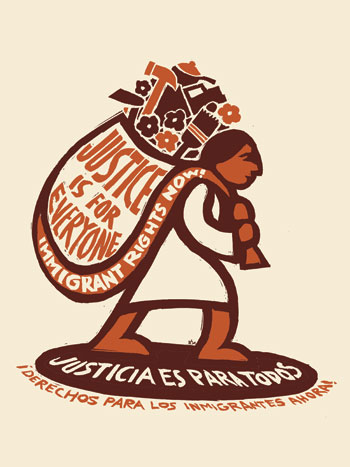
On Wednesday it was announced that six state legislators from Arizona, Georgia, Oklahoma, Pennsylvania, and South Carolina were submitting a proposed legislative amendment that would drastically alter the 14th Amendment to the US Constitution.
Not surprising is the fact that one of these legislators is from Arizona, a state which has led an effort to make it even more difficult for documented and undocumented immigrants to have a chance at making a life for themselves and their families in the US.
Then on Thursday, Iowa Republican Steve King added his name to the list of legislators wanting to alter the 14th Amendment and introduced H.R. 140, the “Birthright Citizenship Act of 2011.” Congressman King issued the following statement to clarify his support for this legislation:
“The current practice of extending U.S. citizenship to hundreds of thousands of ‘Anchor Babies’ every year arises from the misapplication of the Constitution’s citizenship clause and creates an incentive for illegal aliens to cross our border. The ‘Birthright Citizenship Act of 2011’ ends this practice by making it clear that a child born in the United States to illegal alien parents does not meet the standard for birthright citizenship already established by the Constitution. Passage of this bill will ensure that immigration law breakers are not rewarded, will close the door to future waves of extended family chain migration, and will help to bring an end to the global ‘birth tourism’ industry.”
Numerous national civil liberties and immigrant rights groups have responded rapidly to such a draconian measure. The National Council of La Raza said, “These thoughtless and unnecessary proposals take our country in the wrong direction—away from inclusion and away from our core American values. The citizenship clause is a bedrock principle of civil rights and part of what makes us all Americans. Never in our nation’s history have we amended the Constitution to take away someone’s rights, and we should not do so now.”
The National Immigration Law Center responded in part by saying, The legislators who threaten to roll back this sacred value do more than play fast and loose with the Constitution; they suggest that we as a society should treat some American children less favorably than other American children. The National Immigration Law Center stands with civil rights, children’s advocacy, and faith organizations, as well as millions of American parents, who condemn this attack on babies.”
Lastly, Lucas Guttentag, Director of the ACLU Immigrants’ Rights Project, said, “It would be hard to concoct a proposal that is more misguided and contrary to the sacrosanct guarantee of the 14th Amendment. Equality under the law for every person born in the United States is one of the Constitution’s central engines of equality and fundamental to our society.”
GRIID will continue to monitor this proposed legislation and post additional analysis as this unfolds. In the meantime there is an online petition being circulated by the National Council of La Raza.
Crime Coverage: Race and Class factors in reporting
I was asked to give a presentation today to a group of Calvin students on how crime coverage in news media influences public perception. What follows are the points and examples used in that presentation.

There is the old TV news statement, “If it bleeds it leads,” a statement that tends to be misunderstood. In conversations with people over the years of doing local news analysis people would often say that crime was big new because that is what viewers wanted. However, this is just not the case and there is no evidence to support such a notion.
The reality is that news entities, particularly broadcast news do lots of crime stories for a variety of reasons. First, most news stations have police scanners in the newsroom and are monitoring police activity in order to have reporters on the scene as crimes are unfolding.
Second, crime coverage is easy to produce. The story is sort of there for reporters to just fill in the blanks. You have police line and other visuals that make it a compelling story, plus you have built in people to interview – police, witnesses, victims and sometimes suspects.
Look at this example of a crime story from channel 8 a few years ago. The story is typical in that it is short and does not provide much context for viewers, which often can lead to confusion, stereotypes and maybe even fear.
After viewing this story can you honestly say you knew what it was about? What value does it provide for public safety? How do you perceive the suspect in this story and the role of the police?
Race and Crime
A third aspect of how crime coverage is produced that is worth mentioning has to do with location and representation. More often than not crime coverage is presented as an urban issue, which statistically is somewhat misleading……..However, it is more convenient for the 3 Grand Rapids-based TV stations to report on urban crime since they are also in the city. News stations have time constraints, so reporting on urban crime is also a practical matter.
However, this focus on urban crime can lead to misinformation, particularly when it comes to racial representation. From 1998 through 2006 GRIID used to monitor 4 and a half hours of local TV news. We published numerous reports on race representation and in all of those reports we looked at race representation in crime coverage.
Statistically, the racial make up of people who were the subjects of news stories generally were 90% Caucasian, 6-8% African American and the rest of the percentages were made up of Latinos, Asian-Americans, Arab-Americans and Native American. However, when we looked at the representation of crime suspects in news stories the percentages changed drastically and were generally 45-50% Caucasian, 35-40% African American and 10-15% Latino. Here Caucasian representation dropped from the overall news representation, but for African American and Latino the numbers go way up.
How do these dynamics influence public perception? If viewers disproportionately see African American and Latino crime suspects in high numbers, but little non-crime representation from either group, does that increase the chances that people may perceive African Americans and Latinos as more likely to engage in criminal behavior?
When it comes to specific stories, there can also be a bias in reporting, particularly how a story is framed. Look at this story from several years ago by WZZM 13 and think about how the story is framed as well as their use of police footage in the story.
Does the reporter treat the comments from the African American leaders differently than the police chief? Do you think that the police footage used was edited? If it was edited, was that the decision of the police or the news station? How does the use of the police footage influence public perception about crime and who commits it? Lastly, how does the community benefit from viewing this kind of footage?
Street Crime vs Corporate Crime
Another area that should be discussed when the issue of crime coverage is raised has to do with the difference between White collar crime or Corporate crime and street crime. Both are very real, but more often than not people don’t think of corporate criminal acts when they think of crime.
The fact that corporate crime is not often the subject of news coverage says something about how reporters, editors and news directors internalize the values of a system, which do not question this clear class difference. This is not to say that corporate crimes never get reported (think of Enron), but they do get reported less frequently and are often framed differently.
According to the information compiled by the group Corporate Crime Reporter (CCR), corporate crime should be equally (if not more so) a focus of news coverage. The research of CCR shows that on average street crimes cost society around $4 billion dollars in the US each year. Comparatively, corporate crime costs us all hundreds of billions of dollars. Think about the 2008/09 Wall Street Bailout, which cost taxpayers $700 billion and counting.
Some will say that another major difference between street and corporate crime is that corporate crime is not violent. Again, the CCR research shows that roughly 16,000 people are killed each year from street crime, but 56,000 Americans die every year from either on the job or from workplace caused illness (such as asbestosis).
Lastly, there is the issue of access and influence. People who commit street crimes do not tend to have access to people in power – lawyers, judges, law-makers. People in the corporate world and even those who commit corporate crime do have access to political power, so much so that they have even been able to re-write laws that actual favor the kinds of practices that most of American society would consider criminal.
If news agencies were to begin to adopt a similar approach to reporting on corporate crime as they do with street crime, imagine what that might look like. Would we see lead stories about landlords who exploit tenets? How about a crime watch style of story where we are all told to be on the look out for some guy in a business suit, because he might be responsible for toxins in your food or water. And how about violent crime coverage such as profiling or investigating into private contractors that are making billions by profiting off of war? Would the TV stations use graphics with the outline of a body to convey the brutal nature of such crimes?
Several years ago the Project for Excellence in Journalism published a report that demonstrated that not only are viewers sick of so much crime coverage, they actually wanted more stories about positive things happening in their communities. Crime coverage does not need to continue to be reported on the way most of it is done now and the burden of proof lies at the feet of news agencies to demonstrate to all of us what the public benefit is to such reporting.
Daniel Ellsberg and WikiLeaks: Film and discussion will explore implications for social change
Daniel Ellsberg Film & WikiLeaks Potluck Discussion
2 – 4 p.m. Sat. Jan. 15
The Bloom Collective
671 Davis NW, Grand Rapids
(Corner of 5th & Davis)
Bring a dish to pass. Vegan options provided. $3-$5 suggested donation.

A 2010 release, the film The Most Dangerous Man in America: Daniel Ellsberg and The Pentagon Papers takes viewers back to 1971 when Detroit native and Pentagon analyst Dr. Daniel Ellsberg leaked The Pentagon Papers to the Washington Post and 17 other newspapers. This secret history of U.S. involvement in Vietnam revealed that the nation’s leaders, Republican and Democratic alike, had lied, “proclaiming their desire for peace while seeking a wider war, declaring fidelity to democracy while sabotaging elections, and exhibiting a sweeping callousness to the loss of both Vietnamese and American lives,” as the film’s website says.
From 1964 to 1967, Ellsberg worked in the Pentagon and then for General Edward Lansdale in Viet Nam. In 1969, he began attending anti-war events. His epiphany came while listening to a speech by draft resister, Randy Kehler, who later did time in prison for refusing to serve in the military.
“It was the example he was setting with his life. How his words in general showed that he was a stellar American, and that he was going to jail as a very deliberate choice—because he thought it was the right thing to do,” Ellsberg recalled. “There was no question in my mind that my government was involved in an unjust war that was going to continue and get larger. Thousands of young men were dying each year. I left the auditorium and found a deserted men’s room. I sat on the floor and cried for over an hour, just sobbing.”*
Ellsberg was eventually charged with espionage, theft and conspiracy—he faced a maximum sentence of 115 years. However, when the presiding judge discovered that the government had illegally gathered the evidence against him, the case was dismissed.
 Times have changed. The Patriot Act and increased legal latitude given to the military as far as torture, rendition and assassination don’t bode well for Julian Asange and Bradley Manning. Even so, Wikileaks continues to deliver more sordid details about US Foreign Policy on a daily basis.
Join The Bloom Collective for a discussion about the US government documents that are posted on WikiLeaks, the US government response to this information, how corporate media is spinning the story and, in spite of that spin, the implications for radical social change.
View the trailer:
*Source: Thomas, Marlo et al. (2002). The Right Words at the Right Time. New York: Atria books.
Wyoming eighth-grader empowers her peers to make safer choices
PPWNM Safer Choices
12 – 4 p.m. Jan. 16, 23, 30 and Feb. 6
Plymouth UCC
4010 Kalamazoo SE, Grand Rapids
Free plus students receive a $25 gift certificate and book
Pre-registration required
Last spring, eighth-grader Ellie Grossman came home angry after her first day in sex education class at Wyoming Newhall Middle School. The curriculum was an abstinence only program, Willing to Wait, taught by staff of the Pregnancy Resource Center (PRC), a Grand Rapids pro-life organization offering testing and counseling to people with unplanned pregnancies.
“The curriculum they were teaching is pretty typical of what’s offered in the majority of West Michigan schools,” says Ellie’s mom, Stacy Grossman. “It’s very morality based. The problem Ellie had was that she didn’t think it was right that these people should tell her how she should think or behave–or to abstain from sex until or unless she was married. It left her gay and lesbian friends out of the equation. She asked me, ‘What about people who never get married or what if I’m like you and don’t get married until I’m 30? This is just wrong.’ Ellie felt there was no dialog, just a lecture on how to think, what to do and making her feel guilty if she were to choose to have sex. She knew a friend in her class who had had sex and wondered how he was feeling sitting there through it.”
Numerous studies* have proven that abstinence only sex education has the same results as no sex education at all. The Willing to Wait curriculum also demonized condom use by highlighting failure rates, leaving Ellie’s friends asking among themselves, “Why bother even wearing them?”
“Ellie said a kid would ask a question and the presenter would ignore it. The kids felt shamed. She asked me, ‘Isn’t sex supposed to be a great thing? They made me feel like its awful and horrible.’ The curriculum was withholding information, telling kids they weren’t capable of making good choices,” Stacy relates. “Has anyone ever been able to make better decisions when they are less informed?”
Considering the following statistics*, it’s hard to conceive why local schools and community organizations continue to throw away money on a failed approach:
- The teen pregnancy rate has increased in Michigan and nationwide for the past two consecutive years after 14 years of declines.
- Teen pregnancy and STI rates in Kent and Muskegon Counties are consistently higher than the rates for the State of Michigan as a whole.
- More than 40 percent of Michigan high school students report having had sexual intercourse.
- 218,000 teen births in Michigan cost taxpayers an estimated $5.8 billion from 1991–2004.
- An estimated 50% of sexually active people will contract an STI by age 25.
On the bright side, many more studies have found that comprehensive sex education encourages teenagers to delay sexual activity and engage in protective behaviors if they do become sexually active.
Armed with this data and information provided by Planned Parenthood of Western and Northern Michigan (PPWNM), Stacy and Ellie went to the Wyoming Public Schools reproductive health committee meeting the following week. Stacy says it was Ellie’s passionate presentation about the need for more comprehensive education about sex that swayed the committee and then the school board to vote out the abstinence only curriculum and vote in Safer Choices, Planned Parenthood’s comprehensive sex education program. Safer Choices is now taught in all of the district’s schools.
While Ellie doesn’t think her part was such a big deal, Stacy does. In fact, the new program will not only lower teen pregnancy rates but literally save lives, considering the rising rates of HIV transmission among teenagers in Kent County.
Ellie and Stacy have now broadened their focus to all school districts throughout West Michigan. Mother and daughter are active in a newly formed group, Parent Protection Connection, which provides support and resources for parents and students who want to see comprehensive sex education taught in their schools. The group now has more than 20 parents representing eight different school districts. “Our goal is to educate and advocate for medically accurate, developmentally appropriate and culturally sensitive sex education in schools,” Stacy says.
Stacy and Ellie also helped arrange for an upcoming session of the PPWNM Safer Choices program to be held in their church, Plymouth UCC, 4010 Kalamazoo SE. The free four-week program will meet Sundays from noon to 4 p.m. January 16, 23, 30, and February 6.
“Comprehensive sex education teaches abstinence plus birth control plus information. It’s trusting kids to make healthy choices. It teaches refusal skills, how to develop healthy relationships instead of preaching ‘Don’t have sex!’ And, it’s been proven to work,” Stacy says. “Sex education is not a bumper sticker to be preached but a skill to be learned.”
For information and registration for this and other Safer Choices classes, visit the (PPWNM) Website, call (616) 774-7005 or stop by the PPWNM offices at 425 Cherry St. SE in Grand Rapids. For information or to become involved with Parent Protection Connection, email stacysg@gmail.com.
*Sources: Centers for Disease Control and Prevention, Guttmacher Institute, Michigan Department of Community Health, The National Campaign to Prevent Teen and Unplanned Pregnancy
Leaked EPA Memos May Explain Massive Bee Die-Off
(This article is re-posted from PRWatch.)

The Center for Media Democracy’s guest blogger, Jill Richardson, has done some ground-breaking reporting on the potential cause of the massive bee die-off. According to Jill‘s investigation, leaked U.S. Environmental Protection Agency (EPA) memos reveal that the agency gave conditional approval to pesticides now in wide use, without requiring adequate proof that they are safe to use around honeybees.
In the wake of the new information, beekeepers are starting to blame the country’s massive die-off of honeybees on the pesticides. A leaked EPA memo dated November 2, 2010, discusses Bayer CropScience’s efforts to legalize use of its pesticide clothianidin on mustard seed and cotton crops. EPA gave conditional approval for the chemical in 2003 and let Bayer start selling it, but told the company that they needed to complete further safety testing by a certain deadline to get full approval.

The additional testing was to assure the chemical was safe to use around honeybees. Bayer failed to do the testing for years, and instead sought and received an extension of the conditional permit to use the chemical. When Bayer finally performed the study, they did it in another country, and on crops that aren’t grown much in the U.S. Bayer also used bees that were located on a small patch of treated crops surrounded by thousands of acres on untreated crops — a design that handed Bayer the result it wanted by making the chemical appear safe to use. EPA deemed the defective study acceptable and gave full registration to clothianidin in 2007.
In November, 2010, when Bayer asked to extend use of the pesticide to more types of crops, EPA still did not comment on the inadequacy of Bayer’s study. Beekeepers are incensed at this information, and along with others are asking why EPA allows pesticides to go onto the market before they have been adequately safety tested. They also wonder how sound the science around such studies can be when they are performed by the pesticide makers’ themselves.
How Modern Day Mad Men Are Making Our Kids Fat and Sick
(This article by Kelle Louaillier, executive director of Corporate Accountability International, Other Words, is re-posted from Alternet.)
 The television series Mad Men, set in the early 1960s, shocks young parents today with scenes of children riding in station wagons without seat belts and putting dry cleaning bags over their heads for fun. Thank goodness we know so much more about keeping our kids healthy, we chuckle.
But as any one of the smooth advertising executives from the show would tell you, don’t underestimate the power of a well-crafted sales pitch.
Today, one of the most troubling and fastest growing threats to our children’s health is their diet. Pediatricians have seen an astounding jump for their patients in dangerous, diet-related ailments, such as cardiovascular disease, Type 2 diabetes, and asthma.
The best-documented cause is the increased consumption of fast food. It’s a trend propelled in large part by sophisticated and pervasive advertising aimed at children too young to understand the difference between marketing and facts. Don Draper would be proud.
The American Academy of Pediatrics believes that “advertising directed toward children is inherently deceptive and exploits children under eight years of age.” This past June, a study published in the journal Pediatrics reported that children significantly preferred the taste of food when it was packaged with cartoon characters, and that effect was magnified for calorie-dense, nutrient-poor foods.
 Food and beverage corporations certainly know that advertising works. That’s why these corporations spend more than a half billion dollars each year on advertisements for fast food and toy giveaways targeting teens and children. Despite the attention paid to the childhood epidemic of diet-related disease, they aren’t slowing down their marketing.
In November, Yale University researchers found that preschoolers were exposed to 21 percent more fast food advertisements in 2009 than in 2003. The study from the Rudd Center for Food Policy & Obesity also concluded that large fast food chains only offer parents healthy alternatives for their children 15 percent of the time. Experts consider it the most comprehensive study of fast food nutrition and marketing ever conducted.
Five years before the Yale Rudd Study, the Institute of Medicine, part of the National Academies, concluded that television ads sponsored by food and beverage corporations succeed in getting children to consume large amounts of unhealthy food, leading to a dramatic increase in childhood obesity and diabetes.
The Institute recommended that Congress should step in if the food and beverage industry doesn’t change its ways. Advertising Age said the report could be “a watershed on the scale of the 1964 surgeon general’s report on tobacco.”
It certainly feels like societal attitudes have made a clear shift from viewing the marketing of junk food to kids as an accepted practice to something to be shunned, or even resisted.
By adopting voluntary codes to reduce it, the industry tacitly acknowledges that marketing junk food to kids is wrong. But these steps have proved less than half-hearted and, predictably, ineffective.
For our part, my organization launched a campaign in March to convince McDonald’s to retire Ronald McDonald, its iconic advertising character, and the suite of predatory marketing practices of which the clown is at the heart. A study we commissioned by Lake Research Partners found that more than half of those polled say they “favor stopping corporations from using cartoons and other children’s characters to sell harmful products to children.”
Local elected officials are joining the cause, too. Los Angeles recently voted to make permanent a ban on the construction of new fast food restaurants in parts of the city. San Francisco has limited toy giveaway promotions to children’s meals that meet basic health criteria. The idea is spreading to other cities.
Elected leaders will find growing support for taking action. People now realize that protecting our children from diet-related disease requires protecting them from junk food advertising. There’s nothing mad about that.
###
If you are looking for a way to protect your community’s children from fast food and junk food marketers, contact the local grassroots group, Stop Targeting Our Kids (STOK), stokaction@gmail.com.
GRIID Winter 2011 Classes
GRIID is pleased to announce that we have two classes scheduled starting late January. One of the two classes being offered is one of the most requested classes, A History of US Social Movements, while the other class being offered is brand new, Beyond Elections: Obama and the Limits of Electoral Politics.

In the US History of Social movements class we will use Howard Zinn’s seminal work, A People’s History of the United States. The class will look at certain social movements beginning with the Abolitionist movement and talk about what tactics and strategies people used to bring about radical social change. We will also discuss how be can learn from previous movements in terms of how current and future movements will function and be effective.
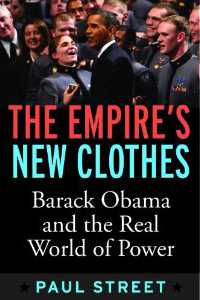
For the second class, Beyond Elections, we will use as a primary text Paul Street’s new book, The Empire’s New Clothes: Obama and the Real World of Power. In addition to a close examination of the first 2 years of the Obama administration we will also look at the structural flaws of electoral politics – money, lobbying, two-party system, political campaigns, etc. Lastly, we will discuss and explore other models for electoral politics and the relationship between civil society and voting in other countries.
Both classes cost $20 (not including the cost of the book, which each participant must get on their own) and will meet for two hours a week for 6-weeks. The Beyond Elections class is on Wednesdays and begins on January 26th and the History of US Social Movements in on Mondays beginning January 31st.
Both classes meet from 7 – 9pm at the Steepletown Center, located at 671 Davis St., NW in Grand Rapids. For more information or to sign up, contact Mike Saunders at outobol@gmail.com or Jeff Smith at jsmith@griid.org.
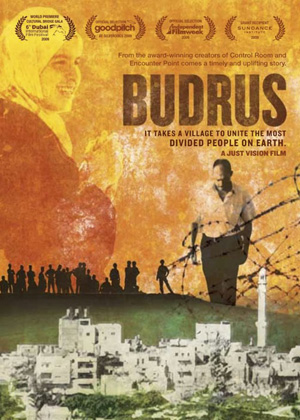
If you are confused by the news media reporting on Israel/Palestine, with the focus on government posturing and so-called peace talks, then I would highly recommend that you see the documentary Budrus.
Budrus is the name of a Palestinian village that has responded non-violently to the Israeli plan to build the “separation wall” that would cut through the village land. Wanting to protect their olive trees, cemeteries and not have the ominous presence of the Israeli wall near their homes Budrus villagers began organizing daily demonstrations against the wall’s construction.
The film is filled with inspiring actions and inspiring words from Palestinian men, women and children who courageous face down Israeli soldiers who sometimes beat them with clubs and shoot tear gas, rubber bullets and concussion grenades at unarmed villagers.
The filmmakers also include interviews with Israeli soldiers and officials who make claims about the necessity of the wall to protect Israeli lives and some who believe that the resistance is illegal.
After weeks of protesting the people of Budrus were joined by Israeli activists, international observers and even a delegation of anti-Apartheid activists from South Africa. This type of solidarity did not prevent the Israeli military from increasing the repression and eventually occupying the town of Budrus itself.

However, after 10 months of non-violent resistance the Israeli government decided to cut their losses and re-route the wall to allow Budrus to keep its olive groves and cemeteries.
This film not only is an inspiration it humanizes Palestinians in a way that few documentaries have. We see how Palestinians organize, we go inside their homes, we hear from both young and old, and we see how the Israeli occupation impacts them on a physical, emotional and psychological level.
This film is important to those of us who live in a country that has continued to support this kind of Israeli repression since the 1967 war. Budrus does not talk about how the US has provided diplomatic, military and economic support for Israel, but it does show us how the $3 billion (annual) of our tax dollars are being used.
The film is also important in that it shows that using non-violent resistance is not just about not using violence, but the willingness of people to fight back by standing in front of bulldozers, not allowing Israeli soldiers to club them and even physically dismantling the parts of the wall that are made from fencing. There is nothing passive about the kind of non-violence that Palestinians use that is documented so well by the filmmakers.
The film starts this Friday (January 7th) at UICA and will only be playing for one week. Check the UICA webpage for times and dates of the screening. This film will change how you see the Israeli/Palestinian conflict!
New Video is Response to Obama’s Afghan War Review

The group Rethink Afghanistan has a new short video in response to the Obama administration’s “Afghan Review” statement last month.
The video highlights soldier and civilian casualties and says that 2010 has seen the highest number of US & NATO troop deaths since the war began in 2001. The video also mentions that the war is costing taxpayers an estimated $2 billion each week in Afghanistan. According to the National Priorities Project the US war in Afghanistan has cost the state of Michigan $10 billion since 2001 and the City of Grand Rapids $200,000.
The video from Rethink Afghanistan is not an analysis piece, but is a good visual response to the administration’s insistence that the US war in Afghanistan is going well For a more detailed analysis of the Obama Afghan war review see the article by Phyllis Bennis and Kevin Martin.
It has been almost a year since the devastating earthquake that struck Haiti, which killed thousands and left hundreds of thousands homeless.

We wrote back then that what the local news media was doing with all their Haiti coverage has been a form of disaster reporting, where there tends to be little or no follow up to the devastation.
Some local news outlets have reported on the activities of area missionary work, medical relief and the 12 year-old boy who sent teddy bears to Haiti, but there has been little coverage of reconstruction efforts or an analysis of what has happened in the past 12 months.
In mid-April of last year there was a speaker in Grand Rapids that did provide some of this analysis. Dr. Joia Mukherjee, medical director of Partners in Health (PIH) spoke to an audience at Spectrum Health, but there was no local news coverage of her important analysis, apart from what GRIID reported.
Haiti continues to be a disaster and it is important that people in this country understand what is going on, what the roadblocks are to recovery and what role the US government and US-based NGOs are playing in Haiti’s future.
Here is an excellent article by Christophe Wargny, which is re-posted in its entirety from ZNet:
Toussaint Louverture International Airport has returned to good health, clean and almost welcoming. It has escalators and duty-free shops. Jet bridges take you straight from your plane into the terminal, as never happened before the earthquake of 12 January 2010. It gives you hope that reconstruction has begun, or is beginning; the promised billions might have finally hit their first targets. You imagine the bulldozers, the diggers and the site trucks at work: perhaps these explain the traffic snarl-up that the taxi driver immediately tells you is a permanent fixture.
But no: rebuilding the airport is the only project to take shape in almost 12 months, backed by clearing the main urban arteries. Reconstruction has not yet started. Unlike the once solid buildings of now devastated Port-au-Prince, the grip of politicians and notables who have strangled Haiti for two centuries managed to withstand the earthquake. They’ve even stolen the word “reform”, which framed the social movement’s projected rebuilding of the institutions and state structures, and emptied it of meaning. For the moment, “reform” equals “staying just the same”.
We already knew the statistics of a disaster worsened by the inertia (or heedlessness) of a pretend state that lacked form, means or political legitimacy. It’s the urban chaos, the absence of any infrastructure worthy of the name, as much as plate tectonics that explain 300,000 dead, the same number injured or maimed, with more than a million people displaced, most of them now in the hundreds of camps around the capital.
TV reports from Port-au-Prince, always looking for the most graphic images, gave the impression of a razed city. The reality was different, but no less tragic. Some blocks, mainly public buildings several storeys high, were completely destroyed. But in the old central and western districts, three out of four houses more or less survived. As you climb the surrounding slopes (the higher you get, the better off the residents), rubble diminishes. A label on each building attests to work promptly undertaken by hundreds of Haitian and overseas contractors: green indicates habitable, orange that work is needed, red calls for demolition. The higher you climb, the more green. Below everything is red, or is a camp.
There are so many camps in the zone near the airport that you see and smell them as soon as you arrive. They fill the flatlands around Croix-des-Bouquets, Tabarre and the Cul-de-Sac plain. A sea of plastic huts ruffled by the wind undulate in huge white and blue waves, occasionally broken by the colours of other protective materials. Tent after tent – they are so close to each other that you can hardly fit a small plastic table between them. The overcrowding is horrible, with living conditions during the (June to November) rainy season either intolerable or appalling, despite “urgent” and “massive” aid from abroad. Before you reach the centre of Port-au-Prince it is plain that at the present pace, the “emergency” could last forever.
Providing basic needs
People once aspired to join Pétionville golf club. Now it’s home to 30,000 refugees. Yet it has an advantage over other camps: the course architects, with golfers’ comfort in mind, planted superb shady clumps of green, effective at protecting new arrivals from the blazing sun in between tropical showers. The paths are walled with sandbags to channel water during rainstorms. Some schoolrooms have been improvised, there’s a children’s clinic, enough water for all, an internet café some days in a communal area, and refugees have been rehoused not too far from their former homes.
NGOs are responsible for drinking water and other basic needs. They empty the latrines, they bring round mobile water dispensers. Minustah, the UN Stabilisation Mission in Haiti, which arrived after the overthrow of President Jean-Bertrand Aristide and the intervention of the US and France in 2004, is here as elsewhere. But there’s no sign of an official Haitian presence. “A government minister here? I’ve never seen one,” a refugee member of the camp’s management team says. “I think they’re worried about what might happen to them.”Not all camps are so well endowed. Even so, storms ravage Pétionville’s tents, which harbour mosquitoes, rats and other vermin. Because life – or the survival instinct – bounces back quickly, small enterprises make sales – fresh sugar cane, Coca-Cola, clairin (a sugarcane-based brandy), soap – along with cafeterias and local crafts. Small shops are doing good business in evil-smelling alleys.
In dry weather the air is full of particles of faecal matter. Like foul water, these carry the cholera bacillus, and cholera has just returned to the island after almost a century. The relatively easy-to-prevent illness – access to clean water and the ability to wash hands limit the risks – has caused major casualties. By mid-December 2010 nearly 100,000 people were affected, 34,000 in hospital and 2,000 dead. Cyclone Tomas, which swept across the island on 5 November, helped spread the bacteria. Septic tanks overflowed, mixing their contents with the refuse borne by the storms, and gushed down into the camps which became huge cesspits, harbouring the cholera bacillus.
Speculators move in
There were predators, too: property owners. Using threats and intimidation, they chased the homeless from land around the golf course. There were skirmishes. Vacant plots became scarce. Speculators jumped in, spurred by the spike in house prices. Because the earthquake destroyed many of the archives and land registries, there has been conflict over title deeds.
Rents tripled because demand jumped as supply slumped. NGOs had little choice but to pay up. Whole new fortunes were created. Those with money made more. A doctor summed it up: “The solidarity of the early days seems far away now. We’re living with an unexpected development – inequalities are spiralling.” They were already the most pronounced in the western hemisphere.
The first objective remains to clear the land. Squads of workers in NGO T-shirts, with spades and brooms that make do for cranes and bulldozers, swarm in the rubble. They clear up each day what the storms drop by night. It’s an understatement to say that productivity is low. Household rubbish, in bins or just trashed, ensures that serious diarrhoea is endemic. Everyone thinks that at today’s speed it will take the trucks more than a decade to clear up.
Moving from tents to stand-by shelters in wood, plastics and corrugated iron (expected life: three to five years) would make things a little less precarious. Construction of 140,000 of these T-shelter dwellings is said to be in hand, even paid for, at $2,000 for a 15-sq-m hut. But where would they be built and on whose land? How would they be procured? Requisitioned? Bought under the counter? In Haiti, housing politics are juggled between five different ministries. In reality, there is no plan. Only 11,000 have gone up in 11 months. By the time the final shelters were to be built, the first would be decommissioned. Meantime the number of “campers” is not falling.
Urban exodus
The catastrophe caused an urban exodus. More than half a million people were accepted by provincial authorities that lacked resources but attempted, with help from NGOs already there and local communities, to provide schools, lodging, medical services, to distribute food, to create building sites, and to offer psychological counselling. Families were called on to take in relatives, sometimes squashing local economies. The provinces have become poorer, reflecting an old Haitian problem – over-centralisation.
After a few months, more than 80% of those who quit Port-au-Prince returned. The services they knew they could find in the capital – including the makeshift camps – seemed better, despite their limitations, than those available near their rural refuges: better schools, better aid, better chances (even if uncertain) of finding work. Internal migration has switched back in the usual direction, rediscovering its own vicious rhythm. All this just makes the camps more permanent.
For a long time now most Haitians have looked to NGOs rather than the state for public services. Before the earthquake, the UN World Food Programme fed almost two million Haitians, with the diaspora taking care of the same number (1). The earthquake has increased dependence. Whether they like it or not, in Port-au-Prince, NGOs are the only means of survival.
Alongside the UN agencies (2), there are some 10,000 organisations around the world helping to support Haiti. More than 1,000 are on the island. Half are unknown to the state, yet identifiable by their logos to all Haitians. Following the old colonists, American and European NGO officials are in just about all the camps. With their luxury vehicles and expensive equipment contributing to the traffic snarl-up, they offer “work for wages” to more than 100,000 people employed in the clean-up. The wage, 200 gourdes (under $7 a day), is a small fortune, which in 2009 President Préval found too costly for the Haitian economy; he would not pay it despite a long struggle with the workforce. But in today’s Haiti, NGOs have more financial muscle than the state.
Humanitarian aid accounted for a third of GDP in 2009. Hundreds of thousands of people live on it, employees and families. Some foreigners – blan in Creole – also live well: Haitians can see that in the restaurants and find enough in rubbish bins to feed the poorest. Practically every Haitian graduate seeks either to emigrate (3) or to join an NGO. It’s safer than working for the state or starting a business. In 2009, after years when “aid” was supposed to encourage “development”, the Haitian state was still dependent on 60% help from international organisations to balance its domestic budget. And even though things are improving, corruption costs the state huge sums in lost taxes. In 2008 and 2009, $300m of oil credits provided by Venezuela under the PetroCaribe agreement vanished. Almost the same amount was spirited away in the public works markets.
Rise of the evangelicals
Churches flourish alongside these organisations – some are also NGOs. Profiting from the state’s absence, evangelical and Pentecostal foundations are a big hit. One afternoon recently, the faithful were gathered in their thousands in Carrefour (the supermarket) in a Port-au-Prince suburb. Heavy American pop music blared from the PA system. The crowd attempted a few dance steps. Sermons by American pastors, translated into Creole, were followed by singing, jubilation, readings and commentary from the Bible from locally based ministers, trained by the incomers in under a year. Sick people were given blessings. “Miracles” happened. Above all, they thanked the Lord for the daily bread from this generous band of militants saying, “Believe and you will be saved.”Beside evangelicals and Pentecostals you see Jehovah’s Witnesses and Seventh Day Adventists. Ministers of self-proclaimed cults are born every minute. The heavenly army poses as a vanguard, as religious commissars: “We must denounce those who falsely repent, the bad pastors. God is great.” They repeat: “Down with places of Satanism [Voodoo temples].” Was it a fluke that God hit public buildings and the cathedral and ejected the archbishop from his own dwelling?Catholicism is now a minority faith. The sociologist Laënnec Hurbon estimates that 45% are Catholic (compared with 75% a few years ago): magic, miracle-working, guilt cults and new forms of evangelism offer more concrete support networks than the Catholic Church, which has shown itself better at creating elites than at working in a changing and savage urban scene. The Church has prevented any possibility of political reform of Haitian society. Its missionary objective was to create an imaginary shield against reality: to cultivate emotion and eradicate thought. In 30 years we’ve moved from the emergence of a liberation theology – embodied by Jean-Bertrand Aristide, president in 1991, 1994-96, then 2001-04 – to the cult of resignation.
The emergency should be nearly over. But with cholera, it is worsening. Everyone counted on the Interim Haiti Recovery Commission, with co-presidents Bill Clinton, the UN’s special envoy to Haiti, and Haiti’s prime minister Jean-Max Bellerive. Disappointingly, it has met just three times in 10 months, few projects have been confirmed, and there’s poor coordination between the sponsors. Haitian civil society has been spurned. The donor states, which have yet to match their promises, show a strange tendency to “place” their own firms. They seem a long way from the $10-15bn target announced: just 10% of donations have materialised. In these circumstances, projects – from land registry to training key people, from supporting agriculture to hospitals – are only part-financed, rarely signed and sealed.
As for elections, preoccupations have shifted: shelter, a job, health. The feeling is that Haiti no longer belongs to Haitians. And in the future, “se blan ki desid” (the foreigners will decide). Reconstruction, rebuilding society, reform? The future is more likely to bring a patching-up of the old order. But how can you help rebuild a state which barely works or help a political system based on clientelism, which guarantees a two-speed society?Stuck in traffic, you understand everything. Gleaming, air-conditioned 4x4s with tinted glass and smartphones for some; foot or wheelbarrow for the rest. The politicians, despite a few elements of modernity, have not changed. The earthquake shook the houses but has not touched the fundamentals of Haitian society.
Translated by Robert Waterhouse
Christophe Wargny is a journalist
(1) The most recent state budget was barely $2bn – or the cost of five days of war in Iraq during the mid-2000s. According to the Inter-American Development Bank, the Haitian diaspora accounts for 16% of GDP.
(2) United Nations Development Programme (UNDP), Unesco, Unicef, World Food Programme, UN Food and Agriculture Organisation (FAO), UN Population Fund (UNFPA).
(3) According to a 2007 report by the UN Conference on Trade and Development (UNCTAD), for every 100 new graduates in Haiti, 80 who have already graduated emigrate, mainly to North America.

