New Media We Recommend
Below is a list of new materials that we have read/watched in recent weeks. The comments are not a “review” of the material, instead sort of an endorsement of ideas and investigations that can provide solid analysis and even inspiration in the struggle for change. All these books are available at The Bloom Collective, so check them out and stimulate your mind.

What Would It Mean to Win? – This book is a collection of essays put together by the Turbulence Collective and deal primarily with issues around current anti-capitalist and social change movements. The authors deal with a variety of aspects related to movements and movement building and raise questions around the idea of winning. Are the movements that are fighting against globalization, war, global warming winning and what would it even look like if they were winning? The essays are thought provoking and important for anyone who is serious about wanting to make radical change in the world. An added bonus is many of the graphics included involve lego characters.

Mexico’s Revolution Then and Now, by James Cockcroft – Cockcroft, author of numerous books on Mexico in both English and Spanish, has put together a short text that makes the argument that Mexico is faced with very similar conditions today as it was one hundred years ago just before the revolution of 1910. The author looks at themes such as class conflict, Neo-liberalism, immigration, imperialism and resistance. For anyone interested in learning about both the 1910 revolution and the current political climate this book is a great introduction.

Policing America’s Empire: The United States, The Philippines, and the Rise of the Surveillance State, by Alfred McCoy – Like his book the Politics of Heroin, Policing America’s Empire is ground breaking work by Al McCoy. This 650-page volume looks at the kind of colonial system that the US set up in the Philippines after the 1898 invasion/occupation. The detail that the author provides is impressive, but more importantly McCoy argues that what the US was able to accomplish in the Philippines was a test case for policing, intelligence gathering and black-operations that would be used in other countries around the world.
This Land Is Our Land: The Fight to Reclaim the Commons, produced by the Media Education Foundation – This new documentary is an important contribution to understand the idea of what the commons are and how the current corporate/capitalist economic model threats its very existence. With an excellent historical overview, this film not only helps us understand the origins of the notion of the commons, it also provides important analysis of how it has been taken over in recent decades and how people and communities are fighting back to reclaim the commons. This is important for anyone concern about public space and the rights that people have to water, air, land and food.

On January 12, the Grand Rapids Press posted an article by Shandra Martinez plus an update by Chris Knape about an important announcement from Steelcase: the closing of the Kentwood East seating plant and two other manufacturing facilities. The loss of 750 jobs, including 400 in Kentwood. And the moving of these jobs to two sites in Mexico: Tijuana and Reynosa.
The article included a statement from Steelcase president and CEO Jim Hackett, who said, “”We continue to make improvements to our industrial system, which have left us with excess capacity to support current and anticipated future demand.” He added that the company had to be “as fit as possible in the highly competitive environment in which we operate.”
Steelcase spokeswoman and apologist Jeanine Holquist then tidied up with additional quotes in both the article and in an explanatory update, reiterating that Steelcase had excess manufacturing capacity, “so our space continues to exceed the need.”
Since Steelcase just announced a month ago that it had stronger sales and earnings than expected in its third quarter, Holquist also had some tap-dancing to do. Explaining that the shifts to Mexico will save the company $35 million annually, Holquist threw out this bone to workers here: “West Michigan will remain the most significant node in our manufacturing.”
Here are five things that the reporters for the Grand Rapids Press could have, but didn’t, ask or include in its initial reporting of the situation:

1. An explanation of “excess manufacturing capacity.” An obvious choice would be to challenge this statement, particularly from a local point of view. Steelcase has closed a number of buildings in the past few years, including its pretentious pyramid office building and, more importantly to workers, its 206-acre manufacturing campus adjacent to the headquarters building. At the same time, it has established manufacturing facilities in Mexico, among other locations. Suddenly, the facilities here have become “excess.” The Press reporters could have asked “why?” but they didn’t.
2. Examining the NAFTA factor. Pinning Holquist down on the “excess manufacturing capacity” quote could have led to interesting revelations about how NAFTA may have led to Steelcase’s abandonment of the West Michigan area. It fits as part of a general deindustrialization of the United States.
Since NAFTA was initiated in 1994, net manufacturing employment in this country has declined by more than 5 million jobs. Companies have also used the threat of moving jobs across borders to undercut union negotiations. NAFTA has authored other disasters, such as the decimation in Mexico of the ejidos, communal land holdings by villages, which have crumpled under U.S. capitalist acquisitions. It’s caused destruction of the country’s agricultural system by agribusiness. Although Canada initially seemed to enjoy gains from NAFTA, it too is feeling the trade agreement’s downside as U.S. corporations, greedy for larger profit margins, are pulling jobs from Canada and moving them to locations with cheaper labor forces and fewer regulations. NAFTA is also seen as a way of undermining Canadian control of Canada, lowering demand for Canadian-made products and weakening the country’s social programs.
But from a purely capitalist viewpoint, NAFTA’s elimination of tariffs makes shifting jobs both possible and profitable. Since Steelcase states it is going to reduce its costs by $35 million a year, and it has facilities in place in Mexico, are those gains going to come from the cheaper labor, the elimination of benefits, and fewer manufacturing regulations made possible by NAFTA? This question went unasked.

3. Questions about Steelcase’s resistance to unionization. Since the Steelcase scenario all through the last decade might have played out very differently had workers been unionized, the corporation’s role in discouraging and breaking up union organization activities could have cast a different light on the current situation. Exploring this issue was an obvious, but overlooked, piece of the puzzle by the Press reporters.
Most notably, in 1993, a strong effort to unionize among the manufacturing workers at Steelcase was squelched, partly with threats of massive layoffs by then-president Jerry Myers. Myers, the first CEO of the company who was neither a family member or a longtime Steelcase employee, was highly unpopular for his vision of a “leaner, internationally competitive company.”
Prior to his advent, both white-collar and blue-collar employees had been used to relative transparency in the way that their wages, benefits, and information about the company’s planning were handled. But Myers began implementing harsh work rules in the manufacturing sites, cutting back on benefit packages, and slashing profit-sharing checks. Workers initiated meetings with the Teamsters and the UAW to protect their job security.
Myers retaliated with threats of widespread job cuts, and did not reveal that the company was actually showing signs of emerging from the recession of the early 90s, an upswing that then continued through most of the decade. The entire stand-off came to an end with the firing of Myers in 1994, termed a “resignation.” The layoffs that came afterward were minimal and most were short-term. Plant employees felt this was a sign that they did not need to unionize after all.
What most workers did not realize at the time was that they may have been played. The company was weathering a crisis due to a death in the family that released nearly 1 million shares of the company’s privately held stock, shares which were sold to “outsiders,” or non-family members. This ultimately led to the company going public in 1998—and a public stock offering would have been much less profitable if the company had a unionized work force.
To replace Myers, Steelcase brought in Jim Hackett—who went right ahead with Myers’ plans, taking Steelcase “‘back to basics’ through a number of Myers’s cost-cutting and international expansion initiatives [that] were left in place.”
4. Pinning down Steelcase’s actual intentions for its West Michigan work force. It’s pretty hard to see Steelcase’s presence evaporating from the West Michigan scene and still choke down the idea that it will remain “the most significant node in our manufacturing,” as Jeanine Holquist stated.
Significance is relative. Once the largest employer in the area, Steelcase has led its now-skeletal work force through one shock wave after another in the past 10 years. In 2001, the company eliminated 1,100 jobs from its Grand Rapids operations, including a full 10 percent of its manufacturing workers. Wages and salaries were “restructured” and mostly reduced. Later that same year Jim Hackett approved a 5 percent raise for himself and other top executives in the firm.
More layoffs for the area followed. In 2002, 150 jobs here were cut. Six years later, in 2008, the company announced the elimination of 300 jobs in the area. In between, these numbers have apparently been augmented by ongoing job eliminations and terminations at the company which have flown mostly under the media radar. After today’s announced job eliminations, the company will have “just under 3,000 employees” in both blue- and white-collar positions here in Grand Rapids. That’s down from over 9,000 employees a decade ago. The math shows that the job-loss bleeding has been ongoing.
The Grand Rapids Press reporters could have asked the hard question: Will Steelcase even be here in five years? Ten years? And just how much more will the company disrupt the lives of residents here in its endless quest to provide investors with increasing profits year after year?
5. Including the voice of the workers. As is the case with most of the Grand Rapids Press’s reporting, the article contained only the corporate point of view, the capitalists’ rationalizations for their decisions, and the barest information about the company’s future plans.
The coverage of this announcement is silent about the workers themselves—both those who will be losing their jobs and those who will be expected to continue working in an environment of distrust and insecurity. The Grand Rapids Press needs to give these folks a platform or at least present their side of this story.
Soon there will be more unemployed workers, more families without incomes, added to the thousands of people in this area who have lost good-paying jobs over the past years because of Steelcase’s corporate gamesmanship. They must have something to say, and it would be valuable to reach beyond the corporate double-talk and let them speak.
Can “Tattoos on the Heart” Erase Injustice in the ‘Hood?
 Fr. Gregory Boyle SJ, Jesuit priest and executive director of Homeboy Industries, delivered the Jan. 12 January Series presentation, Tattoos on the Heart: The Power of Boundless Compassion.
With the wit of a wizened comedian and an obvious heart for his work, Boyle shared a series of anecdotes that illustrated his ministry to people involved in gang life in Los Angeles, California.
The first observation made upon entering the Ladie’s Literary Club, one of the remote locations broadcasting the talk live, was that all but one person attending was White. Perhaps attendance at the main auditorium and other locations was more representative of other ethnicities. This left the writer to wonder if this ministry, like many other outreach programs to African American youth, was more focused on helping individuals find a way to “be productive citizens” of our White dominated society rather than addressing the systemic causes of gang activity.
 Homeboy Industries is the largest such outreach to people involved in gangs in North America, serving more than 1,000 people each month. According to its Web site, it provides wrap-around support services that include “case management, education, job training, employment counseling, legal services, mental health counseling, twelve step meetings, and tattoo removal … Many gang members have visible tattoos that inhibit their ability to secure employment, thus we offer free tattoo removal.”
Because of the difficulty in placing people who have been involved with gangs or have felony records, Homeboy Industries employs hundreds of clients in its screen print, merchandise sales, bakery and restaurant, the Homegirl Café.
“We stand at the margins with the powerless, the voiceless, those who have burdens more than they can bear, those to whom dignity is denied, the easily despised and readily left out, the demonized so that the demonizing will stop,” Boyle said. “No kinship, no justice. No kinship, no peace. If kinship were our (world’s) goal, we would no longer be promoting justice, we would be celebrating it.”
While Boyle’s whole heart is obviously in his work and his presentation left no doubt that he has real love and concern for those he works to help, his use of gang dialect and specific anecdotes to elicit laughter from the predominantly white audience seemed to perpetuate a paternalistic “us-versus-them” mentality.
Why do young people join gangs in the first place? According to Boyle, it is because of a “lethal lack of hope.” He did not go further during this talk to cite where that lack of hope originates. Neither does the Web site mention systemic issues such as racism, white privilege, classism, lack of employment offering a living wage, lack of access to nutritious foods, environmental racism or lack of access to quality education. In addition, there is the whole issue of a prison industrial complex that makes huge profits on the backs of our minority populations.
 GRIID made a call to Detroit community organizer, Yusef Shakur, to discuss these omissions. A former gang member, Shakur returned to his Detroit neighborhood after serving a prison sentence. He has since worked not only as a community organizer but also as a Head Start teacher, youth mentor and business owner.
“I always heard people condemn me for being a gang banger but no one asked me ‘Why?’ For the most part, gang culture is the by-product of social decay, the social let-down of human beings. It’s a reflection of family breakdown. All those aspects we find within our communities, we find within ourselves,” Shakur said. “We are imitating the society we live in. Most young men growing up in a hostile urban environment take on the characteristics of their environment. (An environment with) a lack of consistent resources: social, economical, political and cultural. The fundamental answer is creating a strong foundation. After years and years of indoctrination, you become immune to being shot. You see your homeboys get shot . . . Trauma occurs psychologically. It spiritually damages to the point they grow up in a hopeless environment and that hopelessness takes root in their souls.”
(Shakur recounts his journey from gang member to community organizer in his autobiography, The Window to My Soul.)
Greg Boyle no doubt is doing great work in Los Angeles. In his talk, he mentioned that Los Angeles is home to 86,000 gang members. Turning around 1,000 lives a month could be called a miracle. However, we need more than a miracle. We need to build movements that confront the systems engendering classism, racism and all the other “isms” creating this “lethal lack of hope” within our nation’s urban centers.
IWW to host screening of The Corporation in Grand Rapids 1/20

The Grand Rapids branch of the Industrial Workers of the World (IWW) we be hosting a screening of the documentary film The Corporation.
Provoking, witty, stylish and sweepingly informative, THE CORPORATION explores the nature and spectacular rise of the dominant institution of our time. Part film and part movement, The Corporation is transforming audiences and dazzling critics with its insightful and compelling analysis. Taking its status as a legal “person” to the logical conclusion, the film puts the corporation on the psychiatrist’s couch to ask, “What kind of person is it?” The Corporation includes interviews with 40 corporate insiders and critics – including Noam Chomsky, Naomi Klein, Milton Friedman, Howard Zinn, Vandana Shiva and Michael Moore – plus true confessions, case studies and strategies for change.
The screening will be on Thursday, January 20 at 6pm in the IATSE Labor Hall located at 931 Bridge St, NW in Grand Rapids. The screening is free and open to the public. There will be a discussion after the film.
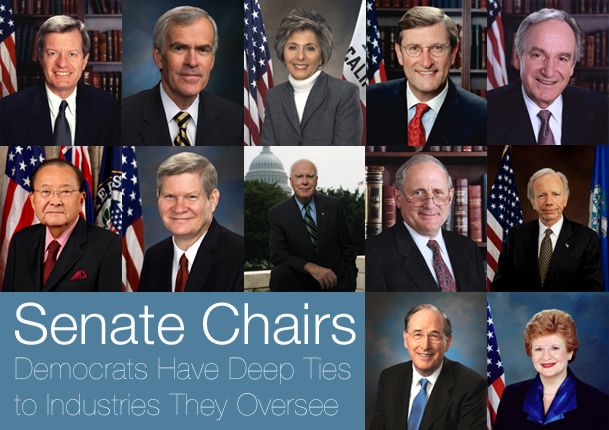
Last week the Center for Public Integrity published a new report entitled Senate Chairs: Democrats Have Deep Ties to Industries They Oversee.
The report looks at 12 Democratic Senators, which chair major committees, their top PAC (Political Action Committee) contributors, whether or not their former staff work as registered lobbyists, budget earmarks and campaign promises.
Both Michigan Senators Debbie Stabenow and Carl Levin are part of the report, since both of them chair major committees – Levin the Senate Armed Services Committee and Stabenow the Agriculture, Nutrition and Forestry Committee. Here are some of the findings on both Stabenow and Levin.
Top PAC Contributors
Mylan Inc., a pharmaceutical company — at least $30,000
UAW, the International Union, United Automobile, Aerospace and Agricultural Implement Workers of America (better known as the United Auto Workers) — at least $27,500

DaVita Inc., a kidney care and dialysis provider — at least $25,000
New York Life Insurance Co., an insurance and investment firm — at least $22,500
Real Estate Roundtable, a public policy group made up of real estate trade associations — at least $22,500
United Steelworkers, a 1.2 million-member labor union for metals, manufacturing, paper and forestry products, chemical industry, health care, pharmaceuticals, public services, mining and energy, and utilities workers — at least $22,500
PACs gave at least $1.4 million to Stabenow’s campaign account and her America’s Leadership leadership PAC
Revolving Door
Patrick Cavanagh, a former Stabenow director of constituent communications, is now vice president for federal affairs at the American Coalition for Clean Coal Electricity
Raphael Goodstein, a former legislative correspondent for Stabenow, is legislative director for the American Automotive Policy Council, a coalition of the Chrysler Group, Ford Motors, and General Motors to promote American automobiles
Noushin Jahanian, after seven years as policy director and chief counsel to Stabenow, now lobbies for The Washington Tax Group on behalf of Yum! Brands, Monsanto Company, Applied Materials Inc., and Oerlikon Solar USA
Lisa Layman, who was senior policy adviser to Stabenow from 2005 to 2007, is director of government law and strategies at Brown Rudnick, lobbying for Apotex Corporation, Hospira Inc., and Norwalk Hospital of Norwalk, Conn.
Alexander “Sander” Lurie, Stabenow’s chief of staff and legislative director from 2001 to 2007, is a principal at SNR Denton, lobbying clients including Allstate Insurance Co., Marsh & McLennan Cos., Sara Lee, and UCare, a nonprofit health insurance company
Mat Young, a former economic policy director for Stabenow, is director of congressional and political affairs at the American Institute of CPAs
Earmarks
Between 2008 and 2010, Stabenow obtained more than $744 million in earmarks, according to Taxpayers for Common Sense
In 2010, she obtained in excess of $186 million in earmarks, including $2.4 million to A123Systems Inc. for an advanced lithium ion phosphate battery system for army vehicles, $1.6 million to AAR Mobility Systems for air mobility shelters and communications systems for the National Guard, and $800,000 to Calumet Electronics for highly integrated siloxane optical interconnect for military avionics. All three companies are headquartered or have major operations in Michigan
Campaign Promises
In a release, Stabenow pledged a bipartisan push to write “a new farm bill that once again recognizes the importance of America’s agricultural economy and rural communities”
Top PAC Contributors

Butzel Long Tighe Patton, a law firm that lobbies for a range of clients including Guam Shipyard and the Workers United labor union — at least $15,048
Amalgamated Bank, the only bank in the U.S. wholly owned by a labor union — at least $15,000
Service Employees International Union, the 2.2 million-member union of service workers — at least $12,500
Laborers’ International Union of North America, the labor union for the construction industry — at least $12,500
PACs gave at least $1.1 million to Levin’s campaign account
Revolving Door
Jason Hill, a former healthcare legislative aide to Levin, is now director of federal government relations for Wal-Mart
Carla Kish, a legislative assistant to Levin in the early 1980s, is a lobbyist at The Margolin Group and represents the County of Los Angeles, Planned Parenthood of California, and the Tarzana Treatment Centers
Marda J. Robillard, who worked for Levin from 1978 to 1986, is now vice president at Van Scoyoc Associates, where she lobbies for Anheuser-Busch Companies, Prince William County, Va., and the Center for Responsible Lending
William J. Weber, a former Levin legislative assistant, is a partner at the Baker Hostetler firm, lobbying for Catalyst Paper Corporation, Federated Investors, Inc., and the Colgate-Palmolive Company
Earmarks
Between 2008 and 2010, Levin obtained over $834 million in earmarks, according to Taxpayers for Common Sense
In 2010, he obtained more than $243 million in earmarks, including $1.6 million for Raytheon Company’s Troy, Mich., location for Hybrid Electric Drive All Terrain Vehicles, $2 million for GE Aviation Systems LLC in Grand Rapids, Mich. for Precision Engagement Technologies for Unmanned Systems, and $3.2 million for L-3 Communications’ Combat Propulsion Systems division in Muskegon, Mich., for Heavy Fuel Engine Family for Unmanned Systems, all defense contractors
Media & Propaganda: The 20th Anniversary of the US War in the Gulf
For the 20th anniversary of the US War in the Persian Gulf, Al Jazeera has produced an excellent investigation into the role of the US media during the building of that war and during the war.

The Al Jazeera video is important not just because it sheds light on history, but because it provides insight for how we all should critically view the current news coverage of the US occupations of Iraq and Afghanistan.
For anyone who wants to find out more about the US media coverage of the 1991 Gulf War here are some additional resources:
Second Front: Censorship and Propaganda in the Gulf War, by John MacArthur
The Center for Media and Democracy has an excerpt from the book Toxic Sludge is Good For You: Lies, Damn Lies and the PR Industry http://www.prwatch.org/books/tsigfy10.html
Fairness and Accuracy in Reporting also has a good archive of analysis of the major US news outlet coverage of the US war in the Persian Gulf http://www.fair.org/index.php?page=18®ion_id=23
GRIID documented the local TV coverage of the US war/invasion on Afghanistan in 2001 and the local TV/newspaper coverage of the US invasion of Iraq in 2003. These reports demonstrate how the shift in coverage in the 1991 Gulf War became a standard for how the US government deals with news media and how news media tends to be a mouthpiece for government propaganda.
Documentary on Bullying to screen at GVSU 1/18
How often would you think that Lesbian, Gay, Bisexual or Trans-gender students get harassed or bullied in the middle or high school on any given day? According to a 2009 survey of students by the Gay, Lesbian and Straight Education Network, 9 out of 10 LGBT students said they were harassed and two thirds said they felt unsafe at school.

This is the context for the documentary film Bullied, which will be shown at GVSU next week. Bullied is about the story of Jamie Nabozny, who as a student in Ashland, Wisconsin was harassed and bullied for years.
The film is a mix of interviews and re-enactments of the life experiences of Nabozny. We see his struggles as a middle school student who gets called names, which later turns to physical abuse. Jamie had been out since he was in middle school, so he had the support of his family. However, despite numerous meetings with the school’s principal, there was never any action taken to hold the students responsible for the bullying accountable and the school never developed a policy on how to deal with this serious problem.
Jamie struggles with the abuse, runs away from home and even takes an overdose of sleeping pills. Jamie went through a period of home schooling, but when he went to high school he was back in the classroom.
High school was no different, except that the verbal and physical abuse escalated. Jamie was beaten so badly one time that he required surgery to repair the damage done by the students. Eventually Jamie speaks to a counselor who suggests that he consider filing a lawsuit against the school district.
Jamie and his family decided to go through with the lawsuit, which was initially thrown out of court. However, the Wisconsin Court of Appeals ruled in his favor and the trial went forward.
The film re-enacted the courtroom proceedings based on transcripts from the trial. The use of both re-enactment and personal testimonies about what happened in the courtroom are powerful. Jamie won the case and set a precedent that would impact the nation.
The film is produced by the Southern Poverty Law Center as part of their Teaching Tolerance work and they are offering free copies of the film for anyone who wants one. GVSU’s College of Education Inclusion Committee is hosting a screening of the film on Tuesday, January 18 at 6:30pm in the Loosemore Auditorium located in the downtown Pew Campus. Following the movie a panel will discussion the implications for local schools and students. For more information, please email Clayton Pelon at pelonc@gvsu.edu.
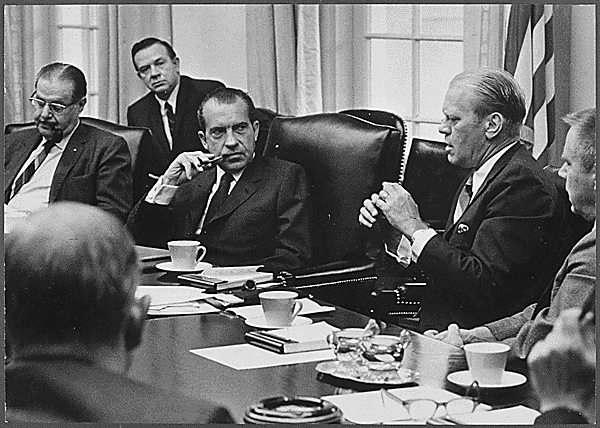
In this GR People’s History Project short we critique the official history of the legacy of former President Gerald Ford. The official version of history on Ford is that he “healed a nation” by pardoning former President Richard Nixon. However, there is plenty of new information and declassified documents that suggest otherwise.
This video argues that Ford actively covered up any serious investigation of the war crimes committed under the Nixon administration and that Ford himself continued the US Imperial Project.
Guantanamo Still Open as 9th Anniversary Looms
(This article is re-posted from Common Dreams.)
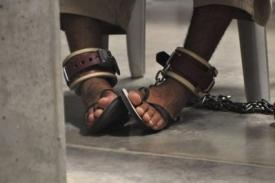
Almost nine years ago to the day, a prison for “war on terror” detainees opened its doors in a remote US base at Guantanamo Bay, Cuba. And despite grand promises, it is unlikely to shut any time soon.
“At this point, it is clear that Guantanamo will not be closed during this presidential term, or maybe even the next one, despite administration claims that it remains committed to the goal,” Columbia University professor, Matthew Waxman, told AFP.
On January 11, 2002, about 20 prisoners arrived at the base, hooded, handcuffed and clothed in distinctive orange prison garb. They were put on display for the world to see, behind the bars of the prison erected on the military base rented from Cuba since the beginning of the 20th century.
Guantanamo quickly became a notorious symbol for the worst of the US excesses in the war on Al-Qaeda launched in the days that followed the September 11, 2001 attacks on the United States.
And rights groups around the world celebrated when new President Barack Obama swore just after his inauguration on January 22, 2009 to shut down the prison, opened by his predecessor George W. Bush.
But two years later some 173 prisoners still languish behind its doors. And Obama’s room for maneuver has been severely curtailed amid a fierce debate over the future of its high-profile foreign inmates.
“The Obama administration has learned that it cannot close Guantanamo without much more cooperation from Congress and from other countries, and that additional support is not forthcoming,” Waxman added.
Just last week, Obama signed into law under protest a huge defense bill which effectively blocks his bid to close the Guantanamo jail.

The 725.9-billion-dollar defense spending plan includes language that makes it virtually impossible to shutter the prison by building a substitute jail or relocating prisoners to the US mainland.
Though he did not explicitly threaten to bypass the restrictions, Obama issued a statement voicing his strong opposition to them, and vowed to try to overturn the measures and ensure they were not expanded in future.
But some Guantanamo opponents believe Obama is hiding behind a convienent excuse.
“The defense authorisation act is not making it impossible to close Guantanamo, the president can use the Department of Justice’s funds to transfer detainees into federal courts in the US for prosecution,” argued Andrea Prasow, from Human Rights Watch.
She added that federal courts — which have already tried their fair share of high-profile terrorism case — were “by far the most reliable place to prosecute people.”
“He has continuously said that he intended to close it. This is something that we believe this administration is committed to. Congress is making it very difficult but not impossible,” she added.
Other activists charge that Obama, still battling the economic downturn and faced with an emboldened Republican party in Congresss after its mid-term electoral gains, is stepping away from the fight.
“He gave up on closing Gitmo a while ago,” criticized Tom Parker, a spokesman from Amnesty International.
“The problem was that closing Gitmo required a great deal of moral courage, required taking a political risk to do the right thing. I think the reality is that we saw that President Obama didn’t have the political courage to follow through on his moral convictions,” he said.
The Republicans’ blocking of the funding needed to shut down the jail and transfer the remaining prisoners onto the mainland was now merely an excuse, he argued.
“The reality is that it is just an excuse and the Obama administration has failed to grapple with this, it failed to take difficult decisions when they had the political path to do so.”
His opinion was shared by Benjamin Wittes, an expert with the Brookings Institution think-tank in Washington.
“As political opposition to his Guantanamo plans mobilized, rather, he became paralyzed,” Wittes told AFP.
“And that paralysis is nowhere better typified than in his passivity in the face of increasingly aggressive congressional efforts to micro-manage the disposition of individual Guantanamo cases.
“If the president doesn’t draw the line somewhere or otherwise rearrange the policy landscape he will end up with zero control over a set of policy questions over which the president simply must retain control.”
Obama could have chosen to veto last week’s legislation. But instead he vowed to try to overturn the measures.
“My administration will work with the Congress to seek repeal of these restrictions, will seek to mitigate their effects, and will oppose any attempt to extend or expand them in the future,” he said.
But activists remain unconvinced. “I think that anybody that thinks that a reelected president Obama will bring a fresh impetus to do the right thing that went wrong in the Bush administration in a second is fooling themselves,” said Amnesty’s Parker.
“President Obama came into office on a mandate for change, a promise of change, and what he exactly delivered on this issue is continuacy.”
AT&T’s Man in the White House
(This article by Tim Karr is re-posted from Save the Internet.)

When President Obama said he was going to “bring change to Washington,” no one expected William Daley to be his choice to get the job done.
Obama’s incoming chief of staff is about as corporate friendly as any Democratic insider can be, which is saying a lot.
For supporters of an open Internet, Daley’s appointment raises the prospect that the president will break all promises to defend Net Neutrality at the urging of a chief of staff determined to cozy up with industry and protect the status quo.
The outlook for any progress under Daley is dim.
Daley currently serves as a top executive at J.P. Morgan Chase & Co — concerning those who had hoped to see this president rein in a reckless financial sector.
Daley once told the New York Times that the Obama administration had “miscalculated” by moving too far to the left on health care reform — concerning those who had hoped the president would fight Republican efforts to repeal the law.
Daley served as a special counsel to President Clinton in 1993, helping the administration’s successful push to ratify NAFTA — concerning those across the labor movement, who delivered supporters to Obama by the busload.
It’s worse for advocates of open and democratic media. From 2001 through 2004, Daley led lobbying efforts for SBC Communications, Inc. His first assignment was to lock in the company’s local monopolies while allowing it to charge extortionate rates for competitors seeking to share SBC’s lines, defying a basic communications principle known as “common carriage.”
He was a top executive at SBC as the company laid the groundwork for its 2005 takeover of AT&T Corporation, after which it rebranded the merged entity as AT&T Inc. During that time, Daley worked very closely with Randall Stephenson, who has since risen through the ranks to become AT&T CEO and chairman.
He joined Stephenson and former AT&T CEO Ed Whitacre in a 2002 meeting to lobby the FCC’s top brass for industry deregulation. Daley, Stephenson and Whitacre wanted the FCC to declare that high-speed Internet access would no longer be considered a “telecommunications service,” but rather an “information service.” The regulatory change would give phone and cable companies broad latitude to raise prices, stifle competition and control consumer choice on the Web.
An all-too-compliant FCC obliged later that year, removing high-speed Internet access services from regulation under common carriage. Daley supported this radical move, which reversed the long-held rule establishing nondiscriminatory communications networks as essential to economic opportunity and innovation. (Read Aparna Sridhar’s 2010 report for a good history of this deregulatory process).

In so doing, the FCC undercut its own ability to keep Internet providers from gutting Net Neutrality and interfering with our right to connect to any website, service or application on the Web.
AT&T Stakes Its Claim to the Oval Office
Now companies like Comcast and AT&T are vying to be the Internet’s new gatekeepers — creating special lanes for their own websites and services, or for those of a few big corporate partners, while leaving the rest of us on a digital dirt road.
However you look at it, there are very few degrees that separate Daley from his successor at AT&T, James Cicconi, who now leads lobbying efforts for the communications giant.
Daley’s appointment to the White House brought praise from the U.S. Chamber of Commerce, where Cicconi serves as a director. The Chamber marches in lockstep with AT&T in opposing Net Neutrality. Working together, the two groups have been very effective in buying up opposition to Net Neutrality among Democrats and Republicans alike.
AT&T is the largest single corporate contributor to congressional campaigns, since 1989 giving more than $45 million in donations to both Republican and Democratic candidates. It spent nearly $13 million on DC lobbyists just in 2010.
AT&T has staked out the legislative branch. With Daley to start work in days, it can now make a claim to the White House, too.
Thus far, AT&T-funded Republicans have introduced one bill, designed to strip the FCC of its power to protect the open Internet. The president was expected to veto this and other anti-Net Neutrality legislation should it make its way to his desk.
But with Daley at his side, how long will it be before Obama caves?


